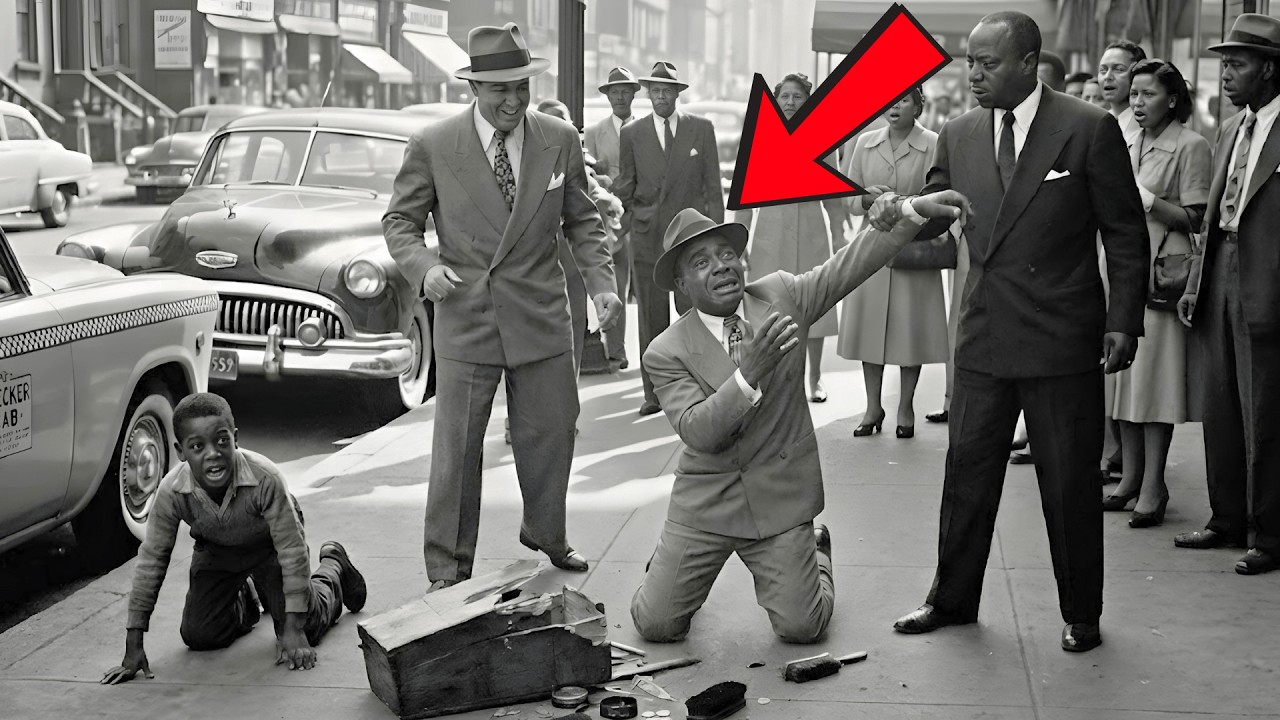
Two armed men from downtown walked into Harlem on a Tuesday afternoon in August 1948 and spent twenty-five minutes humiliating a twelve-year-old shoe shine boy on 125th Street. They kicked his box apart, watched his coins scatter into the gutter, and walked away laughing. They did not know that from the corner booth of the Red Rooster, three blocks south, a man in a cream linen suit had watched every second. A man who never raised his voice, never drew a weapon, and never once looked up from his book.
By the time the sun rose the next morning, both men had vanished, and the only sign that anything had happened at all was the pair of wing-tip shoes left on the exact spot where the boy’s box had been smashed. To understand how it all led there, it helps to understand the kind of gravity Harlem had in that summer of 1948. Not the kind that keeps your feet on the ground, but the kind that pulls everything toward a center. An invisible axis around which the entire neighborhood rotated.
The grocery knew it. The preachers knew it. Even the pigeons roosting on the fire escapes of Lenox Avenue seemed to understand that this stretch of the world operated by laws no courthouse had ever written down. It was a Tuesday afternoon when a man named Deak walked into the Red Rooster and reminded everyone exactly what those laws were.
Deak was not a subtle man. He stood six-foot-two of pure aggression, with a face that looked like it had been assembled in a hurry from leftover parts. He worked collections for a local numbers boss named Sweet Calvin, a man who ran three policy banks above 121st Street and trusted Deak to deliver his messages personally, physically, and with maximum impact. Deak carried a wooden club wrapped in electrical tape—not because he needed it to hurt people, but because he liked the way people looked at it before he did.
He liked the theater of it, the anticipation. He pushed through the door of the Red Rooster at two in the afternoon, when the lunch crowd was thick and loud and the ceiling fans were losing their battle against the August heat. The bell above the door hadn’t finished ringing before his voice filled the room like a burst pipe. “Where is Roosevelt Barnes?
Somebody in here knows where Roosevelt Barnes is, and I suggest they tell me before I start turning over tables. ”
The Red Rooster went quiet the way a record skips. Sudden. Jarring.
Wrong. Forks stopped midway to mouths. Conversations died in throats. Three women at the counter near the window grabbed their purses instinctively, the way people do when the temperature of a room drops without warning.
Deak slapped the club against his open palm in a slow, rhythmic thud, scanning the room with the particular hunger of a man who enjoyed the silence he created. And then his eyes found the corner booth. There was a man sitting there alone. He wore a pale cream linen suit that had no business looking that clean in ninety-degree heat.
His tie was loosened exactly half an inch—not sloppy, not disheveled, but precisely, deliberately relaxed. The way a man relaxes when he has decided the world will wait for him, and not the other way around. In his left hand was a glass of iced tea, condensation running slow lines down his fingers. In his right hand was a small paperback book: Langston Hughes, *The Weary Blues*, held open with the easy familiarity of someone reading for the fourth or fifth time, not the first.
He had not looked up. He had not looked up when the door banged open. He had not looked up when Deak’s voice shook the room. He was reading a poem about a piano player on Lenox Avenue, and he appeared to find it more interesting than anything else happening in the Red Rooster at that moment.
Deak stared at him. Something shifted in the room. Not a sound, not a movement, but a collective holding of breath. The entire restaurant leaning back a single invisible inch, the way a crowd leans back from a man standing too close to a ledge.
Deak opened his mouth. Then he closed it. He looked at the man in the cream suit again. At the stillness of him.
At the absolute undisturbed quality of his presence, like a stone at the bottom of a river that the current simply moves around. Deak’s club slowed in his palm, and then stopped. He looked at the bartender. The bartender looked at the ceiling.
Deak looked back at the corner booth one more time. The man in the cream suit turned a page. “My mistake,” Deak said to no one in particular, in a voice about a quarter of its original volume. “Wrong place.
”
He walked out. The bell above the door rang again, lighter this time, almost apologetic. For a moment the room held its breath, and then slowly, cautiously, like a city coming back to life after a storm, the noise returned. Forks resumed their journeys.
Conversations resurrected themselves. The ceiling fans kept losing their battle with the heat. Ellsworth “Bumpy” Johnson never looked up from his poem. That was the thing about Bumpy Johnson that people who didn’t know him could never quite understand, and people who did know him could never quite explain.
He had never needed to announce himself. He had never needed to raise his voice or display his authority the way other men in his world did, with gold and guns and the theatrical machinery of intimidation. Harlem announced him. The neighborhood itself carried his name in its walls, in its sidewalks, in the way a room rearranged its entire emotional architecture the moment he entered it.
He had fought Dutch Schultz to a standstill when the most powerful organized crime figure in New York had tried to take the numbers racket from Harlem’s own people. He had gone to prison and come back, and the streets had been waiting for him, patient as a river, waiting for a stone to drop back in. He had built something in this neighborhood that was not quite law and not quite justice, but was in many ways more reliable than either. He was forty years old that August, and the years had not softened him so much as refined him, the way long heat refines raw ore into something denser and more essential.
The anger that had driven the young man who arrived from Charleston, South Carolina, with nothing but his wits and his refusal to be diminished had not disappeared. It had simply gone underground, become geological—a pressure beneath the surface that expressed itself not in explosion, but in the quiet tectonic certainty of a man who had decided long ago exactly what he would and would not tolerate in the world he inhabited. He sat in his corner booth and read his poem, and he watched Lenox Avenue through the plate glass window with the patient attention of a man who understood that the street was always telling you something, if you were willing to listen. Three blocks north of the Red Rooster, on the corner of 125th and Lenox, a boy named Curtis Washington had his shoe shine box open for business.
Curtis was twelve years old and built like a question mark—slight, curved forward slightly at the shoulder, as if the weight of his concentration pulled him toward whatever he was working on. He had been working this corner since he was nine, when his father had left and his mother had picked up a second shift at the laundry and someone had needed to fill the gap between what the family needed and what the family had. He had built his kit himself, piece by piece, pulling together the coins from his first weeks of work to buy the right brushes, the right polish, the right cloth. He knew the difference between a good shine and a great shine the way a musician knows the difference between playing the notes and playing the song.
That afternoon, he was working on the shoes of Mr. Theodore Gaines, a retired postal worker who came by every other Tuesday because his wife insisted his shoes reflect well on the family, even in retirement. Curtis worked with the focused efficiency of someone who took genuine pride in what his hands could do. He applied the polish in small circular motions, working it into the leather with the patience of a craftsman, then snapping the buffing cloth in crisp, precise strokes—pop, pop, pop—until the surface caught the afternoon light and threw it back clean and bright.
An old woman was passing with a canvas grocery bag, and a folded dollar bill slipped from her coat pocket and tumbled to the sidewalk without her noticing. Curtis saw it land. He looked at it for exactly one second, the way anyone looks at a dollar when they need one. And then he was on his feet, snatching it up, calling out after her: “Ma’am, excuse me.
Ma’am, you dropped this. ”
The old woman turned, looked at the dollar, looked at the boy, and took it back with a nod that contained an entire vocabulary of things she didn’t say. Curtis returned to his box, settled back onto his knees on the hard concrete, and picked up exactly where he had left off, as if the interruption had never happened. It was a small thing, a thirty-second thing.
But from the corner booth of the Red Rooster, Juni Bard—who had been sitting across from Bumpy, saying nothing as was his custom, peeling an orange with a small folding knife—had watched it happen. He said nothing about it. But Bumpy had seen the slight softening around Juni’s eyes. That was Juni’s equivalent of anyone else breaking into a full smile.
The afternoon was loud and slow and hot in the way only August in New York can manage. And then it changed. They came from the south end of the block. Two of them, moving with the loose-shouldered swagger of men who have never seriously considered that any space they enter might not belong to them.
Sal was the taller one—angular, sharp-featured, with restless eyes that moved constantly, not from nervousness, but from the habitual surveillance of a predator cataloging its options. Rico was shorter and wider, with a neck like a fire hydrant and a dead cigar clamped permanently between his back teeth. They wore dark wool suits entirely wrong for the season—the suits of men who dressed to signal status rather than to be comfortable. Men who wanted you to see the fabric before you saw the face.
They were from downtown. Lower Manhattan. Genovese family. Small-time soldiers sent uptown to chase a debt from a numbers player named Slippery Jones, who had been avoiding their calls for six weeks.
They had done this kind of work before—come up to Harlem to squeeze someone, take their money, and leave with the casual confidence of landlords collecting rent from tenants who had no recourse. In their understanding of the world, Harlem was a place you came to do business and left without ceremony. It was not a place that had feelings about your presence. It was not a place that watched.
A stray dog—a skinny brown mutt with one torn ear—made the mistake of wandering into their path, sniffing at the base of a trash can near the curb. Sal didn’t break his stride. He drew his foot back and kicked the animal with the full careless force of a man who has never once considered that cruelty has a cost. The dog yelped and scrambled away.
Sal and Rico laughed. That specific kind of laughter that isn’t really about what just happened, but about the power behind it. The laughter of men reminding themselves and each other what they are. From the doorway of a barbershop twenty yards back, Juni Bard had stepped outside to light a cigarette and witnessed the moment.
He was a mountain of a man, Juni—wide as a doorframe and as difficult to move, with hands that had seen every variety of hard work the world had to offer. He watched the dog limp away, watched the two men laugh, and said very quietly, to no one in particular: “Trouble just walked onto the block. ”
He wasn’t wrong. But even Juni, who had spent two decades reading the street the way other men read newspapers, did not yet know how precisely correct he was about what was coming, or how completely it would consume the two men who were, at that moment, stopping in front of Curtis Washington’s shoe shine box.
What happened next took twenty-five minutes. Twenty-five minutes of Curtis on his knees in wet ninety-degree heat, working two pairs of shoes with everything he had—brushing and polishing and snapping his cloth in that practiced rhythm built over three years of early mornings and sore hands and concrete-bruised knees. Twenty-five minutes of Sal smoking a cigarette and dropping the ash close enough to the boy’s head that it was either carelessness or theater. With a man like Sal, it was always both.
Twenty-five minutes of Rico shifting his cigar from one side of his mouth to the other and making comments to Sal designed to be heard but not quite addressed—the way men talk when they want an audience but don’t want accountability. Curtis finished. The shoes were immaculate. Twin mirrors of black and white leather that caught the sun and sent it back in clean, bright arcs.
He looked up, tired and sweating, and said the only thing that needed to be said. “Twenty cents, sir. Ten each. ”
Sal looked at the shoes.
He turned his foot left, then right. He looked at Rico. Something passed between them—a current of shared understanding, the silent agreement of two men who have decided that a joke is funnier when someone else pays for it. “Twenty cents,” Sal said, his voice carrying that particular quality of mock surprise designed to humiliate rather than inquire.
“For what? I don’t see twenty cents’ worth of work here. ”
“I got every inch,” Curtis said. His voice was steady.
That was the remarkable thing. His voice was steady. “Every seam. Check the heel.
Check the toe. You won’t find a spot I missed. ”
“He says he got every inch,” Sal said to Rico, as if Curtis had said something charming. “I heard him,” Rico said.
“I think he missed a spot. ”
“Yeah,” Rico said. “I think he missed a spot, too. ”
Curtis looked at the shoes.
There was no spot. There had never been a spot. The shoes were as close to perfect as twelve-year-old hands working with sixty-cent brushes and a tin of Kiwi polish could achieve. And anyone with eyes could see that.
Curtis knew it. Sal knew it. The three women who had stopped walking on the other side of the street to watch knew it. Everyone knew it, except the performance required otherwise.
“You calling me a liar, boy? ” Sal asked. Still conversational. Still almost friendly.
“No, sir,” Curtis said quietly. “Then you agree you missed a spot? ”
The silence that followed was the kind that has weight to it. Curtis looked at Sal.
He was twelve years old, and he had been kneeling on concrete for twenty-five minutes, and his mother was working a double shift at the laundry, and twenty cents was twenty cents. He said nothing. “Walk,” Sal said, and turned away. What came next happened fast enough that the eye caught it only in pieces: a foot drawing back, a sharp violent arc, the crack of the wooden box connecting with the sidewalk, and then the explosion of it—the tin lid spinning, the brushes scattering, the coins flying, and Curtis on his knees in the middle of Lenox Avenue, scrambling between the tires of a slow-moving produce truck, grabbing at pennies and nickels as they rolled toward the gutter like small indifferent moons drifting out of orbit.
Sal and Rico stood on the curb and laughed. A full, physical laughter. The kind that bends men at the waist, the kind that requires an audience to sustain itself. “Look at him go!
” Rico shouted. The street had gone quiet again. Not the polite quiet of a room rearranging itself around authority, but the hard, brittle quiet of people witnessing something that violated an agreement they didn’t know they’d made until they felt it breaking. Inside the Red Rooster, Juni Bard put down the section of orange he was holding.
His hands, those enormous patient hands, flattened against the tabletop. He began to rise. “Bumpy. ”
“Sit down.
”
Bumpy Johnson had not moved. He was still in his corner booth. His iced tea glass was still in the same position it had occupied for the last forty minutes. His book was still open on the table, but he had placed his hand on top of it.
And with the other hand, he had set his glass down—and the glass made no sound at all when it touched the table. Not a click, not a whisper. Nothing. That was the thing that made Juni sit back down.
Not the words. The silence of the glass. “If you go out there now,” Bumpy said, his voice stripped of all color, all texture, all temperature, “you make a scene. The police come.
They see a black man fighting two white men in suits. Who goes to jail? Who gets the chair? ”
“They can’t just—”
“They already did,” Bumpy said.
“That part is over. ”
He looked out the window. Sal and Rico were straightening their jackets, still chuckling, beginning the easy rolling walk of men who believe they have just concluded a satisfying afternoon. They didn’t look back.
Men like that never looked back, because looking back implied that something behind you had the capacity to matter. Curtis was sitting on the curb now, holding the shattered frame of his box, his small shoulders pulled inward, shaking with a silence that was somehow worse than crying out loud would have been. People were stopping, pressing coins into his hands, patting his back. The neighborhood was doing what neighborhoods do, closing around a wound, offering what warmth it had.
But the damage was visible in the boy’s posture, in the particular way his spine had curved inward, as if something inside him had been struck and had not yet decided whether it would recover. Bumpy watched until Sal and Rico disappeared into the heat shimmer at the far end of the block. Then he watched Curtis for a long time. He watched the way the boy finally looked up—not at the people around him, but at the shoes on the curb, the scattered remnants of his kit, the stain the polish had left on the concrete like a dark bruise that the sun would not lift.
Bumpy reached into his jacket pocket and removed a small leather notebook. He wrote two lines in it with a pen he kept clipped to the inside of his breast pocket. Then he closed it. Then, for the first time since Sal and Rico had appeared on his block, Ellsworth Bumpy Johnson looked directly out through the plate glass window—not scanning the street the way he usually did, not reading the rhythm of it, not conducting—but looking with the flat, absolute stillness of a man who has just reached a conclusion that requires no further deliberation.
The corners of his mouth moved. It was not a smile anyone would want directed at them. It was the expression of a man who has just placed the final piece in a puzzle he has been assembling patiently for a very long time. The ice in his glass had almost fully melted, and the tea had gone pale and warm.
He did not notice. He was already somewhere else in his mind. Somewhere at the end of a road that Sal and Rico were currently walking without knowing it existed—without knowing it had an end, without knowing that the man sitting in the corner booth of the Red Rooster had already mapped every inch of it and was even now deciding the hour at which they would arrive. Sal and Rico walked north on Lenox Avenue, their laughter fading with the distance, swallowed eventually by the noise of the street.
They believed the afternoon was behind them. They believed that Harlem had offered no resistance, had asked no questions, and would remember nothing of their passage through it. They were wrong about all three. And before the night was over, they would understand in the most complete and permanent way possible exactly how wrong they had been.
Thirty minutes after Sal’s boot connected with Curtis’s shoe shine box, Bumpy Johnson knew everything. Not approximately. Not an outline. Everything.
He knew that Sal and Rico had found Slippery Jones in the back room of a barbershop on 135th Street and had relieved him of three hundred dollars and two broken ribs. He knew they had then walked six blocks north and pushed their way into the Detroit Red Social Club on 145th, flashing their money at the bar like men who had confused a neighborhood with a stage and themselves with the main attraction. He knew what they were drinking: Sal on rye whiskey, Rico on bourbon, both of them two drinks past the point where judgment becomes a memory. He knew that Sal had been retelling the story of the shoe shine box to anyone within earshot, punctuating the punchline with a sweeping kick of his right leg that sent peanut shells scattering across the floor, while the men around the bar smiled the careful, non-committal smiles of people who understand that laughing along costs less than refusing to.
He knew all of this because of something that had nothing to do with telephones or informants in the classical sense of the word. It had to do with twenty years of understanding that a neighborhood is not a place. It is a living system. A web of relationships and obligations and debts and loyalties that, if you have spent enough time earning your position within it, functions like a nervous system.
Every corner had eyes. Every bar had ears. Every man who owed Bumpy Johnson a favor—and by 1948 the list of such men ran long enough to wallpaper a modest apartment—understood that information delivered promptly was a favor returned. And a favor returned kept the ledger clean.
The bartender at the Detroit Red was a man named Winston, who had worked that bar for eleven years, and who seven years ago had needed a very specific problem made to disappear very quietly. Bumpy had made it disappear. Winston had never forgotten. Now Winston kept a mental transcript of every significant conversation that passed across his bar.
And when two downtown soldiers started performing for an audience at the expense of a child from 125th Street, Winston had sent a boy out the side door within four minutes with a message folded to the size of a matchbook. This was the architecture of Bumpy Johnson’s power. Not guns. Not fear.
Or not fear alone. Information, accumulated and organized and maintained with the patience of a librarian and the precision of an engineer. He had spent two decades building something that most people looking at him from the outside did not recognize as what it was—not a criminal empire in the way the newspapers described it, but a parallel system of governance, accountability, and protection for a community that the official systems had largely decided did not deserve any of those things. And now that system was humming, activated, moving with the quiet efficiency of something that had been designed exactly for moments like this one.
What made Bumpy Johnson different from every other powerful man in his world wasn’t the system itself. It was what he did while the system worked. He went home. He changed into a dark shirt and a pair of charcoal trousers.
He sat down at the mahogany desk in his back office and opened a chessboard. He played alone, the way he always did when he was thinking through a problem that required more dimensions than conversation could provide. He moved the white pieces first, then walked around the board and moved the black—not to simulate a game, but to inhabit two perspectives simultaneously, to think inside the problem from every angle at once. The board was not a distraction.
It was a tool. Each piece had a range of motion and a set of constraints. And the beauty of chess—the thing that had drawn Bumpy to it since a prison chaplain had taught him the basics during his first stretch at Sing Sing—was that it rewarded exactly the quality he valued most in himself: the ability to think not one move ahead, but seven. To hold the entire geometry of a situation in your mind while appearing to consider only the immediate.
He moved a knight. He considered the resulting position for a long moment. Then he picked up his pen and wrote a single line on a piece of paper, folded it twice, and handed it to the man standing by the door: a young, serious-faced man named Ellis, who moved like smoke and spoke like a library. Ellis left.
The door closed. Bumpy moved a bishop. At the Detroit Red Social Club on 145th Street, Winston the bartender received a folded piece of paper via a teenage boy who appeared at the service entrance, delivered it without a word, and was gone before the door had finished swinging. Winston read the two lines written on it.
He nodded once, to no one, and went back to work. Over the next ninety minutes, the pieces moved. The bartender began pouring heavier. A bouncer named George—built like a small building, with a face that suggested he had never once in his life found anything funny—positioned himself near the back exit with the specific body language of a man who is not guarding something, but is available if needed.
Detroit Red himself, a tall, copper-skinned man with a pencil mustache and the alert eyes of someone who had survived this long precisely because he understood which side of every equation to stand on, made a brief tour of the floor, stopped at the bar to exchange pleasantries with Sal and Rico, told them the club had a strict policy about weapons displayed at the bar, and accepted their loud and profane objections with the patience of a schoolteacher dealing with difficult but ultimately temporary students. The confrontation, when it came, was exquisitely calibrated. George materialized at Sal’s elbow at precisely the moment that Sal—deep in his fourth whiskey and growing expansive in the way men do when they mistake loudness for authority—decided to grab a waitress by the wrist to stop her from walking away mid-sentence. George did not raise his voice.
He did not touch Sal. He simply stood close enough that his physical reality could not be ignored, and said in the flat, informational tone of a man reading a train schedule: “Time to find somewhere else to be, gentlemen. ”
“You got any idea who you’re talking to? ” Sal said.
“Two men who are leaving,” George said. The exchange that followed was loud and involved a great deal of vocabulary that the women in the room did not appreciate, but the conclusion was never in doubt. Sal and Rico were steered—not dragged, not manhandled, but steered with the irresistible geometry of two large men creating a human corridor that pointed in only one direction: toward the back exit. George held the heavy steel door open with one hand, the way a hotel doorman holds a cab door, and with the other hand, he pointed down the alley.
“Taxi stand,” George said. “Straight down. Turn left. You’ll see the lights.
”
The door closed behind them with the sound of a vault ceiling shut. The alley was narrow and dark, and smelled of the things alleys smell of when they have been part of a city for fifty years. The light from the club’s back windows had already faded to a dull orange seam along the bottom of the door. Sal stood still for a moment, head tilted back, staring up at the narrow strip of night sky between the buildings, breathing the way men breathe when the alcohol and the adrenaline are having a complicated conversation in their bloodstream.
Rico leaned against the brick wall, loosening his tie. “Forget it,” Rico said. “Place is a dump anyway. Let’s get the cab, get back downtown.
”
“I’m coming back here,” Sal said. “I’m coming back here with people. ”
“Yeah, sure. Come on.
”
They began walking. The cobblestones were uneven and damp, and without the noise of the club behind them, the alley had a quality of silence slightly too complete, slightly too deliberate. The silence of a room after the music stops, rather than the silence of a place where music never played. Neither man noticed.
They were talking about what they would do to the bouncer the next time they came uptown. The specific and detailed plans of men whose anger is running ahead of their judgment. Men who have not yet understood that the knight still has intentions they haven’t been informed of. The alley opened into a small courtyard.
A dead end, surrounded on three sides by the backs of abandoned warehouses, the fourth side sealed by a chain-link fence eight feet high. Sal stopped walking. He looked left. He looked right.
He looked back down the alley behind them, which was empty and dark. “This isn’t a street,” he said. “What? ”
“This is a dead end.
There’s no cab stand here. There’s nothing here. ”
Rico turned a slow circle, confirming the courtyard was empty. The warehouses were dark.
The chain-link fence was solid and offered nothing beyond itself. The alley behind them was the only way in or out. And the alley behind them had gone very, very quiet. Then the headlights came on.
They were at the far end of the courtyard, in the shadows beneath the largest warehouse’s loading dock. And they came on all at once—twin beams of white light so bright and so direct that both men threw their hands up instinctively, blinded, staggering back a step. The light was absolute, filling the courtyard like a searchlight, erasing everything behind it, reducing the world to two men standing in the middle of a bright circle with nothing on either side but darkness. The engine was running.
It had been running the whole time, but at an idle so low and controlled that the ambient noise of the city had buried it completely. Now, in the silence of the courtyard, it was audible—a deep, slow, rhythmic purr, like the breathing of something large and patient that had been waiting for a long time and had all the time in the world remaining. It was a black Packard. Long, wide, and low to the ground, with chrome fixtures that caught the light and sent it back in cold, hard glints.
It looked less like a car than like a declaration. “Hey,” Sal said, squinting into the beams. “Hey, turn those off. We’re trying to walk here.
”
The car did not move. The engine continued its low, steady breathing. “I said turn off the lights. ” Sal’s voice had climbed half an octave without his permission.
A door opened. The driver’s side. A figure stepped out, silhouetted against the headlights—tall, unhurried, wearing a long dark coat despite the heat, moving with the particular quality of stillness in motion that belongs to men who have long ago made peace with the weight of what they carry. The figure walked forward into the edge of the light, and the face resolved itself out of the dark the way a photograph resolves in a developing tray—slowly, completely, with a finality that left no room for doubt.
Bumpy Johnson stopped ten feet away. He was holding a cigar in his left hand, unlit. In his right hand was a small object that he looked at for a moment before tossing it through the air in a gentle, unhurried arc. It landed at Sal’s feet with a small metallic sound.
Sal looked down. His body understood what it was before his mind caught up, and the two or three seconds between the recognition and the full comprehension of what that recognition meant were visible on his face, playing out in sequence like cards turning over one at a time. It was a tin of Kiwi shoe polish. Black.
“You left something on my street,” Bumpy said. His voice was exactly what it had been in the Red Rooster—level, conversational, stripped of all performance. It was the voice of a man who had already decided how this evening would conclude and was now simply fulfilling the remaining administrative requirements. “I thought you might want it back.
”
Sal’s hand moved toward the inside of his jacket. The reflex of a man reaching for the one argument he has always trusted. But before the hand had traveled three inches, a figure materialized from the shadows to his right with a speed that seemed to violate the rules of a man his size, and Sal found his wrist caught in a grip that felt like closing iron. Juni Bard.
He had been standing in the dark for forty minutes, patient as furniture, waiting for exactly this moment. “Leave it,” Juni said. Not loudly. Sal left it.
Rico had gone very still against the wall behind Sal, with the stillness of a man whose body has received information that his mind is still processing. The information being: the distance between where he was standing and any exit that was not currently occupied by Bumpy Johnson, or Juni Bard, or the two additional men who had just stepped out of the shadows on either side of the courtyard, was a distance that could not be covered. “Johnson,” Sal said. His voice was working to stay even, and not entirely succeeding.
“Listen, we didn’t know this was your territory. Nobody told us the kid was connected. If we’d known—”
“He isn’t connected,” Bumpy said. “He is not connected to me.
He is not under my protection in any formal sense. He is a twelve-year-old boy who shines shoes on 125th Street to help his mother pay rent. ” Bumpy paused. He looked at Sal with the patient attention of a professor waiting for a particularly slow student to reach the obvious conclusion.
“And that is precisely the point you are failing to understand. ”
“We’ll pay him,” Rico said from the wall, his voice finding a sudden, desperate practicality. “Whatever he’s owed. Double.
Triple. You tell us the number. ”
“The number,” Bumpy said, “was twenty cents. ”
“So we pay twenty cents.
We pay twenty dollars. We pay whatever you want. This doesn’t have to be—”
“You still don’t understand,” Bumpy said. He took a step forward.
Just one. But it was a step that had the quality of a door closing. “This isn’t a negotiation. A negotiation implies that both parties have something the other wants.
What do you have that I want? Rico, think carefully before you answer. ”
Rico opened his mouth. Closed it.
The answer, examined honestly, was nothing. They had nothing. The money they were carrying was Slippery Jones’s money—blood money from a broken man in an alley—and Bumpy Johnson did not need Slippery Jones’s money. They had names, family names, Genovese names.
But Bumpy Johnson had faced the Genovese family’s patron saint. Had fought Dutch Schultz himself to a standstill on these same streets. And the family knew it. And the family, whatever they might say publicly, had learned to draw their lines at the Harlem River with a prudence that looked, from certain angles, like respect.
“You want to talk about the family,” Bumpy said, reading Sal’s face the way he read the street. “Go ahead. Talk. ”
“My uncle is a capo,” Sal said.
The words came faster now, with the pressured quality of a man emptying his pockets in a last inventory. “He has pull with the Commission. You touch us, and it won’t just be our crew that comes up here. This will be a Commission matter.
You know what that means? ”
“I know what it means,” Bumpy said. “It means men in expensive suits will have a very serious conversation at a very serious table. They will use words like *proportion* and *precedent* and *the good of the arrangement*.
And at the end of that conversation, they will conclude what every serious man at that table already knows—that Harlem is not their territory, that the men who disappeared were not careful men, and that the man who runs 125th Street is not a man whose address you bring to the Commission table, unless you are very certain you want the Commission to look closely at everything that happens north of 96th Street. ” He paused. “Are you certain of that, Sal? ”
Sal said nothing.
The architecture of his confidence had been disassembled so cleanly, so methodically, brick by brick, that he was left standing in the rubble of it without quite understanding how the demolition had occurred. He had come into this conversation with weapons—name, family, money, threat—and every weapon had been taken from him not by force, but by logic. By the simple application of clear thinking to the actual geometry of the situation. He had been outplayed, not overpowered.
And there was something in that distinction that was, in its own way, more terrifying than being overpowered would have been. Rico was crying. Not loudly. Not the theatrical weeping of a man performing distress for an audience, but the quiet, exhausted crying of a man who has run out of options and knows it.
The crying that happens when the body gives up on what the mind is still trying to maintain. Bumpy looked at Rico for a moment. Then he looked at Juni. “Their shoes,” he said.
Juni looked at him. “Take their shoes off. ”
It was not the sentence either man had expected, and the unexpectedness of it was its own particular cruelty, because it meant the evening still had dimensions they hadn’t mapped, still had moves they hadn’t anticipated. And a man who could still surprise you in a moment like this one was a man whose thinking ran deeper than you had prepared for.
Juni knelt—not gently—and removed the shoes. The wing tips. Black and white, two-tone, still gleaming from the afternoon’s work. Still carrying the deep, careful shine that Curtis Washington had applied with his small, precise hands eight hours ago.
Juni held them out, and Bumpy took them, one pair in each hand, and held them up in the headlights. He looked at them for a long moment. “Beautiful work,” he said quietly. “The boy did beautiful work.
”
He set the shoes carefully on the hood of the Packard. “Get in the car. ”
The drive east was the longest either man had ever experienced, measured not in miles, but in silence. Bumpy drove with one hand on the wheel, the other resting on the open window frame, the night air moving across his skin.
He had turned the radio on before they left the courtyard—a jazz station. Miles Davis, “Round Midnight. ” The trumpet line descending in slow, mournful intervals like water finding its level, like something letting go. The music did not fill the silence so much as give it a shape.
A container. And inside that container, Sal and Rico sat in the back seat with the particular stillness of men who have discovered that the mind, deprived of any productive action, turns inevitably inward toward inventory—toward the ledger of decisions that have led to this specific seat in this specific car on this specific night. Bumpy did not speak. Not once.
He drove, and he listened to Miles Davis, and he did not explain where they were going or what would happen when they arrived, because explanation was a courtesy extended between equals, and the geometry of this car did not contain equals. The city changed around them as they drove. The neon and the noise fell away. The brownstones gave way to warehouses.
The warehouses gave way to the industrial margins of East Harlem, where the streets were cracked and the streetlights were sparse and the air carried the chemical undertone of the river. They turned onto a gravel road beneath the rusted skeleton of a bridge, and the gravel crunched under the tires with a sound like something being ground down, and the Packard moved slowly, carefully, toward the edge of the water. The pier was a ruin. Rotting wood and rusted iron and the black water of the East River moving below it with a cold, purposeful energy.
The current known as Hell Gate, where two rivers meet and argue, pulling everything down and east, away from the lights, away from the city, into the dark and indifferent Atlantic beyond. Bumpy stopped the car. He sat for a moment with the engine off, listening to the water. Then he got out and walked to the edge of the pier and stood there looking across at the lights of Queens—a galaxy of indifferent brightness that had nothing to say about what was happening on this side of the water.
He turned around. Sal and Rico were standing on the gravel behind him. Juni at their backs. Shoeless, their silk socks tearing on the stones, shivering in the river wind despite the August heat that had not yet fully left the air.
Bumpy looked at them for a long time. Then he asked his question. Not loudly. Not dramatically.
In the same level, conversational tone he had used all evening—the tone that by now both men had come to understand was not the absence of emotion, but its most concentrated form. “Do you know why that boy didn’t run? ” Bumpy said. “When you kicked his box.
When the coins were rolling. When the trucks were coming. He didn’t run. He got on his knees and he went after every penny.
Do you know why? ”
Neither man answered. The river moved below them. “Because it was his,” Bumpy said.
“Every cent in that box he earned with his hands, on his knees, in ninety-degree heat. It was his, and he knew it was his. And a man who knows what belongs to him does not abandon it because someone larger than him decided to make a joke of it. ”
He paused.
“That boy has more dignity in his twelve-year-old hands than either of you have managed to accumulate in your entire lives. And you used your afternoon to try to take it from him. ”
The question hung in the air over the dark water. Neither Sal nor Rico had an answer for it, because there was no answer.
Not a real one. Not one that held up against the clear, cold light of the river and the man standing in front of it. There was no answer, because the question was not really a question. It was a verdict delivered without a gavel, in a courtroom with no walls, before a judge who required no robe to convey the weight of his authority.
The water moved. The current pulled south and east. Patient and absolute. The Packard turned in the darkness and pointed itself back toward Harlem.
On the back seat, placed carefully, not thrown, the two pairs of wing tips sat side by side, their surfaces still catching what little light there was, still carrying the shine a twelve-year-old boy had worked into the leather with everything he had. They looked, in the dark, like objects waiting to be returned to someone. Like things that had always known where they belonged. Bumpy drove north without speaking, and the city grew bright again around him, and Miles Davis played on the radio.
And somewhere on 125th Street, a boy named Curtis Washington was sleeping, without knowing that the night had been rearranged on his behalf, that men had moved through the dark like tides, that a verdict had been delivered in a courtroom with no walls, and that before the sun came up over Harlem, his name would be written into the neighborhood’s longest and most serious memory in ink that would not fade. Bumpy had one thing left to do. Not for justice—justice, in its formal sense, had already concluded its business for the evening. This last thing was for something older than justice.
Something that lived beneath law and beneath power and beneath all the machinery of the world that men like Bumpy had built to keep the garden alive. It was for the boy. Only for the boy. And it would be done before the milk trucks started their rounds.
The city was at its most honest in the hour before dawn. The performances had ended—the nightclubs dark, the arguments exhausted, the last of the evening’s transactions settled one way or another. What remained was the city stripped to its bones: quiet, true, and slightly cold. The way a person is most themselves in the moments before they remember to put on the face they show the world.
Bumpy Johnson moved through that honesty without disturbing it. He came alone, which was the point. No Juni, no Ellis, no audience of any kind. He parked the Packard half a block south and walked the rest of the way on foot, the two pairs of shoes held loosely at his side, one in each hand, their laces threaded through his fingers.
The street was empty. The storefronts were shuttered. The only sound was the distant percussion of a garbage truck working its way through a parallel block, and the soft scrape of his own footsteps on pavement that still held the day’s warmth in its surface like a memory it wasn’t ready to release. He stopped at the corner of 125th and Lenox.
He looked down at the concrete for a moment—at the dark stain where the polish had soaked into the stone. The outline of a small catastrophe that the morning sweepers had worked around but could not entirely erase. Then he knelt, with the deliberate care of a man performing a task that deserves to be performed carefully, and placed the shoes down side by side on the exact spot. Sal’s on the left, Rico’s on the right, toes facing the street, as if the men who had worn them might still be coming back for them.
He pressed a folded note into the laces of the left shoe. “Payment for services rendered. Keep the change. ” And he tucked the rolled bills deep into both toes.
Tight and secure. He stood. He looked at the shoes for a moment. In the gray pre-dawn light, they gleamed with a quiet, stubborn brightness that belonged entirely to Curtis Washington and to no one else.
Then Bumpy turned and walked back to his car. And the street received the shoes in silence, and held them. Curtis arrived at seven with his head down and his paper bag of salvaged brushes under his arm, moving with the careful, diminished posture of someone who has been hurt in a public place and has not yet decided whether the world deserves his full presence again. He turned onto 125th and stopped walking.
There were people already gathered. Mr. Henderson from the bakery. Anita from the diner.
Three men from the pool hall who were never awake this early, and whose presence meant that word had traveled before the sun had fully cleared the rooftops. They were standing in a loose semicircle, looking down at the curb. And when Curtis pushed through to the front and saw what they were looking at, the paper bag slipped from his arm and he didn’t notice. He recognized the shoes immediately.
He would have recognized them anywhere. He knew every scuff he had removed from those wing tips, every seam he had cleaned, every inch of leather he had worked the polish into until it stopped being leather and started being light. He knew them the way a painter knows a canvas he has spent a day on. Not just visually, but in his hands.
In the muscle memory of the work. He knelt and picked up the note with fingers that were not entirely steady. He read it twice. Then he reached into the left shoe and pulled out the money.
And the sound that came from the people around him was the sound of a collective breath released after being held too long. Curtis sat back on his heels and held the bills in both hands and looked up—not at the people around him, but upward, at the windows of the buildings lining the block. The curtained rectangles of glass behind which the neighborhood lived its private life. Searching for a face.
A figure. Some visible source for what was in his hands. The windows gave him nothing. Only the light, growing stronger now, and the quiet, watching presence of people who had seen something they would spend the rest of their lives knowing how to describe but not quite being able to.
“Who did this? ” someone asked. Old Mr. Henderson lit his pipe, took a long pull, and pointed with the stem toward the upper floors of the building on the corner, where the curtains were drawn against the morning.
“Same one who always does,” he said. “The man who keeps this street standing. ”
The shoes stayed where they were for three days. This was, in its own way, the most remarkable part of the story.
More remarkable than the money. More remarkable than the note. More remarkable than the disappearance of two men who had walked into Harlem’s night and not walked back out. In a neighborhood where an unlocked bicycle vanished in minutes, and a dropped dollar bill had a life expectancy measured in seconds, those shoes sat on the corner of 125th and Lenox untouched.
Unstolen. Undisturbed by weather or want, or the simple opportunism that is the constant companion of poverty. People walked past them. People stopped and looked.
Children were brought to see them by parents who said nothing, but let the image do its own teaching. They were not shoes anymore. They were punctuation. The period at the end of a sentence that the whole neighborhood had been reading since the previous afternoon.
A black car came up from downtown on the second day. Four men in suits got out, asked careful questions at two or three locations, received answers that were polite and uninformative and identical in their essential blankness, looked at the shoes on the corner for a long moment, and drove back downtown without stopping for lunch. They understood what the shoes meant. In the language of the world they inhabited—a language written entirely in consequences and silences—the message was clear enough that translation would have been an insult to everyone present.
Two men had come to Harlem. Two men had not returned. The street had nothing further to say on the matter. On the morning of the third day, Bumpy Johnson stood at the window of his apartment at 409 Edgecombe Avenue, a cup of coffee warming both hands, looking down at the corner of 125th Street through a gap in the curtains.
He could see Curtis below. The new box already assembled—mahogany with brass fittings that caught the morning light and threw it back in small, clean sparks. Exactly as specified. The boy was working.
A man in a gray suit had his foot up on the rest, and Curtis was moving through his rhythm—apply, brush, snap—the cloth popping in its crisp, familiar percussion, with his back straight and his head up, and the particular quality of presence that belongs to someone who has remembered, or perhaps discovered for the first time, that the work of their hands has value that does not require anyone else’s permission to exist. Ellsworth Mae’s voice came from the kitchen, where the smell of coffee and bacon and the sound of a gospel hymn hummed low beneath everything. “Breakfast is ready. How was your night?
”
Bumpy let the curtain fall closed. He turned from the window. “Pest control,” he said. “Garden needed some work.
”
“It’s clean now, huh? ”
Mae appeared in the doorway with a spatula in her hand and looked at him with the eyes of a woman who has spent enough years with a complicated man to have stopped needing the details and started reading only what mattered. She crossed the room and put her hand on his shoulder. Not gently, not softly, but firmly.
The way you hold on to something you have decided not to let go of. “Sit down,” she said. “Your eggs are getting cold. ”
He sat.
And outside, below, on the corner of 125th and Lenox, Curtis Washington’s cloth snapped in its clean, bright rhythm. Pop. Pop. Pop.
And the morning moved around him like water around a stone that has found its place in the riverbed, and settled there, and will not be moved again. The question that this story leaves behind is not a comfortable one. In a city where the official instruments of justice looked at a neighborhood like Harlem and calculated, with the dispassionate arithmetic of institutions, that its people did not warrant the full weight of the law’s protection—who filled that space? Who held the line between the dignity of a twelve-year-old boy and the boots of men who believed that dignity was a luxury distributed unevenly by birth?
The answer in August of 1948 wore a cream linen suit and read Langston Hughes and played chess alone at midnight. The answer was not a clean one. It was not a simple one. It was not the kind of answer that fits comfortably inside the categories we prefer to use when we talk about right and wrong and the distance between them.
But it was the answer that showed up. And sometimes, in the long and complicated history of people trying to protect what is theirs in a world that would prefer they didn’t, showing up is the whole of the argument. The shoes are gone now. The corner is just a corner.
But on Lenox Avenue, among the people who remember, the story is still told—not as a celebration of the man who told it, but as a reminder of the thing at its center: that a child’s labor is worth something, that a person’s dignity is not negotiable, and that somewhere in the architecture of every community that has survived what it was not supposed to survive, there is a man or a woman who decided quietly, and at great personal cost, that the garden was worth keeping. Whatever you think of the gardener.
