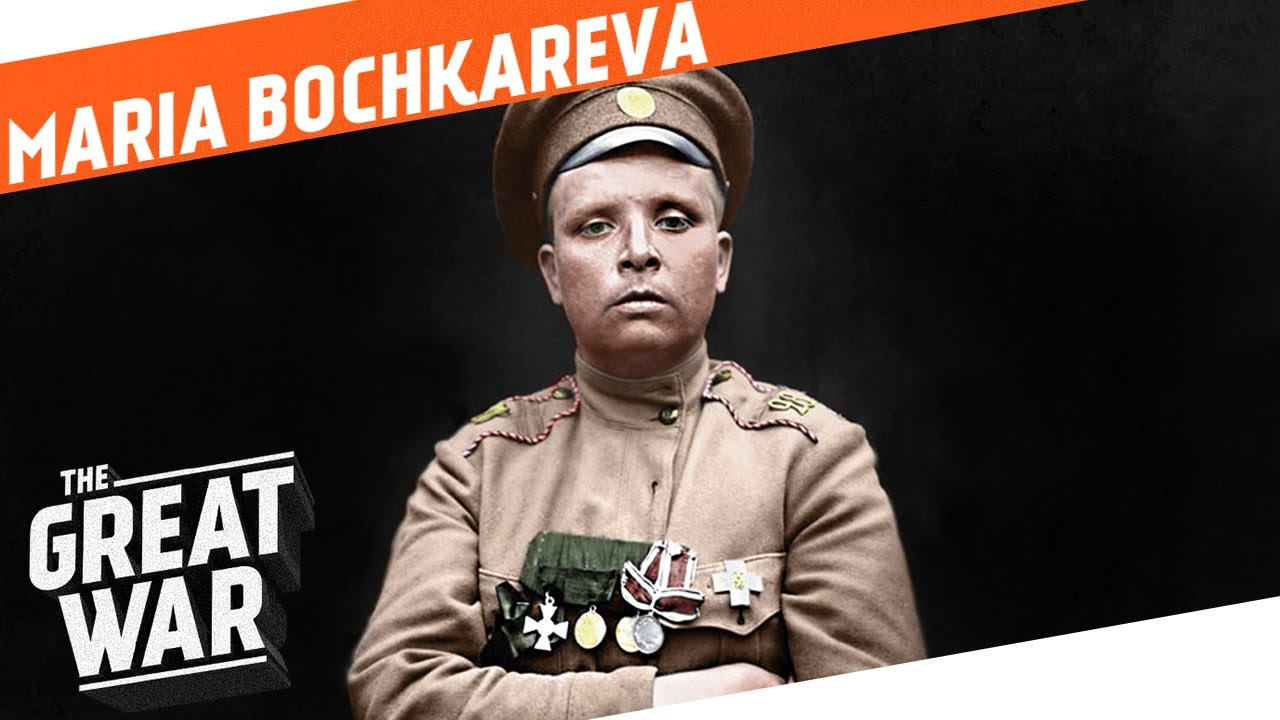
The order came from the top, and it was unlike anything the Russian Army had ever issued. In the spring of 1917, with the February Revolution still fresh and the empire teetering between chaos and hope, the War Minister Alexander Kerensky granted permission for the formation of the world’s first women’s combat battalion. At its head stood Maria Bochkareva, a peasant woman from the Volga who had already spent two years fighting at the front as a common soldier. She had appealed directly to the State Duma’s chairman, Mikhail Rodzianko, during his visit to the front, asking him to carry her request to Kerensky.
Now she had her answer. She was to return to Petrograd, gather volunteers, and build a unit of women soldiers who would show the faltering men of Russia what it meant to fight for their nation. The Russian Army in that summer of 1917 was a fractured thing. The revolution had swept away the old discipline, and with it had gone much of the will to fight.
Soldiers deserted in droves, morale had collapsed to a dangerously low point, and the front lines were bleeding men who no longer believed in the war. In a desperate attempt to restore some sense of purpose, the army had begun forming so-called shock battalions, or death battalions, elite units meant to demonstrate that there were still Russians willing to die for their country. The hope was that their example would shame the rest of the army into fighting. Bochkareva saw no reason why women should not lead that charge.
She would later explain her reasoning in blunt terms: men were given rifles and sent to fight, while women were left to wait for death at home. She intended to change that. Her own path to the front had been anything but conventional. Born in 1889 to a peasant family, Maria had grown up in poverty.
Her father was a drunkard who abandoned the family, forcing her to go to work at the age of eight to help her mother. She married at fifteen and moved with her husband to Siberia, but the marriage turned abusive and she left him, following a new lover to Yakutsk in eastern Siberia. That man was arrested for theft, and then arrested again in 1913. When war broke out in 1914, Bochkareva was filled with patriotic fervor.
She traveled roughly five thousand kilometers to Tomsk and volunteered for the Russian Army. The commander of the 25th Reserve Battalion told her she could join as a nurse, but she wanted to fight. So she did something extraordinary: she sent a telegram directly to the Tsar, appealing for his personal permission. The Tsar agreed.
Maria Bochkareva was built for the soldier’s life. She was strong and sturdy, with a natural muscular build, and she had no qualms about cutting her hair short like any male recruit. She trained in marksmanship and joined the 28th Infantry Regiment, calling herself Yashka. An American journalist from California who was in Russia in 1917 wrote of her: “She had the strength, the breadth, the masculine voice.
When she passed on the street you had to look twice to be sure she was not a man. ” After several days with her unit, her comrades rarely remembered she was a woman at all. That is not to say it was easy. She endured sexual harassment until she proved herself in battle, and prove herself she did.
The details vary depending on the source, but she was wounded multiple times and decorated at least twice with the St. George Cross for bravery during her service at the front in 1915 and 1916. She had initially welcomed the revolution, but the chaos that followed soon horrified her. The collapse of order and discipline in the army, the mass desertions, the dangerously low spirits of the soldiers, all of it convinced her that something drastic had to be done.
When permission arrived for her women’s battalion, she returned to Petrograd and set up a gathering point for volunteers. Her appeal was direct and emotional, aimed at the women of Russia and the men who had forgotten their duty: “Citizens, men and women. Our mother is suffering. Our mother is Russia.
I want to save her. I want women whose hearts are pure as crystal, whose souls are pure, who are full of pride. Such women will set an example of sacrifice. You men will realize your duty in this hour of danger.
”
On that first day, fifteen hundred women answered her call. By the next day, another five hundred had arrived after reading about the movement in the newspapers. Bochkareva was given space in the Kolomensky Women’s Institute to house the recruits. But she was extremely selective.
Many applicants were turned away, and the number quickly shrank to around five hundred, most of them between fifteen and eighteen years old. The reasons for rejection could be as simple as failing to accept orders in a military spirit, or women changing their minds after Maria refused to let them form committees as was happening everywhere else in the country. She alone held authority, and she alone was responsible. Training was brutal.
The volunteers drilled for ten hours a day, and the harshness of Bochkareva’s methods quickly winnowed the ranks down to about three hundred women who could endure it. As female recruits, they received only two concessions: horses and shorter carbine rifles instead of the standard infantry rifles. The carbines weighed more than two kilograms less, a small mercy for the women who carried them. When training was complete, they received their uniforms, identical to the men’s except for one detail: the sleeves were embroidered with a black arrow.
It was the same insignia worn by the men’s death battalions, and it meant that these women were ready to fight and die for Russia. Newspapers around the world wrote about the battalion, but not everyone was impressed. On the streets of Petrograd, the women were often met with jeers, catcalls, and provocative gestures. Still, the official recognition was real.
In a grand ceremony attended by most of the government’s leading officials, Maria Bochkareva was presented with a white and gold ribbon bearing the words: “The First Women’s Death Battalion of Maria Bochkareva. ” She was promoted to officer rank, and General Lavr Kornilov himself presented her with a pistol, a sword, and the officer’s belt. Then the women went to war. As the battalion marched to the Petrograd–Warsaw railway station to depart for the front, crowds of women gathered to salute them and show their respect.
But a group of male soldiers voiced their hostility, and Bolshevik agitators tried to turn the crowd against them. Despite the tension, the battalion boarded the train and headed for Molodechno, where they were attached to the Russian Tenth Army. On July 20, 1917, the Women’s Death Battalion came face to face with the German Army near Smorgon. By that point, much of the Russian Army was in retreat.
The women took their places in the trenches, replacing the soldiers who had fallen back. After five days of fighting, most of the battalion was dead or wounded. Bochkareva herself was hit when a shell exploded near her, and she suffered badly from shell shock. She was sent back to Petrograd and promoted to second lieutenant.
The news of their sacrifice reached far beyond Russia. Emmeline Pankhurst, the British political activist and champion of women’s rights, was in Petrograd that summer. She sent a telegram back to Britain describing what the battalion had accomplished: “The first women’s battalion, 250 strong, took the place of the retreating soldiers at the front. In one counterattack they captured one hundred men, including two officers.
Only five weeks of training. Their commander was wounded. They have gained wide fame, and the moral impact was enormous. More women are joining up, and the navy as well.
”
Bochkareva, however, was no longer in command of the recruiting effort. Her own battalion had been caught up in the events of the Bolshevik Revolution, but the women who defended the Winter Palace belonged to a different unit. Those recruits were disbanded shortly after being detained by the Bolsheviks, and Bochkareva herself was also taken into custody. She was released, but she did not stay idle.
She made her way to Vladivostok and then sailed to the United States, where she met President Woodrow Wilson in Washington and urged him to intervene in Russia. She spent some time in New York, writing her memoirs under the title “Yashka: My Life as Peasant, Exile, and Soldier. ” From the United States she traveled to Britain, where she met King George V, and secured funding from the War Office to return to Russia. She arrived in Arkhangelsk in August 1918 and attempted to organize a new unit of female volunteers.
The effort failed. The following spring, she returned to Tomsk, where she had first volunteered for the Russian Army years before. By then she was serving under Alexander Kolchak, the commander of the White forces in the Russian Civil War. Her allegiance to the anti-Bolshevik cause sealed her fate.
She was arrested by the Bolsheviks once more. This time there was no release. Maria Bochkareva was executed by firing squad on May 20, 1920, condemned as an enemy of the people. Her story has outlived her.
In 2015, a Russian film called “The Battalion” was released, telling the story of her unit and its fight at the front. She remains a singular figure: a woman who rose from nothing to worldwide fame in a matter of months, driven by devotion to her country. Her legacy is real, barely touched by legend.
She was, by any measure, a soldier.
