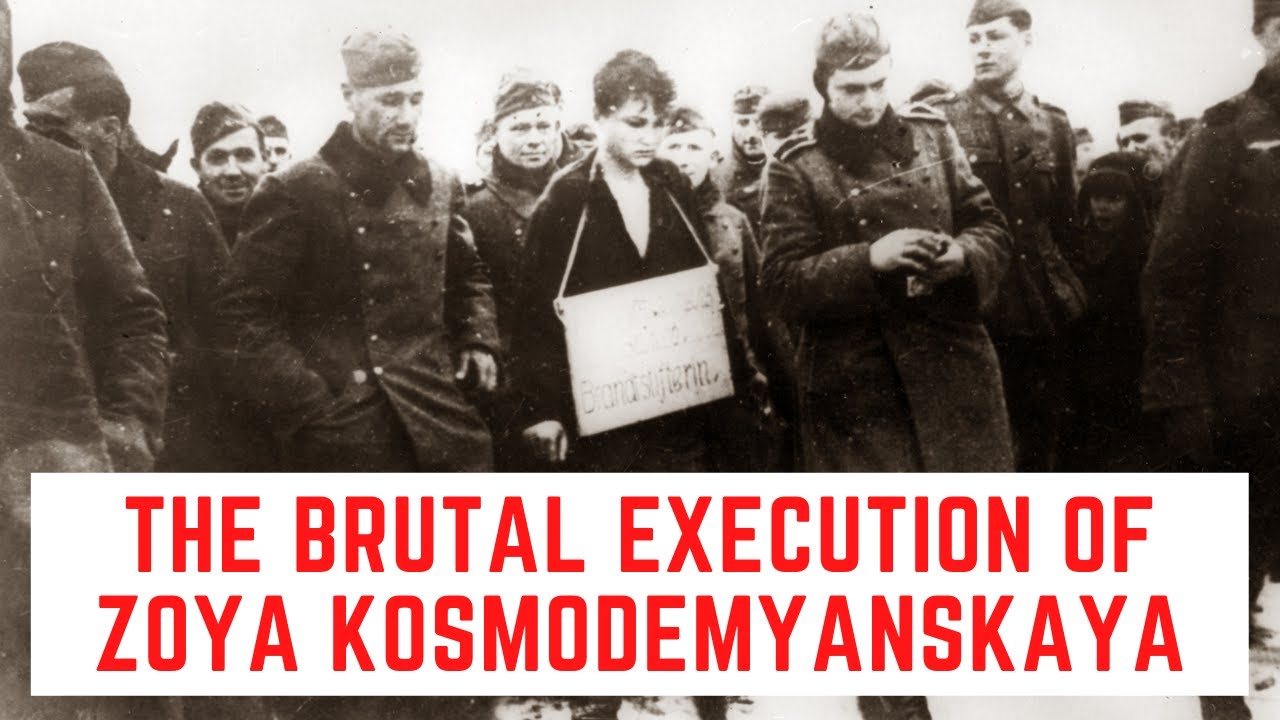
In the freezing dawn of 29 November 1941, an eighteen-year-old girl was dragged barefoot through the snow of the village of Petrishchevo. A board hung around her neck, bearing the words “house burner. ” German soldiers surrounded her, some holding cameras to record her final moments, while the villagers were forced to watch. She had been beaten, whipped, burned, and sliced with a saw throughout the night, yet she had given her captors nothing.
Now, as they placed a noose around her neck and made her stand on a box, she shouted her last words to the crowd: “You will hang me now, but I am not alone. We are 200 million. You cannot hang us all. Farewell, comrades.
Fight. Don’t be afraid. Stalin is with us. Stalin will come.
”
With that, the box was kicked out from under her feet. Her name was Zoya Kosmodemyanskaya, and within months, her story would be told across the entire Soviet Union, turning a teenage girl, hanged by the Wehrmacht, into one of the most celebrated heroes of the war. Zoya had been born on 13 September 1923 inside the Soviet Union, into a family with a long lineage of priests in the Russian Orthodox Church. Her grandfather had been killed in 1918 for publicly opposing atheism.
Her name, Zoya, was Greek for “life. ” She was born in the village of Osino-Gai, near Tambov, a city in central Russia. Her father had studied theology before becoming a librarian, and her mother worked as a schoolteacher. But when Zoya was just six years old, the family was forced to move to Siberia.
It is believed they went to escape persecution after her father gave a speech against the communist idea of collective farming. Later reports said her mother stated they fled because of a charge brought against the family. They lived for a year on the banks of a river in Siberia before moving on to Moscow. When Zoya was ten, her father died after undergoing surgery, leaving the children in the care of their mother alone.
Zoya was a diligent student who loved history and literature. She was well-read in the works of authors like Shakespeare, Dickens, Goethe, and Pushkin, and she loved classical music. She dreamed of attending university in Leningrad. In 1938, she joined the Komsomol, the youth organization of the Communist Party in the Soviet Union.
During the war, the group performed a number of important roles and had a large membership. They carried out work in factories, built infrastructure, and took on many other tasks. Some worked in mines to support the war effort. Zoya was a prominent member of her local group.
When the Second World War broke out with Germany’s invasion of Poland, it seemed at first that hostilities between the Soviet Union and Nazi Germany were unlikely. This was due to the Molotov-Ribbentrop Pact, which guaranteed a 10-year ceasefire between the two countries and also stipulated how Poland would be divided between them. Yet Hitler, while building the Third Reich, was already planning to invade the Soviet Union in Operation Barbarossa. In 1940, Zoya contracted meningitis and was hospitalized, causing her to miss much of her schooling.
But as the Germans drove east toward the Soviet Union, her dreams of entering university changed, and she decided to take up arms. On 31 October 1941, Zoya, along with 1,000 young communist volunteers, joined a sabotage school, becoming a member of the sabotage and reconnaissance force of Unit 993 of the Western Front headquarters. Within the school, she trained in a number of sabotage activities and was then sent to an area in Moscow where her group was ordered to lay mines on the roads. Of the thousand people who joined the unit with Zoya, only about half survived the Second World War.
Behind enemy lines, Zoya was tasked with continuing her work of laying mines, and she went further by attempting to disrupt German communications through cutting telephone wires. Her attitude during operations was: “If we fall, we will fall as heroes. ” But she feared the Germans, truly, as her enemy. At that time, Stalin issued an order to prevent the German army from being stationed and setting up bases inside towns and villages.
Accordingly, he ordered groups to burn and destroy all settlements in the German rear lines. To do this, sabotage groups were tasked with the mission. They worked behind enemy lines and were required to try to burn ten settlements a week. Two groups from the sabotage unit left, and on 27 November, Zoya was sent to Petrishchevo, a village occupied and teeming with Germans.
It was a base for a cavalry unit. Zoya went with a few partisans and set fire to three houses within the village. One of those houses is believed to have been used as a communications center and barracks for soldiers as well. At some point, the three became separated from each other after setting the buildings on fire.
Zoya missed the designated meeting place and time, and one of her comrades was captured. Now alone, she returned to the village to continue her burning operations. But the inhabitants were on alert, and the Germans had placed several men to guard the village. When darkness fell, one of the guards spotted her as she attempted to set fire to a barn.
The guard was rewarded with a bottle of vodka and was later executed by order of a Soviet court. Zoya was arrested and subjected to interrogation. The Nazis inflicted horrific torture upon her in an attempt to extract as much information as possible about partisan movements. They stripped her of her clothes and brutally whipped her with two hundred lashes using German soldiers’ belts.
They even burned her body with fire in an attempt to obtain information. But she gave nothing away at all. They even cut parts of her back with a saw, but she still told them nothing. It was said that the young Russian heroine remained completely silent.
She refused to betray her friends. She turned blue from the cold. Blood flowed from her wounds, yet still she did not utter a word. Her lips were bloody and swollen; she had clearly bitten them when her captors tried to force a confession from her.
When no information could be extracted from her, she was sentenced to death. The next morning, 29 November 1941, at the age of eighteen, she was led from her cell into the streets. Zoya walked through the middle of the village, forced to wear the sign around her neck that read “house burner” or “arsonist. ” A number of Germans gathered to watch Zoya’s execution.
As she was led to the center of the village, she shouted to the villagers: “Comrades, why are you so gloomy? I am not afraid to die. I am happy to die for my people. ” A gallows was erected within the village, and a large crowd gathered to watch her execution.
She was forced to walk barefoot in freezing temperatures and reached the gallows on the morning of 29 November. German soldiers surrounded her. Some carried cameras and were ready to capture her final moments, and the villagers were also forced to watch. She was asked to stand on a box, and then the noose was tied around her neck.
With the rope around her neck, she shouted defiantly: “You will hang me now, but I am not alone. We are 200 million. You cannot hang us all. Farewell, comrades.
Fight. Don’t be afraid. Stalin is with us. Stalin will come.
” With this, the box she was standing on was kicked out from under her, and Zoya was left hanging, executed. Her body was left on the gallows for several weeks as a warning, and the Germans desecrated her body. Her story became famous after it was published in Pravda, the official newspaper of the Communist Party. Zoya Kosmodemyanskaya was described as a popular heroine, and Stalin himself called her that.
Stalin ordered the killing of all the soldiers who had participated in her execution, and Zoya was awarded the title of Hero of the Soviet Union. When partisans had tried to disrupt the German war effort, there were many who also received the award. But Stalin had personally heard Zoya’s story and the immense suffering she endured at the hands of the Germans. She was a girl brutally executed at the end of her life by the Wehrmacht, but she was just an eighteen-year-old girl.
An eighteen-year-old girl who believed she was doing the right thing by fighting the German war machine.
