She lay motionless in the rubble, the Mosin-Nagant pressed against her cheek, and watched the German officer through the PU scope. He was forty-three meters away, exposed for just a moment, and he would never know what killed him. She squeezed the trigger. The rifle cracked.
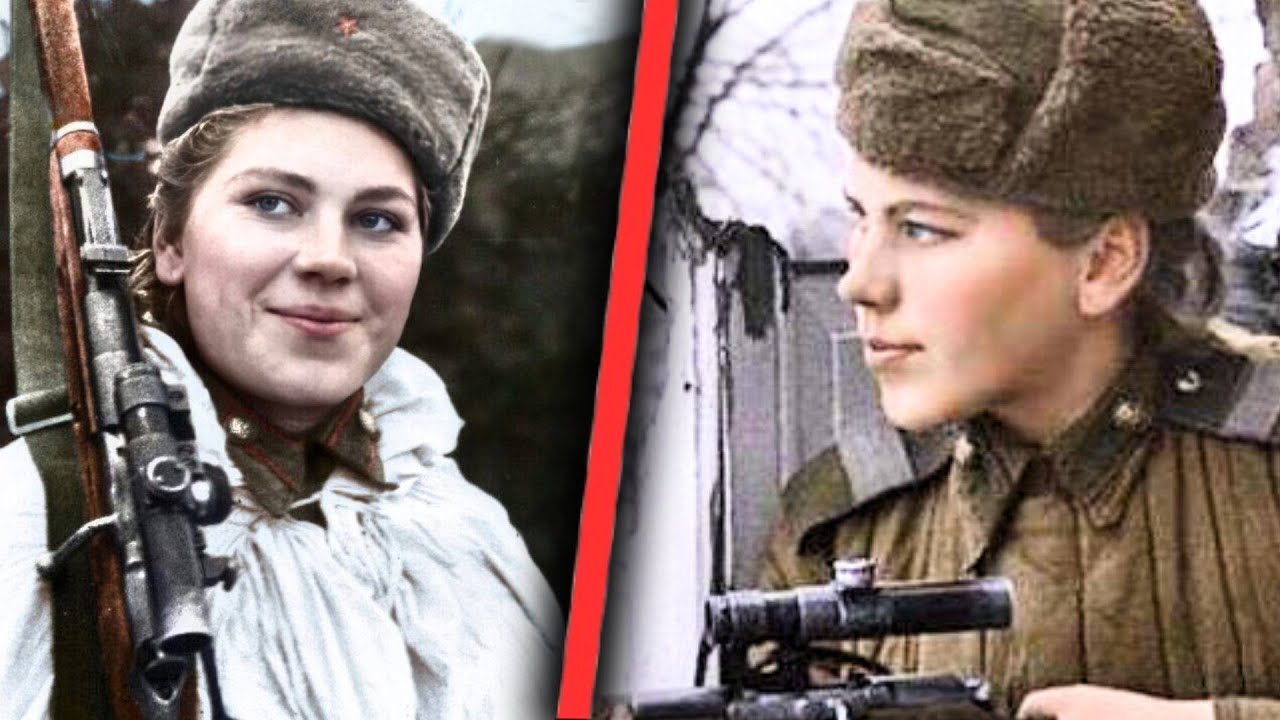
The officer dropped. Two days she had waited for that instant, and she had not moved a muscle in all that time. That patience, more than any technology, was what made the women of the Soviet sniper schools the most psychologically devastating weapon on the Eastern Front. They carried bolt-action rifles designed in 1891, weapons older than most of the women firing them.
They were armed with equipment that was crude by the standards of the Wehrmacht. Yet by the end of the war, Soviet women snipers had recorded over 12,000 confirmed kills of German soldiers, and the true number was certainly higher. German commanders issued specific orders that these women were under no circumstances to be taken alive. The fear they inspired was so profound that it reshaped how German soldiers fought, how they moved, how they slept, and how they thought about the enemy they had been sent to destroy.
The story begins in the darkest days of 1941. On June 22 of that year, Nazi Germany launched Operation Barbarossa, the largest invasion in human history. Three million German soldiers poured across the Soviet border. The Red Army was caught completely unprepared, its forces shattered, its officer corps decimated by Stalin’s purges only a few years earlier.
By December, German forces had reached the outskirts of Moscow. Leningrad was encircled and starving under siege. Millions of Soviet soldiers were dead or captured. The Soviet Union was bleeding to death, and Stalin needed every weapon, every soldier, every advantage he could find.
That was when Soviet military command made a decision that would change the nature of the Eastern Front forever. They would train women as combat snipers. Not as a propaganda stunt, not as a symbolic gesture, but as actual combat soldiers whose job was to kill Germans as efficiently and terrifyingly as possible. The idea was not entirely new.
Soviet women had served in combat roles during the Russian Civil War, and the Soviet Union had promoted gender equality more aggressively than Western nations, at least in theory. Just as importantly, Soviet military doctrine had always emphasized marksmanship training, even for civilians. Thousands of Soviet women and girls had learned to shoot through Osoaviakhim, the Soviet paramilitary sports organization. They had trained with rifles at shooting clubs, at schools, at youth camps.
Many were already excellent marksmen before the war even started. They simply needed specialized training to become snipers. In 1942, the Central Women’s School of Sniper Training was established in Moscow. The program was rigorous, demanding, and designed to produce killers.
Women who volunteered or were selected underwent intensive training in marksmanship, camouflage, and fieldcraft, and most importantly, in the psychology of killing. The rifle they used was the Mosin-Nagant Model 1891/30, a bolt-action rifle that had been in service for over fifty years. It was old, heavy, and crude by modern standards, but it was also reliable and accurate, and when fitted with a PU 3. 5x telescopic sight, it was a deadly precision instrument in the right hands.
It fired the 7. 62x54R cartridge, a powerful round with excellent long-range performance. In the hands of a skilled shooter, it could kill at ranges exceeding eight hundred meters. The rifle weighed about four kilograms with the scope, manageable even for smaller women.
Critically, it was simple to maintain, which mattered in the brutal conditions of the Eastern Front. It functioned reliably in temperatures ranging from minus forty degrees Celsius in the Russian winter to plus forty in the summer. Mud, snow, rain, none of it stopped the rifle from working. You could drag it through a swamp and it would still fire accurately.
The PU scope provided 3. 5x magnification, enough to identify and engage targets at long range, but not so much that acquiring targets quickly became difficult. The reticle was a simple crosshair with range markings, straightforward and functional. At one hundred meters, a skilled shooter could consistently hit a target the size of a human head.
At four hundred meters, a torso shot was reliable. Even at eight hundred meters, with proper range estimation and wind compensation, kills were possible. The training lasted several months. Women learned to calculate range, to adjust for wind and temperature, to read terrain, to move invisibly through enemy territory.
They learned to wait for hours without moving, to control their breathing and heartbeat, to squeeze the trigger at exactly the right moment. They learned to kill without hesitation, without mercy, without remorse. But most importantly, they learned something that would terrify German soldiers more than any weapon. They learned patience.
The ability to wait in a concealed position for hours or even days, watching German positions, studying routines, identifying targets, and then killing with surgical precision when the moment came. Soviet military command looked for specific characteristics in the women they selected: excellent eyesight, steady hands, patience, intelligence, and most critically, the psychological capacity to kill at a distance. Many of the women selected had personal motivations that made them particularly dangerous. Their husbands had been killed by German forces.
Their children had died in bombings or sieges. Their villages had been burned. They were not fighting for abstract political ideology. They were fighting for revenge, and that made them absolutely ruthless.
The training emphasized fieldcraft as much as marksmanship. The women learned to construct ghillie suits from local vegetation, to move across open ground by crawling inches at a time over the course of hours, to read German routines and identify high-value targets. They also learned psychological warfare. Soviet doctrine emphasized that snipers should not just kill Germans, but kill them in ways that would terrorize the survivors.
Shoot the officer first and watch the unit lose coordination. Shoot the medic when he came to help a wounded soldier and watch the unit lose all morale. Wound a soldier rather than killing him and listen to his screams demoralize his comrades. They typically carried sixty to 120 rounds of ammunition in pouches on their belts and in their pockets.
Each round was carefully inspected before a mission. Cartridges with any defects were discarded. The women knew their lives depended on every shot firing exactly as expected. Among all Soviet women snipers, one name stands above the rest.
Lyudmila Pavlichenko. With 309 confirmed kills, including 36 enemy snipers, she became the most successful female sniper in history and one of the deadliest Soviet snipers of any gender. Pavlichenko was born in 1916 in Ukraine. Before the war, she had been a university student studying history.
She had also trained as a sharpshooter, participating in shooting clubs and competitions. When Germany invaded, she immediately volunteered for the Red Army. Initially, military recruiters tried to assign her to nursing duties. Women were supposed to be nurses, not combat soldiers.
Pavlichenko insisted on being assigned to a rifle unit. To prove her capability, she picked up a rifle and, in front of the skeptical recruiters, fired several shots that demonstrated her marksmanship. They sent her to sniper training. She was deployed to the defense of Odessa in August 1941, where she scored her first kills.
The experience of killing another human being, even an enemy soldier, affected her deeply at first. But as she witnessed German atrocities, as she saw Soviet civilians murdered and her comrades die around her, any hesitation disappeared. She became cold, calculating, and absolutely lethal. During the defense of Odessa, Pavlichenko perfected the techniques that would make her legendary.
She would study German positions for hours, memorizing every detail, every routine. She learned to identify German officers by their behavior and equipment. She learned the exact moment when sentries were least alert. And she learned to wait, sometimes lying motionless in the same position for an entire day until the perfect shot presented itself.
German forces quickly became aware that a particularly deadly Soviet sniper was operating in the Odessa sector. They did not know it was a woman. They just knew that officers were dying with disturbing regularity, shot through the head or chest from distances and positions that seemed impossible. German counter-sniper units were deployed specifically to hunt Pavlichenko.
These were experienced marksmen, often veterans who had killed dozens of enemy soldiers. Pavlichenko killed them, too. She claimed 36 enemy snipers among her confirmed kills. Each one was a life-or-death duel where the loser died and the winner survived to fight another day.
One particular duel lasted for days. A German sniper, reportedly a Bavarian nobleman with extensive hunting experience, had been killing Soviet soldiers in Pavlichenko’s sector. He was skilled, patient, and experienced. Pavlichenko made it her mission to eliminate him.
For three days, they hunted each other. The German would fire. Pavlichenko would note the position, and then she would relocate and wait. The German did the same.
They were evenly matched, each too skilled to make the fatal mistake the other was waiting for. On the fourth day, Pavlichenko employed a tactic that required nerves of steel. She positioned herself in a location with poor concealment but excellent fields of fire. Then she had a fellow soldier create a false target, a dummy that resembled a Soviet soldier.
The German, after days of stalking, took the bait. He fired at the dummy. The muzzle flash revealed his position. Pavlichenko fired once.
The German sniper died instantly, shot through the head. When Odessa fell in October 1941, Pavlichenko was evacuated to Sevastopol, where the fighting became even more brutal. The siege of Sevastopol lasted 250 days, from October 1941 to July 1942, and it was one of the most savage battles of the entire war. German and Romanian forces surrounded the city, pounding it with artillery and aircraft while Soviet defenders fought for every building, every street, every meter of ground.
In Sevastopol, Pavlichenko’s kill count climbed steadily. German soldiers began to fear that any exposed position, any moment of carelessness, could result in sudden death from an unseen Soviet sniper. Officers stopped standing near windows. Sentries stayed deep in their positions.
Soldiers moved only at night or under cover of smoke. German intelligence eventually learned that a woman was responsible for many of the sniper kills in the Sevastopol sector. This information spread through German units, and instead of dismissing it, German soldiers found it even more terrifying. They were being hunted and killed by a woman, and they could not stop her.
In June 1942, Pavlichenko was wounded by mortar fire. Shrapnel tore into her face and body, nearly killing her. She was evacuated from Sevastopol just before the city fell. Her combat career was over, but her contribution to the war effort was just beginning.
Stalin’s propaganda machine recognized Pavlichenko’s value. She was sent to the United States and Britain on a publicity tour, where she became an international sensation. American newspapers called her Lady Death. She met President Franklin Roosevelt and First Lady Eleanor Roosevelt.
She gave speeches to workers in munitions factories, inspiring them with stories of Soviet resistance. But Pavlichenko was no propaganda creation. She was a genuine combat veteran who had killed 309 German soldiers with verified confirmation. And back on the Eastern Front, hundreds of other Soviet women snipers were continuing her work.
By 1943, over 2,000 women had graduated from Soviet sniper schools. They were deployed across the entire Eastern Front, from Leningrad in the north to Stalingrad in the south. German soldiers began to encounter them everywhere. A platoon advancing through ruins would suddenly have its officer drop dead, shot from an unseen position.
A company setting up defensive positions would lose its machine gunners one by one to precise shots from hundreds of meters away. Sentries would be found dead at their posts, killed silently by snipers who approached close enough for point-blank head shots. The psychological effect on German troops was devastating. Artillery you could take cover from.
Tanks you could see coming. Aircraft you could hear. But a sniper was invisible, silent, and absolutely lethal. You never knew when you were being watched through a scope.
Any moment could be your last. German soldiers who served on the Eastern Front wrote in letters and diaries about their fear of Soviet snipers. One Wehrmacht corporal wrote in December 1942, “We are more afraid of the Russian snipers than we are of their tanks. The tanks you can see and fight.
The snipers kill you before you even know they’re there. And the worst ones are the women. They’re patient like no man I’ve ever known. They’ll wait all day for one shot, and they never miss.
”
Roza Shanina was another Soviet woman sniper who became legendary. She joined the sniper school in 1943 at age nineteen, motivated by the death of her brother, who had been killed fighting in the Battle of Stalingrad. Her hatred of Germans was absolute, and she channeled it into becoming one of the deadliest marksmen on the Eastern Front. Shanina specialized in double-tap shooting, a technique where she would fire two rapid shots at different targets before the first target even fell.
This required extraordinary skill, because the Mosin-Nagant was a bolt-action rifle. She had to work the bolt, chamber a new round, acquire a second target, and fire again, all within seconds. Very few snipers could manage this technique, but Shanina perfected it. In December 1944, Shanina was operating in East Prussia during the Soviet advance into German territory.
Her unit was tasked with eliminating German strong points that were delaying the Soviet advance. Over the course of five days, Shanina killed 59 German soldiers, all confirmed by observers. German defenders in that sector became paralyzed with fear. They knew a Soviet sniper, reportedly a woman, was operating in their area.
They stopped moving during daylight. Officers refused to leave their bunkers. Morale collapsed. An entire German company effectively became combat ineffective because of one woman with a rifle.
Shanina was killed in January 1945 during the East Prussian offensive. She was hit by artillery shell fragments while shielding a wounded artillery officer. She died from her injuries two days later, at age twenty. By then she had 59 confirmed kills and an unknown number of unconfirmed kills.
Nina Lobkovskaya was deployed to the defense of Leningrad in 1943. The siege of Leningrad was one of the most brutal battles of World War II, lasting 872 days and killing over one million Soviet civilians from starvation, disease, and bombardment. German artillery was positioned in a ring around the city, close enough to shell it constantly, but far enough away to be difficult to assault. Lobkovskaya’s mission was to kill German artillery observers.
These were the men who directed fire onto Soviet positions in the starving city. They typically operated from elevated positions with good visibility, which made them visible to counter-snipers if you knew where to look. Over the course of six months, Lobkovskaya eliminated 89 German artillery observers. Each kill was confirmed by Soviet observers, who noted a reduction in German artillery accuracy after the observer was killed.
The Germans began to fear exposing themselves to observe Soviet positions. Artillery became less accurate. Fewer Soviet soldiers and civilians died from artillery fire. One German artilleryman captured in 1944 described his fear.
“We knew there were Soviet snipers targeting observers. Every time someone went up to the observation post, we wondered if they would come back. Most didn’t. We started drawing lots to see who had to go observe.
Nobody wanted to. It was a death sentence. And we heard rumors it was women doing the killing. I don’t know if that was true, but it made it even more frightening somehow.
”
If there was one battle where Soviet women snipers became truly legendary, it was Stalingrad. The battle lasted from August 1942 to February 1943, five months of the most savage urban combat in history. The city became a wasteland of rubble and ruins. Every building was a potential position, every pile of debris a potential hide.
Urban warfare was ideal terrain for snipers. The ruins provided countless concealed positions. Engagement distances were often short, making every shot count. And the close quarters meant that a single sniper could paralyze an entire German unit by controlling a key intersection or building.
Soviet women snipers operated extensively in Stalingrad, often in pairs or small groups. They would establish positions in ruined buildings overlooking German-controlled areas, then systematically kill any German soldier who exposed himself. Officers were priority targets, then machine gunners, then radio operators, then anyone else foolish enough to show themselves. Tanya Baramzina was deployed to Stalingrad in October 1942 as a reconnaissance scout and sniper.
She operated in some of the most contested parts of the city, including the factory district, where fighting was measured in meters gained or lost each day. Her mission was to eliminate German officers and disrupt German command and control. Baramzina would infiltrate deep into German-held territory, sometimes spending days behind enemy lines, living in rubble, eating whatever she could find, waiting for targets. She learned German soldiers’ routines, when they felt safe enough to expose themselves, when officers would meet to plan operations, and then she would kill them.
Over the course of three months, Baramzina killed 24 German officers, all confirmed. But her contribution went beyond the kills. The fear she generated among German troops was immeasurable. Units operating in her sector knew that any officer who exposed himself would likely die.
This disrupted German operations, slowed their advances, and contributed to the eventual Soviet victory. German soldiers captured in Stalingrad during interrogations repeatedly mentioned their fear of Soviet snipers, specifically women snipers. One German lieutenant captured in December 1942 told interrogators, “We were more afraid of the Russian women than the men. The men would sometimes make mistakes, get impatient, take risky shots.
The women never did. They were cold, patient, and they never missed. We started calling them death maidens. If you heard that a woman sniper was in your sector, morale would collapse immediately.
”
Genya Dumbadze was another woman sniper operating in Stalingrad. She joined the Red Army in 1942 at age twenty, motivated by the death of her entire family during the German advance through southern Russia. Her hatred of Germans was absolute, and she openly stated that she viewed every kill as revenge for her family. Dumbadze specialized in hunting German snipers, the most dangerous targets, because they could shoot back.
Counter-sniper work required extraordinary skill and nerves, because any mistake meant death. You had to find the enemy sniper before he found you, and you had to kill him with the first shot, because he would not give you a second chance. In Stalingrad, Dumbadze killed 14 German snipers, all confirmed by Soviet observers who witnessed the kills. Each duel was life or death, sometimes lasting hours or even days as both snipers hunted each other through the ruins.
Dumbadze survived them all, though she was wounded twice by near misses. One particular encounter became legendary among Soviet forces. A German sniper, reportedly an experienced hunter from Bavaria, had been terrorizing a Soviet-held sector for over a week. He had killed 23 Soviet soldiers, including two Soviet snipers who had tried to eliminate him.
Dumbadze volunteered to hunt him. She studied his previous kills, analyzing the angles and positions. She determined his likely hide locations. Then she set a trap.
She positioned herself in a location she knew the German would need to observe, but she hid so perfectly that she was invisible even to observers who knew she was there. For two days, she waited without moving. On the third day, the German sniper revealed himself for just a moment to observe Soviet positions. Dumbadze fired once.
The German died instantly. When Soviet soldiers later recovered his body, they found he had been shot through the left eye from 430 meters away. What made Soviet women snipers so terrifying to German soldiers was not just that they were deadly. It was how they killed, and what that said about the nature of the war on the Eastern Front.
German soldiers had been told they were fighting an inferior enemy, subhuman Slavs who would collapse under the might of the Wehrmacht. Instead, they found themselves being systematically hunted and killed by women who showed no mercy and accepted no surrender. German military doctrine emphasized aggressive tactics, combined arms warfare, and operational mobility. Snipers were seen as defensive weapons useful for specific situations, but not a primary combat arm.
The Soviets approached sniping completely differently. They saw it as psychological warfare as much as a tactical tool. Soviet women snipers were taught to terrorize enemy forces, not just kill them. Shoot the medic when he tries to help a wounded soldier, and watch the unit’s morale shatter as wounded men bleed out because nobody dares to help them.
Shoot sentries in ways that their bodies were discovered hours later, and watch the next shift of sentries become paralyzed with fear. Kill officers in front of their men and watch the unit lose cohesion and leadership. German soldiers learned to fear certain signs that indicated a Soviet sniper was operating in the area. If officers started dying from precise headshots, a sniper was present.
If sentries were found dead at their posts with no signs of close combat, a sniper had been there. If German soldiers started refusing to move during daylight, morale had collapsed due to sniper activity. Wehrmacht commanders tried various countermeasures. They deployed their own snipers to hunt Soviet snipers, but these duels often ended with the German sniper dead.
German snipers, even experienced ones, found that Soviet women snipers were more patient, more disciplined, and often better trained in fieldcraft. They tried using decoys, fake targets designed to make Soviet snipers reveal their positions. Soviet women snipers rarely fell for these tricks. They had been trained to recognize decoys, to wait for genuine targets, to never take an uncertain shot that might reveal their position.
German forces tried coordinated counter-sniper operations using multiple observers to scan for Soviet positions while snipers waited to fire at any discovered Soviet sniper. This was more effective, but it required significant resources and took German snipers away from other duties. And even when these operations succeeded in killing a Soviet woman sniper, another would arrive to replace her within days. Perhaps most disturbing for German soldiers was the realization that Soviet women snipers felt no hesitation, no mercy, no compassion.
Western gender norms suggested that women were naturally more peaceful, more compassionate, less violent than men. Soviet women snipers shattered this assumption completely. They killed without hesitation. They watched German soldiers through their scopes, studied them, learned their routines, and then killed them with cold efficiency.
They felt no guilt about killing. Many openly stated they enjoyed it, viewing each kill as justified revenge for Soviet civilians murdered by German forces. One German soldier interviewed after being captured in 1944 described his psychological state after months facing Soviet snipers. “You stop thinking of them as soldiers.
They become like death itself, invisible and inevitable. You know they’re out there watching you. You know that any moment you expose yourself could be your last. You stop sleeping properly because you have nightmares about crosshairs on your chest.
Some men broke completely. They would refuse to leave cover even when ordered. They would rather be court-martialed than risk being shot by a Russian sniper. ” The fear was so pervasive that German propaganda tried to counter it by portraying Soviet women snipers as unnatural, as violating the proper role of women.
German newspapers published articles claiming Soviet women snipers were mannish, ugly, and psychologically damaged. This propaganda was meant to reassure German soldiers that these were aberrations, not representative of proper womanhood. But the propaganda did not work. German soldiers on the Eastern Front knew the truth.
Soviet women snipers were effective, deadly, and absolutely terrifying, regardless of how propaganda tried to portray them. As the war entered its final year and Soviet forces pushed westward into Poland and Germany itself, Soviet women snipers continued their deadly work. By this point, they were experienced veterans who had survived years of combat. They knew every trick, every tactic, every technique, and they were fighting on enemy territory, which meant they had no sympathy for the Germans who had invaded their homeland.
The Soviet advance into Germany in 1945 was accompanied by widespread atrocities. Soviet soldiers, after seeing what German forces had done in the Soviet Union, took terrible revenge. Cities were burned. Civilians were killed.
The brutality was immense. In this context, Soviet women snipers continued killing German soldiers with cold efficiency. Yekaterina Zelenko, who had 26 confirmed kills, was killed in March 1945 during the Battle of Berlin. She was shot by a German soldier while trying to rescue a wounded comrade.
Her death, coming just weeks before the end of the war, highlighted how Soviet women snipers fought until the very end. Of approximately 2,000 Soviet women snipers trained during World War II, about 500 died in combat. This represented a casualty rate of about 25 percent, significantly lower than the casualty rates for Soviet infantry, but still substantial. The survivors returned home as war heroes, though many struggled with what they had experienced and done.
Lyudmila Pavlichenko, the most successful Soviet woman sniper, suffered from what we would now recognize as PTSD. She had nightmares about the men she had killed. She saw their faces in her scope, watched them die, and those images stayed with her. But she never expressed regret.
In her view, every German she killed was one less soldier who could kill Soviet civilians. The legacy of Soviet women snipers extended far beyond the war itself. They demonstrated that women could serve effectively in combat roles, that they could kill as efficiently as men when trained and motivated. Postwar Soviet military doctrine incorporated lessons learned from the women’s sniper program, and sniping became a permanent and valued role in Soviet armed forces.
For German soldiers who survived the Eastern Front and later spoke about their experiences, Soviet women snipers remained a source of fear and respect decades after the war. They had faced an enemy who was patient, deadly, and absolutely merciless. Many German veterans stated that of all the threats they faced on the Eastern Front, Soviet snipers, particularly women snipers, were the most psychologically devastating. One German veteran interviewed in the 1970s summarized the experience.
“People ask me what I feared most. They expect me to say tanks or artillery or the Russian winter. But the truth is I feared the snipers, specifically the women snipers. They were something different, something we weren’t prepared for.
They killed with a coldness and precision that was terrifying. And knowing they were women somehow made it worse. We had been told we were fighting an inferior enemy. But those women proved we were wrong.
They were equal to us in skill and superior to us in patience and determination. That’s what I remember most about the Eastern Front. The fear that at any moment a Russian woman with a rifle was watching me through a scope, waiting for me to make one mistake. That fear never left me.
Not even after the war ended. ”
Soviet women snipers with Mosin-Nagant rifles killed over 12,000 German soldiers during World War II, all confirmed kills with observers present. The actual number was likely much higher, as many kills went unconfirmed in the chaos of battle. But beyond the body count, their real impact was psychological.
They demonstrated that women could fight as effectively as men when properly trained and motivated. They broke German morale by being an enemy that could not be seen or predicted. They proved that the supposedly inferior Soviet forces could match and exceed German military effectiveness in specialized roles. The Mosin-Nagant rifle, a weapon designed over fifty years before World War II, became one of the most feared weapons of the Eastern Front when placed in the hands of skilled Soviet women snipers.
Not because it was technologically advanced, but because the women who carried it had the skill, patience, and absolute determination to use it with deadly effectiveness. That is why Germans feared Soviet women snipers with Mosin-Nagant rifles. Not because of the weapon they carried, but because of the women behind the rifles, who hunted them without mercy, killed them without hesitation, and broke their morale in ways that no other weapon could achieve.
