The bill of sale was already unusual enough to draw comment at Ryan’s Mart, but what made it truly singular was the addendum the auctioneers insisted on attaching. Seven men had bid on the laborer that morning in March 1843, and only one had completed the purchase. The document, hidden in a private family collection until the late 1980s, described a twenty-eight-year-old field hand from Virginia whose three previous owners had all died under circumstances so strange that the Charleston constabulary refused to reopen the inquiries. The notation in red ink beneath the ledger entry warned of special conditions.
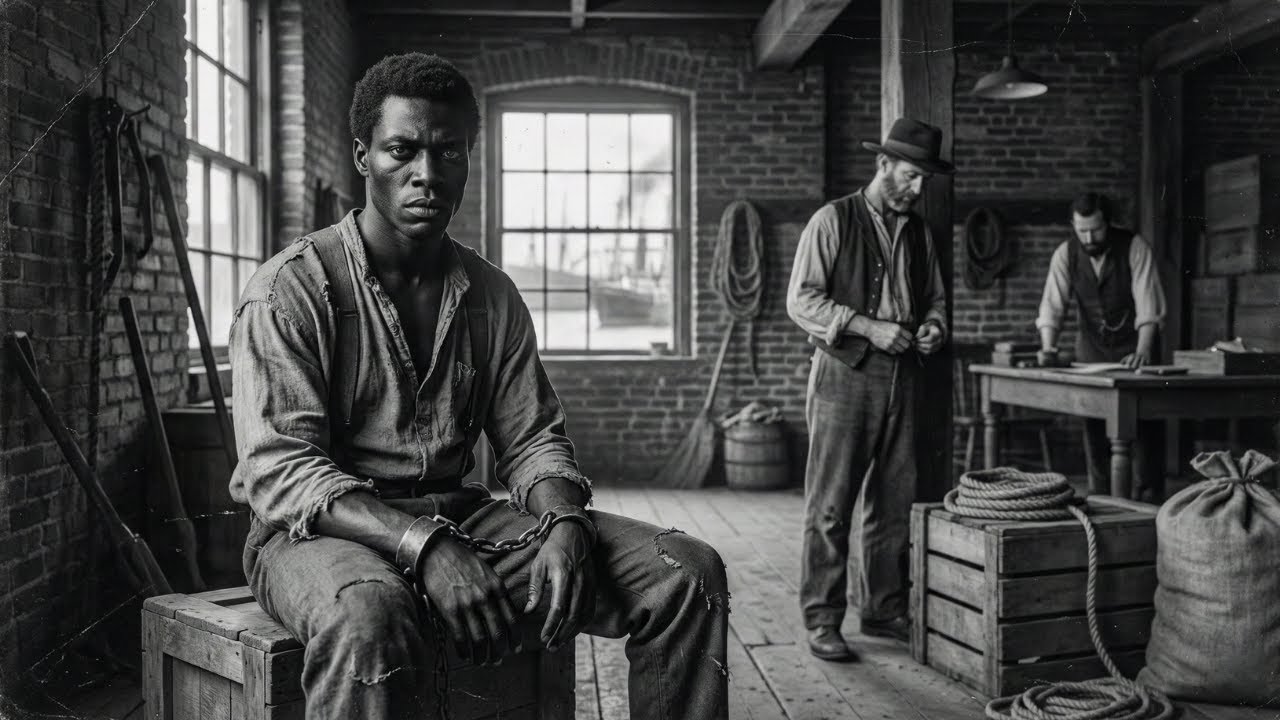
Those who approached the auction block crossed themselves. Seasoned traders refused to meet the man’s eyes. What unsettled them was not rebellion, violence, or any of the behaviors slaveholders most feared. It was something the authorities could not name, a quality that made the most experienced dealers in the city call the whole affair the gravest mistake they ever witnessed.
The sale took place on March 14, 1843, at Ryan’s Mart on Chalmers Street, one of the busiest auction houses in Charleston. The building still stands today, its pale brick walls giving no hint of what once happened behind them. Ryan’s Mart specialized in prime field hands, men judged capable of surviving the brutal rhythm of rice plantations from sunrise to twilight. March was the peak season, as planters prepared for spring planting, and auctions ran three times a week to keep supply flowing north along the Cooper River and south toward the Sea Islands.
The man who arrived in chains that morning was recorded only as subject 41, male, approximately twenty-eight, origin Virginia. The stripping of a name was routine; markets preferred bodies to identities. But the clerk had scrawled something unusual in red ink beneath the entry: Special conditions apply. See manager before bidding.
Thomas Yancy was among the buyers that morning. At forty-six, he owned Belmont Plantation, four thousand acres of carefully organized rice fields carved into the low country twenty miles north of Charleston. He had spent two decades learning to judge a man’s physical capacity at a glance and was known for efficiency rather than cruelty. He had come expecting a simple transaction, three strong workers to replace laborers he had sold the prior season.
He was not looking for mysteries. The morning proceeded through the first seventeen lots without incident. Traders called out descriptions while buyers examined teeth and joints, checking for scars that might signal past resistance. Prices ran true to season, nine hundred to twelve hundred dollars for strong men, slightly less for women, children valued by projected usefulness.
Everything moved like clockwork until lot eighteen was called. Two handlers escorted the man onto the wooden platform. Yancy noticed they stood farther back than they had with any previous lot, a full arm’s length more, as though proximity itself carried risk. The man in chains was tall, perhaps six feet, with broad shoulders and hands marked by years of labor.
But it was not his physique that caught Yancy’s attention. It was his stillness. His face bore no expression, neither dread nor fury nor resignation, only a strange, calm vacancy. His eyes drifted across the crowd as if observing something distant, and when the auctioneer began his introduction, they settled on a fixed point above the assembly and stayed there unblinking.
“Lot 18,” the auctioneer announced. “Prime field hand, approximately twenty-eight, Virginia lineage, strong constitution. ” Then he hesitated. “Special terms apply.
All interested parties must consult manager Tolbert before bidding. ”
A murmur moved through the crowd. In twenty years of attending sales, Yancy had never heard such a statement. Three prospective buyers stepped forward and filed into the manager’s office.
They returned moments later, two shaken and one pale as ash, and not a single one resumed his bidding place. As the last man passed Yancy, he muttered, “Don’t do it, Thomas. Not for any price. ”
Yancy felt a tightening in his chest.
The man on the platform stood motionless, unaffected by the whispers swirling around him. That unnatural composure pulled at Yancy the way a dark well draws the eye. He stepped toward the manager’s office, where Tolbert spoke to each buyer in hushed, urgent tones. One planter lingered long enough to ask what exactly had happened to the previous owners.
Tolbert shrugged, palms lifted in helpless surrender. “The records are vague. The circumstances troubling. The estate insisted on disclosures.
All I can tell you is this: anyone considering the purchase must understand there are uncertainties. ”
When Yancy’s turn came, Tolbert studied him with an expression caught between concern and relief, as if he hoped Yancy might be reckless enough to end a burden the Mart no longer wanted to carry. He spread three documents across his desk: records from 1838 and 1840, and an elegantly penned letter written by a lawyer who sounded far more rattled than any lawyer should. “The man’s first recorded owner,” Tolbert explained, “was a Virginia tobacco planter named Harrison Kemp, who purchased him in Richmond.
Kemp died fourteen months later of heart failure. He was only forty-three and reportedly healthy. But the three days before his death were filled with erratic behavior — interrogations, abrupt punishments, disruptions in the work routine. Kemp became convinced a conspiracy was forming among his slaves.
After one such night of relentless questioning, he was found dead in his barn. No wounds. No struggle. Just gone.
”
Yancy listened in silence. The man was then sold to Virgil Stowe, a Halifax County planter who lasted eleven months before hanging himself. His next owner was a Richmond merchant named Dobbins, who survived six weeks before collapsing from a sudden stroke. In every case the owners had descended into identical patterns: sleeplessness, dread, an irrational certainty that threats surrounded them.
And in every case, this same quiet man had been at the center of their attention. Tolbert’s final document, a sharply worded letter from Dobbins’s estate executor, felt heavier than paper should. The attorney had underlined one paragraph three times, stressing that he would not claim the slave had caused the deaths, but that the pattern was the darkest coincidence of his twenty-year legal career. When Yancy finished reading, his throat felt dry.
Outside, the auctioneer’s voice echoed through the hall, calling bids on later lots, unaware of the strange gravity concentrated in the small office. Tolbert studied him quietly. “You’re still considering the purchase, aren’t you? ”
It wasn’t a question.
Yancy returned to the auction floor just as lot eighteen was about to close without a single bid. The man still stood exactly where Yancy had left him, hands shackled, gaze fixed somewhere above the crowd, body as unmoving as if carved from stone. No fear. No anger.
No hope. The room felt tense, as though everyone had wordlessly agreed to let the lot pass unsold. Then, with an impulse he barely understood, Yancy lifted his hand. “Five hundred dollars.
”
Every head in the building snapped toward him. Five hundred was far below market value, but given the circumstances, no one challenged him. The auctioneer’s relief was evident. The gavel struck once, twice.
A sale sealed not by confidence but by uneasy silence. Yancy signed the required acknowledgement of special risks and accepted Tolbert’s final warning: if anything felt strange — emotionally, mentally, physically — he must document it immediately. The previous owners had kept everything quiet until they were too deep into their own spiraling thoughts. “If anything begins to shift in your mind,” Tolbert said, “write it down.
”
Yancy left with Isaac, the name Tolbert believed belonged to the man, and arranged transport to Belmont. Isaac arrived that same afternoon still bound in leg irons and wrist cuffs. The plantation stretched across the low country like a patchwork of geometry and water, its levees, gates, and irrigation channels allowing rice to grow in the tidal flats. Yancy ran the estate with strict order but not excessive violence, believing predictability yielded more profit than cruelty.
His overseer, Curtis Beale, was a structured man who did not rely on the whip unless necessary. Beneath Beale served drivers, enslaved men entrusted with organizing field crews. One of these, Marcus, had worked at Belmont for fifteen years, and Yancy trusted him the way plantation owners sometimes trusted the enslaved: selectively but sincerely. “Watch him closely,” Yancy told Marcus that first evening.
“Everything he does, every interaction, anything out of place, you come directly to me. ”
Marcus glanced at Isaac, who stood motionless and awaiting direction, and frowned. “What exactly am I watching for, sir? ”
Yancy hesitated.
How could he explain paranoia without sounding paranoid himself? “Just anything unusual. ”
The first week passed quietly. Marcus reported that Isaac worked harder than most, completing every task quickly and precisely, without complaint.
He did not talk during breaks, did not joke with others, ate alone, slept alone, did nothing to provoke suspicion. And yet something about that very absence unsettled Marcus. “It’s not that he’s defiant,” Marcus told Yancy. “It’s that he shows nothing.
Not even the small signs a broken man usually shows. It’s like he’s here but also not. ”
Yancy dismissed it as nerves, telling himself he would not fall prey to the same irrational thinking that had ruined the men before him. But by the second week, he realized Isaac occupied more of his thoughts than any field hand ever had.
He found himself glancing from his study window toward the north fields, searching for Isaac’s figure. At night he lay awake thinking about those emotionless eyes, wondering if anything stirred behind the blank surface. In the third week came the first real disturbance. Two workers got into a fistfight over stolen rations, a routine conflict easily resolved.
But both men insisted the same thing: Isaac had been watching them for days. Not interfering. Just staring. The stare, they said, gnawed at their nerves until everything felt like a threat.
“They’re just making excuses,” Beale insisted. “People blame anything but themselves for their mistakes. ” Still, Yancy ordered Isaac transferred to the River Team in the South Fields. If trouble followed him there, that would dispel coincidence.
Trouble followed. The river team supervisor reported uneasiness. Nothing concrete, just an atmospheric tension that had not existed before. Men snapped at each other.
Work slowed. Several workers echoed the same complaint: Isaac’s stillness made them uneasy. His silence felt like something watching them from the inside. “Superstitious nonsense,” Beale muttered, though he could not entirely hide a flicker of doubt.
That night, Yancy wrote his first journal entry. It was short and factual: workers uneasy, Isaac showing no notable behavior, cannot determine cause. Yet seeing the words on paper made a knot tighten in his stomach. Then came the first dream.
He stood at dawn beside the rice fields, watching his workers move with mechanical precision, like puppets. Something was wrong, terribly wrong, but he could not articulate what. Then he noticed every man staring past him, eyes fixed on someone behind his shoulder. When he turned, Isaac stood at the field’s edge, watching him with that same impassive face.
In the dream, Yancy felt an overwhelming certainty that disaster was moments away, that his life and everything he had built was about to collapse. He woke gasping, drenched in sweat. He dismissed it as stress until it happened again the next night, and again. By the fourth night, a creeping dread had settled into his bones.
He found himself awake at odd hours, staring out the window toward the slave quarters, searching for movement that never came. During the day his thoughts wandered uncontrollably. He lost track of conversations, reread the same plantation accounts without processing the numbers. His wife noticed first, asking repeatedly if he was feeling ill.
The overseer noticed next, remarking that Yancy seemed strangely preoccupied. Through it all, Isaac remained a silent presence in the fields. Obedient. Tireless.
Unremarkable, except for how profoundly he affected everyone around him. By the end of April, the journal entries had grown frenetic. Yancy’s handwriting tilted, words clustered too close together. He described a sensation of being watched, though every time he turned, no one stood there.
He wrote about an unshakable sense of threat without shape, a feeling he could neither justify nor dismiss. He found himself riding out to the South Fields again and again, each time staring at Isaac for several minutes before retreating without a word. Beale whispered to Marcus one evening, “He’s tormenting himself, though I don’t know over what. ”
Marcus replied, “I think we both know.
” His eyes drifted toward the quiet figure working in the fading light. In early May, the tension broke. After another sleepless night riddled with formless fear, Yancy summoned Beale and Marcus to his study and declared he was selling Isaac immediately. He had already contacted a Savannah trader who specialized in difficult acquisitions, a man willing to take Isaac for three hundred dollars — a heavy loss, but Yancy no longer cared.
Beale questioned the decision, arguing that Isaac had caused no actual disruption. Yancy snapped. “He is disrupting operations. ” His voice was sharper than either man had ever heard.
Marcus remained behind after Beale left, studying his master with uneasy concern. “You’re afraid, sir,” he said. “And I’ve never seen you afraid of anything. ”
“I can’t explain it,” Yancy whispered.
“I lie awake certain something terrible is coming. Everything feels dangerous. Every shadow, every routine, even my own thoughts. And the only new element here is him.
”
Marcus hesitated. “Maybe the danger isn’t him. Maybe it’s what fear makes us do to ourselves. ”
The Savannah trader, Rufus Tate, arrived on May 17.
He examined Isaac with professional detachment, checking limbs, teeth, posture, asking basic questions. Isaac responded obediently but without expression. Tate frowned. “Seems good stock.
So why sell him cheap? ”
Yancy offered the prepared explanation about social disruption. Tate narrowed his eyes. “Or maybe you’re scared of something you can’t admit.
”
“Three hundred. Take him or leave him. ”
Tate took him. The wagon rolled away with Isaac, and relief crashed over Yancy so suddenly he nearly staggered.
That night, for the first time in weeks, he slept soundly. The next night passed without dreams. By the third day, color had returned to his face. He dared to hope the nightmare was over.
On the fourth day, a courier arrived with a letter that chilled him deeper than any dream. It was from Rufus Tate, but the handwriting was nearly illegible, trembling across the page. Tate wrote that he was returning Isaac immediately and refusing payment. He described waking at 2 a.
m. the first night with absolute certainty that an intruder was inside his home. He searched the house repeatedly, unable to shake the conviction of danger despite finding nothing. The second night he did not sleep at all, imagining catastrophes with terrifying clarity: financial ruin, fire, murder, storms, dread without cause.
On the third morning, he found the three other slaves huddled away from Isaac in their temporary quarters. They said Isaac had stood awake all night, staring at a wall, motionless, perfectly silent. Tate wrote one line that echoed Tolbert’s warning: “It’s not what he does. It’s what happens to us when we try to understand him.
” He refused to keep the three hundred dollars. His final words were a plea: do not sell him to anyone you value. An hour later, Tate’s wagon appeared at Belmont’s gate, the driver urging the horses at a frantic pace. Isaac was delivered back to the plantation, calm as ever.
Yancy ordered him locked in the isolation shed without hesitation. Marcus asked whether that was appropriate, since Isaac had done nothing wrong. “Do it,” Yancy barked. Isaac obeyed without resistance.
He stepped inside the windowless shed as if entering just another work cabin. Marcus later reported, “It’s like he doesn’t care where he is. He’s empty, sir. Not broken.
Just empty. ”
That night, Yancy sat alone in his study and forced himself to think rationally. He opened his journal and wrote a long reflection, comparing every documented pattern: Kemp’s paranoia, Stowe’s nightmares, Dobbins’s spiral into fear. Had Isaac truly caused anything?
He had never attacked anyone, never resisted, never spoken a threatening word. Yet each owner’s mind had deteriorated in identical ways, and the timing aligned too precisely to ignore. Was Isaac the cause, or was he simply a catalyst revealing terrors that already lived within men like Yancy himself? He found no answer, only a sense of tightening dread.
Three days later, he overheard a conversation that shook him deeper than any letter or dream. Samuel, one of the oldest field hands on the plantation, was speaking quietly to Beale. “Masters live afraid,” Samuel said. “Afraid we’ll rebel, run, poison, burn, or do what they’ve done to us.
They call it caution, but it’s fear. Isaac doesn’t smile, doesn’t cower, doesn’t pretend. He refuses to give you the lies that let you sleep at night. That’s why he scares you.
Not because he does anything, but because he won’t perform the part you expect. ”
Yancy stood frozen behind the open window, listening. The fear twisting inside him was not new. It had always been there.
Isaac had simply stripped away the social masks that made it livable. He was a mirror, not a monster. The next morning, Yancy summoned Samuel and asked if he had ever seen anyone like Isaac before. Samuel considered.
“Not exactly, sir. Some men go silent because they’re broken. Others go quiet because they’re fighting. But Isaac, he’s separate from all of it.
He doesn’t participate in the roles we’re all trapped in. He’s not pretending, not resisting, not pleading. He’s just absent. And that absence makes people see things they try not to see.
”
“And the previous owners died fearing him. How do you explain that? ”
Samuel spoke slowly, choosing each word. “Fear can kill a man faster than poison.
A man who believes danger is around every corner weakens himself, stops eating, stops resting, makes mistakes, falls apart. Maybe Isaac didn’t kill them. Maybe they killed themselves trying to battle their own shadows. ”
That night, Yancy walked alone to the isolation shed, lantern flickering against the darkness.
His hand trembled on the lock, but he forced himself to open the door. Isaac sat in the far corner, legs crossed, posture relaxed. When the lantern’s glow reached his face, he lifted his head. His expression was the same as always.
Empty. Unreadable. Undisturbed. “I need to understand,” Yancy said.
“You’ve had three owners before me. They died. The trader who bought you couldn’t keep you three days. And I — ” he faltered.
“I have spent months fearing things I cannot explain. Did you do something to us? Are you doing something now? ”
Isaac remained still for several long moments, as if considering the question itself.
At last he spoke in that flat, emotionless tone. “I worked for Mr. Kemp. I answered him.
I followed instructions. He died and I was sold. I worked for Mr. Stowe.
I answered him. I followed instructions. He died and I was sold. I worked for Mr.
Dobbins. He died. I was sold. I work for you.
I answer you. I follow instructions. That is all I have done. ”
“But you see the pattern,” Yancy insisted.
“You must see it. ”
Isaac’s gaze remained steady. “I see that men who own other men live afraid. Some more than others.
Some cannot bear the fear. ”
“How are you different from other slaves? ”
For the first time since he had arrived, something flickered across Isaac’s face. Not emotion exactly, but the faintest echo of something long buried.
“I stopped pretending. I stopped giving masters the expressions they need to believe their world makes sense. No fear for them to dominate, no gratitude for them to savor, no bitterness for them to punish. I stopped all of it.
I only work. I only exist. That honesty frightens people more than rebellion ever has. ”
Yancy left the shed shaken.
That night he wrote a long letter to the Charleston constabulary, detailing everything: the deaths of previous owners, the rising dread at Belmont, his own dreams, his slipping sanity. He explained that Isaac had never committed a crime, yet seemed to provoke dangerous psychological reactions in anyone who tried to control him. The constabulary responded by sending Deputy James Wilcox, a seasoned investigator known for level-headed judgment. Wilcox spent two days interviewing overseers, drivers, and workers.
He studied Isaac from a distance, noting his silence, his calm, the absence of any violent behavior. He read through Yancy’s journal entries with troubled eyes. On his second night at the plantation, Wilcox asked the question Yancy had avoided asking himself. “Has this man ever threatened you?
Has he ever shown hostility? Ever raised a hand? Ever attempted escape? ”
Yancy could not speak at first.
When he finally answered, it came out strained. “No. He has done none of those things. ”
“Then what exactly are you afraid of, Mr.
Yancy? ”
“I’m afraid of what I think when he’s near. I’m afraid of my own mind. I’m afraid I’m becoming like the ones who died.
”
Wilcox nodded slowly. “Your field hand, Samuel, understands this better than you. He told me Isaac’s only crime is refusing to play the part slavery demands — that he won’t ease your conscience. ”
Wilcox’s report concluded that Isaac had committed no crime and therefore could not be punished or seized.
The deputy recommended transferring him to state labor projects to minimize one-on-one psychological tension. He added a final line Yancy would reread many times: “The greatest danger here may not be the slave, but the fear he awakens in those who claim ownership over him. ”
No law in South Carolina covered a slave who frightened his owner without committing an offense. The legal system could not intervene.
The nightmares had eased since Isaac’s confinement, but an undercurrent of dread remained inside Yancy, like a bruise that refused to fade. On June 8, Yancy made a decision that surprised everyone, including himself. He summoned his lawyer to Belmont and instructed him to prepare papers for Isaac’s manumission. “I want him freed,” he said.
The lawyer blinked in disbelief. “On what grounds? ”
Yancy hesitated. “Let’s say he has served me in a way I cannot explain.
”
The lawyer crafted the proper justification: exceptional service. Both men knew it was a polite fiction. On the morning of June 11, the manumission papers arrived, stamped and sealed. Under state law, Isaac would have ninety days to leave South Carolina or risk being seized again, but beyond that, his life would finally belong to him.
Yancy personally unlocked the isolation shed and allowed Isaac to step outside for the first time in weeks. He told him he was free, that the papers were official, that he now had money and legal status. Isaac accepted the documents with quiet care, folding them once before placing them inside his shirt. “I don’t know what you are,” Yancy confessed, his voice trembling.
“I don’t know whether you did anything to me or whether I did it to myself, but I cannot continue like this. ”
Isaac regarded him with those hollow, unreadable eyes. “Thank you for my freedom, sir. ” Then, for the first time, he asked a question of his own.
“Do you think you will sleep better now? ”
Yancy had no answer. Isaac did not wait for one. He turned and walked down the dirt road leading to the highway, as though his path had always been decided.
Yancy watched from his study window as the tall figure diminished among the pines. That night he slept deeply. No dreams, no waking terrors. In the following days his mind felt clearer, though something permanent had shifted inside him.
He noticed the way enslaved workers avoided meeting his eyes, how their forced politeness camouflaged discomfort. He wondered how many of them lived in constant silence, hiding thoughts that might bring punishment. Beale commented quietly to Marcus that the master seemed different. Marcus agreed.
“He’s looking at things he didn’t want to see before. Isaac didn’t break him. Isaac opened him. ” Whether that opening was a blessing or a curse, neither man could say.
Records show Isaac appeared in Charleston four days later, presenting his manumission papers and purchasing passage to Boston, a city where free Black people had a small measure of safety. What followed is hazier. Mentions of a quiet freedman with unsettling silence appear in scattered accounts: a domestic worker in Philadelphia who made a household uneasy, a laborer in New York described as impenetrable, a freedman in Massachusetts whose employer wrote that his silence was a reminder of things he wished not to confront. None of these references are confirmed to be Isaac, yet each contains a faint echo of him.
Yancy carried the experience into the years of the Civil War. His journals, donated decades later, reveal a man wrestling with the morality of slavery, questioning the structure he once accepted as natural. One entry from 1862 pondered whether the Confederacy was facing the same revelation he had: that once enslaved people stopped performing compliance, the entire system collapsed. He wrote, “Isaac was the first honest thing I had ever seen within this institution.
He did not play his part. And without that performance, the truth became unbearable. ”
He never saw Isaac again, but the man’s absence haunted him as much as his presence had. The isolation shed where Isaac spent his final weeks at Belmont did not vanish with him.
Somehow it outlived the rice fields, the overseers, the Yancy family, and even the system that built it. Today the structure stands on preserved land, part of a historic site where visitors file through in small groups. They walk across the same dust floor, pass their hands over the same rough boards, and stare at the same door that once closed between Isaac and the outside world. The walls are bare.
The room is small. Tour guides share a simplified version of the story, mentioning strange coincidences, mounting unease, and the unusual step of manumission. But they tend to skim past the deeper question: why did a man who followed every order, who never raised a hand in defiance, become the most frightening presence on that plantation? The record — letters, journal entries, official reports — keeps circling back to the same disturbing idea.
It was not what Isaac did. It was what other people felt when they looked at him and found nothing to cling to. No soothing smile, no practiced fear, no grateful performance. Just an empty surface that reflected their own thoughts back at them.
For three owners and at least one trader, that reflection was unbearable. They called him cursed, dangerous, unnatural. Isaac himself described his crime in simpler terms. He stopped pretending.
Plantation societies survived not only on chains and whips but on emotional theater, on enslaved people forced to act out roles that justified their bondage in the eyes of those who profited from it. Fear had to look like respect. Hatred had to be hidden under bowed heads. Suffering had to be wrapped in the appearance of obedience.
Isaac stripped all that away. He gave his owners nothing but work and silence. No comfort, no absolution, no illusion that the system was anything but what it truly was. As the Civil War tore the South apart, that same dynamic played out on a grand scale.
Enslaved people began walking away from plantations, refusing to maintain the old performances. What slaveholders called insurrection and lawlessness was often just what Isaac had modeled years earlier: people stepping out of roles written for them by others. So was Isaac truly dangerous? If danger means a knife in the dark, a planned revolt, a burning barn, then no.
He never lifted a weapon, never plotted an uprising, never cursed his captors within the record. But if danger means forcing a society to see what it is actually doing, if it means stripping away the stories that allow cruelty to feel normal, then Isaac might be one of the most dangerous people that world ever produced. His presence cracked the story slaveholders told themselves about power, obedience, and righteousness. He stood in the middle of a lie and simply refused to take part.
He said nothing. He played no role. And that absence pulled the mask off everyone around him.
