The road was empty. It was a clear afternoon in the summer of 1944, and a woman was cycling alone through the French countryside. She passed a German checkpoint. The soldier on duty glanced at her.
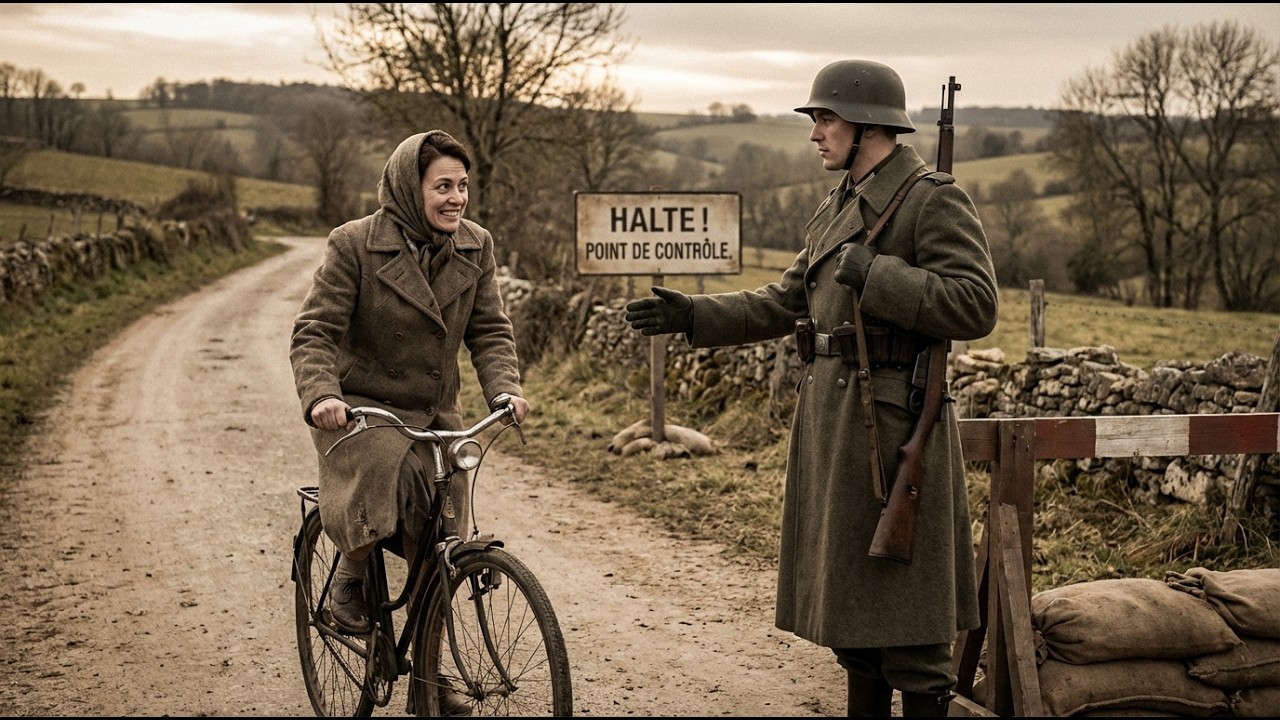
She smiled and gave a small wave. He waved back. She kept pedalling. The Gestapo had been hunting her for two years.
They had a name for her: the White Mouse. They had five million francs on her head. And on that afternoon, the most wanted woman in Nazi-occupied France cycled past their checkpoint, smiled at their soldier, and kept going. She had been riding for over sixty hours.
She still had hundreds of kilometres ahead of her, and if she stopped, if she was caught, thousands of people would die. She was thirty-two years old, and she was hiding in plain sight on a borrowed bicycle. Nancy Wake was born on August 30th, 1912, in Roseneath, New Zealand. Her father left the family when she was two years old.
She grew up poor in Sydney, Australia, raised by a struggling mother and a family that had nothing much except each other. From the beginning, she was the kind of person who did not wait for permission. At sixteen, she inherited £200 from an aunt, packed a bag, and left home. She worked as a nurse, then as a journalist.
By 1933, at twenty years old, she had made her way to Europe as a freelance correspondent, covering a continent that was beginning to change in ways that made serious people nervous. In 1933, she was in Vienna. Walking through the city one afternoon, she came across a scene she would never forget. Men from the SA, Hitler’s Stormtroopers, were beating Jewish men in the street.
Not quietly, not in some hidden place. In the open, in daylight, with crowds of people standing and watching. Some looked uncomfortable. No one moved.
Nancy stood there and watched a man be humiliated and beaten in front of his neighbours, and she felt something harden inside her that never softened again. She wrote in her notebook that evening: “I decided then and there that if I ever could, I would do anything in my power to make war on this thing. ”
She meant it. She just did not yet know what it would cost her.
Over the following years, Nancy built a life in France. She became a respected journalist, covered the rise of fascism across Europe, interviewed politicians, and drank with diplomats. In 1939, she married Henri Fiocca, a wealthy French industrialist—charming, successful, completely devoted to her. They lived in Marseille.
There were dinner parties and champagne and long summers, the kind of life that felt, for a moment, like it might last. On September 3rd, 1939, France declared war on Germany. Nancy volunteered as an ambulance driver. In June 1940, the German army entered Paris.
France signed the armistice. The life she and Henri had built ended in a weekend. Nancy did not wait to be recruited. She recruited herself.
She started hiding Allied soldiers who had been shot down or left behind, sheltering them in safe houses, forging documents, organizing routes through the Pyrenees into Spain. She did it on foot in winter through mountain passes. She used her glamour as cover—elegant dresses, easy French, a glass of wine at the checkpoint, and a joke for the guard on duty. Over two and a half years, she helped nearly two thousand people escape Nazi-occupied France.
Not one of them was captured while in her care. The Gestapo began to notice. By 1942, they had identified her network. They gave her the code name the White Mouse because she always slipped away.
Every trap, every sweep, every operation to catch her ended with nothing. They raised the reward to five million francs, more than they were offering for most Allied generals. Nancy kept moving. By early 1943, the network was too compromised to continue.
She had to run. She crossed the Pyrenees on foot, alone, in winter, and made it to Spain. Henri stayed behind. He told her it would draw less attention if he did not leave with her.
They would find each other after the war. She believed him. She had no reason not to. What Nancy did not know, and would not know for a long time, was what happened after she left.
The Gestapo came for Henri. They had questions. Specifically: where was she? Henri Fiocca knew exactly where his wife was going, who was helping her, and how to find her.
He said nothing. Not a word. Not under questioning, not under anything the Gestapo did to him in the weeks and months that followed. He protected her completely until the end.
Nancy was already in England by then, sending messages to Marseille that went unanswered, asking contacts if they had news, getting nothing back. The SOE, British Special Operations, said they didn’t know anything—or they didn’t say. She kept going. Now, here is what the opening of this story did not tell you.
When you picture Nancy Wake cycling alone down a French road, you might picture a courier, someone carrying a message, running a small errand. That is not what this was. By the time she got on that bicycle, Nancy Wake had already spent three years running one of the most effective escape networks in southern France. She had helped nearly two thousand people survive.
She had been recruited, trained, and deployed by British intelligence as a fully operational special operations agent. She had learned combat, explosives, parachuting, weapons, and codes. She had parachuted back into occupied France in the middle of the night. And she was the coordinating officer for a guerrilla army of seven thousand men operating in the mountains of the Auvergne.
Seven thousand men. She was their commanding officer. When Nancy arrived in England in 1943, the SOE moved quickly. They already knew who she was; they had been watching her network for some time.
Training was immediate and intensive. Her instructors wrote about her in terms that do not appear in many personnel files. One noted that she could drink most men under the table, shot better than the majority of her cohort, and showed an absolute absence of fear that was, in their assessment, either remarkable or concerning, depending on how you looked at it. On April 29th, 1944, Nancy parachuted back into France in the dark.
The drop zone was a field in the middle of the night. She landed in a tree and hung there in her harness, tangled in the branches, unable to get down. A French maquisard named Henri Tardivat ran over and started working to free her. While he untangled the straps, he looked up and said, “I hope all the trees in France bear such beautiful fruit tonight.
”
Nancy looked down at him. “Don’t give me that French nonsense. Undo these straps. ”
She was back.
She was assigned to coordinate Maquis resistance groups in the Auvergne, the mountain region of central France: seven thousand guerrilla fighters scattered across remote terrain, waiting for direction. The men—veterans, farmers, former soldiers—were not accustomed to taking orders from a woman. That lasted about a week. She went on every operation herself.
She drank with them at night and outran them in the field. Within days, the question of her gender had stopped being a subject of conversation. In a planning meeting, a veteran maquisard looked at the route she had marked on the map and said, “Madam, with respect, this route passes through three German checkpoints. ”
Nancy did not look up from the map.
“I know. I came through all three of them this morning. ”
A pause. “We leave at midnight.
”
The operations continued through spring and into summer: sabotage of railway lines, ammunition depots, communication infrastructure. Nancy was in the field for every one of them. Then, during a night assault on a Gestapo garrison at Montluçon, the situation shifted. The attack was going well; the garrison was being overrun.
In a side corridor, Nancy came across a German sentry who had been separated from the others. Using a weapon would have made noise and alerted the remaining guards. Nancy had been trained in silent combat at SOE. She used what she had learned.
The sentry was dead in seconds. She moved on. When someone asked her about it afterward—how she had done it, whether she had hesitated—she considered the question for a moment. “They taught us in training, but I was surprised to find it worked.
” A pause. “My answer is, if I had to, I had to. ”
She said it the same way she might have described a flat tyre. In June 1944, the Germans launched a major offensive against the Maquis strongholds in the Auvergne.
On June 10th, the main attack hit Mont Mouchet. By June 20th, the guerrillas were surrounded and forced to retreat 150 kilometres through the mountains in three days under constant pressure, with casualties. In the chaos of the retreat, Denis Rake, the SOE radio operator assigned to Nancy’s unit, lost the radio. Worse, he burned the codebooks to keep them out of German hands.
The right decision tactically, but it meant the unit was now completely cut off from London. No communication, no confirmation. The next supply drop—weapons, food, ammunition for seven thousand people—could not be coordinated. The nearest SOE operator with a functioning set of codes was in Châteauroux, approximately 500 kilometres away.
There were no vehicles available. German patrols were stopping cars on every major road. A woman alone on a bicycle was less visible than almost anything else moving through occupied France. Nancy looked at the map.
She looked at the team. “I’ll go. ”
Someone asked why her and not one of the men. “A woman cycling alone is less suspicious.
And because I’m faster. ”
She borrowed a bicycle. It was not even hers. And she left alone, with false documents and civilian clothes.
The first forty kilometres, she later said, her legs felt like hot lead. But she could not show effort, could not show urgency. At every German checkpoint, she slowed to a normal pace, smiled, answered questions in fluent French—a housewife going to the village, just passing through. She rode through the day and into the night, resting for short stretches in fields off the road, eating almost nothing.
At the tensest checkpoint, a German soldier took her documents and studied them for ninety seconds. Ninety seconds. He handed them back. “Bonjour, madame.
”
She smiled. She kept pedalling. Seventy-two hours after she left, she arrived in Châteauroux. Her hands were blistered.
Her legs were shaking. She could barely stand when she got off the bicycle. She found the SOE operator. She updated London.
She obtained the new codes. And while she was waiting for confirmation to come through, the operator said he had received a message from Marseille about Henri Fiocca. Nancy stopped. Henri had been arrested by the Gestapo months after her escape.
They had questioned him. He had said nothing about where she was, who was helping her, or how to find her. Not one word. Not under anything they did to him.
He had protected her completely to the end. He had been executed. Nancy sat with that for a long time. The man who had told her to go, who had stayed behind so her escape would be less conspicuous, who had been arrested and tortured and killed while she was in England training, while she was parachuting into fields, while she was cycling through checkpoints and planning operations and leading seven thousand men through the mountains of France.
He had died so she could keep going, and she had not known. For all of it, she had not known. She stood up. She took the new codes.
She walked outside. She picked up the bicycle. “I have to get back. Seven thousand people are waiting.
”
She cycled 500 kilometres back through occupied France alone, with that news inside her, and she did not stop once. When she returned to the Auvergne, she told no one. Contact with London was restored. The supply drop was confirmed.
Weapons, food, and ammunition arrived by parachute. Seven thousand men continued the fight. Nancy coordinated operations, crossed forests, sat in planning sessions, and kept the weight of what she knew entirely to herself. The liberation came.
On August 25th, 1944, Paris was freed. The south of France followed in the weeks after. The Germans retreated. The resistance emerged from the shadows.
Nancy Wake was thirty-two years old and standing in a country she had spent years helping to save. “The liberation was everything I had worked for,” she said later, “and the most painful day of my life. ”
After the war, she returned to Marseille for the first time since her escape. She went to the house where she and Henri had lived.
She confirmed everything the radio operator had told her. Henri Fiocca had been arrested months after she crossed the Pyrenees. He had never said a word. He had been killed while Nancy was still fighting.
She had not known, not through any of it. “He died so I could keep going,” she said, “and I didn’t even know. ”
The decorations came. Nancy Wake became the most decorated servicewoman of the Second World War, honoured by three separate countries.
From Britain: the George Medal and the MBE. From France: the Légion d’Honneur, the Croix de Guerre three times, and the Médaille de la Résistance. From the United States: the Medal of Freedom. In 1987, Australia added the Companion of the Order of Australia.
She tried to rebuild her life. Marseille was impossible—too much of Henri in every street. She moved to London and attempted a political career; it did not take. She married a British RAF officer.
It lasted years, but it was not what she and Henri had been. She moved between London and Australia for decades, refusing film deals and book offers with the same stubbornness she had brought to everything else. “My story is mine. ”
In the 1980s, she finally authorized a biography.
The book, called The White Mouse, became a bestseller. In one of her last major interviews, a reporter asked whether she had any regrets. Nancy thought about it for a moment. “My only regret is not killing more of them.
” A pause. “And not being able to say goodbye to Henri. ”
She died on August 7th, 2011, in Kingston upon Thames, London, at ninety-eight years old. She had asked that her ashes be scattered over the mountains of the Auvergne—the place where she had led seven thousand men, where she had returned from 500 kilometres of cycling with the worst news of her life, where she had kept going anyway.
The request was honoured. Nancy Wake saw a man being beaten on a street in Vienna in 1933. She was twenty years old. She was a foreign reporter.
She had every practical reason to walk away, write the story, and move on. Instead, she wrote a sentence in a notebook: anything in my power. She spent the next twelve years finding out what that meant. It meant two thousand people through the Pyrenees.
It meant seven thousand men in the mountains. It meant 500 kilometres on a borrowed bicycle with a dead husband’s secret in her chest, pedalling back to the people who needed her. It meant asking to be buried in the place where she had honoured her promise, because that was where she had been most alive. The White Mouse.
The most wanted woman in Nazi-occupied France. And the one they never caught.
