A frozen tree line, Eastern Front, 1944. Somewhere in that white silence, a Soviet sniper just ended a life from five hundred meters. The Germans called her the unseen terror of East Prussia. Her own commanders called her reckless, insubordinate, too emotional for combat.
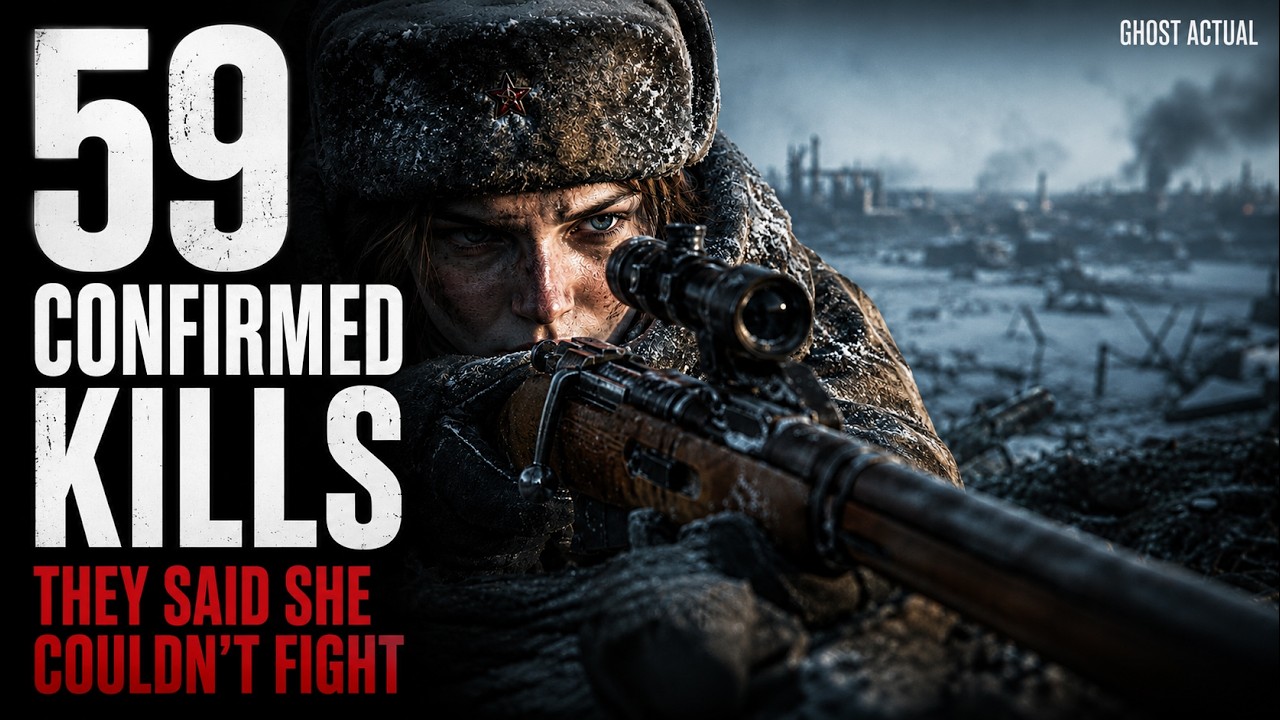
She was nineteen years old, and by the time the war ended she had fifty-nine confirmed kills—more than most men who survived the entire Eastern Front. This is the story of Roza Shanina, the sniper they tried to stop, the soldier they couldn’t contain, and the woman who proved every single one of them wrong. To understand Roza Shanina, you have to understand the world she was born into. The year was 1924, the place a small village called Edma, deep in the Arkhangelsk region of northern Russia.
Not a town, not even close—a cluster of wooden houses swallowed by forest so dense that winter lasted six months and the nearest city felt like another country. Her father, Yegor, was a dairy farmer. Her mother, Anna, raised six children in a house with no running water and no central heating. Roza was the third child.
Quiet, stubborn, and from the very beginning completely unwilling to accept what people told her she couldn’t do. At age six, she watched her older brother leave for school in the city. Girls in villages like Edma weren’t expected to follow. They were expected to stay, marry young, and work the land.
Roza walked two hundred kilometers to Arkhangelsk alone at age six to enroll in school. Let that land for a moment. Six years old. Two hundred kilometers on foot, through the same forest that swallowed grown men in winter.
That single act tells you everything you need to know about who Roza Shanina was, and why no colonel, no commander, and no institution was ever going to tell her what she was capable of. By the time Roza was seventeen, the world had changed forever. June 22, 1941. Operation Barbarossa.
Nazi Germany launched the largest military invasion in human history—three million soldiers pouring across the Soviet border on a front stretching 2,900 kilometers. It was an assault so massive, so sudden, that the Soviet military barely had time to breathe before entire divisions were encircled and destroyed. Within weeks, the Germans had captured more Soviet soldiers than any army had ever captured in history. Cities were falling, towns were burning, and the losses were unlike anything the modern world had seen.
By the end of 1941, the Soviet Union had lost an estimated 4. 3 million soldiers—dead, wounded, or captured—in six months. Every family in the Soviet Union felt it. Every village, every house.
Roza’s family was no different. Her brother Fyodor, the same brother she had followed to the city all those years ago, was killed in action in 1941. She was seventeen when she found out. And from that moment, the question was never if she would fight.
The question was how fast she could get there. Here is where the story gets complicated and infuriating. Roza went to the military enlistment office in 1941 and volunteered. She was turned away.
Too young. She went back in 1942. She was turned away again. Women were not being accepted for combat roles.
This was the official position of the Soviet military in 1942. Despite the fact that the USSR was hemorrhaging soldiers at a rate no military could sustain. Despite the fact that cities like Leningrad were under siege. Despite the fact that the army needed bodies.
Despite all of that, the institutional position was clear. Women fight at home. Men fight at the front. Roza’s response to this was characteristically direct.
She enrolled in a military training program through the Komsomol, the Soviet youth organization, specifically because it gave her access to weapons training. She wasn’t going to wait for permission. She was going to make herself impossible to turn away. She spent months training.
Rifle drills, accuracy exercises, learning to read wind, distance, breath control—the technical discipline of marksmanship that most soldiers spend years developing. She compressed it into months through obsessive, relentless practice. And then the Central Women’s School for Sniper Training opened in 1943. The Soviet military, finally broken by the scale of their losses, had made a decision.
Women would be trained as snipers. Not in front-line infantry roles, not in command positions, but behind a rifle at a distance. That, apparently, was acceptable. Roza didn’t care about the politics of it.
She had her door. She walked straight through it. The Central Women’s School for Sniper Training in Veshnyaki, outside Moscow, was not a gentle institution. The women who arrived there in 1943 came from every corner of the Soviet Union.
Factory workers, students, farm girls, teachers—all of them volunteers, all of them burning with the same motivation. Brothers, fathers, husbands lost to the war machine rolling west to east. The training was brutal by design. Physical conditioning, twenty-kilometer marches in full kit through Russian winter.
Camouflage and concealment, how to disappear into terrain so completely that a man standing three meters from you sees nothing. Patience drills that lasted hours, because a sniper’s greatest weapon isn’t the rifle. It’s the ability to wait, completely still, completely silent, for however long it takes. Roza excelled at all of it.
But what set her apart—what her instructors noted from the very beginning—was her shooting. The Mosin-Nagant rifle, the standard Soviet sniper weapon, was a bolt-action with an effective range in skilled hands of around eight hundred meters. In Roza’s hands, it was something else entirely. She had what veteran marksmen call a natural cold bore.
Her very first shot of any session, before the barrel warmed, before she had found her rhythm, was consistently hitting targets that other trainees were missing by meters. Her instructors flagged her. Not with praise—with suspicion. In an institution full of women the military establishment hadn’t wanted to train in the first place, standing out too much was its own kind of danger.
She graduated in April 1944, assigned to the 184th Rifle Division. She was nineteen years old, and she was finally going to war. The Eastern Front in 1944 was not what it had been in 1941. The tide had turned—slowly, painfully, at catastrophic human cost, but turned.
The Red Army was pushing west now, through Belarus, through Ukraine, through territory the Germans had held for three years. But pushing west makes it sound clean. It wasn’t. It was grinding, brutal, attritional warfare across frozen landscapes where the weather itself was trying to kill you.
Where artillery barrages lasted days. Where a sniper—patient, invisible, precise—could change the psychological balance of an entire sector. Roza’s first confirmed kill came in April 1944, shortly after her deployment. There is no dramatic account of that first shot, no famous record of how she felt.
What we know is that she logged it, reported it through the proper channels, and went back to her position the next morning. That discipline—the logging, the reporting, the return—was something her commanders noticed immediately. A sniper who performs once is interesting. A sniper who performs consistently, who treats each day as a professional engagement rather than an emotional crusade, is valuable.
Within her first month on the front, Roza had accumulated kills at a rate that was drawing attention up the chain of command. And not all of it was positive attention. Here is where the story earns its place. Roza’s growing reputation on the front ran directly into a wall.
Not a German wall—a Soviet one. Senior officers within her division who had never wanted women in combat roles to begin with watched her numbers climb with something between discomfort and outright hostility. The specific friction point was her operating style. Most snipers of the era operated in fixed positions.
Find a good hide, exploit it over multiple days, extract carefully. Safe, methodical, predictable. Roza operated differently. She preferred what she called mobile hunting—moving between positions, never staying long enough to be countered, sometimes advancing forward of the main line to find angles other snipers wouldn’t dare take.
It was tactically brilliant. It was also against regulations, and it terrified her commanding officers. Not because it didn’t work, but because it worked too well and exposed her to risks they hadn’t authorized. One colonel—his name not recorded in detail in the Soviet archives, referred to in her diary only as “the Colonel”—confronted her directly.
She had advanced beyond her authorized perimeter and taken three kills in a single afternoon from a position she had no business being in. His exact words, as she recorded them: “Women are not built for this. You will get yourself killed and create a problem for this division. ”
Her response was not recorded.
But the next morning she went back out. She took two more kills before noon. The colonel escalated. She was to be reassigned, pulled from front-line sniper duty, given a support role.
And then her numbers hit the record books, and everything changed. By mid-1944, Roza Shanina had become something the Soviet military propaganda machine couldn’t ignore, even if it wanted to. Her confirmed kill count was climbing through the thirties, the forties. Each confirmation required corroboration—a second witness or physical evidence.
These weren’t estimated kills. Every single one was verified. The Soviet press found her. Unichtozheniya.
The word means “annihilation. ” It was the headline framing used in a major Soviet newspaper article that ran in 1944, “The Unnoticeable Terror”—describing a sniper on the Eastern Front whose accuracy and aggression was unlike anything her peers displayed. The article ran with her photograph: a young woman, rifle in hand, looking directly at the camera with an expression that wasn’t pride or aggression, just calm. Complete, unnerving calm.
The article was a propaganda gift for the Soviet war effort. Here was proof—visual, documented, named—that the USSR’s commitment to the war crossed every boundary, every person, every background. But for Roza, the publicity was a double-edged weapon. It made her untouchable from reassignment.
You couldn’t quietly sideline someone the national press had just featured. But it also made her a target. Not just for German counter-snipers, who now knew her general sector, but for resentment within her own ranks. She wrote about it in her diary, a document that survived the war and remains one of the most extraordinary first-person accounts of sniper warfare ever recorded.
“They look at my numbers and see a problem to be explained away,” she wrote. “I look at my numbers and see my brother. ”
The diary is where Roza Shanina becomes fully three-dimensional. Because the image the Soviet press sold—the fearless, coldly efficient killing machine—was real, but it was only one layer.
In her diary, she wrote about fear. About nights lying in her hide listening to artillery, wondering if the shell with her coordinates was already airborne. About the specific grief of losing sniper partners—women she had trained with, eaten with, covered for, lost to counter-sniper fire or artillery. She wrote about loneliness.
About the strange isolation of being celebrated publicly while being resented privately. About men in her own division who would not make eye contact with her because her kill count exceeded theirs by a magnitude that made conversation uncomfortable. She wrote about the moral weight of what she was doing. Not guilt—she never expressed guilt, and the context of what Nazi Germany was doing in the occupied Soviet territories makes that entirely understandable.
But the awareness that each mark in her logbook had been a person. “I don’t know what I will do after the war,” she wrote. “I only know how to do this now. I hope there is something else I am good at.
I would like to find out. ”
She was twenty years old when she wrote that. January 1945. East Prussia.
The final push toward Berlin was building momentum. Roza Shanina, now a senior sergeant, was still at the front. Still hunting. Still filing kill confirmations that by this point had reached fifty-nine verified.
On January 27, 1945—the same day Soviet forces liberated Auschwitz—Roza was caught in an artillery bombardment while protecting a wounded officer. She absorbed shrapnel wounds to her chest. She was evacuated. Field surgery.
She survived the initial treatment, but the wounds were severe. She was moved to a field hospital behind the lines. She died on January 28, 1945. She was twenty years old.
The war in Europe would end ninety-nine days later. Fifty-nine confirmed kills. Verified, documented, on the most brutal front of the most brutal war in human history. Against the opposition of commanders who didn’t want her there.
Against an institution that turned her away twice before it finally let her in. Against a system that celebrated her publicly while trying to contain her privately. The colonel said she would create a problem for the division. He was right.
Just not the kind of problem he meant. Roza Shanina’s diary was published after the war. She was awarded the Order of Glory, one of the Soviet Union’s highest military honors. Streets in Russia bear her name.
A monument stands in Arkhangelsk. But the real legacy isn’t the monument. It’s the diary.
The calm, precise, honest record of a twenty-year-old girl from a forest village who walked two hundred kilometers to go to school—and then walked through every door the world tried to close in her face.
