In 1782, a man digging in the ruins of a Gloucestershire chapel struck lead two feet down and cut it open with a knife. The woman inside had been dead for 234 years. Her skin was still white, still soft, still moist to the touch. Six women married Henry VIII.
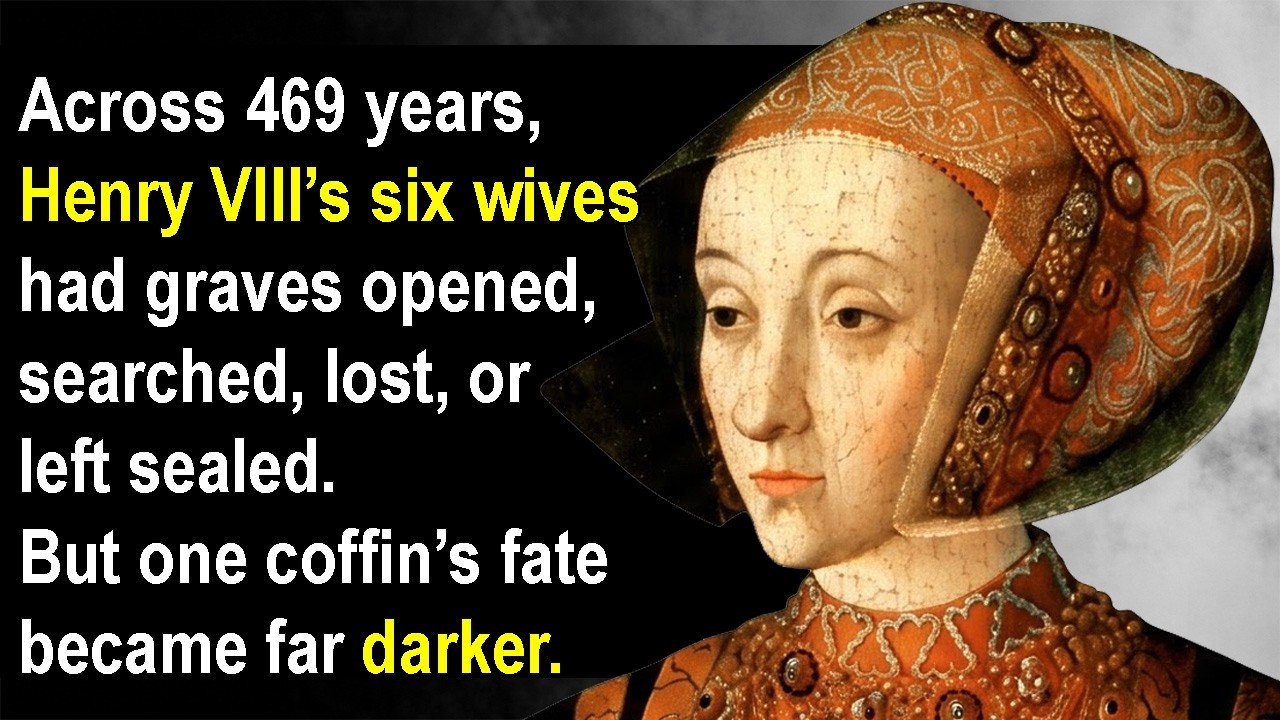
What was done to them in life is common knowledge. What was done to their bodies afterwards is not. And not one of these six graves was left to fate. Every one of them was decided by strangers with a shovel, including the ones who decided to walk away.
Divorced, beheaded, died. Divorced, beheaded, survived. That rhyme covers the marriages. It says nothing about the four and a half centuries that followed, when six bodies were left to the mercy of soldiers, builders, antiquarians, royal physicians, and, if the local accounts are true, a party of drunks with a crowbar.
These graves have not aged equally. One has never been touched in 469 years. One was searched with total precision and produced nothing whatsoever. One was opened by a candle maker within a day of death.
And one was opened so many times that it disintegrated in front of the people opening it. What follows is ranked by exactly that, by how completely each woman’s body was surrendered to the curiosity of people who came long after her. It starts with the queen nobody has ever disturbed. Number six, Anne of Cleves.
She arrived from Düsseldorf in the winter of 1539, married Henry in January 1540, and was annulled by July, six months start to finish. Henry complained that the portrait had been generous. She agreed to the annulment almost immediately, which turned out to be the single smartest decision any of the six ever made. She was given Richmond Palace, Hever Castle, Anne Boleyn’s childhood home, which is a genuinely brutal piece of estate management, and the official rank of the king’s beloved sister.
Then she simply outlived everyone. Henry, Jane, Katherine Howard, Katherine Parr, Edward VI. She died at Chelsea on the 16th of July 1557, aged 41, in the reign of Mary I, and was buried on the 4th of August with a full Catholic requiem in Westminster Abbey. She is the only one of the six who lies there.
Her tomb sits on the south side of the high altar, a low block of dark stone carved with skulls and crossed bones and the initials AC. By most accounts, the monument was never finished. Thousands of people walk past it every day without noticing it is there. And that is the entire record of her grave.
No exhumation, no examination, no Victorian restorer lifting the pavement, no physician with a notebook, no antiquarian with a knife. In 469 years, not one person has looked inside. The wife Henry found so disappointing he could not force himself through the wedding night ended up with the best address of the six and the only resting place in England that nobody has ever thought worth opening. Anne of Cleves was left alone out of something like respect.
The next queen was opened before her body was cold, and not by a doctor. Number five, Catherine of Aragon. Spanish princess, Henry’s wife for 24 years, mother of Mary, and the woman who refused to accept the annulment for the rest of her life. By the end she was confined at Kimbolton Castle in the Cambridgeshire fens, cut off from her daughter, still signing herself queen.
She died there on the 7th of January 1536, aged 50. Within about a day, her body was opened, not by a royal physician, but by the household chandler, the man who made the candles in a remote house in January. He was the one who did the embalming, and that is how the only internal examination ever made of Catherine of Aragon came to be performed by a tradesman. His findings were passed on by her servants and reported to her confessor.
Every organ sound and healthy, he said, except the heart. The heart was black, with a black growth clinging to the outside, and when they washed it, it stayed black. That account survives secondhand, and it detonated instantly. Poison.
Anne Boleyn’s name in every whisper. Some modern historians read the description as a cancer, a melanotic sarcoma, a tumor on the heart itself. We will likely never know which. She was buried on the 29th of January 1536 at Peterborough Abbey as Dowager Princess of Wales, the title she had rejected to her last hour.
Henry reportedly promised her a goodly monument. It was never built. In 1643, Parliamentarian soldiers sacked the cathedral, smashed the windows, and tore out the monuments, and the hearse and marker over her grave went with them, though the burial beneath is believed to have survived intact. Around 1890, work near the site reportedly exposed the lead coffin with the outline of a body pressed visibly through the metal.
Nobody opened it. Since 1895, she has lain under a slab paid for by ordinary English women named Catherine. So the only human being who ever saw inside her was a candle maker in a Fenland house, and 490 years later his description is still being used to accuse a king of murder. Catherine of Aragon at least has a grave that can be stood on.
The fifth wife’s is an educated guess. Number four, Katherine Howard. The Duke of Norfolk’s niece, installed at court while the Cleves marriage was collapsing, married to Henry within weeks of the annulment. She was perhaps 17.
Her birth year was never recorded, which means that even now her age is an estimate. She was somewhere between 18 and 21 when she was condemned by act of attainder and executed on Tower Green on the 13th of February 1542. According to the imperial ambassador, she asked for the block to be brought to her room the night before so she could practice placing her head on it. She was buried in the chancel of St Peter ad Vincula, close to Anne Boleyn, and there the record sat for 334 years, until Queen Victoria ordered the chapel restored.
Between 1876 and 1877, the pavement was lifted and the burials beneath were investigated systematically, with the results published in an official account by Doyne C. Bell. This was not treasure hunting. Every recorded burial place was opened, the contents described, the remains reinterred under named markers.
They went to the spot where Catherine Howard was recorded as lying. There was nothing there. No coffin, no chest, no bones that could be attributed to her by any measure. The explanation offered at the time was her youth and the possibility that quicklime had been used at the burial, though that is a Victorian inference, not a documented fact.
The likelier answer is duller and worse. She was pushed under the floor of a small chapel that was then used for three centuries of further burials, rebuilt, repaved, and dug into repeatedly, and at some point in all of that, she was simply scattered. Today her name is carved on the chapel wall among the dead of the Tower. It marks a place, not a person.
The most thorough search ever conducted for the body of a Tudor queen ended with an empty patch of floor. The Tower’s pavement came up in 1876. Sixty-three years earlier, another royal floor had come up at Windsor, and that one was crowded. Number three, Jane Seymour.
She married Henry on the 30th of May 1536, eleven days after Anne Boleyn’s execution. On the 12th of October 1537, she gave him Edward. Twelve days later, on the 24th of October, she was dead at around 29, almost certainly of infection or hemorrhage following the birth. Henry mourned her for the rest of his life, in the sense that he described her as his true wife and then married three more people.
She was buried on the 12th of November 1537 in a vault beneath the choir of St George’s Chapel, and in 1547 Henry was lowered in beside her. She is the only wife he chose to lie with. There is a famous story that his coffin split open on the journey to Windsor and that dogs were found at it in the morning. A chilling piece of poetic justice, first written down decades later by hostile pens and treated with heavy caution by historians ever since.
But in 1813, something was found in that vault, and this part is documented in detail. Workmen cutting a passage for a new royal tomb house broke through into the space by accident. The Prince Regent came down personally with Sir Henry Halford, the royal physician. They had come for Charles I, whose burial place had been lost since 1649.
They found him. They also found Henry VIII, and the state of his coffin was grim. The wooden shell decayed, the lead split open, part of the skeleton exposed to the air, with some hair reportedly still on the chin. Charles the First’s coffin was opened deliberately.
Halford lifted the severed head out, examined the cut through the neck, and compared the face to the portraits. According to the story repeated ever since, he pocketed a vertebra as a keepsake and used it at his dinner table for years before it was finally returned and reinterred in 1888. And Jane Seymour’s coffin lay right there beside them, identified, intact, undamaged, the only whole coffin in the vault. They left it completely alone.
The queen Henry called his only true wife, the one who died producing the heir, the one whose funeral he staged as the grandest of the reign, was the one object in that room that a group of men who had climbed into a royal tomb specifically to open coffins found no reason to touch. Jane Seymour’s coffin survived because somebody chose not to open it. Anne Boleyn’s remains survived four centuries with no coffin at all. Number two, Anne Boleyn.
She was executed on the morning of the 19th of May 1536 by a swordsman brought over from Calais, a man who had to be booked and travel across the channel before the trial concluded, which tells you everything about how uncertain the verdict was. Reportedly, she made a joke about it, saying she had heard the executioner was good and adding that she had a little neck. Nothing had been prepared for her afterwards. No coffin, no grave dug, no arrangements of any kind.
Her ladies carried the body and the head themselves. The remains were put into a chest, by most accounts an old elm chest that had been used for storing arrows, and pushed into the ground under the chancel floor of St Peter ad Vincula, a few feet from where she had been standing an hour earlier. For 340 years, that was the whole of it. And into that silence came the storytellers.
In 1585, Nicholas Sander, a Catholic exile who was a child when she died and never laid eyes on her, published a description that turned her into a physical monster. A sixth finger on one hand, a growth under her chin, a projecting tooth. It was propaganda written half a century after the fact by a man with an obvious motive, and it has been repeated in books, on television, and in classrooms ever since. Then in November 1876, the restorers lifted the pavement of the chapel, and in the exact spot that tradition had always marked, they found bones.
Dr Frederick Mouat examined them and recorded what he saw. A female skeleton, delicate build, a well-formed round skull, fine slender vertebrae in the neck, small hands, small feet. He estimated the age at between 25 and 30, which sits awkwardly with Anne, who was probably in her mid-thirties. And that gap is precisely why the identification remains highly probable rather than proven, because no DNA test has ever been carried out.
There was no sixth finger, no extra bone in either hand, no wen, no deformity, nothing abnormal recorded anywhere on the body. Three centuries of print describing a witch’s body answered in a single afternoon by a small ordinary set of female bones. They were sealed in a leaden casket and reinterred beneath a marble marker carved with her arms. The first proper grave she had ever been given, 340 years late.
Anne Boleyn was disturbed once, examined by a physician, written up in an official government report, and returned to the ground under marble. That is the careful end of this scale. At the other end is a woman who was opened by a curious local man with a pocketknife, and then opened again and again and again. Number one, Catherine Parr.
She is the survivor, the one who outlasted him. Nurse, stepmother, regent of England while Henry was at war, and the first English queen to publish a book under her own name. Henry died in January 1547. Within months, she married Thomas Seymour, the man she had wanted before the king intervened, and it went badly almost immediately.
On the 30th of August 1548, she gave birth to a daughter, Mary, at Sudeley Castle in Gloucestershire. She died six days later, on the 5th of September, aged 36, of what was almost certainly childbed fever. Her funeral was held in the chapel of St Mary at Sudeley two days later. It was conducted in English by Miles Coverdale, the first Protestant royal funeral England had ever seen.
And the chief mourner was a girl of about eleven who was living in the household. Her name was Jane Grey, and she had five years to live. Six months later, Thomas Seymour was executed for treason. The castle passed through hands, was slighted after the Civil War, and the chapel lost its roof.
By the eighteenth century, St Mary’s was a ruin with ivy growing through the walls and livestock in among the fallen stones, and the location of the grave had been completely forgotten. In 1782, a local man named John Lucas went digging in the ruins out of curiosity. About two feet down, his tools struck lead. What he had found was a coffin molded tightly to the shape of a body, with a plate fixed to the lid.
The lettering identified the occupant beyond any doubt: Catherine, Queen of England, wife to King Henry VIII and afterwards wife to the Lord Seymour of Sudeley. So Lucas cut a hole in the lead. Inside were layer upon layer of cerecloth, waxed linen bandaging wrapped six or seven times around the entire body, which is the reason for everything that follows. He peeled the wrapping back from one arm.
The flesh underneath was white and moist. The nails were still on the fingers. Two hundred and thirty-four years after her burial, Catherine Parr had a hand you could have shaken. He reportedly cut away a lock of her hair, closed the hole roughly, and filled the grave back in.
What Lucas had done, without the faintest idea of it, was let in the air. He came back. Others came with him. In 1784, the Reverend Treadway Nash examined the coffin and reported his findings to the Society of Antiquaries in London three years later.
And by then the picture had changed completely. The smell was overwhelming. The tissue had begun to break down. Ivy roots had grown down through the ground and into the coffin itself, threading through the woman inside it.
Nash ordered the grave properly closed and covered. It did not take. The accounts of the next few years vary in their details, but they agree on the shape of it. The coffin was opened at least twice more.
Relic hunters carried off hair and teeth, and around 1792, a group of local men, drunk by every telling, dug her up, disturbed the remains, and reinterred them carelessly, reportedly the wrong way up in the ground. In 1817, the grave was opened one final time and set right by the parish. Whatever had been done to her was undone as far as it could be. By that point, there was nothing left to preserve.
The white flesh, the intact hands, the features that had survived two and a half centuries sealed in lead, all of it was gone within thirty-five years of being found. She had come through the reign of Henry VIII, the Reformation, the Civil War, and the ruin of the chapel above her head. She did not survive being looked at. In 1863, the chapel was rebuilt and a new tomb raised over her, with a white marble effigy of a sleeping queen carved above the grave.
She is the only one of the six with a sculpted likeness lying over her actual remains. The best-treated monument in this entire story sits on top of the worst-treated body. And there is one more thing missing from that chapel. Mary Seymour, the baby whose birth killed her, was orphaned within six months and passed to a guardian who complained about the cost of keeping her.
She appears in the record for the last time around her second birthday. No death is recorded. No burial is recorded. Nothing.
The mother was dug up again and again for thirty-five years. The daughter was never found at all. Six graves and six verdicts.
So the only question left is whether the women who were opened, measured, and written up were finally given the truth they were denied in life, or whether the two who were never touched are the only ones who were ever really allowed to rest.
