The skull that came back round was the most thoroughly imaged royal skull in Egypt. Broad, short, ordinary, with a cephalic index of 83. 9—the measurement anthropologists use to describe a head that is wider than it is long. It is the exact opposite of the head that made this family famous.
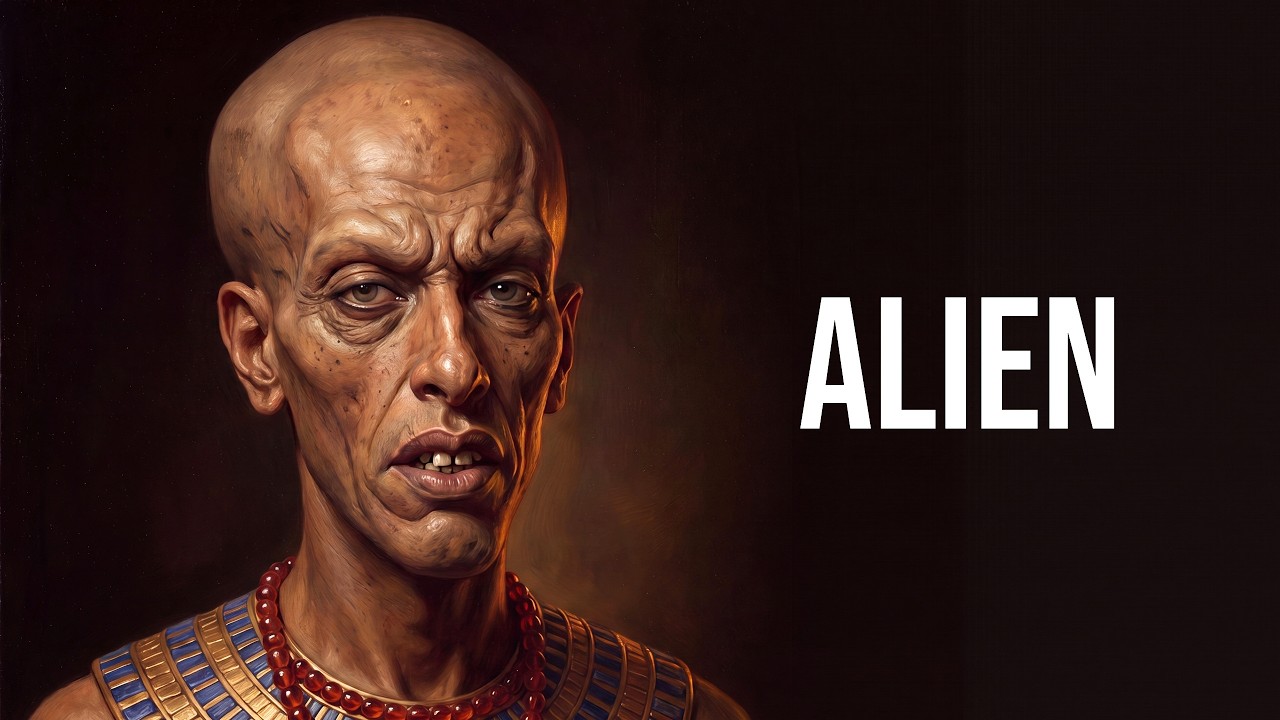
That skull belongs to Tutankhamun. The head you are picturing right now, the one with the sloping crown and the slit eyes and the chin like a garden trowel, belongs to the man reconstructed as his father, and it survives almost entirely in sandstone and limestone rather than in bone. Two men, two completely different categories of evidence, and a hundred years of people welding them into a single monster. So let me sort out which claims sit on a body and which claims sit on a statue, because almost every version of this story you have heard scrambles the two.
It starts in the 14th century BC at Karnak, where a young king called Amenhotep IV was building temples to a sun disk. Within roughly four years of taking the throne, he had reformulated the god’s official name, enclosed it in cartouches, and adopted an image nobody had used before: a disk with rays coming down, each ray ending in a small human hand. Around year five, he changed his own name to Akhenaten and founded a new capital in the desert—Akhetaten, the place archaeologists call Amarna—and marked its limits with boundary stelae cut into the cliffs. The art changed on the same schedule as the theology.
The Karnak colossi from those early years carry the harshest version of the new formula: slit eyes, a long swollen nose, a chin that droops, shoulders narrowed almost to nothing above a stomach that hangs low, and hips that flare out wide enough to look borrowed from a different body. Stand under one of those figures, and the proportions are not subtle. They were never meant to be. Colossal stature is viewed from below, and whoever designed these understood that.
Here is the first thing that ought to bother anyone who reaches for a diagnosis. Amenhotep IV did not look like that at the beginning. His earliest representations are comparatively conventional royal images. The extreme formula developed across the first years of the reign, arrived in force around year four, and then after the court moved to Amarna, softened again.
Later workshops produced faces and bodies that read as far more naturalistic. The Nefertiti bust belongs to that refined end of the range, and nobody looks at it and thinks endocrine disorder. A disease does not usually arrive in regnal year four, peak at Karnak, and then partially resolve itself in the sculpture of the same reign. A visual policy does exactly that.
The second problem is the family. Akhenaten and Nefertiti had six attested daughters: Meritaten, Meketaten, Ankhesenpaaten, Neferneferuaten Tasherit, Neferure, and Setepenre. All of them get the same treatment in the reliefs—elongated heads, narrow torsos, that low protruding belly, those soft tapering limbs. So does Nefertiti.
So in diluted form do courtiers who had no claim to royal blood at all. The daughters are documented unevenly. Ages, maternity, and deaths are mostly missing from the record. Meketaten’s death is represented in the royal tomb at Amarna in a scene that includes an infant, and whether that means she died in childbirth has been argued back and forth for decades without resolution.
People have tried to read that relief as clinical evidence of a hereditary disorder working through the family. It cannot carry that. A carving of a dead princess tells you the court was in mourning and that the mourning was rendered in the house style. It does not tell you what killed her.
That last detail dismantles the hereditary argument by itself. Nefertiti is not known to have been a blood relative of Akhenaten. If a shared genetic condition explains the elongated heads, it has to explain hers too, and it cannot. What does explain it is a workshop convention—a duller answer, and the one the evidence keeps landing on.
It helps to know what Egyptian royal images were for. They were functional and idealizing, and they always had been. A king could be shown eternally young in the fortieth year of his reign. He could be shown at four times the height of the enemies he was clubbing.
Proportion, scale, posture, costume, and attribute carried information about status and theology. They were not recording a sitting. Amarna art is more animated and more intimate than what came before—full of domestic scenes and open physical affection between the king and his family—and it still never stopped being official art produced in state workshops to state specifications. So what were the specifications?
Two explanations have serious support, and neither is provable because no Egyptian text survives saying here is why we render the king this way. The first is theological. The Aten was the self-generating creator, the source of all living things. A creator who generates without a partner is by definition both sexes at once.
A king presented as that god’s unique counterpart and offspring, with the royal family serving as the only channel through which the rays reach the world, might reasonably be given a body carrying male and female signals simultaneously: the wide fertile hips, the full chest, the male regalia, the male titles, none of them canceling the others. That reading fits the religious situation neatly. It is still a reading. The second explanation is blunter, and as a partial account, I find it more convincing.
Breaking the rules was the point. Egyptian royal imagery had been stable for centuries, which meant any deviation registered instantly with anyone who saw it. A king who looked nothing like the kings before him was legible at a glance as a king who had thrown out the old categories. Put that body at colossal scale, repeat it across temple after temple and courtyard after courtyard, and the strangeness becomes the argument.
Nobody standing under a Karnak colossus needed the theology explained to them. People have tried very hard to make it a disease anyway. The list of proposed diagnoses is genuinely long, and going through it is instructive, mostly as a study in how retrospective medicine goes wrong when the patient is a sculpture. The oldest version imagined that the king had been captured and castrated, which explained the wide hips and the soft chest and required inventing an entire biographical episode with nothing behind it.
A related idea held that Akhenaten was biologically female. A second had a female pharaoh hiding in a male king’s regalia. Both theories die on the same fact: the man fathered six daughters. That is not a detail you can wave through.
Froehlich’s syndrome came next—adiposogenital dystrophy. Attractive because it produces obesity and hypogonadism and could be squared with early descriptions of the KV55 skull. It typically causes infertility, which puts us back where we started. Klinefelter syndrome, the 47,XXY karyotype, fits a tall build with reduced musculature and breast development, but it also usually brings small testes and significant subfertility, and nobody has produced a chromosome from Akhenaten to test it against.
Complete androgen insensitivity is simply incompatible: it produces a female external phenotype in an XY individual, which is not what the regalia, the titles, or the paternity describe. The partial form survives slightly longer as an idea and then runs into the same fertility problem and the same absence of anything to examine. The most developed of these is the aromatase excess hypothesis argued in 2009 by Braverman, Redford, and Mackowiak in the Annals of Internal Medicine. Aromatase excess produces familial gynecomastia and a eunuchoid build, and it can produce early puberty in girls, which they connected to the apparently mature chests and hips given to the princesses in some scenes.
It is a clever argument. It is also extremely rare. Its usual onset pattern does not match a body shape that appears abruptly in year four of a reign. No endocrine tissue or genetic confirmation exists.
And Tutankhamun’s genitals were recorded as normally developed. The evidence base is art. That remains its weakness no matter how well the clinical reasoning is done. Marfan syndrome gets proposed constantly because of the long face and the long limbs.
Reported cephalic indices for both the KV55 skeleton and Tutankhamun are brachycephalic, not long-headed. No arachnodactyly. No characteristic long bone proportions. No craniosynostosis, and no way to assess the cardiovascular findings that actually define the condition.
Antley-Bixler syndrome and P450 deficiency were floated because premature suture fusion plus endocrine abnormality would elegantly unite the long skull and the feminized body in one package. CT found no premature suture closure in either skeleton. Hydrocephalus was proposed by early anatomists impressed by the cranium and abandoned once someone measured the endocranial volume and found it normal. Artificial cranial deformation is the one theory that at least has the virtue of not requiring a disease.
Deliberate head binding is well documented in other cultures, and the princesses in the reliefs have skulls that would be powerful evidence for it if a relief were evidence. There is no secure physical sign that this family bound infant heads, and the measured crania do not show the deformation binding produces. Acromegaly, on the strength of the chin: the jaw is not consistently enlarged from portrait to portrait, and there is no pituitary evidence to have an opinion about. Familial temporal lobe epilepsy, proposed in 2012 by Ashrafian, linking the early deaths in the dynasty to visions and religious intensity: no seizure descriptions survive, no diagnostic tissue exists, and treating a religious reform as a symptom is the kind of move that sounds sophisticated and proves nothing.
Then there is the fallback position that some unnamed hereditary syndrome we have not identified explains everything, which cannot be tested and therefore cannot be wrong, which is not a strength. And there is the ancient astronaut version, which requires ignoring measured human skull anatomy in favor of a relief carving. A medical review published in Cureus in 2025 by Turner and Schweiger worked through this catalog and concluded that the imagery was almost certainly a deliberate propagandistic choice rather than a reflection of an underlying condition. That agrees with what the 2010 CT work had already reported: neither Tutankhamun nor the KV55 candidate showed the bizarre feminized physique the Amarna sculptors carved.
Which brings us to the skeleton everyone keeps calling Akhenaten. Tomb KV55 was opened in 1907, and it is a mess. The coffin had deteriorated badly. The assemblage of Amarna-period material inside had been reused, altered, and attacked.
Royal names were hacked out. The face of the coffin was cut away. The coffin itself seems to have been made or adapted for a royal woman often connected with Kiya, then converted for a male king with the inscriptions and regalia altered to suit. The tomb records relocation and post-Amarna hatred with total clarity, and it does not name the man lying in it with any clarity whatsoever.
The remains are male. The 2010 genetic pedigree placed him as a son of Amenhotep III and Tiye, a full brother of another mummy known as the KV35 Younger Lady, and father of Tutankhamun. That narrows the field of historical candidates enormously without actually printing a name, and Smenkhkare, about whose parentage and age we know very little, cannot be excluded. Then there is the age fight, which has been running for sixty years and shows no sign of resolving.
Early anatomical assessments read the skeleton young. Harrison’s reassessment in 1966 argued that the bodily proportions sat within normal limits, which quietly removed the anatomical basis for several of the disease theories. Strouhal later put the biological age at roughly nineteen to twenty-two. A man of twenty-two cannot have reigned about seventeen years and fathered a family that size.
So if Strouhal is right, the skeleton is not Akhenaten and probably is Smenkhkare. The 2010 CT-based assessment came back at approximately thirty-five to forty-five, which makes the identification work comfortably. Later meta-analysis, including Harrich and colleagues in 2016, pointed out the obvious: age estimates from an incomplete, fragile skeleton are broad and heavily method-dependent, and this one has been treated as far more precise than it is. There is a further complication sitting underneath all the arithmetic: whether Akhenaten shared a substantial co-regency with Amenhotep III is itself disputed, and the answer moves how old he would have been at any given regnal year.
Age estimates are being checked against a chronology that is not nailed down. What the bones do say is unglamorous. Stature about 160 centimeters. A cephalic index of 81.
00, in the brachycephalic range. No premature suture closure anywhere in the skull. Mild spinal curvature, which several comparison mummies also show and which diagnoses nothing. A high arched palate reported in some assessments, with the terminology varying between reports.
Nothing establishing gynecomastia, nothing establishing a broad female pelvis, nothing establishing the eunuchoid limbs or the belly and hip formula of the colossi. The statues and the skeleton describe two different men, and only one of them ever existed in flesh. So what can be said without overreaching? That KV55 holds a male member of the late 18th Dynasty royal house who under the 2010 reconstruction fathered Tutankhamun.
That calling him Akhenaten is probable in most modern accounts and not proved. That he shows no extreme feminized or elongated body syndrome, which is a genuine finding and not a small one. And that he does not clear Akhenaten of every conceivable illness—only of the ones that would have left obvious marks on bone, which is a much narrower statement than it usually gets reported as. The DNA work published in JAMA in 2010 by Hawass and colleagues is where the story picks up its most quotable claim.
Using short tandem repeat markers, the team reconstructed a pedigree running from Yuya and Thuya buried in KV46, through their daughter Tiye identified as the KV35 Elder Lady, to Amenhotep III, and then to the KV55 male and the Younger Lady, who came out as full siblings and as the parents of the boy in KV62. Full siblings. That gives Tutankhamun an inbreeding coefficient of 0. 25, meaning that on average a quarter of his paired gene copies would be identical by descent.
What that raises is the probability that a rare recessive variant carried in the family shows up in two copies at once. It does not guarantee visible deformity, intellectual disability, infertility, or any particular disease. And the pop history habit of treating 0. 25 as a verdict rather than a probability is where most of the nonsense enters.
Two very small mummies were buried with him, generally interpreted as stillborn daughters. Earlier examinations put their gestational ages at roughly five months and somewhere between seven and nine, though the figures have moved between studies. The 2010 project tried to fit them into the pedigree and proposed KV21A as their mother, which would make her Ankhesenamun. That result was statistically weaker than the central pedigree, and it circulates with a confidence the data never earned.
Two dead infants in the tomb of a king who died at nineteen is a bleak fact by itself. It is not evidence that consanguinity was killing his children, however strongly the arithmetic invites you to draw that line. The pedigree also has critics with real standing. Loreille and Willerslev published a direct ancient DNA critique in JAMA the same year, focused on degradation, contamination, and the reliability of the markers used.
In 2011, Nature ran a piece by Merchant reporting a fieldwide split among ancient DNA specialists over the PCR fingerprinting approach, sample access, and the absence of the sequence data that would let anyone else check the work. There is a further wrinkle that critics keep raising and that deserves more attention than it gets: in a family that intermarried across generations, several different relationship configurations can produce similar genetic patterns. The pedigree is the strongest reconstruction available. It is not a birth certificate.
What happened after year seventeen is the messiest stretch of political history the dynasty produced. Akhenaten drops out of the record. A king called Smenkhkare appears. A ruler using the name Neferneferuaten appears.
The order in which they held power, whether they overlapped with Akhenaten, and how they related to Nefertiti and to each other are all still being fought over. Then a child called Tutankhaten took the throne, changed his name to Tutankhamun, restored Amun’s institutions, and shifted the royal center away from Amarna—which amounts to quietly canceling his father’s life’s work before his voice had finished breaking. He married Ankhesenpaaten, one of those daughters, who performed the same religious housekeeping on her own name and became Ankhesenamun. If the pedigree holds and the KV55 man was Akhenaten, Tutankhamun married his paternal half-sister.
If KV55 was a different royal male, that relationship changes into something else. The uncertainty about one damaged skeleton propagates outward through the entire family tree. Now, the body that actually exists. Tutankhamun was found in KV62 inside nested coffins inside a sarcophagus in his own inscribed tomb.
The identity is not in dispute. Dental eruption and skeletal maturity put him at roughly eighteen or nineteen when he died. Living stature was estimated at about 167 centimeters—a slight young man of thoroughly average height. Mild retrognathism of the lower jaw.
Prominent upper incisors. Dental traits consistent with the rest of the dynasty. A small cleft or high arch in the hard palate, which the internet has repeatedly upgraded into a cleft lip that the mummy simply does not have. Mild kyphoscoliosis with a Cobb angle reported under twenty degrees—a curve you would not necessarily notice in a living person walking past you.
None of that is a monster. The interesting material is below the ankle. The right foot shows a low longitudinal arch, plain flat foot. The JAMA authors specified that it was not the medial malleolar displacement typical of Marfan flatfoot, which was them closing a door rather than opening one.
The left foot is where the argument lives. It sits rotated inward, supinated, in a position the 2010 team read as a mild club foot, talipes equinovarus. James Gamble, an orthopedic surgeon, wrote back to JAMA and took that apart on anatomical grounds. True talipes equinovarus requires an equinus of the hindfoot and medial displacement of the navicular on the talus.
Gamble judged the published images to show a normal hindfoot and a normal talonavicular relationship and concluded that the foot was neither in equinus nor inverted and therefore was not a club foot. He is describing specific bones in specific alignments, which is a far harder claim to handwave than a general impression of a twisted foot. This does not mean the foot was fine. It was not fine.
The second and third metatarsals on the left are severely deformed, and the head of the second metatarsal has collapsed. The 2010 diagnosis was juvenile aseptic osteonecrosis, which they labeled Köhler disease 2 and which modern orthopedics more often calls Freiberg disease or Freiberg infraction. Osteonecrosis is bone death from interrupted blood supply. In a metatarsal head, it produces forefoot pain, swelling, stiffness, flattening of the bone, and altered weight bearing.
It hurts in a specific grinding-every-single-step way. Destructive changes in the surrounding bone raise the possibility of infection or osteomyelitis, though CT cannot tell you whether an infection was active at the moment of death. There is also a congenital anomaly in a second toe—a missing or underdeveloped middle phalanx, hypophalangism. Worth flagging that the 2010 article’s narrative, figures, and table are not consistent about which side this was on: an internal reporting problem the authors themselves left behind.
So the honest description is a deformed and diseased left foot: called club foot by the original team and disputed on anatomy by an orthopedic specialist, with a genuinely painful metatarsal lesion and a congenital toe defect underneath the argument. That is a real and unpleasant condition. It is not the crumpled, twisted body of the museum documentaries. The canes are the other pillar of the disability story, and they are weaker than they look.
More than 130 complete or fragmentary sticks, staves, and canes were recorded in KV62. Some show wear that has been read as use. The assemblage covers practical walking stick forms alongside ceremonial, symbolic, and prestige objects, and staffs were standard equipment for authority in Egypt. Volume proves fashion, not infirmity.
Combine the worn sticks with the metatarsal collapse, and real-life cane use becomes quite plausible. That is as far as the evidence reaches. Permanently crippled, chair bound, unable to stand: none of that is supported. And the wheelchair pharaoh image that circulated after 2010 was an invention of the coverage rather than the paper.
The seated hunting and archery scenes get pulled in as corroboration. Royal art is selective and ritualized, and a seated king can be seated for compositional or status reasons. The scenes only become suggestive once you already believe the foot finding. Same with the chariots.
Chariots and military equipment were part of kingship and part of the afterlife inventory, and their presence in the tomb documents an office, not an athletic hobby. A painful forefoot might well have made prolonged standing or running miserable without making a chariot impossible. Then he died at about nineteen in the ninth or tenth year of his reign and got a hurried burial. Cause unknown.
And the number of confident explanations offered over the past century is roughly inverse to the amount of evidence available. The murder theory came first and lasted longest. Earlier radiographs showed dense material and fragments inside the skull, which combined nicely with the political situation: a young king dead during a difficult restoration, Ay taking the throne and appearing in the tomb performing the opening of the mouth ritual, Horemheb later erasing and appropriating his predecessors. Excellent motive.
The high-resolution CT in 2005 found no lethal cranial fracture, and loose intracranial material is exactly what you would expect from embalming resin and postmortem breakage. The head blow theory is finished, and it deserved to be. Poisoning has never had anything behind it beyond the age of death and the atmosphere of the court. Embalming chemistry and contamination make retrospective toxicology close to hopeless.
The fracture is more interesting. There is a complex break of the left femur near the knee, classified in the JAMA paper as a type 33C3. No healing is present. Embalming resin appears inside the fracture, which is the strongest argument that the wound was open when the body reached the embalmer.
Before antibiotics, an open fracture of the distal femur is a plausible route to fatal infection, and a severe long bone break can also release marrow fat into the bloodstream and kill someone quickly. Both are real mechanisms. Neither can be demonstrated in this body. Resin can also penetrate a break created during handling, and postmortem excavation damage produces the same absence of healing that perimortem injury does.
The malaria result is where the 2010 paper made its biggest public splash. Plasmodium falciparum DNA fragments were reported in several of the mummies, Tutankhamun included. Detecting pathogen DNA establishes infection or exposure. It does not establish severity, and it certainly does not establish cause of death.
The study identified no cerebral malaria, no organ failure, no parasite load. Falciparum malaria kills people. It also fails to kill enormous numbers of people who carry it, particularly in an endemic environment where partial immunity is common. And the ancient DNA critics argued that short PCR products and microsatellite-style methods make authenticity and contamination extremely hard to assess, which applies to the pathogen result as much as to the pedigree.
Timmann and colleagues offered sickle cell disease as an alternative that would tie the osteonecrosis and the early death together in one package. It is a tidy hypothesis. No direct hemoglobin genotype was ever published to support it, and the metatarsal lesion is not specific enough to distinguish causes on its own. The chariot crash is the most cinematic version and the least defensible.
It leans on the fracture, the missing chest, and the military equipment, and reconstructs a one-sided high energy impact. The destruction of the torso and pelvis is largely postmortem or of undocumented timing, which means the central physical evidence for a crash is damage that we cannot date. There is no crash-specific injury pattern here. The drunk-driving refinement—in which a teenage king takes a chariot out after emptying some wine jars—has no blood chemistry, no witness, and no secure crash diagnosis behind it.
It is a media hypothesis wearing a lab coat. The hippopotamus attack theory rests on the absent heart and chest. Which brings us to the part of this story that actually explains most of the horror. Tutankhamun’s mummy was wrecked, and almost all of it happened after he was dead.
Start with the embalming. Enormous quantities of oils, resins, and unguents were poured over the body. They hardened. The mummy, the wrappings, the gold mask, and the inner coffin fused into one solid mass.
A chemical reaction trapped heat and moisture, carbonizing and degrading linen and tissue in a slow, self-heating process some researchers have described in the material itself. The evisceration was unusual, and the heart is absent, which probably reflects a hurried or ideologically distinctive embalming rather than a wound. The erect position of the penis and the blackened body have been read as deliberate Osiris regeneration symbolism, which is a reading of ritual, not of pathology. Resin inside the skull and body cavity also creates radiographic densities that a hopeful eye can turn into injuries.
Then 1925. Carter and Derry could not separate the body from the coffin. They tried sunlight and heat to soften the hardened resins, and it failed. So the mummy came out in sections.
The accounts describe chiseling through the hardened material, taking the head off with heated knives, disarticulating the limbs, and dividing the torso and pelvic region. The pieces were treated with paraffin and resin and reassembled on a tray of sand. The motivation was substantially the jewelry and the gold mask, which were bonded into the wrappings. By the 1968 X-ray examination, the mummy had deteriorated further.
The sternum, the anterior ribs, and the clavicular region were gone. Whether that was ancient robbery, the Carter-era work, later theft, or some combination has never been settled. Parts of the ears, digits, and wrappings were missing or displaced. The penis, described and photographed in the 1920s, had detached and was not visible in 1968; CT investigators later found a compatible structure lying in the sand beneath the body.
Loose vertebral fragments, a thumb, and other small bones were scattered in the same sand. Every reassembly changes joint positions. The posture of that famous left foot on a CT scan is a combination of congenital anatomy, disease, the position the embalmers put it in, and the way a group of men in 1925 put a dismembered body back together. Bony relationships remain useful.
External posture, much less so. When you see a claim that the chest destruction proves a crushing injury, or that the skull fragments prove a blow, or that the foot position proves a congenital club foot, the honest answer in each case is that the relevant anatomy was destroyed, displaced, or rebuilt long after the man stopped needing it. So the title claim collapses in both directions at once. Akhenaten’s extraordinary body is a theological argument carved in stone, applied to his wife, his six daughters, and his courtiers, introduced in a specific regnal year and softened again within the same reign.
His son had a bad left foot, a collapsed metatarsal head that would have hurt with every step, a missing toe bone, a mild spinal curve, and a broken femur. Real problems, and ordinary human ones. There is no scientific ranking of pharaonic deformity, because there could not be one. The most examined body in the ancient world sits on a sand tray in pieces, and what can be said about it with confidence is smaller and stranger than what we have been told.
A young man of about 167 centimeters, who probably limped, who owned a great many walking sticks and may have leaned on a few of them, and who died at nineteen for reasons that the resin, the knives, and a century of handling have put permanently out of reach.
