The high-resolution lamp cast a hard white glow across the glass table as Elena Rodriguez slid the photograph into place. She had seen thousands of war images in fifteen years as a historian at the National World War II Museum, enough that most passed through her hands without leaving a trace. This one stopped her cold. The black-and-white print showed a young American soldier fallen in a French trench.
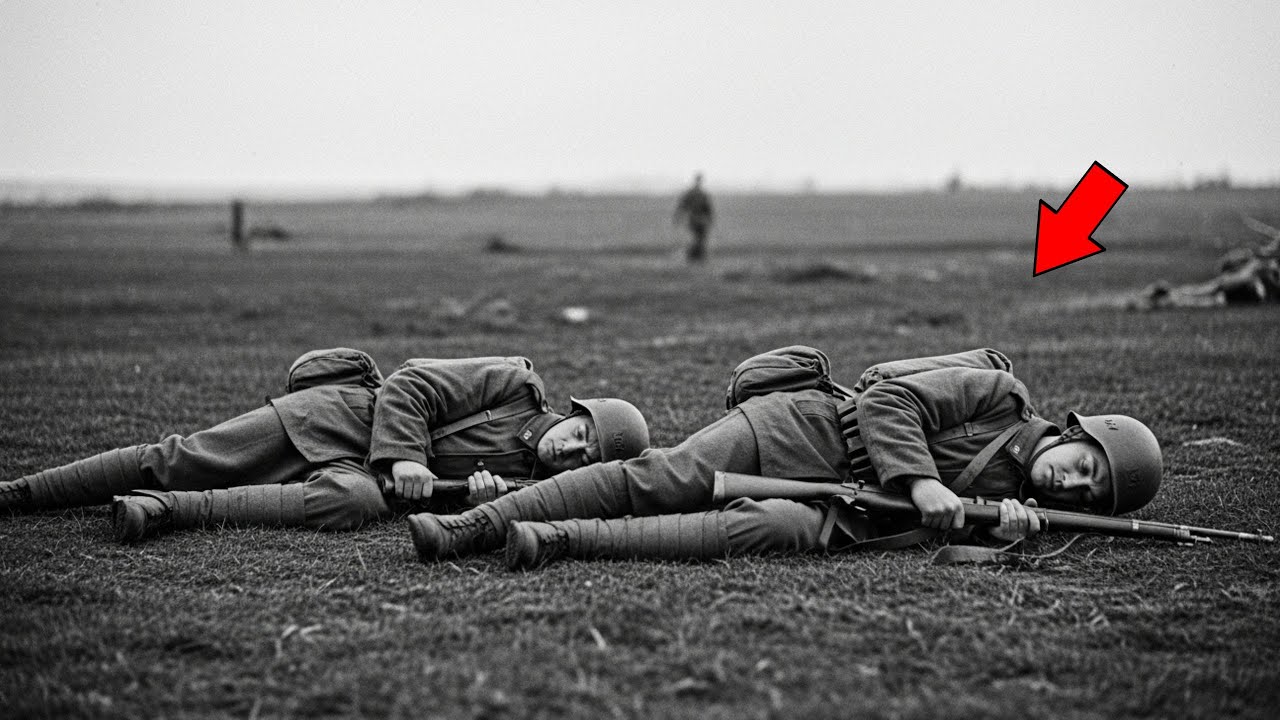
His uniform was torn, his helmet lay a few meters away, and his closed eyes suggested the end of a life cut short in 1944. But something in the composition was wrong, and she could not say what. She turned the image over. In faded ink on the back, someone had written: *Unknown soldier, Normandy, France, August 15th, 1944.
* No name. No identification number. No reference to a military unit. Elena picked up her magnifying glass and began to work through the details one by one: the belt buckles, the uniform buttons, the marks on the helmet.
Then she saw it. From the upper left pocket of the uniform, barely visible, the edge of what appeared to be a folded paper protruded, a letter, perhaps. And on the collar, a small insignia that matched nothing in the standard military divisions of the era. “This doesn’t make sense,” she whispered.
The next morning, Elena arrived early at the museum’s digital restoration laboratory, where her colleague Marcus Thompson was already calibrating the high-resolution scanner. She unwrapped the photograph from its tissue paper and set it on the table. “I need you to enlarge this as much as possible without losing quality. Especially this pocket area and this collar insignia.
”
“What exactly are you looking for? ” Marcus asked. “Something that shouldn’t be there,” she said. “This soldier doesn’t appear in any official record, but his uniform has elements that don’t match known divisions.
”
The digitization took hours. When the machine finished, Marcus turned the screen toward her. At maximum resolution, she could zoom down to the level of individual fabric threads. She moved first to the pocket, where the folded letter resolved into legible handwriting, then to the collar insignia.
What she saw there took her breath away. An eagle with extended wings, but beneath it, instead of the typical American shield, a small French fleur-de-lis. “What does that mean? ” Marcus asked.
“I don’t know. But this suggests this soldier wasn’t who he appeared to be. This insignia seems to indicate some type of joint operation between American and French forces, something not documented in official archives. ”
Elena saved the enlargements to her research folder.
She had the feeling she had just found something that could change the historical understanding of military operations in Normandy. At the National Archives and Records Administration, under a gray Washington sky, Elena walked through the marble hallways carrying a folder of digital enlargements. She had scheduled an appointment with retired Colonel James Mitchell, a specialist in World War II military records. He greeted her with a firm handshake, a gray-haired man of military bearing who remained upright despite his eighty years.
Elena spread the enlargements on the consultation table. “This photograph, Colonel, shows a fallen soldier in Normandy in August 1944, but he doesn’t appear in any official record. And this insignia,” she pointed to the enlargement, “I can’t identify it. ”
Mitchell put on his reading glasses and examined the images.
His expression shifted gradually from professional curiosity to something deeper, recognition mixed with concern. “Where did you find this photograph? ”
“In the museum archives. It was miscataloged without specific reference.
”
Mitchell leaned back in his chair. “What you’re showing me isn’t from any standard military division. It’s the symbol of an operation that officially never existed. ”
Elena felt her pulse quicken.
“What kind of operation? ”
“During the last months of 1944, there were rumors about a joint program between the American OSS and the French resistance. It was called Operation White Shadow. Selected American soldiers were infiltrated behind enemy lines, working directly with French resistance cells.
” He stood and walked to a window overlooking the National Mall. “The problem is that all records of that operation were classified indefinitely. Officially, it never happened. The soldiers who participated, according to the archives, all died in conventional combat.
”
“Are you saying this soldier was part of a covert mission? ”
“It’s possible. But if so, his death in this photograph could have been fabricated. A way to protect his real identity while he continued operating in occupied territory.
”
The nursing home in Virginia, Sunset Manor, smelled of antiseptic and wilted flowers. Elena walked to room 204, where Harold “Hank” Peterson lived, one of the last living veterans of special operations in France during 1944. At ninety-eight, Hank retained a surprisingly clear memory. When Elena showed him the enlarged photograph, his blue eyes filled with tears.
“Jesus, it’s him,” he murmured. “I thought I’d never see that face again. ”
“You knew him? ”
“Tommy Hartwell.
That was his real name. We were twenty-two when they recruited us for Operation White Shadow. ” He took the photograph with trembling hands. “This photo was taken during his first covert mission in occupied territory.
”
Elena felt a chill. “Are you saying he didn’t die in this trench? ”
“Hell no. Tommy was the best actor in our group.
He could pretend to be dead so well that even German medics would believe it. That was his specialty. He’d play dead, and when the Germans moved away, he’d get up and continue with the mission. ”
“What kind of missions?
”
“Deep infiltration. He lived entire weeks in occupied territory, establishing communication networks with the French resistance. That letter you see in his pocket, surely contained coordinates or codes for local contacts. ” Hank leaned back in his bed and closed his eyes.
“Tommy was from Chicago. Had a girlfriend named Mary. Always talked about his family’s bakery in Little Italy. After the war, he was supposed to return home to marry her.
”
“What happened to him? ”
“That’s the thing. ” Hank opened his eyes with an expression of pain. “The last time I saw him was in September 1944.
He left for a mission near Paris and never returned. They told us he had died in combat, but they never found his body. ”
“Do you think he could have survived the war? ”
“I always had that hope.
Tommy was too smart and too careful to die easily. But after the war, when I tried to look for him, it was as if he had never existed. All the records had disappeared. ”
The icy wind off Lake Michigan whipped through the streets of Chicago’s Little Italy as Elena walked toward Taylor Street.
She had flown in with a single clue: the Hartwell family bakery that Hank Peterson had mentioned. After consulting historical business records, she located the address. The bakery had closed decades ago, and a used bookstore now occupied the location, though it preserved some original elements: the white wall tiles, the marble counter where bread and pastries had once been displayed. Elena approached the owner, a middle-aged Italian man named Giuseppe Rosini.
“Hartwell’s bakery,” he repeated, scratching his gray beard. “Yes. My father bought this place from the Hartwell family in 1954. It was a very strange transaction.
”
“Strange in what way? ”
“The family had disappeared during the war. The bakery had been closed since 1943 until my father bought it. But when he signed the papers, it wasn’t with the original Hartwells.
It was with a lawyer representing a surviving heir who never appeared in person. ”
“Do you know if any member of the Hartwell family survived the war? ”
“That’s the strange thing. The old neighbors always said that Tommy Hartwell had returned briefly after the war, but that he looked different.
Thinner, with darker hair. Some thought it was another person. ”
Giuseppe led her to the bookstore’s basement. “When we renovated years ago, we found some things the family left.
I thought about throwing them away, but my wife told me to keep them in case someone appeared looking for information. ”
From among boxes of old books, he extracted a deteriorated leather suitcase. “Here it is. We never opened it out of respect for the family.
”
Inside were family photographs, handwritten love letters addressed to *my dear Mary*, and personal documents. What impacted Elena most was a 1942 family photograph showing the Hartwell parents alongside a young man who was undoubtedly the same soldier from the war photograph. Tommy Hartwell had existed. At the bottom of the suitcase, wrapped in tissue paper, she found something that left her breathless: a small military insignia identical to the one in the enlarged photograph, the same eagle with the French fleur-de-lis.
“What does this mean? ” Giuseppe asked. Elena held the insignia up to the light. “I think it means Tommy Hartwell not only survived the war, but returned home.
But for some reason, he couldn’t reclaim his previous life. ”
The search for Tommy’s girlfriend, Mary O’Connor, led Elena to the Chicago Tribune newspaper archives. The archive librarian, an elderly woman named Dorothy Chen, helped her review microfilms from 1945 to 1950. “Are you looking for obituaries, marriages, or general news?
” Dorothy asked. “Any mention of Mary O’Connor. She would have been between twenty and twenty-five at the end of the war. ”
After hours of searching, Elena found what she was looking for: a small social note in the June 3, 1947 edition.
*Mary O’Connor marries Robert Sullivan at St. Alphonsus’s Church. The bride, a nurse at Mercy Hospital, met her husband during her volunteer service with war veterans. *
“She married two years after the war ended,” Elena murmured.
“Why didn’t she wait for Tommy? ”
Dorothy found more references: a daughter, Mary Sullivan Jr. , born in 1948, followed by two more children in 1950 and 1952. The Sullivan family seemed to have lived a normal life in a Chicago suburb.
Then, in 1965, another note caught Elena’s attention: *Robert Sullivan, public accountant, died unexpectedly at forty-three. He is survived by his wife Mary and their three children. *
Elena kept searching and found something extraordinary in the 1967 archives. A small note in the local news section made her hold her breath: *Mary Sullivan reports encounter with supposed war veteran.
* The Lincoln Park widow had contacted authorities after a man claiming to be Thomas Hartwell, presumed dead in France in 1944, appeared at her door. The man was escorted from the property by local police. Dorothy reviewed the police archives. “Here it is.
Police report from March 15, 1967. A man approximately forty-five, identifying himself as Thomas Hartwell, was found loitering around Mary Sullivan’s residence in Lincoln Park. When Mrs. Sullivan saw him, she apparently fainted from shock.
The man was temporarily detained but released when no charges were found to file. ”
“Is there a physical description? ”
“Yes. Medium height, brown hair with premature gray, visible scar on left cheek, slight limp in right leg.
He spoke with a Midwest accent, but with inflections suggesting time spent abroad. ” Elena looked at the 1942 photograph and tried to imagine Tommy twenty-five years older. The description matched perfectly. “What happened next?
”
“According to the report,” Dorothy said, “the man told Mrs. Sullivan that he had been fulfilling a mission that had finally ended, and that now he could return home. She insisted that her fiancé had died in the war and that she had rebuilt her life. ”
Elena closed her eyes.
Tommy Hartwell had returned after more than twenty years, only to discover that the world he had left behind no longer existed. Back in Washington, Elena decided she needed access to the classified OSS archives. She contacted Senator Richard Hayes, who had supported several of the museum’s research projects and held influence on intelligence committees. “Dr.
Rodriguez,” Hayes said from his Capitol Hill office, “what you’re asking is extraordinarily difficult. The Operation White Shadow archives have remained classified for eighty years. ”
“Senator, I believe we have evidence that an American soldier was kept in covert operations for more than twenty years after the war ended. His family believed him dead.
His girlfriend married another man. He lived as a ghost. ”
Elena showed him all the evidence: the enlarged photographs, Hank Peterson’s testimony, the bakery artifacts, the records of the 1967 encounter with Mary Sullivan. Hayes studied the documents carefully.
“Are you suggesting the CIA kept this man on active missions during the Cold War? ”
“It’s the only logical explanation. Tommy Hartwell was an expert in deep infiltration. Those skills would have been invaluable for operations in Eastern Europe.
”
After several days of negotiation, Hayes obtained limited access to recently declassified archives. In a secure room of the federal building, under the watch of a security officer, Elena reviewed the files. The archives confirmed her deepest suspicions. Operation White Shadow had not ended with the conclusion of World War II.
It had evolved into a network of sleeper agents operating throughout Europe during the early Cold War years. Hartwell, Thomas H. appeared in multiple reports between 1945 and 1967. He had been in Berlin during the Soviet blockade, in Hungary during the 1956 revolution, and in Czechoslovakia during the Prague Spring.
His specialty remained deep infiltration and establishing communication networks. A 1967 memorandum finally explained his release: *Agent Hartwell requests termination of active service, citing operational fatigue and desire for civilian reintegration. Recommendation: Approve request with condition of perpetual silence maintenance regarding past activities. *
Elena understood the complete tragedy.
Tommy Hartwell had served his country for more than twenty years in missions that officially never existed. When he was finally released, the world he had known no longer existed for him. Elena had also located Mary Sullivan Jr. , Tommy’s former girlfriend’s daughter, now a seventy-five-year-old woman living in a nursing home in Evanston.
Mary Jr. had agreed to meet after Elena explained her research over the phone. “My mother never talked much about what happened that day in 1967,” Mary Jr. said, serving tea in the common room.
“But I remember she was very disturbed for weeks. She said she had seen a ghost. ”
Elena showed her the photograph and the enlargements. “Did your mother ever tell you anything about Tommy Hartwell?
”
“Only that he had been the love of her life before the war. She kept all his letters until the day she died in 1998. When I found them among her belongings, I finally understood why she had never talked much about my biological father. ”
Elena straightened in her chair.
“Your biological father? ”
“My official father was Robert Sullivan, who raised me as if I were his own daughter. But the dates never added up. I was born in February 1948, exactly nine months after—” Mary Jr.
stopped, recalculating. “I was born in 1948, and my mother married Robert Sullivan in June 1947. If that man who appeared in 1967 was really Tommy Hartwell—” She stopped, tears in her eyes. “My God.
Do you think he could have returned briefly after the war? ”
“Did your mother keep anything else besides the letters? ”
Mary Jr. disappeared for a few minutes and returned with a wooden box.
“I found this after she died. I never understood what it meant. ” Inside was another insignia identical to those Elena had seen, along with a photograph of a middle-aged man who was clearly Tommy, but twenty years older. On the back, in Mary O’Connor’s handwriting: *Tommy.
Paris, 1965. See you soon. *
“Your mother was in Paris in 1965? ”
“Yes.
She said she had won a church contest for a trip to Europe. But now that I think about it, my mother had never participated in contests. When she returned, she had a sadness in her eyes that never left her. ”
Elena understood the story was even more complex than she had imagined.
Tommy Hartwell and Mary O’Connor had maintained secret contact for decades, but Cold War circumstances had made it impossible for them to be together publicly. Six months after completing her report, Elena received an unexpected call. It was from a man named David Hartwell, sixty years old, living in Portland, Oregon. He had seen an article about her research in the local newspaper.
“Dr. Rodriguez,” he said with a trembling voice, “I think Tommy Hartwell was my father. ”
Elena flew to Portland that same week. David received her in a modest house filled with family photographs and military memorabilia.
He was a medium-height man with the same blue eyes and gentle smile she had seen in Tommy’s photographs. “My mother was named Claire Morrison,” David explained. “She was a nurse at a veterans hospital in Portland after the war. She always told me my father had died in France, but she never gave me specific details.
”
David showed Elena a shoebox full of letters. “I found these after my mother died in 2010. They’re dated between 1948 and 1967, all signed with the initial T. ”
Elena read them with growing excitement.
They were from Tommy Hartwell, written from different European cities, describing a life of loneliness and dangerous missions, but always expressing love for Claire and a desire to meet his son. “In the last letter,” David said, “he wrote that he had finally been released from his obligations and that he would come home. That letter is dated February 1967. ”
“Did he come?
”
“Yes. My mother told me years later that a man appeared at our door in March 1967. She sent me to stay with my grandmother that week. When I returned, she was completely changed.
Sadder, but also more at peace. ”
David led Elena to the garage, where he had been restoring a classic car. “After reading your research, I searched my mother’s attic. I found this.
” It was a leather suitcase identical to the one from Chicago, but this one contained more recent documents: passports with different names, photographs of Tommy in various European cities, and a final letter addressed to David. Elena read aloud: “My dear son. If you’re reading this, it means you finally found the truth about your father. I served my country for twenty-three years in missions that can never be publicly recognized.
My greatest regret is not having known you, but my greatest pride is knowing you grew up to be a good man, thanks to your mother. ” The letter continued: “I have left evidence of my service in a safe place. Someday, when appropriate, the complete story can be told. Until then, know that every day of my life after 1944 was lived with the hope of returning home to you and your mother.
”
Elena finished reading with tears in her eyes. Tommy Hartwell had been the father of at least two children, with two different women. Both nurses who had cared for war veterans. Both who had kept his secret for decades.
“What happened to him after 1967? ” Elena asked. David smiled sadly. “According to my mother, he lived his last years in a small cabin in the Oregon mountains under the name Thomas Morrison.
He died in 1987 and is buried in a local cemetery with a headstone that simply says ‘war veteran. ’”
Elena visited Thomas Morrison’s grave at Mount Hood Cemetery. The simple headstone contrasted with the complexity of the life he had lived. But beside it, she found something that finally completed the circle: fresh flowers and a small black-and-white photograph.
It was the original photograph of the fallen soldier in 1944. But now Elena knew it did not show a death. It showed a rebirth. Tommy Hartwell had died that day in order to live as a ghost in service to his country, sacrificing his personal identity for a greater cause.
Elena arranged for the photograph to be exhibited in the museum with a plaque that read: *To the unknown heroes who served in the shadows. * It did not mention Tommy Hartwell’s name, respecting the secrecy he had maintained throughout his life, but honoring his sacrifice and that of all who had served like him. David Hartwell donated his father’s letters to the museum, where they were preserved for future generations. Mary Sullivan Jr.
did the same with her mother’s belongings, creating a complete archive of a love story that had transcended decades and continents. The photograph of the fallen soldier in 1944 had finally revealed its story. It was not the image of an ending, but of a beginning: the beginning of a life completely dedicated to service, sacrifice, and silent love for a country that could never publicly recognize his contribution.
Tommy Hartwell had finally found his rest, but his legacy lived on in the museum archives, a reminder that history is full of anonymous heroes whose stories wait to be discovered by those brave enough to look closer.
