The telephone was already ringing when the gas pellets dropped into the acid beneath Burton Abbott’s chair. The governor’s office had a stay of execution, and the call was racing toward San Quentin, seeking the warden’s ear before the state of California ended the life of the man convicted of kidnapping and murdering a fourteen-year-old girl. The phone reached the warden too late. Abbott had eaten his final meal hours before, French fried butterfly prawns with cocktail sauce, a single order of ravioli, a tossed green salad dressed with oil and vinegar, a slice of chocolate cake, and a pack of Salem cigarettes.
He never knew how close that telephone came to saving him. In 1955, the country had watched his televised trial, and in 1957, the country watched again as the gas chamber did its work. The cigarettes were as much a part of the ritual as the food, a reminder that this was an era when a man could still smoke in a death cell. A person’s last meal says more about who they were than any confession ever does.
Some requests were enormous and deliberately wasteful. Some were a single piece of food, ordered with a hope that a tree of peace might grow from it. One was a feast so obscene it ended a ninety-year tradition in Texas overnight. And one was ordered by a man who had once managed the very restaurant he ate from, a detail most people refuse to believe is true.
Wanda Jean Allen faced the end and wanted nothing elaborate at all. Executed in Oklahoma in 2001 for shooting and killing her partner, her case had drawn national attention over questions of intellectual disability and the fairness of her trial. Activists across the country had taken up her cause, but when the time came to choose a final meal, the woman whose case had become a symbol asked for one thing: a single bag of potato chips. No steak, no dessert, no last indulgence.
A bag of chips eaten in a cell. For some people on death row, the appetite simply goes. The body knows what is coming even when the mind tries to pretend otherwise, and a person who once might have wanted a feast finds that all they can manage is something they could buy from a vending machine. Thomas Provenzano was executed in Florida in 2000 for a shooting at an Orange County Courthouse that killed a bailiff.
He suffered from severe mental illness, and his case became a long legal battle over whether a man with documented delusions could be put to death. His final meal was the kind of plate you might give a sick child: half a grilled cheese sandwich, a small portion of baked beans, hot canned apples swimming in cinnamon syrup, two slices of plain bread, and a cup of tea. There was no defiance in a meal like that, no statement, no last grand gesture. It read as comfort food, the food of someone who wanted, in his final hours, to feel like he was somewhere safe and ordinary instead of strapped to a gurney.
Half a sandwich, not even a whole one. Richard Henyard was executed in Florida in 2008 for a crime that took the lives of two young children. His final meal stood out precisely because it was so generous, so much like a real dinner a person might order on a good night out: two fried chicken breasts, turkey sausage, a plate of fried rice, chocolate chip cookies, and a Coca-Cola. It was a comforting, almost cheerful spread, the food of celebration rather than mourning.
And that was the unsettling thing. The plate itself carried no memory of what the man had done. The chicken did not know. The cookies did not know.
The condemned man sat down to the same dinner a family might share on a Friday, and the contrast between the meal and the crime was its own kind of horror. Mark Dean Schwab, executed in Florida in 2008 for the abduction and murder of an eleven-year-old boy, did not ask for dinner at all. He asked for breakfast: two fried eggs, four strips of bacon, two sausage links, buttered toast, a pile of hash browns, and a full quart of chocolate milk. It was the meal of a man who wanted to feel like he was waking up to an ordinary morning, the kind you might eat at a diner counter before a long drive.
There was a strange psychology in choosing breakfast as your final meal, a refusal to acknowledge that there would be no tomorrow morning to eat it again. The quart of chocolate milk in particular read like something a child would order, a final reach backward toward a time before everything went wrong. The last meal was never a law. No statute required it.
It grew up as a custom, a piece of folk tradition that prison systems adopted because it felt humane, and because it gave the condemned one small thing to control on a day when everything else was decided for them. Different states handled it differently. Florida capped the cost at around forty dollars and required that everything be bought locally, which was why a condemned man in Florida never ordered anything exotic; the food had to come from a grocery store or a fast food restaurant within driving distance of the prison. Texas, for nearly a century, granted almost any request within reason.
The meals were prepared by prison kitchen staff, sometimes the same cooks who fed the general population, and served on the same plastic trays. There were no candles, no tablecloths, and one rule that surprised people: no alcohol. The few stories of condemned men drinking on their final night always involved something smuggled in. Teresa Lewis was executed in Virginia in 2010, the first woman put to death in that state in nearly a century.
She was convicted of orchestrating the murders of her husband and stepson in a plot for insurance money, and her case was deeply controversial because of her low-measured IQ. Her final meal was hearty and home-style, the food of a Sunday dinner: two pieces of fried chicken, sweet peas dripping with butter, a slice of German chocolate cake with its coconut pecan frosting, and a Dr. Pepper to wash it down. It was a southern comfort plate through and through, the kind of meal that said home more than farewell.
The German chocolate cake was a celebration dessert, something you baked for a birthday, and there was a quiet sadness in a woman ordering a birthday cake for the last supper of her life. Gary Gilmore made history in 1977 as the first person executed in the United States after the death penalty was reinstated, and he did it by demanding to die, famously telling the court, “Let’s do it. ” He chose a firing squad in Utah. His final meal was simple and all-American: a hamburger, eggs, a baked potato, and coffee.
But Gilmore also drank whiskey on his final night, contraband smuggled in by an uncle, because no prison would ever serve alcohol as part of a last meal. He ate little of the actual food. The man who fought for his own execution, who turned his death into a media spectacle that inspired books and songs, spent his final hours with a burger he barely touched and a bottle he was never supposed to have. Karla Faye Tucker was executed in Texas in 1998 for a pickaxe murder, the first woman executed in that state since the Civil War.
Her case became an international sensation because of a religious conversion on death row that won her supporters as unlikely as televangelists and the Pope. Yet, given the chance at the famously generous Texas last meal, where men ordered mountains of barbecue and steak, Tucker asked for almost nothing: a banana, a peach, and a simple garden salad with ranch dressing. It was the meal of someone who had, by her own account, made peace with what was coming. No final feast, no indulgence, just fruit and a little salad, light enough that it could not weigh her down.
Judy Buenoano earned the nickname the Black Widow for a string of poisonings and a drowning that killed her husband and her own son, and nearly took her fiancé, schemes designed to collect insurance payouts. She was executed in Florida in 1998. Her final meal was one of the most darkly ironic on the entire list: steamed broccoli, asparagus, fresh strawberries, sliced tomatoes, and a cup of hot tea. It read like a spa menu, a health-conscious, almost virtuous plate of vegetables and fruit, ordered by a woman who had spent years feeding poison to the people who trusted her most.
The Black Widow, who turned food and drink into weapons, asked for the cleanest, healthiest meal imaginable as her own final act. Odell Barnes Jr. was executed in Texas in 2000, and his case became a rallying point for death penalty opponents around the world who raised serious doubts about the evidence used to convict him. When the prison asked what he wanted for his final meal, Barnes refused to play along with the ritual at all.
He did not ask for food. He asked for justice, equality, and world peace. It was a final act of protest, a way of turning the most personal moment of the entire process into a political statement broadcast to anyone who would listen. The prison could not serve him justice on a tray.
They could not plate up equality. A man went to his death having ordered something no kitchen on Earth could prepare. Psychologists who studied the last meal phenomenon noticed something striking. The choices fell into patterns that had almost nothing to do with the severity of the crime.
Some condemned people ordered enormous feasts they could not possibly finish, and researchers believed this was about control, a way of commanding abundance on a day when they had no power over anything else. Others ordered the food of childhood, the grilled cheese and the chocolate milk and the canned apples, reaching back toward the last time they felt safe. A surprising number refused food entirely, and many of those were people who had, in some way, accepted their fate or detached from their own bodies. And then there was the single most common dessert across every state and every decade: ice cream.
Roughly four out of five people who requested dessert asked for some version of it. Cold, sweet, simple, and gone in minutes, the food associated more than any other with being a small child on a summer afternoon. Philip Workman was executed in Tennessee in 2007 for the killing of a police officer during a robbery, a conviction surrounded by lingering questions about the forensic evidence. When asked for his final meal, Workman refused to eat anything for himself.
Instead, he made a request that turned into one of the most remarkable stories in the history of the last meal. He asked that a large vegetarian pizza be donated to a homeless person in Nashville. The prison refused, saying it was not their job to fulfill charitable requests. But word got out, and across the country, ordinary people who heard what Workman had asked for began ordering pizzas for homeless shelters in his name.
Donations poured into food banks in Nashville and far beyond. A condemned man’s final wish, denied by the state, was answered a hundred times over by strangers. It remained the only last meal request in American history that fed more people than the man himself ever could have eaten while alive. Jonathan Nobles was executed in Texas in 1998 for a double murder committed during a drug-fueled break-in.
On death row, he underwent a religious conversion, and when the time came for his final meal, he did something almost no one else has done. He declined food altogether and asked instead to receive the Eucharist, the communion bread and wine of the Catholic faith. His spiritual advisor administered it to him. For Nobles, the last meal was not about appetite or comfort or defiance.
It was a sacrament. He sang Silent Night as the lethal injection began. Robert Buell was executed in Ohio in 2002, convicted in the murder of a young girl. His final meal was one of the most quietly chilling on the list precisely because of its restraint.
He asked for a single black olive, unpitted. One olive sitting alone on a prison tray. There was no record of exactly what he meant by it, and that absence was part of what made it unforgettable. A feast was easy to understand.
Hunger and indulgence made sense. But a single olive was a riddle, a gesture without explanation. Some read it as a final dark joke, others as a statement of contempt for the whole ritual. The last thing a man chose to taste on this earth was one bitter olive, the pit still inside.
The olive returned, and this time the meaning was known. Victor Feguer was the last person executed by the federal government before a long pause in federal executions. He was hanged in Iowa in 1963 for kidnapping and killing a doctor. For his final meal, Feguer asked for a single olive with the pit left in.
He explained why. He hoped that the pit would be buried with him, and that from it an olive tree might one day grow. The olive branch was the ancient symbol of peace. It was a wish for something good to come out of his death, a small green shoot rising from the place where he was laid.
Reports say the pit was indeed found in the pocket of his suit after he was hanged. No tree ever grew, but the gesture survived more than sixty years later as the gentlest and most poetic request in the entire grim history of the American last meal. Ricky Ray Rector was executed in Arkansas in 1992, and his case was among the most disturbing on the list. Not for the meal, but for what the meal revealed.
Rector had shot himself in the head after his crime, an injury that effectively gave him a lobotomy and left him severely cognitively impaired. For his final meal, he ordered steak, fried chicken, and cherry Kool-Aid with a slice of pecan pie for dessert. He ate the steak and the chicken, but he did not touch the pie. When the guards came to take him to the death chamber, Rector told them he was saving his pecan pie for later.
He did not understand even then that there would be no later. That single sentence became one of the most cited moments in the entire debate over executing the mentally impaired in America. A man so damaged he set aside his dessert for a tomorrow that everyone but him knew would never come. For decades, Texas was famous for the generosity of its last meals, granting nearly any request within reason.
Then came Lawrence Russell Brewer. In 2011, Brewer, convicted in one of the most notorious hate crime murders in modern American history, ordered a final meal of staggering size: two chicken fried steaks smothered in gravy, a triple meat bacon cheeseburger, a bowl of fried okra, a full pound of barbecue, three fajitas, a meat lover’s pizza, a pint of ice cream, and a slab of peanut butter fudge studded with crushed peanuts. The prison kitchen made all of it, and then Brewer announced he was not hungry and refused to eat a single bite. A Texas state senator was so enraged by the waste and the disrespect that he demanded the policy end immediately.
The very next day, the Texas Department of Criminal Justice abolished the special last meal entirely. From that point forward, condemned inmates in the busiest execution state in America would receive only the same tray served to everyone else. One man’s uneaten feast erased a tradition that had stood for almost ninety years. Brewer was sent to death row for a 1998 murder in Jasper, Texas, so brutal and so racially motivated that it shocked the nation and helped inspire new hate crime legislation.
His mountainous final order, deliberately wasteful and then deliberately untouched, read now like a final act of contempt aimed at the entire system. He took the one freedom the state offered him, the freedom to choose a meal, and used it to mock the gesture. The pile of food sat there cooling on the tray. He was executed without having eaten any of it.
And because of him, no one in Texas would ever be offered that choice again. It may have been the only last meal in history whose main effect was to take last meals away from everyone who came after. Timothy McVeigh was not a serial killer in the technical sense. He was a domestic terrorist executed by the federal government in 2001 for the Oklahoma City bombing that killed 168 people, including nineteen children in a daycare on the building’s lower floors.
It remained one of the deadliest acts of terrorism on American soil. And his final meal, given the scale of what he did, was jarring in its smallness and its innocence. McVeigh asked for two pints of mint chocolate chip ice cream. That was all.
No steak, no symbolic statement, no feast, just ice cream, the dessert of a child’s birthday party, chosen by a man responsible for one of the worst mass murders in the country’s history. Two pints of green ice cream eaten in a federal cell by a man who showed no remorse for the lives he ended. Allen Lee Davis was executed in Florida’s electric chair in 1999 for the murder of a pregnant woman and her two young daughters. Davis was a very large man, and his final meal matched his size: one lobster tail, a heaping plate of fried potatoes, a half pound of fried shrimp, six ounces of fried clams, half a loaf of garlic bread, and a full quart of A&W root beer.
It was a seafood feast that strained the forty-dollar Florida cap, an enormous spread of fried everything washed down with cold root beer. His execution became infamous for other reasons, sparking a legal fight over whether Florida’s electric chair was a cruel and unusual method, a controversy that ultimately pushed the state toward lethal injection. But the meal endured in the records as one of the largest a Florida inmate ever managed to order before the limits tightened. Ronnie Lee Gardner was executed in Utah in 2010, and he made a choice almost no one in the modern era makes.
He chose to die by firing squad, one of the last men in America to do so. His final meal was a steakhouse plate fit for a celebration: steak, lobster tail, apple pie, and vanilla ice cream with 7-Up to drink. But the truly unusual part was how he spent his final two days. Gardner asked to watch the entire Lord of the Rings film trilogy, more than nine hours of movies, while he waited for the end.
He ate his steak and lobster, watched hobbits march toward Mordor, and then walked to a chair where five marksmen waited behind a wall with rifles. It was one of the few last meals paired with a last movie marathon, a man choosing to spend his final hours not in prayer or protest, but in front of a screen, escaping into a story until the very last moment. Velma Barfield held a grim place in history as the first woman executed in the United States after the death penalty was reinstated in the 1970s. She was put to death in North Carolina in 1984.
She became known as the death row granny. She had poisoned several people with arsenic, including her own fiancé, often disguising the poison in their food and drink. And so her final meal was almost unbearably ironic. This woman who used food as a murder weapon, who turned ordinary meals into instruments of death, asked at the end for the simplest, most innocent snack imaginable: a bag of cheese doodles and a can of Coca-Cola.
Junk food, the kind of thing you eat on a couch in front of the television. The poisoner who hid death in home-cooked meals went out with a fistful of cheese puffs and a soda, refusing any kind of feast, choosing instead the food of a quiet, ordinary afternoon. These meals had become a form of dark entertainment, and an entire small industry grew up around them. A photographer once recreated famous last meals as a fine art series, plating Gacy’s fried chicken and McVeigh’s ice cream and Feguer’s lonely olive as if they were dishes in a magazine.
There were cookbooks built around them. There were websites that catalogued them in obsessive detail. And recently, a true crime-themed restaurant opened that served replicas of these exact meals on prison-style cafeteria trays, naming dishes after the killers who ordered them, a concept that sparked national outrage and just as much fascination. People were drawn to these plates because they collapsed the distance between the monstrous and the mundane.
We cannot imagine committing these crimes, but we can all imagine ordering a cheeseburger, or craving ice cream, or wanting a quiet bag of chips. The last meal makes a monster briefly, uncomfortably human, and that flicker of recognition is exactly what we cannot look away from. Danny Rolling, known as the Gainesville Ripper, terrorized a Florida college town in 1990 with a series of murders so frightening that students fled campus in droves. He was executed in Florida in 2006.
His final meal was a seafood feast: a buttered lobster tail, butterfly shrimp, a baked potato, a slice of strawberry cheesecake for dessert, and sweet tea to drink. Rolling, who had once aspired to be a musician, offered no spoken final statement. Instead, he sang a gospel hymn in the death chamber in the moments before the injection began. A man who had brought unimaginable terror to a community spent his last meal on lobster and cheesecake, and his last breath on a hymn.
A contrast so stark it left the witnesses unsettled for years afterward. William Bonin was the Freeway Killer, executed in California in 1996 for the murders of more than a dozen young men and boys whose bodies were left along the highways of Southern California. He was the first person in California ever executed by lethal injection. His final meal was a quantity that read less like a last supper and more like a party order for a crowd: two large pepperoni and sausage pizzas, three pints of coffee ice cream, and three six-packs of regular Coca-Cola.
It was an astonishing amount of food and caffeine and sugar for one man on his final night, an order built for a group, consumed by someone facing the end alone. The coffee ice cream was an unusual touch, an adult flavor amid the pizza and the soda. Bonin used his actual final words not to apologize, but to argue that the death penalty sends the wrong message to young people. A chilling statement from a man who preyed on the young, entered into the record alongside an order of three pizzas’ worth of indulgence.
Aileen Wuornos was one of the most infamous women in American criminal history. A former sex worker convicted of killing six men in Florida, her story was later told in an Oscar-winning film. She was executed by lethal injection in 2002. In the end, the woman whose life had been a study in chaos and rage refused the entire ritual.
She declined a special last meal altogether. All she asked for was a single cup of black coffee, which she drank hours before she died. No food, no feast, no comfort, just coffee. Her final spoken words were as strange as her refusal of food, a rambling declaration that she would be back, like Independence Day with Jesus, June 6th, a reference to a science fiction movie about an alien invasion.
She believed she was sailing away on a mothership. A cup of black coffee and a promise to return from the stars. She has not turned up yet. Ted Bundy is, for many Americans, the definition of the word serial killer.
Charming, articulate, and utterly remorseless, he confessed to thirty murders of young women before his execution, though the true number is believed to be far higher. He died in Florida’s electric chair in 1989 as crowds gathered outside the prison, some celebrating, some protesting. His last meal was famous precisely because of what did not happen. Bundy declined to request anything special, so the prison gave him the standard fare offered to any condemned inmate who makes no choice: a medium-rare steak, eggs over easy, hash browns, buttered toast with jelly, milk, coffee, and juice.
A perfectly ordinary American breakfast for dinner. And Bundy, the man who controlled and manipulated everything and everyone around him to the very end, did not eat a single bite. The plate sat untouched. The most calculating killer in modern American history, offered one last small thing to control, simply refused it, and walked to the chair on an empty stomach.
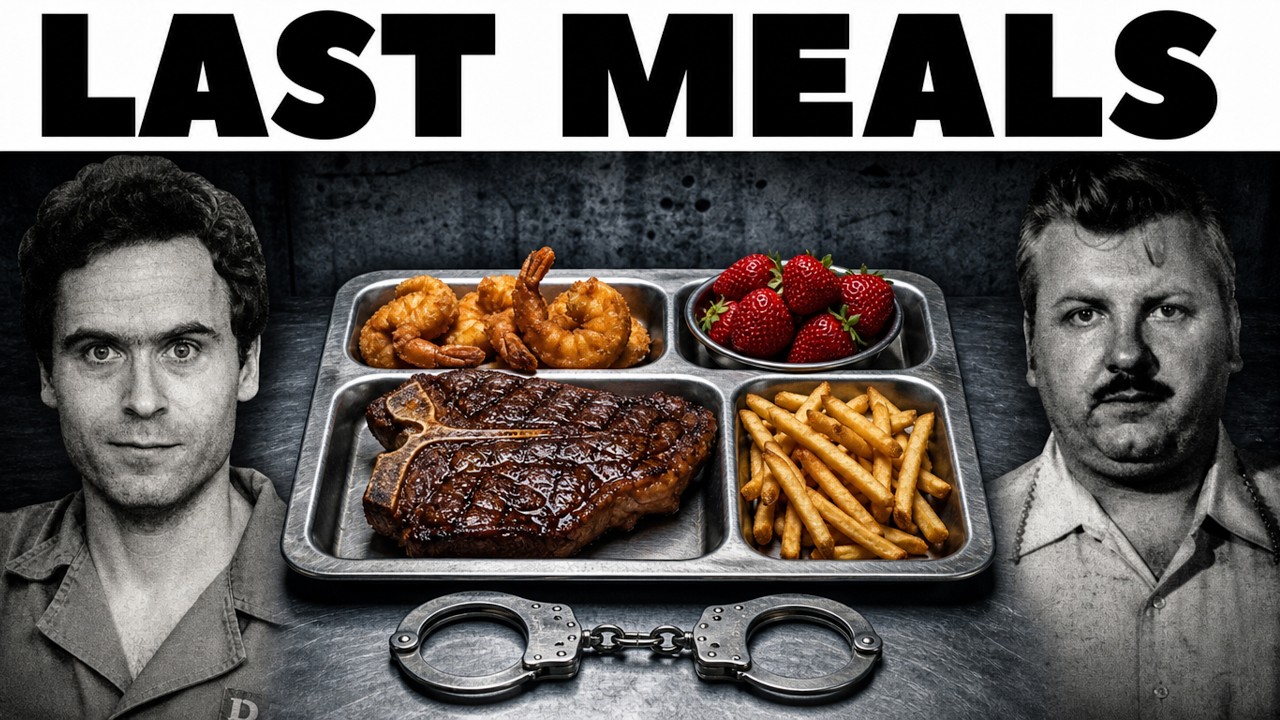
And then there is the meal so darkly fitting that people refuse to believe it. John Wayne Gacy, the killer clown, murdered at least thirty-three young men and boys in the 1970s and buried most of them beneath his own house, all while performing as a clown at children’s parties and posing for photographs with the first lady. He was executed by lethal injection in Illinois in 1994. For his final meal, Gacy ordered a feast: a bucket of original recipe Kentucky Fried Chicken, a dozen fried shrimp, a pile of french fries, a full pound of fresh strawberries, and a Diet Coke.
The fried chicken was the detail that made it unforgettable. Because before he became one of the most notorious murderers in American history, John Wayne Gacy had managed Kentucky Fried Chicken restaurants. He knew that food from the inside. He had cooked it, sold it, run the registers.
And on the last night of his life, the man who hid bodies beneath his floorboards reached back to the one period when he could pass for normal, when he was just a fast food manager in a paper hat, and ordered a bucket of the chicken he once served to the public. He ate it in a cell. Whether it actually came from a real KFC, no one ever confirmed it. But the order stands as the most quietly horrifying last meal on the entire list.
A killer’s final taste of the ordinary life he wore as a mask. Of all twenty-five, which one sticks with you? The single olive and the tree that never grew? The grandmother and her bag of cheese puffs?
The terrorist and his two pints of ice cream? Or the clown who ordered the chicken he used to sell? These were not just meals. They were the last honest thing these people ever did.
A final choice that said more than any words could.






