On a cold November night in 1993, Randy Gail Spierino left her home in Granite City, Illinois, for her usual evening walk. The 34-year-old mother and grandmother had followed the same routine for years, walking nearly every evening through her neighborhood regardless of the weather. It was the kind of small, repeated habit nobody thought about until it became the last thing anyone remembered about her. At around eight o’clock on the evening of November 8, a witness saw her on Rock Road.
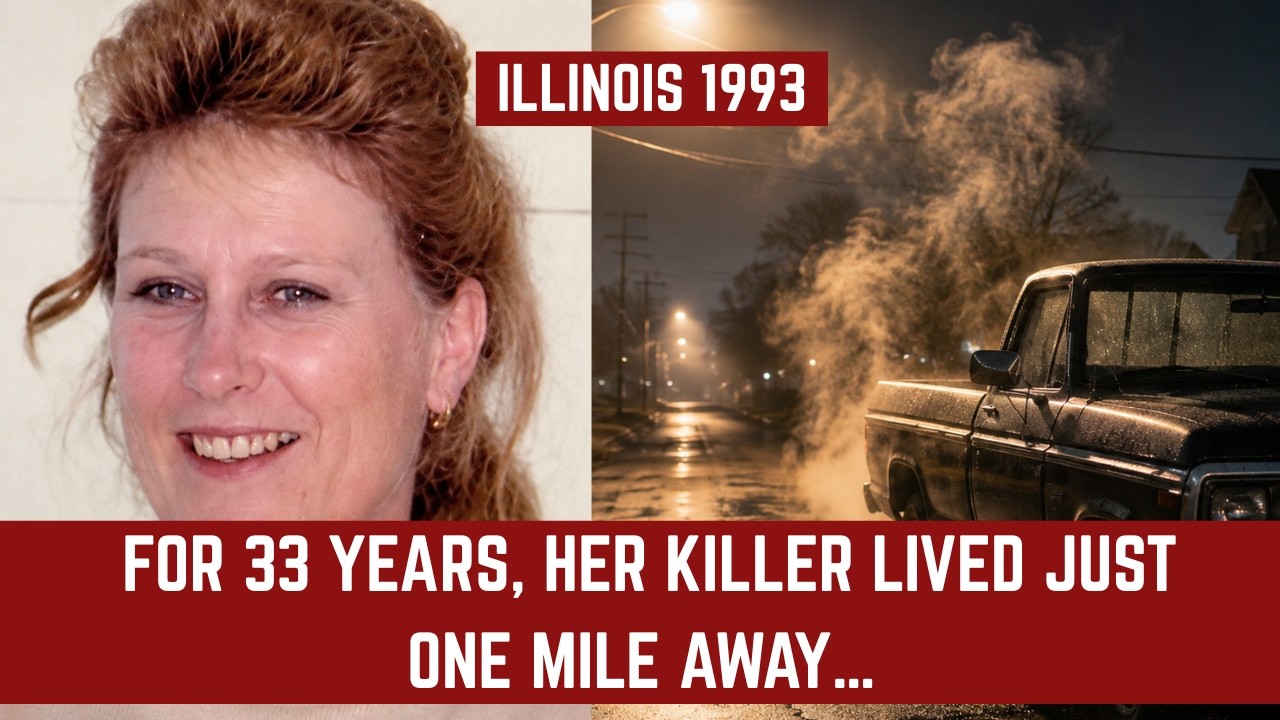
A dark-colored pickup truck, likely made in the late 1970s or early 1980s, pulled up near her. She got in. The witness watched the truck drive off toward Highway 3, but there was no license plate number and no clear view of the driver. Only a shape, a color, and a direction.
Nearly two days passed before anyone found her. Late on November 9, at about 11:45 p. m. , her body was discovered in a field in an unincorporated area of Granite City near Horseshoe Lake Road and Handvelder Road.
The cause of death was determined to be blunt force trauma to the head. Between the truck and the field lay a gap of roughly 28 hours that investigators never publicly explained. What they did recover from the crime scene was biological material that would become the most important piece of evidence in the file. Crime scene technicians cataloged it and preserved it according to standard chain-of-custody procedures, the same procedures that would keep it legally usable more than three decades later.
The case went cold not because investigators stopped caring, but because the tools to solve it did not yet exist. Beginning in 1998, DNA from the crime scene was entered into CODIS, the national criminal database, and tested repeatedly over the years that followed. CODIS compares about 20 specific genetic markers against files already in the system. Those files exist only because someone was arrested for a crime serious enough to require a sample.
If the man who left that DNA had never been arrested for a qualifying offense, there was nothing in the system to match against, no matter how many times the sample was run. Investigators in Madison County interviewed hundreds of people over the following decades. They compared the original truck description against vehicle registration records throughout the region. The description itself was part of the problem.
A dark, older pickup from the late 1970s or early 1980s was not a rare vehicle in that part of Illinois in 1993. It was one of the most common trucks on the road, and the comparison produced a list too long to work through with interviews alone. For 27 years, the case sat with a genetic profile and no name attached to it. Investigators came and went.
Some retired without ever seeing the case solved. Wes Perino, Randy Gail Spierino’s son, was 15 years old when his mother was killed. He grew into adulthood carrying that unanswered file, eventually moving to California, but he never lost touch with Madison County investigators. For years, he kept calling.
Usually, the answer was nothing new. Around 2018, something changed. Jeff Connor, who had just been sworn in as sheriff, began talking directly with Wes about reopening the case. The technology that would eventually solve it was not ready yet, but that single decision, that a new sheriff considered a 25-year-old file still worth pursuing, turned out to be the true starting point for everything that followed.
What changed next did not happen in Madison County. It happened at a laboratory in Texas. In May 2025, the Madison County cold case unit sent the decades-old DNA sample to Astrea, a private forensic laboratory based in Texas. The testing cost nearly $10,000, a number worth noting because solving a case like this is not automatic.
Someone had to choose to spend money on a file most departments would have written off entirely. Astrea’s approach was not just a better version of the same test. It was radically different. Where CODIS compares 20 markers looking for a pre-existing match, forensic genetic genealogy scans hundreds of thousands of markers at once.
That is enough information to reconstruct an entire family structure, rather than simply searching for a match to one fingerprint. Investigators were no longer chasing a criminal record. They were tracing ancestry, following relatives who had never been arrested in their lives and had no reason to believe their DNA had any connection to a murder that predated some of them by decades. Genetic genealogists built that family tree generation by generation, comparing shared ancestry until they landed on a single lineage rooted in southern Illinois.
The man ultimately charged was not on the laboratory’s initial list of relatives at all. He had never submitted his DNA to any authority. It was members of his extended family who had been researching their own roots for reasons unrelated to an old murder, and their genetic information built the thread that eventually led investigators to him. This became the thirteenth case publicly solved in Illinois using Astrea technology.
The family line converged at an address in Caseyville, Illinois, a few miles from Granite City. Attached to that address was a name: Albert Lee Ziegler, known to those around him as Buddy. In his seventies when investigators identified him, he had spent his career in airport maintenance with no prior criminal record. Nothing would have brought his name up on its own in any system at any time during the past three decades.
A familial match, by itself, proves nothing. It is a probability, not a conclusion. The next step was a direct comparison. A reference sample of Ziegler’s own DNA was tested against the 1993 evidence.
According to reports on the case, investigators obtained that sample through standard procedures, and the laboratory compared it against the original material found at the crime scene. At the same time, a second, completely independent thread of evidence emerged. Investigators confirmed that a truck registered to Ziegler matched the general description given by the original witness: a dark, older truck. This line of evidence relied on genetics not at all.
It was a vehicle record that had been sitting in a government database the entire time, independently pointing in the same direction as the DNA. Two unconnected lines of evidence, separated by 30 years, intersected at the same man. Investigators also stated publicly that Ziegler had no known prior connection to Spierino whatsoever. Sheriff Connor described it as a random encounter.
There was no traceable relationship, no shared acquaintances to interview, nothing in Spierino’s life that would have directed anyone toward him. Connor put it simply: Ziegler was never on their radar. He was never considered. Over three decades, that was the entire problem in one sentence.
According to reports on the case, investigators made their first direct contact with Ziegler in April 2026. He denied everything. He denied knowing Spierino. He denied any involvement.
Investigators left him a phone number before departing. Days later, Ziegler called them himself. According to this account, the confession came voluntarily, days after he had denied everything, through a call he chose to make. Prosecutors say that in that conversation, he admitted picking up Spierino that night.
From that point, the accounts diverge. Some reports describe him telling investigators he brought Spierino to his home, where things turned violent. Other reports, citing the state’s attorney’s office directly, say he told them he drove her to a cornfield instead. Prosecutors say he described a dispute that escalated between them.
All accounts agree on the outcome. None agree on exactly where it occurred. On May 26, 2026, Madison County prosecutors charged Albert Lee Ziegler with first-degree murder. DNA evidence and an independent vehicle record had led investigators to a 70-year-old man with no criminal history and no known connection to the victim.
He had denied everything the first time he spoke with investigators, then called them back days later. At his first court appearance, Associate Judge James Hackett appointed a public defender and set a detention hearing for the next day. Prosecutors argued that Ziegler should remain in custody, describing first-degree murder as a violent crime that did not warrant release. His public defender, Mary Copeland, objected directly, arguing that police had obtained Ziegler’s DNA sample while he was in the hospital recovering from a serious heart attack, and that a nurse had to intervene and ask officers to leave the room.
She told the court he had significant, ongoing health problems, posed no threat to the public, and that his family was actively working to place him in a care facility rather than having him return home. Judge Hackett’s answer was direct. Ziegler had enjoyed roughly 30 years to come forward on his own and never had. Given the severity of the charges, Hackett ordered him held without release until trial.
As of now, Albert Lee Ziegler remains in custody at the Madison County Jail. No trial date has been announced. No verdict has been rendered. Madison County State’s Attorney Tom Haine spoke publicly about the case, describing the arrest as proof that advances in forensic technology can still provide answers in cases once considered permanently closed.
He was careful to add that technology alone does not guarantee a conviction, crediting the investigators who kept the case file open for three decades. Standing beside him was Wes Perino, no longer that 15-year-old boy but a man in his late forties, flown in from California with his wife Wendy to be present. He told reporters he never expected to see this day. He said he thought he might die without ever knowing the truth, but that everything had changed because of the investigators behind him.
For 33 years, Wes Perino had no name to attach to his mother’s case. Now he does. An arrest is not a conviction. Prosecutors still have to prove what the DNA evidence shows, explain the vehicle evidence, and present the alleged confession in court.
The defense will have the opportunity to challenge every part of that case. The evidence did not change while it sat in storage. The science around it did. Every agency in the country has a version of that locked drawer: DNA collected decades ago, checked against every available database at the time, then archived not because anyone gave up, but because the tools to read it had not yet been invented.
This case is small proof that the drawer is not necessarily closed forever. Sometimes a cold case is not empty. It is waiting for the right question.
