The verdict landed, and Elizabeth Chudleigh, Duchess of Kingston, collapsed lifeless to the ground. She had been convicted of bigamy in front of a packed Westminster Hall, with Queen Charlotte and her children, including the future kings, watching from the stands. The woman who had clawed her way from genteel poverty to become one of the richest women in Britain now lay in a heap, draped head-to-toe in black, looking for all the world like Mary Queen of Scots awaiting execution. But the fight was far from over.
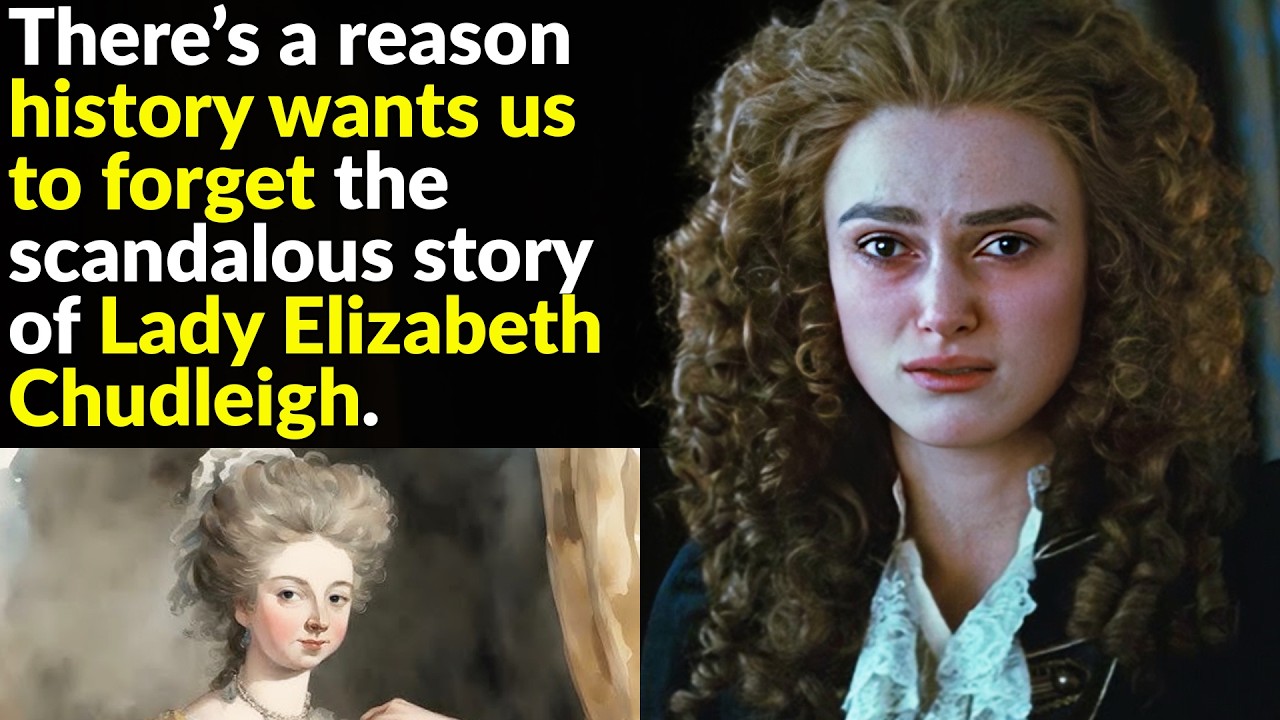
Elizabeth knew her husband’s disinherited nephew, Evelyn Meadows, would sue to overturn the will and would likely try to bar her from leaving the country. She had one last trick to play, and it was infuriatingly brilliant. Her coach was highly recognizable, so she had her driver spirit it all over town while her home buzzed with a raucous party. To any outsider, including Meadows, it seemed she was busy entertaining.
In reality, she was liquidating assets and preparing for flight. She slipped out of the country entirely and landed in France, with infamy at her back. It was a long way from where her story began. When Elizabeth was only five years old, her father, having squandered his money, met a sudden end.
This left the family in a sort of genteel limbo, neither starving nor enjoying the luxuries of the extremely wealthy. At fifteen, she survived a dangerous bout of smallpox, recovering without any lasting scars thanks to a stroke of luck. She was known to be beautiful, exceedingly charming, and quick-witted, and before long, she caught the eye of a much older gentleman. That gentleman was William Pulteney, a powerful politician with a seat in the House of Commons and a wife.
Despite all that, he couldn’t resist the temptation of a teenage girl. Pulteney showed a disturbingly strong interest in her education and began spending long hours alone with her. According to her first biographer, their intimacy wasn’t always platonic. Elizabeth’s mother, seeing a favorable eye cast upon her daughter, only encouraged the connection.
After spending much time with her, Pulteney made a suggestion that changed the course of Elizabeth’s life forever. He advised her to move to London and ingratiate herself in the royal court. The king had smiled on Pulteney, making him the Earl of Bath, and this opened a whole new world for Elizabeth. She arrived on the glittering threshold of the British royal court with an income of four hundred pounds and a role as maid of honor to Augusta Saxe-Gotha, the wife of the Prince of Wales.
She became incredibly popular, wowing even the king himself. On one notorious occasion, she attended a masquerade in the Haymarket dressed as the Greek princess Iphigenia, in a dress so sheer and flesh-colored that in the warm candlelight, she appeared to be wearing nothing. King George II took immediate notice, and instead of being offended, he was delighted. He was so enraptured that he outwardly voiced his approval and even ordered another masquerade in her honor.
The court teemed with vice and ravenous suitors. It was there that Elizabeth met the Duke of Hamilton, the most eligible bachelor of her time. Entranced by her beauty and charms, James, Duke of Hamilton, proposed marriage. But before they could marry, he had to leave on a grand tour of the continent.
That gave Elizabeth ample time to turn her gaze toward another suitor. While attending a horse race, she came face-to-face with Augustus John Hervey, a dashing but poor and lowly naval officer. This did not stop Elizabeth from making the most reckless decision of her life. She fell head over heels for Augustus and didn’t think twice about dealing the Duke of Hamilton a vicious betrayal.
In 1744, a secret marriage came to pass. She and Augustus met at a quiet Hampshire church, and at ten o’clock at night, the illicit ceremony began. Only a handful of friends and servants attended. If anybody found out, the consequences would be severe.
Most shockingly, Elizabeth kept the marriage a secret from her own mother. Not long after saying I do, the couple had a sudden falling out. There’s a good chance the marriage imploded due to aggression and mistreatment, particularly in the bedroom. They went from hot to cold in an instant, and when Augustus returned to his fleet, Elizabeth extinguished their romance.
She never wanted to lay eyes on him again. Despite her disappointment, Elizabeth continued to bat her eyes in court, becoming linked to more than one notorious courtier. Even King George II had a soft spot for her. Under his appreciative gaze, Elizabeth bestowed some of her perks on her own mother, who received a role as a housekeeper at Windsor Castle.
Everything seemed to be going well, until her pesky husband returned home to England. When Augustus made his presence known, she refused to see him. That’s when the threats began. He used their secret marriage as leverage, threatening to reveal their relationship to the world.
Elizabeth had no choice but to go to him. Once alone, he reportedly forced himself on her. When Elizabeth discovered she was pregnant, her courtly agendas took a backseat. She withdrew from court, her absence unexplained, and no shortage of nasty rumors circulated behind her back.
After the child arrived, a wet nurse took over, and the baby didn’t survive very long. When she returned to court, Elizabeth fought the rumors with complete exaggeration to make them seem less believable. Desperate to obliterate the pregnancy rumors, she once jested with Lord Chesterfield, “The world says I have had twins. ” His response was brutal.
“Well, I’ll make a point of believing only one half of what the world says. ”
Drama followed her wherever she went, and her next romantic conquest was aimed high. The Duke of Kingston, Evelyn Pierpont, came from a wealthy family with sprawling estates and an income of seventeen thousand pounds per year. There was just one thing standing in her way.
The Duke already had a concubine, but once he met Elizabeth, the other girls stood no chance. He ruthlessly dumped his French mistress for her. The jilted lover fled to Paris, where she wrote a hostile book about Elizabeth. At thirty years old, Elizabeth wanted nothing more than to keep her man in check.
With one hand in his pocketbook and the other holding his heart, she spent his money like water, filling his estates and the homes he’d gifted her with expensive ornaments. Her lavish parties were plucked straight out of a fairy tale, with fireworks, mountains of strawberries, tableaus, and endless entertainment. High society was more than happy to turn a blind eye to the dark rumors that cast a shadow upon her character. But this would not last forever.
In 1764, the Duke went behind her back and had a brief affair with a hatmaker. Elizabeth took a step back from their ongoing affair and used her freedom to kick up her skirts. She traveled to Europe, where she graced the court of King Frederick II of Prussia. At one of the dances, she drank far too much and ended up completely intoxicated.
But wild nights aside, she still yearned for the Duke, and when he asked her to come back, she didn’t hesitate. Just when her love life seemed to write itself, her past came back to ambush her. Augustus Hervey reared his head again, this time wanting to sue her for a divorce so he could marry another woman. Elizabeth wanted nothing more than to divorce him, but she had her reputation to worry about.
A scandal could destroy her hopes of marrying her wealthy Duke. In response to his threat, she quipped back a chilling warning: if Augustus exposed their marriage, he’d have to take responsibility for her staggering sixteen thousand pounds in debts. A burden he had no desire to take on. So they put their heads together and came up with an underhanded scheme.
She would sue him on grounds of “jactitation of marriage,” claiming he falsely boasted of a marriage that did not exist. During the trial, Augustus purposely made his defense as weak as possible. Simple, cunning, and absolutely brilliant. In 1768, the court sided with Elizabeth and declared that the couple had never been married.
But there was an ironic twist. Years before, in 1759, Elizabeth’s greed had caused her to make the silliest decision imaginable. She’d heard that Augustus’s older brother, the Earl of Bristol, was on death’s doorstep. If he passed, Augustus would inherit the title and fortune, effectively making Elizabeth a countess.
Spurred on by the promise of fortune, she rounded up the surviving witnesses of her marriage and asked them to sign an oath providing the legitimacy of her marriage to Augustus. But the joke was on her. The Earl of Bristol did not succumb to illness as planned. And nine years later, her two-faced nature bubbled to the surface at the worst moment.
She had publicly reaffirmed that she had never been married to Augustus. Now freed from the shackles of her first marriage, Elizabeth could freely marry the Duke of Kingston. In 1770, she finally captured her happily ever after. But a dark current ran beneath their blissful facade.
Society letters from that time revealed that Elizabeth was a controlling spouse. One account claimed she required the Duke to ask for her permission if he wanted to step outside for fresh air. Their time together was heartbreakingly short-lived. Only three years after marrying, the Duke of Kingston passed away.
Elizabeth, now a Duchess, inherited her husband’s entire fortune. This was a hard pill to swallow for the Duke’s nephew, Evelyn Meadows, who wouldn’t stand to see a cent until Elizabeth herself passed. All he needed was a reason to go after the Duchess for bigamy. And the opportunity presented itself in a shocking way.
Elizabeth’s sordid unraveling began with a play. One of her servants had been in contact with the writer Samuel Foote, who used the Duchess’s fascinating life story as the basis for his play, A Trip to Calais. It was safe to say he did not paint her in the most flattering light. Elizabeth certainly didn’t appreciate being represented as Lady Kitty Crocodile.
And that was exactly what Samuel Foote hoped for. He had an inkling that Elizabeth would be willing to pay an exorbitant amount of money to squash the play entirely. She summoned him, and he answered her call. When she asked him to read some of the play’s passages to her, he watched as her expression morphed into one of horror.
Seething with rage, she asked how much it would cost to suppress the incriminating script. Samuel Foote had his desired price ready. A stunning two thousand pounds could buy his silence, and no less. Elizabeth was scandalized by the amount and offered only sixteen hundred pounds.
Foot wouldn’t budge. Her stinginess would be her downfall. Elizabeth went on the attack. She ran to a member of the Whig party spouting accusations of blackmail.
But Foote also had friends in high places. He took the story of Elizabeth’s bigamy to Lord Hertford and insisted there was evidence of her deception. To make matters worse, Evelyn Meadows backed the claims of bigamy against the Duchess. She had no allies.
Faced with mounting evidence, the grand jury decided that a trial was indeed in order. Elizabeth had no choice but to answer the summons. If she didn’t, she would be branded an outlaw. The case went to the House of Lords and caused an unprecedented sensation.
Trial spectators flocked to Westminster Hall, and the stands were completely full. Queen Charlotte and her children, including the future kings, attended. The gossip made the case infamous, and before long, it raged out of control. Elizabeth earned herself a humiliating nickname: the Duchess Countess.
Her first husband had recently become an Earl, so in a way, she was both a Duchess and a Countess. At fifty-six, Elizabeth had lost the blushing beauty of her youth. One witness recalled her looking “large and ill-shaped. ” But although she lacked her physical graces, she still had a penchant for manipulation.
She put her best foot forward and tried to appear as pleasing as possible. She spent a long time testifying in her own defense, but it just wasn’t enough. She’d sorely underestimated the power of her servants. One in particular held the key to her ruination.
The entire trial went south for Elizabeth when her old servant, Ann Craddock, presented chilling evidence. She threw the Duchess under the bus, not sparing her an inch of mercy. When the guilty verdict rang through the air, Elizabeth reportedly collapsed lifeless to the ground. She was convicted of bigamy.
But she slipped through the fingers of not only Meadows, but also her husband Augustus, who wanted to divorce his wild wife once and for all. Because of their past transgressions, he was advised not to pursue it. As for Elizabeth, life was never really the same again. However, she still managed to wheedle her way into the favor of new high-class societies.
Despite the trial, she managed to overcome her spoiled reputation. For the next twelve years, she enjoyed her life and traveled through Europe. She even fell into the good graces of the Russian royal family and the Pope himself. Although she became stingier with age, she was as healthy as ever.
She wanted for nothing, still a wealthy woman who owned multiple estates. On the day before her passing, Elizabeth Chudleigh didn’t seem ill at all. And then, in a single moment, it was all over. As the historian Lewis Melville wrote, “According to one account, the immediate cause of death was of a blood vessel as the result of a violent outburst of rage on hearing that a lawsuit in Paris had gone against her.
“
