The rain came down cold over Middle Tennessee on the morning of November 27, 1863, the kind of steady November rain that soaked through a wool coat and settled into the bones. A wagon climbed the low rise northeast of Pulaski, pulled by two mules, their harnesses wet and creaking, mud caking the wheels. In the bed of that wagon lay a coffin made of fresh pine boards, the wood still pale. A young man sat on top of the coffin.
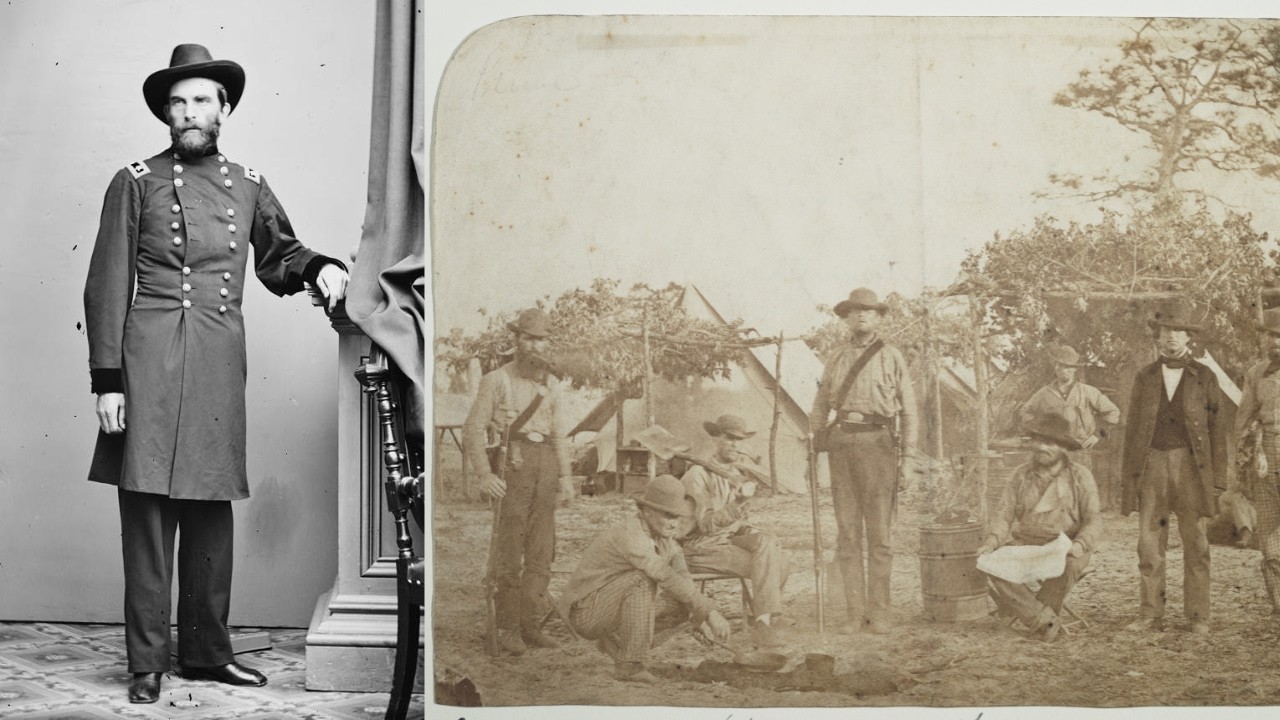
He was twenty-one years old, brown-haired, thin-faced, wearing a coat that was not quite a Confederate uniform and not quite anything else. His name was Sam Davis. He had been born in Rutherford County on October 6, 1842, on a farm in Smyrna, north of the hill the wagon was now climbing. His mother had named him Samuel.
His friends had always called him Sam. The reins were held by a Federal driver he did not know. Walking alongside the wagon were soldiers of the 81st Ohio Infantry, the regiment assigned to carry out the sentence. Some carried their rifles reversed.
Some looked at the ground. One of them was a young chaplain named James Young, who had spent the previous night in the cell with Davis, praying and singing an old hymn, “On Jordan’s Stormy Banks I Stand. ” Young could not look at the wagon now. Davis could see the gallows on the height: two upright posts, a crossbeam, a rope.
He could see a small crowd of townspeople in the distance, holding their hats against the rain. He could see soldiers forming an open square around the place where the wagon would stop. If he turned his head, he could also see the Pulaski jail behind him, growing smaller as the wagon climbed. Inside that jail, four cells down from the one where Davis had slept, there was another man.
He had been arrested two days before Davis. He was being held under an assumed name. He commanded a small Confederate reconnaissance unit called Coleman’s Scouts. His real name was Henry B.
Shaw. His code name was Coleman. Union officers in Pulaski had been hunting him for months. They were about to hang the man who had ridden with him, and they did not know they had already caught him.
Sam Davis knew. He had known since the moment the guards walked Shaw past the window of his cell. He knew it in the courtroom when Union officers put papers in front of him and asked him for a name. He knew it when General Grenville M.
Dodge, the Union commander in Middle Tennessee, sent a written offer to his cell: a pardon, waiting for his signature, in exchange for one word. Davis never said that word. The wagon stopped a few yards from the gallows. Soldiers of the 81st Ohio moved to unload the coffin.
A Union officer stepped forward. According to the most contemporary account we have, a clipping from the Pulaski Chanticleer printed about a week later, that officer was visibly shaken. He could not steady his hand. He looked at the boy on the wagon and could not force himself to give the order.
Davis looked back at him. According to that same account, what Davis said was brief, short enough for a man to remember, short enough to be written down without embellishment: “I have done my duty, and now you do yours. ”
The officer wept on the scaffold platform. A reporter from the Cincinnati Daily Commercial was there, having come to cover the execution.
The crowd was silent, and the rain never stopped. On that hill that morning, every man present, North and South, blue and gray, soldier or citizen, carried the same question in his mind, the same question Grenville Dodge was still pondering in writing and print more than forty years later. How did a boy of twenty-one, with a written pardon waiting in his cell, climb onto a wagon and ride to a hill to be hanged, when all he had to do was speak one name? To understand what happened on that hill, you have to understand the land.
By the fall of 1863, Middle Tennessee was under no one’s real control. It was, in name only, under Union control. Federal armies had pushed through Nashville the previous year. The railroad line running south from Nashville through Columbia and Pulaski to the Alabama border was a lifeline for Union forces.
It carried supplies, men, horses, hardtack, ammunition. It carried the iron of war south to support the campaigns around Chattanooga and into Georgia. If the railroad fell, the campaign fell. Union commanders knew it.
But the country on both sides of that rail line was not friendly to the Union. It was farms and valleys and hills full of people with brothers and sons in Braxton Bragg’s Confederate Army of Tennessee, somewhere to the south, somewhere in the mountains around Chattanooga. The Confederate army was starving for information: what was moving on the railroad, when Federal garrisons were weak, which fortifications were finished and which were still raw earth. They needed eyes inside Union lines.
They got them. Those eyes were called Coleman’s Scouts. They numbered around a hundred. They were not spies in the strict sense.
They wore Confederate uniform whenever they could. They were enlisted soldiers in the Confederate army, not civilians. They were couriers and observers. They carried letters and maps.
They watched train movements. They counted tents. They listened in country stores. They moved at night, slept on farms, ate where they could.
Their leader was a Confederate officer named Henry B. Shaw, a steamboat captain on the Tennessee River before the war. He used the name Coleman to sign his orders and passes, so that even if any of his scouts were captured, the man at the head of the network stayed safe. Most of his scouts never met him by that name.
They knew him only as Coleman. They carried his signature, not his face. The Union commander at Pulaski, charged with protecting the railroad and clearing the scouts from it, was Brigadier General Grenville M. Dodge.
Dodge was about thirty-two years old that fall. He had grown up in Massachusetts, settled in Iowa, and was an engineer by training, the kind of officer who knew how to lay rails and read contour lines. He was not a cruel man. The officers who served under him loved him.
Ulysses S. Grant respected him and would later write it in his papers. Dodge had direct orders to find Coleman, break up the scouts, and keep the railroad open. He set up his headquarters in Pulaski.
He issued instructions that anyone caught carrying Confederate dispatches or wearing what he considered a disguise would be treated as a spy. The papers Sam Davis was carrying on November 20, 1863, were not ordinary papers. He had ridden through the night to a place called Minor Hill, about fifteen miles southwest of Pulaski. He had an old saddle, a tired horse, and a coat.
Historians have described that coat in different ways, sometimes as a Confederate jacket, sometimes as a Federal overcoat thrown over Confederate clothes. Two Union scouts were riding for Dodge that morning, Joseph Farrar and R. S. King, both of the 7th Kansas Cavalry.
They surprised Davis in thick woods along the river. They searched him. What they found in his saddle and on his person, according to the report sent to Dodge that night, included maps of Union fortifications at Nashville, a report on the strength of Dodge’s own division, a letter addressed to the provost marshal of the Confederate Army of Tennessee, and several newspapers carrying recent telegraph dispatches. The maps were the problem.
They were drawn with a level of accuracy no civilian or wandering scout could have produced. They had to have come from someone inside Union command at Pulaski. Someone close to Dodge. Someone with access to engineering reports and the disposition of Union forces.
When Davis was brought to Dodge’s headquarters that night, Dodge, looking at the papers spread on the table between them, realized that the most dangerous thing in the room was not the boy. The most dangerous thing was the name the boy would not speak. According to Dodge’s own account, written years later, the interview was polite. Dodge questioned him civilly.
Dodge laid out the stakes. Dodge told the boy that he understood Davis was just a courier, that the man Dodge really wanted was the one who had given Davis the papers, and that Davis could go home with a pass through the lines if he revealed the source. Davis listened. He did not answer.
He was returned to his cell. That is the contradiction at the heart of this story. A twenty-one-year-old private, unranked, barely educated, with no political stake in the high command and no reason to believe his death would change the course of the war, was offered his life in writing by a general who did not want him dead. All he had to do was answer one question.
He did not answer it. And the question that stayed alive in print and monuments and in the long private memory of a Union general who could not forget it was the simplest question in the story. Why? To get as close to an answer as the record allows, you have to walk through every part of those eight days, slowly, the way they actually happened.
Start with the ground. Middle Tennessee in November 1863 was cold country. The leaves were down, the rivers were up, the rain had been continuous, and the roads were mud. The Federal garrisons at Pulaski, Columbia, and Nashville were settling in for winter with tents pitched on muddy ground, wet blankets, and fires smoking in the damp.
Bragg’s Confederate army held the heights around Chattanooga, about a hundred miles to the southeast, and was about to be driven off Missionary Ridge in the worst defeat of his career. Davis was a few days from his execution, riding north with letters and maps, when that defeat happened. He would learn of it from a Union officer on the morning of his hanging. The country between the two armies was scout country.
It was small farms, women alone in houses after their men had gone, enslaved people whose owners were gone, public roads no one had repaired in two years. It was back-door country. If you knew the byroads, you could move between the armies. If you did not, you got lost or captured.
Sam Davis grew up in that country. He was born on a farm on Stewart’s Creek in Smyrna, a farm run by his father Charles. He grew up riding the byroads of Rutherford County. He attended the Western Military Institute in Nashville briefly in the year before the war.
When the war broke out, he joined the 1st Tennessee Volunteer Infantry, the “Rutherford Rifles,” alongside other boys he had grown up with. He fought in western Virginia at Cheat Mountain. He marched in the Valley Campaign under Stonewall Jackson. He was at Shiloh in April ’62, on that ground above the Tennessee River where the cherry trees were blooming and men were dying in the peach orchard.
He was at Perryville, Kentucky, in October of that same year. He was wounded twice. He was twenty years old and had seen more of war than most men see in a lifetime. At some point in late 1862, he was transferred to a smaller, quieter unit.
It was called Coleman’s Scouts. Captain Shaw, the man behind the alias, had been Sam’s schoolteacher before the war. Shaw recruited boys he knew, boys who were good riders, boys who knew the country. Sam Davis had all three qualities.
Which leads to the second factor. Who were the scouts, and why did the Union army treat them that way? The scouts were enlisted Confederate soldiers. That was their argument after the war, when the story was being shaped and polished.
They wore gray when they could. They carried their pay records and enlistment papers. They considered themselves armed soldiers. Under the laws of war as they understood them, an armed soldier, even one carrying dispatches or moving in the enemy’s rear, was a prisoner of war when captured.
Not a spy. He could be exchanged. He could not be hanged. The Union army did not see it that way.
Dodge did not see it that way. By the fall of 1863, a Confederate informant inside his command was draining Union efforts in Middle Tennessee. Every troop movement he authorized reached Bragg’s headquarters within days. Every fortification he ordered built showed up on a Confederate map within a week.
Dodge had become convinced, and the papers found on Davis now confirmed it, that this was not a network of farmers and women in cotton dresses. This was an organized operation run by a Confederate captain under an assumed name, using men in uniform as couriers. The way to break it was to break those couriers. The way to break the couriers was to hang one of them publicly, on a hill visible to the other ninety-nine, to show them what awaited.
That was the Union argument. It is worth stating without sneering. The man who made that argument was not a butcher. He was a general trying to keep a railroad open in a country that did not want him there.
The third factor is what Dodge saw on his desk that night after Davis was brought in. He saw, by his own description, that the maps were extremely accurate. He saw that the report on his own division was accurate down to the regimental level. He saw that one of the documents had almost certainly been drawn by someone who had recently been in the engineering tent at his own headquarters.
Dodge had a traitor. The boy sitting on the chair across the room knew who the traitor was. And the boy was twenty-one, a private with no rank to protect him, no political weight, no one negotiating his release. If Dodge could get the name from the boy, Dodge could clean his own house.
He could find the informant. He could court-martial him. He could close the leak and send word to his superiors in Nashville that he had broken up Coleman’s network. And if Dodge could not get the name, the boy could be used only one way: publicly, to frighten the rest of the network into stopping.
So Dodge tried, in the order the record allows us to see. He tried courtesy first. He asked plainly. He dangled the hope of mercy.
He ordered Davis returned to his cell. He tried a planted informant second. He sent a man into the cell next to Davis’s, a soldier named C. B.
Van Pelt of the 81st Ohio, disguised as a fellow Confederate prisoner, with instructions to befriend Davis and learn what he could draw out of him. According to what Dodge later wrote, Davis and the other scouts remained silent. They told the planted man nothing. He tried a court-martial third.
The military court sat at Pulaski. Davis pleaded guilty to carrying mail but not guilty to spying. He was convicted on both charges. He was sentenced to death by hanging.
Then, fourth, the offer. The offer was sent in writing by a junior officer carrying a sealed message from Dodge to the cell where Davis was held. The offer was repeated more than once. According to every contemporary account, including the Cincinnati reporters, Davis was told plainly what the bargain was: his life for one name.
Here the story becomes almost unbearable. About forty feet from the cell where Davis sat, in another cell inside the same Pulaski jail, was the man Dodge was hunting. Captain Shaw had been captured two days before Davis. He had been traveling alone through country he thought he knew well.
He was arrested under his alias, “Coleman,” suspected of being a Confederate civilian moving contraband goods. The Federal officers who brought him in did not know his real identity. They thought they had caught a small fish. They locked him in a cell.
They logged him in the books as a man named Coleman. They never connected that name to the alias they were hunting. But Sam Davis knew. He recognized Shaw when he was walked past his cell.
He said nothing. Every time the offer came from Dodge to the cell, every time the pardon paper was laid before him, Davis was being asked to give Dodge a name that was already inside the building. Shaw was only a few feet away. If Davis had spoken, or even pointed at the wall, the Union army would have had the man they wanted before sunset.
There is another figure in that jail, on the edge of the record. The family memory of the Davis family preserved his name, as did memories gathered after the war. He was an enslaved man. He was about the same age as Sam.
He had grown up on the Davis family farm in Smyrna. The two had ridden horses together on the back roads as boys. When Sam went to war, some accounts say the man went with him as his servant. According to later family memory, the two were close in the strange and impossible American way that two boys who grew up together sometimes were.
The enslaved man’s name, in one of those small ironies history sometimes hands you, was also Coleman. He was captured with Sam Davis. He was also held in the Pulaski jail. He was not under sentence of death.
He was held because he belonged to Sam. On the morning of the execution, according to family memory and postwar recollections, he was brought in to see Davis one last time. He begged him to speak. He asked Sam quietly to tell the Yankees what they wanted to save himself.
Sam shook his head. Then Coleman, the enslaved man, asked in some accounts whether he could speak himself. Sam said no. By every account that has come down to us, Sam refused to let the secret out by any road.
That image stays: two young men who grew up on the same land, standing in the same jail, in entirely different worlds, in entirely different bonds. One with everything to lose asking the other to stay silent. There is no clean way to talk about that. The institution of slavery sat beneath that conversation.
The institution of war hung over it. Both were trapped in something neither had built. Which leads to the night of the twenty-sixth. Sam Davis had a candle, paper, and a pen brought to him by Chaplain Young.
He had a Bible. He had a few hours. He wrote a letter to his mother. The letter survived.
The opening words are unadorned. They were copied by hand more than once before any postwar writer got to them. “Oh, how painful it is to write to you. I must die tomorrow morning by hanging by the Federals.
” That is the first line, the opening sentence of a letter from a twenty-one-year-old boy on the last night of his life. There is no rhetoric in it. There is no oratory. It is the writing of a son who does not want to tell his mother what he has to tell her and does it anyway.
He told her not to grieve. He asked her to tell the children to be good. He gave his father instructions on how to send his body home. He said he would leave some small belongings with the hotel keeper in Pulaski.
He signed the letter Samuel Davis. He folded it. Then he began to sing. Chaplain Young, who survived the war, remembered that night for the rest of his life.
He wrote about it later. He said Sam sang with what he called vigor. The hymn was “On Jordan’s Stormy Banks I Stand. ” Other prisoners in the jail, including a man named Joshua Brown who would later write about it, heard the singing from their cells.
Brown remembered watching Davis from the window the next morning and seeing him bow to the men at the cell windows as he passed. Brown said the boy’s last farewell to them was that bow. In the morning they came for him. The wagon was waiting in the jail yard.
The coffin was already on it. They put him in the wagon. He sat on the coffin. The rain fell on the wood and on his shoulders and on the mule team, and the wagon moved out of the Pulaski jail yard and up the muddy track toward the hill.
There are two ways to tell the rest of the story. There is the way the postwar writers told it, the polished version, the gallows speech, the words engraved on a hundred plaques, the phrase about a thousand lives, the line about dying ten thousand times rather than betraying a friend, the slow rise of the chin, the full-throated gallows address ringing across the square. And there is the way the Pulaski Chanticleer told it on December 2, 1863, six days after Davis was executed. The way the Cincinnati Daily Commercial correspondent told it, a man who came from Ohio to cover the execution and wrote down what he saw with his own hand before any cosmetic touches were added.
The way Joshua Brown, the fellow prisoner watching from the jail window, remembered it. The way the men of the 81st Ohio remembered it when they were old men. In that version, Davis spoke very little. He bowed to the men at the jail windows as he passed.
He climbed onto the wagon. He sat on the coffin. He rode up the hill in the rain. On the hill, a Union officer stepped forward and gave him news from the front.
Bragg’s army had been shattered at Missionary Ridge. The Union held the heights at Chattanooga. According to records held in the American Battlefield Trust collection, Davis listened. He said something quietly, something like, “The boys will have to fight their battles without me.
”
At the foot of the gallows, the Union officer in charge of the execution could not give the order. According to the most contemporary accounts we have, this man wept. He was, in some accounts, Captain Chickasaw of Dodge’s staff. He turned to Davis.
He said, in one version, that he wished to God he did not have to do this. Davis, according to that same account, answered with a brief phrase, something like, “Officer, I have done my duty. Now do yours. ” That is the most certain phrase we have.
That is the one a journalist wrote down within six days. A courier came up the hill one last time carrying a written offer from Dodge. The general did not want this hanging. The general spent the night at his headquarters waiting and hoping the boy would change his mind.
The courier put the offer before Davis on the wagon. According to every contemporary account, what Davis said was simple and brief. He asked, in essence, whether they wanted him to betray a friend. He said he would rather die.
Then he climbed the gallows. The chaplain prayed with him. The platform was opened. According to the regimental records of the 81st Ohio, it happened at half past ten in the morning.
The most famous phrases attributed to Sam Davis, the polished gallows speech with the thousand lives, the long defiant orations, were almost certainly never spoken at the foot of that rope. They were composed afterward, by men trying to make the death mean something bigger than it could bear on its own. That is not a criticism of those men. They lost a war.
They lost a great many young friends. They did what the survivors of every war have always done: they wove the dead into a story the living could live with. Beneath that ornament, the documented record is heavier in its own way: a boy who barely spoke, a Union officer who could not steady his hand, a general who gave an order and sat in his headquarters hoping it would not be carried out. What did Davis understand that the men trying to break his will could not see?
It was not heroism in the sense the postwar writers wanted to portray. Sam Davis did not climb onto that wagon believing he would become a hero on a monument. He was not thinking about the South. He was not thinking about a cause.
He was thinking about a man locked four cells away, a man who had been his schoolteacher when he was a boy, and a network of friends who would all be hanged if he opened his mouth, and whether the man he had decided to be at twenty-one could live with himself if he traded those men for his own life. That is a question stripped of all slogans. It is the question anyone faces at some point, even when the price is smaller. Do I betray someone who trusted me to save myself, when the betrayal is easy and survival is certain?
Davis decided he would not. He decided it quietly. He decided it more than once, over a week of decisions in a cold cell with the general’s offer on the table in front of him. He did not decide it loudly, in a long speech before a hundred witnesses.
He decided it the way most of us make our decisions: in silence, unobserved, more than once, in the dark. Grenville M. Dodge came out of the war and went on to build the Union Pacific Railroad. He became one of the richest and most influential railroad men of his generation.
He served in Congress from Iowa. He retired to Council Bluffs. In the 1880s he sat down to begin work on his memoirs. He hired an assistant.
The work eventually filled twenty-three volumes, what historians today call the Dodge Records. He kept coming back to the hanging. He kept writing about Davis. He kept retelling the details of the interview.
He kept publishing his memories, in various forms, of the boy who sat on the chair across from his desk, and the offer he made, and the answer he never got. He published a long account of it more than three decades after it happened. He was an old man by then. He had not forgotten.
That is the most honest touch in the story. Dodge did not write about Sam Davis because he believed in the Confederacy. He did not write about him because he doubted the order he had given. He wrote about him because something that happened on that hill, in that cold rain, in his name and by his order, had settled into him.
It broke something. It also showed him something in another man that he could never quite explain. He spent the last thirty years of his life trying to explain it. After the rope was cut, Davis’s body was brought back to Pulaski.
His father came to take it home. The story goes that the wagon carrying him home crossed the Tennessee River ferry, and that Union soldiers on the road, when they realized whose body was in the box, helped push the wagon up the hill on the far side. They raised their hats to the wagon as it passed. That roadside scene cannot be fully verified.
What can be said is that the story is consistent with what we know of how word of his death moved through both armies, slowly and without ceremony. The family buried him on the farm in Smyrna, in the family cemetery, on the rise above the house where he had been born twenty-one years earlier. The marker is small, and the field around it is open. The wind blows across those lowlands in November the same way it blew in 1863, the same way it blows now.
In 1909, forty-six years after his hanging, a bronze statue of Sam Davis was placed on the grounds of the Tennessee State Capitol in Nashville. The money was raised through private donations. Some of the contributions came from veterans of the Union armies. That detail matters.
The men who paid for Davis’s monument were not all Confederates. Many were old soldiers in blue, men who had been there or had heard the story from those who witnessed it, and who decided in their old age that the boy who refused to talk deserved to be remembered somewhere in stone. The family farm in Smyrna is now a museum. The Pulaski jail where Shaw sat is gone.
The hill where the gallows stood has been built over, swallowed by the town. Most of those places are unmarked. What remains is the question. Sam Davis was not a monster.
He was not the hero the postwar pamphlets painted. He was a twenty-one-year-old boy, barely educated, from a farm in Rutherford County, who fought in a war he was born too young to vote in, and when the moment came, decided not to save himself by betraying the man in the fourth cell. The Union officers who hanged him were not monsters either. They were soldiers carrying out an order under a sky that rained on them too, performing a duty at least one of them could not finish without weeping.
Their general carried the memory of that day with him for the rest of his long life. He built a railroad across a continent. He sat in Congress. He died a wealthy man.
And in his final years, in a quiet house in Iowa, he was still writing about Sam Davis. They were not monsters. They were not heroes.
They were human, and they were there.
