In 1967, a thirty-one-year-old mother of four was branded with a word that British high society wielded with devastating precision. A “bolter” was a woman who had abandoned her marriage, her children, and her entire aristocratic existence for another man. The label was permanent. Names were struck from invitation lists, and whispers followed her from Cornwall to Caithness.
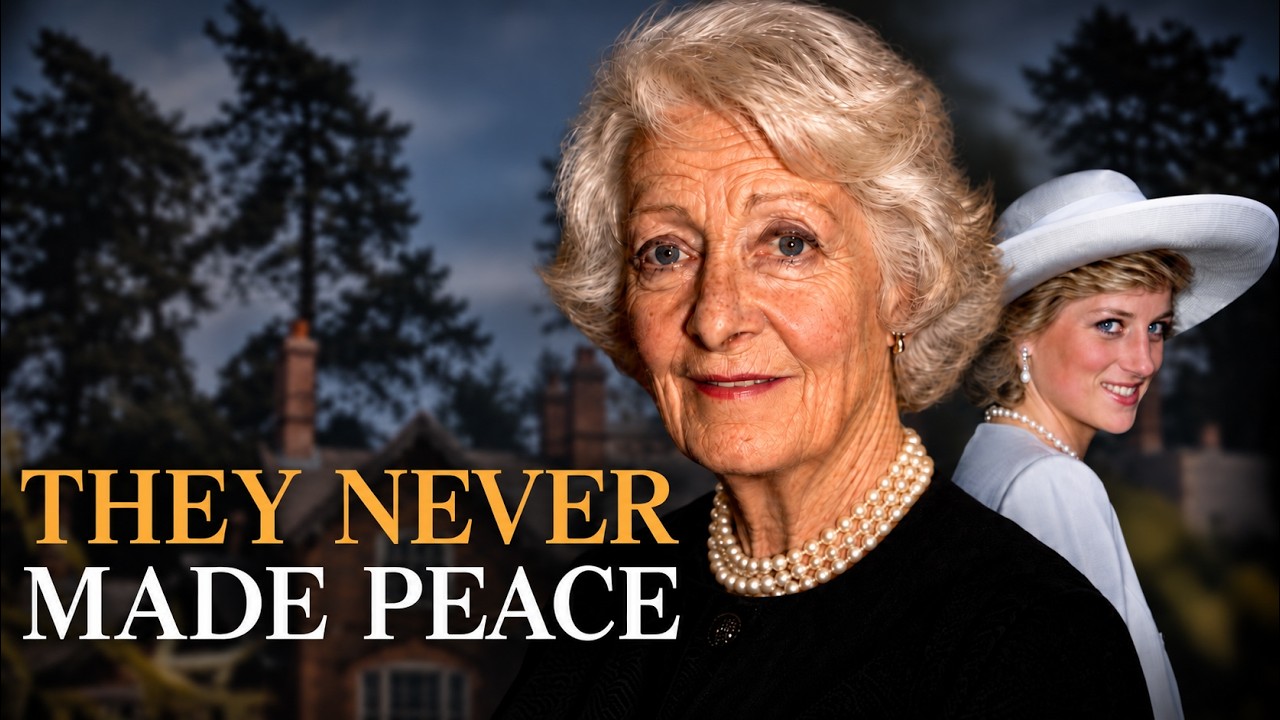
For the next three decades, the press treated Frances Roche as though she had committed an unforgivable sin—yet most accounts omitted what this same woman endured: she raised one of the most famous women of the late century, lost a son who lived only ten hours, lost three more children because she testified against her own mother in court, and later watched her daughter die in a Paris tunnel while they were not speaking. The tabloids had their word for her. The fuller story was far more complicated. Frances Ruth Burke Roche was born on January 20, 1936, in Park House, a grand Victorian residence on the Sandringham Estate, lent to her parents by King George V himself.
Her father, Maurice Roche, was the fourth Baron Fermoy, an Irish title rooted in centuries of family history in County Cork. Her mother, Ruth, was an accomplished pianist with a steel-hard personality—one that would decades later lead her to testify against her own daughter in a custody battle. A more unusual branch of Frances’s family tree ran through her great-grandmother, an American heiress whose father, a New York stockbroker, so despised European aristocrats that he inserted a clause in his will: any descendant who accepted a British title would forfeit their inheritance entirely. The family accepted the title anyway and quietly worked around the condition.
Ruth Fermoy later served as a close confidante of the Queen Mother for thirty-seven years, which made the royal family a regular, unremarkable presence in Frances’s childhood. Raised in the traditional aristocratic mold—ponies, nannies, governesses, boarding school in Essex, and a finishing school in Paris—Frances emerged at seventeen as a tall, golden-haired beauty. Her debut into society came during the 1953 London season, a carefully choreographed ritual in which young women of privilege were presented at court and paraded through dances with an unspoken purpose: finding a husband. It was the year of the coronation, making it the most photographed season in a generation, and into that spotlight stepped Edward John Spencer, Viscount Althorp—known to everyone as Johnny.
He was thirty, heir to an earldom, and still recovering from a broken engagement. Frances was eighteen. The age gap raised a few eyebrows in 1950s Britain, but no more than that. Their engagement was swift, and on June 1, 1954, they married in Westminster Abbey, with Queen Elizabeth II, Prince Philip, and the Queen Mother in attendance.
The papers called it the social wedding of the year, and for once they were not exaggerating. As Viscountess Althorp, Frances moved into the Spencer estate to perform the duties expected of an aristocratic wife in the 1950s: produce children, especially a son, as quickly as possible. Sarah arrived on February 19, 1955—a good start, though not the boy the family wanted. Jane followed on February 11, 1957.
Beautiful, healthy, but in the blunt practical language of aristocratic inheritance, another disappointment. The pressure mounted. Nothing was said directly to Frances, but she understood from the silences, the pointed questions, and her husband’s private appointments with Harley Street specialists. On January 12, 1960, a son was finally born.
They named him John, after his father. He lived only ten hours. The medical records were vague, and the family kept the matter deeply private. What is known is that he was born with serious complications and died within a day, before Frances, still under anesthesia, could hold him.
She woke to the news instead of her child. Johnny Spencer’s response said a great deal about their marriage: he decided the failure was hers, and sent her to Harley Street for tests to determine why she could not produce a healthy son. His wife had just lost a male infant, and his reaction was to have her examined like ailing livestock. On July 1, 1961, she gave birth to her third daughter, Diana, who arrived in a delivery room where her parents’ disappointment was plain.
The most photographed woman of the late twentieth century began life greeted as an obstacle rather than a cause for celebration. It was not until May 20, 1964, with the birth of Charles, that the family finally got the heir they had spent a decade demanding. By then, something inside Frances had broken. Between miscarriages, the invasive medical examinations, grief for John, and years of being judged against a single biological expectation, she could no longer hide her devastation—though she was still in her twenties.
When her father died in 1955, the lease on Park House passed to the Spencers, and Frances returned to the house where she had been born to watch her marriage slowly collapse. From the outside, life there looked idyllic: four children running across Norfolk lawns, playing with the royal children next door. The inside was another story. Diana later described a specific childhood memory to her biographer Andrew Morton: seeing her father slap her mother across the face while she hid behind a door, and hearing her mother cry.
The journalist Penny Junor, who wrote extensively about the family, reported the same: “Johnny could be violent,” Junor said. Frances began secretly planning to take herself and her children somewhere safer. None of this excuses what followed, and it does not need to. It simply means that when Frances finally left, the popular story of a restless aristocrat abandoning her family for excitement was at best an incomplete account.
In 1966, Frances met Peter Shand Kydd, an Australian-born heir to a wallpaper fortune. He was forty-one, married, and the father of three—warm and easygoing in ways that Johnny Spencer’s stiff aristocratic bearing was not. He laughed easily. When women spoke, he listened.
Frances fell in love, and their secret affair ran on the peculiar rules of London high society, where secrets lasted at most forty-eight hours. In late 1967, Frances did what aristocratic wives were not supposed to do: she moved with her two youngest children, Diana and Charles, to a house in Belgravia, intending a trial separation while the older girls were away at boarding school. Johnny’s plan was entirely different. When the children visited Park House for the Christmas holidays, he refused to send them back.
He packed their school trunks himself, hired lawyers, and sued for custody. Frances, alone and childless in London, soon discovered she had no legal standing in the court that would decide her family’s fate. The courts of 1968 saw everything almost entirely from Johnny’s perspective. Custody records from that era were sealed then and remain largely sealed today, so no public transcript exists.
What survives are accounts from biographers and family members, leaked gradually over decades. Frances was certain she would win. She was the mother, the children were young, and by any modern standard the case was straightforward. But Britain in 1968 was not modern Britain.
The legal system had no hesitation punishing a woman who had left her husband for another man. Adultery was taken seriously in family court, and character witnesses carried enormous weight. Among those called to testify was Frances’s own mother, Ruth Fermoy, the Queen Mother’s loyal lady-in-waiting, who took her son-in-law’s side against her daughter in open court. Whatever her testimony was, the outcome was not in dispute.
Frances lost completely. All four children went to Johnny, leaving her only limited weekend access. The divorce was finalized in April 1969. She was thirty-three, and the British press hammered her with the word “bolter” repeatedly until it became a permanent verdict on her character rather than a description.
Diana never fully recovered from the loss of her mother. She told Andrew Morton she remembered lying in bed at Park House crying while listening to her younger brother calling for a mother who was no longer there. The sound of her mother’s car crunching over the gravel on the night she left stayed with her for decades. On May 2, 1969, Frances married Peter Shand Kydd.
The second wedding bore no resemblance to the first. No Westminster Abbey, no queen in the front row—just a small, quiet ceremony far from London’s social circles. She wanted to disappear from public view. A farmhouse on the Isle of Seil, a small island off Scotland’s west coast connected to the mainland by a stone bridge, gave her that chance.
Frances took up salmon fishing seriously and, by all accounts, became skilled at it. She walked for hours across open moorland. She sat with farmers in the local pub who had no interest in her aristocratic past. For the first time in her life, she was simply Frances, without title or rank.
She opened a small gift shop in the nearby town of Oban, selling tweed scarves and shortbread to tourists who had no idea the woman taking their money was the mother of the future Princess of Wales. Her marriage to Peter lasted nearly fifteen years of quiet contentment, a kind of ordinary domestic happiness her old London acquaintances could not have imagined. Her daughters, especially Diana, came north whenever they could, slowly mending the relationship severed by the 1968 court ruling. In November 1977, sixteen-year-old Diana met Prince Charles at the Althorp estate, where Charles was dating her older sister Sarah.
Their romance proper began later, in 1980, and by February 1981 they were engaged. Frances, hidden away on her island, was forced back into the world she had tried to leave forever. On July 29, 1981, the royal wedding took place at St. Paul’s Cathedral, watched by an estimated 750 million people worldwide—one of the most-viewed events in human history at the time.
Frances attended, though the seating arrangements were a silent monument to everything that had happened. She and Johnny, divorced for more than a decade, could not be placed anywhere near each other, so the organizers seated Diana’s parents on completely opposite sides of the cathedral. Johnny, his health already fragile after a stroke, walked his daughter down the aisle on sheer willpower. Frances watched from her assigned seat the wedding of the daughter she had lost custody of in 1968.
Her first grandson, Prince William, was born within a year. Throughout the 1980s, Frances occupied a strange position: mother of the world’s most talked-about and photographed woman, yet a divorced aristocrat who deliberately stayed as far from cameras as possible. She gave no interviews and made no comments. From Scotland she watched Diana’s marriage begin to unravel, an uncomfortable echo of her own past.
Rumors about Charles and Camilla emerged, and Diana’s struggles with bulimia and depression became public—each issue mirroring what Frances herself had experienced a generation earlier. There was a silent precedent of private suffering in the family: Diana’s older sister Sarah had suffered from anorexia in her early twenties. Frances supported her daughter during hard times, but she was not by nature a warm or nurturing person. Diana needed someone to sit beside her and hold her hand; Frances was more accustomed to telling her to go on long trips and throw herself into work.
This fundamental difference in emotional style was something both women expressed to those closest to them. Meanwhile, Frances’s own second marriage was quietly falling apart for reasons neither side ever fully disclosed. By 1988, Peter had left. Their divorce was finalized in 1990, leaving Frances, at fifty-four, twice-divorced and alone on a remote island.
Rather than sinking into despair, she did something nobody expected. In 1994 she formally converted to Roman Catholicism. For a woman raised in the Church of England, it was a far bigger step than it might seem, because she was connected by blood and long friendship to a royal family that had been institutionally hostile to Catholicism for four and a half centuries. In her own quiet way, without saying a word, she signaled to her old world exactly what she thought of it.
Her faith was devoted to the HCPT Pilgrimage Trust, a British Catholic charity that organizes annual trips to Lourdes for sick and disabled children. Year after year, even as her health declined, Frances went, pushing wheelchairs through the narrow streets of the French shrine and refusing any special treatment as the mother of a princess. Every volunteer who worked with her told similar stories: she simply showed up and did the work, without cameras or fuss. In 1996, she was convicted of drunk driving on winding Scottish roads, banned from driving for fourteen months, and fined without protest.
It became national news only because of her daughter’s identity. She was deeply humiliated, though she privately admitted she was entirely responsible. That August, Diana’s marriage to Charles was officially dissolved, costing her the title Her Royal Highness—a protocol decision that caused uproar in the press on both sides of the Atlantic. That spring, Frances, then sixty-one, told Hello magazine that losing the HRH title was “extraordinary” and described it as an opportunity for Diana to be freed to live outside royal constraints.
From Frances’s perspective, shaped by a lifetime of trying to escape the same aristocratic limitations, it was sincere encouragement. Diana saw it as a massive public insult from her own mother, read by the world over breakfast. She reacted as she often did when hurt by someone close: she went silent, and stayed silent for a long time. In June 1997, a phone call changed the rest of their relationship permanently.
Diana, then involved with Hasnat Khan, a Pakistani-British heart surgeon, asked her butler Paul Burrell to listen secretly to a conversation with her mother. Testifying under oath at the official inquiry into Diana’s death, Burrell described what he heard: Frances criticized Diana’s relationship with a Muslim man and called her own daughter a “whore,” adding that she was “going around town with Muslim men. ” After that call, Diana decided not to speak to her mother again. Two months later, on August 31, 1997, Diana died in a car crash in the Pont de l’Alma tunnel in Paris.
Mother and daughter had not spoken since that call, and now they never would. Diana’s brother Charles Spencer delivered the eulogy at Westminster Abbey—the same place where, nearly forty-three years earlier to the week, his mother had been married. Frances attended in the stiff, unyielding manner of her generation, which did not grieve in public, even at her own daughter’s funeral before a watching world. In the years that followed, she quietly maintained relationships with her grandsons William and Harry, largely out of the media’s sight.
In October 2002, Frances, then sixty-six, was called to testify in Paul Burrell’s theft trial. Under cross-examination, she was forced to admit publicly that she and Diana had not spoken in the months before her death and to answer allegations of verbal abuse in those final calls, which she denied firmly under oath. The trial collapsed weeks later on a technicality, but the damage to her privacy had been done. Her painful final chapter with her daughter was again splashed across every front page.
By then, Frances was silently battling two illnesses the public barely knew about: Parkinson’s disease and, diagnosed in the early 2000s, a brain tumor. She attended her parish church in Oban as long as her body allowed and turned down every interview request that came her way. On June 3, 2004, Frances Shand Kydd died at her home on the Isle of Seil. She was sixty-eight.
Her funeral was held at the Cathedral Church of St. Columba in Oban, attended by William and Harry, Charles Spencer, and her two surviving daughters. Prince Charles was noticeably absent. She was buried under a simple stone in the cemetery at Pennyfuir, outside Oban, bearing only her name and dates.
No Westminster Abbey, no royal procession—just a quiet grave in Scotland with the neighbors who had truly known her. It was a very different ending from the version the tabloids had built for thirty years around a single cruel word. Frances Shand Kydd was a woman who had lost more than most: a son, a marriage, four children in a courtroom, and finally a daughter in a Paris tunnel. Near the very end of her life, confined to bed and unable to make the annual trip to Lourdes, the HCPT volunteers she had worked with for a decade sent her the shrine’s holy water in a small vessel, placed beside her bed on the distant Isle of Seil.
She kept it there until she died. For the woman the press had reduced to a single word, that small vessel was something worth holding onto until the very last.
