In March 1945, with the Rhine the last natural barrier shielding the German heartland, Field Marshal Bernard Montgomery spent weeks preparing the largest river assault in history. Three thousand guns, an entire airborne corps, and the world’s press were assembled for the spectacle. On the night before it was to begin, four words passed quietly through Allied headquarters, spoken in a tone men use when they are not sure they are allowed to say something at all. Patton crossed the river last night.
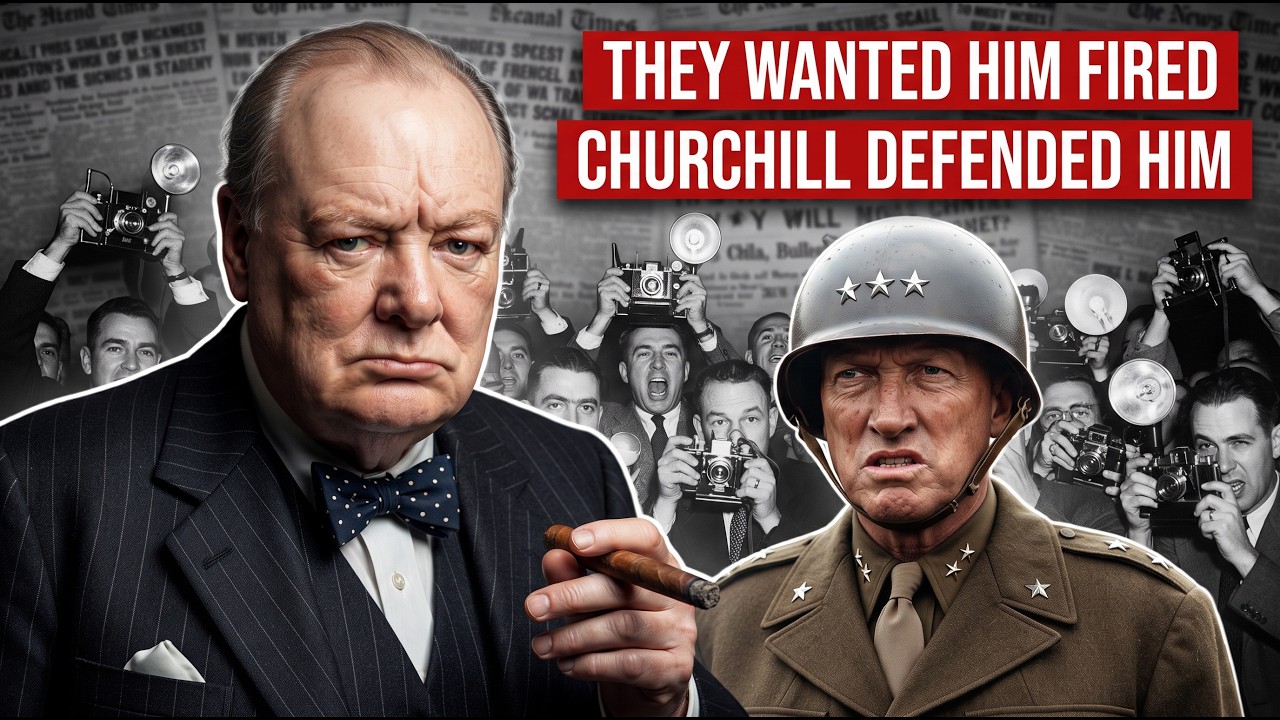
Not with Montgomery’s massive army, not with a single preparatory artillery round, but with wooden boats, a full moon, and a stretch of river no one was guarding. The man who did it had been stripped of command in Sicily, nearly sent home for a sentence spoken at a tea party, and abandoned by half of Washington. Yet there he stood in the middle of the Rhine. And the only voice that kept saving him belonged to a cigar-smoking Englishman in his seventies.
Before Montgomery’s great offensive began, word spread through Allied headquarters that Patton had already crossed far to the south, his Third Army slipping over the river in assault boats under darkness and building a new bridgehead before the Germans could respond. It was exactly the kind of move that had made George Patton famous. But for eighteen months, his own side had repeatedly wondered whether he was too dangerous to keep in command. In the summer of 1943, Sicily was the first piece of occupied Europe the Americans took in force.
The island punished them. Rocky hills without cover, roads that were really goat trails, villages stacked on ridgetops where a single German machine gun crew could hold a battalion for half a day. The heat pressed on the back of the neck, water was rationed, malaria was everywhere. Into this landscape came a 57-year-old American lieutenant general who had spent his entire adult life waiting for this moment.
George Smith Patton Jr. had been a soldier since before World War I, chased Pancho Villa across northern Mexico, led the first American tanks at Meuse-Argonne in 1918, and spent the long empty years between wars reading Caesar, Napoleon, and Rommel in their original languages, waiting for the world to need him again. The invasion plan gave Montgomery’s Eighth Army the main attack along eastern Sicily, while Patton’s Seventh Army landed on the southern coast to protect the Allied left flank. Montgomery was a small, sharp-minded man who had beaten Rommel at El Alamein.
He had also survived the worst battles of the First World War, shot through the chest and left for dead until a sergeant covered his body and took the bullets meant for him. Montgomery had seen a generation of young men fed into machine guns by careless commanders, and he decided he would never be one of those leaders. He would build his forces methodically and move only when the calculations were entirely in his favor. Patton chafed at the limited role initially assigned to his army, but the situation changed when the British advance stalled against strong German positions south of Catania.
While Montgomery was stuck, Patton raced west and captured Palermo in a spectacular dash that put the Seventh Army on front pages but left the Americans farther from Messina, not closer. General Harold Alexander then authorized Patton to advance east along the northern coastal road, and the race was on. Patton drove his divisions on foot through mountains in heat that cracked lips and blistered skin, launched three small amphibious landings behind German positions, and fired officers who told him a road could not be used. On August 17, 1943, American troops entered Messina.
Montgomery’s men arrived hours later. Patton had won the race in 38 days. He had only two weeks to be the most famous general in the United States Army. On August 3, while the race was still underway, Patton stopped at the 15th Evacuation Hospital in central Sicily.
He routinely visited wounded men, walking the rows of beds, kneeling beside dying boys, sometimes pinning Purple Hearts to pillows. That day he passed a soldier sitting hunched on a stool with no bandages on him. The man was Charles Herman Kuhl from Indiana, a private in the 26th Infantry Regiment. Patton asked where he was hurt.
Kuhl said he was nervous, that he simply could not take it anymore. Patton called him a coward, struck him across the face with his gloves, grabbed him by the collar, dragged him to the tent entrance, and shoved him outside into the sunlight. Kuhl was later found to have a fever of 102 degrees and a history of chronic diarrhea, with records documenting acute combat exhaustion. He was genuinely sick.
Seven days later, Patton did it again. At the 93rd Evacuation Hospital, he found a gunner named Paul Bennett trembling on his cot. Bennett had been in the field since March, had twice asked to return to his unit, and had watched a close friend die beside him days earlier. Patton screamed at him, called him a coward before the entire ward, said men like him should be lined up and shot, and according to officers and nurses present, drew one of his ivory-handled pistols and waved it in the sick man’s face, then struck him hard enough to knock his helmet liner rolling across the floor.
The reports moved up the chain of command and within a week were on the desk of the one man in the theater who could end Patton’s career with a single signature. Dwight Eisenhower had known Patton for a quarter century. They had served together at Camp Meade after the First World War, two young officers taking a tank apart in a garage just to learn how it worked. Patton had been the senior, the more brilliant one, the famous cavalryman with money and a name.
Eisenhower had been the quiet man no one had heard of. Now the quiet man held the other’s future in his hands. Eisenhower did not want to lose Patton. He wrote privately that no other American general could lead an army the way this man could.
But he ordered Patton to apologize personally to Kuhl, Bennett, and the medical staff who had witnessed the incidents, then to each division of the Seventh Army. The men would not let him finish speaking. They cheered before he could get the words out. Kuhl eventually returned to duty and served honorably.
So did Bennett. For three months the whole affair stayed quiet, with reporters in Sicily agreeing to suppress it because they believed the war mattered more. Then on November 21, 1943, a radio commentator in Washington named Drew Pearson went on air and told the country everything. The reaction was an explosion.
Editorials demanded Patton’s resignation. Letters poured into the War Department by the thousands, many from mothers with sons in Italy asking how they could trust a man who struck soldiers. Congressmen spoke of stripping him of rank. The British press picked it up and hammered it.
Questions were raised in London about whether such a man should take part in the invasion of France. Eisenhower kept him, because Chief of Staff George Marshall had studied the matter and concluded Patton’s military value still justified the risk. But Eisenhower kept him without a combat command. Patton spent the last months of 1943 in a kind of professional limbo, a general with no role while the war went on without him.
He wrote in his diary that he was being destroyed, that the only thing he was good at in 58 years of life was being taken from him because of two minutes inside a tent. He could not understand how his world had changed so completely while he stayed the same. By January 1944, Patton was assigned to command the Third Army in England, though it would not enter combat until summer. Before that happened, he opened his mouth again.
On April 25, 1944, women of Knutsford, a market town in Cheshire, opened a welcoming club for American soldiers waiting for the invasion of France, and asked a nearby American general to say a few words. They were told he would attend personally, no press, nothing prepared. He arrived late, tried to slip in the back, was pushed toward the front, and stood before about 60 people, mostly middle-aged Englishwomen, and spoke without a note. He said that since it was evidently the destiny of the British and Americans to rule the world, the better the two peoples got along, the better their task would go.
There was a reporter in the room. Within 24 hours the sentence was in London newspapers. In published versions, Patton had named the British and Americans while ignoring the Soviet Union, which in April 1944 was bleeding itself white on the Eastern Front killing more Germans than everyone else combined. Moscow noticed, Washington noticed that Moscow noticed, and a remark at a Cheshire tea party became a diplomatic crisis involving three of the four largest powers on earth.
Six weeks before D-Day, Eisenhower wrote to Marshall asking what he wanted done, saying he did not believe Patton could be trusted to behave like a mature person in public. Marshall responded by doing the hardest thing a chief can do for a subordinate. He returned the decision to Eisenhower, telling him the choice was his alone and would be supported, based only on military needs. For several days in early May 1944, Patton’s career hung on one man’s calculations.
In the midst of those days, Eisenhower discussed the matter with Winston Churchill. The prime minister, 69 years old, had been a cavalry officer in the Sudan in the 1890s, captured and escaped during the Boer War, sent men to die at Gallipoli and carried that burden the rest of his life. He had spent four years watching papers turn small things into large things and had developed a great contempt for the process. Churchill told Eisenhower he saw no problem, because Patton had simply told the truth.
An American general had insulted the Soviets, embarrassed the United States, and been portrayed in the British press as a fool, and the man who dismissed the whole affair was the head of the British government. Eisenhower kept Patton. But he kept him as one keeps a loaded weapon in a locked drawer. Patton would command no army group, would not lead the invasion, would not be told its date.
Instead, he was made the visible face of one of the greatest deceptions of the war. The phantom First United States Army Group became the heart of Operation Fortitude South. In Kent, engineers set up inflatable tanks, dragged rollers behind trucks to leave track marks in the grass, lit cooking fires at the right times, moored wooden landing craft in streams and let the paint weather. From the air and from double agent reports, southeast England looked exactly like a marshaling area for the largest invasion in history.
At the top of this spectacle, walking through those fields in his polished helmet for German reconnaissance planes that were carefully allowed to pass and photograph him, was the only American general the Germans took seriously. German intelligence had assessed Patton as the most dangerous field commander the Americans possessed, and when they saw him in Kent they concluded the main blow would fall at the Pas de Calais. On June 6, 1944, the Allies landed in Normandy, 150 miles from where German high command had been watching. For weeks after the landing, while Allied divisions struggled through the hedgerows and the outcome remained genuinely in doubt, the German Fifteenth Army sat north of the Seine waiting for Patton.
Nineteen divisions, some of the best infantry Germany still had, stayed behind the Atlantic Wall watching an empty sea. The formations that could have reinforced Normandy were pinned by the threat that was never coming. Even into mid-July, German intelligence reported that the main invasion had not yet begun. The irony was that Patton’s punishment had made him the most effective lie in military history.
His humiliation had turned him into a weapon. Finally unleashed on August 1, 1944, the Third Army became operational in Normandy. For the first time since Sicily, Patton had an army in the field and the authority to use it. His columns broke out at Avranches and simply kept going.
They took Le Mans, Orléans, Chartres, Troyes. Rivers that planners had allotted days to cross were crossed in hours. They cut distances at rates that shattered the army’s own planning assumptions. Supply officers could not find the front because it was constantly moving.
For a few weeks in late August, some intelligence officers believed the German army in the West was on the verge of total collapse. Then the Third Army stopped. Not because of the Germans. It stopped because Patton’s tanks had nothing to drink.
Every gallon of fuel consumed in France that summer had to be shipped over open beaches, then trucked over roads that consumed fuel themselves. Eisenhower gave greater logistical priority to the First Army and Montgomery’s 21st Army Group. The Third Army’s daily fuel ration plummeted from about 400,000 gallons to barely 30,000 within days. The Red Ball Express, the famous one-way truck route running night and day from the Normandy beaches, was consuming nearly as much fuel to deliver supplies as the combat units received at the end of the line.
It was a system eating itself. September came gray and rainy, and the muddy fields took the shoes off the men who walked in them. In front of Patton, across ground that had been open in August, the Germans were doing the one thing the Third Army had never given them time to do. They were digging in.
Every hour those tanks remained still was another hour of trenches dug, guns zeroed, fortifications restored around Metz. The cost of taking Metz was severe. By the time Lorraine was secured, the Third Army had suffered more than 55,000 casualties since crossing the Moselle in September, more than all the weeks of the great August pursuit. On December 16, 1944, everything else stopped mattering.
Three German armies came out of the Ardennes forest through fog and snow, hit the weakest point in the American line, and opened a 50-mile gap. Two regiments of the 106th Division were overrun at Schnee Eifel, most of their men captured. At Malmedy, prisoners from an artillery observation battalion were herded into a field and shot. Bastogne was surrounded, where seven main roads met in a pattern that made it the key to the whole southern flank of the German attack.
The 101st Airborne held the center of the defense, but they were not alone. For days the garrison was cut off from normal ground supply, and the weather initially blocked airdrops too. When the Germans sent a delegation under a white flag to demand surrender, the acting division commander, Brigadier General Anthony McAuliffe, gave the war’s most famous one-word reply. On December 19, Eisenhower called his senior commanders to a cold barracks in Verdun, the name every man in that room had grown up hearing, where the French army had nearly bled to death in 1916.
Eisenhower opened the meeting by telling them he wanted them to see this as an opportunity, not a disaster. Then he asked the only question that mattered. How soon could someone strike the southern flank of the German penetration? The answers were cautious, weeks, early January.
The Third Army was facing east, engaged with the enemy, committed to an attack in a completely different direction. Patton said he could attack with three divisions in 48 hours. What the room did not know was that Patton had already done the work. Two days earlier, watching the first reports from the Ardennes, he had sat with his staff and drawn up three separate plans, each keyed to one code word.
He excused himself from the table, went to the telephone, spoke one word to his headquarters, and an entire army began turning. The Third Army attacked on December 22, three days after the meeting. The men were pulled from a line they had been fighting on, ordered to turn around, and put on roads in the worst European winter in decades. Vehicles slid off icy curves into ditches.
Trench foot took men out of the line by the hundreds. Some men died in their vehicles from the cold without ever seeing a German. They kept moving north through Arlon, through Luxembourg, through villages where the civilians had already taken down the American flags they had hung in September, because they had seen this direction of travel before in 1940 and knew what it usually meant. On December 26, tanks of the 4th Armored Division broke through to Bastogne.
The fighting around the town continued for weeks in appalling conditions, but the siege was broken. The change of direction became one of Patton’s most celebrated military achievements, a large-scale improvised maneuver few commanders in any army had ever pulled off under combat conditions. The man was unbearable, erratic, and politically reckless, but on December 19, 1944, his value outweighed all of it. Then, seventeen days after Patton was relieved, Bernard Montgomery held a press conference.
When the German attack split the American front in mid-December, the northern half of Omar Bradley’s command was effectively cut off from his headquarters, and Eisenhower made a purely practical decision to place those American divisions temporarily under Montgomery because he was the nearest senior commander who could actually communicate with them. It was a logical decision. But to American ears it was a British field marshal taking command of American armies in the middle of an American disaster. On January 7, 1945, Montgomery met the press.
He praised the American soldier. He said their fighting quality was superb. He spoke well of Eisenhower. Then he described the battle, how he had been called in, taken control, sorted out the front, and beaten the enemy.
Standing before the world’s correspondents in a maroon airborne beret he had no particular right to wear, he explained in the first person how the Battle of the Bulge had been managed. The published reports left Americans reading between the lines that they had failed, been rescued, and that the rescue had been performed by an Englishman. German propaganda amplified the rift, broadcasting a distorted version to deepen it. Bradley, the most patient of the senior American generals, told Eisenhower he could not serve under Montgomery and would resign first.
When Patton heard of it, he told Bradley that if Bradley resigned, he would resign with him. Two of the three American army commanders in Europe were seriously discussing, over several days in January 1945, leaving the war. On January 18, eleven days after Montgomery’s press conference, Winston Churchill stood in the House of Commons to speak about the fighting in the Ardennes. He had every political reason to do the opposite.
Montgomery was Britain’s soldier, the popular hero, and the British public had spent a week reading that their field marshal had repaired an American mess. Churchill dismantled all of it. He told the House that the Americans had engaged almost all the troops and borne almost all the losses, that British contribution had been modest, and asked them plainly not to exaggerate it. Then he delivered the line that has survived everyone present that day.
He described the battle without question as the greatest American battle of the war, and said he believed it would be regarded as an ever-famous American victory. The prime minister of Great Britain had stood in the British Parliament and publicly stripped credit from the most famous living British general to return it to the American soldiers who had paid for it. The resignation talk faded. Bradley stayed.
Patton stayed. The alliance held together because an old man in London decided the truth of the Ardennes mattered more than politics. In the weeks after the battle, the Third Army turned south and broke through the Palatinate in one of the fastest armored advances of the war. By mid-March, the west bank of the Rhine from Koblenz to Mannheim was in American hands, and the river itself was the only barrier left between Patton and the depths of Germany.
The deliberate plan to cross the Rhine in force belonged to Montgomery, Operation Plunder, near Wesel in the north, the most carefully prepared river crossing in military history. Thirty divisions, bridging equipment measured in acres, amphibious vehicles moved under camouflage nets, smoke generators running for days, 3,000 guns laid and waiting, an entire airborne corps ready to drop behind the German defenses. Montgomery set the date himself. March 23.
Two hundred miles south, on a quiet bend of the same river near the towns of Nierstein and Oppenheim, Patton had spent two weeks collecting boats. Small wooden assault boats, outboard motors, pontoon sections, all moved by truck at night and hidden in the towns behind the river. His staff studied the east bank and found something remarkable. The German units that should have been defending that stretch had been shattered in the Palatinate fighting, and what remained had been pulled north to face the obvious threat at Wesel.
The strongest natural barrier in Europe was being guarded south of Mainz by remnants whose only existence was on paper, old men from Volkssturm battalions handed rifles and told to point them at the river. At ten o’clock on the evening of March 22, the 11th Infantry Regiment of the 5th Infantry Division began its crossing. No artillery preparation, not a single round, because a barrage was an announcement, and Patton had decided his only advantage was that no one across the river expected anything at all. There was a full moon.
The river was lit up. The men could see each other, the boats ahead of them, the east bank approaching. Every one of them knew that if a single German machine gun crew on that bank had been awake and alert, they would all have been exposed for the entire crossing. They rowed.
Some boats had outboard motors, most did not. Men of the first wave described the crossing the same way for decades afterward. They said the worst part was the silence. They kept waiting for the fighting to start.
It never did. The first boats touched the far bank, and the men climbed through the mud toward the trees and found almost nothing. A few panicked sentries, a handful of prisoners taken in their blankets. By 1:30 a.
m. , all three battalions were on the east bank with losses of about 20 men. By dawn, the bridgehead was solid, and engineers were ferrying heavy equipment across. On the morning of March 23, Patton telephoned Bradley.
Bradley recorded the call in his memoirs. Patton said, telling no one to tell anyone, that he had crossed. The careful Bradley asked what he had crossed. Patton said the Rhine, a whole division and parts of another, and that there were so few Germans they did not know it yet.
Six hours later, his tone had changed entirely. Officers in the room remembered Patton’s voice coming out of the telephone loud enough to hear across the tent. He told Bradley, for God’s sake, to tell the world they had crossed. He wanted the world to know the Third Army had crossed before Monty started.
The announcement was made, and American newspapers printed it in the largest type they had. On the night of March 23, as those headlines were being printed, 3,000 guns opened fire in the north and Operation Plunder began. Montgomery’s crossing remained the greatest set-piece operation of the Allied Rhine crossing, a massive technicolor operation that put four corps across and dropped 17,000 paratroopers behind German lines in a single morning. But it entered the history books with Patton’s name already in the headlines, and Montgomery knew it.
The cautious general, who moved only when circumstances favored him, had been beaten by the reckless one who crossed in wooden boats under the moon. On March 24, Patton walked across the treadway bridge his engineers had built, stopped in the middle above the running water in view of his men and the news cameras, and urinated into the Rhine. Then he crossed to the east bank, knelt, scooped up a handful of German soil, and held it up for the cameras in a deliberate imitation of William the Conqueror, who was said to have seized the land of England when his feet touched it in 1066. A coarse joke and a 900-year-old historical reference, ninety seconds apart, both performed for an audience, both entirely sincere.
A staff officer standing nearby said later that Patton looked happier at that moment than at any other time in the war. Two hundred miles north, the prime minister of Britain was already at the river. Churchill had insisted on coming despite the objections of everyone whose job was to keep him alive. He was 70 years old.
He watched the paratroopers of Operation Varsity cross on the 24th, hundreds of aircraft and parachutes in daylight, the largest single airborne operation of the war, aircraft coming in such dense waves they darkened the sky, towing gliders that released and spiraled down onto landing zones under German anti-aircraft fire. Churchill watched the scene from a hill on the west bank, standing in the open with binoculars, refusing the chair someone had brought him. He stood there looking across the river toward Germany. Then he turned to Eisenhower and said the words he had come to say.
The German was beaten, they had got him, it was finished. On March 25, Churchill crossed the Rhine into Germany. The next day he crossed again and stood in an amphibious vehicle in the middle of the river. An old man in a naval greatcoat who had first gone to war on horseback in the Sudan while Queen Victoria was on the throne.
He picked up spent bullets and shell fragments from the riverbank and put them in his pockets as souvenirs. He was repeatedly asked to take cover. Aides said later that trying to keep Churchill away from the fighting was like trying to keep the river from flowing downhill. Six weeks later, Germany surrendered.
Patton had won his race, and there was nothing left to race toward. He was given occupation duties in Bavaria, a job entirely of administration, diplomacy, and public statements, exactly the thing he had never safely mastered. Within months, another unguarded interview, this time about former Nazi Party members in the Bavarian government, cost him command of the Third Army, the army he had built and led from Normandy to Czechoslovakia. He was transferred to the Fifteenth Army, a paper formation with no combat troops, tasked with compiling a historical record of the war.
On December 9, 1945, riding in the back of an official sedan on a road outside Mannheim on his way to hunt pheasants with his chief of staff, his car struck a military truck at low speed. No one else was seriously hurt. Patton was thrown forward, hit his head, and broke his neck. He died twelve days later on December 21, 1945, paralyzed from the neck down in a hospital in Heidelberg, his wife Beatrice beside him.
He was 60 years old. He was buried in Luxembourg, in the American military cemetery at Hamm. The grave lies at the front of the rows of white crosses and Stars of David marking the Third Army’s dead, most of them killed in the winter battles he led them into in 1944. He had asked to be buried with his men rather than brought home, and the wish was honored.
The inscription bears his name, rank, and unit. It does not mention Sicily or the Rhine or the race to Messina. It does not need to. Every telling of this story places Churchill and Patton at opposite poles of the war, the cautious old Englishman against the reckless American.
The documents tell something more complex. At the critical turn after Knutsford, Churchill’s sympathy for Patton was one factor among others that kept the general in service. After the Ardennes, Churchill did not intervene to save Patton personally, but to correct the impression that British forces had decided the battle, and in doing so preserved the alliance that kept Bradley and Patton in their commands. The two men had more in common than either ever said aloud.
Both were cavalry officers from a time when cavalry meant horses. Both had been told by serious men with serious files that their careers were over. Both had a gift for gestures that were at once absurd and completely sincere. Churchill offered the British people only blood, toil, tears, and sweat.
Patton urinated in the Rhine. And both of them meant it. In March 1945, both stood at the same river, looking east toward a crumbling Germany, aware that everything they had held together long enough to reach this bank had been worth every compromise it had cost them.
