On the evening of October 4th, 2001, Emily Roark finished cross-country practice, waved goodbye to her teammates, and walked toward the far edge of the school parking lot in Maren, Vermont. She was seventeen years old, the anchor of the high school team, and she carried a red spiral notebook where she had logged every mile she had run since she was thirteen. She was never seen alive again. Maren sat in a fold of the Green Mountains, a town of nine hundred people with one blinking traffic light and a general store that still ran tabs for families who were short that month.
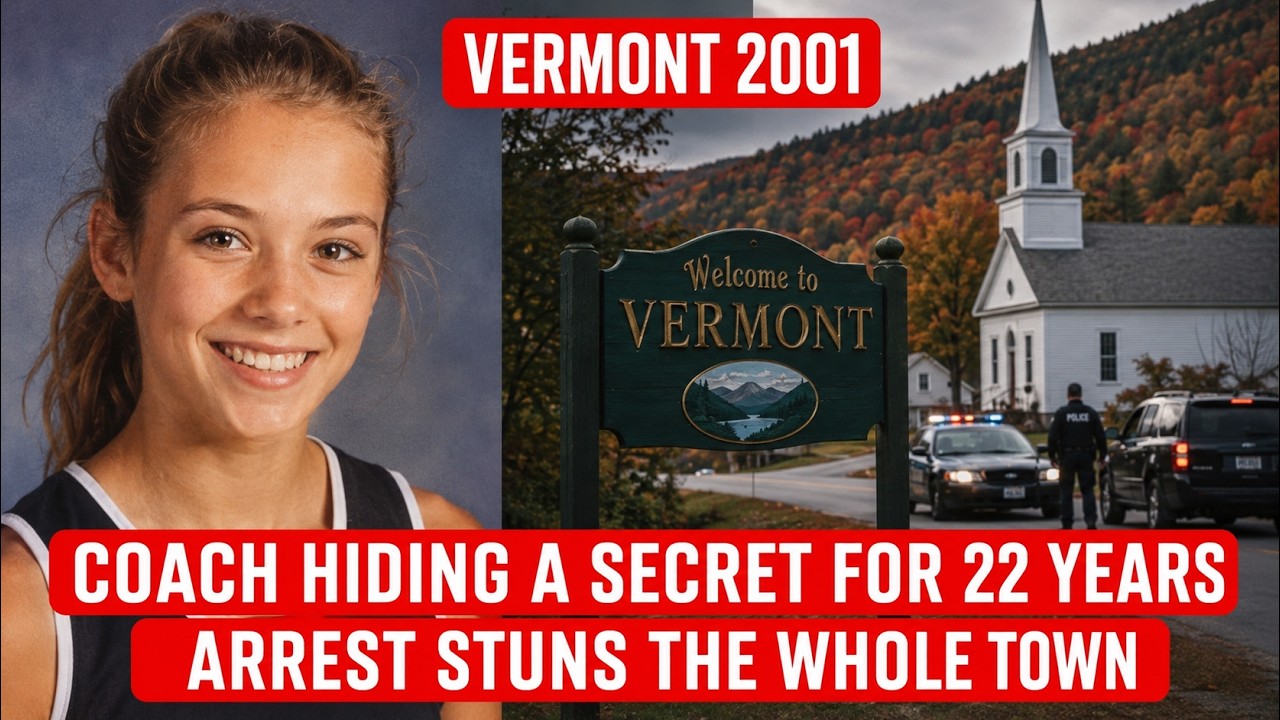
People left their doors unlocked and their keys in the ignition. The worst thing anyone could remember happening was a barn fire in the 1970s. That autumn, the country was still raw from the attacks of September 11th, and the little white church rang its bell every evening at six. Cell phones were rare and only worked on the ridge road.
In Maren, if you wanted to find someone, you drove to their house. Emily Roark was the only daughter of Tom and Diane Roark, who ran the hardware store. Her brother Ben was away at his first year of college. She was a senior, and letters from universities with mountains had begun arriving in the mailbox.
The thing everyone remembered about her was the notebook. She logged every run, the distance, the time, the weather, and one line at the bottom about how it felt. She laced her left shoe first every time, a small superstition her father teased her about. Her coach was a man named Dale Fenner.
He had taken over the track and cross-country program that fall, a young, energetic coach who ran drills alongside the kids and stayed late to lock up. Parents loved him. He knew every runner’s split times by heart and organized pasta dinners at his own house before meets. In a town that had waited a long time for someone to care about its children, Dale Fenner looked like an answer to a prayer.
On the afternoon of October 4th, Emily kissed her mother goodbye at the store and said she would be home by dinner. Practice ended a little after five, and the light was already going. Emily stayed behind to run one more loop of the field and told a teammate, a sophomore named Katie, that she wanted to add a mile. Katie waved from a departing station wagon.
Emily waved back, standing at the edge of the lot with her gym bag over her shoulder and the red notebook tucked under her arm. It was 5:35. It was the last confirmed sighting of Emily Roark alive. When Diane put dinner on the table at 6:45, Emily’s chair was empty.
By eight, her father was driving the ridge road with his high beams on, and by nine, half the town was out with flashlights. They searched all night. Men walked the tree line behind the school, calling her name into the dark. Coach Fenner was there before anyone else, the first to organize volunteers into grids and the last to go home at sunrise.
He found Emily’s gym bag near the equipment shed at the edge of the athletic field, sitting neatly upright. There was no sign of a struggle. The red notebook was not in the bag. It was never found.
Three days later, a hunter walking his dog along an old logging road four miles north of town found Emily. She had been strangled, and the medical examiner placed her death within hours of when she was last seen. The case landed with a young state trooper named Rebecca Torrance, who had grown up two valleys over and had never worked a homicide in her life. She would work this one, in one form or another, for the next twenty-two years.
The investigation was hobbled by the very thing that had made Maren feel safe. Nothing like this had ever happened there, and no one was ready for it. The logging road had been walked over by searchers before anyone thought to treat it as a scene. It rained the second night, and any tire impressions were gone by morning.
But under Emily’s fingernails, the medical examiner recovered a small amount of biological material that did not belong to her. It was sealed, logged, and placed in an evidence envelope. In 2001, in rural Vermont, that swab was close to useless. The technology to build a usable profile from so small a sample barely existed, and there was no database to compare it against without a suspect.
Investigators looked at a quiet boyfriend who had taken Emily to a homecoming dance, but he had been at his grandmother’s in Rutland with six people to vouch for him. They looked at a drifter seen hitchhiking on Route 12, only to learn he had been in a county lockup in New Hampshire the night she died. They looked at every registered offender within forty miles. Nothing fit.
And through it all stood Coach Dale Fenner, helpful, devastated, always available. He gave a long statement. He said he had left the school around 5:15, before Emily finished her extra loop, stopped for gas, and gone home. No one could quite confirm the timing, but no one had any reason to doubt him.
He was the coach. He had organized the search. When investigators asked the town who could have hurt Emily Roark, the answer was always the same. Nobody, everybody loved that girl.
Rebecca Torrance wrote one line in her notebook that she would return to for two decades. Fenner, last adult with regular contact. Timeline soft. She had nothing else, a sealed swab and a soft feeling, and in 2001, neither one was enough.
The file went cold. Years moved through the town without ever really leaving. Tom Roark got quieter. Diane kept Emily’s bedroom exactly as it was, the running shoes still lined up by the door.
The family kept a candle in the store window every October 4th. The school retired Emily’s race number and gave a scholarship in her name. Each autumn, Maren held the Emily Roark Memorial Run, a two-mile loop ending at the football field where she had been last seen. And every year, at the front of that race, organizing volunteers and reading Emily’s name aloud to the crowd, was Coach Dale Fenner.
He never left. He coached for another two decades, was named the state’s high school coach of the year twice, founded a summer running camp for younger kids, and wore a jacket with Emily’s number stitched over the heart. Each fall, he gathered new freshmen and gently told them about the girl they ran for. Grief made him beloved.
It made him untouchable. To suspect Dale Fenner would have felt, to the people of Maren, like suspecting the memorial itself. The only person who never fully let go was Rebecca Torrance. She rose through the ranks and made detective, and every few years she pulled the Roark file and read it again.
She kept a photograph of Emily on the corner of her desk, a girl mid-stride, notebook in hand. Colleagues told her to let it go. She never did. By the early 2020s, a new kind of detective work had started closing cases everyone had given up on.
Investigative genetic genealogy compares crime scene DNA to the public databases ordinary people upload when they research their ancestry. Investigators do not need the suspect to have taken a test, only a distant cousin who did. In 2022, Vermont’s cold case unit received grant funding to retest aging evidence, and Detective Torrance, now two years from retirement, made sure the Roark swab was near the top of the list. The sample was small and old, but the science had caught up to it.
A profile was built and uploaded to a genealogy database late that fall. For a long time, nothing happened. Then, in the spring of 2023, a match came back, a distant one, a woman in Ohio who had no idea her DNA was about to matter. A genealogist began the slow work of climbing her tree, filling in a hundred years of marriages and birth and death records.
The branches spread, then began to close. They narrowed to a family that had lived in central Vermont for generations. They narrowed to two brothers. And then, because one brother had been overseas in the military in October of 2001, they narrowed to one.
The name at the end of the tree was Dale Fenner. A genealogical match is a lead, not a conviction. Investigators needed Fenner’s own DNA directly, and they were not ready to knock on his door and warn him. So they waited and watched.
On a Tuesday morning, Dale Fenner stopped at a diner on Main Street, drank his coffee at the counter, and dropped the empty cup in the trash on his way out. A detective walked in ten minutes later and took it. The lab confirmed eight days later that the DNA under Emily Roark’s fingernails belonged to her coach. By then, Dale Fenner was sixty-one and preparing to retire.
The town had planned a ceremony, and the gymnasium was going to be named after him. Posters hung in the school hallway, and the memorial run that October was to be dedicated in his honor, a tribute to the man who had carried her memory for twenty-two years. He was arrested four days before the ceremony, in the parking lot of Maren High School, the same lot where Emily Roark had last been seen alive, a few hundred feet from the equipment shed where her gym bag had been found sitting upright. He did not run.
Witnesses said he simply set down the box of team equipment he was carrying and put his hands behind his back. The news moved through Maren house to house in the dark. People refused to believe it, and some still do. The man had shaped a generation of kids and stood at the graves and read the names.
Investigators would later say that was the whole architecture of it. The safest place to hide was inside the town’s grief. For twenty-two years, the person leading the search had been the one thing no one thought to search. What happened that October evening has never been fully explained, and perhaps it never will be.
But the evidence was enough. Prosecutors laid out the genealogy, the coffee cup, the fingernail sample, and the soft timeline a young trooper had flagged in her notebook two decades earlier. Dale Fenner was charged with second-degree murder. A jury needed less than a day.
He is serving a sentence he will not outlive. The red spiral notebook was never found. Tom Roark did not live to see the arrest; he passed in 2019. Diane did.
When the verdict came in, she stood outside the courthouse and said only that she could finally take the candle out of the store window. The scholarship still runs every year, and the memorial race still winds through the valley each October. Now when they read Emily’s name aloud at the starting line, there is no one standing at the front of the crowd pretending to grieve.
