In 1913, a wholesale grain merchant named Archabald Brennan inserted a strange clause into the deed of his Victorian house on North Broadway in Saratoga Springs, New York. The master bedroom on the second floor was never to be occupied. No explanation was given, and no expiration date was attached. The restriction would survive every ownership change for more than half a century.
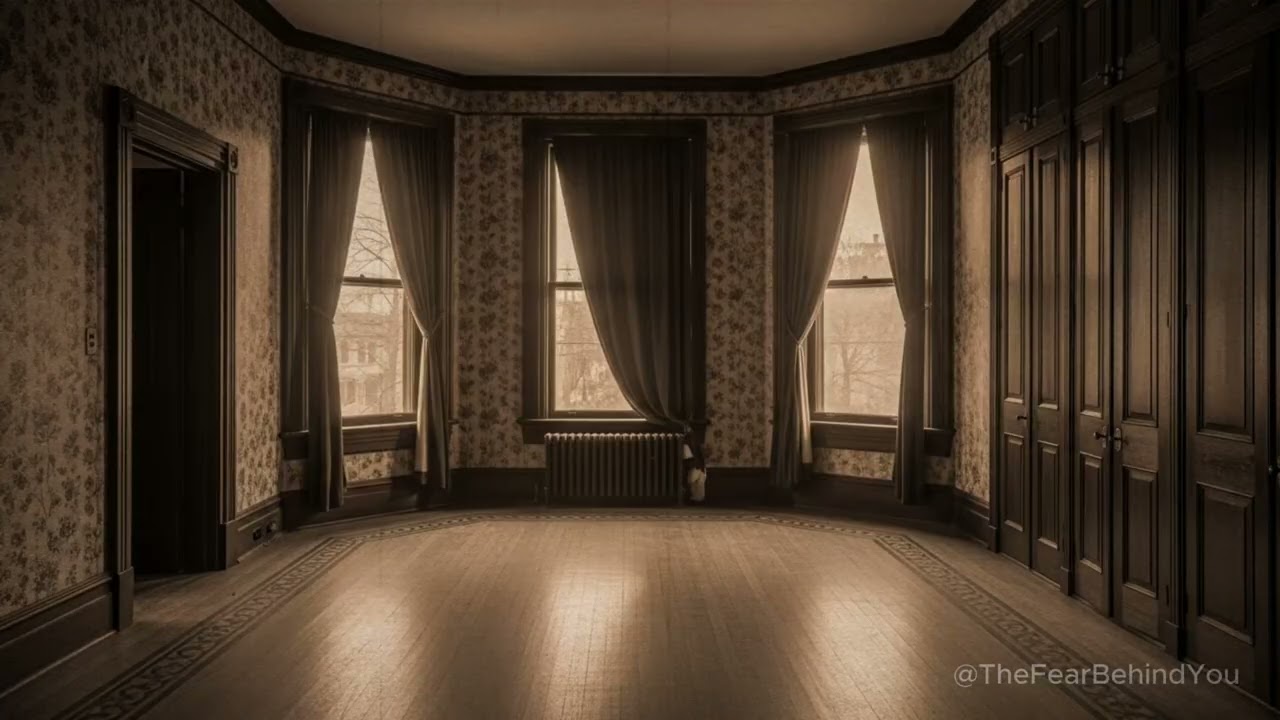
Brennan had built the three-story residence in 1889, at the height of Saratoga Springs’ transformation from a frontier settlement into a fashionable resort destination. Wealthy visitors came for the mineral springs, and their money funded an architectural boom along streets like North Broadway. Brennan, who had made his fortune supplying flour and feed across the capital region, commissioned a Second Empire mansion with a mansard roof, decorative slate tiles, iron cresting, and tall windows facing Congress Park. He lived there with his wife, Lenora, and their housekeeper, Astrid Halverson, a Norwegian immigrant.
For twenty-two years, the household remained constant and prosperous. The first sign of trouble appeared in February 1912. In the margin of a business ledger, Brennan noted that Lenora had mentioned the master chamber had become uncomfortable to her, though she could not articulate the nature of the discomfort. He had a builder inspect the room thoroughly.
No defects were found in the construction, windows, or walls. By the end of the month, Lenora had moved her belongings to a guest room, saying she could not explain her aversion to the master chamber, only that remaining in it produced increasing distress. In March, Brennan himself abandoned the room. He wrote that after five consecutive nights of poor sleep in the master chamber, he had relocated to the green guest room.
The decision felt irrational, he admitted, because he could identify no specific problem with the chamber itself. Yet the unease he experienced while trying to sleep there had become intolerable. What followed was a systematic effort to find a rational cause. A physician examined both Brennan and his wife and found nothing wrong.
A heating specialist adjusted the system, but the room felt the same. On April 19, Brennan recorded that he had taken to walking past the master chamber with increasing reluctance, feeling compelled to hurry past the closed door. Lenora experienced the same urge to avoid that end of the hallway. By June, both used the back stairs exclusively and had rearranged the household routine to minimize anyone’s need to pass by the area.
In July, Brennan consulted his attorney, Ephraim Townsend, about the situation. Townsend suggested that if the family decided to sell the property, they might include a restrictive covenant regarding the room. Such provisions, he said, were unusual but not unprecedented. Brennan gave the idea serious consideration.
The house was listed for sale in September 1912 but attracted no suitable buyer for seven months. In March 1913, Brennan added the covenant to the deed and reduced the asking price by twenty-five percent. The house sold within three weeks. The purchasers were Gideon Whitmore, a retired Albany attorney, and his wife Millicent.
Whitmore wrote to a former law partner that he had acquired an excellent property at a most favorable price, noting that the restriction on one bedroom presented no practical difficulty since the house contained seven others. Within months, his tone shifted. In November 1913, he confessed that the previous owner’s insistence on the restriction no longer seemed quite so eccentric. There was something about that area of the house that he found difficult to articulate, not frightening precisely, but distinctly uncomfortable.
By 1914, Whitmore was analyzing the problem with the habits of a legal mind. The room itself appeared entirely ordinary, with standard construction, adequate light, and proper ventilation. Yet remaining in that space produced a mounting sense of anxiety that intensified with each passing minute. He and Millicent had unconsciously altered their movements through the house, using the rear staircase despite its inconvenience, and had moved their own chambers to the opposite end of the second floor.
These adjustments occurred gradually, without explicit discussion, as though both had independently concluded that distance from that room was preferable. The Whitmores sold the house in 1921, and the deed restriction transferred intact to the new owners: a retired physician named Dr. Cornelius Ashford and his sister Prudence, who served as his housekeeper. Dr.
Ashford approached the room as a scientific problem. He conducted what he termed exposure experiments, spending measured periods in the master bedroom and recording his physical and psychological responses. His notes were detailed. In a June trial, his heart rate rose from a resting rate of 68 beats per minute to 89 within the first ten minutes and remained elevated.
His respiration increased. His hands became cold despite warm ambient temperature. He experienced mounting anxiety without identifiable cause, a sensation of being observed despite confirmed solitude, and a strong compulsion to exit the space. The symptoms resolved within five minutes of leaving the room.
The results remained consistent across different times of day, weather conditions, and durations of exposure. He measured temperature, humidity, air pressure, light, and sound. All fell within normal ranges. In September 1921, he concluded that whatever produced the responses was not detectable through standard medical or environmental assessment.
He consulted colleagues in psychiatry, neurology, and environmental medicine. None could offer an explanation that accounted for the consistent responses. By March 1922, he abandoned the investigation, writing that the phenomenon was real and the effects measurable, but the cause remained beyond their capacity to identify. The purchasers in 1928 were Horus and Beatrix Cunningham, who employed a Danish housekeeper named Dagmar Olsen.
Dagmar kept a personal journal, and her entries provide a domestic servant’s perspective on the house. Within months of arriving, she disliked the second-floor hallway near the locked door. The air felt heavier there, she wrote, though she knew it sounded foolish. She completed her work in that area as quickly as possible.
When Beatrix Cunningham asked if she had noticed anything unusual, Dagmar admitted she found it uncomfortable. Beatrix seemed relieved, telling her that she and her husband experienced the same discomfort, as had all the previous owners she had spoken with. There was something wrong with that room, she said, though no one could say what. The Cunninghams sold the house in 1934 during the depths of the Depression.
Between 1934 and 1948, the property changed hands six times, with each ownership lasting only two to four years. The property records showed rapid turnover, declining prices, and the persistent deed restriction traveling with every transfer. In 1948, the house was purchased by Roland Prescott, a civil engineer who had recently returned from wartime service in the Army Corps of Engineers. Prescott drew precise architectural measurements of the room, analyzed its proportions, and exposed a section of wall to examine the framing.
He found standard construction consistent with 1889 practices, no hidden spaces, no unusual materials. He tested the room’s acoustics with tuning forks and found nothing anomalous. Despite finding no physical explanation, Prescott experienced the same psychological effects as his predecessors. In March 1949, he wrote that after spending three hours in the room, determined to overcome the irrational discomfort, he had documented elevated heart rate, increased perspiration, and mounting unease.
Yet every measurement of the room itself revealed ordinary construction. The disconnect between subjective experience and objective measurement, he wrote, was profound and troubling. By June 1949, Prescott had reached the same conclusion as Dr. Ashford.
The problem existed. The effects were reproducible. The cause remained hidden. He sold the house in 1950, leaving a final note that some structures harbor qualities that resist engineering analysis.
The house changed hands twice more in the 1950s, each time with the restriction intact and the sale price declining relative to comparable properties. By then, the property had developed a reputation among local real estate professionals. A 1957 memorandum from a broker to his associates recommended pricing the house thirty percent below market for comparable unrestricted properties and disclosing the restriction early in the showing process to avoid wasting time with buyers who would reject it after learning of it. In 1959, the house was purchased by Dr.
Helena Ashworth, a professor of psychology at Skidmore College, who bought it specifically because of its unusual history. She conducted controlled experiments with volunteer subjects who were brought to the house without being told its history and asked to rate their comfort in each room. The master bedroom consistently received the lowest comfort ratings, even from subjects with no knowledge of the room’s history or the restriction. She wrote that the consistency of negative response was statistically significant and could not be attributed to suggestion or prior knowledge.
Subjects reported elevated anxiety, discomfort, and a desire to leave the space, regardless of personality type, cultural background, or belief in environmental influences on mood. Despite her professional interest, Dr. Ashworth found living in the house increasingly difficult. In a 1962 letter, she wrote that confirming the phenomenon did not make living with it any easier.
The knowledge that a room in her own home produced consistent psychological distress in everyone who entered it had become more disturbing than intellectually interesting. She sold the house in 1963. In 1965, a property development company purchased the house with plans to convert it into apartments. The space containing the former master bedroom was designated as mechanical room, with no residential use.
The project manager later explained that the first tenant lasted six weeks before requesting to break the lease, saying the room made her uncomfortable. The second tenant lasted two months with the same complaint. After that, the company sealed it off and designated it as mechanical space. It was a loss of rentable square footage, he acknowledged, but better than constant turnover.
The room was closed behind a plastered wall, marked on no floor plan, accessible to no tenants, mentioned in no rental agreement. Three tradesmen who entered the space before the wall was permanently sealed described their experiences. A building inspector said the room looked completely normal, but he could not wait to finish and get out. A plumber said the room gave him the creeps, that he kept looking over his shoulder the whole time, like someone was watching him.
A plasterer who closed up the doorway said he felt like the air was heavier, like his chest was being compressed. None could articulate what specifically caused their discomfort, but all were relieved when the doorway was sealed. The house still stands on North Broadway, operating as an apartment building. The former master bedroom remains sealed behind a plastered wall, a void within the structure of the building, serving no purpose except to remain closed.
The deed restriction imposed in 1913 technically remains in effect, though it has become moot. The room cannot be occupied because it no longer legally exists as habitable space. For seven decades, one room in a functioning building has been rendered unusable, not because it is structurally unsound or environmentally hazardous, but because it produces an inexplicable effect on human psychology. Multiple owners approached the problem with different tools: practical problem solving, legal analysis, medical methodology, engineering principles, psychological research.
All failed to identify an explanation. The restriction has outlasted everyone involved in its creation. It has survived economic depressions, wars, social changes, and the transformation of the property from a single-family home to an apartment building. It persists not because of tradition or superstition, but because everyone who encountered that room independently reached the same conclusion.
It should not be used. The room exists, sealed and silent, in the heart of a functioning building, not because anyone believes it is haunted or cursed, but because everyone who spent time there agreed that it produces effects that make it unsuitable for human occupancy.
