The bell came across the fields just as Charles Dennison lifted his horse’s hoof to check for a stone. It was the signal for the enslaved workers to begin their day, a sound he had heard a thousand times on plantations across Georgia. Nothing unusual about it. But when he looked up, he froze.
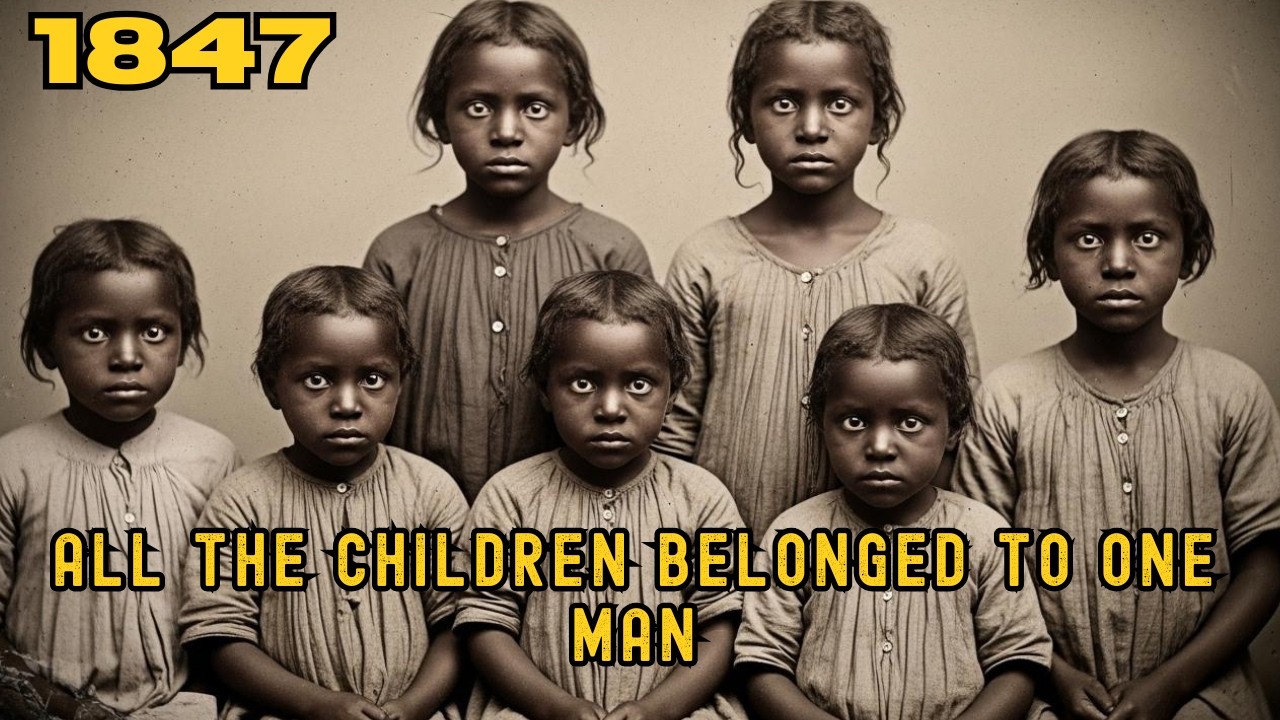
The workers were emerging from a long wooden quarters building about two hundred yards from the main house. Among them were children, and that was not unusual either. But these children were different. Even through the morning fog, even at a distance, Dennison could see that their skin was pale.
Not the light brown of mixed ancestry that was common enough on plantations, but truly pale, almost translucent in the early dawn light. Their hair ranged from light brown to almost blonde. Their features were unmistakably European. As they dispersed into the cotton rows, Dennison counted them.
Twelve children, from what looked like three or four years old to early adolescence. Every one of them had the same distinctive hazel-green eyes. An overseer appeared, a thick-set man carrying a long stick. He barked orders and the children moved faster, taking their places in the fields alongside the adults.
Dennison stood there, still holding his horse’s hoof, trying to process what he was seeing. He had been in the cotton trade for twenty years, visited dozens of plantations, profited from the system without thinking too hard about its human cost. But this was different. He released Constance’s hoof.
The mare was fine, just a small stone he had already removed. He led her to a hitching post near the plantation entrance and walked toward the house. The plantation house was modest by the standards of larger operations. Two stories, white painted wood, a porch wrapping around three sides.
As Dennison approached, a man emerged. He was in his early forties, dark hair graying at the temples, a neatly trimmed beard, a cup of coffee in his hand. He was watching the fields, watching the workers, watching the children, and on his face was an expression of quiet satisfaction. “Morning,” the man called out, his voice friendly.
“You look like you could use some coffee yourself. Come on up. ”
The man extended his hand. “Horace Crawford.
This is my place. You’re passing through, I assume. ”
Dennison gave his name and his business, a cotton merchant out of Savannah, and mentioned he might be interested in purchasing rights to the harvest. It was partially a lie.
He had not planned to stop at this plantation. But he needed to know more. Inside, Crawford’s wife Margaret appeared, younger than her husband by at least a decade, blonde hair pulled back in a severe bun, her expression polite but distant. A young enslaved woman, no more than sixteen, dark-skinned, brought in coffee and biscuits.
As she poured, Crawford spoke to her without looking at her. “Tell Rebecca to make sure the young ones get extra water today. It’s going to be hot. ”
Dennison saw his opening.
“The young ones? ”
Crawford smiled. “You noticed them, I assume. ”
“Hard not to.
”
“Seventeen, actually,” Crawford said, and there was pride in his voice. “Though two of them are too young for fieldwork yet. The oldest is thirteen now, named him Thomas. Strong boy, good worker.
I expect he’ll fetch a premium price when I sell him next year. ”
Dennison forced himself to maintain a neutral expression. “That’s quite a few children. Your workforce must be expanding rapidly.
”
Crawford leaned back. “I’ve been implementing a breeding program,” he said, in the same tone someone might use to discuss livestock management. “Started about twelve years ago, not long after I inherited this place from my father. The results have exceeded my expectations.
”
Dennison kept asking questions. Crawford warmed to his subject. He selected specific women, young, healthy, with certain physical characteristics. Light skin was a factor, but more important was bone structure, facial features, overall build.
And then he ensured the next generation carried the traits he wanted to emphasize. “You’re saying you father the children yourself? ”
“Of course. That way I control the bloodline completely.
Those children you saw, every buyer who’s seen them has been impressed. They pass for white in most contexts, which means they’re valuable for housework, personal service. I can get twice what I’d get for a darker field worker. ”
“And the mothers?
How do they respond to this arrangement? ”
Crawford’s expression shifted, not to shame, but to irritation. “Most accept it. They understand their position.
I’m not cruel, Mr. Dennison. I don’t beat them unnecessarily. I make sure they’re fed adequately during pregnancy, that they have time to recover after birth.
Though not too much time, of course. Can’t afford to have valuable workers idle. ”
“And if they don’t accept it? ”
Crawford’s eyes hardened.
“Then I make it clear that acceptance isn’t optional. I own them. They don’t have the luxury of refusal. The law is quite clear on that point.
”
Margaret Crawford appeared in the doorway. “Horace, you have a visitor. Mr. Bennett from town about the feed order.
”
Crawford excused himself and left. Dennison sat alone at the table, his vision blurring with anger. He thought about those children in the fields, seventeen lives created not out of love but as a deliberate business strategy, enslaved by their own father, knowing that when they reached a certain age he would sell them away without hesitation. When he asked Margaret whether the minister ever visited the plantation, a coded question about external oversight, her hands tightened on her apron.
“We attend services in town every Sunday. The reverend considers my husband a pillar of the community. Very generous with his donations. ”
Men like Crawford always were.
Generosity bought silence. When Crawford returned fifteen minutes later, ready to discuss cotton prices, Dennison played along. He negotiated a preliminary agreement, promised formal contracts, planned to visit again in the fall. He had no intention of keeping any of those promises.
He had seen something he could no longer ignore. Back in Savannah, his clerk Robert Parrish noticed his distraction. Dennison told him everything. Robert listened, troubled.
“What are you going to do? ”
“I don’t know. I was hoping you might have suggestions. ”
They went through the options.
Reporting it to the authorities? Crawford wasn’t breaking any laws. The children were legally property, following the condition of the mother. Selling his own children?
Not illegal. Robert leaned back. “There is one person in Savannah who might be able to help. Dr.
William Preston. He’s been practicing medicine here for thirty years, treats patients on plantations all across the region. And I’ve heard he has sympathies that not everyone in Savannah shares. ”
Robert warned him to be careful.
If Crawford found out he was investigating, there could be consequences. Men like that had friends, connections, power. Dr. Preston’s office occupied the ground floor of a narrow brick building on Abercorn Street.
The doctor was in his early sixties, white hair, spectacles that gave him an owlish appearance. When Dennison told his story, Preston listened without interrupting. “I’ve been practicing medicine in this region for thirty-one years,” Preston said. “I’ve delivered hundreds of babies on plantations across Georgia.
I’ve seen things that would make a hardened soldier weep. The Crawford situation isn’t even the worst I’ve encountered. But it is one of the most systematic. Crawford isn’t acting out of impulse or passion.
He’s implemented a calculated strategy optimized for profit. ”
Preston had been called to the Crawford plantation many times. First call was in 1835, a difficult birth. A young woman named Mary, seventeen years old.
The baby survived, a girl with skin light enough that Preston knew immediately who the father was. Crawford’s eyes. No mistaking it. “Did you say anything to him?
”
Preston laughed bitterly. “Say what? Congratulate him on his daughter? I sewed up the woman, made sure the baby was breathing, collected my fee, and left.
That’s what I’ve always done. ”
Three women had died on that plantation between 1835 and 1844, all within two weeks of giving birth, all because Crawford insisted they return to fieldwork before they recovered. Preston had argued with him. Crawford didn’t care.
“That’s murder,” Dennison said. “Is it? Any lawyer would raise reasonable doubt within minutes. Any jury of his peers, wealthy white men who own slaves themselves, would acquit him without hesitation.
”
“So there’s nothing that can be done? ”
“I didn’t say that. I said a criminal prosecution would fail. But there are other approaches.
”
Preston pulled down a worn leather journal from his bookshelf. He had kept records for years, notes on every patient he treated on plantations. Observations about conditions, treatment, outcomes. Hundreds, maybe a thousand pages of documentation.
And he had connections. “Not the kind of connections that help in polite society, but the kind that might be useful for someone looking to challenge the system. People who help enslaved individuals escape to freedom. ”
Dennison understood.
The Underground Railroad. Activities that were not only illegal but could result in prison time, financial ruin, even violence. “The question is whether you’re ready to take that step,” Preston said. “Once you start down this path, there’s no going back to comfortable ignorance.
Are you prepared for that? ”
Dennison thought about Thomas, who had twelve months left before his father sold him away. About the mothers who died because Crawford valued cotton more than human life. “Yes,” he said.
“I’m prepared. ”
Preston gave him instructions, carefully worded to sound innocent to anyone who might overhear. A Quaker meeting house about fifteen minutes outside Savannah. Attend the Wednesday evening service.
Ask to speak with the elder. Express interest in the community’s charitable work. Dennison began keeping notes, everything he remembered from his visit, every detail, a record that would grow over the coming weeks. The following Wednesday, he attended the Quaker meeting.
About twenty people sat in silence on wooden benches. After a long pause, an older man stood and spoke about Isaiah. “Learn to do right, seek justice, defend the oppressed, take up the cause of the fatherless, plead the case of the widow. We are called to do more than merely believe in justice.
We are called to act. ”
Afterward, Dennison approached him: “I’m interested in learning about your community’s charitable work. ”
The man studied him for a long moment. “I’m Nathan Garrett.
Perhaps you’d like to stay for our fellowship meal. ”
At the meal, Garrett made coded references, mentions of traveling friends who needed assistance, goods that needed to be transported north. Afterward, he led Dennison to a grove of trees where they could not be overheard. “Dr.
Preston sent word that you might be coming. He vouches for you, but trust has to be earned. ”
Dennison told him about the Crawford plantation, the seventeen children, the breeding program. Garrett listened.
“We’re aware of the situation. We’ve been monitoring it for several years. The problem is access. The plantation is relatively isolated, Crawford keeps tight control over his workforce.
A coordinated effort to remove multiple people from an active plantation is much more difficult. But not impossible. ”
Garrett explained what he needed: detailed information about security routines, safe houses along a route north, reliable conductors. And he would need to be absolutely certain the people being helped wanted to leave, understood the risks, and would not panic halfway through and reveal the network.
“You’re a merchant. You have a legitimate reason to visit plantations. You could make regular visits to Crawford’s property, observe conditions, learn routines, potentially make contact with the enslaved people there. It’s slow, careful work.
Are you willing to do that? ”
“Yes. ”
Over the following weeks, Dennison became a student of the network. He learned its codes.
A letter mentioning five bales of premium cotton meant five people ready to travel north. “Expecting rain delays” meant increased patrols. “Prices remain favorable” meant it was safe to proceed. Safe houses were maintained across the social spectrum, each knowing only the locations immediately before and after their own position, limiting the damage if anyone was captured.
He made regular trips to the Crawford plantation under the pretense of negotiating cotton purchases. He learned that Crawford employed two overseers, that security was tightest at night but relaxed on Sundays when the family attended church. Once a month, Crawford sent a wagon to town for supplies, usually with two or three enslaved people doing the loading. A potential window.
The challenge was making contact. On his fourth visit, while Crawford was occupied, Dennison left a folded piece of paper under his coffee cup. “Friends, wait north. If you wish to travel, leave a blue ribbon on the fence post by the main road.
”
Three days later, riding past the plantation, he saw it. A small piece of blue fabric tied to the fence post. He passed another message, hidden in a newspaper left in the kitchen. How many wish to travel?
Can you move without being caught? Two weeks later, a reply came through a free black carter who worked between plantations. The handwriting was barely legible, probably someone who had taught themselves to read and write in secret. The meaning was clear.
“Six of us could go. Four mothers, two oldest children. Need help getting off property. Crawford watching close since last month.
Someone tried to run and got caught. ”
Six people. Dennison brought the message to Nathan Garrett. “Six is a significant group,” Garrett said.
“We’d need to move them in stages, probably split them into smaller groups. And we’d need a very good opportunity to get them off the property without immediate pursuit. ”
They brought in a conductor named Benjamin, a tall, quiet black man in his forties who had made the journey north and back seventeen times. His first question was blunt.
“Are they prepared to never see their families again? Because that’s what this means. Once they leave, they can never come back. Anyone left behind, they won’t see them again in this life.
Are they ready for that? ”
“I think they understand,” Dennison said. “But I’m not sure. I haven’t been able to speak with them directly.
”
“Then that needs to be your next step. Because if someone panics halfway through, they endanger everyone. I’ve seen entire networks exposed because one person couldn’t handle the pressure. ”
The next supply run was scheduled for the first week of June.
Dennison arranged to be in town that day. The wagon arrived mid-morning, driven by an overseer named Polk, known for his cruelty. With him were Rebecca, the woman Dennison had been communicating with; a man named Daniel; and Thomas, the thirteen-year-old boy. When Polk went into a tavern, Dennison crossed the street.
“Rebecca, the blue ribbon message. I need to know if you and the others understand what you’re committing to. ”
“We understand. We know we can never come back.
”
Thomas spoke without turning around. “We’re certain. Crawford’s selling me next month. He moved up the date.
If we don’t go soon, I won’t get another chance. ”
That changed everything. The plan had been to wait until July. Now they had two weeks.
“Can you be ready in two weeks? ” Dennison asked. “We can be ready tomorrow,” Rebecca said. “We’ve been ready for years.
”
Dennison explained the plan. On the next supply run, Polk would be delayed, arrested on some minor charge that would be dropped later. During that window, the six escapees would be moved to a safe house in town, then transported north that night. “There are safe houses all the way to Ohio.
People who will hide you, feed you, keep you safe. You have to trust them, follow their instructions exactly, and never panic. Can you do that? ”
“Yes.
”
“What about the others? Louisa, Hannah, Abigail, Susan? ”
“They’re ready. Susan decided not to come.
Can’t leave her babies. But she’ll help the rest of us get away. She’ll cover for us. ”
Polk emerged from the tavern.
Dennison moved away casually, disappearing into the crowd. The solution to delaying Polk came from an unexpected source. A local sheriff’s deputy named Marcus Reed had his own reasons for disliking Crawford. His sister had worked as a governess in the region and had witnessed Crawford’s treatment of the women on his plantation.
Reed couldn’t arrest Crawford, the man hadn’t broken any laws, but he could help delay Polk on the day of the supply run by conducting a very thorough inspection of the wagon. “I can give you two hours,” Reed said. “Maybe three if I really drag it out. But after that, Crawford will start asking questions.
”
Dennison prepared his own affairs in case something went wrong. He drafted a letter to his clerk Robert to be opened if Dennison was arrested. He wrote a will leaving everything to his brother in Boston, with instructions that none of it should go to anyone still involved in the slave trade. Margaret, his housekeeper, a free black woman who had worked for him for years, confronted him one evening.
“You’re planning something dangerous. ”
He told her everything. When he finished, she was quiet for a long moment. “My mother was born enslaved.
She escaped when I was three years old, brought me with her. We traveled for six weeks, hiding during the day, moving at night. Without the people who helped us, I’d still be someone’s property, or more likely, I’d be dead. Whatever you’re doing, you’re doing the right thing.
”
She agreed to find people willing to house the escapees for a few hours before they could be moved to the first official safe house. Three days before the escape, Dennison visited the plantation one final time. Crawford was distracted, irritable. He mentioned that one of his enslaved workers had been caught trying to smuggle a letter off the property.
“Had to make an example. Twenty lashes. Can’t allow that kind of behavior. ”
Dennison felt his stomach drop.
But Rebecca served coffee later, showing no signs of injury. Still, the incident was a reminder of how quickly everything could go wrong. As he was leaving, he passed a final message under a plate. Still ready?
The next day, the blue ribbon was back on the fence post. June 14, 1847 dawned hot and humid. The supply wagon left Crawford’s plantation around eight in the morning, arriving in Savannah by ten forty-seven. Polk was driving, looking bored.
On the wagon were Rebecca, Thomas, Daniel, and three others. Six people total. All of them. Deputy Reed appeared almost immediately.
“Need to inspect your cargo. New regulations about transporting goods into the city. You’ll need to unload everything for examination. ”
Polk protested.
Reed, perfectly bureaucratic, insisted. Polk started unloading, grumbling. For over an hour, Reed examined everything with exaggerated thoroughness, finding minor issues, requiring documentation Polk didn’t have. At twelve fifteen, Polk finally snapped.
“I need to find a privy. You keep inspecting, they’ll help you. ” He gestured at the six enslaved people and stalked toward the nearest tavern. It was the moment they had been waiting for.
A wagon appeared, driven by a black man Dennison didn’t recognize, part of the network. It pulled up next to the inspection site. In less than three minutes, the six escapees climbed into the back, hidden under canvas and empty crates. The driver snapped the reins and moved off at a normal pace.
When Polk returned twenty minutes later, Reed was examining a barrel of salt pork. He declared the packaging didn’t meet current standards. Polk was reloading the wagon when he looked around and noticed something was wrong. “Where are they?
”
“Where are who? ” Reed replied innocently. “The workers. There were six of them.
”
Reed looked around. “I assume they went with you. They’re your responsibility, not mine. ”
By the time Polk raced back to the plantation, it was nearly two in the afternoon.
The escapees had been hidden for two hours. They had maybe four more before Crawford organized a serious search. Catherine’s house was small, tucked away on a narrow street where few white people ventured. She had cleared space in her cellar, cramped and humid, but hidden.
Dennison visited briefly around three, carrying a basket of food and water and a message about the next stage. When the six escapees saw him, Rebecca started to cry, not tears of sadness, but of relief. “You’re safe for now. At nightfall, a man named Benjamin will come to take you to the next safe house.
Do exactly what he says. ”
Thomas spoke for the first time. “Is it real? Ohio?
Freedom? Or is it just another place where someone will own us? ”
“It’s real. In Ohio, you’ll be free.
Not property. Free to work for wages, to make your own decisions. You’re going to make it there. ”
Crawford discovered the escape around three thirty.
He rode directly to the sheriff’s office, demanding action, threatening lawsuits. The sheriff promised to investigate but warned that with a few hours head start, they could be anywhere. Crawford wasn’t satisfied. He hired four slave catchers, professional bounty hunters notorious for their brutality.
They questioned people in Savannah. They checked the docks. They searched the roads north. But the network knew how to hide people, how to mislead searchers, how to create false trails.
By nightfall, the slave catchers were twenty miles away following a deliberately planted rumor that the group had headed west toward Alabama. Benjamin loaded the six people into a covered wagon with hidden compartments beneath false floors. The route north took them through back roads and small towns, transferring from conductor to conductor, sometimes by wagon, sometimes on foot, once by boat. They traveled mostly at night, hiding in barns, cellars, attics.
They endured hunger, rainstorms, exhaustion, the constant terror of being discovered. But they kept moving, through Georgia, through Tennessee, through Kentucky. It took eighteen days to reach Ohio. On July 2, 1847, six people who had been enslaved their entire lives crossed into free territory and stood legally beyond Crawford’s reach.
Benjamin sent word back. Delivery complete. All packages safely arrived. When Dennison received the message, he wept.
Six lives saved. It wasn’t enough, couldn’t undo the suffering of everyone still enslaved, but it was proof that resistance was possible. The consequences were far from over. Crawford’s rage at losing six workers, including his oldest child, was spectacular.
He increased security, hired additional overseers, instituted harsher punishments. He interrogated everyone. Susan, the woman who had decided not to escape because she couldn’t leave her young children, was subjected to particularly brutal questioning. Crawford suspected she knew something.
When she maintained she knew nothing, he didn’t believe her. She was sold two weeks later, separated from her children, sent to a plantation in Alabama. Three other enslaved people were sold in the following month. Families torn apart.
Suspicion was enough. But Crawford’s problems were only beginning. The six escapees reached abolitionist settlements in Ohio, and the abolitionists recognized the propaganda value of their stories. Within weeks, Louisa and Hannah were interviewed by newspapers across the north.
They told their stories in detail, how Crawford had systematically impregnated them, how he had fathered seventeen children and treated them all as property, how mothers had died from being forced back to work too soon. The accounts were published, reprinted in pamphlets, cited in speeches. Crawford’s name became synonymous with the worst excesses of plantation slavery. At first he fought back, publishing denials, threatening lawsuits.
But the details were too specific, too well documented. Dr. Preston, emboldened by the publicity, provided copies of his medical records to abolitionist organizations, confirming the births, the deaths, the timeline. Other witnesses came forward.
Even Margaret Crawford gave a statement through her lawyer expressing her disgust and requesting a legal separation. The social consequences were severe. Crawford was ostracized. His church asked him to stop attending.
Business partners distanced themselves. By September 1847, his reputation was in ruins. The district attorney, Theodore Walsh, saw an opportunity. With public attention focused on the case, he brought forward legislation addressing exploitation of enslaved women.
It was modest, full of loopholes, carefully worded to avoid challenging the fundamental legality of slavery. But it required documentation of all births on plantations, mandated basic medical care for enslaved women before and after childbirth, created penalties for deliberate negligence that resulted in death. It was the barest minimum, but in the context of Georgia in 1847, even that represented a significant shift. The legislation passed in November, unofficially named the Crawford Act, a permanent reminder of the man whose actions had made it necessary.
Dennison was questioned twice by Crawford’s slave catchers, but his role as a cotton merchant gave him plausible reasons for being in town. Deputy Reed’s story held up. The network remained hidden. Crawford never recovered.
He continued operating his plantation until 1851, but profitability declined as he struggled to maintain his workforce and faced increasing difficulty conducting business. In May 1851, he sold the property at a significant loss and moved to Texas. Whether he continued his breeding program there, Dennison never learned. The seventeen children Crawford had fathered, those who remained enslaved on the plantation were sold along with the property.
Some remained enslaved until the Civil War freed them in 1865. Others were sold north before the war and gained freedom earlier. A few escaped through the Underground Railroad. Thomas, the thirteen-year-old boy who had been the first to commit to the escape, grew up in Ohio.
He learned to read and write, worked as a carpenter, married, had four children. He made sure every one of them knew their history. Ruth, his sister, became a teacher. She wrote about growing up enslaved by her own father.
Louisa struggled at first, depressed by the trauma and the grief of leaving three children behind, but slowly she healed. She remarried and had two more children, children who grew up free. Hannah became involved in the abolitionist movement, traveling across the north giving speeches. Abigail gave birth to a son three months after reaching Ohio.
She named him Charles, after the merchant who had risked everything to help her escape. Dr. Preston continued his work for another decade. His medical journal grew to over a thousand pages.
He never published it during his lifetime, too dangerous, but left instructions for it to be donated to a historical society after his death. It was published in 1869, four years after the war ended, and became an important historical source. Nathan Garrett and the Quaker network helped hundreds of people escape over the following decade. Garrett died in 1862, before the Emancipation Proclamation, but he died knowing he had made a difference.
Benjamin made the journey north seventeen more times before the war. In 1863 he joined the Union Army as a scout, using his knowledge of Georgia’s backroads to help Union forces. He survived the war and lived until 1894, a free man in a country that had finally abolished the institution he had spent decades fighting. Charles Dennison lived until 1873.
He never married, never had children of his own, but he maintained connections with the people he had helped escape and their descendants. Before his death, he wrote a detailed account of the Crawford case, including copies of letters, financial records, testimony. He donated it all to the Massachusetts Historical Society, where it still resides. His account was published in 1875 as part of a collection of Underground Railroad narratives.
Of the seventeen children Crawford fathered, most survived to see emancipation in 1865. A few had already died, claimed by disease or accident or the brutality of enslaved life. One of them, a woman named Martha, born on the plantation in 1846, wrote an autobiography in 1891. It was a slim volume, barely a hundred pages, titled Owned by My Father, A Childhood in Georgia.
Near the end she wrote: “People ask me if I hated him. I tell them hate is too simple a word for what I felt. He was my father. He was my owner.
He gave me life. He stole my childhood. How do you hate someone who exists in all those roles at once? When I was finally free, I expected to feel pure joy, but what I felt was more complicated.
Relief, yes. Hope, yes. But also grief for the childhood I never had. It took me twenty years to make peace with my history.
I married a good man. We have three children. They know where they came from, what their grandmother endured, what their mother survived. But they also know they’re free, that they belong to no one but themselves.
I’ll never forget my father, but I’ve made peace with never forgiving him either. Some things are simply beyond forgiveness. I’ve built a good life anyway. That’s my revenge.
That’s my victory. Living well, living free, making sure my father’s legacy dies with his generation, while my mother’s legacy, her courage, her endurance, her refusal to be broken, lives on through us. ”
