In the spring of 1942, an eighteen-year-old named Betty Jane Greer posed for Life magazine in a crisp new uniform of the Women’s Army Auxiliary Corps, a nameless model hired on the strength of her mother’s connections to the War Department. The shoot was so minor that she went uncredited, and nothing about the formal military setting hinted at what lay ahead. Yet within five years, the same face that smiled out of that uniform would belong to one of the most desired women in Hollywood, and her life would twist into a real-life noir thriller involving one of the most powerful men in America. Betty Jane Greer was born in Washington, D.
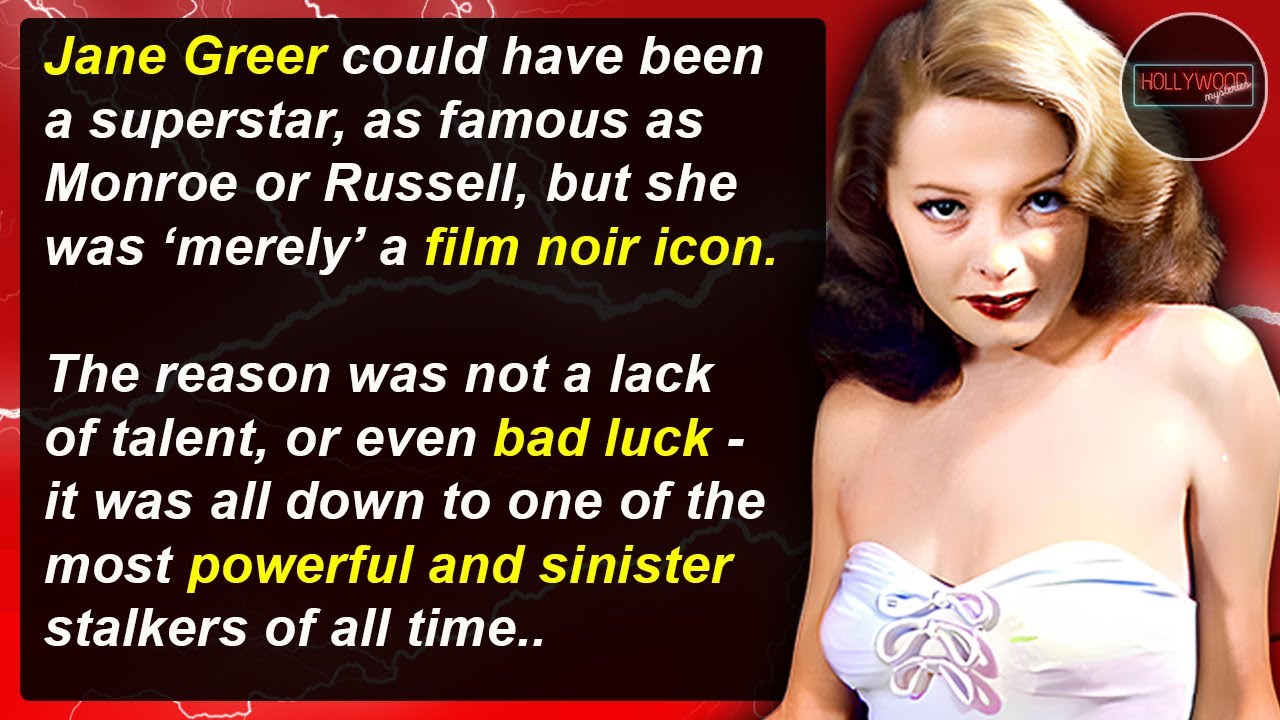
C. , on September 9, 1924, the daughter of a salesman whose frequent job changes left the family struggling through the Great Depression. Her mother, also named Betty Jane, had once dreamed of an artistic career and channeled those ambitions into her daughter. Jane entered beauty pageants and talent contests as a child, losing every one, then took up professional modeling at twelve.
At fifteen, her life was upended by Bell’s palsy, a neurological condition that paralyzed one side of her face. Doctors warned that few ever fully recovered. Jane refused to accept that. She spent months under heat lamps, moving her facial muscles with her fingers, forcing her mouth into a smile each morning before school, until slowly the muscles responded.
The ordeal left her with a calm, quizzical gaze and an enigmatic expression that would later be marketed as the Mona Lisa smile. It also taught her something she carried into acting: that emotion could be directed with conscious control of the body. Financial pressure forced her to leave high school in her senior year. She sang with a band for a hundred dollars a week, then joined Enrique Madriguera’s orchestra at Washington’s Club Del Rio, performing Spanish songs she had learned phonetically, her deep voice and exotic look drawing attention.
Meanwhile her mother, now employed by the War Department during the Second World War, recommended Jane for a job modeling the new WAC uniforms. The Life magazine spread and a Paramount newsreel brought her to the attention of Paramount’s talent scouts, who signed her to what turned out to be a one-month option. When the studio abruptly dropped her with a letter saying only, “Sorry, we have so many of your type,” Jane retreated in embarrassment, telling friends her attorney had advised against the contract. One man was not deterred.
Rudy Vallee, the forty-one-year-old crooner famous for his romantic exploits, saw Jane in the WAC uniform and obtained her phone number. He called the Greer apartment and offered to help launch her Hollywood career. Her mother declined on the grounds that Jane was still a minor under strict supervision. Months later, through David O.
Selznick’s office, Jane finally secured a successful screen test in New York. The footage reached Freddy Schussler, casting director for both Selznick and Howard Hughes. Selznick was unimpressed. Hughes was anything but.
Mesmerized, Hughes sent a scout to Washington to photograph Jane without makeup, and shortly afterward signed her to a contract with thirty-day options. Jane and her mother arrived in Hollywood in early 1943. Hughes placed her in a stable of roughly twenty other young women under personal contract, each kept deliberately unaware of the others. Jane once hid behind a bush to glimpse one of her rivals.
Hughes coached her himself, asking her to read scenes from a comedy called The Awful Truth. Aware that Hughes was partially deaf, Jane read the script at the top of her lungs. He was impressed enough to convert her option into a formal contract. The press began speculating about romance, but their only date was a trip to an amusement park where Hughes spent most of his time throwing baseballs at bottles.
Jane later described him as vulnerable and insecure, a man who had never really had a childhood. Rudy Vallee had not disappeared. He began taking Jane to his Coast Guard band appearances, and a romance blossomed. On December 2, 1943, they married at a chapel in Westwood beneath an arch of crossed sabers held by Coast Guardsmen.
Howard Hughes was enraged. While the couple honeymooned at a desert resort, Hughes began working quietly to sabotage the career of his own contracted star before it had even started. The marriage collapsed quickly. Jane and Vallee separated in March 1944 and divorced that June, though Jane briefly told the press that Rudy was the only one for her.
By 1949, Vallee had married someone else. Meanwhile Jane realized that with Hughes bitter over her marriage, no roles would come. She bought her way out of his contract for seven hundred and fifty-seven dollars, correctly guessing that a man of Hughes’s wealth would not bother collecting the debt. She joined RKO in early August 1944, making her film debut in a dull murder mystery called Two O’Clock Courage.
Her reaction to seeing herself on screen was harsh: her mouth was too large, her eyes bulged, her legs were toothpicks. She shuffled through a string of forgettable films, appearing briefly in Pan-Americana and George White’s Scandals, where her character had a bucket of paint dumped over her head. Her first real success came with Dick Tracy, which earned her a raise to two hundred dollars a week. In December 1945, she legally changed her name to Jane Greer, saying her old name was “too Bo-Peepish” for the roles she wanted.
The turning point arrived with They Won’t Believe Me in 1947. Jane had lightened her hair, softened her image, and delivered a substantial performance as a sympathetic character. RKO promoted her to third billing above the title. Her dressing room moved from the top floor to the first, complete with a private shower.
Then came the film that defined her: Out of the Past, opposite Robert Mitchum and Kirk Douglas, directed by Jacques Tourneur. Jane played Kathie Moffat, the femme fatale who betrays everyone who loves her, described in the film as an autumn leaf blowing from gutter to gutter. During the filming, she noticed something odd on Mitchum’s lips and pointed it out. He examined himself in a mirror and explained casually that it was just chocolate and tobacco, then wiped his mouth and returned to the scene.
Mitchum teased her constantly, pretending he never learned his lines, while she memorized hers for weeks in advance only to discover he had memorized his perfectly all along. When the wardrobe department sent Jane to set in an unfinished dress, Mitchum shouted at the wardrobe staff until the dress was fixed. The same could not be said for Kirk Douglas, who bruised her arms during a scene and slapped her face so hard that she wondered how he managed it without injuring his partner. Out of the Past made Jane Greer a star.
Darryl Zanuck, then running RKO, raised her salary to a thousand dollars a week. She bought a mansion in Brentwood, where her neighbors included Marilyn Monroe and William Powell. Yet her reign at RKO was short-lived. In 1948, she married Edward Lasker, a wealthy attorney.
She gave birth to her first son, Albert, in June of that year. And then Howard Hughes bought RKO. He now owned her contract. His jealousy, stoked by her marriage, reached its peak.
He told her directly: while she was under contract to him, she would never work. When she protested that this would end her career, he replied that he supposed it would. Hughes kept his word. The only exception came in 1949, when he cast her in The Big Steal opposite Robert Mitchum, whose public image had been damaged by a jail sentence for marijuana possession and suspicion of Communist sympathies.
Jane took the role, hiding her second pregnancy from the studio by taking morning sickness pills on set. Co-star William Bendix noticed the pills and asked what they were. Thinking quickly, she claimed they were for an upset stomach. Bendix asked if he could have some, and she agreed.
He later thanked her, saying they made him feel wonderful. The damage was done. Jane spent the early 1950s trapped in a studio system that saw her as a risk because of Hughes’s vendetta. After a series of minor roles and failed projects at MGM, she negotiated her release and stepped away from acting for three years.
During that time she had her third son, Steve, born in May 1954. She returned for a few films, including Run for the Sun, where she contracted a serious tropical virus while filming on location and fractured her tailbone during swamp scenes. The virus damaged her heart and would require surgery years later. In 1963, she divorced Lasker and underwent heart surgery.
She found love again with Frank London, a casting director, and married him in 1967. Her career had never fully recovered from Hughes’s interference, but in later decades she found a new audience. She appeared in the 1984 remake of Out of the Past, titled Against All Odds, and took roles in Falcon Crest and David Lynch’s Twin Peaks. She never won the Oscar she had once wanted desperately, and in 2009 The Guardian listed her among the greatest actors never to receive one.
Frank London died in 2001, and Jane Greer passed away a few months later after a battle with cancer. In her final years, she spoke of Howard Hughes without bitterness. She said she liked him as a man, calling him elegant and graceful, even as she acknowledged the ruthlessness that had quietly stolen her career. Jane Greer starred in nearly thirty films.
Few reached the level of her talent, but Out of the Past remains one of the masterpieces of film noir, and in it, she left a portrait of the femme fatale that has never been forgotten.
