In April 1552, a fifteen-year-old king caught the measles. He recovered completely. Fourteen months later, he was dead, his lungs so destroyed that the surgeon who opened his chest found nothing but rotting holes where healthy tissue should have been. What happened in those fourteen months is one of the most horrifying medical declines ever documented in royal history.
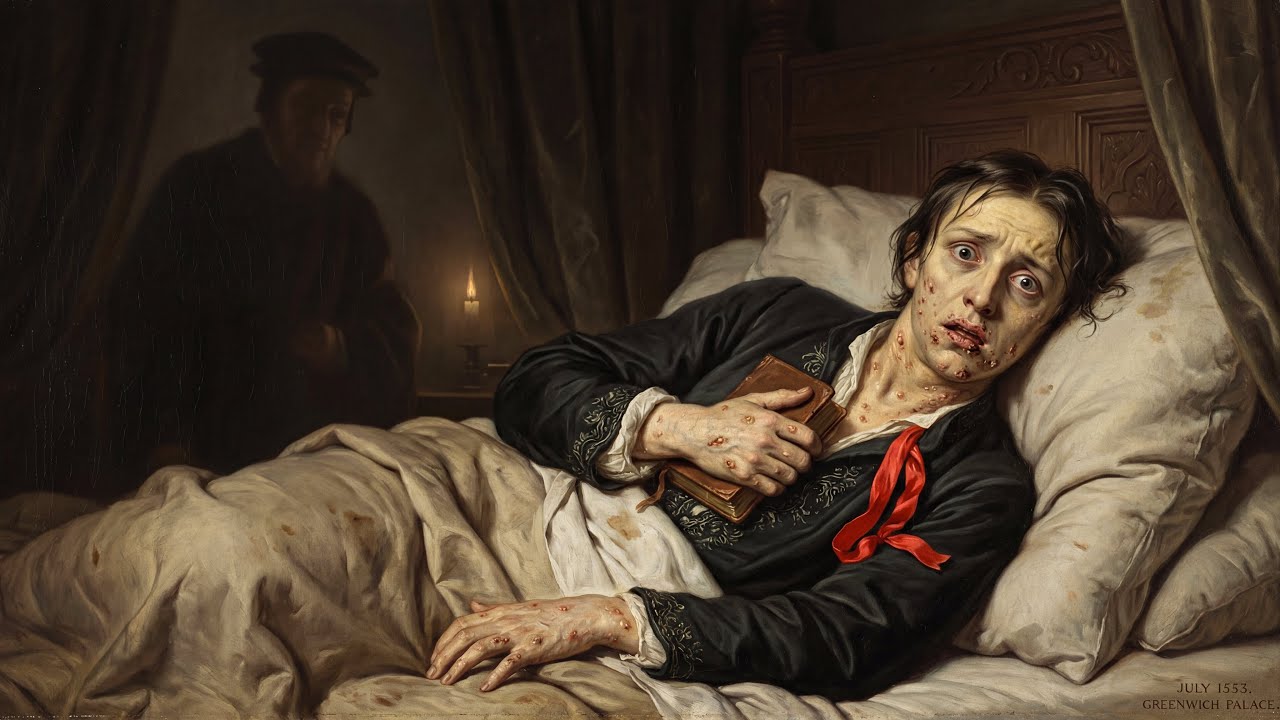
And the strangest part is that we have day-by-day accounts of it. The imperial ambassador had a medical student feeding him information from inside the palace, recording the color of the king’s sputum, the swelling of his legs, the exact hour his breathing changed. We know more about how Edward VI passed than almost any other medieval monarch, and what we know is genuinely disturbing. Edward VI was the son Henry VIII had torn the Catholic Church apart to have.
He was the heir that cost Anne Boleyn and Katherine Howard their heads. Jane Seymour died giving birth to him. This boy was the most protected, most precious child in England, raised in rooms scrubbed twice daily, isolated from anyone who might carry illness, watched over by physicians who monitored his every meal. And yet, by the summer of 1553, his own doctors were watching his fingernails loosen from their beds.
His hair was falling out in clumps. He couldn’t digest food. The smell of decay was coming from inside his living body. He was fifteen years old.
But here’s what makes Edward’s death more than just a medical tragedy. It was the third time the same thing had happened to the same family. Edward’s uncle, Arthur, Prince of Wales, died at fifteen of what physicians called consumption. Edward’s half-brother, Henry Fitzroy, died at seventeen of rapid consumption.
Both wasted away. Both showed the same respiratory symptoms. Both were dead within months of falling ill. Three male Tudor heirs, three deaths before adulthood, the same disease claiming each of them.
By the time Edward caught measles in 1552, he was walking into a pattern that had already killed two of his relatives. To understand how devastating Edward’s decline was, you need to understand how carefully he’d been shielded from it. Edward VI was born on October 12th, 1537, the son Henry VIII had spent twenty years, six wives, and a religious revolution trying to produce. When that baby boy finally arrived, Henry didn’t leave anything to chance.
The floors in Edward’s chambers were scrubbed twice a day. Dirty dishes were removed immediately. Every person who entered his presence was inspected for signs of illness. His food was prepared under strict supervision.
When outbreaks of sweating sickness or plague hit London, Edward was moved to the countryside. When anyone at court fell ill, they were removed from his presence immediately. This wasn’t paranoia. It was policy.
Edward was the heir, the only legitimate male heir. If he died, the Tudor dynasty’s future was uncertain. For fifteen years, it worked. Edward was rarely sick.
Aside from a serious bout of quartan fever, a form of malaria at age four, from which he fully recovered, he was healthy. Contemporary accounts describe him as well-fed, handsome, and remarkably tall for his age. He could ride, he could hunt, he participated in mock jousts. He wasn’t the sickly weakling later historians would imagine.
He was an active, athletic teenager with every reason to expect a long reign. Then came April 1552. What happened next is where modern medicine can tell us something sixteenth-century physicians couldn’t have known. Edward caught measles.
He also appears to have contracted smallpox around the same time, though historians debate whether that second diagnosis was accurate, since no distinctive scarring was later noted. Either way, both illnesses caused severe systemic reactions. He was sick for about two weeks. Then he recovered completely, it seemed.
By May 1552, he was back to his normal activities. But here’s what nobody in 1552 understood. The measles virus doesn’t just make you sick. It suppresses your immune system’s ability to fight tuberculosis.
Modern research has documented this phenomenon extensively. Measles essentially resets your body’s defenses against TB. If Edward had been exposed to tuberculosis before that spring, if he carried even a latent infection in his body, the measles would have knocked down the very immune responses keeping it in check. The clock had started.
Edward just didn’t know it yet. Through the summer and fall of 1552, Edward appeared to return to normal court life, but those closest to him noticed changes. He was visibly weaker than before the illness. His stamina had declined.
He was unable to complete his planned summer royal progress through southern England, a trip that should have been a triumphant display of the young king’s health and authority. His complexion remained pale. He appeared exhausted even with moderate activity. By September, Edward’s physicians began to suspect something was wrong with his lungs.
They couldn’t identify tuberculosis—the bacteria responsible wouldn’t be discovered until Robert Koch’s work in the 1880s—but they recognized the signs. A persistent cough was beginning to emerge. Fevers that came and went, the characteristic symptoms of what they called consumption. Edward himself continued his official duties.
He studied. He attended council meetings. He participated in court ceremonies. But his capacity was diminishing, and the people around him could see it.
By December 1552, there was no hiding it anymore. Edward had a persistent fever that wouldn’t break. His weakness had progressed to the point where moving was difficult. He was short of breath even at rest, a terrifying symptom for a fifteen-year-old.
And the cough had become constant, racking, impossible to ignore. What made it worse was what he was coughing up. The imperial ambassador, Jean Scheyfve, had a medical student named John Banister feeding him daily reports from inside the palace. These reports are remarkably detailed, more clinical than you’d expect from the sixteenth century.
Banister recorded the color of Edward’s sputum: sometimes greenish yellow, sometimes black, sometimes pink with blood. Each color told a story. Greenish yellow meant infection. Black suggested dead tissue.
Pink meant the infection had begun to erode blood vessels in his lungs. Edward was intelligent enough to understand what was happening. At fifteen, he’d already reigned for six years. He’d sat through countless council meetings.
He’d read extensively. He knew that consumption killed, and he knew it had killed members of his own family. As January 1553 began, Edward started to contemplate his own mortality. And what he chose to focus on wasn’t his own survival.
It was the succession. In early February 1553, Edward’s half-sister Mary came to court. The two had been estranged for years. Edward was a committed Protestant, raised by Protestant tutors, surrounded by Protestant advisers, genuinely devoted to the reformed faith.
Mary was an equally committed Catholic who had refused to abandon her religion despite intense pressure during Edward’s reign. Their relationship had become a source of constant tension. Edward had repeatedly tried to force Mary to convert. She had repeatedly refused.
Letters between them were formal and cold. But now Edward was dying, and Mary came to see him. The visit was not what either of them had hoped. Edward was bedridden.
During their meeting, he was seized by violent coughing fits, the kind that left him gasping and exhausted. The physical decline was obvious now, even to someone who hadn’t seen him in months. Mary could see that her brother was dying. But even in his weakened state, Edward maintained his intellectual engagement.
He discussed religious and political matters with her. He didn’t soften his position on her Catholicism. He wasn’t asking for reconciliation. He was still, even now, trying to convert her.
It would be their last significant meeting. Within weeks, Mary would leave the capital, anticipating her brother’s death and fearing what would come after. In March 1553, one of the strangest episodes of Edward’s illness unfolded. An unknown woman appeared at court claiming she could cure the king.
The circumstances are bizarre. Edward’s regular physicians were clearly struggling. They couldn’t agree on treatment, and nothing they tried was working. The king was deteriorating despite their best efforts.
Into this desperation stepped this woman, identified in one Italian source as an Italian gentlewoman who insisted she had a remedy. Despite protests from the royal physicians, the Council of State allowed her to attempt treatment. John Dudley, Duke of Northumberland, appears to have been behind this decision. She refused to reveal her treatment method in advance.
The regular physicians were excluded from the room while she worked. What happened next is documented. Edward’s condition got dramatically worse. His legs swelled severely, so badly that he couldn’t move them without extreme pain.
His general condition deteriorated rapidly. Whatever she was doing was clearly causing harm. She was quickly dismissed. The regular physicians returned, but the damage was done.
The question historians have debated ever since is what was she administering. One possibility is mercury. Mercury was widely used in sixteenth-century medicine for various conditions. It’s also highly toxic, and the symptoms it causes, including dramatic swelling of extremities, match what was observed in Edward after her treatment.
If Edward received mercury around this time, the heavy metal’s toxicity combined with his already compromised immune system could have accelerated his physical collapse. We don’t know for certain. We may never know. But what we do know is that after this woman’s intervention, Edward never recovered even to his previous diminished state.
He had entered the final phase. By early April, Edward had recovered slightly from the worst of his acute symptoms, enough that his physicians tried something new. If the air at Westminster was corrupted, perhaps the cleaner air of Greenwich would help. On April 11th, Edward traveled by barge to Greenwich Palace.
The next day, he appeared in the gardens. Crowds gathered. The people of London had heard rumors about their king’s health. Some said he was already dead, others that he was recovering.
Now here he was, walking in the gardens of Greenwich. But those who actually saw him understood the truth. Contemporary observers noted that Edward was extremely thin, wasted beyond what illness alone should explain. His complexion was ghostly pale.
His movements were slow, obviously painful. Everyone who looked at him realized they were watching a dying man, not a recovering one. The fresh air of Greenwich couldn’t reverse what was happening inside his body. His lungs were being consumed.
His organs were beginning to fail. No change of scenery could stop it. Edward’s brief appearance in the April sunshine was a final gesture of defiance, a king showing himself to his people even as his body betrayed him. It wouldn’t last.
By mid-May, the physicians’ assessment shifted from hopeful to terminal. Their diagnosis: Edward was suffering from a suppurating tumor of the lung, essentially a lung abscess, a collection of pus within the lung tissue caused by bacterial infection. This was probably more accurate than tuberculosis alone. The infection had created pockets of decay inside his living body.
The symptoms were now overwhelming. A racking cough that dominated his existence. Constant high fever that never fully broke. His belly became severely distended and swollen, a sign that the infection was spreading and his digestive system was failing.
His body broke out in ulcers. Whether these were bedsores from being unable to move or secondary infections spreading through his skin, they added to his misery. He could no longer digest food. What little nutrition he received came from medicinal restoratives, fortified broths and liquids.
He was dependent on laudanum, opium dissolved in alcohol, just to sleep. And yet his mind remained clear. On May 21st, Edward altered his will. His devise for the succession was modified to explicitly name Lady Jane Grey as his preferred heir, ahead of his half-sisters Mary and Elizabeth.
This wasn’t the act of a delirious man. This was a dying teenager making a calculated political decision. Edward understood that Mary would restore Catholicism to England. He had spent his entire reign building a Protestant nation.
He wasn’t going to let his death undo that work. The devise was controversial. It contradicted Henry VIII’s succession acts. It bypassed two adult women with stronger claims to name a teenage cousin.
But Edward was determined. If he was going to die, England would remain Protestant. By the end of May, the pace of Edward’s decline accelerated dramatically. He was wasting away at a visible rate, losing weight even though he couldn’t eat.
His body began to swell, especially his head and feet. He couldn’t rest without opiates. Violent coughing fits prevented sleep even when the drugs wore off. And there was the smell.
Contemporary accounts are delicate about this, but they make it clear: the odor of disease and decay was becoming noticeable to those attending him. Edward’s body was rotting from within, and that process was now detectable to everyone in his chamber. What was happening inside him was catastrophic organ failure. His respiratory system was collapsing.
His damaged lungs could no longer adequately oxygenate his blood. His kidneys were failing, hence the severe swelling in his lower extremities, the inability to regulate fluids. His digestive system had shut down. His hair was falling out in clumps.
His fingernails were loosening from their beds. These are signs of systemic toxicity. His body was accumulating waste products that healthy kidneys would have filtered out. On June 10th, Edward’s physicians gave him three days to live.
They were wrong. He would survive another three and a half weeks, but those weeks would be unimaginable suffering. By mid-June, Edward had given up any hope of recovery. On June 11th and 12th, he couldn’t hold anything on his stomach.
The only nutrition entering his body came from medicinal restoratives, broths and cordials designed to provide some sustenance without requiring digestion. On June 15th, he was attacked by a violent fever that lasted twenty-four hours. Two days later, another violent fever. He couldn’t expel bodily waste.
When he could, contemporary accounts note that it had a terrible stench, a sign of severe systemic infection and toxemia. His body was poisoning itself. But his mind remained sharp. On June 21st, Edward ordered his devise for the succession to be authenticated under letters patent.
This was a legal document, properly witnessed and sealed. It wasn’t a dying man’s rambling. It was a king’s final command. The document named Lady Jane Grey and her heirs.
Mary and Elizabeth were explicitly excluded. Edward’s rationale was clear. Both sisters had been declared illegitimate by acts of parliament under Henry VIII. More importantly, Mary was a Catholic, and Elizabeth’s religious convictions were uncertain.
Jane was Protestant. Jane would preserve what Edward had built. By June 24th, the ambassador reported that Edward could hardly breathe and rarely stirred. His body no longer performed normal functions.
He was covered in scabs. The ulcers had spread across his skin. His hair continued to fall out. His nails continued to loosen.
Contemporary accounts are blunt: Edward’s last days must have been unendurable. He was incapable of doing anything more than waiting and preparing for death. News of Edward’s imminent death had spread throughout London. Rumors multiplied.
Some said he was already dead. Others claimed he was recovering and the government was lying about his condition. To counter the speculation, Edward was positioned at a window at Greenwich Palace on July 1st. Picture this scene.
A crowd gathered below, hoping to see their young king. After weeks of rumors, here was proof he was alive. The window opened. Edward appeared.
The reaction was horror. Contemporary observers describe what they saw. The king was so thin and wasted that all men said he was doomed. This wasn’t the healthy teenager who had appeared in the gardens two months earlier.
This was a skeleton draped in royal clothing. This was death walking. Edward had shown himself to his people one last time. It was both a gesture of royal authority and an inadvertent final statement.
The crowds understood what they were seeing. Over the next two days, people returned to Greenwich, hoping Edward would appear again. He didn’t. The official excuse was that the air was too chill for him.
Everyone understood the truth. On July 4th, while Edward lay dying, his half-sister Mary received word of what was coming. She understood immediately what would happen after Edward’s death. John Dudley, Duke of Northumberland, was planning to place his daughter-in-law, Lady Jane Grey, on the throne.
Mary would be arrested, imprisoned, possibly executed. Mary made a decision that would change English history. She fled, feigning illness to avoid a summons from Northumberland. She left London and headed northeast, first to Kenninghall in Norfolk, then to Framlingham Castle in Suffolk.
She began gathering supporters, preparing to fight for her throne. Meanwhile, at Greenwich, Edward was spending his final night in prayer. Those attending him—Sir Henry Sidney, Sir Thomas Wroth, Christopher Salmon, the royal physicians Owen and Wendie, and the Bishop of Ely—remained at his bedside through the night. The Bishop of Ely, Thomas Goodrich, heard Edward’s final confession.
The details of that conversation were not recorded. The confession was a private spiritual matter between the dying king and his spiritual adviser. Edward was still conscious, still mentally clear, still breathing, though barely, still waiting. Edward VI died on the evening of July 6th, 1553, between eight and nine o’clock, at Greenwich Palace.
Before he lost the ability to speak, Edward prayed. His final prayer was documented by those present, and it reveals something remarkable about this dying teenager’s state of mind. He didn’t pray for his own recovery. He didn’t ask for more time.
He prayed for England. His words: “Lord God, deliver me out of this miserable and wretched life, and take me among thy chosen. Howbeit not my will, but thy will be done. Lord, I commit my spirit to thee.
Oh Lord, thou knowest how happy it were for me to be with thee. Yet for thy chosen’s sake, send me life and health, that I may truly serve thee. Oh my Lord God, bless thy people and save thine inheritance. Oh Lord God, save thy chosen people of England.
Oh my Lord God, defend this realm from papistry and maintain thy true religion, that I and my people may praise thy holy name for thy son Jesus Christ’s sake. ”
Even in death, Edward’s fear was for his kingdom’s soul. He had spent his reign building a Protestant England. His final words were a plea that it would survive him.
As he grew weaker, his prayers shortened. His final words, spoken as his strength gave out: “I am faint. Lord, have mercy upon me and take my spirit. ”
Sir Henry Sidney, Edward’s closest friend, took the dying king into his arms.
Sidney would later report that Edward surrendered his spirit in great sweetness. Edward VI was dead. He was fifteen years old, fifteen days short of his sixteenth birthday. He had reigned for six years.
After Edward’s death, a court surgeon performed an autopsy, unusual for the period, but Edward’s death was significant enough to warrant one. What they found inside his body was horrifying. Both lungs contained what the surgeon called putrified ulcers, not simple sores, but areas where the lung tissue had literally rotted away while Edward was still alive. The tissue was severely damaged, riddled with cavitations, holes eaten away by infection.
There was extensive necrosis, dead tissue filled with pus and infected matter where healthy lung should have been. The diagnosis was clear: the disease that killed Edward VI was consumption, what we now call tuberculosis, in its most devastating disseminated form. But the lungs weren’t the only site of infection. The surgeon found tubercles on Edward’s brain membranes, tuberculous meningitis.
This explained the severe headaches and violent fevers of his final weeks. The infection had spread from his lungs into his central nervous system. His liver was swollen and mottled, evidence of secondary infection spreading throughout his body. His intestines were ulcerated.
The disease had reached his digestive system, explaining why he couldn’t eat or process food. Edward VI hadn’t died of one condition. He had died of a systemic infection that consumed him from the inside out, attacking his lungs, his brain, his liver, his intestines. By the end, there was almost nothing left of him that wasn’t diseased.
Edward’s death wasn’t just a personal tragedy. It was the final chapter in a devastating family pattern. Arthur, Prince of Wales, Edward’s uncle, had died at fifteen in 1502. The official cause was sweating sickness, but the rapid wasting and respiratory symptoms suggest tuberculosis or a similar pulmonary condition.
Henry Fitzroy, Edward’s half-brother, had died at seventeen in 1536. The diagnosis was rapid consumption. He wasted away within months. Henry VII himself, Edward’s great-grandfather, had died of a wasting illness at fifty-two, his final years marked by respiratory decline.
Four male Tudors, all showing similar symptoms, all dying before their time. Modern historians have proposed several theories. Some suggest a genetic mutation, possibly in the CFTR gene that causes cystic fibrosis. Non-classic CF would allow relatively normal early development but result in chronic lung damage that becomes catastrophic when combined with a secondary infection.
This would explain why Arthur, Fitzroy, and Edward all died after catching something else: a cold, a fever, the measles. Others point to the measles connection specifically. Modern research has documented that measles suppresses immunity to tuberculosis. If Edward, and possibly his relatives, had latent TB infections, an acute illness like measles could activate the bacteria with devastating speed.
We may never know for certain. Genetic testing on historical remains is possible but rarely permitted on royal bodies. What we do know is that the Tudor male line was cursed, not by witchcraft, but by biology. Something in their inheritance made them vulnerable to the very diseases their careful isolation was meant to prevent.
Edward’s death was kept secret for three days. John Dudley, Duke of Northumberland, needed time. Edward’s devise had named Lady Jane Grey as queen, Dudley’s daughter-in-law, a teenager he could control. But making it reality required careful preparation.
On July 10th, four days after Edward died, Jane Grey was proclaimed Queen of England. She was fifteen years old, the same age Edward had been. By all accounts, she was reluctant. She didn’t want the throne, didn’t believe her claim was legitimate, and was terrified of what she’d been thrust into.
Meanwhile, Mary was raising an army from Framlingham Castle. She sent out letters declaring herself the rightful queen. Men flocked to her banner, thousands of them. Within days, she had assembled approximately six thousand armed supporters.
Northumberland marched north with a military force to crush the rebellion. He reached Cambridge and found himself facing a superior army. Rather than risk battle, he retreated. It was over.
On July 19th, nine days after Jane had been proclaimed queen, the Privy Council formally deposed her and proclaimed Mary as queen. Northumberland was arrested and later executed. Jane, her husband, and her father were imprisoned in the Tower. Edward’s desperate gamble had failed.
His devise hadn’t preserved Protestant England. It had created a succession crisis that was resolved in thirteen days with his Catholic sister firmly on the throne. Everything Edward had feared was about to happen. Edward’s funeral took place on August 8th, a month after his death.
The delay was caused by negotiations over the form of the service. Edward would be buried with Protestant rites. His funeral used the 1552 Book of Common Prayer, the first time this Protestant service was ever used for an English monarch’s burial. The night before the burial, a great procession moved from Whitehall Palace to Westminster Abbey.
Singing clerks in religious vestments, children in white surplices, servants dressed in black, heraldic banners emphasizing Tudor ancestry, and at the center a horse-drawn chariot decorated with cloth of gold, carrying a life-sized wooden effigy of Edward dressed as king with crown, scepter, and garter insignia. Londoners lined the streets weeping and lamenting. Whatever their religious allegiances, they had lost a young king, a boy who had never reached manhood, consumed by disease before he could fulfill his promise. Edward was buried beneath the original altar of Henry VII’s Lady Chapel in Westminster Abbey, near his grandfather’s tomb.
The vault was small, a narrow space meant for just one coffin. No monument was ever constructed. For centuries, Edward’s burial place remained unmarked. It wasn’t until 1966 that Christ’s Hospital, a school Edward had founded, placed a stone memorial to mark where the boy king rested.
But here’s the detail that captures the religious tragedy of Edward’s death. While Protestant services were being held at Westminster Abbey, Mary Tudor held Catholic requiem masses for her brother at the Tower of London. The same prayers, the same grief, completely different faiths. Edward’s fear that his death would mean the return of papistry was already coming true.
Within months, the Protestant reforms of his reign would be reversed. The religious persecutions of Bloody Mary would begin. The faith Edward had died defending would be driven underground. He had prayed for England to be saved from Catholicism.
His prayer was not answered. Edward VI’s final days were terrible in the truest sense of the word. Not dramatic, not theatrical, terrible. A fifteen-year-old boy watched his own body betray him.
His lungs filling with rot, his organs failing one by one, his skin breaking out in sores, his hair falling out in his hands. He endured this for six months, fully conscious, fully aware, maintaining the duties of kingship even as he lost the ability to stand. And when death finally came, his last words weren’t for himself. They were for England.
“I am faint. Lord, have mercy upon me and take my spirit. ”
But Edward’s death didn’t end the Tudor tragedy. The sister who replaced him, the Catholic queen he tried so desperately to exclude, would face her own terrible final days.
Mary’s death would be just as devastating, and the religious reversal she caused would set the stage for centuries of conflict.
