She stood in front of it with tears in her eyes and thanked the artist to his face. Ten days before the whole of Parliament gathered to give Winston Churchill his eightieth birthday present, Clementine Churchill had been shown the finished portrait of her husband, and she had wept over it. But in 1955 or 1956, on her instruction, that painting was taken out of a cellar in Kent and burned. A van in the dark, a bonfire in a back garden several miles away, built where no one could see the flames from the street.
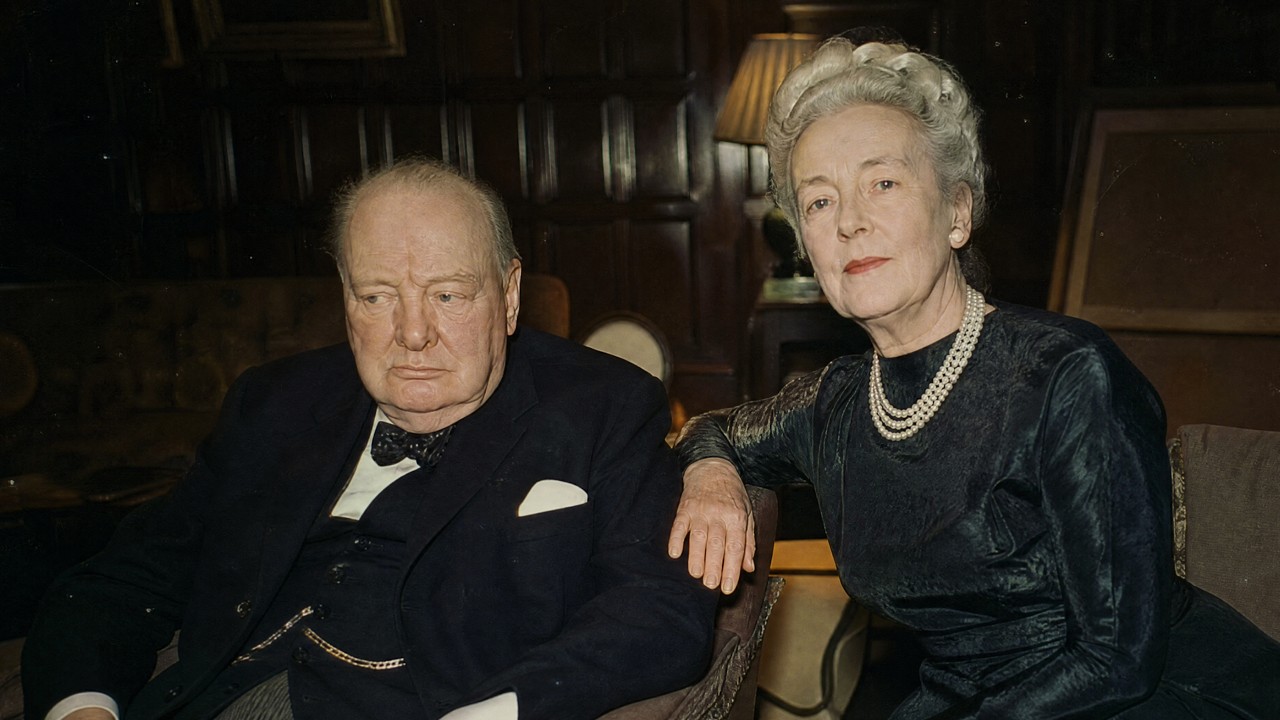
Both houses of Parliament had subscribed a thousand guineas for it. The woman who carried it out kept the secret for twenty-two years and told her daughter once, on a ship. The country found out a month after they buried her. The girl who grew into that woman was born on a drawing-room floor in Mayfair in 1885, and nobody has ever established who her father was.
The address was Grosvenor Street, as good an address as London has. The birth, by Sonia Purnell’s account, was hasty enough that it happened on the floor of the drawing-room rather than in any bed. The child was named Clementine Ogilvy Hozier, and on paper she was the second daughter of Colonel Sir Henry Montague Hozier and Lady Blanche Ogilvy, a daughter of the Earl of Airlie. That is the surface of it.
Underneath, almost nothing was fixed. Henry Hozier was, by the account of every biographer who has gone near him, set against having children and reputedly incapable of them. Lady Blanche was unfaithful on a scale that startled even a permissive society; Purnell’s phrasing is that she was reputed to entertain as many as ten lovers at a time. Two men are named in the record as candidates for Clementine’s real father.
One is Bertram Freeman Mitford, the first Baron Redesdale, Blanche’s own brother-in-law, married to her sister, a woman also called Clementine, and grandfather to the Mitford sisters. That theory belongs to the biographer Joan Hardwick, and Purnell calls it the likeliest. The other is Captain George Middleton, called Bay, the celebrated horseman. That version was Blanche’s own claim, and the one her daughter Mary believed.
Nothing in the record settles it. The birth was registered to Henry Hozier, and she was treated as his daughter for the whole of her life, yet she is reported never to have known for certain which man had made her. A great deal of what she later did was done by a woman who could not answer the first question anybody asks about themselves. In 1891, when she was six, her father found her mother with a lover and began divorce proceedings.
Blanche stopped him by threatening to lay out his own infidelities in court. The suit collapsed, and the marriage ended anyway. There was a custody fight, and in the middle of it, Clementine and her elder sister were handed for a time to their father and to a strict aunt who believed in whipping children. Then came the years that formed her.
For roughly eight years, a family of five moved between furnished lodgings every few months, partly to stay ahead of the people they owed money to, partly because Blanche could not sit still. Around 1899, they went to Dieppe, where living was cheap and where London’s opinion of Blanche did not reach across the water. They joined the English colony there, which took in Aubrey Beardsley and the painter Walter Sickert. Sickert became a friend of the family and, by Purnell’s account, Blanche’s lover as well.
At the casino in Dieppe, Blanche gambled away whatever money the household had. Her daughter never forgot it; a letter Clementine wrote to her husband in April 1924, now held at the Churchill Archives Centre, returns to the gambling and to why her mother lived where she did. The education was assembled out of whatever could be afforded: tutoring at home, a short spell at a school in Edinburgh run on the Froebel method, then Berkhamsted School for Girls, and then, from about 1902, the Sorbonne. She earned money teaching French.
On the evening in March 1908 when she met Winston Churchill at Lady St Helier’s dinner table, she arrived tired because she had spent the day earning her living giving French lessons. In March 1900, when Clementine was fourteen, her elder sister Kitty died of typhoid at the age of sixteen. Blanche sent the two younger girls away to Scotland so that she could nurse Kitty alone and without distraction. Kitty was the pretty one and the favored one, and the mother’s choice about who to send away and who to keep was not a subtle piece of information for a fourteen-year-old to receive.
By her early twenties, she had been engaged three times: twice in secret to Sir Sidney Peel, a grandson of Sir Robert Peel and fifteen years her senior, and twice she broke it off. Then, within weeks, she became engaged to Lionel Earle, a wealthy civil servant roughly twice her age, whom she had known for barely a month. A fortnight’s holiday together in the Netherlands showed her that he was a pompous bore. She broke that off too, and had to send back the wedding presents.
Take the inventory of what Clementine Hozier possessed at twenty-three: no money, no settled address, no father she could name with confidence, a dead sister, a gambling mother, a scandalous surname in the drawing rooms that mattered, and a personal reputation for accepting proposals and then refusing to go through with them. Everything she had after that, she made. In fifty-six years of marriage, she would never once behave like a woman who believed her position was safe. The man she was about to marry had no money either.
They met at a ball in 1904, and he could barely speak to her. It was at Crewe Hall. Winston Churchill was already famous, already a member of Parliament, already a man who talked for a living. He was introduced to Clementine Hozier and was reportedly tongue-tied.
Nothing came of it. Four years went by. In March 1908, Lady St Helier sat them next to each other at dinner. He arrived late and in a bad temper, expecting to be bored by whichever dignitary he had been placed beside.
He spent the entire evening talking to the young woman on his other side and ignored the rest of the table. The courtship ran about five months. On the eleventh of August 1908, at Blenheim Palace in the small classical summer house called the Temple of Diana, he proposed and she accepted. They married on the twelfth of September 1908 at St Margaret’s, Westminster.
Crowds gathered in the street outside. David Lloyd George, who would be Prime Minister within a decade, was a witness. Lord Hugh Cecil was best man. King Edward the Seventh sent a gift.
Some popular accounts describe more than a thousand guests filling the church and call it the social event of the season; that figure is a round one that has never been properly checked. But here is the thing about that wedding which has never been explained: it was one of the most public society marriages in Edwardian London, held five minutes from Parliament, and no photograph of the day has ever been located. The most photographed Englishman of the twentieth century was married in front of a crowd, and the crowd took nothing home. The finances were bleak and stayed bleak.
She brought no dowry because after the separation of 1891, her mother had effectively nothing. He had no inherited fortune to speak of either. Members of Parliament in Britain were not paid a salary at all until 1911, three years into the marriage. His income came out of journalism and books.
He had earned two hundred and fifty pounds a month writing for the Morning Post during the Boer War, serious money for a young man, and he had spent it along with everything else that came in. Friends who visited the young Churchills in those first years found the household oddly modest, more like the establishment of a comfortable professional family than of a public man. They gave each other animals: she was the cat, sometimes written cat; he was the pug and later the pig. Beside the signature in his hand or in hers, there is very often a small drawn animal.
Mary Soames edited a selection of their correspondence and published it in 1998 under the title Speaking for Themselves, running from the courtship in 1908 through to his death in 1965. That correspondence is the reason this story can be told at all, and the reason the ending is so strange: a marriage that put everything on paper for fifty-six years produced, at its single most consequential moment, not one written word. What she was actually building in those years was not a fortune and not a house. She had married a man of enormous ability and no restraint.
Within a very few years, she had appointed herself the only person in England permitted to tell him when he had gone too far. Nobody gave her that job. There was no precedent for it and no title attached to it. She simply took it, and she held it until he died.
It was not a matter of soothing him at the end of a difficult day. She warned him about the people around him, told him which of his friends she believed were using him, and when he became unbearable, she said so in writing. The first great test of that arrangement was still thirty-two years away. Before it came, he bought a house.
In the autumn of 1922, he signed for a house in Kent for five thousand pounds and told her afterwards. He had seen it in July of that year and brought her back to look at it. Her first reaction was warm. Then, in Stefan Buczacki’s words, her enthusiasm cooled during subsequent visits, the polite formulation for a woman doing sums in her head.
The house was called Chartwell. It failed to sell at auction in September 1922 and was then offered to Churchill at five thousand five hundred pounds. He countered at four thousand eight hundred and was refused, writing that the house would have to be very largely rebuilt and that the presence of dry rot was a very serious adverse factor. He then paid five thousand pounds and concluded the sale on the eleventh of November 1922.
He did not tell his wife he was buying it until it was bought. The seller was Captain Archibald Colquhoun, a contemporary from Harrow, and Churchill wrote to him that he had been searching for two years for a home in the country, and the site was the most beautiful and charming he had ever seen. Later he said it more simply: he bought Chartwell for that view. And a day away from Chartwell, he said, was a day wasted.
Now set that against the only thing she is recorded as having wanted from a country house, in her own words: she longed for a country home, but she would like it to be a rest and a joy, and not a fresh preoccupation. Consider what was happening to her at that moment. His mother, Lady Randolph, had died in June 1921. Their daughter Marigold had died that August.
He had appendicitis in the late autumn of 1922 and lost his seat at Dundee at the turn of the year. Into the middle of that, without consulting her, he bought a rotting, chewed-up house on a Kentish hillside and committed them both to rebuilding it. The rebuilding was given to Philip Tilden, a fashionable architect. Work began in 1922, and Churchill moved in during April 1924.
The cost was estimated at seven thousand pounds and came in at over eighteen thousand. By 1924, the client and the architect were barely on speaking terms, and the argument was being conducted through lawyers, which it continued to be until 1927. Across the following fifteen years of work and improvement, the International Churchill Society puts the total spent on the place at upwards of thirty thousand pounds on top of the five thousand it cost to buy. He wrote to her about it in September 1923, a small masterpiece of a man asking his wife to stop counting.
“My beloved,” he wrote, “I beg you not to worry about money or to feel insecure. Chartwell is to be our home and we must endeavor to live there for many years. ” The first letter he ever wrote from the finished house, on the seventeenth of April 1924, was to her: “This is the first letter I have ever written from this place, and it is right that it should be to you. ”
The scale of what she was now running is set out in the sale particulars drawn up in 1938 when the house was very nearly sold to pay his debts: five reception rooms, nineteen bed and dressing rooms, eight bathrooms, eighty acres, three cottages, a heated and floodlit swimming pool.
The sale was withdrawn only because Sir Henry Strakosch took over Churchill’s share portfolio for three years and cleared the debts attached to it. David Lough’s research puts the household spending at around four hundred and eighty pounds a month across food, wages, maintenance, and cars, with thirteen servants indoors and a team of twenty outside on the grounds. The title of Lough’s book comes from a note Churchill sent his wife in 1926: “No more champagne is to be bought. ”
Two features of the property matter more than any of that, and neither appeared in the sale particulars as anything special.
The first is the studio, freestanding out in the garden beyond the croquet lawn near the kitchen garden and the golden rose walk, put up in the 1930s for Churchill to paint in. The Soviet ambassador, Ivan Maisky, saw it in September 1938 and described a pavilion and studio with dozens of paintings hanging on the walls, all of them the owner’s own work. The second is the cellar, where the wine was kept. Maisky, on that same visit, asked what occasion could possibly justify opening a bottle dated 1793, and Churchill told him they would drink it together when Great Britain and Russia had beaten Hitler’s Germany.
In April 1921, her brother shot himself in a Paris hotel, and four months later, her daughter was dead. Her brother was Lieutenant Commander William Ogilvy Hozier of the Royal Navy, known in the family as Bill. He was thirty-three. He had inherited the family talent for losing money and had been ruined by gambling debts, and on the nineteenth of April 1921, in the Hotel D’Iena in Paris, he shot himself.
The Churchills had only just returned from the Cairo conference. Marigold Churchill had been born on the fifteenth of November 1918, the fourth of the five children. In the summer of 1921, she developed what everybody took to be a cough, and it did not clear. She was at Broadstairs on the Kent coast while her parents were in Scotland.
The cough became septicemia. By the time it was understood how ill she was, there was nothing to be done for her. On the twenty-third of August 1921, Marigold died. She was two years and nine months old.
William Manchester’s account records that her mother, on being told, shrieked in agony like an animal in mortal pain; that phrasing comes to us through Manchester rather than from a first-hand note. But no version of that afternoon is gentle. The child was buried at Kensal Green in London, and she stayed there, apart from the rest of them, for the next ninety-eight years. It was not until 2019 that Marigold’s remains were taken up and reburied at Bladon, in the churchyard where her father and her mother and her eldest sister already lay.
The family took almost a century to bring her home. One correction is worth making, because it circulates constantly and it is wrong. Lady Blanche Hozier did not die in 1921. She died in Dieppe on the twenty-eighth of March 1925, four years later.
What 1921 took from Clementine Churchill was a brother in April and a daughter in August, and that is enough without adding to it. The five children were Diana, born in 1909, Randolph in 1911, Sarah in 1914, Marigold in 1918, and Mary, born in 1922, the year of Chartwell. Three of them died before their mother did. Diana was the eldest.
She suffered from depression across a long stretch of her adult life, with documented breakdowns and treatment by electroconvulsive therapy. In 1962, she began volunteering for the Samaritans, the charity that answers the telephone to people considering ending their own lives. On the twentieth of October 1963, at her house in Chester Row in Westminster, she took at least seventeen barbiturate sleeping capsules with alcohol. She was fifty-four.
The inquest was held on the twenty-fourth of October before the coroner Gavin Thurston. The pathologist Keith Simpson told the court that the standard dose of those capsules was two, and that a woman of her intelligence could not have taken seventeen by accident. The verdict was suicide while of sound mind. Randolph was the only son and was indulged by his father to a degree that everybody around them could see.
He was drinking double brandies at nineteen, he gambled and his father paid the debts repeatedly. His relations with his mother were cold, and Purnell’s account is that she detested him partly as a reaction against her husband’s refusal to correct him. He died of a heart attack in 1968. Sarah went on the stage.
She married three times, and the only one of her husbands her parents approved of died. After that she had an affair with the jazz singer known as Lobo Nocho, and she was arrested and jailed for driving while drunk. The alcoholism ran through the rest of her life. Mary, the youngest, born into Chartwell, outlived every one of them and wrote the family’s history.
She would eventually be one of the people who told the world what her mother had done, and one of the people who decided when. There is a detail in Diana’s case that has to be stated flatly rather than dressed up. From 1962, she was answering telephones for the Samaritans, the charity people ring when they are thinking of killing themselves. She spent the last year of her life talking strangers out of it.
Then she went home to Chester Row and did it. Her mother was seventy-eight when that happened, and she had another fourteen years to live. It is also worth saying plainly what kind of household these children grew up in, because the accounts are consistent and they are not flattering. Clementine Churchill ran Chartwell to a standard of perfection that everybody around her found exhausting.
No dirty windows, no crumpled tablecloths, hems washed and pressed after every outing. Behind the public composure there were what those close to her described as emotional electric storms. She was demanding of her staff and more demanding of her children. And she was married to a man who indulged them without limit, which meant that every correction in that house came from one parent only.
The result was a family in which the father was adored and the mother was obeyed, and in which two of the surviving children drank themselves towards early graves, while a third was treated for depression with electric current. Hold all of that together, because it explains something that would otherwise look like a fit of temper. By the middle of the 1950s, Clementine Churchill had buried a sister at sixteen, a brother by his own hand at thirty-three, and a daughter at two years and nine months. She had watched a second daughter treated with electric current for depression and would eventually bury her too.
She had a son drinking himself towards a heart attack and a daughter whose drinking would end in a police cell. She had lived through two World Wars, run a national charity in the second of them, and spent nearly half a century managing the temper of the most watched man in the country. Set a painting next to that. That is not an argument that she was right to do it.
It is an explanation of why the decision, when it came, seems to have cost her so little. People who have carried genuine catastrophe develop a very exact sense of what is and is not survivable. And a canvas in a cellar was not going to frighten a woman who had lost a two-year-old at Broadstairs. There was one stretch of her life, and only one, when she put all of it down and walked away.
It lasted four months, and it happened at the other end of the world. In January 1935, she went aboard another man’s yacht without her husband and did not come home until April. The yacht was the Rosaura and it belonged to Lord Moyne. There had been an earlier voyage in late September 1934 around the Mediterranean, and on that one Winston was aboard.
This one, she took alone. The Rosaura sailed for the Dutch East Indies. The purpose was a collecting expedition, and its most famous object was the Komodo dragon. Moyne’s party went through Borneo, the Celebes, and the Moluccas and brought back the first live Komodo dragon ever to reach Britain.
The ship went on to Australia and New Zealand. Clementine Churchill did not return to Southampton until the twenty-sixth of April 1935. She was forty-nine when she left and fifty when she came back. Put the arithmetic of that voyage next to the arithmetic of the life she had left at home: four months at sea, a private yacht and a party assembled for the pleasure of collecting reptiles, while back at Chartwell there were nineteen bed and dressing rooms, eight bathrooms, eighty acres, and three cottages to keep running in a house so far beyond its owner’s means that within three years it would be advertised for sale to clear the debts.
She was fifty years old. She had buried a sister, a brother, and a daughter. And she got on a boat. Among the other guests aboard was a man called Terence Philip, an art dealer born in Moscow in 1891, working for Wildenstein and Company.
The descriptions of him are consistent: tall, rich, suave, an authority on pictures. He was about seven years younger than she was. Here is where this story has to be handled with care, because the temptation to fill in the blank is enormous and the record does not permit it. What is documented is this: he was on the voyage, and he gave her a pink dove from Bali.
What is not documented is an affair. A great many biographers believe there was one. Some accounts hold that he had no sexual interest in women at all and was believed by many who knew him to be homosexual, and that claim is also made without hard citation. No conclusive evidence has ever been produced in either direction.
The honest position is that nobody knows what happened on that ship. What is not in doubt is what she did when she got home. The dove died. She buried it in the garden at Chartwell beneath the sundial, and the sundial carries an inscription:
Here lies the barley dove.
It does not do to wander too far from sober men. But there’s an island yonder. I think of it again. It is still there.
Sit with that for a moment, because it is one of the most extraordinary objects in this entire story, and it has been standing in a Kentish garden in plain view ever since. A woman of fifty in the middle of a house full of servants and secretaries and visiting politicians buried a bird in the lawn and had it commemorated in verse that says in public, where her family would walk past it every day, that she thinks about an island. “It does not do to wander too far from sober men. ” That is a description of a return and a judgment that the return was correct.
And then the line that undoes it: “But there’s an island yonder. I think of it again. ” Nobody had to put that up. Almost every other act of commemoration in her life was performed on her husband’s behalf.
This one was hers. What is relevant is not who did what on which yacht. What is relevant is that by the middle of the 1930s, this was a marriage of two people who had been apart a great deal, who wrote to each other constantly because they were so often in different countries, and who had already survived more than most marriages are asked to carry. Purnell, drawing on her daughter-in-law Pamela Harriman, records the claim that Clementine may have spent as much as eighty percent of her marriage without him; that figure comes from a single biographer and should be carried as her estimate.
But the shape of it is right. People who live together do not need to write. She came back from the Dutch East Indies in April 1935. Within five years, her husband was Prime Minister, the country was fighting for its existence, and she was about to write him the most direct letter anybody sent him during the entire war.
Five weeks after he became Prime Minister, she wrote him a letter, tore it up, and then wrote it again. It was the worst summer in British history, and there has never been a worse month in which to hand a man a piece of criticism. She wrote it anyway. Then she destroyed it.
Then, several days later, she wrote it out again and sent it. The letter is dated the twenty-seventh of June 1940, and it is the only letter between Winston and Clementine Churchill known to survive from the whole of that year. “There is a danger,” she wrote, “of your being generally disliked by your colleagues and subordinates because of your rough, sarcastic, and overbearing manner. ” She told him what the effect of it had been on the men working immediately around him: his private secretaries had agreed among themselves to behave like schoolboys and take what was coming to them.
When she had protested about the way he spoke to people, the answer she got was that no doubt it was the strain. Then she stopped reporting other people’s opinions and gave him her own. “My darling Winston,” she wrote, “I must confess that I have noticed a deterioration in your manner, and you are not so kind as you used to be. ” And then the letter stops being a complaint and becomes a piece of political advice from someone who understood the job as well as he did.
“With this terrific power,” she told him, “you must combine urbanity, kindness, and, if possible, Olympic calm. You will not get the best results by irascibility and rudeness. They will breed either dislike or a slave mentality. ” She signed it, “Your loving, devoted, and watchful, Clemmie.
” Watchful. She chose that word and put it at the bottom of the page in the same position where, in easier years, she drew a cat. No answer survives. Mary Soames, going through the papers decades later, concluded that the two of them must simply have talked about it.
Now take the two versions of that letter and put them side by side, because the one that does not exist is as important as the one that does. She wrote it. She read it back. She decided it was too much and she tore it up.
Then she waited and thought about it and wrote it out a second time and put it into his hands during the worst summer in British history. That is not the behavior of a woman losing her temper. That is the behavior of an editor. She had a draft.
She rejected the draft and she issued a revised version. The first attempt was destroyed because she judged it unfit to go out under her name, and nobody has ever read a word of it. There is one more thing in that letter worth naming, because it is the whole architecture of the marriage in a single mechanism. The information had not come from her.
Somebody inside the machine had gone to the Prime Minister’s wife because there was no other route. She was not simply his wife by 1940. She was the appeals process. That is an unofficial position with no salary, no title, and no protection, and she had built it herself out of nothing over thirty-two years.
It ran on exactly one asset: his willingness to accept correction from her, and from nobody else on earth. Everybody around him understood it, and so did the men who competed with her for his ear. She had a private name for three of them. Lord Beaverbrook, Lord Birkenhead, and Brendan Bracken she grouped together and called the terrible bees.
She believed Bracken took her husband away from her and did what she could to discourage the friendship. She distrusted Beaverbrook’s motives from beginning to end, including through the war, when he was running the Ministry of Aircraft Production, and running it well. Her objection to those three was never social and never about their politics. It was that each of them had a channel to him that she could not see into.
Remember that name, because Beaverbrook is about to appear twice more in this story, and on both occasions on the wrong side of her. The recommendation of the painter came through him, and he is the man she chose to write to in October 1957 with a sentence about the portrait that could not possibly have been true. She was right to guard the channel, because it was the only instrument she had. She could not sack anybody.
She could not vote in his cabinet. She could not correct a speech in the Commons. What she had was the ability to tell him the truth in a room with the door shut, and the certainty that he would take it from her, and from nobody else. And she was not simply a wife with opinions borrowed from her husband.
She had come into the marriage a liberal, interested in politics in her own right, and a committed supporter of votes for women. She is credited by some historians with moving him towards women’s suffrage during the twenty years he sat as a liberal himself, having crossed the floor from the Conservatives in 1904. On a number of questions, she stood to the left of the man she was married to, and she stayed there. Her opinions were not decoration, nor was she gentle at home.
The standards she kept at Chartwell were exacting to the point of cruelty, and everybody in the house felt them. No dirty windows, no crumpled tablecloths, hems washed and pressed after every outing. Behind the public composure came what those closest to her described as emotional electric storms. She was demanding of her staff and more demanding of her children.
And she was the only person in that household who ever said no to anybody. That is the woman, not a soother: an editor with a red pen and a temper in a house where she was the only adult applying a standard. She used the pen on his manner in 1940. Fourteen years later she would use it on something he could not shout down.
And the second time she would not put a word of it on paper. The war gave her something else as well, and it is the part of her life that has been most thoroughly forgotten. She raised a million pounds for Russia before the year was out, and by the end of the war she had raised about eight. She had been a Red Cross volunteer from the outbreak.
In October 1941, the British Red Cross Society appointed her to head the Aid to Russia Fund, and she ran it for the rest of the war. Between the middle of October 1941 and the end of December, the fund raised one million pounds. Within eighteen months it had raised three million. On the sixteenth of April 1945, a telegram from Lord Iliff reached her while she was traveling reporting that the fund had now passed seven million pounds.
By the end of the war the figure was around eight million, four million of it spent on medical supplies. What that bought was 11,600 tons of medical aid and clothing, 2,000 tons of powdered medicines, and 22,000 units of medical equipment. The King and Queen gave a thousand pounds in the first week, and Lord Nuffield gave fifty thousand. But that was never where the money came from.
It came from subscriptions of a penny a week, from flag days, school pageants, knitting circles, baking groups, and collections in factories and hospitals. She built an eight million pound charity out of pennies in a country that was being bombed. That was not all she did. She chaired Fulmer Chase Maternity Hospital for the wives of junior officers from 1940 to 1946.
She was president of the YWCA wartime fund from 1941 to 1947. She was a fire watcher during the Blitz. She campaigned to improve conditions in the public air raid shelters, went into them herself to see what they were like, and pressed for compensation for the people who had been bombed out of their homes. Then, in the spring of 1945, she went to Russia.
The party was three women: Clementine Churchill, Mabel Johnson, the fund secretary, and her private secretary, a woman of thirty-seven named Grace Hamblin. Remember that name properly this time. They reached Moscow on the second of April 1945. She saw Molotov on the third, who referred to present difficulties but said that they would pass.
On the seventh of April, she was received by Stalin in the Kremlin. She had brought him a present from her husband, a gold fountain pen, and she handed it over with a line she had clearly prepared: “My husband wishes me to express the hope that you will write him many more friendly messages with it. ” Stalin smiled at her and said, “I only write with a pencil. ” He cabled Churchill the same day: “I had an agreeable conversation with Mrs.
Churchill, who made a deep impression upon me. ” She left Moscow by special train on the ninth of April and reached Leningrad on the tenth, where she visited the orthopedic clinic for children in a city that had been under siege. Then Stalingrad, Odessa, Kursk, the Caucasus, and the Crimea. The train carried dining cars and sleeping cars, serving staff, guides, translators, a Red Army detachment, and a resident troop of musicians and dancers with their own technicians.
She was awarded the Order of the Red Banner of Labor, the Soviets having put the request to Eden on the fifth of April. She was still in Moscow on the eighth of May, which is to say she spent Victory in Europe Day in the Soviet capital rather than in London. Her husband cabled a tribute for her to read out on Radio Moscow; there is very little evidence that it was ever approved or broadcast. On the ninth of May, she was handed a specially made folder about the partisan Zoya Kosmodemyanskaya, which included photographs of the girl’s public hanging.
She left Moscow on the eleventh. She wrote one book in her life, published by Hutchinson in 1945, called My Visit to Russia. Two sentences from it are worth having. “I have never been more deeply moved in my life,” she wrote, “than by the spectacle of child victims of the siege.
” And, at the end: “I prayed, as I turned to take my farewell look at Moscow, may difficulties and misunderstandings pass. May friendship remain. ” In June 1946, Clement Attlee’s government made her a Dame Grand Cross of the Order of the British Empire, largely for the Russia fund. A Labour government decorating the Conservative leader’s wife in her own right for her own work.
So, by the summer of 1946, the position was this. She was sixty-one. She had been married thirty-seven years. She held one of the highest honors the country awards, given for something she had done herself.
She had stood in the Kremlin and made Stalin smile. And she had spent the previous six years as the only person in Britain permitted to tell the Prime Minister he had become unkind. Shortly before that, something happened to Chartwell that almost nobody remembers, and it changes the legal shape of everything that followed. In November 1945, friends organized by Lord Camrose raised fifty-five thousand pounds and handed it to the National Trust, which bought the house from Churchill for forty-three thousand eight hundred pounds with the surplus kept as an endowment.
The Churchills stayed on a fifty-year lease at three hundred and fifty pounds a year plus rates for as long as either of them lived, after which the house went to the nation. He undertook to leave it garnished and furnished so as to be of interest to the public. So, by the time the painting arrived at Chartwell, the Churchills did not own Chartwell. They were tenants.
The cellar the canvas went into belonged to the National Trust. Nine years after that sale went through, a committee of members of Parliament sat down to decide what to give him for his eightieth birthday. The committee’s first choice was rejected as too expensive, so they picked a man who had never painted a flattering face in his life. The body that made the decision was an all-party committee drawn from both houses, formed in the summer of 1954 to settle what Parliament should give Winston Churchill on his eightieth birthday, which fell on the thirtieth of November.
Frank McLeavy, a Labour member, was its chairman. Charles Doughty, a Conservative barrister sitting for Surrey East, was its secretary. Sources differ on whether the artist was engaged in June or in July, which mattered a great deal to him because the later date left him just over four and a half months to produce a state portrait of the most photographed Englishman of the century. The fee was a thousand guineas, 1,050 pounds, from individual subscriptions by members of all parties in both the Commons and the Lords.
Nobody has ever established how many members subscribed. The only figure that can be stated with any confidence comes from Churchill himself, who said in his speech on the day that the accompanying book bore the signatures of nearly all his fellow members, and then added, with a precision that says a good deal about the temperature of British politics in 1954, that he thoroughly understood the position of those who had felt it their duty to abstain. Their first choice of artist was Sir Herbert James Gunn, a safe and accomplished portraitist. He was rejected as too expensive.
The name that replaced his came from Jennie Lee, the Labour Member for Cannock and the wife of Aneurin Bevan. She proposed Graham Sutherland and was deputed to sound him out, being a friend both of the painter and of his framer, Alfred Hecht. Sotheby’s account adds that she made the proposal on the recommendation of Lord Beaverbrook, who had sat to Sutherland himself a few years before. Kenneth Clark was also partly responsible for the recommendation.
The committee’s choice of Sutherland was unanimous. So consider who was actually put in front of Winston Churchill and what anybody could have found out about him in an afternoon. Graham Sutherland was born in Streatham on the twenty-fourth of August 1903. He left Epsom College in 1919 and was apprenticed as an engineer at the Midland Railway Works in Derby.
He was rejected by the Slade. He went instead to Goldsmiths from 1921 to 1926 and specialized in engraving and etching, and it was as a printmaker that he first made his name and his living. When the print market collapsed in the depression, he turned to painting. From 1934, he went to Pembrokeshire every year until the war, and what he did there was take natural forms and pull them into shapes that were very nearly surreal.
He exhibited at the International Surrealist Exhibition in London in 1936. As the decade darkened, the forms in his pictures began to look like distorted human figures coming up out of the ground. Through the war, he was an official war artist, salaried full-time by the War Artists Advisory Committee, and he produced about 150 paintings for them: bomb damage in Wales in late 1940, the wreckage of the city and the East End, blast furnaces in Wales, tin mines in Cornwall, a limestone quarry in Derbyshire, open cast and underground coal near Swansea, four months in the Royal Ordnance Factory at Woolwich Arsenal from the end of March 1944 which produced five paintings, then France in December 1944 painting what the Royal Air Force had done to the railway yards at Trappes and the flying bomb sites at Saint-Leu-d’Esserent. In 1944, the Vicar of St Matthew’s in Northampton, Walter Hussey, commissioned him to paint a crucifixion.
It was finished in 1946, his first major religious work and his first large study of the human figure, and what he produced was a pale Christ with broken limbs. He was a trustee of the Tate from 1948 to 1954. He had a commission for the Festival of Britain in 1951, a retrospective at the Institute of Contemporary Arts in the same year, and the British Pavilion at the Venice Biennale in 1952. In the early 1950s, he was commissioned to design the tapestry for the new Coventry Cathedral, Christ in Glory, which would be woven by Pinton Freres at Felletin, take twelve weavers two years, use over nine hundred colors, measure roughly seventy-five feet by thirty-nine, and be installed in March 1962.
This was not an obscure man. This was one of the most serious artists in Britain, an insider at the Tate, chosen unanimously. And he had painted exactly two portraits of any note in his life. Both of them had wounded the sitter.
The first was Somerset Maugham in 1949, the picture credited with reviving English interest in portrait painting at all. Maugham wrote about it in the Daily Express on the sixteenth of November 1951: “The first time I saw it, I was shocked. ” Then, he went on, he began to realize that here was far more of him than he had ever seen himself. His old friend, the painter Gerald Kelly, put it less generously: “It made Maugham look like the madam of a brothel.
” The second was Lord Beaverbrook in 1951, painted, in the standard description of it, as cunning and reptilian. Beaverbrook’s own verdict on his own face has never been bettered. “It is an outrage,” he said, “but it is a masterpiece. ” He is said to have delivered the first half of that with real delight.
Line the evidence up. A man whose reputation rested on thorns, crucifixions, bomb damage, and distorted organic forms. A man with two portraits behind him, both of which had shocked their subjects. A man who had never in his career produced a flattering likeness and had no intention of starting.
And the recommendation had come through Beaverbrook, who had been through it himself and had called the result an outrage. Sutherland did not conceal his method either. Churchill wanted the composition pushed towards something staged and heroic. Sutherland insisted on painting what was actually in front of him.
Nobody who knew the work could have expected a bulldog. They commissioned him anyway. And in the last week of August 1954, he arrived at Chartwell with his paints. He asked at the first sitting whether he was to be painted as a bulldog or a cherub and got the only honest answer.
The exchange survives in slightly different wordings. Mary Soames records her father demanding at the outset, “Are you going to paint me as a bulldog or a cherub? ” and the painter replying, “This depends on what you show me. ” The International Churchill Society has it as “How are you going to paint me?
As a cherub or the bulldog? ” with the answer, “It depends on what you show me, sir. ” The wording varies. The transaction does not.
Sutherland gave his own answer to that question on the third of December 1954, three days after the unveiling, in an interview with Honor Balfour on the BBC Home Service. Consistently, he said, “He showed me the bulldog. ” They worked in Churchill’s own painting studio out in the garden, some way from the house and down a steep slope. It was Churchill’s suggestion.
There was a movable platform in there on which his chair could be placed, and the portraitist Oswald Birley had found it convenient in 1946. Sutherland and his wife, Kathleen, were reported as arriving at Chartwell on the twenty-sixth of August 1954. How many times Churchill actually sat is one of those questions where every source gives a different answer, and none of them can be reconciled. His wife, writing to her daughter on the first of September, says “Papa has given him three sittings.
” Brad Tolppanen says he sat eight times. Jane, Lady Williams, who was Jane Portal then, Churchill’s secretary and the only eyewitness still on the record, told the researcher Celia Lee in March 2019 that there were between ten and twelve sittings in total, each of about two hours. Sotheby’s says several days in September. The truthful answer is that nobody knows.
What the sittings were actually like is much better attested, and it is very funny until it stops being funny. He sat in the afternoons. Lady Williams describes the routine precisely. He stayed in bed until eleven each morning, working.
He drank half a bottle of claret with his lunch. He did not sleep in the afternoon because that was when he was sitting to Sutherland, and he went to sleep around five or half past five in order to be fresh for the night’s work. And he did not sit still. “He never sat doing nothing,” she said.
“He was always writing and reading throughout the sittings, and he would be dictating letters to her at her typewriter while the painter tried to work. ” Sutherland found him a very restless sitter, posing rather than relaxing, and torpid after lunch. Berthoud records the painter’s sense that the two of them were really engaged in a duel. The cigar smoke is Sutherland’s own detail.
For weeks, he wrote, he painted in an atmosphere of cigar smoke, and the sitter’s cigar would often go out unnoticed. He was plied with gifts from the box. But there was no cigar in the portrait by agreement. Only one head study included one, and Churchill rejected that study on the grounds that it made him look like a toffee apple.
Churchill’s bodyguard, Detective Sergeant Edmund Murray, sat back to back with him through the sittings, and Churchill would call out to him, “A little more yellow ochre, please, Sergeant Murray. ” He also tried to pull rank as a fellow professional. “Do not forget I am a fellow artist,” he told Sutherland at one point, which was true. The studio they were standing in was his, and the paintings on its walls were his own.
And Sutherland would not let him look at the canvas. This is the detail that poisoned everything, and it was noticed at the time by the people in the room. Jane Portal, recalled in Martin Gilbert’s volume, described it plainly. He used to dictate while he was sitting.
Sutherland would not let him see it. He would scribble on a piece of paper and say, “This is what it is going to be,” but he would not let them see the picture itself. Lady Williams, decades later, was blunter about how it felt. “What made me suspicious from the start,” she said, “was that he would not allow Winston to see the portrait before it was finished.
” When Winston asked, “May I look? ” Sutherland replied that he had a rule and never permitted his work to be seen until it was done. Two men in a hut in a garden, both painters, one of them the most powerful Englishman alive, and only one of them allowed to look at the picture. Into the middle of this walked Lord Moran, Churchill’s physician, who spoke to Sutherland at Chartwell and had a conversation with him that turns out to be the key to the whole commission.
“There are so many Churchills,” Sutherland told him. “I have to find the real one. ” Moran’s reply was a warning, and Sutherland does not appear to have taken it as one. “Do not forget that Winston is always acting,” he said.
“Try to see him when he has got the greasepaint off his face. ” That is exactly what Sutherland then did, and it is why the picture came out as it did. His own account of the conception was that he wanted to paint him with a kind of four-square look, to picture Churchill as a rock. And his description of his own working method in a letter to Beaverbrook in March 1961 was as close to a warning label as an artist ever writes.
“For better or worse,” he said, “I am the kind of painter who is governed entirely by what he sees. I am at the mercy of my sitter. What he feels or shows at the time I try to record. ”
The breakthrough came at a card table.
Sutherland felt he had solved the picture after watching Churchill play a combative game of bezique with his guard down. And there is a surviving object that proves how closely he was looking. A sketch lent by the Beaverbrook Foundation to the National Portrait Gallery in 1977 carries the painter’s own pencil annotation, deciphered later under a magnifying glass: “Done while WSC playing cards with Soames,” it reads, “Checkers, 14th of November, 1954. ” Underneath he had written his color notes.
“The eyebrows appear almost corn color. Under cheekbones, pink. Jowls, pink. Upper lip, cream.
Overall impression, pink with cream lights over temples and eyelids. Shadows under chin, very gray, very pale. Side of eyes, pinker. ” Beside a study of a single eye, he wrote, “Darker and light blue.
” That is a man taking the face apart while its owner plays cards with his son-in-law, six days before the finished canvas was shown to anybody. There was one more argument, and it was about clothes. Churchill wanted to be painted in his garter robes. The committee’s brief specified ordinary parliamentary dress: black coat, waistcoat, striped trousers, and a spotted bow tie.
And that is what the finished portrait shows. Sutherland borrowed a set of garter robes anyway, and rather than ask Churchill to put them on, he had his own solicitor, a bulky man named Wilfrid Evill, sit in them during a visit to Kent on the first of September. That study was shown to Churchill only after the presentation was over, then finished and sold to Beaverbrook. Sutherland’s later remark about it was four words long: “It served its purpose.
” On the twentieth of November 1954, ten days before the ceremony, Clementine Churchill was shown the finished picture. With tears in her eyes, she told the artist she could not thank him enough. That is the hinge of this entire story, and everything that happens afterwards has to be read through it. She had been warm about him from the beginning.
On the first of September 1954, with three sittings done, she wrote to her daughter Mary in terms that are almost girlish. “Mr Graham Sutherland is a wow,” she wrote. “He really is a most attractive man and one can hardly believe that the savage cruel designs which he exhibits come from his brush. Papa has given him three sittings and no one has seen the beginnings of the portrait except Papa and he is much struck by the power of his drawing.
” Read that again with the ending in mind. She knew exactly what he was. She had looked at the savage cruel designs and found the contrast between the work and the man charming. What she did not do was draw the obvious conclusion about what such a brush would do to her husband’s face.
Then came the twentieth of November. Somerset Maugham, who had been through it himself five years earlier, was present when she was shown the picture and reported what he saw. She liked the portrait very much, he said. She was very moved and full of praise for it.
Simon Schama records what she said to the artist with tears in her eyes: “I can’t thank you enough. ” Sotheby’s characterization of the same moment is that she visited the studio to inspect the picture and burst into tears, and that they were tears of joy rather than horror. Then her husband saw it. Mary Soames wrote about her father’s reaction in language that does not soften anything.
He felt he had been betrayed by the artist whom he had liked and with whom he had felt at ease, and he found in the portrait causes for mortal affront. She also recorded that there was a great and emotional upset behind the scenes in the days before the presentation. He had been shown a picture of an old man at the end of his powers, painted by somebody he had spent weeks joking with in his own garden, and he could not unsee it. Roughly ten days before the ceremony, he wrote to Sutherland to tell him the painting would not feature in it at all.
The letter survives in two renderings. In one, the painting, however masterly in execution, is not suitable. In the other, not suitable as a presentation from both houses of Parliament. Understand what that meant procedurally.
Both houses of Parliament had raised a subscription, appointed a committee, chosen an artist, and commissioned a work. And ten days before the unveiling, the recipient was proposing to cancel the unveiling. By the Churchill project’s account, he almost refused to attend the presentation at all. The man who talked him out of it was Charles Doughty, the committee’s secretary.
He is credited with persuading Churchill that the presentation had to go ahead because to cancel it would insult the members of Parliament who had put their own money into it. Celia Lee’s account is that following a visit from the Doughtys, Winston was persuaded to change his mind. So, the ceremony was saved by an argument about manners. Not because he had been reconciled to the picture.
Because it would have been rude to the subscribers. And in the space between the twentieth of November and the thirtieth, Clementine Churchill changed her mind completely. Mary Soames is the source for how it happened, and she is the best possible one because she was watching both of them. Clementine, she wrote, who had been shown the picture by Graham Sutherland before Winston saw it, had at first sight seemed inclined to like it.
But later she came to share Winston’s feelings. Seeing how deeply he was upset by the picture, she promised him that it would never see the light of day. That is the sequence, and it is documented by the daughter of both parties. She liked it.
He was destroyed by it. She changed her mind, and then she made him a promise. It was a specific undertaking about the future disposal of an object that did not belong to her, made by a woman who had spent forty-six years demonstrating that she meant what she told him. The only reason anybody knows the words were ever said is that she repeated them years later to her daughter.
And on the thirtieth of November, two and a half thousand people gathered in Westminster Hall to watch the picture come out from under its cloth. Two and a half thousand people watched Attlee pull the cloth off, and the room made a sound the microphones did not catch. It was the morning of Tuesday the thirtieth of November 1954, his eightieth birthday. He was still Prime Minister, and would remain so until the fifth of April the following year.
The venue was Westminster Hall, and the occasion was a joint gift from both houses. The National Trust record for the accompanying book puts the attendance at 2,500. Clement Attlee, leader of the opposition and a former Prime Minister himself, gave the presentation speech and unveiled the portrait. Then David Rhys Grenfell, Father of the House of Commons, presented the second gift on behalf of the Commons: an illuminated book in green leather, designed by James Arnold Frere, executed by Gerald Cobb, bound by Sangorski and Sutcliffe, with a eulogy on the title page built around a quotation from John Bunyan.
It is at Chartwell today. The whole thing was televised live and filmed by both the BBC and British Pathé. Television in 1954 was black and white, so the audience at home never saw the color that half the argument was about. The cameras were mostly on Churchill rather than on the canvas, which stood several yards behind him, high up above the steps, surrounded by a large display of autumn chrysanthemums.
Celia Lee’s account of the unveiling records gasps going round the hall, not picked up by the sound recordists. And then, as the room recovered itself, a thunder of applause. Then Churchill spoke. And what he said about the portrait was two sentences long.
“The portrait is a remarkable example of modern art. It certainly combines force and candor. These are qualities which no active member of either house can do without or should fear to meet. ” That is the authoritative text from the collected speeches.
Lord Moran was watching. “There was a little pause,” he wrote, “and then a gust of laughter swept the hall. ” It is worth listening to what he actually did there, because it is a piece of public performance of a very high order, carried out by a man in a rage. Force and candor are qualities which no active member of either house can do without or should fear to meet.
He turned an insult about his own face into a compliment to the room. And then he stood there while two and a half thousand people laughed at the picture behind him, which was exactly what he intended. And then he turned to the book, and the temperature changed completely. “The care and thought which has been devoted to this beautiful volume,” he said, “and the fact that it bears the signatures of nearly all my fellow members deeply touches my heart.
” He thoroughly understood the position of those who had felt it their duty to abstain, because the value of such a tribute is that it should be free and spontaneous. He would treasure it, he said, as long as he lived. And when he read the eulogy inscribed on the title page with its famous quotation from John Bunyan, he confessed to being overpowered by two emotions, pride and humility. Two flat sentences for the painting.
A paragraph of real warmth for the book. Everyone in the hall could count. The rest of that speech is among the best things he ever said in public, and it makes the meanness of the two sentences even louder. This, he told them, was the most memorable public occasion of his life.
No one had ever received a similar mark of honor before. He doubted whether any modern democracy had shown such kindness to a party politician who had not yet retired and might at any time be involved in controversy. And then the line that has outlived everything else in the room. “It was the nation and race dwelling all round the globe that had the lion heart,” he said.
“I had the luck to be called upon to give the roar. ”
Meanwhile, standing in the same hall, the man who had painted the thing was listening to strangers. Sutherland had already tried to get out in front of it. In the Daily Mail that same morning, he had published a statement of extraordinary bleakness for a man about to be honored.
“I expect criticism of this painting,” he said, “because my idea of Sir Winston is probably nothing like the idea of the ordinary man in the street. I do not paint pretty pictures just to win applause. ” Inside the hall, people said things to his face. “Look, Sir Winston has got a dirty face.
What a terrible tribute to our greatest man. ” His wife, Clementine, wrote in her diary that night, “I felt sick with disgust. ” The verdicts afterwards split almost perfectly along party lines, which fed everything Churchill already suspected. Berthoud’s summary is that socialists liked it.
Aneurin Bevan called it a beautiful work, and on the twenty-fifth of November, five days before the unveiling, the Bevans had telephoned Sutherland to tell him how much they liked it. The conservatives were another matter entirely, and Viscount Hailsham was the loudest man in England on the subject. “It is disgusting,” he said. “It is ill-mannered.
It is terrible. If he had his way, he would throw Mr Graham Sutherland into the Thames. The portrait was a complete disgrace. He had wasted his money, and they had all wasted their money.
It was a filthy color, and Churchill had never had so much ink on his face since he left Harrow. ” Sir Robert Cary was more economical: “It is all right, if you like a study in lumbago. ” The following day, in the Commons, the Labour member Emrys Hughes got gales of laughter by calling it an excellent portrait of a depressed-looking old man thinking of the atom bomb. The painter Ben Nicholson, writing in the New Statesman on the eleventh of December, put his finger on the real offense.
The public had grown so used to flashy elegant portraits, he said, that it was shocked by the representation of the loose stomach, scraggy necks, and pudding cheeks old gentlemen were apt to develop. And one reviewer noticed that in the portrait, Churchill’s flies appeared to be undone, a detail independently confirmed by Lady Williams, who said that one of the things she noticed was that he had not done his trousers up. What he said in private is a different register altogether. The best sourced comes from Lord Moran in the published diaries of his years as Churchill’s physician.
“Filthy,” he spluttered. “I think it is malignant. ” The second comes from Anthony Montague Brown, his last private secretary, in his memoir: “It makes me look like a down-and-out drunk who has been picked out of the gutter in the Strand. ” The third is the most famous of all, and its date is not what people assume.
“It makes me look half-witted, which I ain’t. ” That line did not enter the public record in 1954. It was released in January 1978 by his widow’s executors in the same statement that told the country the picture had been destroyed. The family put his insult and their confession into the world in the same breath.
Roy Jenkins judged that Churchill’s dislike of the picture passed the bounds of rationality. There is one final piece of evidence, and it is the cruelest in the file. In February 1955, three months after the unveiling, the Foreign Office official Evelyn Shuckburgh recorded in his diary that he had come across the Prime Minister slumped in his chair looking just like the Sutherland portrait. The painting was accurate.
That was the entire problem with it. And in a house in Kent, a woman who had spent forty-six years making sure the country saw the version of him she approved of had already given her word about what was going to happen to it. It went into the cellar at Chartwell behind the boiler, and the only question left was who would be asked to move it. The picture had a short life above ground after the ceremony.
On the first of December 1954, there was a reception at Downing Street, and the Sutherlands were guests. The portrait was not displayed, and the reason given was that it would spoil the occasion. On the third of December, a group of artists was invited to the Churchills’ London house at Hyde Park Gate for a private viewing. The picture had been put in the basement and hung there temporarily, where it was agreed that it looked a great deal better in the subdued light.
Then something happened that almost nobody knows about. Hans Juda, formerly the owner and editor of a magazine called The Ambassador, offered to take the painting off Churchill’s hands altogether. It was delivered to the Judas’s London home, and two days later it was shipped straight back. Ian Jack, reporting this years afterwards in the Sunday Times, judged that Churchill had developed a guilty conscience about actually giving it away.
Those two days are the reason anybody today knows what color the picture was. Elspeth Juda took color slides of it in her own house. When Sutherland was shown them later at the Connaught Hotel, he complained that they were too black, too blue, too brown, and said the background had been pure yellow ochre with a touch of umber. After that it was crated and taken down into the cellar at Chartwell behind the boiler.
Lady Williams described the arrangements. There was electric light down there. The wine was kept there. Grace Hamblin would have been the one responsible for getting the painting crated and placed in the cellar.
“Grace’s word,” she added, “is reliable. ” There was no security. It was never publicly displayed again after the thirtieth of November 1954. Twice people asked for it.
On the fourth of May 1960, the bursar of Churchill College, Cambridge wrote asking for items to display and named the Sutherland. Anthony Montague Brown’s reply is a small masterpiece of refusal. “The suggestion about Graham Sutherland,” he wrote, “was not smiled on at all. Neither Sir Winston nor Lady Churchill ever liked it.
In addition to this, it is a singularly disagreeable sepia color and I would not call it an ornament to any wall. ” In June 1962, Churchill’s cousin Shane Leslie tried again, noting that as a scientific college they most wanted Graham Sutherland’s strange portrait. He was refused as well. By then, there was nothing in the cellar to lend.
Here is what happened, and it has to be told carefully because the entire account rests on one source, and that source did not speak until she was an old woman. What follows comes from a recording of Grace Hamblin held at the Churchill Archive Centre at Churchill College, Cambridge, which the biographer Sonia Purnell found while researching her life of Clementine and published in 2015. Everything after this point is her account relayed by Purnell. Nobody has ever corroborated it.
Grace Hamblin had joined the Churchill staff in 1932 at the age of twenty-four, after answering an advertisement in a local paper for an assistant to do political and literary work at Chartwell. Churchill interviewed her in bed recovering from paratyphoid. Her own account of it ends with the exchange that set the tone for the next seventy years. “So, you wish to come to me?
” “Yes, sir. ” “Never call me sir. ” “That,” she said, “was how it all started. ” She became Clementine’s private secretary at the end of the 1930s, went with her to the Quebec Conference in 1943, and stood beside her in the Kremlin in 1945.
Sometime in 1955 or 1956, Lady Churchill came to her, much exercised, and Grace Hamblin offered to deal with it. The description that survives runs like this. The painting had been hidden in a sort of cellar at Chartwell, and it was very, very heavy, so she got her big, burly brother over to Chartwell in the dead of night, and they carried it out and into her brother’s van. They drove to his house several miles away and then went round the side of the house into the back garden and built a huge bonfire and put it on so that nobody could see it from the street.
The next day, she told Lady Churchill what she had done. And the answer she got, as Purnell relays it, was this: “We will never tell anyone about this because after I go, I do not want anyone blaming you. But believe me, you did exactly as I would have wanted. ” Every word of that reaches us through one recording quoted by one biographer.
The only phrases quoted as Grace Hamblin’s own are “in the dead of night” and “Lady C and I decided we would not tell anyone. ” Two details have to be corrected because the popular version has them wrong. The fire was not at Chartwell; every account places it several miles away in the brother’s back garden, deliberately out of sight of the road. And the canvas was carried, loaded, and put on the fire.
There is no first-hand support for the story that it was cut into pieces first. The brother is never named in any source. He was a gardener. That is all anybody knows about the man who helped burn a national gift.
It was not the first time she had done something like this. Clementine Churchill had destroyed portraits and sketches of her husband before when she disliked them, including work by Paul Maze and work by Walter Sickert. Sickert. The painter from Dieppe, the friend of her mother’s household in the years when the family had nothing, the man who had known her since she was a girl with no money and no name.
She destroyed him too. And then she said nothing at all about it for the next ten years. In October 1957, she wrote to Lord Beaverbrook about the portrait. Her words to him were that it will never see the light of day.
Read that again. She wrote it in the future tense to one of the most inquisitive men in Britain about an object that was already ash. In January 1965, he lay in state in the room where they had unveiled it, and 321,000 people filed past. Winston Churchill died at Hyde Park Gate on the twenty-fourth of January 1965.
His wife was seventy-nine. The plan for what followed had a name, Operation Hope Not, and it had been in preparation for years under the Duke of Norfolk as hereditary Earl Marshal. The final version of the document is dated the twenty-fourth of January 1965, the day he died. It ran down to the arrangements for where the honor guards would get buns and hot drinks.
It committed 575 officers and 6,508 other ranks. The Metropolitan Police traffic order alone ran to fifty-nine pages printed on paper normally reserved for royal occasions. The Queen had let her wish be known after her coronation in 1953 that he should have a state funeral, the first for a man outside the royal family since Wellington in 1852, on which it was modeled. There is one documented moment where his widow tried to shape it, and she lost.
In 1964, knowing that he had originally wanted to be cremated and his ashes left at Chartwell, she expressed the opinion that it might be better for his body to be cremated before the lying in state. She was overruled. The decision was taken to embalm him. That is worth marking.
The last time she tried to change the form of his memorial, she said it out loud to the people organizing it, and they told her no. He lay in Westminster Hall from Wednesday the twenty-seventh of January until six in the morning on the thirtieth, although some give the twenty-sixth to the twenty-ninth. The catafalque was draped in black velvet, and beige carpet was laid across the floor of the hall to muffle the footsteps. The Union Flag carried the insignia of the Order of the Garter.
There were no flowers. Five watch officers kept the vigil in twenty-minute reliefs, heads bowed, hands resting on unsheathed swords. The first watch taken by Mountbatten and the Chiefs of Staff. The hall stayed open twenty-three hours a day and closed one hour for cleaning.
The queue ran up to three miles long. About four thousand people an hour went through. The final total was 321,360. It is the same room.
Ten years and two months earlier, on a morning in November, two and a half thousand people had sat in that hall and watched a cloth come off a painting. And the man on the platform had described it in two sentences and moved on to talk about a book. Now the same man was lying in the middle of the floor and a third of a million people were walking past him. By that January, the painting had been ash for nine or ten years.
Two people alive knew it. One of them was the widow. The other was a former private secretary in her late fifties who had promised never to tell, and who would be one of the very few people outside the family standing at the graveside at Bladon a few hours later. The funeral was on Saturday the thirtieth of January.
The procession stepped off at a quarter to ten with 7,000 military personnel, and half a million people lined the route. The coffin was English oak, lead-lined, and weighed a quarter of a ton. Attlee, who was eighty-two and who had unveiled the portrait, paused on the second flight of the steps at St Paul’s, and the Grenadiers carrying it had to hold the shifted weight. Inside there was a congregation of 3,000, leaders of over 100 countries, and nearly every reigning monarch in Europe.
It was a dark, gray, freezing day, and during the Battle Hymn of the Republic, a shaft of sunlight came down through the dome and fell on the coffin. A press caption from that day describes the seventy-nine-year-old widow, assisted by her only son Randolph, following the coffin out of St Paul’s. That evening, at Hyde Park Gate, getting up to go to bed, she said something to her daughter Mary that her grandson Nicholas Soames, then sixteen and just back from marching behind the coffin, recalled many years afterwards. The exact wording has come down in more than one form, but the sense of it has never been in doubt.
“It was not a funeral, Mary. It was a triumph. ”
Then, in February, she got on a ship. She sailed from Southampton on the twenty-fourth of February 1965, bound for New York with Mary and Christopher Soames.
And somewhere on that crossing, one month after burying her husband, she told them that the Sutherland portrait no longer existed. “We were both flabbergasted,” Mary wrote. Mary Soames set the rest of it down in print fourteen years later: that her mother had promised her father the picture would never see the light of day; that it was sometime in 1955 or 1956 that she gave the instruction for it to be destroyed. And then the judgement of a daughter who had spent a lifetime watching both her parents.
“I do not believe Clementine ever specifically told Winston what steps she had taken,” she wrote. “But her original pledge calmed him. He died without knowing. ” She then went home and said nothing about it to anybody else for another twelve years.
And in those twelve years, she did three things that ought to be set next to the fire. She gave up Chartwell immediately. The lease ran for as long as either of them lived, and she surrendered it within months, and the house opened to the public in 1966. Its first administrator, appointed to arrange the rooms and prepare the place for visitors, was Grace Hamblin.
She took control of the archive. And this part is not a matter of interpretation; it is a matter of property law. Her husband’s papers up to the twenty-seventh of July 1945 belonged to his literary trust. The papers after that date were hers personally.
Which means that from January 1965, the entire written record of the last twenty years of his life, the end of the war, the second premiership, the years of the portrait, belonged to his widow. In 1969, she gave those papers to Churchill College, Cambridge, because they were hers to give. And on the first of November 1973, she stood in Parliament Square and unveiled the twelve-foot bronze statue of him by Ivor Roberts-Jones. The Queen declined to perform the unveiling herself, so that the honor could go to darling Clementine, and gave the speech instead.
The serving Prime Minister and four former Prime Ministers stood and watched. She had now personally decided which image of him the nation would keep. She had decided it in daylight in Parliament Square in front of the cameras, eighteen years after deciding the other one in the dark. She died at ninety-two in a Knightsbridge flat, and within weeks her executors told the country what she had done.
After his death, she sold Hyde Park Gate and moved to a smaller flat at 7 Princes Gate in Knightsbridge. Harold Wilson’s government made her a life peer, Baroness Spencer Churchill of Chartwell, and Hansard records her introduction to the Lords on the fifteenth of May 1965. She sat as a crossbencher and voted for the abolition of capital punishment. Her deafness got worse and eventually ended her attendance.
In 1977, five of her husband’s paintings were sold at Christie’s for a total of 86,300 pounds, with a record 48,000 paid for the Mimizan, which he had painted in 1924 while staying with the Duke of Westminster. On the twelfth of December 1977, she died of a heart attack at Princes Gate. She was ninety-two. Her grandson Winston said she had dressed for an afternoon drive and collapsed.
The funeral was private. She was buried at Bladon beside her husband and beside Marigold and beside Diana. She had outlived him by nearly thirteen years and three of her five children. And then in January 1978, roughly a month after the funeral, the executors of her estate made a statement to the press.
It was not her daughter acting alone, which is how the story is usually told. It was all three executors together: Mary Soames, Sir John Colville, and Peregrine Spencer Churchill. It was a statement to reporters, not a letter and not a book. Mary Soames’ biography would not appear until the following year.
The portrait, they said, had been destroyed by Lady Churchill on her own initiative before Sir Winston’s death. She neither consulted anyone nor informed anyone of her intention. The picture, which both she and Sir Winston disliked, had preyed on her husband’s mind. And they released his line about it along with the confession: “It makes me look half-witted, which I ain’t.
” The New York Times carried it on the twelfth of January 1978 under the headline that Churchill’s wife had destroyed a portrait they both disliked. The Press Association reporter framed it as a mystery solved after twenty-three years. Graham Sutherland was seventy-four and had two years to live. He said that although he felt no rancor, he believed the destruction of his painting to be an act of vandalism unequaled in the history of art.
When he died in February 1980, the Washington Post obituary carried the same sentence and beside it two more. “I painted what I saw,” he had said. “I do not paint pretty pictures just to win applause. ” The second of those he had first put in the Daily Mail on the morning of the unveiling twenty-five years earlier.
But he said one other thing to the Daily Express on the thirteenth of January 1978, and almost nobody quotes it. “There is no proof that it was destroyed,” he said. “It is conceivable that it was not. As an artist, I take nothing on trust completely.
It is an interesting speculation, is it not? It could well be that Lady Spencer-Churchill, anticipating inquiries about the portrait, told her daughter that it had been destroyed. ” He went to his grave not entirely believing her. No prosecution followed and no complaint was ever made.
Whether the picture had been hers to burn has never been settled and never been tested. Mary Soames pointed to a document dated the thirtieth of November 1954, signed on behalf of the committee assigning the sole and exclusive copyright to her father, and to the fact that everyone close to the family understood it as an outright gift, and to Frank McLeavy saying afterwards that there were no strings attached. Sutherland said the opposite, that he had been told it would revert to the House of Commons after Churchill’s death, and that he had even been shown places where it might hang. His widow, Kathleen, said the same in 1981, that the Churchills had no lawful right to destroy it.
Both of those are recollections. No deed of reversion has ever been produced. The Churchill project at Hillsdale concluded that technically it was not hers to destroy. The Churchill Center concluded that if private property means anything, she was within her rights.
What is left of it fits into a short list. Twelve pencil and charcoal studies and six oil sketches, plus drawings of his hands, eyes, nose, and mouth. Most of them bought up by Beaverbrook as fast as Sutherland could produce them and now in Fredericton in New Brunswick. Six accessions at the National Portrait Gallery in London, five of them given by Kathleen Sutherland in 1980, and the sixth bought by the gallery ten years later: a squared-up drawing it describes as the nearest anybody can now get to the composition.
A set of color slides taken by a woman in her own front room over two days. A full-size copy painted in 1981 by Albrecht von Leyden from a transparency and a set of measurements given to the Carlton Club and kept in the attic, where it is not on display. And on the sixth of June 2024, at Sotheby’s in London, one preparatory oil study of Churchill’s head, which Sotheby’s dates to the ninth of September 1954 and which the artist had given to his framer, sold for 660,000 pounds against an estimate of 500 to 800,000. It was reported as the second highest price ever paid at auction for a portrait of Churchill.
One study, 660,000 pounds. The finished picture, bought by both houses of Parliament for a thousand guineas, went up on a bonfire in somebody’s back garden. What she actually did was quieter and much stranger. She was the woman who could not name her own father, who was moved between lodgings to dodge the creditors, who buried a sister at sixteen and a brother by his own hand and a daughter at two.
She was the woman who told the Prime Minister in the worst summer of the war that he had become unkind, and who tore up the first version because it was not good enough to send. She was the woman who raised eight million pounds out of pennies and made Stalin smile. And she was the woman who wept in front of a portrait on the twentieth of November 1954 and thanked the painter to his face. And then, in 1955 or 1956, had it taken out of a cellar in the dark and burned on a bonfire several miles away.
For twenty-two years, the country was not told. She wrote to Beaverbrook about it in the future tense. She stood in Parliament Square in 1973 and unveiled the bronze she approved of in daylight in front of the country, and she arranged her affairs so that the only announcement that mattered could not be made until she was no longer in the room to be asked about it. She told her daughter once, on a ship.
The country found out a month after they buried her. She had promised her husband that it would never see the light of day, and she was the only person alive who could make that true.
