On Christmas Day 1936, in London, a princess was born. She was the second child and only daughter of Prince George, Duke of Kent, and his wife, Princess Marina of Greece and Denmark. As a grandchild of King George V, she was a first cousin of the future Queen Elizabeth II, and at the time of her birth, she stood sixth in line to the throne. Her name was Alexandra Helen Elizabeth Olga Crisel of Kent.
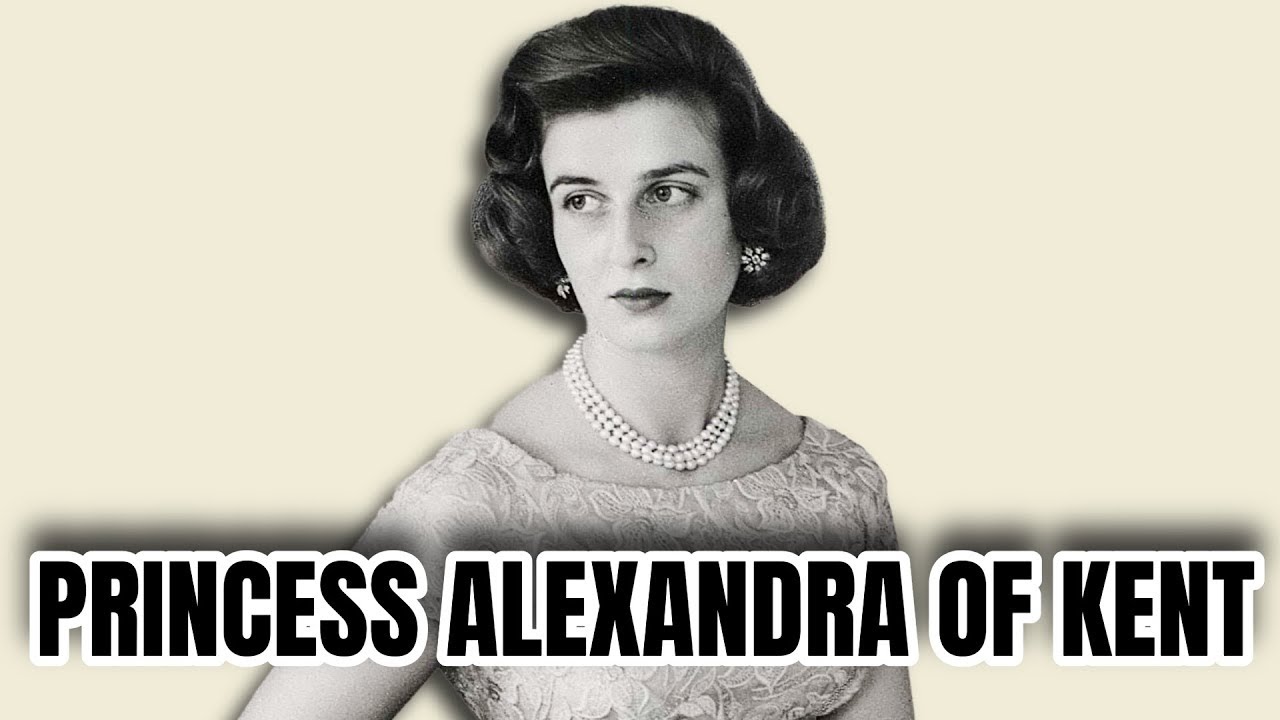
Her early years were shaped by privilege, but also by the upheaval of war. When World War II broke out, the Kent family left London for their country home at Coppins in Buckinghamshire, and much of Alexandra’s childhood was spent under the care of her grandmother, Queen Mary, at Badminton House. Tragedy struck early. In August 1942, her father, a serving RAF officer, died in a plane crash in Scotland.
The crash at Dunbeath killed fourteen of the fifteen people on board. The Duke of Kent was killed in a wartime flying accident when Alexandra was just five years old. Her only brother, Edward, became the new Duke of Kent, and a baby brother, Michael, had been born in July 1942, only weeks before their father’s death. Alexandra grew up without a father, and the loss left a deep mark on the family.
Her mother, Princess Marina, was now a young widow with three small children. She continued with royal duties, but her own life would be cut tragically short in 1968. During Alexandra’s wartime childhood, Marina strove to maintain a sense of stability. Despite the restrictions of the era, Alexandra was remembered as a cheerful child, and life at Coppins and later at Badminton remained spirited under Queen Mary’s kindly guardianship.
These early years, growing up in the shadow of war under the care of two strong grandmother figures, instilled in the young princess a sense of resilience and duty that would shape her adult character. After the war, the family returned to ordinary life in London, and Alexandra made a break with royal tradition. She became the first British princess to attend an ordinary boarding school. In 1947, at the age of eleven, she enrolled at Heathfield School near Ascot.
During her first term, she served as a bridesmaid at the wedding of her cousin, Princess Elizabeth, and Philip Mountbatten in November 1947, a remarkable honor for the young princess that highlighted her place in the royal circle. She was later sent to a finishing school in Paris, where she studied French and music. These years of education gave her a broader outlook than previous generations of princesses. She learned to speak fluent French and developed a confidence that would serve her in public life.
Her youthful interests included the arts and helping others. In 1957, she undertook training as a nurse at London’s Great Ormond Street Hospital. Though she ultimately chose not to pursue nursing as a career, the experience reflected her lifelong concern for health care and charity. Even as a teenager and young adult, she showed a dedication to service.
By the late 1950s, Alexandra was emerging onto the world stage. In 1959, at age twenty-two, she carried out her first solo overseas tour for the Commonwealth, traveling to Australia. Her visit to Queensland was met with great enthusiasm, so much so that a local composer wrote a waltz in her honor, and a hospital was later renamed Princess Alexandra Hospital. These early tours tested and prepared her for the royal duties she would take on in the coming decades.
Her warm personality and elegant style, traits noticed even by the press, began to make her a popular figure. The combination of her royal birth and her down-to-earth manner helped Alexandra connect with people. As one biographer observed, she soon became one of the most popular members of the royal family. On 19 November 1962, her engagement to the Honourable Angus James Bruce Ogilvie was announced.
Angus was the second son of the 12th Earl of Airlie, a businessman whose family had long ties to the royal household. Alexandra and Angus had known each other socially, and their engagement was widely celebrated. They were married on 24 April 1963 at Westminster Abbey. It was a grand royal occasion, attended by the Queen, the Duke of Edinburgh, Princess Margaret, and other royals, with fourteen-year-old Princess Anne serving as chief bridesmaid.
The ceremony was broadcast on television to an estimated 200 million people worldwide. As the Guardian later noted, Angus was known for his honorable intentions and devotion to Alexandra, and the marriage was regarded fondly by the public. Following the wedding, Princess Alexandra became officially known as Her Royal Highness the Honourable Lady Ogilvie. Notably, Angus declined the Queen’s offer to make him an earl upon marrying a princess.
The couple chose a relatively private family life. They lived at Thatched House Lodge in Richmond, Surrey, rather than in one of the palaces, and their two children would carry no royal titles. Alexandra gave birth to her only son, James, on 29 February 1964, and her only daughter, Marina, on 31 July 1966. Both children were raised out of the public spotlight, reflecting their parents’ desire for normality.
Angus was later knighted in 1988, making Alexandra the Honourable Lady Ogilvie, and he served as a devoted husband and supporter. The 1960s were otherwise happy years for Alexandra, balancing family life with royal service. But the decade also brought personal sorrow. In August 1968, Princess Marina died at age sixty-one of an inoperable brain tumor.
Alexandra was at Kensington Palace with her two brothers when their mother passed away in her sleep. Alexandra was just thirty-one at the time, and a mother herself. The loss brought home the fragility of life she had experienced in childhood. It is said that Princess Marina’s charm and sense of duty deeply inspired her children, and her death left Alexandra with the responsibility of upholding her mother’s memory in the family.
Throughout the 1970s, Alexandra fully embraced her role as a working royal. Alongside her husband, she undertook many official tours and engagements, frequently representing the Queen on overseas visits and at state functions. In 1971 and 1972, she accompanied her aunt, the Queen Mother, on goodwill tours to countries like Ghana and the Bahamas, and in 1973 and 1974, she undertook a solo tour of the Caribbean. Back home, she was a regular presence at events such as Trooping the Colour, state banquets, and garden parties, often standing in for the Queen when needed.
Historians note that throughout Queen Elizabeth’s reign, the princess often represented her at events both in the UK and around the world. Her diary of royal duties grew to some 100 to 120 engagements per year, making her one of the busiest royals of that era. Even as she took on these responsibilities, she remained graceful and approachable, earning praise in the press as a figure of warmth and duty. Her philanthropic work expanded during these years.
She became patron or president of more than a hundred charities and organizations, particularly in health and social welfare. Her early nursing training was reflected in her commitment to health care causes. She served as patron of the Cystic Fibrosis Trust, the Alzheimer’s Society, hospices, and other medical charities. From the late 1970s onward, she was joint president with the Duke of Gloucester of Cancer Research UK and deputy president of the British Red Cross.
She also championed the blind, serving for decades as patron of Guide Dogs for the Blind and of Action for Blind People. Beyond health, Alexandra had a deep love of the arts. She regularly attended operas and concerts and became patron of organizations such as the English National Opera and the London Philharmonic Choir. Her sense of duty was widely noted.
A royal biographical note summarized: “Princess Alexandra is patron or president of over 100 organizations, reflecting her wide-ranging interests from the arts to healthcare. She also supported Queen Elizabeth II in her duties, attending ceremonial occasions alongside other members of the royal family. ” In public, she was often seen wearing crisply tailored outfits and distinctive hats, projecting a sense of confidence. Meanwhile, her husband Angus, though successful in business, became embroiled in the so-called Lonrho scandal of 1973.
He was criticized for his role as a director in a company that broke sanctions against Rhodesia. Though he felt this was unfair, he resigned most of his corporate posts in 1974 to protect his reputation. Alexandra supported him through the ordeal, and he later devoted himself to charity work and to her official duties. The hard lessons of that episode reinforced Alexandra’s sense of responsibility.
She continued her engagements without drawing much attention to the controversy, embodying the resilience she had learned in childhood. As the 1980s and 1990s progressed, Alexandra’s public life remained busy, but her private life saw new challenges. In 1988, Angus was knighted, and Alexandra formally became Lady Ogilvie. The couple continued joint appearances, and in 1994, the Queen granted Alexandra the rare honor of becoming a Lady of the Garter.
Yet family matters occasionally made headlines. In late 1989, Alexandra’s daughter, Marina, then twenty-three, announced she was pregnant out of wedlock. This personal crisis became a public controversy. Marina’s fiancé was reluctant to marry, and a tabloid reported that Alexandra and Angus threatened to cut off the young couple’s finances unless she wed.
Alexandra and Angus firmly denied any withholding of funds and maintained that Marina was always welcome at home. Eventually, Marina did marry in 1990, but the rift took months to heal and was a source of deep stress. Despite this, Alexandra continued her royal duties with composure. In 1990, she accompanied the Queen on a state visit to Portugal, and in later years she traveled around the world for charity events.
Even after the birth of her grandchildren, through James’s and Marina’s families, Alexandra remained focused on her role. In 1996, she became joint president of the Princess Alice Hospice and a patron of the Alzheimer’s Society, reflecting her compassion and sense of continuity. She is often described as having a caring, sympathetic personality, attributes no doubt informed by the adversity she had faced in life. Sir Angus’s health declined in the early 2000s.
He died on 26 December 2004 at the age of seventy-six after a long illness. Alexandra was sixty-eight at his death and had been married to him for over forty years. The loss was a quiet one. The couple’s private funeral was held at Windsor, and the public scarcely saw Alexandra mourn.
The Guardian’s obituary of Sir Angus highlighted how, in the following years, he devoted much of his time and energy to good causes and was notable for his support of his wife, Princess Alexandra, one of the most popular members of the royal family, in her official duties. The partnership had been a true one, and Alexandra now continued her life as a dedicated widow. In the 1990s and early 2000s, Alexandra had also faced her own health challenges. In 2013, she was diagnosed with polymyalgia rheumatica, an inflammatory condition, and had to cancel many public engagements.
Yet she gradually recovered and returned to active duty. Throughout these decades, her personal style—elegant suits, signature hats, and pearls—remained the same. Newspapers occasionally noted that she still carried herself with poise and grace, even as her hair turned silver. By this time, she had become one of the few senior royals not in the Queen’s immediate family, but she was respected as a symbol of continuity with the older generation.
She remained a working member of the royal family, with her office at Buckingham Palace, and she continued to lend support at ceremonies and charities in the twenty-first century. In 2016, Queen Elizabeth II herself hosted a celebration at Buckingham Palace for Alexandra’s eightieth birthday and her many patronages, a rare honor showing the high regard in which she was held. Alexandra accepted her elder-stateswoman role with characteristic modesty, remarking in interviews that she felt as useful as ever. Even after the passing of Queen Elizabeth II in 2022, Alexandra remained an active figure in royal life.
She attended all major ceremonies of mourning, through the ten-day period after the Queen’s death and the state funeral at Westminster Abbey. She often appeared with younger members of the family. She was photographed standing quietly behind Catherine, Princess of Wales, at the Remembrance Sunday service, symbolizing her bridging of generations. In May 2023, Alexandra again marked history by attending the coronation of King Charles III, making her one of the only living royals to have been present at both Queen Elizabeth’s coronation in 1953 and King Charles’s in 2023.
Even in her late eighties, she continues to serve the crown, regularly attending garden parties, charity dinners, and commemorations, often supporting King Charles III and Queen Camilla at ceremonial events. During the King’s early reign, Alexandra, now age eighty-eight, was by the throne at the coronation ceremony. Historian Annie Goldsmith observed: “Throughout Queen Elizabeth’s reign, the princess often represented her at events both in the UK and around the world. In King Charles’s reign, she has shown the same loyalty.
” She still maintains her patronage of charities and hospitals, remaining joint president of Cancer Research UK and remembered for decades of compassionate service. She has no official office now beyond continuing as a working member of the royal family. Over nine decades, Princess Alexandra’s life has seen the full sweep of modern British royal history, from a wartime childhood shadowed by her father’s death, to being one of Queen Elizabeth II’s dearest cousins, to raising a family and dedicating herself to countless causes. Her private choices—attending a public school, marrying for love, declining grand titles, and facing family tragedies head on—have shaped a public image of grace under pressure.
Born into royalty, she forged her own path through compassion and devotion.
