She was a princess, and she fell in love. She asked her father for permission to marry, and he said no. Then she spent the next forty years waiting for a freedom that never came. This is the story of Princess Augusta Sophia, the daughter King George III kept hidden from the world.
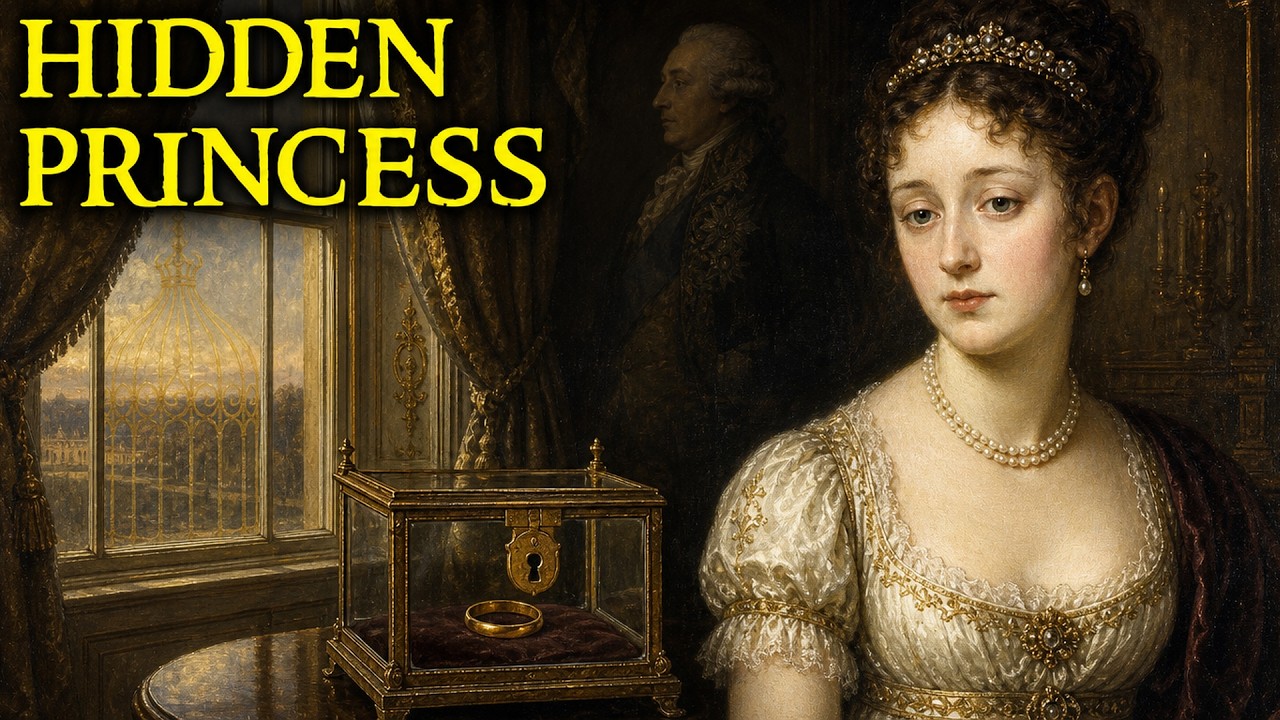
To the British public, King George III was the definition of domestic virtue. Over a reign spanning six decades, the longest in British history at that point, he cultivated the image of a devout, moral family man dedicated to his wife and their fifteen children. Yet behind the palace gates, that paternal devotion manifested as absolute control. The instrument of that control was forged in 1772.
Driven by anger over his brother’s unsanctioned marriage to a commoner, the king pushed a sweeping piece of legislation through Parliament. Its official title was An Act for the Better Regulating the Future Marriages of the Royal Family, and its passage was driven entirely by the monarch’s personal determination to protect dynastic purity. That statute transformed the lives of his daughters into legal hostages. Under its terms, any descendant of King George II had to obtain the sovereign’s formal written consent before they could marry.
That approval had to be signified under the Great Seal and declared in council. If a royal child dared to marry without that royal assent, the law was unyielding: the union was declared completely null and void. For those over the age of twenty-five, the law offered a single, highly restricted path. They could give twelve months’ notice to the Privy Council, allowing the marriage to proceed only if both houses of Parliament did not object during that year.
In reality, that route was nearly impossible to pursue without triggering a massive constitutional scandal. The practical consequence was devastating. Without the sovereign’s signature, a princess could never establish her own independent home or secure a separate household. She remained legally and financially bound to the crown, unable to escape her family’s direct authority.
For Princess Augusta Sophia, only three years old when the act became law, her entire adult life was effectively signed away before she could even understand the rules of her confinement. She entered the world on November 8, 1768, at Buckingham House in London, the sixth child and second daughter of King George III and Queen Charlotte of Mecklenburg-Strelitz. Inside the palace walls, her upbringing was placed under the vigilant care of the royal governess, Lady Charlotte Finch, who designed a highly regimented daily existence. Augusta’s world was defined by structure.
Her days began with early rising, strict religious observance, and carefully managed isolation from the public. Yet within those boundaries, her education flourished. Tutors instructed her in modern languages, history, geography, and art, alongside traditional courtly skills like needlework and spinning. She possessed a deep affinity for music; her surviving childhood manuscript notebooks, filled with hand-annotated piano exercises, reveal a girl of genuine talent and focused devotion.
Those who knew her closely observed a bright, engaging child. The novelist Fanny Burney described Augusta as having a great deal of sport in her disposition, reflecting a natural warmth, intelligence, and sociability. She was fiercely loyal to her siblings, thriving in the lively but cloistered world of the nursery. Even in those early years, a quiet, unyielding rule governed her life: the king’s daughters did not leave the family orbit.
Her education was designed not to prepare her for a life of her own, but to perfect her role within her father’s court. King George III and Queen Charlotte raised fifteen children: nine sons and six daughters. For the nine brothers, royal birth served as a passport to the wider world. From adolescence, these princes received high-ranking military commissions, traveled freely across the continent, and established their own grand independent households.
They built private lives of immense autonomy, funding separate courts and openly pursuing unsanctioned alliances. The Prince of Wales flaunted his mistresses and even contracted a secret, illegal marriage to Maria Fitzherbert, confident that his male status shielded his personal mobility. The brothers operated in a public sphere where dynastic duty could be negotiated, or simply ignored in favor of personal ambition and desire. But for the six daughters, no such horizon existed.
Their lives remained closely tethered to the domestic orbit of the royal court, where every future prospect was entirely dependent on their parents’ absolute control. The daily existence of the princesses unfolded in a quiet, heavily guarded routine. From sunrise, Augusta and her sisters accompanied their parents to chapel, attended repetitive court ceremonies, and occupied their hours with intricate embroidery. Their evenings were filled with chamber music, performed under the watchful eyes of their mother, Queen Charlotte, and a rotating circle of approved courtiers.
This structured seclusion led the sisters to privately refer to their quarters as the nunnery. While some later accounts have sensationalized this as a literal prison, it functioned more quietly as a system of enforced celibacy and domestic isolation, masquerading as royal dignity. Augusta’s world was bounded by her father’s erratic moods, her mother’s hypervigilance, and the limited outlets of her piano exercises and needlework. For most of these women, there was no exit.
But in May 1797, a rare exception broke the monotony. Princess Royal Charlotte, Augusta’s eldest sister, married the Duke of Württemberg and departed for Germany at the age of thirty-one. It was a singular, highly political release that only emphasized the entrapment of those left behind. For Augusta, now twenty-eight, no such rescue arrived.
She remained tethered to the domestic sphere, her adult years spent pouring her devotion into her father’s declining company and her own quiet, unrecorded longings. Her confinement was structural, woven into the very fabric of her family’s daily demands. Around the year 1800, a figure arrived in Augusta’s restricted world who would alter the course of her private life. His name was Brent Spencer, a highly distinguished British military officer whose service in the Caribbean and Europe had earned him a prestigious assignment as an equerry at court.
By 1803, contemporary letters indicate that a quiet understanding had developed between the princess and the soldier. While later accounts have decorated this connection with the grand flourishes of a Gothic romance, the historical record reveals something far more grounded: a genuine, quiet attachment that endured through decades of enforced silence. For Augusta, this relationship offered a rare, fragile hope of a life outside the palace walls. But the legal boundaries surrounding her made any open courtship impossible.
She could not simply choose her own path. In 1812, Augusta took a bold, desperate step. She drafted a formal petition directly to her brother, the Prince Regent, pleading for sovereign permission to marry the man who had by then become General Sir Brent Spencer. Her letter was an act of personal agency, a rare moment where Augusta openly challenged the system that bound her.
She did not ask for a grand public wedding. She begged only for a quiet, discreet union that would allow them to live together in peace. Yet the historical record after this petition becomes entirely vacant. No written consent was ever granted, and no formal written refusal from the Prince Regent has ever been found.
The official files contain only her desperate plea, followed by absolute silence. The practical consequences of that silence were unyielding. A private marriage, an elopement, or an appeal could never provide Augusta with a secure, recognized household. Without the crown’s sanction, she could not establish a home of her own, nor could she secure the legal protections of a wife.
To step outside the system was to invite social exile and financial ruin. And so Augusta remained unmarried within the family system, her long relationship with Spencer sustained only in the shadows of the court, an endurance that spoke of both quiet devotion and absolute restriction. Augusta’s silent struggle was not an isolated trial, but a shared inheritance among her sisters. Each princess faced the same unyielding choice between absolute submission and clandestine rebellion.
In the summer of 1800, rumors swept the court that Princess Sophia had secretly given birth to an illegitimate child. While no baptismal record exists to confirm the birth, the persistent reports highlight the severe limits placed on Sophia’s ability to ever experience an open, formalized family life. For the youngest sister, Amelia, the confinement carried an even heavier toll. Amelia developed a deep, reported attachment to the king’s equerry, Charles Fitzroy.
Though primary evidence of their romance remains incomplete, their bond was governed by the same strict unspoken prohibitions. When Amelia died at just twenty-seven years old in 1810, her passing was the result of severe chronic illness compounded by intense emotional vulnerability, a tragic end that exposed the frailty of these captive lives. Escape, when it finally arrived for the other sisters, came only in middle age. Princess Mary was forty years old when she married her cousin, Prince William Frederick, in 1816.
Two years later, in 1818, Princess Elizabeth finally left the household to marry the Landgrave of Hesse-Homburg at the age of forty-eight. These exceptionally late, government-sanctioned departures made the cost of their delay painfully measurable. Across the lives of all six sisters, the pattern was absolute: a bleak cycle of secrecy, unformalized devotion, and youth spent waiting behind palace walls. In the late 1780s, a quiet distress settled over the royal apartments at Windsor.
King George III began experiencing severe physical and mental crises that completely baffled his court physicians. The archives record episodes of intense physical agitation, days of persistent sleeplessness, and rapid, incoherent rambling that went on for hours. At his lowest points, the king’s confusion turned to rare moments of physical violence, terrifying the family who watched from the corridors. In the decades since, modern medical historians have hypothesized that the king suffered from acute intermittent porphyria, a genetic metabolic disorder that attacks the nervous system.
But this remains a retrospective theory, not a definitive or settled diagnosis. In the actual rooms where the family lived, the debate over clinical terms meant nothing. They were simply living with a father whose mind was fraying. During the fragile, quiet intervals when his mind cleared, the king’s emotional reliance on his daughters grew heavy and constant.
Augusta became one of his primary sources of comfort. Her care was never a formally appointed role, nor was she a sole caretaker. It was an informal, shared duty carried out alongside her sisters. She sat by his bed for hours, reading to him in the dim light, preparing his prescribed medicines, and offering a calm, familiar presence to quiet his racing thoughts.
In this tense, claustrophobic atmosphere, Augusta’s own needs and private longings receded. Her life was shaped entirely around her father’s health, her own future placed on indefinite hold to help manage his condition. There was no villain in the king’s demands, only the stark vulnerability of an ailing man who clung to his daughters for stability. For Augusta, the royal palace had become a quiet house of sickness, where her devotion was required and her own life was expected to wait.
In 1811, the governance of Great Britain shifted. The king’s mental collapse was now deemed permanent, and Parliament passed the Regency Act, naming the Prince of Wales as Prince Regent. For Augusta, now forty-two years old, this political transition sparked a quiet, desperate hope. With her brother holding sovereign power, the rigid family rules might finally soften, offering a path to a life with Brent Spencer.
But this new political order stopped at the palace doors. While her brother ruled the state, the Regency Act left Queen Charlotte with absolute authority over the royal household. Augusta’s life in her forties remained under her mother’s vigilant, unyielding supervision. This confinement was not the literal locked cell of popular myth, but the far more inescapable captivity of domestic expectation and maternal control within the Windsor household.
Inside the castle, the physical reality was deeply painful. Augusta lived in constant proximity to a father who no longer recognized her. King George III was now blind, deaf, and lost in mental darkness, a shadow wandering his own corridors. She watched the monarch who had once controlled her destiny shrink into a helpless invalid.
Outside the castle gates, England entered the glittering, opulent Regency era, a world of vibrant art, high fashion, and social change. Inside Windsor, time remained frozen in a muffled, quiet stasis. Augusta’s youth had slipped away, replaced by the heavy silence of her family’s private apartments. The dawn of the Regency promised liberty to the kingdom.
But for the daughter still waiting inside the palace, it was only a false promise of a freedom that would not come. On November 17, 1818, Queen Charlotte died at Kew Palace at the age of seventy-four. For Augusta, the passing of the formidable matriarch removed the most immediate guardian of her daily confinement. Yet the structure of her world remained largely unchanged while her father still lived.
For decades, her daily life had been governed by her mother’s strict demands. Now, even with the queen gone, the heavy atmosphere of the Windsor household did not lift. That final unyielding link dissolved fourteen months later. On January 29, 1820, King George III died at Windsor Castle at the age of eighty-one.
The monarch had spent his final decade in total mental darkness, blind, deaf, and entirely unaware of the daughter who had spent so much of her life tending to his needs. In those silent, shadowed years, there had been no opportunity to reopen the painful discussions of her future, nor any chance to seek the royal blessing he had so long withheld. He left the world without ever recognizing the sacrifice she had made. Augusta was fifty-one years old when the old authority finally fell away.
For the first time in her existence, she was legally and financially independent. Freedom, when it arrived so late in life, manifested in the quiet restoration of basic human choices. She gained the ability to choose where she would live, whom she would welcome as visitors, how she would travel, and how she would spend her own money. She established her own household at Clarence House, far from the heavy surveillance of the court, discovering an independence she had never been permitted to know.
But this hard-won autonomy could not rewrite the past, and it could never restore the youth she had surrendered. On December 29, 1828, General Sir Brent Spencer died. The man associated with her desperate 1812 request, the partner she had quietly loved through decades of enforced silence, was gone. The years she had waited through could never be recovered.
The life she had so patiently awaited dissolved, leaving only the reality of her solitude. The tragedy of Augusta’s confinement lay in the slow, methodical erosion of her prime. The late arrival of her independence served to highlight the irreversible cost of delayed autonomy. She was left to live her remaining years with the quiet knowledge of what had been systematically denied.
Today, we still obsess over a king’s madness, while the women who paid the price of his crown remain in the shadows. Augusta’s silent sacrifice reminds us that history often remembers the rulers, but forgets those who bore the weight of their legacy. Their struggle is a quiet warning about the cost of denied autonomy, a cost we still fail to see.
