A photograph from 1860 looked ordinary at first glance, until the historians noticed the enslaved woman’s smile. The photographic archive at Duke University held thousands of daguerreotypes and early paper prints from the antebellum South. Dr. Lauren Mitchell had spent three years cataloguing them, documenting the faces of plantation owners, merchants, and politicians who had built their fortunes on the labor of the enslaved.
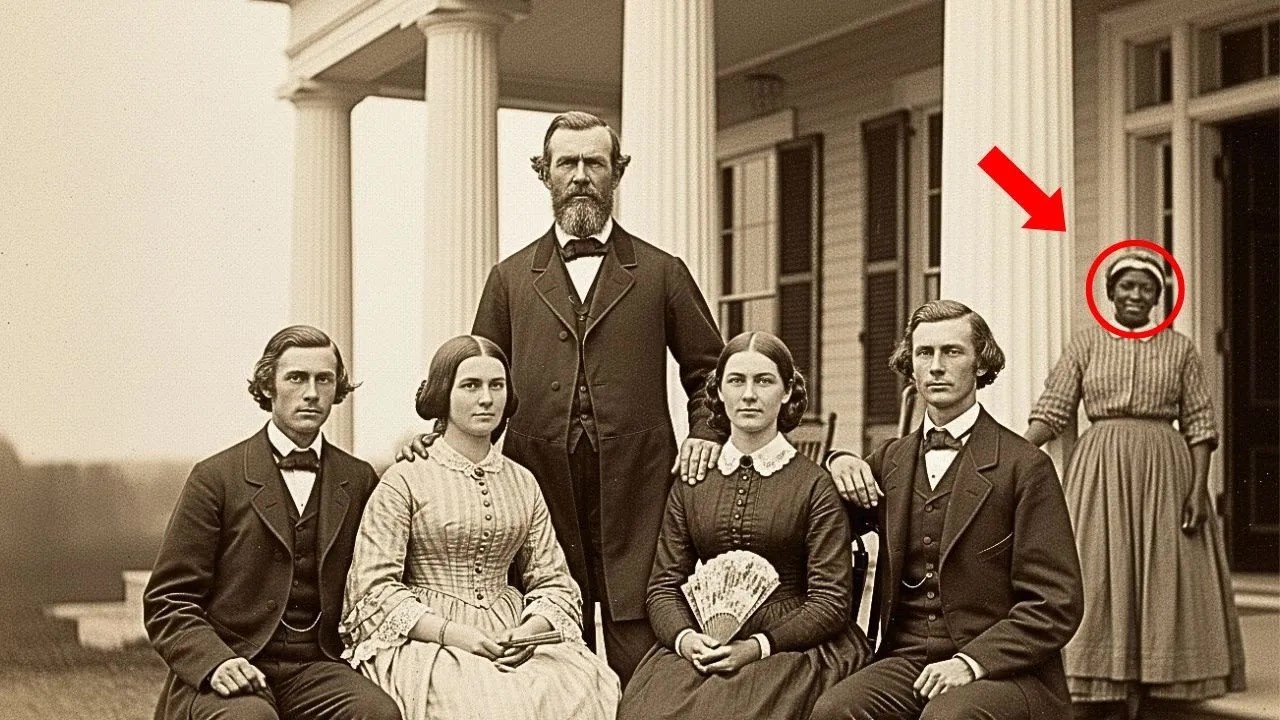
Most of the images were predictable. Grim white families posed in their finest clothing, projecting wealth and respectability. The enslaved, when they appeared at all, were placed like decor, standing motionless in the background with utterly neutral faces, their humanity reduced to ornamentation in someone else’s portrait. But one photograph made Lauren freeze in place.
It was dated 1860, taken in South Carolina according to the notation on its frame. The Whitmore family, Riverside Plantation, April 1860. The image showed a family of five standing before an imposing columned house. The father, around fifty, sat on an ornate chair, his hand resting on a cane.
His wife stood beside him, her features severe beneath an elaborate head covering. Three adult children, two sons and a daughter, all in their twenties, stood around their parents in formal arrangement. It was a typical portrait of Southern aristocracy, except for one detail that made Lauren’s breath quicken. In the background, near the entrance to the house, stood an enslaved woman.
She appeared to be in her thirties, wearing a simple dress resembling domestic servant’s clothing. But unlike every other enslaved person Lauren had seen in hundreds of similar photographs, this woman was smiling. It was not a fake or forced smile, the kind ordered for appearances. This was something else entirely, a knowing smile, almost secretive, as if the woman possessed knowledge that made her deeply and genuinely satisfied.
Lauren zoomed in on the woman’s face on her computer screen. The smile was unmistakable. Her eyes held something remarkably like triumph. It made no sense.
Everything about her violated the visual language of antebellum photography, where the enslaved were supposed to be invisible, passive, or at most quietly content. This woman looked as though she knew a secret, and she was happy about it. Lauren opened the archive’s database searching for additional information about the Whitmore family. The entry was sparse.
A prominent South Carolina family, owners of Riverside Plantation. The photograph had been donated in 1932 by the heirs of Margaret Whitmore Clayton. She expanded her search to include historical records outside the archive. The Whitmore name appeared in several digitized South Carolina newspapers from 1860.
What she found made her sink back in her seat, her heart pounding hard. The Charleston Mercury headline, dated May 3, 1860: “Tragedy at Riverside Plantation. Entire Whitmore Family Found Dead. ” Lauren read the article with growing fascination and horror.
James Whitmore, his wife Elizabeth, and their three adult children, Margaret, James Jr. , and Robert, had all died within hours of one another on May 1, 1860. The family physician attributed the deaths to acute digestive distress, possibly contaminated food. The photograph was dated April 1860, less than a month before the entire family died.
Lauren looked again at the photograph, specifically at the enslaved woman’s enigmatic smile, a smile that suddenly seemed far less mysterious and far more deliberate. She reached for her phone and opened the contact for Dr. Raymond Chen, a colleague specializing in crime and justice systems in the antebellum period. This was no longer merely an unusual photograph.
This could be evidence of one of the most perfectly executed acts of resistance in history. And that smile, that confident, satisfied smile, might be the only testimony that survived. Raymond arrived at the Duke archive the next morning, barely able to contain his excitement. He was a criminal historian who had spent a decade researching crime in the antebellum South, particularly cases involving enslaved people.
When Lauren showed Raymond the photograph and the newspaper article, his expression shifted from curiosity to intense focus. “Acute digestive distress,” he read aloud. “That’s nineteenth-century code for poisoning when doctors either can’t determine it or choose not to investigate it carefully. ” He looked at the photograph again, studying the woman’s face.
“And you said this photo was taken less than a month before they died? ” Lauren nodded. April 1860. The newspaper recorded their deaths on May 1.
All five family members died within hours of one another. Raymond opened additional newspaper archives on his laptop. “Let me see what else was reported. ” He searched through digitized South Carolina papers and found several follow-up articles about the Whitmore deaths.
One article from May 5, 1860, provided more details. “The tragic deaths of the Whitmore family have left the community in shock. All five members complained of severe stomach pain and vomiting after dinner on April 30. Despite the physician’s best efforts, they all passed away by the morning of May 1.
The authorities ruled the deaths accidental, likely due to spoiled meat or contaminated water. ”
“The authorities ruled the deaths accidental,” Raymond repeated in a skeptical tone. “Which means they chose not to investigate further. In 1860, in South Carolina, if a white family died under suspicious circumstances, there would normally be an extensive investigation, unless the alternative was too uncomfortable to consider.
”
“You mean if it implicated an enslaved person,” Lauren said. “Exactly. The last thing white Southerners wanted to admit was that an enslaved person could successfully poison an entire white family. It would mean the enslaved had power and will, and the capacity for revenge.
Much easier to declare it an accident and move on. ”
Lauren opened the photograph again and zoomed in on the woman’s face. “So this smile, she already knew they were poisoned when this photograph was taken. ” Raymond leaned closer to the screen.
“That’s possible. Many poisons work slowly. If she was feeding them something over time, causing toxins to build up in their systems, they might have been symptom-free when the photo was taken, but their fate was already sealed. ” He paused.
“She would have known, of course. And this smile, it’s her documentation, her testimony. ”
They spent the next hour searching for more information about the Whitmore family and their plantation. Property records showed Riverside Plantation covered over 800 acres and enslaved about 40 people.
James Whitmore had inherited it from his father and expanded operations significantly in the 1850s. Raymond found several court records mentioning the plantation, mostly routine business matters, property disputes with neighbors, and slave sale documents. But one entry caught his attention: an advertisement in a Charleston newspaper from 1858. “Listen to this,” Raymond said.
“It’s a runaway slave ad. ‘Escaped from Riverside Plantation, a Negro woman named Celia, approximately 30 years old, skilled in cooking and domestic work. $50 reward for her return. Warning: the woman is considered dangerous and should be handled with caution.
‘”
Lauren felt a chill. “Celia. Could she be the one? ” She pointed to the woman in the photograph.
“The age matches, and the cooking skill, that’s important. If she was the one preparing the family’s food, she had both the ability and the opportunity. ” Raymond took notes. “The ad says she ran away in 1858, but if she returned to the plantation by 1860, whether recaptured or returned voluntarily, and if she is the same woman in this photograph, she had two years to plan her revenge.
” Lauren continued, “Two years to obtain poison, to understand how to administer it, and to wait for the perfect moment. ”
Raymond pulled out another document, a property sale notice from June 1860. After the Whitmore family’s death, the plantation and all its assets were sold to pay debts. “Including,” he ran his finger down the detailed list, “including 42 Negro slaves of various ages and skills.
” Lauren felt sick. “She killed them, and yet she was sold too. Her act of resistance, her revenge, it didn’t free her. ” “No,” Raymond agreed quietly.
“It didn’t free her, but it eliminated the specific people who had hurt her. And she made sure to document it. ” He looked at the photograph again. “That smile isn’t about freedom.
It’s about justice. Her justice. ”
Finding records of the enslaved was always difficult. They were treated as property in legal documents, often mentioned only by their first names or not recorded at all.
But Raymond had decades of experience navigating these scattered archives, and he was determined to learn what happened to Celia after the Whitmore family’s death. The estate sale document from June 1860 listed the enslaved by approximate age, gender, and skills, but without names. “Female, age 32, skilled cook and domestic servant, sold to Thomas Bradford for $900,” one record stated. The age matched the description of Celia in the runaway ad.
Raymond tracked Thomas Bradford through property records. He owned a small plantation about 30 miles from Riverside, with properties in Charleston. Bradford appeared in numerous business documents and social records, another wealthy white Southerner who built his comfort on the labor of the enslaved. But Bradford’s records stopped abruptly in 1862.
Raymond found a brief obituary. “Thomas Bradford, 47, died suddenly at his residence in Charleston. Survived by his wife Catherine and two daughters. ”
“Died suddenly,” Lauren noted.
“That’s interesting timing. ” “Only two years after purchasing someone who had already poisoned one family. ” Raymond’s expression was grim. “Well, I was thinking the same thing.
Let me see if I can find more details about his death. ” He searched Charleston newspapers from 1862. The obituary was deliberately vague, but a small article a few days later provided more context. “The unexpected death of Mr.
Thomas Bradford has been attributed to an acute illness. His household staff reported that Mr. Bradford complained of severe abdominal pain and died within hours. Physicians could not determine the exact cause.
”
Lauren and Raymond looked at each other. The pattern was unmistakable. “She did it again,” Lauren said quietly. “Celia killed Thomas Bradford too.
” Raymond cautioned, “If she is Celia, we can’t be certain without more evidence, but the circumstances are strikingly similar. ”
They continued researching, trying to trace what happened to Bradford’s enslaved workers after his death. Records were scarcer than before. The Civil War had begun and documentation grew chaotic as the South slid into conflict.
But in the Union occupation records in Charleston, Raymond found something significant. A list of people who had been enslaved and were freed by Union forces in 1865 included a notation: “Celia, approximately 37 years old, formerly property of Catherine Bradford, claims free status, granted papers accordingly. ”
“She survived,” Lauren said, catching her breath. “She lived to see emancipation.
” Raymond pulled up additional records from the Freedmen’s Bureau, established after the Civil War to assist formerly enslaved people. There, in a list of people searching for family members separated by slavery, was another record. “Celia Johnson, approximately 40 years old, seeking information about her daughter Ruth, sold away from Riverside Plantation in South Carolina in 1858. ”
Lauren felt tears burning in her eyes.
“That’s why she ran away in 1858. They sold her daughter. ” Raymond nodded slowly. “And when she was recaptured or returned, perhaps because she had nowhere else to go, no way to survive on her own, she decided that if she couldn’t save her daughter, she could at least make the Whitmore family pay for taking her.
”
The pieces began falling into place. Celia lost her daughter to the slave trade, one of slavery’s cruelest aspects: the deliberate separation of families for profit. She tried to escape, failed, and was returned to the plantation where her child had been stolen from her. Then she took revenge.
Methodically, patiently, she poisoned the entire Whitmore family, and smiled at the camera knowing her justice had already been done, and that the photograph would capture her moment of triumph for generations to come. “We need to find out if she ever found her daughter,” Lauren said. “And we need to document Celia’s complete story. She was erased from history as a nameless enslaved person, but she reclaimed her power in the only way available to her.
She resisted. ” Raymond was already searching the Freedmen’s Bureau records for any mention of Ruth’s name. If Celia had found her daughter after the war, there might be documents, family reunification records, or settlement information, anything that would clarify what happened to them after emancipation. The search would take time, but both historians realized this was no longer about an unusual photograph.
It was about restoring the story of a woman who had been persecuted, lost everything, and refused to remain powerless. Celia smiled for that photograph in 1860, and now, more than 160 years later, historians were finally ready to understand what that smile meant. While Raymond continued searching for records of Celia’s daughter, Lauren focused on understanding the mechanics of the poisoning itself. If Celia had succeeded in killing five people at once, she must have used a specific poison and administered it in a way that wouldn’t immediately raise suspicion.
Lauren contacted Dr. Helen Martinez, a toxicologist at the University of North Carolina specializing in historical poisoning cases. She sent Helen the newspaper descriptions of the Whitmore family’s symptoms: severe stomach pain, vomiting, rapid onset, death within hours. Helen’s response came the next day.
Based on the symptoms and timeline, the most likely poison was arsenic. It was readily available in the 1860s, used in rat poison, insecticides, and even some medicines. A skilled cook could access it and administer it in food without detection if done carefully. Lauren researched its history and discovered it had been called “inheritance powder” in previous centuries because it was so often used to kill family members for money or property.
In the antebellum South, arsenic was so common that obtaining it wouldn’t necessarily raise suspicion. But Helen’s follow-up email provided even more critical information. If this was arsenic poisoning, and if the family was buried rather than cremated, forensic evidence might still exist. Arsenic preserves remains.
It essentially mummifies the body. If they could locate the Whitmore family graves and obtain permission for exhumation and testing, modern forensic analysis could conclusively prove poisoning. Lauren shared this immediately with Raymond. “If we can prove they were poisoned, Celia’s story becomes indisputable, not just speculation, but documented fact.
” Raymond pulled up property records for Riverside Plantation. “The plantation was sold after the family’s death, but there should be a family cemetery on the property. Most plantations had them. Let me see if I can find the current owner.
” The land that once formed Riverside Plantation was now divided among several owners. The original plantation house had been demolished in the 1920s, but the family cemetery, according to county records, remained on a two-acre plot now part of a private residence. Raymond contacted the property owner, a retired teacher named Margaret Ellis who had bought the land 15 years earlier. Raymond explained their research carefully, emphasizing the historical significance without mentioning poisoning at first.
Margaret seemed fascinated. “I knew there was a cemetery on the property. There are six marked graves, all from the 1860s. I’ve maintained it, but I never researched who was buried there.
If these are the Whitmore family, and if there’s a story worth telling, I’m willing to discuss the exhumation process. ”
Two weeks later, Lauren and Raymond met Margaret at the site. The cemetery was small, enclosed by a corroded iron fence and shaded by ancient oak trees. Six headstones stood in a neat row, weathered but still legible.
James Whitmore, Elizabeth Whitmore, Margaret Whitmore, James Whitmore Jr. , Robert Whitmore, and a smaller stone simply marked “Infant Whitmore, 1842. ”
“The five who died in 1860 are all here,” Raymond pointed out, “plus the child who died before them. ” Lauren photographed the graves to document their condition.
“If we want to request exhumation, we’ll need to make a strong case to the county. We’ll have to prove historical significance and research value. ”
Over the next month, they assembled a comprehensive proposal: the unusual photograph of Celia’s smile, newspaper reports of the mysterious deaths, the pattern suggesting poisoning, and the historical significance of documenting enslaved resistance. They submitted the application to the South Carolina Department of Archives and History, accompanied by letters of support from Duke and UNC.
Approval came three months later, with conditions. Only one grave would be exhumed initially. The work must be done by licensed forensic archaeologists, and any remains handled with proper respect and reburied after analysis. The team chose to exhume James Whitmore, the family patriarch, reasoning that as the plantation owner, he would have been the primary target of Celia’s revenge.
The exhumation took place on a gray November morning. Dr. Sarah Kim, a forensic archaeologist, led the team. Lauren and Raymond watched as the grave was carefully opened, revealing a remarkably well-preserved coffin.
When the coffin was opened, Dr. Kim’s assessment was immediate. “Exceptional preservation. The body is partially mummified, which is consistent with arsenic poisoning.
” She took tissue samples from multiple locations, from bone, hair, and soft tissue preserved by the poison itself. The samples were sent to three different laboratories for independent analysis. The results from all three were identical. James Whitmore’s remains contained arsenic levels over 200 times the normal rate.
The levels were consistent with deliberate fatal poisoning. Lauren held the lab report in her hands, staring at the conclusive evidence. “Celia did it. She really poisoned them.
And that smile in the photograph, she knew. She knew they were already dying. ” Raymond looked at the photograph on his laptop, studying Celia’s enigmatic expression. “She used the only power she had, and she made sure to document it, to leave evidence so that someday someone would know she resisted.
”
But one question remained. What happened to Celia after the war? Did she find her daughter? Did she live to see freedom, or did her story end in tragedy?
They had to continue the search. Celia deserved to have her full story told. With conclusive evidence of poisoning, Lauren and Raymond’s research gained official support from Duke University and several historical societies. The story began attracting attention, not just academic but public.
Media outlets started covering it. “Enslaved woman’s revenge revealed in 1860 photograph,” the news said. But for Lauren and Raymond, the most important question remained unanswered. What happened to Celia’s daughter, Ruth?
Raymond had been searching the Freedmen’s Bureau records regularly, looking for any mention of Ruth in connection with Celia’s 1865 request for information. The records were fragmentary. Much had been lost or damaged over time, but he finally found a match in a file from Georgia. A notation dated 1866.
Ruth, approximately 15 years old, formerly enslaved in Georgia, seeking information about her mother Celia, last seen in South Carolina in 1858. The entry included a brief description. Domestic servant, literate, received secret education, bears a scar on her left arm from punishment. “She was looking for her mother too,” Lauren said, reading over Raymond’s shoulder.
“They were searching for each other after the war. ” The next entry in the file, dated three months later, was even more significant. “Ruth Johnson reunited with her mother Celia Johnson in Charleston, South Carolina. Family registered in the assistance program.
”
Lauren felt tears streaming down her cheeks. “They found each other. After everything Celia went through, all that loss and violence and revenge, she found her daughter. ” Raymond was already searching for more records.
If Celia and Ruth had been registered in Charleston after the war, there might be additional documents: census records, property deeds, church records, anything that would tell them what happened next. The 1870 census provided their next breakthrough. In Charleston’s Fourth Ward, a household was listed: Celia Johnson, age 45, Black, occupation: laundress. Ruth Johnson, age 19, Black, occupation: teacher.
“Ruth became a teacher,” Lauren said. “After being enslaved, after being separated from her mother for 8 years, she became a teacher. ” They found Ruth’s name in the records of the Charleston School for Colored Children, founded by formerly enslaved people and Northern missionaries to educate Black children. Ruth taught there from 1868 to 1872, according to school records preserved at the Avery Research Center.
And in a collection of letters at the center, they found something extraordinary: a letter written by Ruth Johnson in 1871 addressed to a Northern charity supporting Black schools. Lauren read it aloud, her voice trembling: “I write to thank you for your continued support of our school. As one who was denied education during slavery, and learned to read in secret at great risk, I understand the transformative power of knowledge. My mother, who suffered greatly under the yoke of slavery and fought in her own way for dignity and justice, always told me that education is freedom.
We teach our children not only letters and numbers, but the truth of their worth and their own power. ”
Raymond sat back, absorbing the significance. “Ruth knew. Celia told her daughter what she had done.
” Lauren repeated, “‘Fought in her own way for dignity and justice. ‘ Those aren’t casual words. Ruth is acknowledging that her mother resisted, that she fought back. She knows about the poisoning.
”
They continued researching and found more documents about the Johnson family. Celia worked as a laundress in Charleston until her death in 1878 at approximately 53 years old. Her death certificate listed the cause as tuberculosis, the disease that claimed many lives in the overcrowded and impoverished conditions of postwar Charleston. Ruth continued teaching until 1875, when she married a carpenter named Samuel Porter.
They had four children, three of whom survived to adulthood. Ruth lived until 1912, described in her obituary in a Charleston Black newspaper as a pillar of the community, a teacher who dedicated her life to uplifting her race, and a woman who carried the strength of her ancestors. Lauren and Raymond traced Ruth’s descendants and discovered some still lived in South Carolina. One of them, Dr.
James Porter, was a retired physician in Columbia. Raymond contacted him, explaining their research carefully. Dr. Porter’s response was immediate and emotional.
“I’ve heard family stories about Celia my entire life. My grandmother, Ruth’s daughter, used to tell us that our great-grandmother was a woman of fierce courage, that she stood up to those who enslaved her in ways we couldn’t speak about openly, but we never had details or evidence. If you’ve found proof of what she did, and if you can tell her story properly, my family would like to be part of that. ”
A week later, Lauren and Raymond met Dr.
Porter and several other descendants at his home in Columbia. Lauren brought the photograph, now professionally restored and enlarged so Celia’s enigmatic smile was perfectly visible. The descendants gathered around it in silence. One of the women, Sharon, Dr.
Porter’s cousin, began to cry. “That’s her. That’s the woman who saved her daughter, who survived everything they did to her, who resisted when she had nothing left to lose. ”
Dr.
Porter spoke quietly. “My grandmother told me that Celia said she smiled that day because she knew her daughter would be avenged. And that every moment of suffering the Whitmore family endured while dying was justice for taking Ruth from her. She said Celia never regretted it, never felt guilt, only satisfaction at having reclaimed some of her power.
”
The family looked at the photograph, at Celia’s confident smile and at the white family standing proudly, unaware they were already doomed. Dr. Porter said to Lauren and Raymond, “Tell her story. Tell it truthfully.
Don’t beautify it. Don’t apologize for it. Celia did what she had to do to survive and achieve justice in a world that gave her no other options. That smile is her testimony, and we are proud of her.
”
With full support from Celia’s descendants, Lauren and Raymond began assembling a comprehensive historical record. They didn’t want to tell only the story of the poisoning, but the broader context: the violence of slavery, the dispersal of families, the impossible choices the enslaved faced, and the diverse forms of resistance they employed. Lauren contacted several museums and historical societies to propose an exhibition centered on the photograph and Celia’s story. The response was immediate and enthusiastic.
The Smithsonian National Museum of African American History and Culture expressed significant interest, as did the Charleston Museum and several academic institutions. But while preparing exhibition materials, they faced difficult questions about how to present the story. Should they explicitly state that Celia killed five people? How would audiences react to celebrating an act that was, legally speaking, mass murder?
Raymond convened a committee of historians, ethics experts, and descendants to discuss these questions. The conversation was intense and precise. Dr. Porter spoke first.
“My ancestor killed five people. That’s a fact. But those five held her and her daughter in slavery. They claimed ownership of human beings.
They destroyed families for profit. The law protected them and criminalized her very existence as a free person. So when we talk about killing, we need to ask, what do we call what they did to her? What do we call the violence of slavery itself?
”
A historian from the Avery Research Center added, “For too long, we’ve told the history of slavery from a perspective that prioritizes white comfort. We focus on the enslaved who resisted peacefully, who waited patiently for emancipation, who fit into a narrative that doesn’t threaten contemporary white audiences. But the truth is the enslaved used every means available to them, including violence, to resist their oppression. Celia’s story is disturbing because it forces us to confront the moral complexity of resistance under extreme oppression.
”
Lauren said cautiously, “I think we need to present the facts honestly and let viewers grapple with the implications. We show the photograph with Celia’s smile. We document the sale of her daughter. We present the evidence of poisoning.
We trace what happened to Celia and Ruth after the war, and let people draw their own conclusions about justice, resistance, and the ethics of violence in the face of violence. ”
The exhibition, titled “The Smile That Haunts Us: Celia’s Story and Enslaved Resistance,” opened at the National Museum of African American History and Culture in Washington, D. C. , 18 months after Lauren first noticed the photograph.
The centerpiece was the original 1860 photograph, enlarged and dramatically lit, with Celia’s face placed at the center. Beside it were the forensic evidence of arsenic poisoning, newspaper accounts of the Whitmore family’s deaths, and documents from Celia’s postwar search for her daughter. But the exhibition also provided crucial context. It displayed slave sale documents showing how families were deliberately separated for profit.
It included runaway ads with descriptions of brutal punishments. It presented statistics on enslaved mortality rates, the violence they endured, and the complete absence of legal protection. And it included testimonies from Celia’s descendants explaining what the photograph meant to them. Not shame, but pride in an ancestor who refused to be powerless, who fought when the world gave her no other choice.
The exhibition drew enormous crowds and sparked intense public debate. Some visitors were disturbed by what they considered glorification of murder. Others argued Celia was entirely justified, that self-defense and resistance to oppression could not be equated with criminal violence. Media coverage was extensive and divided.
Conservative commentators criticized the exhibition for promoting violence and rewriting history. Progressive voices praised it for honestly confronting the realities of slavery and the moral complexity of resistance. But the most powerful responses came from Black visitors who saw in Celia’s smile something deeply moving and meaningful: an ancestor who refused to break, who seized power when it was denied her, and who smiled in the face of her oppressors because she knew they had already lost. One woman, visiting from Atlanta, stood before the photograph for nearly an hour, tears streaming down her face.
When a museum volunteer asked if she was alright, she answered, “My ancestors survived because they were smart and strong and willing to do whatever it took. This woman, Celia, she’s all of us. She represents every Black person who had to smile while planning how to survive, how to resist, how to protect the ones we love. That smile isn’t cruelty.
It’s resistance. It’s survival. It’s power. ”
Lauren, standing nearby, felt the weight of responsibility.
They had brought Celia’s story to light. They had made visible what was deliberately hidden. And now the world had to confront what that story meant. The success of the exhibition brought both praise and controversy.
Within academic circles, debates raged about how to teach Celia’s story and contextualize it properly. Some historians praised Lauren and Raymond for expanding the historical narrative beyond tired accounts of passive resistance. Others argued they were romanticizing violence and justifying criminal acts. The controversy escalated when the American Historical Association invited Lauren to present her research at their annual conference.
Her presentation, titled “Resistance, Violence, and Agency in the Antebellum South: Reexamining Celia’s Story,” drew a massive crowd. Lauren began with the photograph, projecting Celia’s smile in large scale on the screen behind her. “This is what power looks like when you have no power. This is what resistance looks like when resistance is criminalized.
This is what justice looks like when the law denies it to you. ” She walked the audience through her findings: the poisoning evidence, the separation of mother from daughter, the authorities’ failure to investigate, Celia’s survival and reunion with Ruth after the war. Then she addressed the heart of the controversy. “Some have asked whether we should celebrate Celia’s actions, whether telling her story encourages violence, whether we’re abandoning moral judgment for political correctness.
” Lauren paused, choosing her words carefully. “I would say we’re asking the wrong questions. The question isn’t whether Celia’s violence was morally justified by our contemporary standards. The question is, what does it mean that she lived in a system so brutal and dehumanizing that killing five people seemed to her the only path to justice?
What does it mean that the legal system protected her enslavers and criminalized her very existence as a free person? ”
She advanced to the next slide, showing the slave sale document that separated Celia from Ruth. “This is the violence. Legal violence.
State-sanctioned violence. Violence that destroyed families, treated human beings as tools, and stripped people of every basic right. We have no problem documenting this violence in our museums and textbooks. But when we document how the enslaved resisted this violence, we suddenly become uncomfortable.
Suddenly we have to debate whether their resistance was morally acceptable. ”
The question-and-answer session was heated. A historian from a Southern university challenged her: “But you’re portraying Celia as a hero. Five people died, including three young people who may not have been personally responsible for enslaving her or selling her daughter.
How do we reconcile that with basic human morality? ” Lauren met his gaze directly. “I’m presenting Celia as a human being who made choices in an impossible situation. Were those young people responsible?
They benefited from slavery. They lived in luxury built on enslaved labor. They enjoyed wealth derived directly from the sale of human beings, including the sale of Celia’s daughter. At what point does benefiting from an evil system make you complicit in that system?
”
Another questioner, a Black woman from Howard University, spoke. “I think we need to stop making white discomfort the center of these discussions. For Black people, Celia’s story isn’t controversial. It’s familiar.
We all have ancestors who had to make impossible choices to survive, to protect their children, to maintain some shred of dignity and power. The question isn’t whether Celia’s actions make us uncomfortable. The question is: why are we more comfortable with the violence of slavery than with the violence of resisting slavery? ”
The room erupted in applause from some sections and murmurs of objection from others.
The conference became a referendum on how American history should be taught and remembered. Raymond, watching from the audience, realized Celia’s photograph had become something larger than they had anticipated. It had become a symbol, a focal point for debates about historical memory, racial justice, and the narratives communities tell about themselves. After the conference, Lauren and Raymond received hundreds of emails.
Some were supportive, praising their academic courage. Others were threatening, accusing them of promoting violence and betraying academic objectivity. But the most important messages came from descendants, thanking them for telling a story that had been suppressed for far too long. One letter, from a high school teacher in Alabama, read: “My students need to see Celia’s photograph.
They need to know their ancestors weren’t passive victims. They need to understand that resistance took many forms, including forms that make us uncomfortable. Thank you for showing them that their ancestors resisted. ”
Lauren kept that letter.
In moments when she doubted whether the controversy was worth it, she would reread it and remember why Celia’s story mattered. Because Celia had smiled in that photograph for a reason. She wanted to be seen, remembered, and understood. And after 164 years, she was finally getting her wish.
Six months after the exhibition opened, the museum organized a public symposium featuring Celia’s descendants. Dr. James Porter agreed to speak alongside his cousin Sharon, his sister Dr. Angela Porter Williams, a sociologist, and Sharon’s son Marcus, a graduate student in African American studies.
The auditorium was packed with over 500 people, with many more watching via livestream. Lauren and Raymond sat in the front row, feeling both pride and anxiety about what the descendants might say. Dr. Porter spoke first, his voice steady and clear: “I want to start by saying something that might surprise people.
My family doesn’t celebrate what Celia did. We don’t hold parties on the anniversary of the Whitmore family’s deaths. We don’t teach our children that poisoning people is acceptable. But we do honor Celia’s courage, her refusal to break, her insistence on achieving justice when it was systematically denied to her.
” He clicked a button to advance to a slide showing the 1860 photograph. “That smile has been described many ways: triumphant, sinister, knowing, defiant. I see something simpler than that. I see a woman who endured, who bore the unbearable and came out of it alive.
That smile isn’t about cruelty. It’s about survival. ”
Sharon spoke next, her passion evident. “People want to judge Celia by contemporary moral standards, as if she lived in a society with laws that protected her, options for legal recourse, the ability to simply leave.
But she didn’t. She lived in a society that defined her as property. That gave her owners the legal right to beat her, to separate her from her child, to work her to death. When we talk about Celia’s violence, we need to talk about it in context.
She was responding to a system built on violence. ”
Dr. Porter Williams, the sociologist, provided academic context. “There’s a body of research on how oppressed peoples resist oppression.
Sometimes that resistance is overt and organized, like rebellion, escape, and sabotage. Sometimes it’s subtle, like slowing down work, feigning ignorance, preserving culture. And sometimes it’s intimate and targeted, like what Celia did. All these forms of resistance are rational responses to oppression.
They’re not pathological or criminal in the usual sense. They’re adaptations to impossible circumstances. ” She displayed a slide with statistics: documented slave rebellions, escape attempts, and acts of resistance in the antebellum South. “We tend to focus on large-scale insurrections, like Nat Turner and Denmark Vesey, because they fit a narrative of organized political resistance.
But most resistance was smaller scale, more personal, and no less important. Celia’s story represents thousands of similar stories that were never documented, never photographed, never preserved. ”
Finally, Marcus spoke. At twenty-six, he was the youngest family member addressing the symposium.
“I’m a graduate student studying Black resistance movements. When I tell people about my research interests, they usually assume I study the civil rights movement or perhaps earlier political movements. They’re surprised when I say I study how the enslaved resisted daily, those small acts of defiance that historians have often overlooked or dismissed. ” He gestured to Celia’s photograph.
“This is my inspiration. My great-great-grandmother who smiled at the camera because she knew she had reclaimed her power from those who tried to strip it from her. That smile is resistance. It’s documentation.
It’s testimony. And it’s a reminder that our ancestors weren’t victims waiting to be saved. They were agents of their own liberation, using whatever tools they had. ”
The audience questions were thoughtful and respectful.
Someone asked whether the family worried about the story being misused, potentially used to justify violence in contemporary contexts. Dr. Porter answered carefully: “Of course we worry about misinterpretation, but we can’t let that worry silence Celia’s story. The truth is the enslaved had no peaceful legal path to freedom.
The system was designed to make them powerless. When we refuse to acknowledge how they resisted, including violence, we erase their agency and their humanity. We reduce them to passive victims rather than recognizing them as people who made effective choices in pursuit of freedom and justice. ”
Sharon added, “And frankly, I’m tired of Black resistance being held to standards that are never applied to white resistance.
The American Revolution was violent. The Founding Fathers committed treason and killed British soldiers, but we call them heroes, not murderers. John Brown used violence to fight slavery, and while some condemned him, many consider him a hero. So why is Celia’s violence, used in direct self-defense and in response to the most extreme injustice, the violence we question?
”
After the symposium, dozens of people lined up to meet the family, to thank them, to share their own stories of ancestors who resisted slavery in various ways. Many were crying. Some brought photographs of their own ancestors, formerly enslaved people whose stories had been lost or suppressed. Lauren watched from the side of the hall, overwhelmed by the response.
This is what Celia’s photograph had created: not just a historical debate, but a space for people to reclaim their ancestors’ agency, honor their resistance, and acknowledge the complexity of surviving under oppression. That night, Dr. Porter approached Lauren and Raymond. He said simply, “Thank you for seeing Celia, for taking the time to understand her story, for giving her voice back.
” Lauren felt tears on her cheeks. “She made sure others would see her. With that smile, she was telling us to look, to pay attention, to understand. We finally listened.
”
The controversy over Celia’s story reached a new level when several school districts attempted to include the photograph and accompanying materials in high school history curricula. The reaction was immediate and fierce. In South Carolina, where the original photograph was taken, a proposal to include Celia’s story in the curriculum drew protests from parent groups. They argued that teaching students about an enslaved woman who poisoned a white family was inappropriate, potentially traumatizing, and promoted violence.
The state board of education held a public hearing. Lauren was invited to testify alongside several educators, historians, and community members. Opponents spoke first. One parent from Charleston argued, “This teaches our children that killing is acceptable if you feel oppressed.
What kind of message is that? How can we expect students to respect law and order if we’re glorifying someone who killed five people? ” A school board member added, “I’m concerned about the racial implications. This story might increase racial tensions, make white students feel blamed for slavery, and make Black students feel angry.
Why can’t we just teach the facts of history without these controversial, divisive stories? ”
When Lauren’s turn came, she approached the microphone calmly. “I’ve been listening to these concerns, and I notice something interesting. No one is questioning teaching students about the violence of slavery itself.
No one worries that learning about family separations, about people being whipped and branded and worked to death, might traumatize or anger students. We’re comfortable teaching the violence whites committed against Blacks, but we’re deeply uncomfortable teaching how Blacks resisted that violence. ” She displayed the photograph on the hearing room screens. “This is Celia.
She was enslaved. Her daughter was sold away from her, essentially stolen from her for profit. When she tried to escape to find her child, she was recaptured. She lived under a system where she had no legal rights, no protection, no path to justice through legitimate channels.
So she made a choice, a desperate choice, a choice born of profound oppression. ”
Lauren’s voice grew stronger. “If we teach students about slavery and refuse to teach them about resistance to slavery, we’re lying to them. We’re portraying the enslaved as passive victims rather than human beings who fought for their freedom in every way possible.
That’s not just bad history. It’s dehumanizing. ” A Black educator from Columbia spoke next. “I teach at a majority-Black high school.
My students need to see Celia’s photograph. They need to know their ancestors weren’t powerless. They need to understand that resistance took many forms, some comfortable to discuss and some not. When we sanitize history, when we teach only the resistance that makes white people comfortable, we steal our students’ heritage.
”
The debate continued for hours. Finally, the school board voted. The motion regarding the…
