In June 1942, the Battle of Midway had just ended. Four Japanese aircraft carriers lay at the bottom of the Pacific Ocean. The Imperial Navy was in full retreat. But two weeks after the battle, an American ship spotted something floating in the open ocean, a small boat.
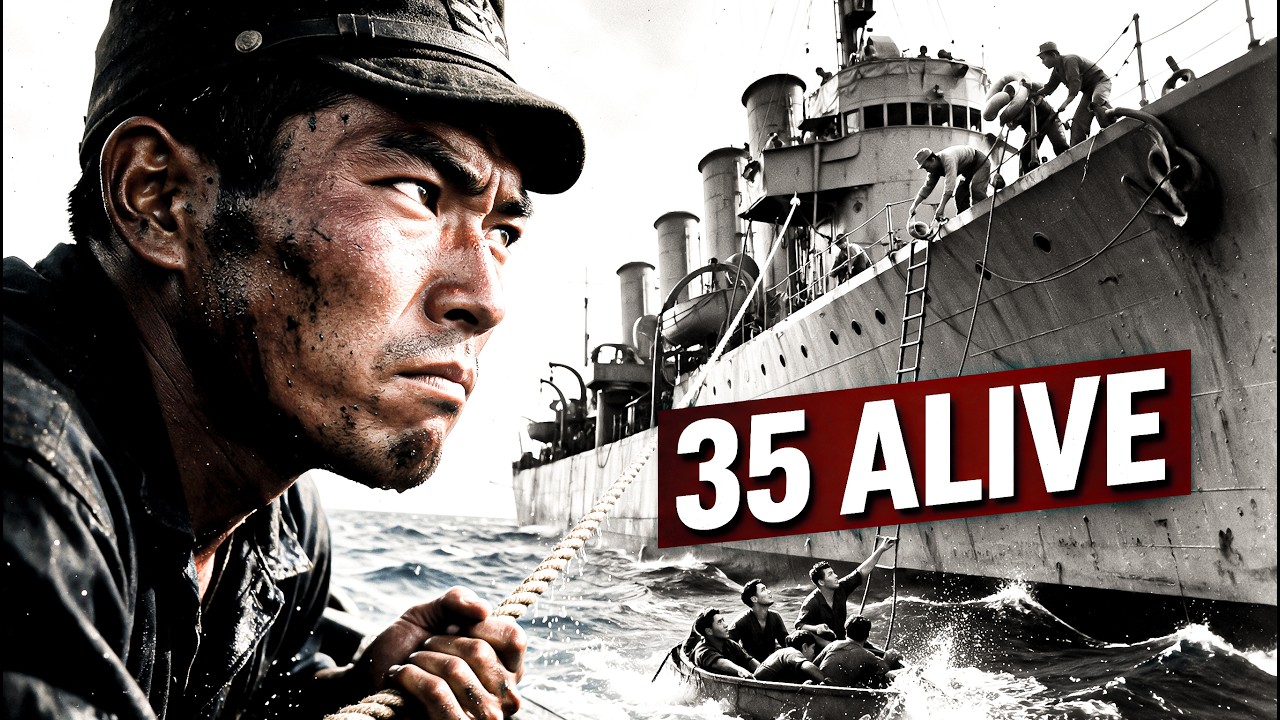
Inside were dozens of men, barely alive, burned by the sun, suffering from dehydration, waving for help. They were Japanese sailors. Survivors of an aircraft carrier that their own navy had torpedoed, abandoned, and left to sink while they were still aboard. No one had come back for them.
No one knew they were alive. This is how they got there, and what the Japanese Navy did not want anyone to know. On the morning of June 5, 1942, the destroyer Makigumo fired a torpedo into the burning aircraft carrier Hiryu and turned west to rejoin the withdrawing Japanese fleet. As the destroyer pulled away, her lookouts reported shapes on the carrier’s rear deck.
Men were moving and waving at the departing ship. Makigumo did not turn back. The shapes grew smaller and disappeared beyond the horizon. The Japanese Navy had just torpedoed its own carrier with its sailors still aboard.
Six months before that morning, in December 1941, the Hiryu had helped launch the attack on Pearl Harbor as part of the most powerful striking force ever assembled. The ship displaced just over 17,000 tons, carried more than 60 aircraft, and could steam at 34 knots. Her air group had bombed targets from Hawaii to Darwin to Ceylon. By the spring of 1942, the Hiryu and her pilots were among the most experienced naval aviation units in the world.
She was one of four carriers assigned to Vice Admiral Chuichi Nagumo’s First Air Fleet for the operation against Midway Atoll, a strike designed to lure out and destroy what remained of the United States fleet in the Pacific. Aboard the Hiryu, the officer in charge was Rear Admiral Tamon Yamaguchi, commander of the Second Carrier Division. Yamaguchi was 50 years old, the son of a former samurai retainer, and a graduate of Princeton University in the early 1920s. He was direct, aggressive, and impatient with caution.
He had trained his air crews with a severity that caused accidents and drew complaints, but the results showed in combat. His pilots hit hard and came back alive. The ship’s captain was Tomio Kaku, a quiet, competent officer who had commanded the Hiryu since the fall of 1941. The Japanese plan for Midway was ambitious.
Four carriers, the Akagi, Kaga, Soryu, and Hiryu, would neutralize the island’s air defenses, then cover an amphibious landing force. The operation aimed to expand Japan’s defensive perimeter and force the remaining American Pacific fleet into a decisive battle. What the Japanese did not know was that American codebreakers had penetrated enough of the Imperial Navy’s communications to reveal the target, the approximate timing, and the composition of the attacking force. Three American carriers, the Enterprise, Hornet, and Yorktown, were waiting northeast of Midway.
On the morning of June 4, 1942, Nagumo launched a combined strike of 108 aircraft against Midway’s shore installations. The Hiryu contributed 18 torpedo bombers under Lieutenant Joichi Tomonaga, escorted by 90 fighters. The attack damaged buildings and fuel stores but failed to destroy the runways or anti-aircraft batteries. Tomonaga radioed that a second strike was necessary.
During the raid, his aircraft had taken damage to its wing fuel tank, leaving its ability to complete another long-range mission in serious doubt. The plane returned to the Hiryu, but the damage could not be quickly repaired. Flying the damaged aircraft again meant accepting an extraordinary risk that it would not have enough fuel to return. Nagumo had kept a reserve of torpedo-armed aircraft in case American warships appeared.
When Tomonaga’s report arrived requesting a second strike on Midway, Nagumo ordered those reserve aircraft rearmed with bombs for the ground attack. Then, at 8:20, a scout plane from the cruiser Tone reported American ships to the northeast. Nagumo reversed his order and had the aircraft rearmed with torpedoes again. Inside the carrier hangars, crews struggled to service and rearm aircraft while the fleet maneuvered under repeated attacks, leaving the Japanese strike force dangerously unprepared.
Yamaguchi, aboard the Hiryu, urged Nagumo by flag signal to launch immediately with what was ready. Nagumo waited. While Nagumo’s crews were rearming, American torpedo bombers found the Japanese fleet. Between roughly 7:30 and 10:15 that morning, three squadrons of torpedo planes from the Enterprise, Hornet, and Yorktown attacked the Japanese carriers at low altitude over the waves.
The results were devastating for the Americans. Squadron after squadron flew into a wall of anti-aircraft fire and Zero fighters. Nearly every torpedo plane was shot down. Not one torpedo hit a Japanese ship.
But the attacks achieved something their pilots did not live to see. The repeated low-level attacks forced the Japanese combat air patrol down to sea level. The Zeros were low, out of position, and burning fuel and ammunition when the next American wave arrived. At about 10:20, 37 SBD Dauntless dive bombers from the Enterprise and Yorktown reached the Japanese fleet from high altitude, almost undetected.
Squadron Commander Wade McClusky led the Enterprise squadrons. Squadron Commander Maxwell Leslie led the Yorktown bombers. The Japanese carriers were in a catastrophic moment, with aircraft being serviced and armed in their hangars while their air defenses were drained by the repeated American attacks. The dive bombers struck.
Within about five minutes, three carriers were destroyed. The Kaga took four or more direct hits. Fire swept through her hangars where dozens of fueled, armed aircraft waited. The Akagi took one devastating hit near the midship elevator, penetrating the hangar deck and triggering a series of explosions among armed aircraft ready for launch.
The Soryu took three hits, all penetrating the hangar deck, where bomb- and torpedo-loaded aircraft turned the enclosed space into an inferno. Within 30 minutes, the three carriers were finished. Nagumo was forced to abandon the burning Akagi’s bridge and transfer his flag to the light cruiser Nagara. One Japanese carrier survived those five minutes.
The Hiryu, steaming several miles ahead of the other three, had escaped the dive bombers entirely. She was now the only operational flight deck in the Japanese fleet. Yamaguchi did not hesitate. With three carriers burning behind him, he ordered the Hiryu to attack alone.
At 10:50, the Hiryu launched 18 D3A dive bombers under Lieutenant Michio Kobayashi, escorted by six Zero fighters. The bombers flew southeast toward the American fleet. American fighters from the Yorktown intercepted them, and without adequate fighter escort, the dive bombers took heavy losses. Most of the eighteen aircraft were lost in the attack.
Enough survived the defenses to score three bomb hits on the Yorktown. One bomb struck near elevator number two and opened a hole in the flight deck. Another pierced the boiler exhaust uptakes, extinguishing fires in five of six boiler rooms and slowing the Yorktown to six knots. The third started fires below.
The Yorktown’s damage control parties fought the fires and managed to relight the boilers. Within an hour, the carrier was making 19 knots and her flight deck had been patched enough to land aircraft. The Hiryu’s first counterattack had cost her most of her dive bombers and escorts, leaving only a handful of aircraft for further operations. Kobayashi himself was among the dead, but Yamaguchi did not give up.
He ordered a second strike, this time with torpedo bombers. Only 10 aircraft remained operational in the Hiryu’s torpedo squadron, and its leader was Tomonaga, the same officer who had led the morning attack on Midway. His aircraft still had the damaged wing fuel tank. Everyone aboard the Hiryu understood the risk.
Tomonaga volunteered to lead the attack anyway. Yamaguchi agreed. At 1:31 in the afternoon, 10 torpedo bombers lifted off the Hiryu’s deck, escorted by six Zero fighters. Tomonaga led his planes toward the Yorktown.
Her damage control parties had worked with extraordinary speed. Fires were out, the flight deck was patched with steel plates and timber, and the carrier was steaming at 19 knots. She looked so different from the burning wreck left by the first strike that the incoming Japanese pilots believed they were attacking a second, undamaged carrier. The torpedo bombers split into two groups for an anvil attack, approaching from both sides to split the anti-aircraft fire.
Wildcats under squadron commander John Thach intercepted them. Thach himself shot down Tomonaga’s plane. The lieutenant and his crew were killed instantly, but the remaining bombers broke through the defenses. Two torpedoes hit the Yorktown’s port side, flooding three engine rooms and knocking out all electrical power.
The carrier stopped dead in the water with a heavy list. She would never steam under her own power again. In two strikes launched just three hours apart, the Hiryu had crippled an American carrier. The Yorktown would never move under her own power again, and two days later a Japanese submarine would finish her with two more torpedoes.
But the effort destroyed the Hiryu’s air group. She had started the day with more than 60 aircraft. Now she had fewer than a dozen ready for action and almost no experienced attack crews. The Enterprise and Hornet were untouched.
Every scout aircraft in the American fleet was now searching for a single ship, and that ship was the Hiryu. The attack that doomed the Hiryu came late in the afternoon. Earlier that day, American scout bombers from the Yorktown had located the Hiryu and sent the contact report that enabled the Enterprise to launch the decisive strike. Twenty-four SBD Dauntless dive bombers took off without fighter escort.
Squadron Commander Earl Gallaher led Scouting Six, and Squadron Commander DeWitt Shumway led the surviving bombers of Bombing Three, the same Yorktown squadron whose carrier now lay dead in the water. These were men with personal reasons to find the Hiryu. Gallaher’s formation sighted the Japanese force at about 4:50 in the afternoon. The Hiryu was steaming northwest at high speed, her flight deck crowded with the remnants of her air group being readied for a dusk strike that Yamaguchi believed might still change the outcome.
The SBDs climbed to 19,000 feet and attacked out of the sun. The first two bombs missed, but the third struck near the forward elevator with devastating effect. The 1,000-pound bomb hurled the elevator platform upward and backward, slamming it into the island structure. Four more bombs hit the forward flight deck in rapid succession.
The explosions tore apart the Hiryu’s forward flight deck and ignited catastrophic fires in the hangar spaces below, where aircraft and ordnance fed the disaster. Secondary explosions ripped through the hangar. Burning aviation fuel spread through the enclosed space and ignited. The flight deck of the last operational Japanese carrier in the Pacific was closed for good.
Yamaguchi received the attack reports from his surviving pilots. They told him they had sunk or fatally damaged a second American carrier. What Yamaguchi did not know was that both strikes had hit the same ship. He believed he had evened the score, trading three Japanese carriers for two American ones.
In reality, the Americans had the Enterprise and Hornet fully operational, and only the Hiryu remained as a target. Aboard the Hiryu, the situation deteriorated through the evening. Fires raged downward and aft, consuming compartment after compartment. Damage control parties fought the fires with hoses and portable pumps, but water pressure fell as the main fire main was damaged.
Heat forced firefighters back from one compartment to the next. Ammunition in the forward magazines began to explode, sending violent shocks through the hull. Smoke in the passageways was so thick that men could not see their hands in front of their faces. The ship’s medical team, working in an aid station filling with smoke, treated burns, shrapnel wounds, and smoke inhalation with dwindling supplies.
Deep in the ship, inside the engine rooms below the waterline, the situation was different. The engine rooms were isolated from the fires above by armored decks and layers of compartments. The engineering crew heard the explosions and felt heat radiating through the overhead plating, but they did not see what was happening above. Their job was to keep the engines and generators running as long as possible.
They stayed at their posts through the afternoon and into the evening while fire consumed the upper decks. The engine room men kept the Hiryu moving. The carrier maintained her speed for hours after being hit, steaming northwest at nearly 28 knots. Her engines continued to answer signals despite the destruction above.
Only at 9:23 that evening did the engines finally stop. Fire had reached the boiler uptakes and cut off the air supply to the combustion furnaces. The Hiryu lay dead in the water. For the engineering crew, the hours between the attack and the engine shutdown had been a test of endurance.
Even under normal conditions, heat from the boilers and turbines made the spaces stifling. Now, with fire burning in the decks above and ventilation deteriorating, temperatures rose to levels that pushed men to the edge of consciousness. Engineers stripped to their underwear. They wet rags and wrapped them around their heads.
Men rotated through the most exposed stations. The chief engineer kept them working through discipline and the simple logic that the engines were the only thing keeping the ship alive. Without engines, there was no water pressure for firefighting. Without engines, there was no electrical power for the pumps keeping the lower spaces dry.
Without engines, the Hiryu was dead. Shortly before midnight, a massive explosion shook the entire ship. It was powerful enough to buckle hull plating and open hatches that damage control parties had sealed. The source was almost certainly a magazine or fuel tank that fire had finally reached.
After the explosion, remaining damage control efforts ceased. The fires were beyond any possibility of control. At 2:00 a. m.
on June 5, Yamaguchi ordered damage control parties to stop work and assemble on the aft section of the flight deck, behind the bomb hoists. On the dark flight deck, lit only by the glow of fires forward, Yamaguchi addressed his surviving crew. He made no excuses. He took full responsibility for the loss of the ship and the men who had died.
Then he gave an order that surprised some of the officers standing near him. He told the crew they must survive. He told them they were needed, that the war was not over, that the Imperial Navy must be rebuilt, and that these men, the survivors of the Hiryu, would form the core of what came next. He ordered the ship’s flag lowered.
The crew faced west toward Tokyo and gave three cheers. Then Yamaguchi sent his final signals: an apology to Vice Admiral Nagumo for the loss of the ship, and an order to the escorting destroyers to sink the Hiryu with torpedoes after the crew had been evacuated. At 3:15, Yamaguchi gave the order to abandon ship. The destroyers Kazagumo and Makigumo moved alongside the Hiryu in the darkness.
The Hiryu’s deck was hot in places from the fires below. Smoke still rose from open hatches. The sea was calm, which helped, but the smaller destroyers rolled against the carrier’s hull, and men had to time their jumps. Some descended by ropes and cargo nets.
Others jumped into the water and were hauled aboard the destroyers. A few were so badly burned or wounded they could not move on their own and were carried by shipmates. About 700 men crossed to the other ships. Captain Kaku asked to remain aboard with Yamaguchi.
Many staff officers asked the same. Yamaguchi refused all their requests except Kaku’s. One account states that Yamaguchi gave Kaku the ship’s naval ensign to tie around his waist. The two officers stood together on what remained of the bridge as the last boats pulled away.
Yamaguchi had served in the Imperial Navy for 30 years. He had studied at Princeton, served as a naval attaché in Washington, and attended the London Naval Conference alongside Isoroku Yamamoto. Of all the commanding officers in the Japanese carrier fleet, Yamaguchi was the one many believed had the vision and boldness to handle Midway differently. Now he chose to go down with a ship that was not even his own.
The Hiryu was under Kaku’s command, but Yamaguchi had been giving orders from her bridge and would not leave. But not everyone heard that order. About 70 men remained aboard the Hiryu, including nearly 30 to 40 men trapped in the engineering spaces below deck for hours. The passageways they would normally have used to reach the flight deck were blocked by fire, debris, or closed hatches.
The ship’s internal communication system, the voice tubes and telephone circuits linking the bridge to the engine rooms, had been destroyed by bombs and fire. There was no way for the bridge to reach them and no way for them to reach the bridge. They never heard the order to abandon ship. They never heard Yamaguchi’s farewell speech.
They never heard the cheers. No one went below to look for them. In the midst of the evacuation, dozens of men remained aboard, and the exact reasons each one stayed remain uncertain. The destroyers pulled away from the Hiryu with their decks crowded with survivors.
No one on those destroyers realized that men were still alive below the waterline. At about 5:10 a. m. , the destroyer Makigumo fired a torpedo into the crippled Hiryu and departed without confirming that the carrier had sunk.
Contrary to expectations, the Hiryu stayed afloat. The ship listed slightly forward and continued to burn, her hull still intact enough to keep her above the waterline. The Japanese fleet was withdrawing west on Yamamoto’s orders, and Makigumo could not lag behind. As the destroyer pulled away, some of her lookouts reported shapes on the Hiryu’s rear deck.
Men were moving and waving at the departing ship. The destroyer did not turn back. The shapes grew smaller and disappeared beyond the distant horizon. Dawn came, and the Hiryu was still afloat.
Morning light revealed the full extent of the destruction. The forward flight deck had collapsed inward, a tangle of twisted steel plates and smashed elevator machinery. The island structure was charred black, but the hull below the waterline was intact except for torpedo damage forward, and the carrier was stable, with only a slight list. At about 9:00 that morning, an aircraft from the carrier Hōshō found the Hiryu still afloat and took photographs of the burning ship with survivors visible on board.
The pilot radioed the fleet. The report reached Admiral Isoroku Yamamoto aboard the battleship Yamato, more than 300 miles to the west. Yamamoto was already absorbing the scale of the disaster. Four carriers destroyed.
The Navy’s best-trained air groups annihilated. The Midway operation cancelled. And now, one of those carriers still had living men aboard. Yamamoto ordered the destroyer Tanikaze to race back at full speed, rescue any survivors, and ensure the Hiryu sank so the Americans could not seize her.
Below the decks, the engineering crew finally found a way out. Through the long night, while the evacuation, farewell ceremony, and torpedo hit took place above them, these men had been fighting their own battle for survival. When the engines stopped and the ventilation system shut down, the engine rooms became steel ovens. Heat from the fires above seeped through the deck plating.
The air grew thick with smoke leaking through joints and fittings. In the darkness, with power cut to the lighting, engineers used emergency lamps to move through passageways they had walked a thousand times, now filled with debris and distorted by heat. Some compartments were impassable. Doors stuck in their frames.
Ladders buckled or collapsed. The men worked their way upward through alternate routes, emergency hatches, and maintenance trunks that bypassed the main passageways. Some were burned by hot metal. Others were wounded by shrapnel from earlier explosions or the torpedo hit.
It took them hours. With dawn, about 39 of them reached the aft flight deck. They emerged into daylight and found the ship abandoned. The bridge was empty.
Gun positions were unmanned. The forward section of the flight deck was twisted wreckage, still radiating heat. The men searched the aft section for supplies. They found water containers, some provisions, and emergency equipment.
Then they found what they needed most: the ship’s boat, a large open boat carried on davits on the port side, still in place. The men worked together to lower the boat into the water. They loaded the supplies they had gathered. They climbed into the boat.
During the morning of June 5, the stranded men pulled away from the Hiryu in the ship’s boat. Later that morning, the Hiryu finally sank. Her bow, heavy with floodwater from the torpedo damage, slipped beneath the surface. Her stern rose into the air, exposing the red anti-fouling paint on her bottom and the bronze blades of her propellers.
For a long moment, she hung there almost vertical, then slid beneath the water. The sea closed over the spot where she had been. The men in the boat watched their ship disappear. Some had served aboard her since before Pearl Harbor.
Now the ship was gone and they were alone. They were about 350 miles northwest of Midway in the open Pacific, in a boat designed for harbor work and short transfers, not ocean voyages. The destroyer Tanikaze, sent by Yamamoto to rescue any survivors and finish off the carrier, reached the area but found nothing. The Hiryu had already sunk, and the boat was too small to be spotted from any distance.
Tanikaze searched briefly, then came under attack from American bombers and withdrew west at high speed. The men in the boat had been left behind. No one in the Japanese fleet knew they were alive. No one in the American fleet knew they existed.
The Battle of Midway was over. The Japanese lost four carriers, one heavy cruiser, 248 aircraft, and more than 3,000 men. The Americans lost one carrier, one destroyer, 150 aircraft, and 307 men. And in the middle of the ocean, where the events had taken place, 39 men sat in a small boat with no radio, no engine, and no idea whether anyone would ever come looking for them.
The boat was about 20 feet long, open to the sky, with a small mast and a canvas sail. It had oars, but rowing 250 miles across the open ocean was not realistic. They tried to sail west toward Wake Island, more than 1,000 miles away, but the winds and currents in that part of the Pacific in early June worked against them, pushing the boat slowly east and south, back toward Midway, toward the enemy. The first days were the hardest.
Four of the 39 men were badly wounded, either burned during their escape from the engine rooms or wounded by metal fragments. With no proper medical supplies, almost no medical supplies at all, there was little the others could do for them. They rationed the drinking water they had brought from the ship, dividing it into small amounts enough to keep a man alive but not enough to ease the thirst that tormented them all. The sun in the central Pacific in June was merciless.
It burned their exposed skin within hours and raised the temperature inside the open boat to levels that made men dizzy and confused. The four most seriously wounded men died within the first few days. Their bodies were committed to the sea. Thirty-five remained.
The survivors organized themselves with the discipline instilled by years of naval service. They set watch rotations. They maintained the boat. They rationed food and water with absolute strictness, measuring each man’s daily share by the cup.
Days blurred into each other. The Pacific stretched to the horizon in every direction, empty, flat, vast. The men suffered from dehydration, from sunburn that blistered and peeled in layers, and from salt sores where wet clothing rubbed against skin. Their lips cracked.
Their eyes burned from the glare reflecting off the water. They collected what rainwater they could when squalls passed, holding out containers and cloths to catch every drop. Some caught fish with improvised lines. They had no way to call for help.
The boat contained no radio, no flares, no signal mirror. They were invisible from any distance. A ship passing five miles away would never see them. The nearest land under American control was Midway Atoll itself, about 250 miles to the southeast.
A small ring of sand and reef in the middle of an ocean covering 64 million square miles. The men did not know what had happened to the rest of the fleet. They did not know that all four Japanese carriers had been sunk. They did not know the Midway operation had been cancelled and the fleet had withdrawn.
They did not know that the Imperial Navy was already working to suppress all information about the disaster, classifying the losses and isolating survivors to keep the news from the Japanese public. The men in the boat had been left behind in the confusion of the Hiryu’s loss, and the Japanese secrecy that followed made their fate even more obscure. On June 14, nine days after the Hiryu sank, a PBY Catalina patrol aircraft launched from Midway spotted a small craft on the water far to the northwest. The crew reported the sighting, noting a small boat that appeared to have passengers.
The sighting was logged, but no immediate rescue mission was launched. The area was still considered a potential combat zone. The men in the boat did not know they had been spotted. Five more days passed.
On June 19, two weeks and one day after the men had climbed into the boat, another PBY spotted them again. This time action was taken. The seaplane tender USS Ballard, a converted Clemson-class destroyer displacing just over 1,200 tons, was sent to the coordinates. The Ballard had been on patrol and guard duty around Midway since the battle.
Now she was sent to pick up what a seaplane had found floating in the Pacific. When the Ballard reached the boat, her crew found 35 Japanese sailors in a state of extreme exhaustion. The men suffered from sunburn so severe that their skin had cracked and peeled in layers. They were dehydrated and emaciated, having survived on meager rations for two weeks.
Some could barely stand. Others could not stand at all and had to be lifted from the boat onto the Ballard’s deck. They offered no resistance. They were in no condition to resist anything.
For many of the Ballard’s crew, this was their first close look at the enemy. What they saw was not the fearsome warriors of Imperial Japan but 35 broken, exhausted men who wanted water. The Ballard’s crew took the survivors aboard, gave them water, food, and medical care, and secured them under armed guard. One survivor died during the overnight passage from the rescue point to Midway Atoll.
His body was buried at sea. The remaining 34 arrived at Midway on June 20, where they were held under Marine guard. Photographs taken that day show the Japanese sailors sitting on the ground in a group, guarded by Marines carrying Springfield rifles. The men look thin-bodied and hollow-eyed.
One prisoner is shown reading a copy of Life magazine from 1941. A small, strange image: a man who had fought a war for six months reading an American magazine from the month the war began. On June 23, the prisoners were transferred to the attack cargo ship USS Sirius for transport to Pearl Harbor. They arrived on July 1, 1942, and were registered in the prisoner-of-war system.
For American naval intelligence, these men were a valuable catch. They were the first large group of Japanese carrier crews captured alive in the Pacific War. And they belonged to the engineering division, meaning they had technical knowledge of Japanese carrier propulsion, damage control, and ship systems. What the Hiryu’s engineers told them helped American analysts understand the internal design and weaknesses of Japanese carriers.
The men who had served aboard one of the most powerful ships of the Imperial Navy, who had fought the last carrier battle at Midway, who had been left behind by their own fleet in the Pacific, were now behind wire in Hawaii. In the official narrative of the Imperial Navy, the matter was closed. The Navy’s main concern after Midway was concealing the scale of the defeat. Sailors wounded in the battle were isolated in military hospitals with visits restricted.
Survivors of the four lost carriers were scattered to distant postings to prevent them from gathering and talking. What the Hiryu survivors revealed, unintentionally, was the gap between the Japanese official account of Midway and the reality of what had happened. The Imperial Navy reported the battle as an exchange of losses, claiming two American carriers sunk while admitting only limited damage to its own forces. The truth was that Japan had suffered the worst carrier defeat in naval history.
Four carriers, the core of the striking force that had dominated the Pacific for six months, lay at the bottom of the ocean. Japan lost veteran pilots and precious aircraft at Midway, even though many carrier air crews survived. Later battles deepened the losses that the Japanese training system struggled to replace. The Battle of Midway did not end the war.
Japan had to fight for three more years. Japan would launch major carrier operations again in 1942, including the battles of the Eastern Solomons and Santa Cruz, but Midway dealt a devastating blow to the carrier force that had dominated the first months of the war. The men in the lifeboat became some of the most extraordinary surviving witnesses to the destruction of the Hiryu and Japan’s defeat at Midway. They survived because the engineering spaces that had trapped them had also protected them, because the ship’s boat had remained intact on the aft davits, because Pacific weather stayed calm enough to keep an open boat afloat for two weeks, and because an American seaplane happened to fly over the right spot of ocean on the right day.
Their survival was not planned. It was an accumulation of slim chances. Each one unlikely on its own, but together they kept 35 men alive long enough to be plucked from the water by the enemy they had been fighting. Rear Admiral Yamaguchi and Captain Kaku went down with a ship they could have left.
Seven hundred men were rescued by destroyers that came alongside in the darkness. And 35 men who were not supposed to survive did so because they kept working in a burning engine room after everyone above them had abandoned ship, and because the Pacific Ocean decided for 14 days to let them live.
