Just before noon on December 22, 1944, Brigadier General Anthony McAuliffe was asleep in a stone barracks in Bastogne, a frozen Belgian town on a high plateau in the Ardennes forest. He had been awake for most of the previous four days. His division was fighting without enough ammunition, without winter clothing, without adequate food, and with no realistic prospect of resupply. German armored units had sealed every road out of town.
Temperatures at night dropped well below zero Fahrenheit, and the men in the foxholes around the perimeter stuffed newspaper inside their boots to ward off frostbite. McAuliffe’s acting chief of staff, Lieutenant Colonel Ned Moore, walked into the sleeping quarters and woke him. German officers had come forward under a white flag with a message. Still half inside his sleeping bag, McAuliffe heard the word surrender and muttered a single word under his breath.
According to Moore and every officer in the adjacent communications room, the word was nuts. That one syllable was about to become the most famous reply in the history of the United States Army. It was aimed at a German general from a Prussian aristocratic family whose military tradition went back six centuries, a man commanding three divisions and tens of thousands of soldiers. The reply told him that his formal ultimatum was worthless.
To understand why it landed the way it did, you have to go back six days. On December 16, 1944, at 5:30 in the morning, three German armies launched the largest ground offensive on the western front since the fall of France. More than 200,000 German soldiers, supported by roughly one thousand armored vehicles, came out of the forests east of the Belgian and Luxembourg border in thick morning fog that grounded Allied aircraft and concealed the columns until they were among the forward American positions. The attack caught Allied High Command completely off guard.
American intelligence had concluded the Germans were too depleted to mount a serious offensive. That assessment was wrong. Hitler had spent months secretly concentrating his last strategic reserve, stripping other sectors, pulling Panzer divisions off the Eastern Front, and aiming everything he had left at the Belgian port of Antwerp. If the Germans reached Antwerp, they would cut Allied supply lines and split the British and American forces, potentially forcing a negotiated settlement.
The Ardennes had been chosen precisely because Allied planners believed it was too difficult to attack through in winter. The forest canopy, the narrow roads, and the high plateau terrain all seemed to make large armored operations impractical. The American units in the path of the assault were thin on the ground. The sector had been treated as a quiet zone.
Entire regiments were overrun in the first hours. The 106th Infantry Division, new to combat, was shattered within forty-eight hours. The 28th Infantry Division, already battered from fighting in the Hurtgen Forest, found itself fighting on three separate axes at once. Those costly delaying actions bought time that mattered.
By December 18, Eisenhower called an emergency conference at Verdun. The German penetration was already fifty miles deep in places. The road junction at Bastogne, where seven roads converged in the middle of the Ardennes plateau, had become the critical point. The Germans themselves called it a road octopus.
Every armored column in the southern half of the offensive had to flow through or around it. Whoever held Bastogne constrained everything the Germans were trying to do. At the conference, Eisenhower asked his commanders how quickly they could act. Lieutenant General George Patton, whose Third Army was engaged with German forces to the south in a completely different direction, announced he could attack toward Bastogne with three divisions in forty-eight hours.
The room went quiet. No army as large as Patton’s had ever pivoted ninety degrees while actively engaged with the enemy. Moving more than 133,000 vehicles onto new routes with new supply lines in winter on ice-covered roads looked unsolvable in that time frame. What the other generals did not know was that Patton had quietly ordered his staff to begin drafting contingency plans weeks before the German attack.
He arrived at Verdun with three complete plans, each corresponding to a different axis of advance. The one selected was code-named Nickel, running from Arlon north to Bastogne. But before Patton’s columns could reach the town, someone had to hold it. That task fell to the 101st Airborne Division, resting at Camp Mourmelon in France after seventy-two days of continuous fighting in Holland.
The division was not ready. It was short on winter clothing. Ammunition stocks were incomplete. Major General Maxwell Taylor, the division commander, was in Washington.
The assistant division commander was in England. Command fell to the next senior officer available, Brigadier General Anthony McAuliffe, the division’s artillery commander. He had never commanded a division in combat before. McAuliffe was an artilleryman who had spent his career calculating trajectories and coordinating fire support.
Born in Washington in 1898 to a family of Irish heritage, he had advanced slowly through the peacetime army. He was not a protégé of any senior general. His elevation to acting division commander was an accident of absence. On D-Day he had jumped into Normandy as the 101st Artillery Commander despite never having received formal parachute training.
It was the first jump of his life. His personal aide later said McAuliffe was the only general he had ever served under who did not use profane language. The word nuts was simply part of how the man talked. It was what he said when he dismissed something.
Not a performance, not a chosen expression, just the natural language of a direct man with no instinct for theater. On December 17, McAuliffe began loading his division onto trucks. The convoy moved through the night in drizzle and sleet, using headlights despite the risk of air attack because speed mattered more than concealment. The column stretched roughly seventy-five miles, grinding north toward Bastogne.
The first elements reached the assembly area west of town just after midnight on December 19. By nine that morning, the full division had arrived. McAuliffe sent regiments forward to contact as they came in, committing them before the complete picture was clear because waiting meant losing ground that could not be recovered. By December 20, the last road out of Bastogne had been cut.
The 101st Airborne Division was surrounded. The American garrison inside the perimeter numbered somewhere between eighteen and twenty-three thousand troops. The German forces pressing against them numbered roughly forty-five to fifty-four thousand soldiers across three divisions, and they had the heavier armor. The division’s main surgical unit had been overrun on the night of December 19, losing nearly its entire stock of surgical equipment.
From that night forward, the wounded were treated in improvised aid stations with whatever could be found. Temperatures at night regularly fell to minus ten degrees Celsius. Without proper boots, frostbite developed within hours. Without adequate gloves, men lost feeling in their hands before the end of a night watch.
German artillery rounds exploding in the frozen canopy sent wooden fragments down as effectively as metal shrapnel. The perimeter was not a continuous fortified line. It was a series of strong points and roadblocks connected by patrol routes, with gaps the Germans probed constantly. The 502nd Parachute Infantry Regiment held the northwest shoulder against repeated attacks.
The 506th held the northern sector. The 327th Glider Infantry stretched along the southern perimeter. Together they held a circumference of roughly sixteen miles with forces that were outnumbered, unsupported by air, and running short of the most basic materials of combat. McAuliffe managed the defense the way good artillery officers do.
He mapped the positions, identified the points most likely to be hit, and pre-positioned mobile reserves to respond quickly. He let his regimental commanders run their own sectors without interference. By December 22, artillery ammunition had been restricted to carefully selected targets. D ration chocolate bars were being divided among groups of men.
The division’s entire surgical capability was gone. This was the situation the German general Heinrich von Lüttwitz was looking at from outside the wire when he decided to try something other than direct assault. Borne in 1896 into a Prussian aristocratic family, he commanded the 47th Panzer Corps. Bastogne was costing him time he could not spare.
He had tried coordinated assaults from multiple directions. The perimeter had bent but had not broken. He ordered his staff to draft a formal surrender ultimatum, without informing his superior, General Hasso von Manteuffel. It was a unilateral decision and a significant misread of the men he was facing.
German doctrine had established a reliable pattern: encircled units cut from resupply reached a psychological breaking point within days. What von Lüttwitz did not fully understand was that the 101st Airborne Division had been specifically trained for exactly the kind of isolated, surrounded, hold-at-all-costs defensive action he expected to break them with. For airborne infantry, being surrounded was the operating environment. There was also a piece of military logic the ultimatum had inadvertently revealed.
A commander who genuinely holds an overwhelming advantage does not ask the enemy to surrender. He destroys them. The formal offer with its language of annihilation and its two-hour deadline was a signal. It told McAuliffe that von Lüttwitz was under time pressure and that taking Bastogne by direct assault was not going as planned.
On the morning of December 22, four Germans approached the American lines from the southeast, carrying two large white flags. They were Major Wagner of the 47th Panzer Corps staff, Lieutenant Hellmuth Henke, and two enlisted men. The message was typewritten on two sheets, one in English, one in German. It declared that the American forces in and near Bastogne had been encircled, offered one possibility to avoid total annihilation, and demanded the honorable surrender of the encircled town within two hours.
It warned that a German artillery corps and six heavy anti-aircraft battalions stood ready to open fire when the deadline expired. Moore brought the message to McAuliffe. McAuliffe’s first response was confusion. He assumed for a moment the Germans were offering to surrender to him.
When Moore clarified that the Americans were being asked to surrender, McAuliffe read the document again, set it down, and said the words multiple witnesses confirmed: “Us surrender? Oh, nuts. ” He dropped the paper on the floor and walked out to the western perimeter to congratulate a unit that had destroyed a German roadblock that morning. When he returned, his staff reminded him the German officers were still waiting for a formal reply.
McAuliffe admitted he was not sure what to write. Lieutenant Colonel Harry Kinnard, the division operations officer, told him his first reaction had been pretty good. The room of tired men actually laughed. McAuliffe wrote the reply.
It was four words: “To the German Commander. Nuts. The American Commander. ”
Colonel Joseph Harper volunteered to deliver it personally.
He had the Germans’ blindfolds removed and handed Major Wagner the envelope. Wagner opened it and read it. His expression was complete confusion. He asked whether the reply was negative.
Harper confirmed it was very much negative. He told Wagner that in plain American English, the word Nuts was the equivalent of telling them to go to hell. He added that if German forces continued to attack, every German who tried to enter Bastogne would be killed. The promised artillery annihilation never came.
The Luftwaffe bombed the town that night instead, and on several nights following. Ground assaults continued around the perimeter, particularly brutal in the tree lines north of town. The Americans held. German commanders found it perplexing that the 101st responded to pressure not with increasing passivity but with aggressive local counterattacks.
When German infantry found a gap in the perimeter, American reserves appeared from an unanticipated direction and sealed the breach. McAuliffe had given his commanders a clear mission and trusted them to fight their own sectors. The ammunition was rationed, but the decision authority was not. On December 23, the cloud cover that had grounded Allied aircraft for a week began to break.
Pathfinders jumped in to set up radar beacons. On December 24, the first major resupply mission reached Bastogne from the air. That same night, the Luftwaffe struck the town with its heaviest bombing of the siege. A direct hit on a building used as a medical aid station killed Belgian nurse Renee Lemaire, who had been working alongside Captain Jack Prior and another Belgian nurse, Augusta Chiwy, who had chosen to stay through the siege.
The sight of supply parachutes opening over Bastogne on Christmas Eve told every man on the perimeter they had not been forgotten. McAuliffe wrote a letter to every man in the division that night, including the text of the German ultimatum and his reply, word for word, signed “The American Commander. ”
On Christmas Day, German infantry launched a sizeable assault on the northwest perimeter at the village of Schuman, beginning around three in the morning. It overran forward positions and pushed into the village before being contained by companies of the 502nd, supported by tank destroyers firing at close range.
The perimeter held. McAuliffe ate canned rations with his staff. Patton’s Third Army had begun its attack on December 22, the same morning the German delegation walked up the Arlon road. The drive north cost substantial casualties.
At 4:50 in the afternoon of December 26, a Sherman tank named Cobra King from the 37th Tank Battalion broke through the German encirclement at the village of Assenois and made contact with soldiers of the 326th Airborne Engineer Battalion inside the perimeter. The siege had lasted ten days. Wounded men who had been waiting in improvised aid stations for more than a week began moving south on trucks. Supply convoys came in behind them.
News of McAuliffe’s reply spread through the American perimeter by word of mouth from the moment Harper returned. It reached American newspapers through an Associated Press dispatch that ran when the wire cleared on December 26. The story spread nationally within days. Eisenhower brought McAuliffe to Paris for a press conference on January 2, 1945.
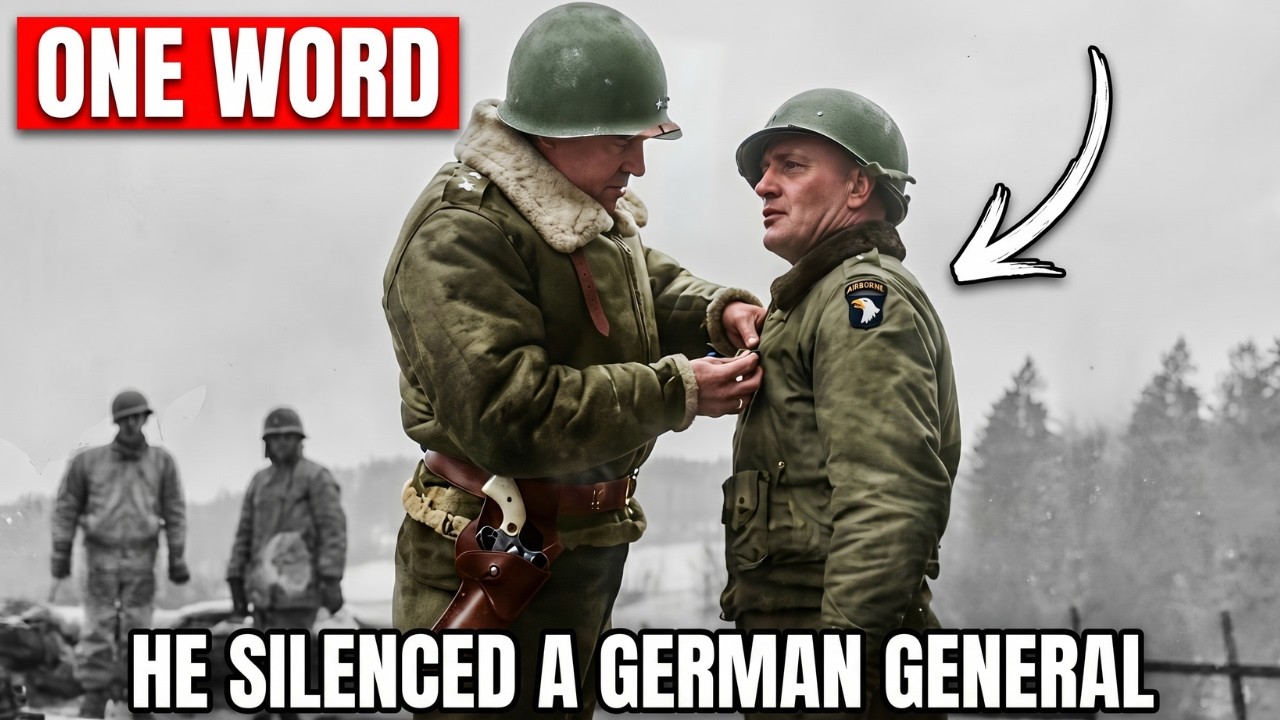
McAuliffe told the reporters his men had never needed rescuing. They had held what they were asked to hold. On December 30, Patton reached Bastogne and awarded McAuliffe the Distinguished Service Cross, telling him it was the greatest example of American fighting spirit he had ever seen. The Presidential Unit Citation awarded to the 101st Airborne Division for the defense of Bastogne was the first ever awarded to a full American division.
Between December 19, 1944 and January 6, 1945, 341 men of the division were killed, 1,691 were wounded, and 516 were listed as missing. The Battle of the Bulge was officially declared over on January 25, 1945. The German offensive collapsed across the Ardennes in the weeks following the relief of Bastogne. The last strategic reserve of the Wehrmacht in the west had been consumed.
The war in Europe ended less than four months later. Von Lüttwitz needed 165 words to explain why McAuliffe should stop. McAuliffe needed one to explain why he would not. The reply was not bravado.
It was the unguarded expression of a man who had already assessed his situation and found no reason to change what he was doing. History tends to distill a ten-day siege into a single exchange of notes because the exchange is clean and quotable and the siege is not. But the notes were written on top of everything those men did in the days on either side of them. The reply worked because the defense worked.
And the defense worked because more than twenty thousand American soldiers, running short on everything armies run on, held a sixteen-mile perimeter in the middle of a Belgian winter against an enemy with every material advantage, and refused, methodically and without drama, to stop. Von Lüttwitz sent 165 words. McAuliffe sent one. After Moore left with the reply, McAuliffe went back to sleep.
He had a perimeter to run in the morning, and he was going to need the rest. That was the man. That was the word.
That was what it cost.
