Ruth Arden sat in her 1987 Toyota Camry in the gravel lot at the top of the bluff and did not get out for eleven minutes. She was forty-two years old, a freelance archives and records preservationist, and she had driven up State Route 73 out of Lacy, Tennessee, past the point where the yellow line disappeared and the potholes became suggestions and the trees closed in on both sides, and then up 210 yards of gravel at a grade that made the sedan work for it. The building stood at the top, three stories of red brick gone the color of dried blood in the morning shadow of the ridge, a central bell tower with its copper dome gone green to black, 112 windows, most of them boarded, and the ones that were not boarded were dark with the darkness of a room that had decided not to show you what was in it. She sat in the car and looked at it, and later she told the historian Anson Pool that she sat there because she was organizing her equipment.
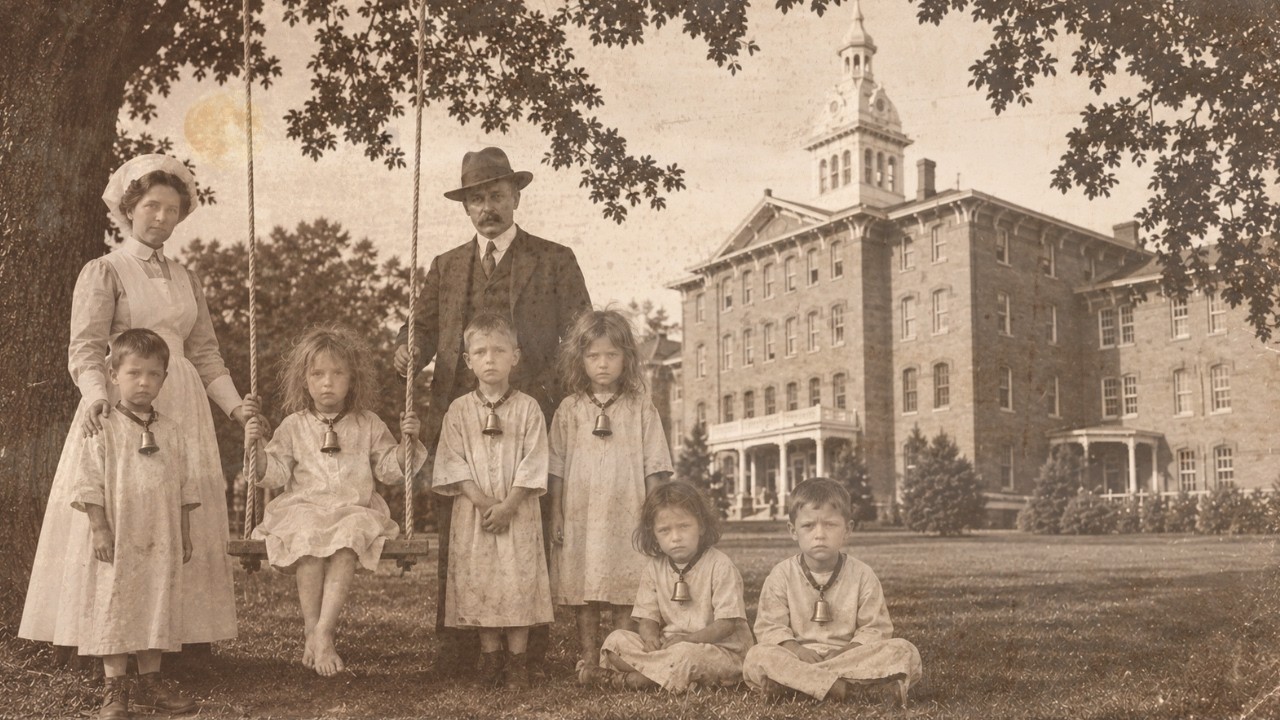
Then she paused, and then she said, no. That was not why. The building did not want her to get out of the car. The building was in the middle of something, and she sat in the car and waited for it to finish.
Kelmore State Asylum for the Chronic Insane was built in the summer and fall of 1896 on a bluff above the North Fork of the Pigeon River in Braden County, Tennessee, on land purchased by a physician named Phineas Kelmore from the heirs of a man named Wallace Hensley, who had used it for pasture and never dug on it. Kelmore paid ninety dollars. He had come down from Ohio after the war, served as a field surgeon on the Union side at Shiloh and Chickamauga, carried two pieces of shrapnel in his left thigh for the rest of his life, and held a medical degree from the University of Edinburgh. He was a widower by 1893, a good doctor by every account, a decent man, and he was wrong, and the combination of those three things is what made the story what it was.
The building sat directly on the blue limestone bedrock, poured concrete three feet thick with no crawl space, no gap between the concrete and the stone, rooted like a tooth in a jaw. It did not shift a quarter of an inch in 127 years. The land had a history Kelmore did not know. In 1858 a tanner named Elden Furth dug a soaking pit twelve feet deep into the limestone on that bluff, and on the second day of August, at a depth of about nine feet, his shovel broke through the ceiling of a cave.
The county land records include a surveyor’s note from 1859: natural cavern discovered at approx 9 ft depth extending below grade to unknown distance. Owner states, cavern has been filled with rubble and sealed. Furth filled the hole the same day, sold the land within the month for twelve dollars, moved to Chattanooga, and walked into the Tennessee River on a clear evening in March of 1860. He did not come out.
Luella Furth told the coroner that he had been hearing bells for six months. That is the first time the word bells appears in the record for that piece of ground, thirty-six years before Kelmore had the first one made. The first patients arrived on the 21st of September 1896, fourteen of them transferred from the county poorhouse, eight women and six men. Mabel Oaks, patient number one, thirty-four years old, committed by her husband for chronic melancholia following the death of two of her children in a diphtheria outbreak.
Kelmore’s intake note describes her as quiet, cooperative, oriented to person and place, does not appear to pose a danger to herself or others. The staff numbered six: Kelmore himself, a matron named Josephine Bird, a cook, two attendants, and a groundskeeper named Hosea Webb who lived in a cottage at the bottom of the bluff road and never slept in the building, not once in thirty-one years. He would not stay past sundown, no matter the emergency, and nobody pressed him, because pressing Hosea Webb on anything was like pressing a post. The first three months were ordinary.
Kelmore recorded pulse rates and diet changes and weight records, and the patients slept. On the 14th of January 1897, at approximately ten minutes past two in the morning, the night attendant, a twenty-three-year-old named Pruitt Cobb, made his round and found Mabel Oaks sitting upright in bed, facing the exterior wall, speaking in a low, steady, conversational tone, using a man’s name he could not quite make out, Ezekiel or Ezra, not the name of any patient or staff member he knew. He touched her shoulder, and she stopped and turned and looked at him, and said, he is counting. She said she had heard someone counting from below the floor, and she had answered, and the counting had stopped, and a voice had said a name, not her name, another name, and she had said here, the way you say here when your name is called in a schoolroom.
Kelmore examined her, noted an auditory experience consistent with a hypnagogic state, no treatment indicated, and then in pencil, in a hand he did not want part of the official record, he wrote that he had checked the subbasement that morning and found nothing, but the temperature at the bottom of the stairs was nine degrees warmer than the corridor above, and he did not like not having an explanation. Six weeks later, two more patients were speaking to the wall at night, using names no one recognized, and both said they had been answering a roll call from below. Kelmore decided it was the steam pipes, and wrote it in his ledger, even though there were no steam pipes. The building was heated by coal stoves.
There were no pipes in the walls, no pipes in the subbasement, and Kelmore knew it, because he had designed the building. It was the last time in sixteen years of records that he lied to himself on paper. Between March and December of 1897 he logged the nighttime speech week by week, and by the end of March there were eleven names in his log of names being spoken by patients who did not know them. In April he descended to the subbasement for the second time since the building opened, and on the exposed face of the natural limestone below the level of the foundation he observed a series of marks, too regular to be natural, arranged in vertical rows, evenly spaced, shallow, as if scored with a tool no wider than a nail.
He counted them. There were fourteen. Fourteen marks, fourteen patients. He wrote the number and moved on to the next entry, which was about a patient’s appetite, and the silence between those two entries is loud enough to hear across 127 years.
In June of 1897 Kelmore admitted patient number fifteen, a man named Lester Boggs, and that night he went down to the lower chamber alone with a lantern and counted the marks. There were fifteen. By the fall of 1898, nine patients in the east wing were sitting up between one and three in the morning, speaking to the wall. He moved patients from east to west, and the behavior stopped for a few days, then returned differently: the patients in the west wing lay flat on the floor and spoke downward, as if the thing they were answering was beneath them.
In one desperate week in November he sent all the east wing patients to the county hospital, and on the second night of emptiness Josephine Bird, the matron, heard the speaking coming from the empty rooms below her, not the patients speaking, the rooms, the walls, the names coming up through plaster and lathe and brick and limestone, one at a time, in order. Josephine Bird stayed four more years, and when she left in 1903, the only account of her departure is Kelmore’s ledger entry: Mrs. Bird has given her notice. She says she cannot hear her own name anymore without flinching.
I understand the feeling. On the 14th of January 1899, exactly two years and one day after Pruitt Cobb found Mabel Oaks, patient number three, Virgil Sams, fifty-two years old, chronic mania, one of the original fourteen, was found in his bed, eyes open, breathing, heart beating, responsive to nothing. He lived eleven more years, fed by tube, bathed by staff, turned every four hours, and never spoke again. Kelmore’s ledger entry for that day runs four pages, and at the end he writes that he went to the subbasement alone with a lantern and stood at the wall and counted the marks and there were twenty-six, and then he stood there and listened and heard it, a vibration below speech, regular, rhythmic, and he understood what it was.
It was counting, not words, not numbers in any human sense, but a tally, working its way through a list made of names, reading them as a teacher reads a role, waiting for an answer. And he understood what had happened to Virgil Sams. His name had been called, and he had answered not out loud, not voluntarily, as a bell answers when it is struck, because a bell does not choose to ring. And he wrote: I must find a way to muffle the bell, because if I do not, it will call every name in this building one by one, and every name will answer.
And when the last name has answered, the count will be complete. And I do not know what happens when the count is complete. And I do not want to know. In March of 1899, Kelmore commissioned forty small brass bells from a foundry in Knoxville and had them sewn to every garment in the building, sleeves, collars, hems, to be worn after sundown by patients and staff alike.
On the first night the bells were worn, the nighttime speaking stopped entirely, as if the counting below had been interrupted by a frequency it did not expect, 4,000 hertz, made physical, made constant, a wall of arithmetic the thing in the limestone could not get through. For a year the arithmetic held. 1899 was the best year Kelmore ever had. The state inspection rated the asylum satisfactory.
The first case of bell fever appeared in January of 1901. A patient named Agnes Pine, sixty-one years old, admitted in 1898 for senile dementia, refused to take her bells off, and said she could hear bells that were not on her clothing, bells in the walls, bells in the floor, bells in the silence between the actual bells. Six patients reported the same thing by March, and by May Kelmore had shortened it to bell fever, a term that appears on fifteen separate patient records between 1901 and 1912. He documented the progression meticulously.
Stage one, the patient hears bells when no bells are present, four to eight weeks. Stage two, the patient becomes agitated in silence and seeks the bells as a cold person seeks heat, two to six weeks. Stage three, a single voice beneath the bells saying the patient’s own name just below the threshold of clear hearing, and Kelmore writes, the patient cannot confirm the voice and cannot deny it. They live in the gap between hearing and imagining, and the gap widens, and I begin to suspect that the bells are not closing it because the bells are what opened it.
Stage four, the patient answers physically, a turning of the head, a step toward the wall, a hand raised, the body presenting itself to be counted. Stage five, which Kelmore records only twice, the patient stops answering to their own name when spoken by the living. Agnes Pine reached stage five in the autumn of 1901. She lived until 1906, but the woman who lived those years was not the woman who had arrived in 1898.
What remained in the bed was what remains in a bell after the ringing stops: the shape, the hollow, the memory of a sound. Kelmore tested removing the bells twice. Without them, the speaking returned within forty-eight hours and escalated within a week, and the roll call from the subbasement grew louder, more insistent, more precise. With them, the patients developed bell fever.
He tried thicker bells, cast iron instead of brass, lower frequency; the iron bells stopped the speaking but produced bell fever in half the time. He tried intermittent bells on alternate nights; the speaking returned on the silent nights and the fever progressed on the bell nights. He tried bells from sundown to midnight and silence from midnight to dawn; the speaking came at one minute past twelve. He kept the bells.
He chose the slower loss. And for the next eleven years he ran the asylum with a system he knew was killing his patients by degrees and could not replace with anything better. In 1904 he brought in a second physician, a man named Harold Strake from Knoxville, who stayed three months and left without writing a report. He did not descend to the lower corridor.
He did not count the marks. Kelmore’s note records that Strake recommended consultation with a specialist in disorders of the nervous system, and I do not blame him for leaving. And I hope he forgets this place as quickly as the place will allow. By 1907, Kelmore measured the marks on the stone: forty-seven, exact to the cumulative count of admissions.
Then he measured the shadows the formation cast under his standard lantern, and found they had grown one foot eight inches while the formation itself had grown three inches. The shadows were not proportional to the formation. The shadows were growing faster than the thing that cast them. And he put his hand on the formation and it was warm and it vibrated at a frequency of 4,000 hertz, the frequency of the bells he had introduced.
The formation had absorbed the frequency of the bells and added it to its vocabulary, and now it was speaking the language of the bells back at the bells, and the bells were no longer a wall. They were a window. He wrote: I have made a terrible error. The bells do not keep it out.
The bells taught it what a frequency is. It has the grammar of a language it did not have, and the first word it learned was my name. In 1911 Kelmore had bricks made on site from local clay and laid them himself, alone, at night, sealing the passage to the formation’s chamber with a wall two feet thick laid with Portland cement. He recorded the work in three sentences.
The wall held. But the bricks stopped the warmth from reaching the corridor and stopped anyone from walking down to the chamber; they did not stop the sound. In March of 1912 he sent the night attendant, a young man named Isaac Develin, to place his ear against the wall. Develin listened for two minutes and came back up at a run, saying he had heard counting, a roll call, and at the end a name, his own name, spoken in a voice that sounded like his own mother, who was alive and living in Lacy and had never been inside the building.
Develin had recalled his mother’s name aloud once, in conversation with another attendant, on his first day of work. Once was enough. He quit that night. The last entry in the ledger is undated, written in a hand that slants to the left, the mirror hand.
It reads: There are 47 names on the stone, and mine is the last, and it is spelled correctly. I did not write it. I do not remember not writing it. Kelmore died in the building on the 12th of August 1912, age seventy-one, heart failure.
The matron who found him, a woman named Hattie Dunlap, told Anson Pool in 2003, at the age of ninety-six, that Kelmore was wearing his bells when they found him, and the bells were still ringing. Not swinging, not moving, flat against his shirt, but ringing. The whole body was ringing at the frequency of the bells, as a tuning fork rings after you strike it, and it did not stop for forty-five minutes, and then the room was the quietest room I have ever been in, and the quiet was worse than the ringing. His will left the asylum to the state of Tennessee with one condition: the lower passage was to remain sealed in perpetuity.
The state accepted the bequest. The state ran the asylum for thirty-five more years. Between 1912 and 1947 it employed over two hundred attendants, cooks, matrons, nurses, and orderlies, with an average tenure of seven months, six times the state average. The building was warmer than it should have been, cleaner than it should have been, quieter than it should have been, and nobody asked why the storage rooms were well organized in a building that had no staff member assigned to organize them.
In 1946 the superintendent, Dr. Leland Marsh, wrote a letter to the state commissioner of health that survives only because Anson Pool found it in the personal papers of the commissioner’s secretary in a shoe box in a closet in Memphis in 2002. It read: The building is occupied by a presence that I cannot explain and that the state’s medical vocabulary does not have a term for, and this presence has been here since before the building was built, and the bells we have been requiring our patients to wear for the past 48 years are making it stronger, not weaker. The state closed Kelmore three months later.
The word bells does not appear anywhere in the official record of the closure. The transfer of patients is described as routine consolidation. Marsh resigned in June of 1947 and moved to California and never practiced medicine again. Ruth Arden arrived in Braden County on the 4th of October 1993.
She was hired by the Braden County Historical Society, funded by a small state heritage grant of $5,000, to survey and catalog the contents of the building before the county decided its future. She had spent nine years at the Tennessee State Library and Archives in Nashville, had been freelancing since 1991, and had taken the job because it was a building and not an office, because the building was in the mountains, and because the mountains had always been the place where the noise in her head went quiet. She did not take the job because of the ledger. Nobody had told her the ledger existed.
On her first morning at the building, a Wednesday, she met the county maintenance man, Ward Picket, seventy-one years old, who had been boarding windows and mowing the grounds for thirty-nine years and was the only person in the county who would go up there at all. He showed her the building. The air that came out of the front door was warm, warm the way a building is warm when someone has been heating it. She put her hand flat against the door frame, and the door frame was warm, and she pulled her hand back, and Ward watched her the way a man watches someone touch a stove.
The building was clean in a way abandoned buildings are not clean, as if someone were taking care of it, and the someone was not Ward Picket, and was not the county, and was not a trespasser. They walked the ground floor, the east and west wings, twenty rooms each, iron bed frames bolted to the floor, some still with mattresses in better condition than they should have been, blankets folded at the foot of the beds, soft, not moth-eaten, not rotted. The second floor held the infirmary and the superintendent’s office, the filing cabinets empty. The third floor was staff quarters, the claw-foot tub with brass fixtures green with corrosion but porcelain white, and Ruth ran her finger along the rim and her finger came away clean.
Then Ward took her below. The floor plans showed one subbasement. At the far end of it, past the point where the floor plan said the subbasement ended, cut into the limestone itself, there was another staircase, and at the bottom of it, a natural passage in the stone, roughly five feet wide, with a floor someone had improved with a pour of concrete, and at the end of that passage, a wall of newer brick, laid tight, with good mortar, no gaps, no door, no window, and a wall that said, in the language of brick and mortar, do not go further. Ward Picket took his cap off, which he had not done, and turned it in his hands, and told her three things.
Do not go below where we are standing. The wall was put there by men who knew what they were doing, and it was old when his father found it. Behind that wall there is a room that is not on any drawing the state ever filed, and whatever is in that room is what the building was built on top of. Second, if you hear bells at night, and you will hear bells, stand still and count backward from a hundred out loud in the dark, and when you reach one, stop.
If the bells have stopped, you can move. If they have not, count again. Third, if somebody calls your name from inside this building after sundown, do not answer. Not because of what is in here; it is counting the voices it can make you answer to.
Every time you answer, it has one more. Then he put his cap back on and said he would not speak of it again. And his hands were shaking, and they had not been shaking before. She found the first document on the second day, in room nine of the east wing, wedged between the iron rail of a bed frame and the wall: a single sheet of paper, yellowed but sound, handwritten in pencil in a careful script, a list of fourteen names in a column, numbered one through fourteen.
She recognized none of them. On the back, in the same hand, a single line: the count is not ours. She placed it in an acid-free sleeve and cataloged it. She went to the historical society on her second Monday in Braden County, the 11th of October, and Lorna Pace showed her the ledger, kept in a glass case in the reading room.
It was Phineas Kelmore’s personal record of patient care, 1896 to 1912, a leather and board volume of approximately four hundred pages, found in 1978 by a demolition surveyor named Paul Creech behind a collapsed plaster wall in the superintendent’s office, in a cavity that appeared to have been deliberately sealed. Ruth sat in the reading room and read it from front to back. It took her nine hours. She did not stand up until seven in the evening, when Lorna came to the door and said the building was closing, and Ruth looked up with the face of a person who has read something that has rearranged the furniture of the world.
She went back to the building the next morning and went directly to the subbasement. The room on the second floor was sixty-one degrees. The ground floor was sixty-four. The subbasement was seventy-one.
The lower corridor at the brick wall was seventy-eight degrees, forty feet below ground, in October, with no heat source. She knelt and looked at the floor and saw that the concrete was cracked, the cracks running in roughly parallel lines spaced about six inches apart, running outward from the wall toward the stairs, as if something beneath the concrete was pressing upward along those lines, stretching the surface as a face stretches the surface of a mask from underneath. She took eleven photographs. She did not notice, on that day, a detail in photograph seven, a close-up of the brick wall at eye level, that she would notice later, in February of 1994, when she was printing the photographs in Chattanooga, and when she noticed it she sat down on the floor of her apartment and did not get up for forty-five minutes.
Over the next three days she found tally marks scratched into the plaster behind the last bed in the east wing second floor, the west wing second floor, and the staff quarters on the third floor: forty-seven clusters of five in each place, and next to each set of tallies, one more mark, a letter scratched deeper, with more force, the letter K. Kelmore had added himself to the count, the forty-eighth name, his own. And when Ruth went down to the lower corridor on Saturday, the 16th of October, with a flashlight and a notebook and her hands shaking, and counted the marks on the limestone herself, she found not forty-seven but three hundred and forty-seven. Three hundred additional marks accumulated in the eighty-one years since Kelmore’s last entry, marks that had to include a demolition surveyor named Paul Creech, and a maintenance man named Ward Picket, who came every three months for thirty-nine years, and everyone else who had ever entered the building and spoken a name inside it.
And one of them now was hers. Ruth Arden had a sister named Caroline. Caroline was the older one, born in 1948, three years and four months between them, taller, louder, quicker to laugh and quicker to forgive. Ruth was the small one, the still one, the one who sat at the kitchen table and read while Caroline ran the neighborhood.
Caroline married a man named Doug Jessup in 1971 and taught second grade in West Knoxville and was good at it because she did not talk down to children. Four small things defined her, and Ruth knew them the way you know furniture, so familiar she had stopped seeing them until the day she could not see them anymore. Caroline tapped her collarbone with her left index finger when she was thinking, always twice, a pause, twice more, a double tap and a double tap, like a heartbeat with a rest in the middle. Caroline called Ruth Ruthie Bird, a name that existed only between the two of them, a word that existed in the private language of the house.
Caroline had a laugh that started silent; her shoulders would go first, shaking, and the sound would come about two seconds late, and Ruth once told her that her laugh had a loading screen. And Caroline could not abide the taste of black licorice, a whole-body revulsion the family had accepted the way families accept the small impossibilities of each other’s bodies. Caroline died on the 3rd of June 1989, ovarian cancer, forty-one years old, in a hospital in Knoxville, on the fourth floor, with Doug on one side of the bed and Ruth on the other. Ruth told Anson Pool in the 2003 interview that the last thing she heard her sister say was not a word but a breath, and in the breath was the shape of the double tap, the same rhythm her fingers made on her collarbone, as if her body was keeping time with something her lungs could not quite carry.
And then the rhythm stopped. Ruth told Pool that the silence after that breath was the loudest sound she ever heard in her life. On her fourth night in Lacy, Sunday the 10th of October, Ruth woke at two in the morning in her room at the Mountain View Motel to the sound of small bells moving on fabric, swaying, as if someone nearby was walking in a garment covered in bells. She heard them again on the fifth, sixth, and seventh nights, always between one and three in the morning, always the same swaying walk.
On the seventh night she remembered Ward Picket’s second warning, counted backward from a hundred out loud in the dark, and the bells stopped at sixty-three. The next night, forty-one. The next, nineteen. The bells were getting closer to zero.
Each night the count reached a lower number, and the lower the number, the longer the silence held, and the silence was not peace. It was the space between a name being called and the answer being given. In her field notebook, on the 19th of October, she wrote: the bells are not coming from the motel. They are coming from me.
The frequency is in my body. She was developing bell fever twenty-six days after walking into a building that had been empty for forty-six years, without wearing a single bell. She began setting an alarm for 12:30, counting backward preemptively, and the counting held the bells off, but she was sleeping three hours a night by early November, losing weight, making mistakes in her field notes, a room number written backward that she did not catch for weeks. On the 12th of November, a Friday, she fell asleep at the desk in the superintendent’s office and woke at four-fifteen to the light of a building after sundown.
From below, from the subbasement, she heard bells coming up the stairs, one step at a time, the sound of a person walking in bells. She stood at the top of the main staircase and counted backward from a hundred. The bells came up one step with each number. At seventy-three they were on the first landing; at fifty, the second floor; at thirty, the hallway.
She backed down the corridor toward the superintendent’s office, counting, and at fourteen she hit the wall and could not back up any farther, and the bells stopped. In the absolute silence, from the darkness of the hallway six feet from the office door, a voice spoke one word. Ruthie Bird. Nobody in Braden County knew that name.
Nobody in Tennessee knew that name except Ruth herself. It was a name that had existed only between two sisters, and one of those sisters had been dead for four years, and the name should have died with her, and it had not, because Ruth had written the name Caroline in her field notebook on the second day, and the building had read the name, and followed it backward through Ruth’s memory to the only voice that had ever spoken it. Ruth did not answer. She counted.
The voice did not come again. She walked out of the building and drove to the motel, sat in the parking lot with the engine running and her hands shaking for twenty minutes, and then turned the car around and drove eight miles up the North Fork of the Pigeon to Clingman Branch, where a yet older truck had come up the gravel road on the 1st of November, a 1963 Chevrolet, pale yellow under a generation of dirt, with a dog in the back, and a ninety-three-year-old woman behind the wheel who told her, You have written your name in there. I can see it on you. It is a particular kind of tired.
The tired of a person whose name is being used and who does not know it yet. Come and see me when you know it. Granny Reeve Combs was born on the grounds of Kelmore Asylum in 1900 and lived there until she was nineteen. Her grandmother, Birdie Combs, was a laundress at the asylum for twenty-three years, and every time she sewed a bell onto a garment, she was sewing a window, and every time she took a bell off, she was closing it, and the opening and closing wore her out, and she heard the bells for the rest of her life.
Granny Combs sat Ruth at a kitchen table that had been in that cabin since 1919, poured her something hot, and talked until two in the morning. Some rock is just rock, she said. Some rock remembers. It is down deep where the water has been working on it since before there were people to name things, and it has been listening that whole time, learning as a child learns, one sound at a time.
And then people came and people brought names, and a name is a different kind of sound. A name is a sound that belongs to somebody, and the rock had never heard a sound that belonged to somebody before, and it wanted it, not like hunger. Like a mirror wants a face. It wears the names one at a time.
It puts a name on like you put on a dress, and it walks around in it, and it speaks with the voice that belongs to the name, and it does not know that it is not the person. It is not pretending. It thinks it is answering a roll call. When somebody answers, it puts them on.
The cure, she said, was an empty name. Write a name that has never belonged to anyone, a name you make up, with no face behind it, no voice, no history. Go down there and say it three times in the dark and leave the paper where it can reach it. It will take that name and put it on, and it will be busy with that name for years, trying to find the face that goes with it, and there is no one, and while it is chewing on that empty name, it will put yours down, and the frequency will let go of you, and you can walk away.
But, she said, the empty name will buy you time. It will not buy you freedom. The rock is patient. It will chew on the empty name for years, and then it will realize the name is empty, and it will go back to the names that are not empty.
And the next time the count will start lower. It is getting closer. And one day the count will start at one, and you will not have time to say a number, and it will have your name and your voice and your face. Ruth asked how she would know, if it came for her as her sister, if it wore her sister’s face.
Count the hands, Granny Combs said. Count the habits. Count the things a mirror would reverse. A part in the hair flips.
A left-handed woman becomes right-handed. It builds everything from a reflection, and a reflection transposes left and right. On the 25th of November, Thanksgiving, Ruth went down to the lower corridor with a piece of paper in her hand. She had assembled the name from syllables that pleased her, checked the census records, the Social Security death index, the county registers of Braden County and every adjacent county back to 1820.
There had never been a Leodin Vas. The name was empty. She stood in the corridor with the paper in her right hand, and at the end of the corridor stood the face of her dead sister, smiling with the wrong mouth, tapping the collarbone with the wrong hand, the right hand, saying Ruthie Bird in a voice that was perfect except for the loop, the repetition, the stuck record quality, and the voice said, come down, the bells are so pretty down here, you can hear them all, every single one, come down and listen. Ruth counted, and at forty-one she spoke the empty name, and the face stopped as a sound stops when you press the mute button.
She spoke it three times. On the third speaking the face descended to the paper on the floor and pressed itself against it as a person presses their face against glass, and the paper absorbed the face as blotting paper absorbs ink, reducing the three-dimensional face of Caroline Arden to a two-dimensional mark on a piece of paper that bore the name of a person who did not exist. The bells stopped. The warmth was gone.
The bricks of the sealed wall were cold. The paper on the floor was blank. She picked it up and folded it and put it in her jacket pocket and walked out of the building and drove to Granny Combs’s cabin, and Granny Combs looked at her face and said, you gave it the empty name. It always works, she said.
The question is how long. Her grandmother gave it an empty name in 1908, and the bells came back in 1912, four years. She gave it one in 1919, and the bells came back in 1937, eighteen years. But I was young, she said.
You are forty-one. You have a whole life written in your body, a whole archive. You have years, not decades. Ruth left Braden County on the 30th of November 1993.
She delivered her survey report on the 15th of December, fourteen pages cataloging the contents of every room. Nowhere in the report did she mention the bells, the warmth, the voices, the face, the empty name, or the fact that the formation underneath the asylum had been wearing the names and faces of patients for ninety-seven years. She married a carpenter from Murfreesboro named Glenn Harker in 1995, a man who did not ask why his wife counted backward from a hundred before sleep every night, who respected privacy the way carpenters respect wood. She worked at the state archives, published three articles in the Tennessee Historical Quarterly, none of which mentioned Kelmore.
Granny Reeve Combs died on the 14th of March 1996, at ninety-six, in her cabin, and her last words were the same as her grandmother’s: make them stop ringing. And there were no bells in the house. For twenty-nine years, Ruth did not hear bells. She allowed herself to believe, carefully, as a careful person believes, without letting belief become certainty, that the empty name had worked permanently, that Leodin Vas had been enough, that the formation was still chewing on a name with no face behind it and might chew forever.
The bells came back on the night of the 17th of October 2022, ninety-three miles from the building, in the house in Chattanooga she and Glenn had moved to after retirement. She lay in bed and counted backward, and the bells stopped at fifty-one. The next night, thirty-three. The next, nineteen.
On the seventh night, the 23rd of October, the bells stopped at seven, and in the silence a voice spoke from the hallway. Ruthie Bird. Caroline’s voice, exactly Caroline’s, the pitch, the warmth, the particular way Caroline said the first syllable like a question. She did not see the face again until the night of the 3rd of December, when she woke at one-fifteen and looked at the bedroom door and saw the shadow standing there, the hair parted on the wrong side, the right hand raised, tapping the collarbone twice, pause, twice.
The formation had learned to project at a distance. She counted until the shadow vanished at seven, and she lay in the dark and understood that the proximity rule was gone. Ruth Arden Harker died on the 11th of August 2024, at the age of seventy-two. Cardiac arrest, the death certificate said.
Glenn found her in the kitchen at six-forty-five in the morning, sitting at the table in a robe and slippers, a cup of coffee in front of her, half full, still warm. Anson Pool visited the house four days later. On Ruth’s desk was a cardboard box sealed with packing tape, labeled in her handwriting: For Anson Pool. Open in daylight.
Do not open after dark. Inside, wrapped in cotton batting, was a brass bell, approximately two inches in diameter, with a clapper and a loop at the top for sewing onto fabric, an ordinary small bell, except that it was warm, warm the way the subbasement floor had been warm, with the warmth of skin. And inside the bell, folded into a square no larger than a postage stamp, a piece of paper with six words in Ruth’s handwriting: Do not ring. Do not say the name.
It is still chewing. Glenn told Pool that Ruth had never mentioned a bell, had never mentioned bells of any kind, that the only unusual thing about her was the counting, and that sometimes, after the numbers, she would say a name, not his name, not anyone’s name he recognized, Leodin Vas, three times, and then she would go back to sleep. Thirty years later, she was still speaking it, three times in the dark, the ritual number, the feeding, keeping the chewing going, buying time in increments of one night, one count, one speaking. Pool took the bell, wrapped it back in the cotton batting, sealed the box, and put it in a locked filing cabinet in his office in Knoxville.
The bell is still there. He checks the cabinet once a month. The bell is still warm, two years after Ruth Arden’s death, one year after Ward Picket’s granddaughter sold the property down the road from the asylum, six months after the last person who had ever been inside the building retired and moved to Florida. Kelmore Asylum is still standing in Braden County, Tennessee, closed since 1947, no lock on the front door because the lock rusted through in the 1980s and no one replaced it because no one goes there.
No one checks the warmth. No one counts the marks. The building is alone with its names and its frequency and Leodin Vas, which it has been chewing on for thirty-one years and which it will finish someday, and when it finishes it will go back to the names it put down, and Ruth Arden’s name will be among them. But Ruth Arden is dead, and the dead cannot answer a roll call.
Or can they. The bell is still warm with the frequency of a formation that has been listening since before there were names, that has not stopped listening and will not stop, because stopping requires a beginning, and this thing did not begin. It was there when the rock was water. It was there before counting.
It was there before names. It was there before bells.
