From the founding of the Republic through the eve of the First World War, the United States government ran on a single source of money. There was no income tax, no payroll tax, no corporate levy. From 1789, when the Constitution took effect, until 1913, customs duties collected at American ports supplied roughly 80 to 95 percent of all federal revenue. The navy, the army, the postal service, the courts, the diplomats, the lighthouses, western expansion, even pensions for Civil War widows, were all paid for by taxing imports.
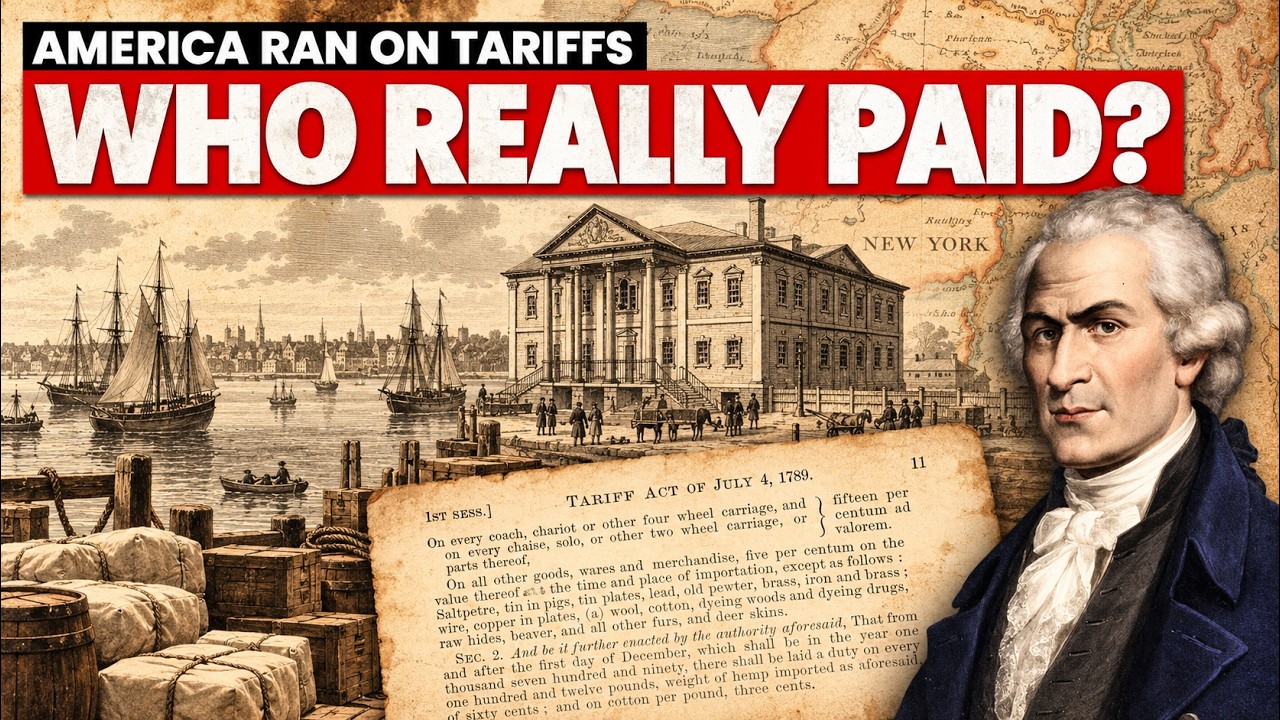
The arrangement seemed like a political miracle: foreigners paid for the American government. No worker saw a deduction, no farmer faced an auditor, no small business filed quarterly returns. But the reality was far different. Tariffs may have been collected at the border, but they were almost always paid by the people living inside it.
Every imported bolt of wool, every pound of sugar, every nail driven into a barn carried the cost of government baked into its price. For over a century, Americans quietly financed their federal state through the goods they bought, and the fight over who truly bore that burden became the central political conflict of the nineteenth century. It nearly triggered a civil war in 1832, helped drive the actual Civil War in 1861, built the great Gilded Age fortunes, and when the system finally collapsed in 1913, it took the entire architecture of American finance with it. The story begins in the summer of 1789, when the new nation was catastrophically broke.
The Revolutionary War had been financed with borrowed money, worthless paper currency, and the patience of foreign creditors. The government under the Articles of Confederation could not even compel the states to pay their share of the national debt. By the time George Washington took office, the debt stood at over 75 million dollars, an apocalyptic sum in an economy where a skilled craftsman earned a few hundred dollars a year. The country owed money to France, to Dutch bankers, to its own unpaid soldiers, and to merchants who had supplied the army on credit.
The very first substantive law passed by the first Congress, signed by Washington on July 4, 1789, was the Tariff Act. Sponsored by James Madison, it placed a flat 5 percent duty on most imports, with higher rates on items domestic producers wanted protected. The law stated its purpose plainly: support of the government, discharge of the national debt, and the encouragement and protection of manufacturers. Three goals bundled together that would quietly tear the country apart for the next seventy years.
Alexander Hamilton, the first Treasury Secretary, saw the tariff as more than a revenue tool. In his 1791 Report on Manufactures, he argued that the young nation could not remain a plantation economy forever. It needed factories, mills, and foundries, and the way to build that base was to shield American infant industries from cheaper foreign competition by taxing imports heavily enough to level the playing field. Thomas Jefferson initially disagreed, convinced the future lay in independent farming, but even he eventually came around.
The War of 1812, which cut off trade with Britain and forced Americans to make their own goods, proved domestic manufacturing was both possible and strategically necessary. After the war, British manufacturers tried to dump cheap goods on the American market to crush the new factories, and Congress responded with the Tariff of 1816, raising average duties to around 20 percent. At that moment, the tariff’s character changed. It was no longer just a revenue measure; it was industrial policy.
The federal government was now picking winners and losers inside the American economy. Textile mills in Massachusetts, iron forges in Pennsylvania, the infant steel industry, hat makers, shoemakers, glass works, carriage builders, all won. They could charge higher prices because their foreign competitors were taxed. And someone somewhere had to make up the difference.
The question that would define American politics for the next century was simple: who? Southern planters were the first to see it clearly and the first to get furious. Their economy was built on exports: cotton, tobacco, rice, indigo, shipped mostly to Britain. In return, they bought imported manufactured goods because American factories did not yet make enough of them, and what they did make was often more expensive and lower quality.
When Congress raised tariffs, the South was hit twice. The price of nearly everything Southerners bought went up, and because foreign countries sold less to America, they had less money to buy Southern cotton. Southern exports suffered, Southern purchasing power shrank, and Northern manufacturers got rich under the shelter of the tariff wall. The arrangement had the elegant symmetry of a trap: the South paid, the North collected.
Nothing illustrates this more sharply than the Tariff of 1828, passed in an election year full of maneuvering. It raised average rates on dutiable imports to around 62 percent, applied to roughly 92 percent of all imports, an unprecedented burden in peacetime. Southerners named it the Tariff of Abominations. In the House, the Southern vote was devastatingly unanimous: only four in favor, sixty-four against.
Then came John C. Calhoun. A brilliant lawyer from South Carolina, serving as vice president, he anonymously wrote the South Carolina Exposition and Protest, arguing that the tariff was unconstitutional and that individual states possessed the sovereign right to nullify any federal law they judged beyond constitutional limits. The doctrine of nullification was explosive.
If a state could reject one federal law, it could reject any federal law, meaning the United States was not really a nation but a loose confederation of independent sovereignties. For four years the question simmered. In 1832, after Congress passed a mildly revised tariff that satisfied no one, South Carolina formally adopted its ordinance of nullification, declaring both tariffs unenforceable within its borders and threatening to secede if the federal government tried to collect them by force. President Andrew Jackson, himself a Southerner and a slave owner, did not blink.
He issued a thundering proclamation that nullification was treason, and Congress passed the Force Bill authorizing him to use the army. For a few weeks it looked like civil war would arrive thirty years early, triggered not by slavery but by taxes on imported wool. Henry Clay negotiated a compromise tariff that gradually lowered rates, and South Carolina backed down. But the fuse had been lit and never really went out.
Jackson admitted privately that the tariff was only a symptom; the real disease was the widening gap between the industrial North and the slave-based agricultural South. The next time that gap exploded, it would not be contained. By the late 1850s, the tariff situation had calmed. The Walker Tariff of 1846 and the Tariff of 1857 had lowered rates substantially, favoring Southern interests.
Average duties sat around 20 percent, the lowest in decades. But in the North, a coalition had been building that wanted tariffs raised again. Pennsylvania iron manufacturers, New England textile mills, Midwestern railroad companies, and the emerging Republican Party all shared one conviction: the American industrial future required a wall of protective duties, and the Southern Democrats who kept blocking it had to be defeated. In 1860, Justin Morrill, a Republican congressman from Vermont, drafted a dramatically higher tariff.
The bill passed the House in May 1860, before Abraham Lincoln was even elected. Southern senators had enough votes to block it in the Senate for most of that year. Then came November. Lincoln won the presidency.
South Carolina seceded in December, and by February six more Southern states had followed. When those Southern senators left Washington to join the Confederacy, they took their blocking votes with them. The Morrill Tariff sailed through the Senate on February 20, 1861, and was signed into law by outgoing President James Buchanan two days before Lincoln’s inauguration. It roughly doubled the average tariff rate.
During the Civil War, Congress passed two more Morrill-sponsored hikes, pushing rates to levels not seen since the Tariff of Abominations. Historians have argued for a century and a half about whether the tariff caused the Civil War. It did not by itself. The Confederate states left the Union over slavery, and their own secession documents say so explicitly.
But the tariff was never far from the fight, one of the economic grievances layered on top of the slavery dispute. When Lincoln was asked why he would not simply let the South go, he reportedly replied, “If I do that, what would become of my revenue? What then would become of my tariff? ” The federal government depended on customs duties for the overwhelming majority of its income, and most of those duties were collected at Southern ports.
Letting the Confederacy walk away meant letting the money walk away. Once the war began, the federal government, facing expenses no tariff revenue could cover, invented a new tax. In 1861, Congress passed the Revenue Act, including the first federal income tax in American history, a 3 percent levy on incomes above 800 dollars. It was a desperate wartime measure, supposed to be temporary.
In 1872, with the war long over and the government flushed with tariff revenue, Congress repealed it entirely. For the next forty years, the United States returned to funding its central government almost exclusively through import duties. The decades after the Civil War are remembered as the Gilded Age, a term from a satirical novel by Mark Twain and Charles Dudley Warner that captured how the shining surface of American prosperity hid a corrupt and rotting interior. By 1890, 11 million of the roughly 12 million American families earned less than 1,200 dollars a year, and the average income among that group was around 380 dollars, below what we would now call the poverty line.
Meanwhile, a handful of industrialists accumulated fortunes beyond anything the country had ever seen: Andrew Carnegie in steel, John D. Rockefeller in oil, J. P. Morgan in finance, Jay Gould in railroads.
Known as the robber barons, many were enormous beneficiaries of the tariff system. In 1890, Republican congressman William McKinley pushed through the McKinley Tariff Act, raising duties by roughly 50 percent and bringing average rates to around 48 percent, the highest in peacetime. After McKinley became president in 1897, Congress passed the Dingley Tariff, raising rates even higher, the highest protective tariff in American history at the time. Between 1897 and 1907, the cost of living rose by nearly 25 percent.
Groceries, clothing, furniture, tools, everything a working family needed got more expensive. Meanwhile, the protected steel mills and textile factories posted record profits, and their owners built mansions on Fifth Avenue and in Newport. The central question of the entire story is who actually paid the tariff. Legally, the importer of record paid it, the American merchant who brought foreign goods through customs.
But that is a bookkeeping fact, not an economic one. Economists have settled the question: the burden is distributed among foreign exporters, who may lower prices to keep selling into the American market; American importers, who may absorb some cost in reduced profit margins; and American consumers, who ultimately pay higher prices when importers pass the tax along. In almost every case studied, consumers end up paying the largest share. A tariff is a sales tax on imported goods, and sales taxes are paid by the people who buy things.
In the Gilded Age, this meant a farmer in Kansas needing a plow paid the tariff, a seamstress in Chicago needing thread paid it, a miner in West Virginia needing boots paid it, a railroad worker in Nebraska needing a winter coat paid it. The tariff was in practice a national consumption tax that fell heaviest on people who spent most of their income on basic manufactured goods: working people and farmers. Meanwhile, the industrialists receiving protection did not pay it themselves, because they bought mostly domestic goods and benefited from charging higher prices for their own protected products. The entire system functioned as a regressive wealth transfer from poor and middle-class consumers to wealthy manufacturers.
One critic described tariffs as a tax on the shoes of the laborer to protect the profits of the shoemaker who hired him. Farmers understood this, which is why the Gilded Age saw the rise of the Grange, the Farmers’ Alliance, the Populist Party, and the Progressives. They pointed out that American farmers sold their wheat and corn into unprotected world markets where they had to accept global prices, while buying their tools and clothing inside a protected American market where prices were artificially inflated. The farmer was squeezed on both ends, and the squeeze financed mansions in Manhattan.
By the early 1900s, the pressure for change had become overwhelming. In 1909, Congress proposed a constitutional amendment permitting a federal income tax. An earlier attempt in 1894 had been struck down by the Supreme Court as an unconstitutional direct tax. Conservative Republicans led by Senator Nelson Aldrich supported sending the amendment to the states, not because they wanted an income tax but because they thought it would never pass.
They were catastrophically wrong. One state legislature after another ratified it. On February 25, 1913, Secretary of State Philander Knox certified the Sixteenth Amendment, giving the federal government explicit power to tax incomes from whatever source derived. That same year, the Underwood-Simmons Tariff Act slashed average tariff rates and enacted the first permanent federal income tax.
At first it applied only to the very wealthy; only about 1 in 271 Americans paid any income tax at all, at a top rate of 7 percent. Then World War I happened. Rates were raised, the threshold lowered, and by World War II the income tax had become the dominant pillar of federal finance, where it remains today. Where tariffs had provided roughly 90 percent of federal revenue in the 1800s, they would provide less than 5 percent for most of the twentieth century.
But the tariff system did not go quietly. It made one final catastrophic appearance. By the late 1920s, agricultural prices were collapsing, and farmers demanded help. President Herbert Hoover had campaigned on a promise to raise tariffs to help them compete against foreign imports.
After the stock market crashed in October 1929 and the economy slid into the Great Depression, Congress doubled down. Senator Reed Smoot and Representative Willis Hawley shepherded through the Tariff Act of 1930, raising average duties by roughly 20 percent, second only to the Tariff of Abominations. Over a thousand American economists signed a petition begging Hoover to veto it. Hoover, trapped by his own campaign commitments, signed it anyway on June 17, 1930.
The rest of the world retaliated swiftly. Canada, America’s largest trading partner, acted immediately; European nations followed. A global trade war erupted at the worst possible moment. Between 1929 and 1934, world trade collapsed by roughly two-thirds.
American iron and steel exports dropped by 85 percent due to retaliation from Canada alone. Unemployment climbed from 8 percent to 25 percent. Smoot-Hawley did not cause the Depression, but virtually every economist agrees it made it deeper, longer, and more global than it needed to be. In 1932, voters threw Hoover out.
Smoot and Hawley lost their seats. Franklin Roosevelt took office, and his Secretary of State, Cordell Hull, pushed through the Reciprocal Trade Agreements Act of 1934, shifting American trade policy toward lowering tariffs through bilateral and later multilateral agreements. After World War II, the General Agreement on Tariffs and Trade, which became the World Trade Organization, institutionalized the global movement toward lower tariffs. American average tariff rates, which had been as high as 60 percent in the nineteenth century, settled at around 5 percent and stayed there for seventy years.
The tariff debate did not stay buried. It returned in 2017 and 2018 with new tariffs on steel, aluminum, and Chinese imports, and then erupted in 2025 with the most sweeping protectionist program in nearly a century. By September of that year, the trade-weighted statutory tariff rate climbed to roughly 27 percent, the highest level in nearly a century. The Yale Budget Lab calculated that the program would raise consumer prices between 1.
7 and 2. 9 percent in the short run, costing the average household between 2,800 and 3,800 dollars per year. Apparel prices were projected to rise by as much as 64 percent, textile prices by 44 percent. Working-class Americans making about 35,000 dollars a year were projected to lose roughly 1,700 dollars in annual spending power, a 4 percent hit to real income.
The Peterson Institute for International Economics concluded that American importers and consumers bore roughly 96 percent of the cost, with foreign exporters absorbing only about 4 percent. The New York Federal Reserve reached a similar conclusion. Federal Reserve Chair Jerome Powell attributed essentially all of 2025’s inflation overshoot above the 2 percent target to tariffs. The deepest irony is that the nostalgia for an America funded by tariffs rests on a historical misunderstanding.
Tariffs funded the nineteenth-century federal government only because that government was tiny, spending just 2 to 4 percent of GDP. Federal spending in 2024 was around 25 percent of GDP, roughly ten times larger as a share of the economy. There is simply no realistic tariff rate that could finance a modern American government; rates high enough to do so would collapse trade, destroy revenue, and crater the economy, exactly as Smoot-Hawley demonstrated. So who actually paid for America’s tariff-funded government all those years?
The same answer applies to tariffs today. Americans paid, specifically the Americans who did the most consuming relative to their income: farmers, workers, immigrants, families scraping by on narrow margins. The tariff was a tax that hid itself inside the price of goods, letting politicians pretend the government was financed by foreigners while the actual money came out of American wallets. For 124 years it built the early republic, paid for the Louisiana Purchase and the Mexican War, funded the Union armies.
It also enriched a small industrial elite at the expense of a vast consuming public and played a role in nearly every major crisis of the century. The system did not fall because people suddenly loved paying income tax. It fell because enough Americans over enough decades slowly came to understand what was being taken from them, how, and by whom. They demanded a system that made the costs visible.
The Sixteenth Amendment did not eliminate the burden of government; it just moved it out of the shadows and into daylight. The choice between a visible tax and a hidden one is not a choice between paying and not paying. It is a choice between knowing what you are paying for and being told falsely that someone else is paying for it.
