The katana came down in darkness. Walter McIlhenny had stumbled into a Japanese officer on Guadalcanal, close enough that neither man had time to raise a rifle. The officer snatched the nearest weapon, a sword still in its scabbard, and swung it at Walter’s head. The blow dented his helmet and knocked him off his feet.
As he blacked out on the jungle floor, six thousand miles from Louisiana, Walter shot the man. When he woke on a stretcher, the helmet and the katana lay beside him. He kept both. They sit in a museum case in New Orleans today, and most visitors walk past without reading the placard.
The habit of leaving the pepper business to fight foreign wars had started forty years before Walter ever reached the Pacific. It began in Cuba, with his father, John Avery McIlhenny, charging up a hill alongside Theodore Roosevelt. And it all traced back to a single unlikely discovery: the man who created Tabasco sauce never once mentioned it in his own autobiography. He died in 1890, and his obituary skipped it entirely.
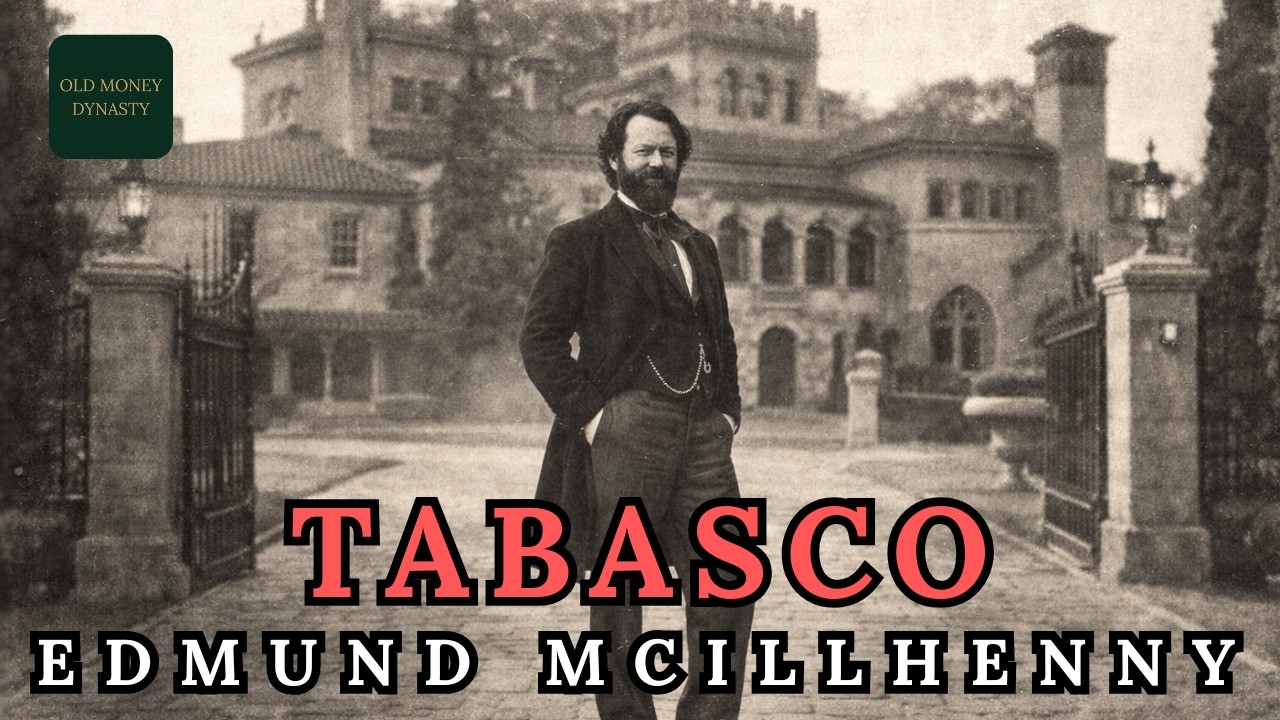
Edmund McIlhenny built what is now estimated to be a two to three billion-dollar family empire, and he apparently considered it beneath mention. Edmund was not born into money. He came from Hagerstown, a small town in Western Maryland, to a family of Irish and Scottish descent. Born in 1815, he headed south as a young man, and by the early 1840s he had reached New Orleans.
The city ran on cotton and sugar. Enormous sums moved through its trading houses daily, and for a newcomer with sharp instincts and no inherited advantages, banking was the clearest path upward. Edmund was good at it. He worked his way into the industry, accumulated capital, and eventually owned five banks in the city.
It was a remarkable rise for someone who had arrived without connections. But New Orleans had a ceiling for men like him. The real power in Louisiana did not sit in bank vaults. It sat on the land.
That was where Mary Eliza Avery entered the picture. Her family owned something unusual. Her father, Judge Daniel Dudley Avery, had married into the Marsh family, who back in 1818 had purchased a remote stretch of elevated terrain in the coastal marshlands south of New Iberia. The land rose sharply from flat, soggy surroundings, roughly 2,200 acres covered in subtropical growth and enormous live oaks tangled with Spanish moss.
Locals called it Petit Anse Island, though it was surrounded by bayou, not open water. Nobody yet understood what sat underneath. The Averys operated a sugar plantation there, with enslaved workers farming the fields, and the family lived in a large house accessible only by a narrow road through the marsh. Edmund married Mary Eliza on June 30, 1859.
They would have eight children. He moved onto the island and into the Avery household. For the first time, he had both money and land. The Civil War was two years away.
And when it arrived, it would take everything he had: his banks, his currency, his assumptions about the future. Even the island itself would be overrun by soldiers who were not coming for sugar or peppers. They were coming for something buried just sixteen feet below the surface that nobody in the family had discovered yet. There is a reason armies have fought over salt for thousands of years.
Before refrigeration, it was the only reliable way to preserve meat on a large scale. It cured leather. It kept soldiers alive on long marches. And by the second year of the war, the Confederacy was running out of it.
The Union naval blockade had sealed New Orleans, which before the war had received millions of bushels of English rock salt annually. That supply disappeared in 1861. Florida set up coastal evaporation stations. Virginia fortified its works at Saltville.
None of it was enough. Edmund, watching his banking career disintegrate in real-time as Confederate currency lost value by the month, saw the only tangible asset left to the family as the property itself. Then the ground beneath it changed everything. Workers on the Avery estate had been evaporating brine from a natural spring, producing small amounts of salt in a slow, low-yield process.
In May 1862, while deepening one of those springs, they struck something solid roughly sixteen feet below the surface. A Mississippi state geologist named Eugene Hilgard tested samples and found the deposit nearly pure. It was the first commercially significant rock salt discovery in the United States. The news reached Confederate leadership almost immediately.
The governor of Mississippi telegraphed President Jefferson Davis. General Richard Taylor arrived in September to inspect the site in person. State agents from Alabama, Georgia, and Mississippi followed within weeks. Judge Avery placed the operation at the disposal of the government.
His son, John Marsh Avery, received an exemption from military service to manage extraction. Ten pits were opened across the property. Hundreds of laborers worked around the clock while wagon teams from across the South lined up to haul salt away. Before the blockade, imported salt had cost a fraction of a cent per pound; now it sold for four cents.
In less than a year, the operation produced over 22 million pounds, supplying Confederate garrisons at Vicksburg, Port Hudson, and across the lower Southern states. Edmund’s role during this period was not on the property. He had taken a civilian position with the Confederate military, first as a clerk in a commissary office, then as a financial agent for the army paymaster. But whatever security the salt operation might have offered his family was about to disappear.
In November 1862, two federal gunboats and a transport ship attempted to reach the property by water. Confederate defenders held them off. Five months later, in April 1863, General Nathaniel Banks launched a land campaign through the Bayou Teche region. On April 16, his troops reached the estate and met almost no resistance.
They burned all eighteen buildings connected to the works, smashed the engines and equipment, and broke apart six hundred barrels of salt waiting for shipment. The operation that had supplied Southern armies for nearly a year was gone in an afternoon. The family fled to Texas for the duration of the war, except for two Avery sons who served as Confederate officers. When the war ended in 1865, they came home to a different world.
The sugar fields had gone to seed. The salt works were rubble. The enslaved workforce was free. Edmund’s banking wealth had vanished with the Confederacy.
He was approaching fifty, with a wife, eight children, and nothing that produced income. But before the family had fled, Edmund had planted a small crop of red peppers in the garden, a variety believed to have originated in the Mexican state of Tabasco. Against all odds, those plants had survived the occupation, the neglect, and the years of abandonment. When the family returned, the peppers were still growing.
Ask the McIlhenny family how Tabasco sauce was invented, and the answer is simple: Edmund came home from the war, found peppers in the garden, and made a sauce. The truth requires more asterisks than that. Twenty years before Edmund ever touched a Tabasco pepper, a New Orleans plantation owner named Maunsel White was already growing the same variety at Deer Range, his estate along the Mississippi. By 1849, White was cultivating them extensively and serving a homemade pepper sauce at dinner parties famous across Louisiana society.
A letter published in the New Orleans Daily Delta in January 1850 credited him with introducing the pepper to the region. He shared bottles freely with friends and associates. One of those associates was Edmund. The two men knew each other.
What remains in dispute is how much White shared before his death in 1862. Court testimony recorded decades later described a claim that White had given pods and his recipe to Edmund during a visit to Deer Range. The McIlhenny family has always rejected that account. Their version is that Edmund obtained his seeds independently, perhaps from a soldier returning from the Mexican-American War.
But the timeline is awkward. Edmund did not live on the Avery property until 1860, a year after his marriage. No record places him growing peppers before that date. What is beyond question is that Edmund’s method was entirely his own.
White boiled his peppers. Edmund fermented them. Sometime around 1866, working in the remains of a kitchen garden, he crushed the ripest peppers he could find into a coarse mash, mixed in a heavy proportion of salt from the ground beneath the property, and packed the mixture into containers to sit. When the aging was complete, he stirred in French white wine vinegar, blended the liquid by hand over several days, then strained out the solids.
The result was too concentrated to pour. So Edmund went to a glassware supplier in New Orleans and acquired small cologne bottles, the kind designed for perfume, and fitted each with a narrow sprinkler top. You shook the sauce out in drops. He started by calling it Petite Anse Sauce, after the old French name for the property.
That name carried no weight. He switched to a single word instead: Tabasco, a state in southern Mexico. At that time, the peppers themselves were not commonly known by that name. The label would come later, applied backward because of the sauce.
Edmund did not name his product after the pepper. The pepper was named after his product. He tested it on family and friends first. The response convinced him to go commercial.
In 1868, he grew his first dedicated crop. In 1870, he secured a patent for the method, not for the sauce, but for the process of crushing, salting, fermenting, and straining. Maunsel White’s version of pepper sauce had already vanished from shelves by the late 1860s. Edmund’s version survived because of what he had added to the concept: fermentation instead of boiling, the controlled dispenser instead of an open bottle, the single foreign word that stuck in memory.
And yet Edmund himself never seemed to regard any of it as important. He composed an autobiographical sketch toward the end of his life and left the sauce out entirely. Imagine trying to sell a product nobody has tasted from a place nobody can reach. That was Edmund in 1869: a middle-aged former banker on a remote salt dome in the Louisiana marshlands, trying to convince grocers to pay a dollar for two ounces of pepper sauce in a bottle the size of a cologne flask.
He had no distribution network, no advertising budget, and no employees beyond his own household. In 1868, he grew his first full commercial crop, filled each bottle, corked it, and sealed it with green wax. The following year, he shipped his first batch: 658 bottles, a dollar apiece wholesale, sent to grocers along the Gulf Coast, concentrating on the city where he had once run five banks. The total revenue was less than what one of his banks might have processed in an afternoon.
But the product moved off shelves quickly. Through the early 1870s, he connected with a food distributor named Hazard, one of the largest in the country, with warehouses, sales teams, and relationships with retailers in New York, Philadelphia, and Boston. Within a few years, a sauce that had launched from a bayou property was sitting on shelves in the biggest consumer markets in America. By the late 1870s, Edmund was shipping across the Atlantic.
Heinz had been around for roughly a decade. Coca-Cola would not be invented for several more years. The product had an unusual commercial advantage. The bottles were small, the sauce concentrated, used in drops rather than spoonfuls.
A single bottle lasted weeks, sometimes months. That should have meant low revenue per customer. But the bottle sat on the table, meal after meal, visible, present, constant exposure that no advertising budget could have replicated. By the late 1880s, the pepper variety itself had been formally classified by a botanist as Capsicum frutescens variety Tabasco, based on specimens Edmund had submitted.
A pepper that once went by generic names now carried the name of his sauce as its scientific designation. No outside investors, no partners, no corporate structure. One location, one product, three ingredients. Edmund built the entire operation himself, and he never wrote a word about it.
He died in 1890 at the age of 75. The two-ounce bottle outlived every other thing he built. Walk into the barrel warehouse on Avery Island today, and the first thing that hits you is the smell: sharp, sour, vegetal. Rows of white oak barrels stretch from wall to wall, each packed with pepper mash and topped with a thick crust of salt.
Some have been sitting here for three years. The contents are not spoiling; they are transforming. The process has barely shifted since Edmund figured it out in the 1860s. The ingredients have not changed.
The sequence has not changed. The barrels are the same type of wood. What grew over the decades was the volume, not the method. It starts in the fields.
Tabasco peppers ripen from green to yellow to red, and the company wants only the red ones. Picking at the right moment matters. For generations, field workers have carried a small wooden dowel painted the exact shade of red the company requires. In French, they call it le petit baton rouge, the little red stick.
If a pepper on the vine matches the color of that dowel, it gets picked. If it does not, it stays. No sensors, no spectral analysis. Once picked, the peppers are ground into a mash on the same day.
Salt from beneath the property is mixed in at a specific ratio. Then the mixture goes into white oak barrels. A layer of salt is packed across the top, and everyone walks away. For up to three years, the mash ages.
Inspectors check for spoilage, but the process is largely passive. When aging is complete, the mash is blended with high-quality distilled vinegar, stirred and agitated over weeks until it fully integrates. Only then is the liquid separated from the solids, filtered, and sent to bottling. Peppers, salt, and vinegar.
No preservatives, no colorings, no thickeners. Major food brands reformulate constantly, adjusting for cost, supply chains, and shifting consumer tastes. The modern food business assumes that standing still means falling behind. McIlhenny Company has never accepted that logic.
Nobody in the family has shortened the aging process or added a filler to stretch the yield. The little red stick still goes into the fields every harvest, and the peppers that do not match still get left on the vine. Edmund died on November 25, 1890. The obituaries mentioned his banking career, his family connections, and his standing in the community.
None of them mentioned Tabasco sauce. By then, the sauce was being sold across the United States and exported to Europe. Grocers reordered it without being asked. And Edmund, as far as anyone can tell, considered the whole thing a practical solution to a financial problem.
He had lost his banks and his currency. He needed income. The peppers were there. He made sauce.
It sold. There is no evidence that he ever imagined Tabasco as something that would outlast him. He ran the operation himself, filled bottles, corresponded with distributors, shipped product, and collected payment. It was commerce, not ambition.
His wife, Mary Eliza, was still very much present when he died, and in the immediate aftermath she helped manage the transition. But the real question facing the family was straightforward: who would run the business, and did anyone actually want to? Two of the sons would prove decisive. The eldest was John Avery McIlhenny, born in 1867 on Avery Island.
Educated by private tutors, then sent north to schools in New York and Massachusetts before attending classes at Tulane and Harvard, though he finished at neither. He returned to the family home in 1890 when his father died and took charge of the sauce operation immediately. John was not Edmund. Where his father had treated the business as a necessary chore, John saw something worth building, and he made a choice Edmund never had: he decided to commit.
Under John’s management, the operation became an actual company. He modernized manufacturing, increased advertising, expanded retail accounts, and began thinking about the brand as an asset, not just the liquid inside the bottle. His younger brother Edward Avery McIlhenny, known as Ned, took a different path initially. Born in 1872, Ned was drawn to the natural world.
By his early twenties he had joined a scientific expedition to the Arctic as an ornithologist, and would later lead his own polar expedition before returning to Louisiana. But when John left the company in 1898 to volunteer for military service, Ned stepped in. He renamed the operation McIlhenny Company, replacing the older name E. McIlhenny’s Son.
He standardized production methods, redesigned the label, and in 1927 replaced the original cork and wax seal with the screw-top bottle cap still used today. Ned would lead the company for fifty years, longer than any other family member. He brought radio advertising to the brand and created the version of the diamond logo recognizable around the world. John’s decision to walk away from the company in 1898 came when the Spanish-American War broke out.
He was thirty-one. He tried to raise his own volunteer regiment from the area around Iberia Parish. When that stalled, a woman in the McIlhenny household wrote a letter of introduction to Theodore Roosevelt, who was assembling his own volunteer cavalry unit. Roosevelt accepted John into what would become the most famous regiment of the war, the Rough Riders.
John shipped to Cuba with Troop F. He fought at Las Guasimas and at the battle that made Roosevelt a national figure, the charge up Kettle Hill, often called San Juan Hill. Roosevelt promoted him twice on the battlefield for what he described as gallantry in action. John claimed for the rest of his life that he had pushed Roosevelt out of the path of a Spanish sniper and covered the future president with his own body.
Whether that story is entirely accurate remains debated; John had a reputation for embellishment, but Roosevelt never contradicted him, and the two became lifelong friends. John served through the campaign despite contracting both measles and malaria. He was discharged as a second lieutenant in September 1898 and returned to Louisiana, where he entered politics almost immediately. He won a seat in the State House of Representatives, served in the State Senate, and in 1906 accepted Roosevelt’s offer to join the United States Civil Service Commission.
He held that federal post through three presidencies, under Roosevelt, Taft, and Wilson, before accepting a diplomatic assignment as financial adviser to Haiti during the American occupation. His time in Haiti ended badly: he clashed with the Haitian president over economic policy, suspended the man’s salary, and triggered a diplomatic incident that drew criticism from the State Department. John retired to Virginia in 1922 and spent his later years helping reorganize the company he had left decades earlier. He died in 1942 and was buried at Arlington National Cemetery.
Bernard Trappey knew exactly what he was taking. He had worked as a blacksmith on the McIlhenny grounds for years, repairing equipment and maintaining the tools that kept the pepper operation running. He watched mash being packed into barrels and finished product shipped out by the crate. He understood the process from beginning to end.
Before he left, Trappey took pepper seeds with him. Grown from McIlhenny stock, he started his own crop, and in 1898 he founded B. F. Trappey & Sons.
The sauce he produced carried a familiar word on the label, the same word Edmund had chosen three decades earlier, and he began selling to the same grocers, in the same markets, targeting the same customers. From the McIlhenny side, this was not competition. It was appropriation. Stopping him proved far more complicated than anyone anticipated.
The legal difficulty centered on what the word actually was. Edmund had selected it because it was distinctive and memorable, but it was also the name of a Mexican state. Under American trademark law, geographical terms were notoriously hard to claim as exclusive property. The family’s first move came in 1906, when John Avery McIlhenny filed for federal trademark registration under a new law that allowed companies to protect names they had used exclusively for ten years.
John signed a sworn statement asserting that no other company had used the word to market pepper sauce during that decade. The registration was granted. The sworn statement was, at best, misleading. Several competing products already carried the word, and Trappey was the most visible.
But a man named C. P. Moss operated the New Iberia Extract of Tabasco Pepper Company and had been selling under that name for years. Moss challenged the registration almost immediately.
In 1909, the Patent Office canceled it. A year later, a federal appeals court agreed, ruling that the word was geographical and could not belong to one producer. The family regrouped and changed tactics. Instead of arguing that the word was inherently theirs, they pursued a different legal theory: secondary meaning.
Yes, the word originated as a place name. But after thirty uninterrupted years during which the McIlhenny operation was the only company using it commercially, consumers had come to associate it with one specific sauce. An early ruling in the family’s favor came in 1918, when the Fifth Circuit recognized their exclusive right to the commercial use of the word. But Trappey kept fighting, and the battle bounced between federal circuits and the patent office through the early 1920s, with rulings going in different directions.
At one point, Trappey won permission to use the word on his own labels. At another, that permission was reversed. The decisive ruling came in 1929, when the courts barred Trappey permanently from labeling his sauce with the contested word. He could state on the ingredient list that his product was made from Tabasco peppers.
He could not put the name on the front of a bottle. Trappey’s company survived, continuing to make hot sauce under its own name for decades. Then, in 1991, McIlhenny Company quietly purchased Trappey’s bottled sauce division. The family that had spent thirty years in court trying to stop a former blacksmith from borrowing their name ended up owning his entire operation.
Walter Stauffer McIlhenny was John’s son, born in 1910 in Washington, D. C. , while his father was serving on the Civil Service Commission. He grew up between Virginia and Louisiana, joined the Virginia National Guard in 1931, and transferred to the Marine Corps Reserve in 1935.
By 1940, he had started executive training at the company, preparing to eventually take over from his aging Uncle Ned. Then the Japanese attacked Pearl Harbor, and Walter’s plans changed overnight. He spent thirty-one months in the Western Pacific with the 1st Marine Division. His war was not a cavalry charge in tropical sunshine.
It was jungle combat at close range. On Guadalcanal in August 1942, Walter led a rescue party to evacuate wounded Marines from an exposed forward position. Armed with a rifle and nothing else, he moved ahead of his men, drew enemy fire deliberately to create cover for the evacuation, and silenced a Japanese machine gun nest. A mortar round concussed him.
He kept going, advancing alone toward enemy lines to relay targeting information back to supporting artillery. He only pulled back when ordered to do so. For that action, he received the Navy Cross. The moment that followed Walter for the rest of his life happened during a night engagement on the same island.
He stumbled into a Japanese officer in the dark. The officer grabbed a katana and swung it at Walter’s head. The blade was still in its scabbard. The blow dented Walter’s helmet and knocked him off his feet.
Before he blacked out, Walter shot the man. When he woke up on a stretcher, the dented helmet and the katana were lying next to him. Walter also earned a Silver Star and a Purple Heart on Guadalcanal. He later served at New Britain and at the battle of Peleliu, where the entire First Marine Division received a Presidential Unit Citation.
He returned to the United States in late 1944, stayed in the Marine Reserve, and eventually retired as a Brigadier General. He took over McIlhenny Company in 1949 after Ned’s death and ran it until his own death in 1985, thirty-six years at the helm. Under Walter, the company became a genuinely global operation. But his most lasting contribution to the brand may have come directly from his years eating field rations in the Pacific.
Walter understood from personal experience that military food was miserable, and that a few drops of pepper sauce could transform a bland ration into something edible. During the Vietnam War, he created a small publication called the Charlie Ration Cookbook, a tongue-in-cheek recipe guide explaining how soldiers could combine standard C ration components with Tabasco to produce meals with actual flavor. Each copy came wrapped around a two-ounce bottle. The cookbook became a cult object among troops in Vietnam.
Soldiers who did not receive one wrote home asking their families to send Tabasco in care packages. By the 1980s, the United States military had made it official: miniature bottles began appearing inside MREs, the individually packaged field meals issued to the armed forces. The Australian, British, and Canadian armies followed. Walter never talked about the war much.
He let the helmet speak for itself. And the same red liquid that sat on a military mess tent table also sat on white linen at a state dinner in London. It rode in the cargo bay of a space shuttle and in the breast pocket of a line cook in São Paulo. NASA added Tabasco to the menus aboard the space shuttle program.
Astronauts on Skylab used it. Crew members on the International Space Station requested it. In microgravity, the human sense of taste dulls significantly, and a few drops of concentrated pepper heat solved the problem. On the ground, the brand embedded itself into American food culture through co-branding.
McIlhenny licensed the Tabasco name and flavor to dozens of major food producers: Slim Jim beef sticks, Spam, Heinz ketchup, Cheez-It crackers, branded popcorn, chocolate, mustard, steak sauce, jelly, and Bloody Mary mix. The product line itself expanded carefully. For more than a century, McIlhenny produced only the original red. Then came jalapeño, chipotle, habanero, sriracha, and a scorpion pepper edition.
The original red never lost its position at the center. In 2009, Queen Elizabeth II granted McIlhenny Company a royal warrant, certifying it as a supplier of pepper sauce to the British royal household. It was one of roughly 850 such warrants worldwide, and it placed a Louisiana operation alongside centuries-old European firms that supplied tea, biscuits, and champagne to the crown. The warrant was not honorary.
It meant the product was actually being used and reordered by the royal kitchens. What explains the longevity is not marketing. The explanation is architectural. Edmund’s original design decisions, made out of necessity rather than strategy, turned out to be structurally perfect for global expansion.
The concentrated formula means a tiny amount goes a long way. The small container travels easily and stores indefinitely. The sprinkler top prevents waste. The flavor is strong enough to register across any cuisine, but neutral enough not to overwhelm any dish.
It works on eggs in Texas, pho in Hanoi, and pasta in Rome. That versatility was not engineered. It was accidental. Hundreds of hot sauce brands have launched since Edmund filled his first batch, and a few have built significant businesses.
But none of them have matched the geographic spread, the cultural penetration, or the staying power of the original. Tabasco is not the hottest sauce, not the cheapest, not the trendiest. It is the one already on the table when you sit down in a restaurant you have never visited, in a country you have never been to before. Ned McIlhenny spent his life trying to protect the natural world.
He also accidentally unleashed one of the most destructive invasive species in North American history. Both happened on the same piece of ground. Ned was a paradox: the man who ran the company for half a century was also, and perhaps more genuinely, a naturalist. He had explored the Arctic twice before the age of thirty.
He collected rare plants from around the globe and cultivated them in a 170-acre private garden he called Jungle Gardens. Between 1912 and 1942, he personally banded more than 286,000 birds for tracking and research. His most celebrated conservation effort began around 1895, when he noticed that snowy egrets on the estate were vanishing, killed by hunters selling their plumage for women’s hats. Ned responded by establishing Bird City, a protected rookery on the grounds where egrets could nest without interference.
Theodore Roosevelt called it the most noteworthy wildlife reserve in the country. Ned then persuaded other major landowners, including the Rockefeller Foundation, to set aside additional coastal marshland. By the time he was done, nearly 175,000 acres of Louisiana wetland had been placed under protection. The same man who saved the snowy egret also brought the nutria to Louisiana.
In 1938, Ned purchased a group of the large South American rodents from a breeder and established a farm on the estate. His reasoning was straightforward. Louisiana’s fur trapping industry was profitable, and nutria pelts seemed like a promising addition. He was not the first person to bring the animal to the state, but Ned was the most prominent, and his operation was the one that mattered most.
The animals bred faster than anyone anticipated. Their pens could not contain them. On June 1, 1940, Ned released approximately twenty of them into the surrounding marsh. In 1945, he freed his entire remaining stock, publicly encouraging the idea that nutria would benefit Louisiana by establishing a new fur industry.
It was a catastrophic miscalculation. Without natural predators, the population exploded. By the late 1950s, an estimated twenty million nutria had spread across the coastal wetlands. They devoured native marsh grasses, stripped root networks from the soil, and burrowed into levees and drainage infrastructure.
When the fur market collapsed in the 1980s, there was no longer any economic incentive to trap them, and the population surged again. Louisiana has lost more than 2,000 square miles of coastline since 1932, and while nutria are not the only cause, their relentless feeding has accelerated the destruction significantly. The state now pays a $6 bounty per tail, employing local trappers to harvest roughly 400,000 animals a year just to hold the damage steady. Ned died in 1949, the same year Walter took control of the company.
He never saw the full consequences of what he had released. That ecosystem is the same one protecting the McIlhenny operation from the Gulf of Mexico. In 2005, Hurricane Rita drove a storm surge across the Louisiana coast that came within inches of the factory. Inches.
The entire production facility, the barrel warehouses, the bottling lines, the pepper seed vaults nearly drowned. The damage would have ended more than a century of continuous production on the same ground. The response was a seventeen-foot earthen levee built around the forty acres containing the factory at a cost of $5 million. A dirt wall standing between a two to three billion-dollar enterprise and the next category 4 hurricane.
Behind that wall, the same barrels still age. The same mash still ferments. Louisiana’s coast is not stabilizing. The marshland that buffers the factory from storm surges is thinner than it was a decade ago.
Sea levels are rising. Hurricanes are intensifying. And the nutria are still out there, still feeding, still undermining the root systems that hold what remains of the wetlands together. The company’s response has been characteristically quiet.
McIlhenny funds volunteer marsh grass planting programs across 30,000 acres of surrounding wetland and has invested in coastal restoration research. Harold Osborn, who goes by Took, became president and CEO in 2019. He is Edmund McIlhenny’s great-great-grandson, holds a master’s degree in environmental science from Oxford, and has described the effort as probably a standoff. In a state that has lost 2,000 square miles of coast, holding your ground counts as a victory.
The succession of leadership tells its own story. After Walter died in 1985, his nephew Edward McIlhenny Simmons ran the company until his death in 2012. Paul McIlhenny, who had led the operation since 1998 and once reigned as Rex, the king of carnival, at Mardi Gras in 2006, died of a heart attack in 2013 at 68. Tony Simmons took the presidency in 2012.
Osborne followed in 2019. Four leadership transitions in three decades, each passing to another branch of the same extended clan. No outside CEO has ever held the position. No board has ever voted to sell.
700,000 bottles still roll off the line every day. The factory still sits on the same ground where Edmund first crushed peppers in 1866. The salt column beneath it is still rising slowly, even as the marshland around it sinks. The oak trees still stand.
The egrets still nest in Bird City. And somewhere in the tall grass at the edge of the bayou, the nutria are still chewing. The McIlhennys are still there. They have outlasted the Civil War, the collapse of the Southern economy, thirty years of trademark litigation, two World Wars, five hurricanes, and twenty million rodents.
They have done it by refusing to sell, refusing to relocate, refusing to change the recipe, and refusing to believe that a 2,000-acre salt dome surrounded by disappearing wetlands is anything other than home. The gap between what Edmund built and what he thought he built is the center of the whole story. He was a banker who became a refugee who became a condiment maker almost by default. He never called himself an entrepreneur.
He never described a grand ambition. He sealed bottles with green wax, shipped crates to grocers, and tracked payments in a ledger. The product he considered a practical solution to a temporary problem has now outlasted every bank he ever owned by more than a century. Generation after generation looked at the same recipe, the same aging process, the same small glass container, and decided that nothing needed to change.
The pressure to modernize, to diversify, to sell to a larger corporation, to move production somewhere cheaper and safer must have been enormous at times. Every generation pushed back against it. Edmund McIlhenny never imagined any of this. He took some peppers, mixed in salt and vinegar, and poured the result into whatever small bottles he could find.
He was not founding a dynasty. He was keeping his household afloat. Sometimes that is how the most permanent things begin: not with a vision, but with a necessity that nobody thinks to question.
And by the time anyone realizes what it has become, it is already too deep in the ground to pull out.
