The night wind moved softly through the tobacco fields of Willow Creek, and somewhere behind the barns, the overseer Bu was about to die. Sarah had waited years for this moment—waited through every beating, every humiliation, every night of listening to her brother gasp in pain from wounds that never healed. She had watched Bu walk the same path at the same hour for so long that she knew his steps better than her own heartbeat. Now she raised the heavy wooden beam and looked into his eyes.
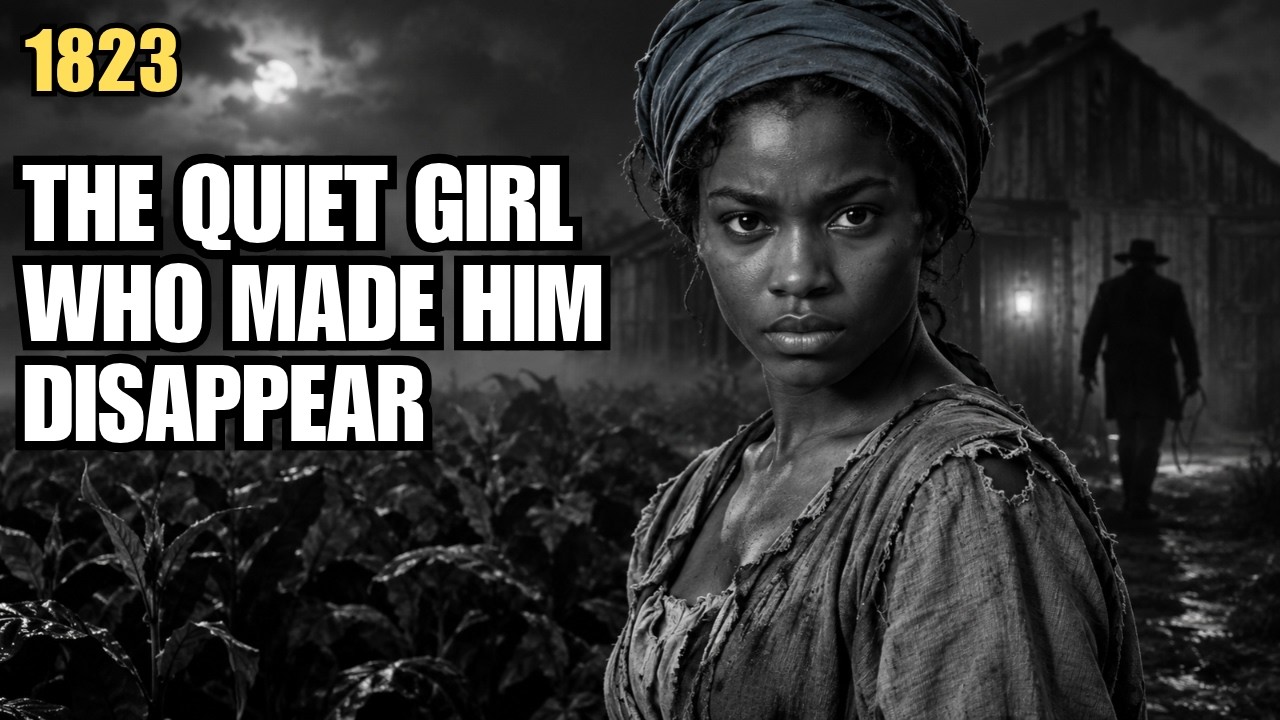
She saw confusion, then anger, then fear. The beam came down, and Bu’s shadow fell to the ground and did not rise again. Sarah had been only fourteen when they dragged her from the wagon and pushed her into the tobacco fields without food or rest. That same day, she watched her brother Elely beaten nearly to death for refusing to leave her side.
Afterward, he never walked the same again. His back healed in twisted scars, and the pain in his leg never left him. The overseers teased him, calling him limp leg even though both legs were intact. She never forgot the way he lay bleeding on the dusty ground while Bu laughed and wiped sweat from his forehead.
She never forgot the way the sun made the blood on his shirt shine like dark fire. From that moment, revenge took root in her heart. She was only a child, but she made a promise that one day she would make the overseers pay. She learned to wait.
A slave had no weapons, no voice, no freedom to plan or act boldly. So Sarah kept her head low, moved quickly, worked quietly, and never looked directly into an overseer’s eyes. People believed she was shy and fearful. She wanted them to believe it.
But inside her heart burned a fire hotter than the summer sun that shone over the endless fields. She watched every routine, every shift change, every weak point in the plantation structure. She learned which overseers were drunk at night, which ones were cruel, which ones could not resist the temptation of silence or shadows. She waited for the moment when the tobacco fields would whisper her name.
Years passed, and the cruelty of the plantation worsened with each season. Bu grew more violent, and new overseers joined him, each trying to outdo the others in brutality. The worst among them was a man named Rufus, whose favorite punishment was to tie people to the whipping post for the smallest mistakes. He once whipped a twelve-year-old boy for dropping a bucket of water.
He once beat a pregnant woman until she fainted. The enslaved people feared him more than darkness itself. Yet even Rufus did not know that Sarah had quietly gathered a small circle of trusted people who had also tasted pain too bitter to forget. The first person she confided in was Elely, who at first refused.
He feared her plan would cost her life. But Sarah told him with calm conviction that living in silence was no different from death, and that sometimes a soul must choose to rise even when rising is dangerous. He finally agreed. Their circle grew slowly: a quiet man named Marcus whose sister had been killed by the overseers; a woman named Anna who survived an assault but lost her husband when he tried to protect her; a field hand named Joseph who had seen more cruelty in thirty years than any man deserved.
They all listened as she spoke in whispers under moonlight, her voice steady, her eyes focused on something far beyond fear. She told them that revenge was not anger, but justice, and justice was something the enslaved were denied every day. She told them she believed the spirits of the tobacco fields would protect them, for they were fighting for every soul that had ever been beaten, broken, or buried without a name. The night that changed everything came in the late season, when the stalks grew tall under a pale moon.
Sarah watched as Bu struck a young girl for working too slowly. The girl fell to the ground crying, and Bu lifted his whip again. Something in Sarah snapped. She felt the wind shift sharply, as if the spirits themselves gasped in anger.
She stepped forward and grabbed the whip midair. Bu stared at her in shock, because Sarah had never acted out before. His face twisted with rage and he pushed her so harshly she fell into the tobacco. But as she fell, she saw something she had never seen before: the overseer Rufus watching from a distance with a strange smile, a smile that carried a message she could not yet understand.
Bu kicked dust at the crying girl and walked away, but that single moment lit the fire within Sarah completely. She rose from the ground with her hands shaking and her heart pounding like drums. She knew then that waiting was over. That night, she called her circle together behind the workers’ cabins.
She told them the time had come to end the torment. She said that unless they acted, more children would be beaten, more families destroyed, more lives crushed without mercy. She had studied the overseers closely for years. She knew their paths, their routines, the places where they were vulnerable.
Bu often patrolled near the barns alone in the late hours while Rufus drank heavily behind the plantation house before staggering into the fields. She believed they could strike with precision and disappear into the shadows before dawn. Some trembled with fear. Others felt a spark ignite.
Sarah reminded them that fear was natural, but silence was deadly. She told them they were not just fighting for themselves, but for those who had died without justice, for those who could no longer speak. When she finished, the group sat in a long silence. Finally Elely nodded, placing his hand on the ground as if listening to the heartbeat of the earth.
He said the time felt right. One by one, the others agreed. The next day, Sarah worked in the fields while studying the overseers. She noticed the way Bu tapped his whip against his thigh, the way Rufus constantly checked his pistol but never properly secured it.
These small observations became the foundation of her plan. She noticed something else too: a new overseer had arrived that morning. His name was Gerald, a tall man with a thick beard and a cold stare. Unlike the others, he walked silently, observing the workers without speaking much.
His silence worried her. Men who watched too much and spoke too little often carried secrets. That evening, she gathered her circle again. She described Bu’s schedule, the path he took near the barns, the way he visited them alone at the same hour every night.
She spoke of Gerald and warned that they must be cautious. Then she revealed the second phase of her plan: they would not strike all overseers at once. They would begin with Bu, because he walked alone at night and trusted no one. He believed the enslaved feared him too much to ever strike back, which made him vulnerable.
She said they needed to study the barn area closely for several nights before taking action. Then she added something that made everyone silent: Bu carried a pistol, but she had seen him drop it once in the dirt, and she believed he did not know how to aim properly. “A man who holds a weapon with no respect for it cannot use it well,” she said. The group found new confidence.
Elely placed his hand on her shoulder and told her she was brave. Sarah shook her head. She was not brave, she said. She was simply tired of suffering.
For several nights, they watched. The moon was only a thin sliver, casting soft light across the barns. Sarah lay in the tall grass with her group, counting crates, counting steps, memorizing the blind spots where lantern light did not reach. On the second night, Bu emerged from behind the barn exactly where she expected him.
He held a lantern in one hand and his whip in the other, moving with the confidence of a man who believed no one dared challenge him. He paused near the crates, lifted his lantern, and looked behind him. His expression changed—serious, almost suspicious, as if he sensed something in the air. Sarah’s heart tightened.
She signaled her group to remain completely still. Bu stared into the darkness for several seconds, then shrugged and continued his round. Only after he walked far away did Sarah release a slow breath. She realized how close they had come to being discovered.
Bu was careless and cruel, but he was not entirely foolish. A man who had survived years of hunting runaways had some instincts. Afterward, the group gathered in the shadows. Joseph whispered he feared Bu almost saw them.
Anna admitted her heart nearly stopped when he stared into the darkness. Marcus asked whether they should postpone the plan. Sarah listened, then spoke calmly. She said Bu sensed something because the spirits in the wind were restless.
The tobacco fields carried memories of past suffering, and sometimes those memories rose with intensity. She reminded them she had watched Bu for years and knew his habits better than he knew them himself. They were not yet ready to strike, but they were close. The next day, Gerald kept glancing toward her.
His stare was not cruel like Rufus or mocking like Bu. It was calculating, as if he studied the way she moved. She pretended not to see him, but inside she felt uneasy. When the workday ended, she told her group about Gerald’s watchful eyes.
Marcus said he did not trust men who stare quietly. Anna wondered if Gerald had been warned that workers were planning something. Joseph asked if they should target Gerald first, but Sarah shook her head. Gerald was dangerous because they did not understand him.
Then she said something that caught everyone’s breath: the timing might need to move faster. Bu’s suspicious behavior meant waiting too long could raise more red flags. Within a few nights, they must be ready. That night, Sarah slipped out alone.
She walked to the edge of the tobacco fields and let her fingers slide along the leaves. The air felt heavy and warm. She closed her eyes and listened. The wind whispered softly at first, then grew stronger.
She felt a pull in her chest and followed it deeper into the field. She looked up at the stars and whispered that she was ready, but she needed the spirits to help her protect her people. She asked for strength, clarity, courage. The wind responded with a long sigh that carried through the tobacco like a living voice.
When she opened her eyes, she felt more certain than ever. The following day began with a heavy sky. Clouds hung low over Willow Creek, casting dull gray light across the fields. The overseers were restless.
Bu snapped his whip against the ground for no reason other than to make people tremble. Rufus shouted at a young man for walking too slowly, insulting him until he nearly cried. Gerald watched everything silently, his cold stare moving from person to person. In the afternoon, a sudden storm began forming in the distance, dark clouds rolling in quickly from the west.
Rain fell in heavy drops, turning the dirt into thick mud. The overseers rushed to gather tools and drive the workers back to their cabins. Rufus cursed loudly as the rain soaked his clothes. Gerald moved quickly toward the main house, but before entering, he paused and looked straight at Sarah.
The rain fell across his face, but his stare remained sharp. She looked away quickly, pretending to struggle with her basket, but Gerald did not move. He watched her for several seconds, then turned away. When Sarah returned to her cabin, Elely was waiting, drenched and shivering.
He asked whether they should postpone the plan. Sarah shook her head. The storm was a sign that the spirits were restless, she said. They must act soon, but not tonight.
Tomorrow night would be their moment, because storms always confused the overseers and made them sleep heavier from drinking. The next day, the air was thick with humidity. The ground remained muddy, making movement slower. The overseers were in worse condition.
Rufus complained loudly that his joints hurt from the cold rain. Bu looked tired, his eyes puffy from a night of drinking. Gerald looked less alert than usual, as if the storm had interrupted his sleep. Sarah noticed every detail.
As the day passed, she studied Bu carefully. She saw how often he rubbed his neck, how clumsy his steps were, how he winced when he lifted his whip. She recognized this as the perfect time. When the workday ended, the workers returned to their cabins.
Sarah gathered her group behind the old oak tree near the edge of the quarters. She told them that tonight they would strike. The group fell silent. Marcus swallowed hard before asking if they were truly ready.
Sarah nodded. They had watched enough, studied enough, prepared enough. She explained that Bu was weak, tired, careless, and predictable. Joseph would make a noise near the corner.
Bu would follow, as he always did. Marcus and Elely would strike first, then she would finish it herself. Anna asked what they should do if Gerald or Rufus came near. Sarah said she did not think they would.
Rufus rarely left the plantation house at night unless he was drunk. Gerald had no reason to patrol near the barns at midnight. Their focus must be Bu. She reminded them that if anything went wrong, they must run into the tobacco fields and let the wind hide them.
The night was unusually quiet. The frogs that usually croaked near the creek were silent. The crickets were still. Even the wind seemed to hold its breath.
Sarah led her group toward the barns with slow, careful steps, crawling like shadows through the tall grass. Joseph slipped around the corner and positioned himself behind a pile of wooden crates. Marcus and Elely crouched behind a broken cart. Anna hid near the fence, watching both paths.
Sarah stood slightly apart, her eyes fixed on the path Bu always walked. Minutes passed in heavy silence. Then footsteps echoed across the dirt. Bu entered the area holding his usual lantern, muttering to himself, stumbling slightly.
He set the lantern down and leaned against the barn wall, stretching his neck as he always did. Sarah signaled Joseph. Joseph picked up a small stone and threw it against the wooden crates. Bu jerked his head up, startled.
He grabbed his whip and stepped cautiously toward the sound, moving exactly as Sarah had predicted. When he reached the corner of the barn, Marcus and Elely rose from behind the cart in one swift motion. Bu barely had time to lift his whip before Elely struck him in the knee, making him stumble. Marcus grabbed his arm.
Bu tried to shout, but Sarah rushed forward and covered his mouth with her hand. His eyes widened in shock as he stared at the woman he had tormented for so long. Sarah looked at him without fear. She whispered that the tobacco field had waited for this moment longer than he knew.
Bu tried to pull away, but Elely and Marcus held him down. Sarah raised the heavy beam that lay on the ground. One heavy sound echoed in the night. Bu’s shadow fell to the ground and did not rise again.
The group stood frozen, shocked by the speed and force of what had happened. Anna trembled. Joseph stared at the ground. Elely placed a hand on Sarah’s shoulder, calling her name softly.
Sarah dropped the beam and stepped back. She expected to feel relief, but she felt something deeper—the weight of every beating her people had suffered, the voices of every forgotten soul rising within her. For a moment she feared her legs would give out, but she steadied herself. She told the group they must move quickly.
They dragged Bu’s body behind the barn and covered it with tobacco leaves and mud. Sarah instructed them to return to their cabins separately and to speak to no one. Tomorrow would be dangerous, because the overseers would investigate the disappearance. They must act natural and calm.
One by one, they slipped into the darkness. Sarah looked up at the sky and whispered that the first strike had been delivered, that justice had begun. Then she returned to her cabin with steady steps, knowing the real storm was still coming. Morning rose with a strange stillness.
Sarah stepped out of her cabin with careful movements, hiding the trembling in her hands by clenching them into fists at her sides. When they reached the open area near the barns, Gerald stood in the center of the path with his arms crossed. Rufus stood beside him, angrier than usual. Gerald motioned for the workers to line up, then walked slowly in front of them, his eyes sharp as blades.
When he reached Sarah, he paused. He asked if she had seen Bu last night. Sarah felt her breath catch for a moment before she answered. She said softly that she had been asleep because the storm had made her tired.
She said she knew nothing about Bu. Gerald studied her for another long moment, then moved on. But the look in his eyes lingered in her mind like a warning. Rufus paced up and down the rows of tobacco, muttering that Bu must be drunk somewhere.
Gerald did not share this belief. He ordered several workers to search near the barns, but they found nothing. Sarah knew they would not find the body, hidden deep behind the second barn under mud and tobacco leaves. At midday, Rufus ordered a headcount.
He announced loudly that Bu was missing, his voice shaking with a mixture of anger and fear. He threatened everyone: if anyone knew something and kept silent, he would beat them until they could no longer stand. Gerald stepped forward and spoke quietly but firmly, telling Rufus that shouting at frightened workers would not bring Bu back. He turned to the workers and told them they were free to speak if they noticed anything strange last night.
No one spoke. Sarah noticed that Gerald kept looking toward the barns as if the ground itself spoke to him. He walked there several times, studying the dirt and the crates. He was not like Bu or Rufus.
He was observant, calculating, patient. He had the mind of a man who did not trust what he could not see. Sarah realized that Gerald would not stop searching until he found answers, and that made him their greatest threat. That evening, the group gathered behind the oak tree.
Marcus said he feared Gerald would find Bu’s body soon, because Gerald kept inspecting the barns. Anna said she felt sick all day, convinced Gerald knew something. Joseph feared someone in the camp might talk out of fear. Elely said Gerald appeared too smart for them to deal with easily.
Sarah listened, then told them they needed to move Bu’s body before Gerald found it. The storm had softened the ground around the barns, making it dangerous to leave any trace. They would wait until the deepest part of the night, when the overseers fell into heavy sleep, then carry the body into the tobacco fields and bury it beneath thick roots where no one would search. She also told them that killing Bu was only the first step.
Rufus would be next, because his cruelty stretched across too many years. Gerald would be last, because he was the most dangerous. When night fell, the overseers remained awake longer than usual, discussing Bu’s disappearance. Sarah waited inside her cabin with Elely, listening to their muffled voices drift through the walls.
She heard Rufus shouting about runaway slaves. She heard Gerald answering with calm logic, insisting that Bu would not wander far. The two men argued until their voices faded with fatigue. When the night grew silent, Sarah touched her brother’s shoulder and told him it was time.
They stepped outside and moved quietly toward the oak tree, where Marcus, Anna, and Joseph waited. Together they crept through the thick grass toward the barns. The moon hung low behind clouds. The air smelled of wet soil from the storm.
Sarah knelt beside the pile of mud and tobacco leaves and dug with her hands until she felt the cloth of Bu’s shirt. The group pulled the body from the earth. Bu’s face was twisted in the same expression of fear he had worn in his final moment. Sarah looked at him without emotion.
His cruelty had ended, she whispered, and the earth would now swallow his memory. They carried the body toward the tobacco fields, struggling through the mud. Every sound felt loud. When they reached a deep cluster of tobacco, Sarah stopped.
This was the place. They dug a shallow grave with their hands, burying Bu beneath a thick patch of roots and covering him with layers of soil and leaves. Sarah smoothed the ground with her palms and whispered a final word to the earth, asking it to hide the overseer from all searching eyes. As the group prepared to return, Sarah felt something shift in the wind—sharp and cool, like a warning touch.
She paused. Somewhere near the barns, she heard a faint crack of wood, a boot scraping softly against the ground. She signaled for the group to drop to the ground. They pressed themselves into the earth and listened.
The sound grew clearer. Someone was walking. Someone was close. Sarah held her breath.
She recognized the rhythm of the footsteps. Gerald. He was patrolling the barns at night. Sarah saw a shadow pass near the barn wall, long and thin under the faint moonlight.
Gerald paused, staring into the darkness as if trying to see what hid inside. Sarah pressed her hands into the earth, praying he would turn away. After what felt like a long eternity, Gerald finally exhaled, turned his back, and walked toward the plantation house. The sound of his footsteps faded slowly.
Only then did Sarah and her group rise quietly and return to their cabins separately, each breath heavy, each heart beating hard. The next morning arrived with a strange heaviness, as if the land itself waited for something to happen. Sarah noticed Gerald standing near the barns, staring at the ground with narrowed eyes. He moved slowly, studying every footprint, every patch of dirt, every disturbed leaf.
Rufus paced back and forth angrily, shouting at anyone who moved too slowly. Sarah kept her eyes down, but she felt Gerald’s gaze sweep across the workers. He paused briefly when his eyes reached her. Later in the morning, Rufus shouted for everyone to gather in an open space between the tobacco rows.
He accused the workers of hiding information and threatened to punish dozens at once. Gerald stepped forward and raised a hand. Rufus fell silent. Gerald spoke quietly.
He said he believed Bu had not run away or wandered off. Something must have happened to him. He had searched the barns, the storage areas, and parts of the tobacco fields. He did not trust the silence of the workers.
His voice carried no anger, only cold certainty. Then he announced that every worker would undergo questioning that evening. Sarah kept her expression as still as stone while her group shifted uneasily beside her. Gerald watched them all carefully, like a hunter studying the movement of prey.
That night, the workers returned to their cabins in silence. Parents told their children to stay quiet. Old men sat outside their cabins, muttering prayers. Sarah gathered her group once again behind the oak tree.
Marcus whispered that Gerald was becoming too suspicious. Anna said she felt certain Gerald had seen them near the barns. Joseph said he feared Gerald would question the workers separately, and someone might break under pressure. Elely said they had no choice but to act before Gerald uncovered the truth.
Sarah listened with her eyes fixed on the dark hills beyond the tobacco fields. She felt the wind touch her face gently, felt the spirits pressing against her heart, urging her to think clearly. She understood what needed to be done, though the idea frightened her deeply. She turned to her group and spoke quietly.
Gerald must be stopped before he discovered the body or connected the clues. He was too observant, too focused. If they waited, he would uncover something. He would not confront them openly.
He would stalk them quietly, waiting for a crack in their silence. Marcus asked how they could deal with Gerald when he watched the workers so closely. Sarah said they would not confront him in the open. The time to strike Gerald would come, but not tonight.
Tonight they needed to prepare for his questioning. She told them to stay calm no matter what he asked, to keep their answers simple, to avoid giving extra information. Gerald looked for hesitation, and fear could betray them. They must hide their fear deep inside their hearts.
She placed her hand on the earth and whispered to the spirits for clarity. When she stood, her decision was firm. Tomorrow they would begin planning how to deal with Gerald. But tonight they must protect themselves with silence.
As the night deepened, Sarah returned to her cabin and sat near the doorway while Elely tried to sleep. She listened to the quiet sounds of the camp, to her own heartbeat, slow and heavy. Then she felt something strange—a sudden coldness in the wind, a faint soft sound like a tobacco leaf brushing against another, a sense of warning. She stood slowly and looked outside.
The clouds drifted lazily across the moon. The tobacco fields moved in gentle waves. But something felt wrong. She stepped outside quietly, moving barefoot on the soft earth.
When she reached the edge of the cabins, she stopped. Near the barns, a faint movement caught her eye—a quiet shadow walking slowly, a tall figure. She knew immediately who it was. Gerald.
He walked softly, almost gliding across the ground. He paused near the second barn and studied the ground with the lantern he held. He knelt and touched the soil. He stood up again and walked slowly along the edge of the barn.
Sarah watched him carefully, hidden in darkness. She realized Gerald was close to discovering the truth.
