A woman presses tissue paper around a strand of pearls in a bedroom that overlooks Fifth Avenue. She is not preparing for a party. She is preparing for her own funeral. She is sixty-two years old, she is dying, and she is doing what she has done her entire life—everything, as Truman Capote once said of her, perfectly.
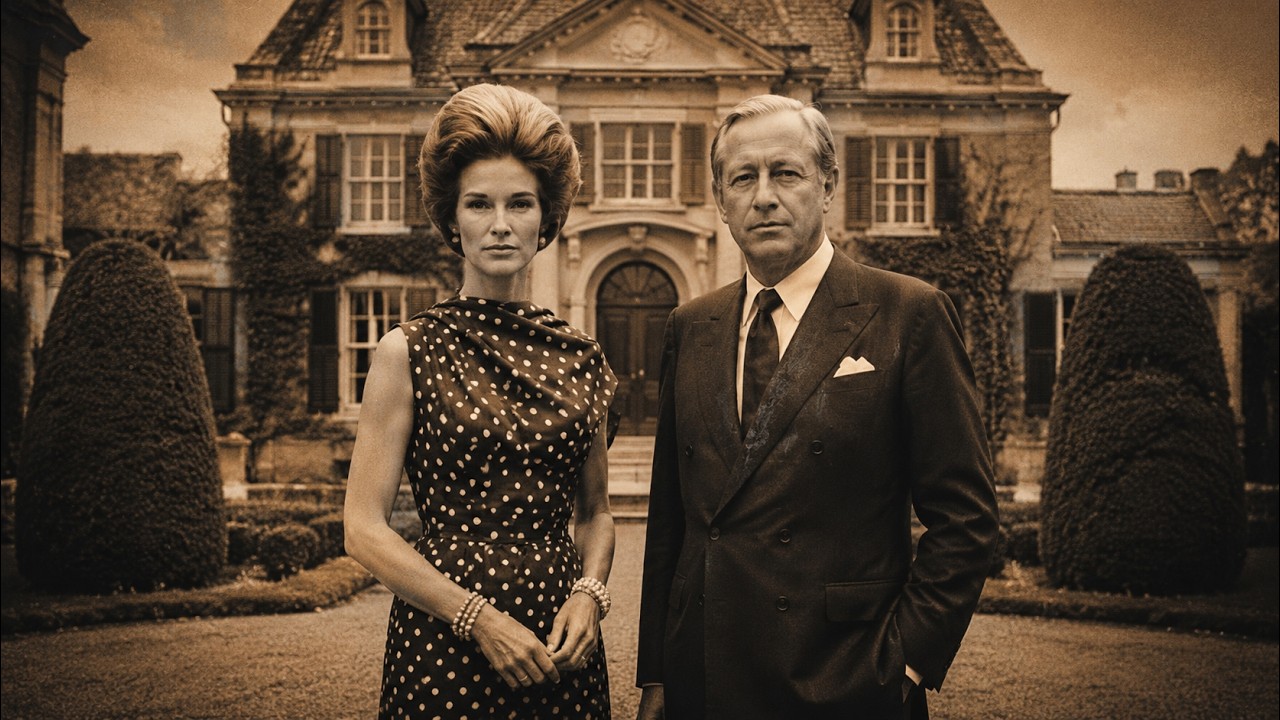
Her name was Barbara Cushing Paley, Babe to the world, the youngest daughter of a celebrated Boston surgeon, a fashion editor at Vogue before anyone knew her name, and from 1947 until the last day of her life, the wife of William S. Paley, the man who built CBS and turned American television into the most powerful force in the country. She was on the international best-dressed list fourteen times. In 1941, Time named her the second best-dressed woman in the world.
She tied a scarf to her handbag one afternoon, and within weeks women across the country were doing the same. She let her hair go gray instead of dyeing it, and that too became a trend. She mixed a Cartier emerald-cut diamond with a cheap plastic bangle from a midtown drugstore, and somehow it looked like genius. Capote, the author of Breakfast at Tiffany’s and In Cold Blood, called her the finest thing he had ever seen.
“Mrs. P had only one fault,” he once said. “She was perfect. Otherwise, she was perfect.
” He meant it. He also meant something else by it. This is not the story of Babe Paley’s style, though the style was extraordinary. It is not the story of the dinner parties at Kiluna Farm, the eighty-acre estate in Manhasset, Long Island, where Russell Page designed the gardens and the menus were archived so that no guest was ever served the same meal twice.
It is the story of what lay beneath all of that. She had two men in her life who mattered more than any others—her husband and her best friend. Both had the power to break her. Both of them did, in different ways, at different moments.
And Babe Paley, trained since childhood to absorb every blow without letting it show, absorbed them both. Boston does not forgive weakness. It is a city of old money and older expectations, where a woman’s value is measured almost entirely by who she becomes after she leaves the house her father built. Barbara Cushing was the third daughter in a family that produced nothing but ambition.
Her father, Harvey Cushing, was one of the most celebrated neurosurgeons in the world, a Pulitzer Prize winner who trained surgeons at Johns Hopkins, Harvard, and Yale. Her mother, Katherine, called Kate by everyone who mattered, was the other kind of architect entirely. Harvey built minds. Kate built marriages.
She had one wish for her three daughters: that they marry well, marry up, marry into the kind of money and position that would carry them into the highest rooms of New York and Washington. The lesson took. The eldest, Minnie, married Vincent Astor. The middle sister, Betsy, married James Roosevelt, eldest son of Franklin and Eleanor, and later the enormously wealthy John Hay Whitney.
And Barbara, the baby, watched and understood what it meant. She was seventeen when she understood it completely. In the autumn of 1934, on a road outside Boston, she was in a car accident. It left her with bruises and scars and knocked out her front teeth.
She went into surgery. When she came out, she was, if anything, more beautiful than before. The reconstruction had given her cheekbones a finer line, a sharpness that photographs would love. She was nineteen, and she understood something she had not understood before.
Beauty was not a gift. It was a material. It could be shaped, repaired, maintained, deployed. The question was not whether you had it, but whether you understood what it was for.
By the time she arrived at Vogue in the late 1930s, she was learning the second language of her real education: the grammar of other people’s desires, how a room should feel when a powerful man enters it, which flowers last longest in winter light, how to remember the names of a hostess’s children. Her first marriage, to Stanley Grafton Mortimer Jr. , grandson of a Standard Oil founder, was correct by every measure her mother had established. It lasted six years.
He returned from the war changed, with a cruelty that drank, moods that swung without warning, a coldness that filled the rooms of their house on Long Island. She divorced him in 1946. The settlement was $40,000. In the gossip columns, it was a scandal.
In Babe’s mind, it was a calculation, and she was already running the next one. She had met someone who needed exactly what she had been trained her entire life to provide. William S. Paley was the founder and chief executive of CBS.
He had taken a small radio network in 1928 and built it into the most powerful media company in the country. By 1947, CBS was in every living room in America. Its founder was a man of prodigious appetites for art, for influence, for the company of beautiful women, and almost no patience for the social barriers that had kept his family out of the better clubs on Long Island because they were Jewish. Babe had what he needed: the lineage, the manner, the friendships with the families who controlled those clubs and those rooms.
Her sisters had married a Roosevelt and an Astor. She moved through old money as easily as breathing. She was, in the phrase of Laurence Leamer, who wrote the definitive account of these women, the key to a door that Bill Paley had been standing outside for years. And Bill had what Babe had been raised to need: money of a scale she had not encountered before—an apartment at the St.
Regis, the eighty acres in Manhasset, houses in the Bahamas, a villa in Jamaica—and power larger and louder than anything her father’s reputation had given the family. They married on July 28, 1947. She left Vogue the same week. She never went back.
What she did instead might, in another era, have been called a career. She made their world. She decorated the apartment at 820 Fifth Avenue with Billy Baldwin. She transformed Kiluna Farm into something people remembered for the rest of their lives.
She hired Russell Page to design the gardens. She created what she called the secret garden, a small enclosed space behind the tall azalea hedges near the pond, where no camera ever followed her. She archived the dinner menus so that no guest was ever served the same meal twice. She remembered names, children’s birthdays.
She made every room feel inevitable. From the outside, it was the picture of everything her mother had wanted for her. From the inside, she was still learning how to live with it. There was one thing her education had not prepared her for—or perhaps had prepared her for too well: the lesson that said, find the best position in the room, then learn how to stay in it, whatever the cost.
The cost, she was beginning to understand, was considerable. That understanding would come later, and with it a friendship she did not expect, with a small man who arrived in her life entirely by accident, somewhere over the Caribbean, in the summer of 1955. A private plane belonging to William S. Paley was carrying a small group of friends toward the Paley cottage in Jamaica.
The group included David and Jennifer Selznick—he, the legendary producer of Gone with the Wind; she, a woman of sharp social intelligence that Babe particularly valued. The Selznicks had asked if they could bring along a friend. Bill Paley said yes. He thought the friend’s name was Truman.
He thought it was President Truman. It was not President Truman. It was a short, slightly built man in his early thirties named Truman Capote. By 1955, he was one of the most talked-about writers in the country.
Babe looked at him. He looked at her. They fell instantly in love. By the time they reached Jamaica, they were inseparable.
At 820 Fifth Avenue, a seven-foot Picasso dominated the living room. She was the most imitated woman in America; a photograph of her appeared, and within weeks thousands of women were tying scarves to their handbags. She was also, by her own interior accounting, the loneliest woman she knew. Because the man she had married had gotten what he needed, and now he was busy getting other things.
Bill Paley was not a woman lover. He was a womanizer. He trawled bars and private clubs, his preferences running to blondes and models. Babe knew.
She was a doctor’s daughter, trained in the observation of symptoms. The late returns. The particular quality of her husband’s attention. She said nothing.
What she had instead was the life itself—the curated, magnificent, endlessly maintained performance of a perfect marriage. According to Leamer, Babe Paley did not have friends in the conventional sense. The women of her circle were companions, rivals, ornaments, not friends. Truman Capote was different.
He was brilliant, uninhibited, capable of an intimacy that bypassed all social distances. He made her laugh. She told him things she had never told anyone—about Bill’s affairs, the humiliations she had swallowed, the gap between the life she appeared to live and the one she inhabited. He told her, “Look upon being Mrs.
William S. Paley as a job, the best job in the world. Accept it and be happy with it. ” She accepted it.
She was not happy. What neither discussed was the book he called his masterpiece, the one he referred to as Answered Prayers. He was building something with her secrets. For twenty years, Truman Capote was the best thing in Babe Paley’s life.
He called every morning. He appeared at her apartment unannounced with flowers or gossip or both. He sat beside her at dinner and made the whole table feel like the only table in the world. He arrived in Palm Beach, in Jamaica, at Kiluna Farm, everywhere the Paleys occupied.
And wherever he arrived, Babe was more alive than she had been before. Capote later said, to more than one person, that Babe Paley was the most important person in his life. “I was her one real friend,” he said, “the one real relationship she ever had. We were like lovers.
She loved me and I loved her. ” He said it with the absolute conviction of a man who believed it. She believed it too, and for her, belief in it mattered in a way it did not quite matter for him. Because for Babe, the friendship was not one relationship among many.
It was the only relationship of its kind she had ever permitted herself. There were the Swans, the women Capote collected and named and celebrated—Gloria Guinness, whose elegance sometimes frightened people; Slim Keith, droll and competitive, whose friendship with Babe ran alongside a low steady current of rivalry; C. Z. Guest, the ash-blonde Boston Brahmin who seemed to move through every room as if she had designed it herself; Marella Agnelli, the Italian aristocrat whose style came closest to Babe’s.
These women were Babe’s world. They were not her confidants. What she and Truman had was built on a foundation the other friendships could not bear: the foundation of actual disclosure. She told him things she told no one else—about Bill’s infidelities, year after year, in the particular detail only someone living inside that knowledge could provide.
The silences in her marriage. The permanent gap between the woman the world photographed and the woman who sometimes sat alone in the secret garden and felt the afternoon get dark around her. Capote received all of it. He held it.
He never appeared to judge it. He was the confessional she had never had. He was also working. Truman Capote was always working.
The notebook was never entirely closed. The ear was never entirely off duty. He had told people he was building something enormous, a novel to rival Proust, a reckoning with American society never written before. He called it Answered Prayers, from Saint Teresa of Avila: more tears are shed over answered prayers than unanswered ones.
Nobody paid much attention to the title. They should have. He had been working on it since the early 1960s. He had told his publisher it would be the defining literary event of the decade.
He had told Babe it would be magnificent. What he had not told her was that the confidences she had given him were not merely the things a friend keeps safe and private. They were, in his notebooks, already turning into sentences. In November 1966, Capote threw the party of the century, the Black and White Ball, at the Plaza Hotel on the Monday after Thanksgiving.
Five hundred guests, selected with a ruthlessness that made the exclusions as famous as the invitations. Princess Lee Radziwill, Lauren Bacall, Frank Sinatra, Katharine Graham, Norman Mailer, Lyndon Johnson’s daughter. Before the ball, the Paleys hosted a small dinner at their apartment, Capote among the guests. It was the apex of everything, the most glamorous world in the country with Truman at its center and Babe beside him.
Even then, Capote was writing. The women he called his Swans, who had given him their secrets and their trust, were already on the page. In 1974, Babe Paley was fifty-eight, and she had smoked two packs of cigarettes a day for most of her adult life. The doctors gave her the diagnosis: lung cancer.
She received it directly, without visible collapse. She was a surgeon’s daughter. She began chemotherapy. The treatments made her hair fall out.
She bought silk turbans. Another woman might have retreated. Babe Paley did not. She folded the turban around her forehead with the same care she had always given to everything she wore, and she went to dinner.
She appeared at the theater. She attended the parties. Women across New York noticed the turbans and began wearing them. She had turned dying, as one observer later put it, into an accessory.
Meanwhile, Truman Capote had, for years, been telling anyone who would listen that Answered Prayers was nearly done. It was not nearly done. The advance had been paid. The deadline had passed.
Under pressure from a publisher threatening to reclaim the advance, Capote agreed to submit a single chapter to Esquire, as a preview of the larger work. He chose the chapter he called “La Côte Basque, 1965,” named after the restaurant on West 55th Street. The chapter was fiction, officially. The names had been changed.
But a socialite named Lady Ina Coolbirth, based transparently on Slim Keith, sat at the restaurant and talked, telling stories about people in their world—things that happened at private parties, in private bedrooms, in the particular intimacy of marriages the public imagined as perfect. One of those stories concerned a media executive named Sidney Dillon. The name was barely a disguise. Sid, Dill, Bill.
An advanced copy was sent to certain people mentioned in the text. One of them was a woman named Ann Woodward, a former model and socialite who, in 1955, had shot and killed her husband, a banking heir named William Woodward Jr. , in a bedroom of their Long Island estate, in circumstances a Nassau County grand jury ruled accidental. The shooting had never stopped following her.
Capote had written about her before, told the story at dinner parties for years with a relish she found unbearable. Now it was in print. Ann Woodward received her copy of “La Côte Basque. ” She read it.
Then she took a handful of barbiturates and did not wake up. Her death moved through the Swans’ world like a cold current. Slim called Babe. C.
Z. called Slim. Nobody said exactly what they were feeling, because what they were feeling was too large to name directly: that Capote had used their lives, their secrets, the things whispered over luncheon and in the back of taxis. Someone had always been listening.
Someone had always been writing it down. In November 1975, the Esquire issue arrived at the newsstands. Babe picked it up. She read the first paragraphs.
She recognized a sentence, then another, then a detail—a specific, small, intimate detail that could only have come from a single source. From her. She read it a second time, the way a doctor re-reads a result that does not match what she expected to find. She looked for the error.
There was no error. The detail was Bill Paley’s detail. The indiscretion described, the specific shape of the humiliation she had carried in private for years and disclosed to no one but Truman—her private knowledge, given in confidence, now printed in a national magazine with a circulation of one million readers. According to Kelly Greenburg Jeffcoat, who spent more than a decade researching the Swans, what Babe felt was not rage.
It was something harder to name and harder to recover from: absolute disbelief. From Babe’s perspective, Greenburg Jeffcoat said, it was an absolute disbelief that someone she had trusted more than her husband, more than her children, more than her sisters, could ever do that. She picked up the telephone. She called Slim.
“Have you seen Esquire? ” Slim had. Slim told Babe that Ann Woodward was dead because of what Truman had written, and that at least they were still alive. Babe’s response was very quiet.
“Well,” she said, “I want to die, too. ”
There is no record of how long the silence lasted after that. There is no record of what Slim said. What we know is that Babe Paley did not speak to Truman Capote again—not that day, not the following week, not in the three years that remained of her life.
Not one word. Capote tried to explain himself. He wrote to the Swans. He telephoned.
He deployed the full arsenal of his charm and his remorse. He said, to anyone who would listen, “What did they expect? I’m a writer. ” It explained nothing.
The other Swans cut him off as well: Slim Keith, C. Z. Guest, Gloria Vanderbilt. The world that had made Capote possible closed around him like water closing over a stone.
He was not invited to the parties. The calls went unreturned. But Babe’s silence was the one that mattered most to him. She gave him her absence, completely.
She was dying. The chemotherapy continued. The turban remained. She appeared at the events she could still attend, perfectly, because perfection was no longer a performance but a reflex.
Bill Paley was still there. He had read the chapter, had recognized himself in Sidney Dillon with the certainty of a man seeing his own face in an unfamiliar mirror. What he felt, Babe never said. She had spent thirty years not saying what she felt about Bill’s behavior.
In the evenings, in the last year of her life, she sat in the apartment at 820 Fifth Avenue, the Picasso still on the wall, and she wrapped things carefully, methodically. She wrapped her jewelry in tissue paper. She tucked a small card into each parcel with a name written in her handwriting. She was distributing herself, the material version of herself, to the people who had not left her.
Not to Truman. Not to him. She was sixty-two years old, dying, doing what she had always done: making sure everything would be in order when she was no longer there to maintain it. What she could not make orderly was the unanswered question at the center of everything—the fear that ran beneath the turban and the tray of wrapped jewelry, that she had never been truly loved.
That she had given everything and received in return a husband who used her and a friend who sold her. She did not say it out loud. She had been trained from the beginning not to say it out loud. On the morning of July 6, 1978, in the apartment at 820 Fifth Avenue, Barbara Cushing Paley died of lung cancer.
She was sixty-three years old. She had turned sixty-three the day before. The apartment was exactly as she had left it. The parcels were already wrapped.
The cards were already written. The instructions for the jewelry, the funeral, and the wine to be served at the reception afterward were filed in a system her household could follow without confusion, because Babe had never trusted confusion. Her funeral was held at Christ Episcopal Church in Manhasset, the church nearest to Kiluna Farm. The guests came in the kind of clothes she would have approved of.
The wine was the wine she had selected herself: French, expensive, correct. Truman Capote was not there. He had not been invited. C.
Z. Guest was the one who told him. She called him, and told him that Babe was gone, and that he was not invited to the funeral. Capote had been carrying, for months, an unfinished piece he called “Beautiful Babe,” a eulogy he had not been able to finish.
Answered Prayers was never finished. He spent the remaining six years of his life trying and failing to complete it, and when he died in August 1984 at the home of his friend Joanne Carson in Los Angeles, the manuscript was still incomplete. Whether it was hidden, destroyed, or simply abandoned, no one has ever been certain. The book that was going to be his masterpiece, the great Proustian work built from the secrets of the women who trusted him, does not exist in the form he intended.
The women he used outlasted the work he used them for. Bill Paley went on. He attended the funeral, and by the accounts of those present, he wept openly, in a way that surprised people. In 1985, Cosmopolitan published a list of the ten most eligible bachelors in the country.
William S. Paley was on it. He was eighty-three years old. He died in October 1990, of kidney failure, at eighty-nine.
His estate was valued at half a billion dollars. His art collection, the Picasso, the Bonnard, went to the Museum of Modern Art. The money went to his six children. He was buried at the Memorial Cemetery of St.
John’s Episcopal Church in Cold Spring Harbor, New York, beside Babe. Capote had said, before the end, “Mrs. P had only one fault. She was perfect.
Otherwise, she was perfect. ” He had loved her. He had used her. These two facts exist together, and they do not resolve each other.
What remains of Babe Paley is what she intended to remain: the photographs, the style, the influence on a hundred women who never knew her name but who tied a scarf to their handbag one afternoon because she had done it first. The small white cards inside the carefully wrapped parcels of jewelry, each bearing a name in her handwriting. And somewhere in the memorial cemetery at Cold Spring Harbor, the grave she shares with the man who never quite deserved her. The turban is gone.
The secret garden is gone. Kiluna Farm burned in a fire and was demolished around 1990, and with it the hedges, the pond, the small enclosed space where she used to sit alone until the light changed. Everything she built and maintained with such extraordinary care has passed into the ordinary dissolution of things.
What has not dissolved is the question she carried, the one she never answered out loud.
