The photograph from 1938 shows Rosemary Kennedy at twenty, in a white gown with long gloves reaching her elbows, caught just after she curtsied before the king and queen of England at Buckingham Palace. She is smiling, not the tight performance smile of someone managing anxiety, but the open, unguarded smile of someone who is genuinely, simply happy. Several people said afterward that she was the most beautiful one in the room. Three years later, her father paid two surgeons to cut into her brain while she was awake.
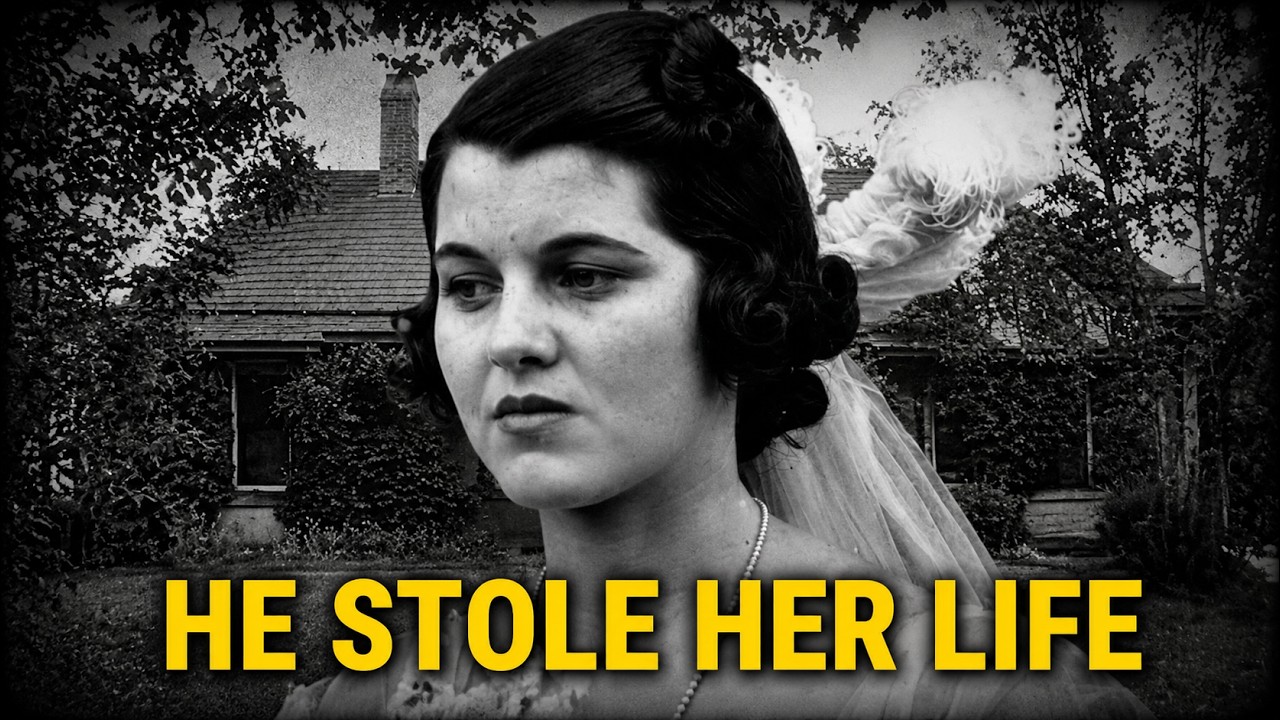
While she was conscious, they asked her to sing songs and recite prayers so they would know when to stop cutting. When her speech dissolved into sounds, they stopped. She was twenty-three years old. She would live for sixty-four more years, most of them spent unable to form a sentence, rocking mostly silent in a care facility in Wisconsin that her father had chosen because it was far enough from Boston that no one would make the trip.
Her mother did not know the surgery had happened for twenty years. Not a rumor Rose had suppressed, not a fact she was managing carefully. She did not know her husband had arranged for a surgeon to cut into their daughter’s brain, watched the result, put Rosemary on a train to Wisconsin, and told his wife she had been placed in an institution. Rose Kennedy believed him because he was the one who handled things, and he always had, and she had no reason to know this time was different.
The story they filed under tragedy, under disability, under the private sadness of America’s most powerful family. Here is the story the record actually shows. Rosemary Kennedy was born on September 13, 1918, the third child and first daughter of Joseph and Rose Kennedy in Brookline, Massachusetts. The birth was complicated.
The attending nurse, because the doctor had not yet arrived, held Rosemary inside the birth canal for two hours, waiting. Two hours of oxygen deprivation, damage that would not be fully understood for years by anyone, including the people responsible for her. That is where the accepted version plants its flag: birth injury, intellectual disability, a family doing its best. It is not entirely wrong.
Rosemary did have developmental difficulties. She was slower to read, slower to process the rapid social choreography of a household that treated every dinner table as a debate tournament and every sibling relationship as practice for some future campaign. In a family that would produce a president, two senators, an attorney general, and a Supreme Court justice, Rosemary moved at a different pace. She always had.
But the Kennedy family, by every account that predates the surgery, worked to include her. Rose Kennedy hired tutors. She enrolled Rosemary in specialized programs. She refused, against the advice of the era’s medical consensus, to institutionalize her daughter in childhood, which was the standard recommendation in the 1920s and 1930s for any child with intellectual delays.
Rose Kennedy said no. She kept Rosemary home. She kept her in school. She kept her in the family.
And Rosemary responded. She learned slowly, at cost, with effort, but she learned. By the late 1930s, she was swimming competitively at her school’s level. She was dancing at family parties with enough confidence that guests who met her casually had no idea she had any disability at all.
She was writing letters, real letters in her own voice, to her parents, her siblings, friends at school. The handwriting slanted, the grammar strained, but the emotional content was fully present. She expressed affection. She reported on her days.
She asked questions. She expected answers. Then came London. In 1938, Joe Kennedy was appointed United States Ambassador to the Court of St.
James. The family moved to England. Rosemary came with them. This is where the accepted version makes its most powerful argument, because what happened in London was by any measure a success.
Rosemary was presented at Buckingham Palace alongside her mother and her sister Kathleen in May 1938. The presentation required weeks of preparation: the correct curtsy, the correct attire, the correct pace of movement across a formal room under the eyes of the British royal family and the diplomatic corps. Rose Kennedy worked with Rosemary on the curtsy until it was right, until it was more than right. On the day, it was perfect.
The court circular, the official record of royal engagements, noted the Kennedy daughter’s presentation without incident. Photographs show Rosemary poised, composed, radiant. Those who spoke with her at subsequent embassy social events described her as charming, warm, easy company. A State Department memo from the period describes the Kennedy daughters collectively as an asset to their father’s diplomatic work.
Rosemary was twenty years old in that photograph. She was, by every measure available to the people around her, participating in the world. The accepted version uses London as its strongest evidence. Look how well they managed her condition.
Look how devoted the family was. Look how far she came. It uses London to make everything that followed seem like a sad but logical deterioration. There was just one problem with that version.
London was not evidence of decline. It was evidence of capability. And the people who built the false version knew the difference. Joseph Patrick Kennedy built it not in a moment of grief, not in a panic, but through a sustained, deliberate, decades-long campaign to control what his family meant to the world.
He had been doing it his entire adult life. He managed his own biography the way other men managed their investments: constantly, specifically, at a level of detail that most people would find exhausting. His children were not simply his children. They were assets in a construction project, the construction of the Kennedy dynasty, American royalty, Catholic triumphalism made flesh in Massachusetts.
Every child’s success reflected his genius. Every child’s failure threatened the architecture. Rosemary had not failed him. Not yet, not in the way that counted.
The problem was independence. As she reached her early twenties, she began to resist control. She snuck out of the convent school where she was enrolled in Washington, DC. She met men her father had not vetted.
She went places without permission, stayed out past curfew, came back flushed and alive in a way that terrified him. Not because he feared for her safety, though he may have told himself that, but because he could not account for where she had been or what she had done or who had seen her. For most twenty-three-year-old women, this is simply called growing up. For Joe Kennedy in 1941, with Joseph Jr.
being groomed for a political career that required the family’s image to be flawless, it was a liability he could not price and could not manage. He didn’t confront it publicly. He didn’t announce a decision. He made a phone call.
Dr. Walter Freeman was, in 1941, America’s most prominent advocate for the prefrontal lobotomy, a procedure developed in Portugal in 1935, imported to the United States by Freeman himself, and performed on thousands of patients before anyone had conducted a serious long-term study of its outcomes. Freeman believed it could calm agitation, reduce emotional volatility, make difficult people manageable. He was wrong in ways that would not be fully documented for decades.
But in 1941, he was credentialed, published, and available. Joe Kennedy did not tell Rose. He did not consult her, inform her, or ask for her opinion. He arranged the surgery through his own channels, his money, his connections, his decision, and scheduled it at George Washington University Hospital in Washington, DC, in November 1941.
He didn’t lie loudly. He just made the decision quietly and controlled every piece of information that came after it. Dr. James Watts performed the procedure.
Freeman was present, directing. The technique required the patient to be awake throughout. This was considered standard practice. The surgeons needed to monitor cognitive response in real time.
So Rosemary was awake. They asked her to recite the Lord’s Prayer. They asked her to count. They asked her to sing.
She did all of it for as long as she could. Watts would later describe the procedure as cutting in small increments, pausing after each pass, asking Rosemary to speak, listening to what came back. At some point in that sequence, the words began to fragment. Fragments became syllables.
Syllables became sounds with no retrievable meaning. When Rosemary could no longer produce language, what stopped? The surgery left her with the cognitive function, by Watts’s own later estimate, of a two-year-old. Joe Kennedy understood within days what had happened.
He understood it well enough to do two things immediately: move Rosemary out of the hospital before anyone could observe her condition, and begin building the story that would contain it. He told Rose she had been placed in an institution. He said her condition had required it. He did not say there had been a surgery.
He did not say he had authorized it. He did not say he had made this decision alone, without her, about their daughter. Rose Kennedy believed him. What else could she do?
He was her husband. He was the one who handled things. He always had. He didn’t need her to understand what had happened.
He needed her to not ask questions. And for twenty years, she didn’t ask the right ones because she didn’t know there were right ones to ask. That is how completely he had controlled the version. The first crack is in the timing.
The accepted version says Rosemary’s condition worsened in the months before the surgery, that she became more volatile, more difficult, more dangerous to herself, that the lobotomy was a last resort reached after conventional options had failed. But the nuns who worked with her at St. Gertrude’s School of Arts and Crafts in Washington, DC, in 1941, the last institution where Rosemary was enrolled before the surgery, did not describe a young woman in crisis. Sister Anastasia at St.
Gertrude’s kept notes. Other sisters who worked directly with Rosemary during 1940 and 1941 gave accounts that historian Kate Clifford Larson gathered for her 2015 biography. What those accounts describe is not a young woman at the edge of her functional limits. They describe a young woman who was difficult in the specific way that growing independence is always difficult: wanting things she was not supposed to want, going places she was not supposed to go, testing the rules the way any person in their early twenties tests rules.
The sisters found her stubborn. They also found her warm. She helped younger students. She was devout in her prayers.
She had favorites among the nuns, and the nuns had favorites among the students, and Rosemary was one of them. By measurable indicators — her academic work, her participation in activities, her social functioning within the school — she was improving, not deteriorating. The record shows something different from what the family needed the world to see. The second crack is in the letters.
Rosemary Kennedy wrote continuously. She wrote to her father, to her mother, to her siblings across years, from boarding schools, from London, from Washington. The letters that survived are held in the Kennedy family archives at the John F. Kennedy Presidential Library in Boston.
For decades, access was restricted. When Larson gained access to them, she did not find what the false version required her to find: a record of deterioration, confusion, incapacity. She found a young woman. She found letters from 1938 and 1939 and 1940 that are emotionally coherent, socially specific, relationally alive.
Rosemary wrote about friends she had made, about dances she had attended, about a boy she had spoken to at a party who had made her laugh. She wrote about her faith, about missing her family, about wanting to be good. The grammar was imperfect, the handwriting slanted, and every word was real. These letters are a problem for the false version because the false version requires Rosemary’s pre-surgery condition to be severe, severe enough that an experimental brain procedure in 1941 could be described as a reasonable medical response.
The letters refuse that requirement. They are evidence of a person who was present, connected, and capable of sustained meaningful communication. The third crack is the largest. If the surgery had been the compassionate last resort the family later framed it as — a decision made with grief, in consultation with the best available medical thinking, in the genuine interest of Rosemary’s well-being — it would have been followed by transparency, by medical documentation, by some attempt to visit, monitor, support, recover.
Instead, it was followed by isolation so total it is difficult even now to fully absorb. Rosemary was moved first to Craig House, a private psychiatric facility in Beacon, New York, then to St. Coletta School for Exceptional Children in Jefferson, Wisconsin, a care facility run by the Sisters of St. Francis of Assisi, roughly a thousand miles from Boston.
The sisters were instructed: no visitors without explicit Kennedy family approval, no contact with the outside world, no photographs. Her siblings were not told where she was. Her mother was not told the surgery had occurred. Joe Kennedy visited St.
Coletta once, early on, and understood on that visit that what he had authorized had destroyed his daughter’s mind. He did not return. He did not tell Rose what he had seen. For twenty years, Rosemary Kennedy lived in Wisconsin inside a contract, in a world she had not chosen, surrounded by people paid to care for her, unreachable by the family that had produced her.
Compassion does not require those conditions. Control does. It was a management decision. The specific fear documented in accounts gathered by Larson and by Laurence Leamer in The Kennedy Women in 1994 was that Rosemary’s growing independence would produce a public scandal.
Joe Kennedy was positioning Joseph Jr. for a congressional run. The family’s image was the product he was selling, and the product required no visible damage. A daughter who snuck out of a convent school at night, who met men she hadn’t been introduced to through proper channels, who could not be relied upon to stay where she was put — that daughter was a liability he could not calculate.
He could not fire her. He could not divorce her. He could not explain her. So he found a different solution.
Hiding this required working backward from the outcome. The surgery’s catastrophic result had to be absorbed into the narrative rather than disclosed as its cause. The story became: her condition was already so severe that even the surgery, even this drastic intervention, could not help her. The result was presented as evidence of the severity of the original problem.
It was not. The result was evidence of a procedure that Dr. Watts himself would later describe with evident discomfort as having gone further than intended in Rosemary’s case. In a 1987 interview, the first time Watts spoke publicly about the surgery in forty-six years, he said carefully that he had not been certain at the time what the right outcome would look like.
Hiding this required more than they had planned for. It required the story to be maintained not just for years but for decades, because the further from 1941 the public got, the harder any correction became to absorb. The accepted version needs Rosemary to have been, before the surgery, a young woman at the edge of her functional limits: struggling, angry, deteriorating, nearly impossible to manage without professional intervention. This is the version’s load-bearing wall.
Remove it and everything collapses. The letters remove it. They are not the only evidence. Teachers’ reports from her years at the Brookline public schools and the Assumption Academy describe a student who was slow but persistent, who responded to patient instruction, who made measurable academic progress year over year.
The nuns at St. Gertrude’s in 1941 used the word “improving” in their internal communications, according to Larson’s research. The false version needed these accounts buried. It needed Rosemary’s pre-surgery life to be summarized rather than examined, because examination produces specifics and specifics produce questions.
As long as her condition could be referred to in general terms — significant intellectual disability, increasingly difficult to manage — the story held. The moment anyone looked at what specific teachers had written in specific years, the timeline began to crack. So the documents were not sought. The nuns were not interviewed.
The family controlled the archive, and what the family controlled, the narrative controlled. For fifty years, no biographer had access to the letters. For fifty years, the general terms held. What would have happened if one reporter in 1945 had asked to speak with Rosemary’s teachers from 1940?
If one journalist had pressed Rose Kennedy about what “placed in an institution” actually meant — what institution, what address, what diagnosis, what treatment — the entire structure unravels from a single specific question. They survived by never being asked specific questions. And nobody asked because the family was the Kennedys, and in 1941 you did not press the Kennedys on personal matters. The press corps that covered Joe Kennedy understood implicitly that certain subjects were unavailable.
The culture around powerful families in mid-century America operated on a system of mutual PR protection. Journalists received access in exchange for restraint. The restraint in Rosemary’s case lasted forty-six years. Rose Kennedy was not a passive figure.
She was Rosemary’s primary advocate for twenty years. She had fought the medical establishment’s recommendation to institutionalize her daughter in childhood. She had designed Rosemary’s educational program, found the tutors, chosen the schools, monitored the progress. She understood her daughter’s capabilities in specific practical terms better than anyone alive, which is exactly why she could not be told.
If Rose had known about the surgery before it happened, she would have stopped it. Joe Kennedy understood this. He had watched his wife fight for Rosemary’s education against every expert who told her it was pointless. He knew what Rose would do if he told her he was planning to authorize a surgeon to cut into their daughter’s brain to make her easier to control.
So he didn’t tell her. And afterward, when the surgery had produced what it produced, he could not tell her, because telling her then would have required him to explain the decision, the reasoning, the unauthorized consultation with Freeman, the surgery performed without her knowledge on her daughter. It would have required him to say in plain language what he had done and why. He never said it.
Not once in the years before his stroke. Not to Rose. Not to any of his children. Rose Kennedy learned the truth in the early 1960s, after Joe Kennedy suffered a catastrophic stroke in December 1961 that robbed him of speech and removed him from the position of being able to manage any version of anything.
Eunice, the daughter who had been closest to Rosemary, told her. By then, Rosemary had been at St. Coletta for nearly twenty years. Rose went to visit her daughter.
She traveled to Jefferson, Wisconsin, a thousand miles from Boston. She walked into the building and found Rosemary in the room where she spent most of her days. What she found was a woman in her forties who rocked back and forth with the rhythmic constancy of someone whose nervous system had found the only movement that still made sense, who could not speak in sentences, who looked up when Rose entered, some reflexive recognition of a presence, a sound, a face, but gave no sustained sign that she knew who had walked through the door. The woman in that room had once written letters about dances, about boys who made her laugh, about wanting to make her father happy.
Rose Kennedy stood in that room and understood what twenty years of not knowing had actually contained. She went back the following year and the year after that. She went back every year for the rest of her life, well into her nineties, making the trip, sitting with her daughter, talking to her whether Rosemary could process it or not. Whatever those visits cost her, whatever a mother carries when she finally absorbs the full weight of what was done to her child without her knowledge or consent, she converted it into presence, into showing up.
She never described those visits publicly, not once in any interview, not in her memoir. Some things are not available for the record. But she kept going back every year until she couldn’t. In September 1958, Eunice Kennedy Shriver published an article in the Saturday Evening Post.
It was titled “Hope for Children. ” It was one of the first times any prominent American figure had addressed the subject of intellectual disability in a national publication with political intention, arguing for federal research funding, for better educational resources, for a shift in public attitude from shame to engagement. Eunice wrote about Rosemary by name, with specificity and love. The article is careful.
It says nothing about a lobotomy. It says nothing about 1941 or Washington or Dr. Freeman or what had been decided in a hospital without anyone’s consent. It places Rosemary’s story inside the frame of Kennedy-type disability, consistent with the accepted version, and does not contradict it.
But read it now knowing what you know, and you can feel the weight of what Eunice was not saying. You can feel the deliberate precision of every sentence, the specific decision not to use certain words, not to answer certain questions, not to walk through certain doors that once opened could not be closed. By 1958, Eunice Kennedy knew enough of the real version to feel its full cost. She had made a choice not to break the family’s version publicly, but to spend her life responding to what it had cost her sister.
The Special Olympics grew from this. Eunice founded it in 1968, a direct structural response to the world’s treatment of people with intellectual disabilities. She built it with the particular intensity of someone not merely interested in a cause, but personally, specifically, permanently damaged by what a system of shame and control had done to someone she loved. The false version almost missed this.
It almost allowed someone who knew the real version to put enough into the world that the questions would eventually become unavoidable. The 1958 article didn’t break it open, but it left a thread, a public thread attached to Rosemary’s name, attached to a cause specific enough that researchers would eventually have to pull it. Eunice knew what she was doing when she published that article. She was not breaking the version.
She was marking the territory around it. The false version required constant maintenance. That is the part they never expected anyone to notice. We cannot know with certainty what Rosemary Kennedy understood about what was being done to her.
The surgery ensured that whatever she had known, whatever she had been building toward, it was taken in ninety minutes in a hospital in November 1941. But we know what she did before it happened. And every act she left behind looks less now like the behavior of a young woman unaware of her situation, and more like the behavior of a young woman who understood with the specific intelligence she had exactly how precarious her position was. She wrote letters constantly, persistently, at a cost of effort her siblings never had to pay for the same act.
She wrote from the Assumption Academy. She wrote from London. She wrote from Washington. She wrote to her father: “Dear Daddy, I would do anything to make you so happy.
” And she wrote those words meaning them. And she wrote them also in the hope that a father who felt that love from her would keep her close. The letters were not just communication. They were evidence.
She was putting herself on paper repeatedly, specifically, in a form that could be kept, referenced, returned to. She was insisting in the only durable medium available to her that she existed, that she was present, that she mattered to the people she was writing to. She kept writing even when the responses were sparse. She kept writing when her father was in Washington and her mother was occupied with the other eight children and the academy was a place she had been sent rather than chosen.
She wrote through all of it. She also appeared in photographs. Every family photograph, every diplomatic event in London, every social occasion where a Kennedy daughter was expected: she showed up, she was composed, she smiled. This may appear to be compliance, a daughter doing what was expected.
But consider what the photographs produced: a record, dated, published, newspaper-archived, of a young woman participating in public life at a level that contradicts specifically and permanently the narrative of severe deterioration that would later be used to justify what was done to her. The photographs were in newspapers. They had already left the family’s control. Unlike the letters, which were archived and restricted, the photographs were already in the world.
The image of Rosemary at Buckingham Palace was reprinted in American newspapers in 1938. It existed outside any archive Joe Kennedy could manage. And then there were the evenings. In the months before the surgery, living at St.
Gertrude’s in Washington, DC, Rosemary began leaving the school without permission. She went out at night. She met people. She moved through the city on her own terms, for her own reasons, making her own decisions.
This was the act closest to breaking everything wide open, not because it was dramatic, but because of what it was building: independent social connections, people outside the Kennedy apparatus who knew Rosemary as a person, as a young woman who laughed at certain things, who liked to dance, who had opinions about where she wanted to go and who she wanted to talk to. Washington in 1941 was not a small town. It was a wartime capital full of people who had not grown up in the careful proximity of Kennedy family management, people who would have had no reason to protect the version. If she had built enough of those connections, if she had established in Washington a life that existed outside her father’s control, there would have been witnesses — people who knew the real version from direct experience, people who, when Rosemary suddenly disappeared from the city, might have asked where she went, might have written to her, might have made inquiries that required answering.
One more month, perhaps two. That is the margin by which Rosemary Kennedy came closest to having the kind of life that could not be silently rearranged. Joe Kennedy found out about the evenings. Within months, the surgery was scheduled.
What she left that survived were the letters. Kate Clifford Larson found them in the Kennedy family archives, held for decades, restricted to family-approved access, unavailable to any independent researcher until the archive began opening in the 1990s. When Larson read them, she found not the record of a woman incapable of ordinary emotional life, but a portrait, specific, sustained, irreducible, of a person across years. “I would do anything to make you so happy.
” She wrote that before she knew what he was planning. She wrote it in good faith. She wrote it as a daughter to a father. She was fighting the false version before it had a name, before it had been built.
She was just fighting for her place in the world, which is all she had ever been doing with every letter, every photograph, every unauthorized evening in a city that briefly, dangerously felt like it might belong to her too. Return to the cold open. Both versions. The version the world accepted: Rosemary Kennedy was born intellectually disabled.
A gentle soul who could not keep up with her famous family and was quietly institutionalized for her own good. A private tragedy handled with compassion by a devoted father. Look at every word now. “Born intellectually disabled”: true, and positioned to function as a full explanation of everything that followed.
If the disability is present from birth, then the surgery becomes a response to the disability, and the hiding becomes a response to the surgery, and the whole chain runs back to biology, back to the nurse who waited, to the delayed doctor, to 1918. Joe Kennedy becomes a father managing a medical situation rather than a man managing a secret. “Could not keep up”: her letters gone, her London curtsy gone, the nuns’ accounts gone. Twenty-three years of a life reduced to a phrase that contains no specific fact and can be argued against by nothing because it contains nothing specific enough to argue against.
“Quietly institutionalized”: the surgery unnamed, the location unnamed, the twenty-year separation from her family unnamed, Rose’s exclusion unnamed, the instructions to the nuns at St. Coletta unnamed. Everything that happened between the decision and the outcome compressed into a single adverb. “Devoted father”: this is the one that required the most maintenance, because Joe Kennedy was by many accounts devoted to his other children.
He attended their events, celebrated their successes, built their careers. The devotion was real with the other children, in the ways he understood devotion. With Rosemary, devotion became the word placed over a decision he visited once and never returned to. The false version survived because it was maintained at every level simultaneously: archival, institutional, familial, cultural.
Joe Kennedy controlled the archive. He controlled access to St. Coletta. He controlled what Rose knew and what the siblings were told.
And he benefited from a cultural willingness in mid-century America to accept a powerful family’s description of a disabled daughter’s fate without asking follow-up questions. The press that covered the Kennedy family in the 1940s and 1950s operated under an unspoken compact: access in exchange for restraint. What a powerful family chose to keep private stayed private. Not because journalists were corrupt, but because the system rewarded the relationship and punished the inquiry.
Any reporter who had pressed Joe Kennedy on Rosemary’s whereabouts in 1945 would have been the last reporter Joe Kennedy ever spoke to. Everyone understood this. No one pressed. The false version also survived because it was built to absorb its own evidence.
The surgery was not hidden; it was reframed. The isolation was not denied; it was described as necessary. Every specific fact that might have broken the version was incorporated into the version in a form that made it legible as compassion. No correction was ever formally issued.
No family statement was ever released acknowledging what had actually happened until Eunice Kennedy Shriver gave an interview in 1987 that came closest, forty-six years later, to placing the real version on the record. By then the false version had been in print for nearly half a century. It had been copied into encyclopedias, repeated in documentary narration, summarized in journalism for forty-six years. The wrong version had outlived everyone who might have stopped it from being built.
And Rosemary Kennedy was sixty-nine years old, living in Wisconsin, unable to tell anyone what she remembered. It left the encyclopedia entries — dozens of them, in reference books published between 1945 and 1987, that describe Rosemary Kennedy’s institutionalization without mentioning a surgical procedure, without naming the facility, without recording a date or a decision or a doctor. It left the early authorized Kennedy biographies where she appears as a paragraph, a sad, brief, accurately described-as-disabled paragraph that contains no specific medical facts and asks no specific questions. It left the grave marker at St.
Coletta where she is buried: “Rosemary Kennedy, 1918 to 2005. Sister, daughter. ” The marker doesn’t say what happened to her. Markers rarely do.
It left Joe Kennedy’s name in the record as a man who made a difficult decision for a daughter he loved, in a time when medicine offered imperfect tools, and who should perhaps be understood in the context of his era. That framing is still available. It is still offered periodically by people who find the alternative, the accurate version, too stark to absorb without mitigation. The false version left all of this in the physical world.
It is still there. Anyone can find it. It left the letters. They are at the John F.
Kennedy Presidential Library in Boston. They are accessible to researchers. They are quoted at length in Kate Clifford Larson’s Rosemary: The Hidden Kennedy Daughter, published in 2015, the first full biography of Rosemary Kennedy published ninety-seven years after her birth and ten years after her death. They are in her handwriting.
They are in her voice. They contain her specific observations about specific days: the dance she went to, the boy who made her laugh, the prayer she said before bed. The real version left the Special Olympics. Eunice Kennedy Shriver built it from 1962 onward, beginning with summer camps for children with intellectual disabilities at her own home in Maryland and culminating in the first International Special Olympics Games in Chicago in 1968.
It is global now. It operates in 190 countries. It was built by a woman who could not publicly say what she knew, but who spent thirty years building the world that should have existed for her sister. The real version left Dr.
James Watts’s 1987 interview, given to journalist Ron Kershaw of the Chicago Tribune, in which Watts described the surgery on Rosemary Kennedy for the first time publicly. He was careful. He was technically precise. He expressed, in the measured language of a man in his eighties reviewing a decision made in his thirties, something that read like regret without ever using the word.
The interview is in the Tribune’s archive. It is still there. The real version left Rose Kennedy going to Jefferson, Wisconsin every year for the rest of her life. Rose lived to 104.
She made that trip for decades to sit with a daughter who rocked, who could not produce sentences, who had been reduced by a surgery Rose had not known about until twenty years after it happened. She went anyway. She kept going. Whatever she felt on those visits, whatever settled weight a mother carries when she finally understands what was done to her child, she converted it into presence.
She showed up. That is also in the record. The distance between these two versions left a woman who lived eighty-six years and spent sixty-four of them in a care facility in Wisconsin, most of that time unreachable by the family she had written letters to with such effortful love. It left the siblings growing up with an absence they couldn’t name, a sister who existed as a rumor, a vacancy in the family photograph that nobody explained.
It left every person who read the authorized biographies and felt vaguely that the story didn’t quite add up, but who had no access to the specific facts that would have told them why. It left the particular kind of wrong that comes from a half-truth repeated long enough that it calcifies into fact. It left the question that the false version was specifically designed to prevent: who decided, and why, and who was not asked. The false version left a word: compassion, placed over a decision made by one man alone in 1941, without asking his wife, without asking the doctors who knew Rosemary best, without asking Rosemary.
The real version left her letters, written in a hand that cost her more than it cost anyone else in that family to hold a pen, written to a father who read them, kept them, and then arranged for a surgeon to make certain she could never write another one. She wrote them anyway. For years, she wrote them, and they are still there.
That is the verdict.
