The rain was steady and indifferent, drumming against the roof of the private auction house as if the sky itself had no opinion about what was happening below. I stood on the raised platform with perhaps a dozen other souls, all of us dressed in rough cotton, all of us waiting to be assessed like livestock. The room smelled of tobacco and sweat and fear. There were no windows, just oil lamps casting flickering shadows across the faces of the buyers who circled us, commenting on our physical attributes as if we could not hear them.
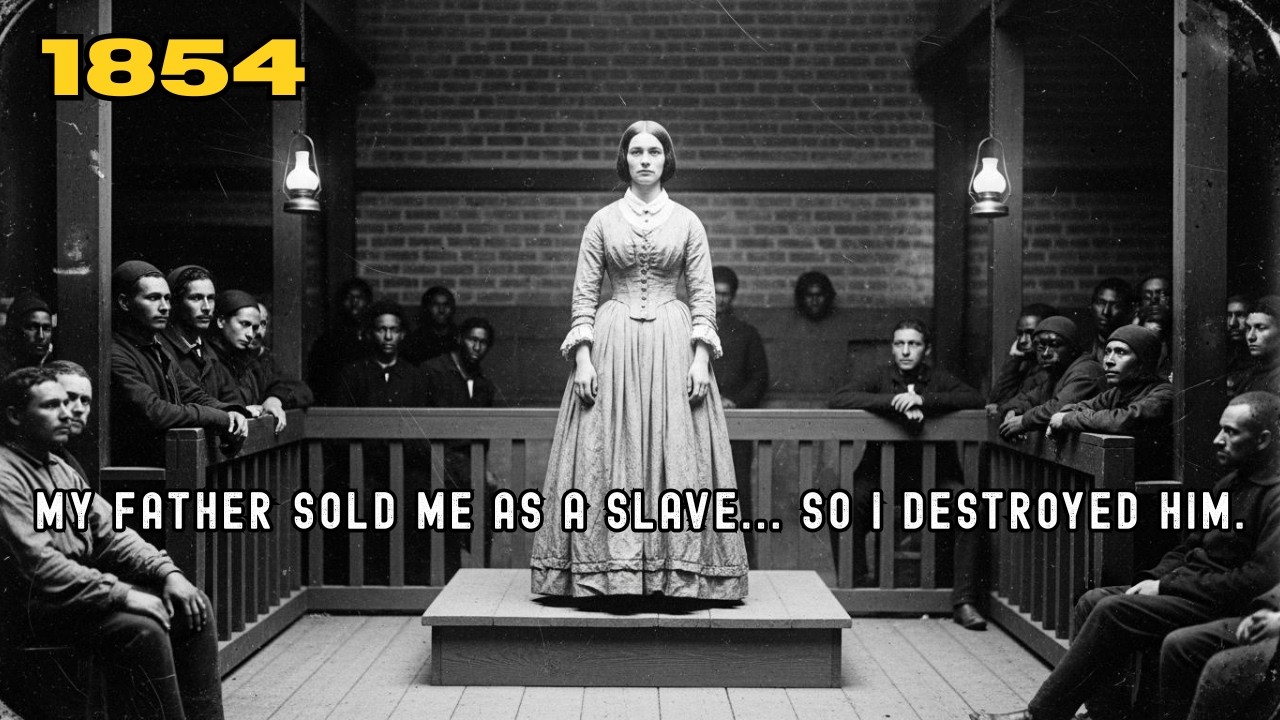
A man pried open my mouth to examine my teeth. Hands checked the muscle tone in my arms. I wanted to bite those fingers, to scream, to fight, but I had already learned that resistance only brought more pain. My name was Genevieve Dubois.
I was twenty years old, educated in French and Latin, accomplished at the pianoforte, and promised to marry the son of a shipping magnate by Christmas. On a warm September evening, I had watched my father supervise the unloading of contraband at the docks, and by the following week, I no longer existed. Not as Genevieve, not as anything but property. Every fall begins with a single step, and mine began in the parlor of our Creole townhouse on Royal Street, where I sat embroidering roses onto linen while my father prepared for what he called business matters.
Judge Laurent Dubois was a monument in New Orleans society, a man whose word could condemn or absolve, whose presence commanded respect in drawing rooms and courtrooms alike. He was my hero, the man who taught me that justice was the highest calling, that integrity was worth more than gold. He quoted Cicero at breakfast and donated generously to the orphanage. He was a beautiful lie, and I believed every word.
Our home was a testament to his success, or so I thought. Three stories of elegant architecture with wrought iron balconies overlooking the street. High ceilings painted with pastoral scenes. Furniture imported from France.
Floors of polished cypress, walls covered in silk damask, windows dressed in velvet curtains that pooled on the floor in luxurious folds. Crystal chandeliers hung in every major room, catching the light and scattering it in rainbow fragments across the walls. It was a house designed to impress, to announce to the world that Judge Laurent Dubois was a man of substance and taste. My mother presided over it all with the distracted grace of a woman who had learned not to ask too many questions.
She had been a beauty once, the daughter of a respected family with dark hair and eyes the color of honey. But something in her had dimmed over the years. She spent most of her time in her rooms reading novels and taking tonics for ailments that had no name. She would hum old French songs from her childhood and stare out the window at the street below as if waiting for something that would never arrive.
I see now that she knew, or suspected, and had chosen the comfort of willful ignorance over the danger of truth. I had no such luxury of ignorance, though I tried to maintain it. The first crack appeared on a Tuesday in late August. I was reviewing household accounts, a duty my mother had abandoned to me after her health declined, and I noticed irregularities.
My father’s judicial salary was respectable but modest, yet our expenses had tripled in recent months. New furniture arrived monthly, each piece more elaborate than the last. My mother’s jewelry box overflowed with pearls and emeralds, sapphires and diamonds, pieces that would have cost a fortune. There were payments to people I did not recognize, large sums with vague notations like consulting fees or business expenses.
When I asked him about it, he smiled that warm paternal smile and told me not to trouble my pretty head with such matters. He kissed my forehead. I smelled cognac and tobacco and something else, something sharp and foreign like tar and salt water. I should have let it go.
God knows my life would have been easier if I had simply returned to my embroidery and my piano lessons and my comfortable ignorance. But my grandfather, my mother’s father, had been a different kind of man. He had been a circuit judge in the territories, a man who believed justice was meant for everyone, even those society deemed unworthy. He died when I was fifteen, but his words stayed with me like a fever I could not shake.
“Genevieve,” he had said, holding my hands in his weathered ones, “the greatest sin is not ignorance, but willful blindness. When you see wrong, you must name it, even if the world punishes you for speaking. ”
So I began to watch my father more carefully. I noticed patterns.
He left the house at odd hours, always with the same excuse about judicial matters or political meetings. He received visitors who did not look like lawyers or politicians, men with hard faces and calculating eyes who spoke in low voices and left quickly. They arrived after dark, slipping in through the side entrance, and I would hear their voices rumbling through the walls of his study, though I could never make out the words. He kept a locked study that no one was permitted to enter, not even the servants.
And there were the letters sealed with wax and marked with symbols I did not recognize, arriving by private courier and disappearing into that forbidden room. My curiosity became an obsession. I told myself I was being foolish, that there were perfectly innocent explanations for everything I had observed. But the doubt had taken root, and it grew like a poisonous vine, choking out my faith in the man I had idolized.
The way he would return home in the early morning hours, his clothes smelling of the river and sweat. The way he would lock himself in his study for hours, emerging with ink-stained fingers and a satisfied expression. The way certain names would make him tense, his jaw tightening almost imperceptibly. Finally, I made a decision that would change everything.
I would follow him and see for myself what business kept him out until dawn. It was shamefully easy. He left the house at midnight on a Thursday, thinking everyone asleep, and I simply wrapped myself in a dark cloak and trailed behind his carriage through the French Quarter’s narrow streets. The city at night was a different creature, dangerous and alive.
Drunken laughter spilled from taverns. Women in rouge beckoned from doorways, their voices husky with promises and desperation. The air grew thicker as we approached the docks, heavy with the smell of the river, that ancient brown water that had seen so much suffering, so much commerce, so much sin. His carriage stopped at a private wharf belonging to a shipping company that operated just outside the bounds of respectability.
I hid behind a stack of cotton bales, my heart hammering so hard I feared it would give me away. The night was warm and humid, the air so thick it felt like breathing through wet cloth. Mosquitoes whined around my ears. In the distance, the sounds of the city came muted and strange.
Then I heard voices, and I peered around the cotton bales to see what I had come to witness. What I saw broke something fundamental inside me, something that could never be repaired. My father stood at the center of an operation that was efficient and brutal. A ship had docked, unmarked and low in the water, clearly carrying more than it should.
Men, black men in chains, unloaded crates under the supervision of overseers with whips. I saw weapons, rifles and pistols still packed in grease. Crates marked with French and Spanish letters. Barrels that I suspected contained rum or worse.
This was smuggling on a scale that spoke of years of practice, of vast networks and corrupted officials. And at the center of it all stood Judge Laurent Dubois, inspecting ledgers by lantern light, his face calm and satisfied. I watched one man stumble under the weight of a crate, watched an overseer raise his whip, watched my father nod his permission. The crack of leather on flesh echoed across the water.
The man did not cry out. He simply straightened and continued working, and in that silence I heard more suffering than in any scream. Our eyes met for just a moment, his and mine. He was perhaps thirty, with scars on his arms, and something in his face that spoke of intelligence being slowly crushed under the weight of this existence.
His eyes were dark and deep, and in them I saw a kind of resigned fury that I would come to understand intimately. Later I would learn his name was Marcus. Later he would help me burn my father’s empire to ash. But that night, I simply fled.
I ran through those dangerous streets without thought for propriety or safety, my mind fracturing under the weight of what I had witnessed. The man I loved most in the world was a criminal, trafficking contraband, likely weapons that would fuel conflicts, possibly enslaved people beyond what the law allowed. He was using human beings as tools, breaking them methodically, and he did it with the same calm efficiency he brought to the dinner table. I did not sleep that night.
I sat in my room, still wearing my cloak, watching the sky lighten from black to gray to the pale gold of dawn. I thought about my grandfather’s words. I thought about the man whose eyes had met mine, about the suffering I had witnessed. And I thought about what I should do with this terrible knowledge.
I could go to the authorities, but my father was the authorities. I could tell my fiance’s family, but they were business partners with my father, their fortunes intertwined in ways I was only beginning to understand. I could remain silent, marry as planned, and live my life pretending I had seen nothing. That was what any sensible woman would do.
But I was my grandfather’s granddaughter, and I could not unsee what I had witnessed. I could not unknow what I knew. So the next morning at breakfast, with my mother picking at her food and humming absently, I confronted him directly. I told him I had seen everything.
I begged him to stop, told him he was better than this, that he could still make things right. I see now how naive I was, how fundamentally I misunderstood the nature of power and the men who crave it. My father set down his coffee cup with deliberate care. He looked at me for a long moment, and I saw him calculating, weighing options, making decisions that would destroy me.
“Genevieve,” he said gently, “you are unwell. This is clearly hysteria, perhaps brought on by the stress of your upcoming nuptials. We must get you help. ”
“I am perfectly well.
I know what I saw. You were at the docks supervising the unloading of contraband. There were weapons, illegal goods, and you were using enslaved people to do the work. You are a criminal.
”
The words hung in the air between us. My mother had stopped humming. She stared at her plate, her hands trembling slightly. My father’s expression did not change, but something shifted in his eyes, something cold and final.
“Do you? ” His voice remained soft, almost pitying. “You are telling me that your own father, a respected judge, is engaged in criminal activity. Can you hear how that sounds?
How irrational? How much like the ravings of a disturbed mind? ”
“I am not disturbed. I am telling you the truth.
”
“The truth,” he repeated as if tasting the word. “The truth is that you have been under considerable strain. Your upcoming marriage, your mother’s illness, the responsibilities of running this household. It has clearly been too much for your delicate constitution.
These fantasies you are experiencing are a symptom of a deeper malady. ”
“They are not fantasies. I saw you. I saw the ship, the weapons, the men in chains.
I saw everything. ”
He stood then, his chair scraping against the floor. “I will not argue with you, Genevieve. You are ill and you will receive treatment for your own good and the good of this family.
”
And just like that, I understood. He was not going to stop. He was going to eliminate me as a threat, and he was going to do it legally, using the very system he had corrupted. I stood from the table, my napkin falling to the floor, and ran.
I made it as far as the front door before his men caught me. Not police, not anyone official, just men who worked for him, men whose loyalty he had purchased along with their silence. They were rough but efficient, grabbing my arms and holding me as I screamed and fought. My mother appeared in the doorway of the dining room, her face pale and stricken, but she said nothing.
She simply watched as they dragged me back into the house, up the stairs, and locked me in my bedroom. I heard the key turn in the lock, heard their footsteps retreating down the hallway, and then silence. I spent the rest of that day pounding on the door, screaming for help, begging anyone who could hear me to let me out. No one came.
The servants had been instructed to ignore me, and they did, because their livelihoods depended on my father’s goodwill. By evening, my voice was hoarse and my hands were bruised. I collapsed on my bed and wept until I had no tears left. They held me while a doctor arrived, a man with kind eyes and poisonous intentions.
Dr. Mercier was well-known in New Orleans society, respected and trusted. He had delivered me when I was born, had treated my childhood illnesses, had always been gentle and patient. But now he looked at me with professional detachment, as if I were a specimen to be examined rather than a person he had known for twenty years.
“Tell me, Genevieve, what did you see at these docks? ”
“My father was supervising the unloading of contraband. There were weapons, crates marked in foreign languages, enslaved people being forced to work. ”
“And what time was this?
”
“Midnight, perhaps a bit after. ”
“And you were there alone, a young lady of good family, wandering the docks at midnight. ”
“I followed my father. I wanted to know where he was going.
”
“I see. And does that seem like rational behavior to you? Does it seem like something a well-adjusted young woman would do? ”
I saw the trap then, but it was too late.
Anything I said would be used against me. If I insisted on the truth, I was delusional. If I recanted, I was admitting to lying. There was no way to win.
Dr. Mercier shook his head sadly and signed papers declaring me mentally unsound, a danger to myself and others. Under Louisiana law in 1854, women had few rights, and a father had near absolute authority over an unmarried daughter. But my father went further than simply having me declared incompetent.
He knew that would not be enough, that eventually questions would be asked, that my fiance’s family might investigate. So he found another method, one that was diabolic in its creativity. Louisiana’s complex caste system was built on the concept of racial purity, with elaborate legal definitions of who was white, who was colored, who had rights, and who did not. The state recognized multiple categories, white, free people of color, enslaved people, with further subdivisions based on the proportion of African ancestry.
It was a system designed to maintain white supremacy while acknowledging the reality of a mixed-race society. And it was a system my father knew intimately. Using his connections and his judicial authority, he produced evidence of African ancestry in my mother’s bloodline. It was entirely fabricated, documents that claimed my maternal great-great-grandmother had been a quadroon, a woman of one-quarter African descent.
In the rigid hierarchy of New Orleans, this would make me one-eighth black and therefore subject to entirely different laws. Combined with the declaration of mental instability, it was enough. Within three weeks, I had been stripped of every right, every protection. Genevieve Dubois, the judge’s daughter, ceased to exist in the eyes of the law.
I screamed. I fought. I called for help to neighbors who turned away, to my mother, who wept but did nothing. To my fiance, who simply disappeared.
No one challenged Judge Dubois. His power was absolute, and I was learning a terrible lesson about the nature of society. All those fine words about justice and dignity and human worth meant nothing when they conflicted with convenience. I was inconvenient, so I was erased.
They kept me locked in my room for two weeks while the paperwork was processed. My father visited me once during that time. He stood in the doorway looking at me with something that might have been regret, but was more likely calculation. “You could have had everything, Genevieve,” he said.
“A good marriage, a comfortable life, respect. All you had to do was keep silent. But you could not do that, could you? You had to be righteous like your grandfather.
And look where it has brought you. ”
“You are a monster,” I said. My voice was gone from screaming, from begging, from crying until I had no tears left. “No,” he said calmly.
“I am a pragmatist, and you are a problem that I have solved. Goodbye, Genevieve. I do not expect we will see each other again. ”
He was wrong about that, but he would not learn it until it was too late.
The day they took me to the private auction house, it was raining. They had dressed me in rough cotton, removed my jewelry, cut my hair short. I was being transformed from person to property, and the process was methodical. The auction house catered to those who wanted discretion, who were buying slaves for purposes they did not want examined too closely.
I was purchased by a sugar planter named Hutchinson, a man whose reputation for cruelty extended even to New Orleans. He paid well for me because I was young and educated enough to be broken into service in the main house, or so he thought. He looked at me the way one might look at a horse, checking my teeth, examining my hands, asking me to walk so he could assess my physical condition. I wanted to spit in his face.
I wanted to claw his eyes out. But I had already learned that resistance in that moment would only bring more pain. So I stood silent and let myself be sold. The journey to his plantation took two days by riverboat and wagon.
I was kept separate from the other enslaved people, still too clearly different, still marked by years of privilege that showed in my posture and my speech. They looked at me with suspicion and something that might have been pity. They knew what I did not yet understand, that I was about to enter a hell that would make my previous suffering seem like a minor inconvenience. We traveled down the Mississippi, that great brown river that was the lifeblood of the South’s economy and the highway of its sins.
I watched the landscape change from the urban density of New Orleans to the endless green of sugarcane fields. Plantation after plantation lined the river, each one a self-contained world of suffering. I saw enslaved people working in the fields, their bodies bent under the weight of labor and oppression. I saw the great houses where the planters lived, white columns gleaming in the sun, built on foundations of human misery.
Hutchinson’s plantation was called Belle Reve, a mockery of a name for a place of such suffering. Three hundred acres of sugarcane worked by over one hundred enslaved people, with a house that tried to ape European grandeur but achieved only grotesque pretension. The main house was white-columned and sprawling, surrounded by gardens maintained by enslaved gardeners. Behind it, out of sight of visitors, were the slave quarters, rows of rough cabins that housed families in conditions barely fit for animals.
And beyond that, stretching to the horizon, were the cane fields, green and beautiful and deadly. I was assigned to the house initially, but I made the mistake of speaking correctly, of forgetting to lower my eyes, of responding to the housekeeper’s orders with the tone of someone who had once given orders herself. The housekeeper was a free woman of color named Delphine, and she had survived by being harder on the enslaved people than any white overseer. She took one look at me and knew I would be trouble.
The overseer, a man named Crawford with a face like spoiled meat and breath that reeked of whiskey, decided I needed to be taught my place. He had me sent to the fields. If you have never cut sugarcane under the Louisiana sun, you cannot imagine it. The stalks are thick and tough, requiring a machete to cut through.
The leaves are sharp enough to slice skin, leaving cuts that burn with sweat and dirt. You work bent over, your back screaming, your hands bleeding from dawn until you cannot see anymore. The sun beats down without mercy, turning the fields into an oven. The humidity is so thick you feel like you are drowning in air.
And always, always there are the overseers on their horses watching, waiting for any excuse to use their whips. The quotas are impossible. You will fail and you will be punished and you will fail again. That is the point.
The system is designed not just to extract labor, but to break the spirit, to make you forget you were ever human. I nearly broke. God forgive me, I wanted to. There were nights I lay on the floor of the slave quarter, my body a map of pain, and wished for death.
The only thing that kept me alive was rage. It burned in me like a coal that no amount of suffering could extinguish. Every time I closed my eyes, I saw my father’s face. I heard his voice calling me unwell.
I felt his betrayal like a knife between my ribs. And I made myself a promise: I would survive this. I would destroy him. I would make him regret that he had not killed me when he had the chance.
The other enslaved people on the plantation were wary of me at first. I was too different, too obviously not born to this life. They suspected I might be a spy for Hutchinson, or that I would break under the pressure and become dangerous to be around. But slowly, as they saw me endure the same suffering they did, as they watched me learn to survive, some of them began to accept me.
There was an older woman named Aunt Bess who took pity on me. She was perhaps fifty, though she looked seventy, her body bent from decades of labor. She had been born on Belle Reve, had never known anything but this plantation, and yet she had maintained a core of dignity that no amount of cruelty could touch. She taught me which plants could ease pain and which could kill.
She taught me how to make my rations last, how to treat wounds with what little we had, how to read the moods of the overseers and avoid their worst rages. She taught me the songs that carried coded messages, the stories that preserved African traditions, the small acts of resistance that kept the spirit alive. “You got fire in you,” she said to me one night as we sat outside our cabin, too exhausted to sleep. “I seen it the first day you come here.
That fire going to keep you alive or going to get you killed. You got to learn to bank it. Let it burn low and steady, not let it flare up where they can see it. ”
“How do you do it?
” I asked. “How do you survive this without going mad? ”
She was quiet for a long time. “I remember,” she said finally.
“I remember my mama and her mama before her. I remember the stories they told about Africa, about being free. I remember every kindness, every small victory, every moment of beauty in all this ugliness. And I remember every wrong done to me and mine.
And I know that someday, somehow, there going to be a reckoning. Maybe not in my lifetime, but someday. That’s what keeps me going. ”
I understood then that survival was an act of resistance in itself.
Every day I continued to live, every moment I refused to let them break me completely, was a small victory. But I wanted more than survival. I wanted revenge. Two years passed.
I learned things in those fields that no lady’s education could teach. I learned to read the weather in the flight of birds and the smell of the air. I learned the complex social structure of the enslaved community, who could be trusted and who could not, who worked for Hutchinson and who merely pretended. I learned to make myself invisible, to hide my intelligence behind the mask of exhaustion.
I learned to survive on almost nothing, to endure things I will not describe because they would break your heart as they nearly broke mine. And I learned to listen. The plantation was not isolated. News traveled along invisible networks, carried by enslaved people who moved between properties, by freed men who worked as tradesmen, by overseers who drank too much and talked too freely.
I learned that my father’s operation had grown. He was now one of the most powerful men in Louisiana, his criminal empire hidden behind judicial robes. I learned that my mother had died, officially of yellow fever, though I suspected grief and guilt had as much to do with it. I learned that my former fiance had married someone else, a girl with an impeccable pedigree and no inconvenient sense of justice.
I learned that Genevieve Dubois was remembered, if at all, as a tragic case of inherited mental instability. My father had won completely. But then Marcus arrived, and everything changed. It was a sweltering August morning in 1856 when a wagon rolled up with a new group of enslaved people purchased in New Orleans.
This was not unusual. Hutchinson bought regularly, worked people to death or near it, and bought again. The economy of sugar demanded fresh bodies. I was carrying water to the fields when I saw them being unloaded, and my eyes locked on a man whose face I recognized immediately.
He was thinner, more scarred, but unmistakably the same man I had seen at the docks that night two years ago, the man whose eyes had met mine. Marcus. He recognized me, too. I saw it in the way his posture shifted, the brief widening of his eyes, but he was smart enough not to show it further.
We both understood that survival depended on giving away nothing. It was three days before we had a chance to speak, a brief moment when we were both sent to retrieve supplies from a storage shed. The overseer was dealing with a dispute on the other side of the property. We had perhaps two minutes.
“You’re the judge’s daughter,” he said quietly. It was not a question. “Not anymore. I’m no one.
But you were her. ”
“The night at the docks. ”
“Yes. ”
He was silent for a moment, and I could see him processing this, understanding the enormity of what my father had done.
“He sold his own daughter to protect his operation. ”
“He did. ”
Marcus shook his head slowly. “I thought I had seen every kind of evil.
I was wrong. ”
He looked at me, then really looked at me, seeing past the rough dress and the scars, seeing something that made him decide to trust me. “I worked the docks for him for three years. I know things.
Names, dates, ships, warehouses. He kept records of everything because he was arrogant enough to think no one would ever dare challenge him. ”
My heart began to race. “You remember specifics enough to hang him?
”
“If anyone would listen to a slave’s testimony. But they wouldn’t. ”
“What if we found someone who would? ”
And there it was, the seed of a plan that would grow into my father’s destruction.
Over the following months, Marcus and I met whenever we could steal moments, always careful, always watching for informers. He told me everything he knew about my father’s operation, and I told him about the legitimate business connections I remembered from my old life, the rivalries and alliances that formed New Orleans’ power structure. Marcus had been born free in Charleston, the son of a skilled carpenter. He had been educated, could read and write, and had learned his father’s trade.
But when his father died and left debts, Marcus had been seized by creditors and sold south to pay what was owed. It was legal, barely, one of the many ways the system found to enslave free black people. He had ended up on the docks in New Orleans, where my father’s operation used enslaved labor for the most dangerous and illegal work. Marcus had been forced to participate, knowing that refusal meant death.
But he had watched and remembered everything. “Your father kept two sets of books,” Marcus told me during one of our stolen conversations. “One for the public, showing legitimate shipping business, and one hidden, showing the real operation. Weapons going to filibusters in Nicaragua and Cuba.
Stolen goods from ships that mysteriously sank. Bribes to customs officials and harbormasters. He documented everything because he needed to keep track of his partners and their shares. ”
“That ledger is in a safe in his study.
I was never allowed inside, but I know where it is. The safe is behind a painting of my grandfather, ironically enough. ”
“The ledger is evidence that could destroy him, but only if it reaches the right hands. And the right hands belong to Armand Devoe.
”
I knew that name. Devoe was my father’s greatest rival, a shipping magnate who had long suspected my father of illegal activity but had never been able to prove it. He was no saint himself, but he was practical, and he understood that eliminating my father would benefit him enormously. “How do we reach Devoe?
” I asked. “We’re enslaved people on a plantation sixty miles from New Orleans with no freedom of movement and no legal standing. ”
“We escape,” Marcus said simply. “And we bring him information so valuable that he has no choice but to help us.
”
It was an insane plan. The likelihood of success was minimal. If we were caught, we would be killed, and our deaths would be slow and public, meant to discourage others from attempting the same. But what was the alternative?
To spend the rest of our lives in this hell, knowing that my father lived in comfort and power while we suffered? I could not accept that. I would rather die trying to destroy him than live knowing I had done nothing. We began to plan in earnest.
We needed to know the patrol schedules, the locations of dogs, the best routes through the swamps. We needed supplies, food and water that we could carry, clothes that would not immediately mark us as runaways. And we needed an opportunity, a moment of chaos when our absence might not be immediately noticed. The answer came with yellow fever.
It swept through the region in September of 1856, a plague that respected neither master nor slave. Hutchinson’s plantation was hit hard. Half the enslaved people fell sick, and three overseers died in a week. The plantation descended into chaos.
Bodies were burned in mass graves. The healthy were worked even harder to compensate for the sick. The normal surveillance collapsed as everyone focused on simple survival. Marcus and I saw our chance.
We were both healthy, having somehow avoided the fever, and in the confusion, we could slip away. We chose a night when the remaining overseers were drunk, trying to forget the death that surrounded them. We took what little we could carry, a knife, a flint, a small amount of food stolen over weeks, and we walked away from Belle Reve, leaving behind two years of suffering and walking toward an uncertain future. The journey to New Orleans took five days.
We traveled at night, hiding during the day in the swamps and forests that lined the river. It was dangerous in ways I had not anticipated. The swamps were home to alligators and snakes, to mosquitoes that swarmed in clouds, to mud that could swallow you if you stepped wrong. But they were also home to communities of escaped slaves, maroons who had built lives in the places where white people feared to go.
Marcus knew how to find them, and they gave us shelter and guidance, passing us along a network that existed beneath the surface of society. We met people who had been free for years, living in hidden communities deep in the swamps. They had built houses on stilts, grew their own food, fished and hunted. They had created a world outside the plantation system, a world where they answered to no master.
They were wary of strangers, but Marcus knew the right words to say, the right signs to make. They fed us, gave us directions, warned us of patrols. Without them, we would never have made it. We reached New Orleans on the fifth night, exhausted and filthy, but alive.
Marcus had contacts among the enslaved and free black communities, people who could be trusted for a night’s shelter or a meal. We made our way through the network, moving carefully, always aware that we were fugitives who could be captured at any moment. Finally, we reached the house of a free man of color named Baptiste, a dock worker Marcus had known before. Baptiste was suspicious at first, but when Marcus explained what we needed, he agreed to help.
He carried a message to Armand Devoe, a message that was simple and direct: The daughter of Judge Dubois has information that will make you the most powerful man in Louisiana. To his credit, Devoe was curious enough to take the risk. He arranged to meet us in a warehouse he owned, with guards present in case this was some kind of trap. When he saw me, still in the rough dress of an enslaved field worker, dirty and scarred, and nothing like the refined daughter of his rival, he was skeptical.
“You claim to be Genevieve Dubois,” he said, his voice cold and assessing. “That girl died or went mad years ago. ”
“I am what my father made me,” I said, meeting his eyes without flinching. “But I remember everything.
My mother’s maiden name was Rosalie Armand. Your mother and mine were cousins. I attended your daughter’s eighth birthday party at your home on Esplanade Avenue. The theme was butterflies, and she was given a porcelain doll from Paris that she named Celeste.
Your wife wore a green silk dress, and you gave a toast about the future. I know you, Mr. Devoe, and I know my father well enough to destroy him. ”
His eyes narrowed.
“Why would you do this to your own father? ”
“He is not my father. He ceased to be that when he sold me to protect his profits. Now, do you want to hear what I know, or should we find another buyer for this information?
”
We talked for six hours. Marcus and I laid out the entire operation. The ships that carried not just contraband goods, but weapons destined for filibustering expeditions in Central America. The warehouses where stolen property was stored.
The officials who were bribed, including a customs inspector named Fournier and two harbormasters. The schedules of shipments. The names of partners in other cities, Charleston, Havana, Vera Cruz. And most damning, the location where my father kept his true ledgers, the ones that recorded everything.
Devoe listened, asked sharp questions, and verified what he could against his own intelligence. At the end, he leaned back and studied us both. “If I use this information, your father will be ruined. But he will also know who betrayed him.
Even if I secure your freedom papers, you will never be safe while he lives. ”
“Then make certain he does not live free either,” I said. “Make certain he loses everything so completely that he has no power left to reach us. ”
Devoe smiled then, a smile that reminded me uncomfortably of my father’s men of power.
I was learning that men of power had much in common regardless of which side of the law they claimed to inhabit. But he was my weapon, and I would use him as ruthlessly as he would use the information I had given him. “Very well,” he said. “I will destroy Laurent Dubois, and in return, you will give me everything you know, every detail, every name, and you will disappear afterward.
I cannot have you surfacing later to complicate matters. ”
“Agreed,” I said. What followed was systematic destruction. Devoe did not go to the law directly, though he had allies there.
Instead, he orchestrated a series of carefully timed disasters. Ships carrying my father’s contraband were intercepted by federal revenue cutters, apparently acting on anonymous tips. Warehouses suffered mysterious fires that destroyed evidence but also cost my father enormous sums. Partners in other cities were arrested on unrelated charges, and in their desperate attempts to save themselves, they gave up evidence that pointed back to New Orleans and Judge Dubois.
It was death by a thousand cuts, each one seemingly unconnected, but together forming an obvious pattern. My father fought back, of course. He used every connection, called in every favor, threatened and bribed and maneuvered. But Devoe had prepared well, and the evidence was overwhelming.
Federal prosecutors, unable to ignore such obvious corruption, even in a system designed to look the other way, were forced to act. The final blow came when Devoe arranged for the true ledgers to be stolen from my father’s study. It was done during a party my father hosted, a desperate attempt to shore up his social standing. While guests drank champagne and pretended not to notice the rumors swirling around their host, thieves broke into his study and cracked his safe.
The ledgers were delivered to the newspapers, and the public outcry was immediate and savage. The hero judge was revealed as a villain who had corrupted the courts while profiting from illegal arms trading. In December of 1856, Judge Laurent Dubois was arrested in his own courtroom. His assets were seized, his reputation destroyed.
The trial was swift, a mockery of justice that pleased me because it mirrored what he had done to me. He was convicted of conspiracy, smuggling, corruption, and a dozen other charges. He was sentenced to twenty years in the Louisiana State Penitentiary, a place of such horror that it was effectively a death sentence for a man his age. I attended the sentencing.
Devoe had secured my freedom papers and Marcus’s, the price of our cooperation. The documents were legal fictions claiming we had been wrongly enslaved due to clerical errors, but they were accepted in the chaos of my father’s fall. I wore a simple dress, neither the finery of my old life nor the rags of my enslavement. I sat in the back of the courtroom and watched my father’s face as the sentence was read.
He searched the crowd, perhaps looking for someone who still believed in him, and his eyes found mine. He stared, and I saw recognition dawn. I saw him understand who had destroyed him. I did not smile.
I did not gloat. I simply looked back at him with all the weight of what he had done to me reflected in my eyes. Then I stood and walked out, leaving him to contemplate the consequences of teaching his daughter that justice was the highest calling. Devoe kept his word, perhaps because he respected the efficiency of our revenge, perhaps because it cost him little and bought him goodwill with the black community that had sheltered us.
He gave us enough money to start over, a small price for the empire he had gained. We took it and disappeared before anyone could look too closely at our papers or our story. Marcus and I left Louisiana on a steamship bound for Philadelphia. We traveled as free people of color, which was dangerous in itself, but less dangerous than remaining in New Orleans, where someone might recognize me.
The journey took two weeks, and every day I expected to be discovered, to be dragged back to face punishment for my escape and my revenge. But no one stopped us. We were just two more black people traveling north, invisible in our ordinariness. Philadelphia was a revelation.
The free black community there was large and well-established, with churches and schools and businesses. There were still restrictions, still prejudice, but it was nothing like the suffocating oppression of Louisiana. We could walk the streets without papers. We could work for wages.
We could build lives. We opened a small bookshop on a street where other black-owned businesses operated. It was modest, just two rooms, but it was ours. We sold books and newspapers, provided a place where people could gather and talk, offered literacy classes to those who had been denied education.
Marcus used his carpentry skills to build the shelves and furniture. I used my education to teach and to manage the business. We built something good together, a small corner of dignity and peace in a world that had tried to destroy us both. We did not marry, though many assumed we had.
The truth was more complicated than that. We were survivors who had been through hell together, who understood each other in ways that had nothing to do with romance and everything to do with shared trauma and shared victory. We were partners in the truest sense, bound by respect and common purpose. There was affection between us, certainly, and loyalty that ran deeper than blood.
But we had both been broken in ways that made traditional relationships difficult. We found comfort in our friendship and in the work we did together. But I never forgot. I kept track of the news from Louisiana through newspapers and letters from contacts Devoe had provided.
I learned that my father’s trial had been a sensation, that his fall had exposed corruption throughout the Louisiana judiciary. I learned that several other officials had been arrested in the aftermath. I learned that the federal government had cracked down on smuggling operations throughout the Gulf Coast. My revenge had accomplished more than I had dared hope.
And I learned that my father died in prison in 1859, killed in a fight with another inmate over something trivial. The newspapers reported it as a tragedy, the final chapter in the fall of a once great man. I felt nothing when I read that news. The man I had loved was already dead, killed by his own greed and cruelty years before.
The body that died in prison was just the conclusion of a story that ended the day he sold his daughter. Marcus lived until 1873, dying of pneumonia at the age of forty-nine. I mourned him as I would mourn a brother, a fellow soldier who had fought beside me in a war that most people did not even know was being waged. After his death, I continued running the bookshop alone, serving the community, telling stories to children who needed to know that survival was possible, that resistance took many forms, that intelligence and courage could triumph over even the most overwhelming power.
I lived my life in Philadelphia, known simply as Miss Genevieve to the community that embraced me. I taught children to read. I provided books to those hungry for knowledge. I offered shelter to fugitives traveling the Underground Railroad.
I lived to see the Civil War, to see slavery finally abolished, though I knew the fight for true freedom was far from over. I never returned to New Orleans. I never spoke publicly about who I had been or what I had endured. But I wrote it all down, every detail, so that someday someone might understand.
So that the girl who died in that auction house might be remembered, and so that the woman who rose from those ashes might bear witness to what she had seen and what she had done. This is my testimony. This is my truth. And if there is any justice in the universe, it is that my father spent his last days in chains knowing that it was his own daughter who had put them there, using the very principles he had pretended to uphold.
They tried to erase me. They thought they could take my name, my identity, my humanity, and leave nothing behind. They were wrong. I am Genevieve Dubois, and I survived.
I fought back not with violence, but with truth. Not with anger, but with cold calculation. I used the same system that had been used against me. And I burned my father’s empire to the ground.
And then I built something new, something better, something that honored every person who had suffered under his greed and my suffering alongside them. This is how resistance looks sometimes, not in open rebellion, but in patient, careful destruction. In memory, in refusal to disappear, in the quiet work of building community and passing on knowledge, in the determination to survive and to make that survival mean something. I lived to see the Civil War, to see slavery finally abolished, though the fight for true freedom was far from over.
And I lived knowing that I had taken the worst thing that had ever happened to me and transformed it into a weapon that destroyed the man who had wielded it. That is my legacy. Not the fine dresses or the elegant townhouse or the respectable marriage I was supposed to have, but this. I survived.
I resisted. I won. And I made sure that my story and the stories of those who suffered alongside me would not be forgotten. Genevieve lived until 1891, dying at the age of fifty-seven.
Her bookshop continued operating under new ownership until 1923. She left no direct descendants, but her story, preserved in private letters discovered in 2011, provided historians with detailed evidence of the Dubois smuggling operation and the complex dynamics of race, class, and resistance in antebellum Louisiana. Her account remains one of the few first-person narratives of a white woman who experienced enslavement, offering unique insight into the arbitrary nature of racial classification and the vulnerability of women under nineteenth-century law. The letters are now housed in the Library Company of Philadelphia, available to researchers studying the era.
The echoes of Genevieve’s methodical revenge reverberate through time, a stark reminder that resistance takes many forms and that intelligence can be as powerful as any weapon.
