The man’s skin burned over the fire for two and a half hours. He no longer screamed, because his vocal cords had long since reached the point where they could not carry it. Around him stood roughly a hundred people, watching, waiting, none of them looking away. This was not a coincidence, and it was not, strictly speaking, an execution.
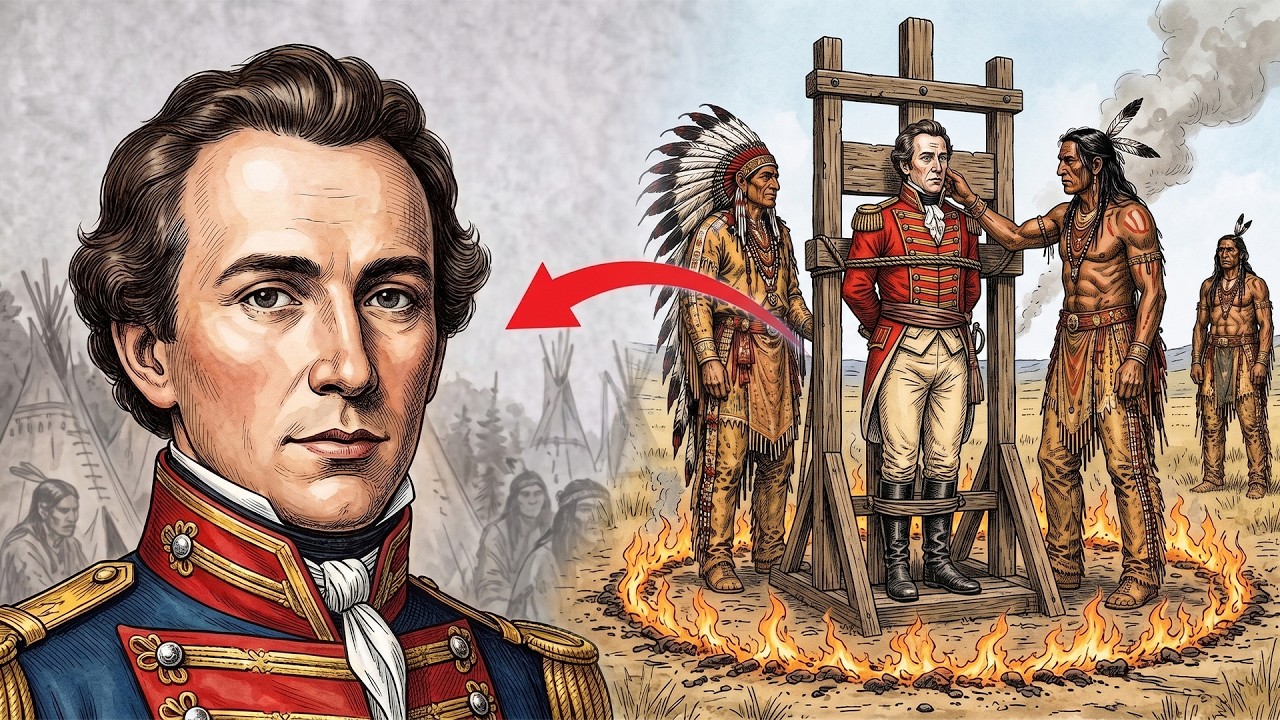
It was a reckoning. And the man being killed was not even the one who had started it. To understand why William Crawford stood tied to that stake, one had to go back three months, to March 1782, and to a settlement called Gnadenhütten, a name that meant, with bitter irony, “tents of grace. ” In northeastern Ohio, at the end of that winter, lived a community of Lenape who had converted to Christianity.
The community, established years earlier by Moravian missionaries, had tried to remain neutral in a war that offered no neutrality. They had gathered in their village, praying, unarmed, hoping to stay out of the violence that had swallowed the frontier. A militia unit from the Pennsylvania border, commanded by Major David Williamson, entered the village. The people there were praying.
They were not enemies. They were people trying to live in peace with their neighbors. The militia gathered them inside a building and, over the course of hours, killed ninety-six of them, not with bullets but with carpenters’ mallets, one by one, men, women, and children alike. It was a planned, systematic, slowly executed slaughter.
The Lenape had believed, for a moment, that the arriving militia had come to protect them, perhaps even to help recover property stolen in earlier raids. That misunderstanding proved fatal. A vote was held among the militia. A minority suggested taking the prisoners to Pittsburgh to stand trial.
The majority chose to kill. It is said the victims were allowed to pray and sing hymns before they died, a detail that made the event even more painful, because those who carried out the massacre even believed they were showing respect for the piety of the people they were murdering. The day after the massacre, the militia looted the village’s barns, livestock, and stored provisions, then set the buildings on fire. All that remained were burned walls and mass graves.
As Williamson’s men turned back toward Pittsburgh, it is said an unease was sensed even among some of the officers. But that unease never turned into an investigation, a trial, or a punishment. The Pennsylvania administration announced that the incident would be investigated, then quietly shelved it. The news reached every native community on the frontier.
The Lenape, the Wyandot, the Shawnee all knew. And they all knew that one day, the score would be settled. The indifference of the American institutions was like a prologue to what would happen at Sandusky three months later. One side’s justice would be administered by official institutions.
The other’s would be applied directly, on their own land. William Crawford was a fifty-nine-year-old Virginian, a surveyor by trade, a man who had spent more than twenty years drawing borders and preparing land claims in the Ohio Valley. But what made him truly important was a friendship forged in his youth with a man named George Washington. Together they had ridden horses through the western lands, debating which valley was valuable, which river was suitable for trade.
It was a true friendship, sustained through letters over the years. In the spring of 1782, Crawford was retired. He had his farm, his family, his grandchildren. His military days were behind him.
But the volunteers along the frontier were looking for a commander for a new expedition, an attack being planned against native settlements along the Sandusky River. Most of the volunteers were the same men who had been at Gnadenhütten three months earlier. They needed an experienced, reliable name to hold their force of 480 men together. They came to Crawford.
There is no definitive answer to why he accepted. Some historians think he wanted to rein these men in. Others say his loyalty to the new nation Washington represented pushed him into the duty. Whatever the case, he said yes.
Crawford personally knew some of the men who had been at Gnadenhütten. Frontier communities were small. They went to the same churches, lined up at the same mills, were connected by the same kinship networks. To say no would mean leaving his neighbors alone with officers of their own choosing, undisciplined, angry men who had murdered people three months earlier.
Some historians argue his reason for going was not heroism but a desperate sense of responsibility. If someone did not control this mob, there could be a second Gnadenhütten, this time in the form of retaliation against his own frontier community. Crawford was trying to limit a disaster, not win a war. He failed.
In the days before he left, he wrote letters to his wife and daughter. There were no grand words in these letters, only ordinary instructions regarding the farm, which field to plow, which debt to pay. They were the mundane lines of a man who thought he would only be gone for a few weeks. The man walking toward one of the most dramatic deaths had devoted his last letters to the harvest schedule.
On May 25, 1782, the volunteer force crossed the Ohio River at a point called Mingo Bottom. These were not regular soldiers. They were farmers, land clerks, young men who had lost relatives in frontier raids. They had divided themselves into four companies and elected their officers unanimously.
Some were boys of eighteen or nineteen who had never seen war, joined through family insistence or neighborly pressure. Some were men in their forties and fifties who had turned frontier fighting into a near-professional habit. Some sources mention that a few women accompanied the column for tasks like washing clothes and cooking, though this detail has been lost in most official narratives. The plan was simple.
March 150 to 180 miles northwest to the villages near Sandusky, burn the villages, shoot anyone who resisted, and return home. Ten days to get there, a few days of operations, ten days to return. Crawford had told his officers the job would be done in three weeks. But there were two things he did not know.
First, the villages he was targeting had already been evacuated. Second, and much more importantly, a war party was already tracking them. Warriors made up of Lenape, Wyandot, and a small Shawnee group were gathering under experienced commanders, men in their forties and fifties, whom American sources referred to as Captain Pipe and Wingenund. A small group of British soldiers and interpreters from the British fort at Detroit had joined them.
Initially there were about 200 warriors, and their numbers increased later. They had been watching the volunteer column for days. They did not even consider defending the villages, because there was nothing left to defend. Instead, they planned to fight on terrain of their own choosing, on an open plain where tall grass could hide a person and where 480 exhausted men could be seen from a mile away.
Crawford thought he was going to raid a village. In reality, he was marching to an appointment, and the location, time, and conditions of that appointment had been set by the opposing side. The British command in Detroit was aware of the volunteer column’s movements days in advance, because they had their own scout networks. The force facing Crawford was not a randomly assembled group but a coordinated, intelligence-backed fighting force led by experienced commanders.
There was one thing the American side lacked, and it was the thing that would be most useful to the other side throughout the campaign: patience. The militia expected a three-week campaign and a quick victory. The opposing side was ready to wait, watch, and choose the right moment for days, even weeks. Among these warriors was one of the most controversial figures in the story: Simon Girty, a forty-one-year-old Irish-descended man born on the Pennsylvania frontier, taken prisoner during a native raid as a child and raised among the natives.
He spoke Lenape, Seneca, and Shawnee fluently. When the Revolution began, he chose the British and native side and never returned. In American frontier culture, his name became the symbol of treason, a legend used to frighten children. In reality, Girty was not a war leader.
He was an interpreter, an observer. The Sandusky Plains looked nothing like the frontier landscape of the American imagination. There were no dark forests, no dramatic mountains. It was open, rolling terrain, waist-high dry grass, occasional clusters of oak and hickory trees.
On a clear June afternoon, a man on horseback could see a mile away. But a man lying in the grass would be invisible from forty yards. The Lenape knew this. Crawford did not yet.
As the column advanced northwest, they left traces behind: broken branches, cold campfires, moccasin prints in the mud. Scouts reported small groups of natives tracking them but keeping their distance. The officers debated what this meant. Some said it was a sign of flight.
Some said it was a sign of surveillance. The majority preferred the comforting interpretation. The weather was also against them. According to the diary of a soldier named Rosenthal, rain lasting for days caused gunpowder to become damp, roads to turn to mud, and shoes to begin rotting.
Some men fell ill with fever and stomach aches, likely infections from dirty water. Crawford considered sending the sick back, but doing so would further reduce the column’s numbers and demoralize them. So everyone kept walking, some feverish, some barely able to stand. On June 3, ten days after crossing the river, the column reached the Sandusky Plains and experienced its first shock.
The villages they had come to burn were completely empty. The settlements where Lenape and Wyandot families lived consisted only of bare frames and cold hearths. Some officers suggested turning back, some going forward. Crawford decided to march for one more day.
He would find someone. In the camp that evening, no one noticed the native scouts lying in the tall grass around them. Every joke told around the fire reached enemy ears. A young soldier would later remember the night with a strange tranquility: the clarity of the stars, the crackling of the fires, the sound of an owl from afar.
The most dangerous moments are often the ones that seem the calmest. Before noon on June 4, scouts came running back. There were warriors ahead, not a hunting party, a regular line. Crawford ordered his companies to form up and advance toward a small grove of trees.
There could be twenty men inside, or two hundred. The battle began at two in the afternoon with a single rifle shot, then another, three more, then a volley from four hundred yards away. Suddenly the volunteers were under fire from three directions, but they could see no one in front of them. Bullets hit the dirt.
The man next to you suddenly coughed and fell. But finding a target was impossible, because the grass was taller than the shoulders of a kneeling soldier. Crawford pointed to the only way out: the small cluster of trees. His men gathered inside, dug shallow trenches with knives and bayonets, built simple breastworks from branches and logs, and formed a defensive circle.
The Lenape and Wyandot did not charge. They did not need to. They surrounded the grove, fired from the grass eighty yards away, from the trees three hundred yards away, changed positions, took return fire, and changed again. It was a slow squeezing strategy.
With every hour, the volunteers’ ammunition dwindled a little more. The goal was not to win the battle in an afternoon. The goal was to keep the volunteers in that grove, because the moment they left and stepped into the open plain, the real hunt would begin. The firing lasted until dusk, four, maybe five hours.
It was irregular, unpredictable, exhausting. Men lay behind logs, aiming at the unmoving grass. The wounded were carried to the center of the grove, where a young surgeon, Dr. John Knight, tried to treat them by the fading daylight.
According to Knight’s journal, a strange discipline emerged among the men. Not panic, but a quiet reckoning. Everyone was counting his own ammunition pouch, trying to guess what his neighbor had left. Officers circulated, trying to boost morale, but no one voiced the true situation out loud.
At one point a group in the grove opened fire on smoke drifting through the trees, which may have been a decoy deliberately left by the opposing side to make the volunteers waste ammunition. The night brought no relief. The native warriors kept the circle loose but effective, occasionally firing into the grove, war cries rising from the darkness, sometimes close, sometimes distant, constantly in motion. For some volunteers, the hardest part was not the combat but the display, a deliberate repetition reminding them that the enemy was still there, still awake, still making decisions.
On the morning of June 5, Crawford saw the truth. More warriors were arriving. The circle was tightening. The number of wounded was increasing.
Water, ammunition, and options were all running out. His officers, primarily Williamson, voiced the thought passing through his own mind. They could neither hold on nor attack. They had to go.
Crawford agreed to retreat. The plan was a night retreat. Small groups would move silently, dispersing in different directions, eventually regrouping on the banks of the Ohio. It was the least bad option.
Crawford knew what would happen to the pieces left behind. Still, he gave the order. When darkness fell, the companies began slipping out of the grove and blending into the grass. Crawford moved last, with a smaller group that included Knight and his son-in-law, William Harrison.
According to some accounts, Crawford wasted time in the dark looking for his son and nephew. He did not want to leave without taking them into his own group. Those few minutes of delay formed the threshold that detached him from the main body. Williamson, with the larger group of 300 men, moved southeast steadily and quickly.
Crawford stayed behind with the slower groups and the wounded. He could not abandon them. They set out later, moved slower, and as dawn began to break, they were still out in the open terrain. During the night, the native warriors did not pursue heavily.
They watched, followed the sounds, noted which group moved with discipline and which was scattered. Williamson’s disciplined column was too fast to be worth catching in the open. Crawford’s fragmented group was the exact opposite. When dawn broke on June 6, Crawford’s group was no longer a whole.
Some men had mixed into other units in the dark. Some had fallen behind. Small groups were scattered over miles of plains and light woods. Anyone moving alone could be caught by three or four warriors without a single shot being fired.
At two in the afternoon, one of the retreating American columns, some of Williamson’s rear companies, was caught near Olentangy Creek, around present-day Bucyrus. The native pursuit units had caught up to them. The Americans took cover behind the creek bank and fallen logs. Fire came from a tree line to the north and a low ridge to the east.
The skirmish lasted an hour, maybe two, a series of clashes where officers tried to keep panicked small groups from plunging alone into the grass, which was exactly what the opposing side wanted. When the pressure eased, and because the natives deliberately relaxed it to conserve ammunition, the Americans slipped southeast and continued moving. But this resistance told the enemy one more thing: the main American body was intact and moving. Williamson was gone.
By elimination, it was understood that the small, slow group still on the plain contained the officers who had not managed to escape, meaning Crawford was still out there. The pursuit changed direction. Warrior bands turned back, fanned out across the plain, roaming in wide arcs, sweeping the creek beds and low spots where exhausted men might hide. Crawford, Knight, Harrison, and perhaps a dozen others heard the warriors calling to each other in the Lenape language through the grass.
They pressed themselves even lower and waited for darkness. The darkness did not come fast enough. The group lay motionless for hours, hungry, thirsty, almost out of ammunition. Crawford, in a low voice, told those around him to stay calm and avoid sudden movements.
At one point, the footsteps of a warrior group passing nearby became so clear that Knight would later write he held his breath, fearing even his heartbeat would be heard. Meanwhile, to the southeast, Williamson, the man responsible for Gnadenhütten, was heading toward the Ohio, toward safety, with his 300 men. He would reach Mingo Bottom safely on June 13. He would not be caught.
He would not be burned. He would live for decades more. The man the natives wanted more than anything else was surviving the story, while the man who had never touched Gnadenhütten was still lying in the grass, listening to the warriors call out to each other. Crawford was captured on June 7.
The exact moment is not clear in the documents. Knight’s account is fragmented: a group of warriors with raised weapons cornering them in the grass, the impossibility of resistance. There were perhaps eight people left in the group. They were exhausted, had not eaten a proper meal in days, and their ammunition was almost entirely depleted.
They surrendered. Crawford was quickly recognized. His rank, his age, his posture were obvious. The natives knew what a colonel looked like.
His son-in-law, Harrison, was with him. Knight was with him. There were other officers and privates as well. Some would be killed on the trail in the coming days.
Some would be held for ransom or join the villages. But Crawford and one other person were immediately separated for something else. They were marched not north toward the British, but toward the Lenape villages, to the place Americans called Pipe’s Town. Knight would later describe the silence of the old man who walked beside him during those days.
He did not cry. He did not beg. He just walked. At one point he asked Knight if there was any chance.
Knight, a doctor and not a liar, said no. Miles of plains under the June sun. A fifty-nine-year-old man who had once mapped these lands in his youth and ridden horses with a future president, led by a rope, marched by warriors whose relatives had been bludgeoned to death with mallets three months prior. With every step he knew where he was arriving, yet he walked.
He had no other choice. They reached Pipe’s Town around June 10. The village Crawford saw was a village that had made preparations. The news had arrived before him.
They knew who was coming and what was going to happen. About a hundred people had gathered: men, women, children. This was not a crowd of spectators. It was a community.
Every single one had lost someone to the frontier violence of the last decade. Most had lost family members specifically at Gnadenhütten. The mothers who came to watch that afternoon were mothers who had buried their children in a mass grave in March. A stake had been prepared.
A fire pit had been dug. The materials to be used, small branches, embers, gunpowder, had been gathered. The community had organized itself around this event. This was not chaos.
It was a ceremony. Knight was kept nearby, in a place where he could see. Whether this was deliberate or an accident is still debated among historians. Knight would later escape, and his account would become the defining record of American memory.
Accident or not, the man who would carry the story to the world had been placed exactly where he could see it. Simon Girty was there too. The white man raised among natives, the interpreter, the greatest traitor figure in frontier memory. Crawford knew him, at least by reputation.
Girty’s story overlapped with Crawford’s in a strange way. Both were men who grew up on these lands. Both knew both sides of the frontier. But one chose to stay within white society, while the other abandoned it.
When the Revolution broke out, Girty started as an interpreter serving on the American side, then crossed over to the British and native allies, a switch that earned him a label of treason that would stick until his death. When Crawford saw him, something appeared on his face. An expression Knight would later describe as the first real hope he had seen in three days. That hope lasted about twenty minutes.
In the final minutes before the ceremony began, a kind of expectant silence prevailed among the crowd. No shouting, no chaotic display of anger. The violence was not a moment of madness but part of an agreed-upon order. Crawford was first offered food and water, a final gesture of humanity, which also showed that the event was not a chaotic lynching but a ceremony operating within its own logic.
Crawford was stripped and tied to the stake, his hands up, his torso upright but bound, his feet on the ground but able to move only a single step. Around him, in a shallow trench, were small fires and embers. The community formed a loose circle: men in front, women behind them, children among the women. The process began with a detail Knight watched from about thirty yards away, one that survived in every retelling for two centuries.
Gunpowder. Small handfuls of black powder were sprinkled onto Crawford’s bare skin, his chest, his shoulders, his arms, his back, and ignited. The powder burned with a bright flash, leaving severe burns underneath. This was not random.
It was the beginning of a sequence. Then came the embers, small sticks with glowing tips pressed into the skin, held, lifted, and applied elsewhere. Then the women stepped forward and took the sticks, and continued. Then the children, with smaller sticks, learning.
American narratives have always stumbled here, unable to make sense of children participating in such a thing. But this was not random cruelty. It was a message. Your ninety-six deserved this.
This was our debt. Crawford tried to walk around the stake as far as his bonds would allow. When he tried to go too far, the embers drove him back. His feet blistered on the earth heated by the fires.
His skin blackened with powder burns, torn apart by wounds opened by the embers. After about an hour, he saw Girty in the crowd and began calling out to him. This dialogue, as recounted by Knight, is the moment that most shaped the American memory of the story. Crawford asked Girty to shoot him, to finish it, to use his influence in the camp as a white man to provide him a bullet instead of fire.
Girty, according to Knight, said the natives were resolute, that he must die by fire, and that no intervention was possible without angering them, almost as if delivering a diagnosis to a patient. Crawford heard this, turned back to the stake, continued to walk in his circle, and continued to burn. After about an hour, he was scalped. A knife was run around his scalp while he was still standing, still alive, still able to make sounds.
Then embers were applied to the exposed skull. Knight, watching from thirty yards away, would later write that he could not understand how Crawford was still alive at that point. He thought the old man should have long since died from shock or blood loss. But he was not dead.
Crawford’s screams changed over time, Knight said. At first cries of pain and anger, then increasingly lower, more muffled, but a groaning that never completely stopped. It was as if the body refused to give up. Something beyond will was keeping him on his feet.
Toward the end of the second hour, Crawford could no longer stand upright. His legs gave out. His torso leaned against the ropes. His voice, which had been steady when calling out to Girty, had turned into a shattered whisper.
Knight kept watching. He had to watch. The natives had not yet turned to him. He thought his turn would come after Crawford was finished.
It did not. The natives were entirely focused on Crawford, about a hundred people for two continuous hours directing deliberate, organized violence at a single man. Some accounts mention hymns being sung during the process. Some refer to taunts referencing Gnadenhütten.
Some say the voices of the women rose above those of the men. Crawford died late in the afternoon. Knight could not pinpoint the exact moment. There was no clear final blow.
His body simply stopped reacting to the embers, the sticks, the voices. The Lenape noticed this. The ceremony changed. What was torture now turned into a dismemberment.
The body was cut. The bones were broken. Some parts of his body were taken away. The rest was scattered around the stake.
Two or three hours. That is what the sources say. Not violence in an instant, but an entire afternoon in June. A man’s body was used as a message, written slowly and read by everyone present.
The scale of what was done to Crawford is measured not in his wounds but in its duration, in the fact that no one stopped, in the fact that no one was expected to stop. That evening, Knight was taken away. He was held for a few days, marched toward another village, and then escaped into the woods during a moment of confusion around a campfire. He walked barefoot and starving for three weeks.
He ate roots, drank water from creeks, avoided every trail and village. When he finally reached an American settlement on the banks of the Ohio, he was almost unrecognizable, a skeletal figure, the story of what he had seen already taking shape on his tongue. Most of the other captives did not fare well either. Crawford’s son-in-law, William Harrison, was killed on the trail.
A few were tortured or executed in other villages. Another, John Slover, escaped later and gave his own account, which was combined with Knight’s when the pamphlet was printed. But it was Knight who watched the execution itself, and it was he who transformed his narrative into the form in which the American frontier would remember this story for 150 years. The numbers of the Sandusky expedition told their own story when the survivors gathered.
Of the roughly 480 men who crossed the Ohio from Mingo Bottom in May, between seventy and one hundred died. Perhaps twenty were taken prisoner, most killed like Crawford. On the opposing side, casualties were limited: a few dozen dead and wounded over two days of combat and a week of pursuit. Tactically, this was one of the most one-sided frontier campaigns of the Revolutionary War.
Williamson, the man responsible for Gnadenhütten, the man the natives wanted more than anyone else, returned to Mingo Bottom on June 13 at the head of his surviving column without taking a single scratch. He lived for decades more. He was criticized for Gnadenhütten, but never stood trial. The news spread rapidly for the conditions of that era.
A letter from Fort Pitt dated July 6, 1782, not even three weeks after the execution, reported the defeat of the expedition and the fate of its commander, describing how Crawford was tied to a post and burned. The letter was reprinted in the Pennsylvania Journal and Weekly Advertiser on July 23 and spread to every colonial newspaper within a few weeks. George Washington received the news in early August. On the sixth of the month, in a letter to General William Irvine, commander at Fort Pitt, he spoke of his old friend’s barbarous execution.
Washington’s sorrow in that letter is evident. Crawford was his childhood friend, someone he had ridden with in the western territories. Washington’s reaction to frontier violence in 1782 was influenced by many things, but Crawford’s death was one of the sharpest among them. When Knight reached safety, he began recording his narrative.
It was published in Philadelphia in 1783 by a printer named Francis Bailey, with a long title taking up half the page: a narrative of the expedition detailing the savage execution of Colonel Crawford and the miraculous escape of Dr. Knight and John Slover from captivity. The pamphlet sold well, was reprinted repeatedly, and became one of the most influential frontier narratives of the founding era. The narrative of the Sandusky expedition in American memory was fixed right there, with that pamphlet.
Not in Rosenthal’s notebook that meticulously recorded the daily marches, but in a single pamphlet where a surgeon described the fire at Pipe’s Town. Every American child who learned anything about Crawford in the following century learned it through Knight. The depiction of Simon Girty as the ultimate villain of the frontier came from Knight’s scene of begging and refusal. Every reason found to fear the Lenape people came from those pages.
The pamphlet did not lie. Knight recounted what he saw. Crawford died the way Knight described. But what the pamphlet did was choose what to highlight and what to push into the background.
That choice, made by a printer in Philadelphia in 1783 to sell books, determined how a country would remember its frontier history for the next 150 years. The letter Washington wrote to Irvine, characterizing Crawford’s death as barbarous, entered the archives and remained there. It was read by generations of officers and statesmen. It hardened a policy already taking shape: the idea that the frontier was a place where restraint could not survive, that the only response to native resistance was a heavier hand, a larger force, a longer campaign.
Simon Girty lived another thirty-six years. At the end of the war, he fled to Canada and never returned to the American side. When Americans remembered him, they remembered him through Knight: the white man who refused to shoot Crawford, the traitor who watched an old man burn. His real life, which was complex and often surprisingly ordinary, remained buried under the story of a single afternoon in Pipe’s Town.
There is a truth the pamphlet did not put on its cover. Three months before Crawford’s death, in March 1782, ninety-six Christian Lenape were beaten to death with carpenters’ mallets, men, women, and children. They died while praying. David Williamson was responsible for that massacre, and he survived the Sandusky expedition, never judged for what he had done.
Where every American textbook mentioned Crawford’s execution as an atrocity, the texts written for generations passed over Gnadenhütten as a sad event. Ninety-six people against one person. The proportions of American memory had been quite literally inverted, and this inversion was no coincidence. The frontier narratives sold in Philadelphia and Boston needed a specific mold: a heroic white victim, a savage native mob, a traitor to be hated.
Knight’s pamphlet offered all three elements. Moravian Lenape kneeling in a mission house, murdered by men from the very same militia tradition, fit none of those molds. And so they remained a footnote for a century and a half, while Crawford became the story itself. The Lenape people were pushed westward in the following decades, driven out of Ohio, out of Indiana, placed first in Kansas, then on reservations in Oklahoma.
Their descendants always remembered that the fire at Pipe’s Town was not the beginning of something. It was an answer. For historians, the Crawford case still stands as an interesting case study, because trying to draw a clear line between good and evil yields no result other than distorting the event itself. Crawford was not personally present at Gnadenhütten.
He was not himself a killer. But the vast majority of the column he commanded consisted of the perpetrators of that massacre, and he knew this. Agreeing to go on the campaign with this knowledge places him in a gray area between an innocent victim and an accomplice, neither sharp guilt nor complete innocence. Similarly, the community that tortured him at Pipe’s Town was a community administering justice from their own perspective, carrying out a form of accountability within their own traditions that the American legal system had never offered them.
This is not to justify the violence. A two-and-a-half-hour torture cannot be justified in any framework. But it is to make it understandable, to remove it from random savagery and place it within the logic of a war. Modern historiography began rereading this event in the last thirty or forty years.
Crawford’s death used to be told alone, as a frontier tragedy stripped of its context. Today, academic works almost universally address it alongside Gnadenhütten, within a chain of cause and effect. This shift is not a small thing. It is part of a larger debate about how a country remembers the violence of its own founding era.
Who is remembered as a victim and who is a perpetrator is not merely a matter of classification left in the past. It is an issue with still-living consequences, extending from present-day land disputes to native peoples’ demands for federal recognition. Gnadenhütten itself is preserved today as a small historical park in Ohio. A monument erected over the mass graves, a few plaques summarizing the event for visitors.
But even the existence of this monument is the result of a long struggle. It was when the German-descended communities who settled the region in the nineteenth century began to embrace and commemorate the event, partly as a piece of their own religious history, that the incident could re-enter the broader public agenda. The exact location of Pipe’s Town, where Crawford died, has not been definitively determined today. Historians still debate a few candidate spots in the area, because the village itself was abandoned after the war and eventually blended back into nature.
Rosenthal’s diary was kept as a family heirloom for years after the war and only reached the hands of historians in the late nineteenth century. His plain, unadorned narrative, a soldier’s diary recording how far they marched each day, at which creek they found water, who fell ill, was always overshadowed by Knight’s dramatic pamphlet. But when these two texts are read together, a much richer picture emerges. One shows the mundane, bureaucratic face of the campaign, and the other shows the horror at its most extreme point.
What emerges is neither an epic of heroism nor a simple tale of savagery. It is the ordinary and simultaneously terrifying record of how two peoples consumed each other within a decades-long conflict. When Knight recorded what he saw, he was writing with the natural biases of a surviving witness, placing his own pain, his own fear, his own struggle for survival at the center. This does not make his narrative a lie, but it does not make it impartial either.
We will never know how a Lenape observer would have narrated the same scene, because no oral or written record from that side, at least from that era, has reached us. This asymmetry of history, one side having a printing press, a newspaper, an archive, while the other could leave no record outside oral tradition, is one of the most fundamental reasons why the Crawford story has been remembered so one-sidedly. The voices of the killed, the ninety-six people at Gnadenhütten, were never put on record, because there was no one left to record them. The mothers standing in the crowd that June afternoon were mothers who had buried their children in March.
The children stepping forward with sticks in their hands were children whose siblings had died on their knees. And one must also ask this question: if Crawford had not stayed behind that night, if he had not lost a few minutes looking for his son and nephew, how would the story have ended? Perhaps he would have caught up to Williamson’s column and returned safely to Ohio, just like the true culprit of Gnadenhütten, growing old, telling campaign stories to his grandchildren without ever being held accountable. This possibility makes the story even more unsettling, because it shows that what determined Crawford’s fate was not a moral equation.
It was a few minutes of delay, the pace of a night march, who was in front and who was left behind. History sometimes works this arbitrarily. It does not match great crimes with great punishments. It just catches the slowest, the most exhausted, the one left furthest behind.
Today, in the area where the Sandusky Plains used to be, in the north-central part of Ohio, there are small historical markers commemorating the event, mostly erected in the mid-twentieth century, with brief and official texts. None of these markers can bear the weight of a two-and-a-half-hour afternoon. A stone plaque cannot tell the final hours of a human being. But they remind us of at least one thing: here, two centuries ago, the darkest logic of a war played out, and both the victims and perpetrators of that logic were part of a much larger, much longer conflict.
Go back to that plain, to that June day, to the fifty-nine-year-old man tied to the post, the friend of the future president, the surveyor who had once mapped this land for his country. He was not tortured because he was an American. Nor was it because he was white. He was tortured because he was the closest man their hands could reach, a name that needed to be paid off in the ledger of an unsettled debt.
The fire at Pipe’s Town burned for two or three hours in June of 1782. But the spark that lit that fire had not been extinguished since March. William Crawford’s pain was real. It was horrific, and no context mitigates it.
But the pain of the ninety-six people who died at Gnadenhütten was equally real, and for two centuries, they were barely mentioned. The justice of history often depends on who holds the pen, who has the printing press, who has the archive, whose grandchildren write the textbooks in schools. To fully understand what happened at Sandusky is not just to know one man’s final hours, but to know who was brought to those hours, and why.
