In June 1876, on the battlefield of the Rosebud in Montana Territory, the sound of General Crook’s soldiers opening fire rolled across the grass, and a Cheyenne warrior pitched from his horse, wounded, into the open ground between the lines. No one could reach him. The fire was too heavy. Then a woman spurred her horse forward and rode straight into the line of bullets.
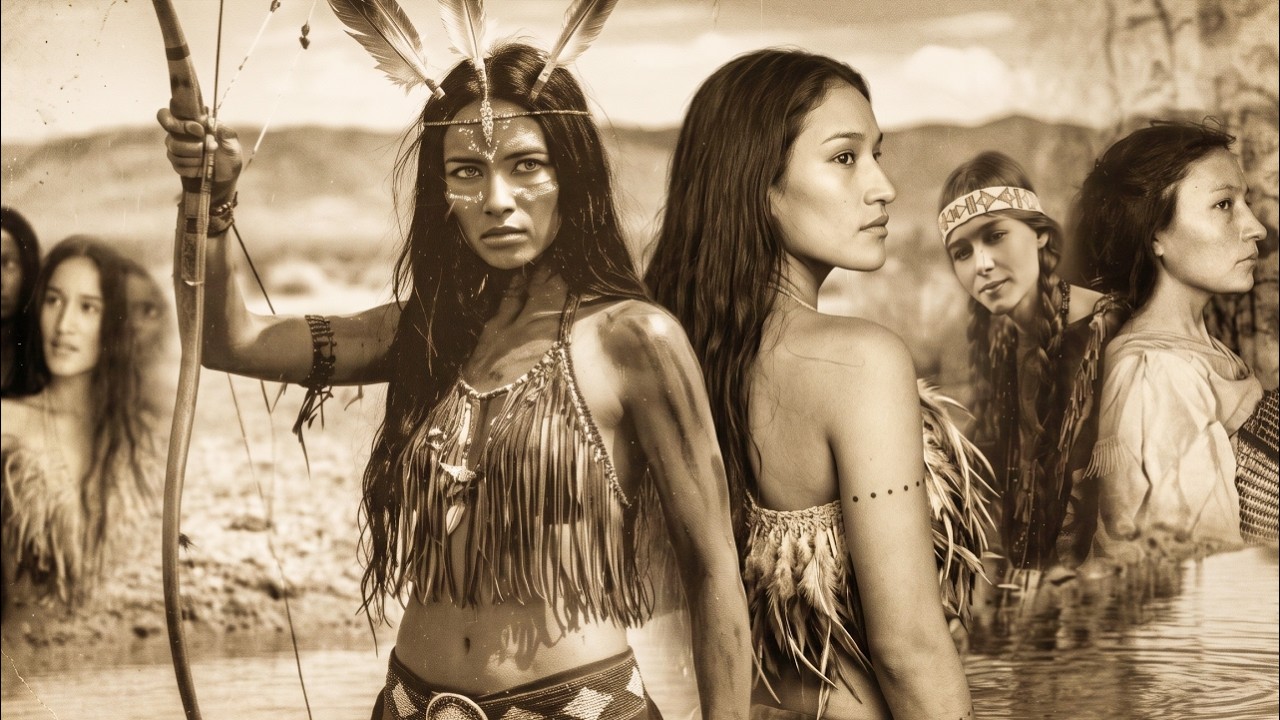
Her name was Buffalo Calf Road Woman. She pulled her brother up behind her and galloped away under the gunfire. The Cheyenne still call that place and that day where the girl saved her brother. Eight days later, she was at the Little Bighorn, fighting alongside her husband against the 7th Cavalry.
And there, according to an oral tradition the Cheyenne kept for more than 130 years, she did something that would have made her the most famous woman in American military history if anyone had believed it. In 2005, Cheyenne elders finally spoke what their people had preserved in memory: it was her blow that knocked George Armstrong Custer off his horse. The woman who helped bring down America’s most celebrated officer died in 1879, with no movie, no statue, and almost no record of her at all. She was not the only one.
A number of Native American women took up arms against the United States and against enemy nations on the plains, and the official records—when they bothered to notice—caught fragments of their stories. Some were documented by the army itself. Others survived only in the memories of their own people. A few lived long enough to see the twentieth century.
One was officially listed as a combatant, the only Native American woman ever held as a prisoner of war by the United States. Another tried to negotiate Geronimo’s surrender. None of them has ever had a Hollywood movie made about her. Mo-chi was 24 years old in 1864 when she watched her mother die in the Sand Creek Massacre.
She survived by hiding among the bodies. What she did afterward was not what anyone would have expected from a young woman who had just lost everything. Instead of running, she took up arms. For eleven years she rode with her husband, Medicine Water, fighting as a Cheyenne warrior, and the United States Army itself documented her attacks in official reports.
In 1875 she was captured and sent to Fort Marion in Florida. On her record, the army did not write “warrior’s wife. ” It wrote “combatant. ” With that single word, Mo-chi entered the historical record as the only Native American woman officially held as a prisoner of war by the United States—a rare acknowledgment, written by the very enemy she had fought for more than a decade.
In June 1876, Tashenamani—known as Moving Robe Woman—was gathering wild turnips near the Little Bighorn River when the gunfire began. Minutes later came the news: her younger brother, Deeds, had been killed by Custer’s soldiers. She did not hide and grieve. She tied back her braids, mounted her horse, and rode for the front lines, shouting for revenge.
Warriors who were there said, decades later, that she rode ahead of the men. Rain in the Face, one of the most respected fighters of the plains, admitted that her courage put anyone who hesitated to shame. According to him, seeing a woman in battle made the warriors fight twice as hard. That day the 7th Cavalry was wiped out.
Among those who brought down Custer was a woman who, just hours earlier, had only wanted to gather roots to feed her family. Pretty Nose, of Arapaho and Cheyenne descent, was also at the Little Bighorn that June. Two years later, a photographer captured her face at Fort Keogh, and that image still exists. Most people who look at it have no idea who they are seeing.
Her own grandson, a Navy veteran, confirmed it. Among her people, Pretty Nose held the rank of war chief. She lived until 1952, reaching the age of 101, and spent her final years on the Wind River Reservation in Wyoming. The woman who faced the cavalry on horseback lived through two world wars and watched airplanes cross the same plains where she had once fought.
Hollywood never touched her story, but the photograph is still there. In 1869, on a battlefield somewhere on the plains, Cheyenne fought Shoshone—dust, horses, shouting. In the middle of it, a woman charged forward with a spear in her hand. Ahiopsta, the yellow-haired woman, daughter of Chief Stands in Timber.
Cheyenne elders say, and ethnographers later confirmed, that she took down a Shoshone warrior and took his scalp. Counting coup was the ultimate proof of courage among the plains nations, reserved for men who faced the enemy up close. That night, in front of the council and witnesses, she told the story of what she had done by the fire, following the same ritual as the warriors. No one challenged her.
Her name has been passed down through generations of Cheyenne accounts to this day. At the Battle of the Rosebud in June 1876, among hundreds of armed men, a Crow woman entered the fight carrying nothing but a wooden club. No rifle, no bow. What the Other Magpie had was a score to settle: the Lakota had killed her brother.
Witnesses said she charged forward, spitting toward the enemy and shouting that it was her ammunition. When a Crow warrior fell from his horse and was surrounded, she rode straight into the gunfire, touched an armed Lakota with her club—the greatest act of courage among the Plains peoples—and the man was killed right afterward. She took his scalp. During the victory dance, she cut that scalp into pieces and handed them out among the warriors so more of them could share in the honor of the day.
Of the few scalps the Crow took at Rosebud, one came from a woman who went to war with a stick. Around 1840, a Crow war council of 300 chiefs gathered, and ranked third in influence was a woman. Bia Owacheshe, the woman chief, was not even born Crow. She had been captured from the Gros Ventre at the age of ten.
Her adoptive father, who had lost his sons, allowed her to train with a bow, horses, and a rifle. When the Blackfeet attacked the camp, she rode out alone, killed attackers, and came back without a scratch. After that she led war parties, stole hundreds of horses, and married four wives, as any chief would. The trader Edwin Denig, who knew her, wrote that she was a chief in the fullest sense of the word.
In 1854 she tried to negotiate peace with the Gros Ventre, the people she was born into. They recognized her and killed her in an ambush. There is a waterfall in Glacier National Park, Montana, that thousands of tourists photograph every year without knowing it was named after a warrior. Pitamakan of the Blackfeet lost her husband in a Crow attack.
Instead of staying home to grieve, she did what only men did: she formed war parties and set out for revenge. Pikuni oral tradition records several expeditions under her command, capturing enemy horses and defending hunting territory. The tribal council gave her an honor name reserved for men—Running Eagle—and she led her warriors to the very end. She died in battle against the Flathead around 1878, weapon in hand, on the front lines.
Today Running Eagle Falls bears her name, and almost no one who stops there to take a picture has any idea who she was. In September 1858, the US Army was advancing through Washington Territory to crush the resistance of the Plateau tribes. At the Battle of Four Lakes, Yakama Chief Kamiakin led his warriors against soldiers armed with long-range rifles. There was someone there no one expected.
Colestah, Kamiakin’s wife, a healer and seer, refused to wait at camp. She rode into battle carrying a stone club. In the middle of the fight, a branch torn off by a cannon shot struck Kamiakin and knocked him from his horse. Colestah rode to him under fire, dragged him away from the soldiers, and treated his wounds with her own medicine.
He survived. The army reports recorded the victory. The Yakama people recorded something else: the name of the woman who saved the chief. In the 1800s, the Ojibwe nation had strict rules about who could be a warrior, and women were not on that list.
Except for one. Aazhawigiizhigokwe—Hanging Cloud—was a young woman when she watched her father get ambushed by a rival war party. Instead of running, she picked up a weapon and fought. What happened next had never happened before: the elders gave her full warrior status.
Not a nickname, not a courtesy. The real deal—war paint, war dances, and a seat among the fighting men. From then on she went into battle and on hunts alongside the men, and nobody questioned it. To this day she stands as the only woman in Ojibwe history to earn that honor in full ceremony.
Goyan, whose name means “she who looks ahead,” was an Apache woman who lost her husband in an attack and found that none of the tribe’s warriors had the courage to go after those responsible. She did not wait for anyone. She followed the Comanches’ trail alone for days, found their camp, and waited for the night of the victory dance. There was the chief, dancing with her husband’s scalp hanging from his belt.
Goyan approached him as if she were a dancer, gained his trust, and killed him right there. She returned home carrying his boots and scalp as proof. The story is still told today by the Mescalero and Chiricahua. Years later she survived the Tres Castillos massacre and ended her life as a prisoner at Fort Sill, Oklahoma.
No man in her group did what she did alone. When the final surrender of Geronimo’s band came in 1886, the person who sat down to carry messages between the Apache camp and the American officers was a woman. Dahteste rode with Geronimo’s band as a scout and fighter, and she spoke fluent English—rare at the time. Both sides trusted her to carry messages between the Apache camp and the American officers.
She did her part, and the war ended. The government’s repayment was prison. She spent eight years imprisoned in Florida and Alabama, caught tuberculosis and pneumonia—diseases that killed dozens of people around her—and survived both. Dahteste lived until 1955, long enough to watch Hollywood turn the Old West into movies, tell Geronimo’s story a thousand times on screen, and never once mention the name of the woman who helped bring that war to an end.
In 1785, in Spanish California, a 24-year-old woman did what few men dared to do: stand up to an empire. Toypurina was a healer of the Tongva people, respected by villages throughout the region. When Mission San Gabriel expanded onto her people’s lands and banned their rituals, she helped unite six villages in a plan to attack the mission at night. Someone gave away the secret, and the soldiers were waiting.
Arrested and brought before the colonial court, she did not bow her head. She looked the Spaniards in the eye and said, with every word recorded in the official record: “I hate the priests and all of you for living here in my homeland. ” Her sentence was exile. She was banished forever from the place where she was born.
Two hundred years later, Toypurina became a symbol of indigenous resistance in California, but her name remains more alive in university textbooks than in public memory. In 1755, during the Battle of Taliwa, an 18-year-old Cherokee woman was chewing her husband’s rifle bullets to make them more deadly. When he fell beside her, she picked up the weapon, stood up, and led the Cherokee warriors to a victory that had seemed lost. Nanyehi—later known as Nancy Ward—was given the title Giga, the beloved woman, something extremely rare.
It gave her a seat on the nation’s council and the power to decide whether prisoners lived or died. In the decades that followed, she negotiated face-to-face with the Americans, trying to prevent wars that would destroy her people. A warrior in her youth, a diplomat in her later life. In 1675, a woman commanded 300 armed men in a war that nearly wiped the English colonies off the map.
Weetamoo led the Pocasset people in the region that is now Massachusetts, and when King Philip’s War began, she chose to fight. She was not just a figurehead. She planned attacks, moved troops, and negotiated alliances like any general. The English themselves called her a queen.
Mary Rowlandson, an English woman who was captured and worked in her household, later said Weetamoo carried herself like royalty and expected to be treated that way. In August 1676, surrounded, she tried to cross a river to escape and drowned. The colonists cut off her head and hung it on a post in the village of Taunton. No one does that to just any enemy.
They do it to the one who kept them up at night. In June 1878, at the height of the Bannock War, a Paiute woman did what no army scout could. Sarah Winnemucca rode about 360 kilometers in three days, crossing hostile territory between Idaho and Oregon to find the camp where her father, Chief Winnemucca, was being held. She went in undercover, got dozens of people out in the middle of the night, and still returned with information for General Oliver Howard.
It is all in the army records, where she served as an interpreter and scout. In 1883 she published Life Among the Paiutes, the first autobiography by a Native American woman in the United States, and traveled across the country giving more than 300 lectures against the reservation system. She was received at the White House and spoke before Congress. In the field, the army trusted her.
On paper, Washington learned to respect her. In 1900, a Boston magazine published something the US government did not want anyone to read: a Sioux woman’s account of what happened inside Native American boarding schools. Gertrude Simmons Bonnin, who wrote under the name Zitkala-Sa, Red Bird, had lived through it herself. Taken from South Dakota at the age of eight, she had her hair cut and was forbidden from speaking her language.
Years later she told the whole story in The Atlantic Monthly, and the Carlisle school responded with a campaign to destroy her reputation. It did not work. She co-wrote the country’s first Native American opera, founded the National Council of American Indians, and fought for native citizenship and voting rights until the end in 1938. She never held a weapon, but the system treated her like the most dangerous threat of all: someone who knew how to write the truth.
In 1889, a woman from the Omaha Nation graduated from medical school at the top of her class, at a time when women could not vote and female doctors were rare. Susan LaFlesche Picotte returned to the reservation in Nebraska and became the only doctor for 1,300 patients across nearly 3,500 square kilometers. She made house calls on horseback in the middle of the night, through snowstorms, while the government delayed her pay and medical supplies. She stood up to Washington bureaucrats, took on those making money by selling alcohol on the reservation, and without a single federal dollar built a hospital entirely through donations.
She died in 1915, nine years before Native Americans became US citizens by law. The hospital remained standing. The system said someone like her could not exist. She did, and left the proof in brick and mortar.
Wilma Mankiller walked into a US government meeting and introduced herself by a name that literally means “killer of men. ” A lot of people laughed. She let them laugh. The last name came from an old Cherokee war title, Asgaya digeh, given to the warrior who protected the village.
In 1985 she became the first woman to lead the Cherokee Nation as principal chief, responsible for around 140,000 citizens and a multi-million dollar budget. She won two elections in a row. While in office she brought running water, clinics, and schools to communities the rest of the country had forgotten. When someone asked about her name, she would smile and say, “I earned it.
”
And then there was Lozen. Victorio, the feared Apache chief, had hundreds of warriors, but when he needed someone he could trust, he called on his sister. Before the council he would say: “Lozen is my right hand, a shield for our people. ” It was no exaggeration.
For 30 years she fought the US Army, first alongside Victorio, then with Geronimo. During a desperate escape she crossed the Rio Grande under gunfire, guiding women and children to the other side. The military recorded her presence in battle several times and never managed to capture her in combat. She only surrendered in 1886 with the last free Apache group, and died as a prisoner from tuberculosis in Alabama in 1889.
No treaty bears her name. No movie tells her story. The most complete warrior of the Old West was erased with an efficiency no enemy ever had against her.
