Every kid in early 1960s America remembers the day they got their first transistor radio. It came at Christmas or on a birthday, after three weeks of saved allowance, or handed down from an uncle who had bought a newer model. It fit in the palm of a hand, had a leather or plastic case, a wrist strap, a small dial on the side, and a single earphone jack. It ran on a 9-volt battery that lasted about a day at full volume.
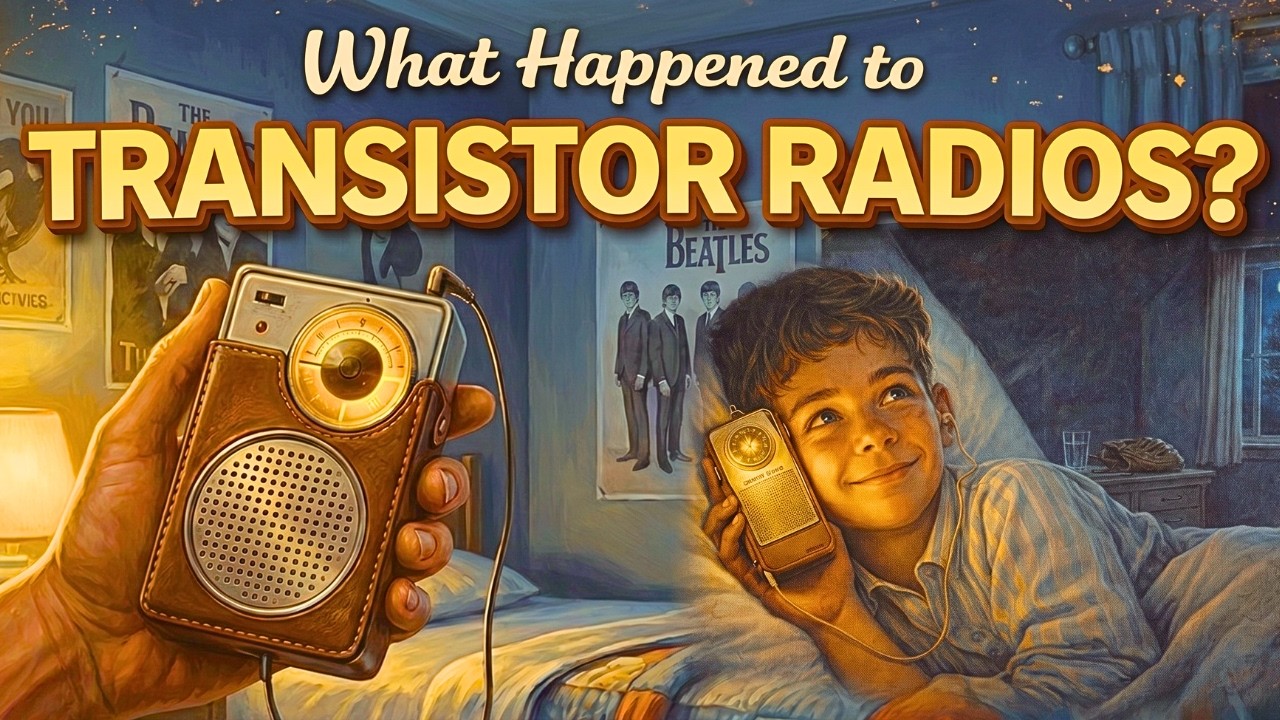
By the mid-1960s, it cost about fifteen dollars, a sum a boy who mowed lawns could earn in two weekends. It was not expensive, but it was the most important possession a child had ever owned, because it was the first thing that was truly theirs. Not the family radio in the living room that the father controlled. Not the record player the mother could hear from the kitchen.
Not the car radio that played only what the parents wanted. This was a personal radio, a personal station, a personal world, and it could go anywhere. The sound was unlike anything else. It was tinny, mono, and AM only, with static between stations and distant voices bleeding through from cities a thousand miles away.
The speaker was two inches wide, the bass did not exist, and the treble was sharp and scratchy. It was, by any objective measure, a poor way to hear music. But through that tiny speaker came the Beatles, the Supremes, the Rolling Stones, the Beach Boys, Sam Cooke, and Roy Orbison. Every song that defined a generation reached its listeners through a piece of technology that fit in a shirt pocket.
The music industry understood this completely. Phil Spector built his wall of sound specifically so it would come through loud and clear on a transistor radio speaker. Motown mixed its records to sound perfect on that tinny little AM frequency. The entire sound of the 1960s was shaped by the limitations of a two-inch speaker, because the record companies knew that was how the kids were listening.
Not on stereo systems. Not on hi-fi equipment. On a transistor radio under a pillow in the dark. The memory that every person who grew up in that decade shares is the ritual of the pillow.
Lying in bed with the lights off, the parents convinced the child was asleep, the radio tucked beneath the pillow with the volume nearly off. An ear pressed against the pillowcase brought the music through, muffled, warm, and private. It was the first secret that felt good, not guilty, just personal. A DJ spoke at 11:30 at night as if addressing a single listener.
Songs played one after another, and when the one you loved came on, the bedroom disappeared. You closed your eyes and were somewhere else entirely. You did not know it then, but you were participating in the first private listening experience in human history. The transistor radio went everywhere.
On a bicycle, it hung from the handlebars with the wrist strap looped over the grip, bouncing against the chrome as you pedaled through the neighborhood. The wind stole most of the sound, and the static was constant, but you could hear the DJ and the opening notes of the next song. For the first time, you moved with music. Not sitting still in the living room, not trapped in the backseat of a car, but moving, free.
The song made you ride faster. When it ended, you slowed. When your mother called you in, the radio came with you. Nothing had ever gone with you before.
At the beach, the pool, the backyard, on the porch steps after dinner, the ritual was the same. You turned the dial slowly between stations, searching. At night, AM signals traveled farther, and a child in a small town could pick up broadcasts from St. Louis, Chicago, or cities they had never heard of.
Ghost voices from the other side of the country came through the little speaker like messages from another world. Sitting in the dark, listening to a DJ seven hundred miles away play a song you had never heard, you felt for the first time that America was bigger than your town, and that somewhere out there, other people were listening to the same sky and the same music. The single white earphone changed everything. Plugged into the jack on the side of the radio, it split the world in two.
One ear heard the mother in the kitchen, the brother in the hallway, the dog on the porch. The other ear heard the Temptations. It was the first time in history that a human being could listen to music that nobody else in the room could hear. Before the transistor radio, there were no consumer headphones and no earbuds, and there was no private listening of any kind.
That single white earpiece, plugged into a nine-volt radio in 1963, was the ancestor of the Walkman headphones, the iPod earbuds, and the AirPods worn today. It began with a kid who wanted to hear the Beatles without a parent telling them to turn it down. The transistor radio broke the communal nature of music. Before it existed, all music was shared.
Families gathered around the living room radio. Families sat together around the record player. Music was something you shared whether you wanted to or not. The transistor radio ended that.
For the first time, a twelve-year-old could hear rock and roll without parents in the room. For the first time, a teenager could listen to music her mother did not approve of. For the first time, kids had their own soundtrack, separate from the adults. Rock and roll exploded because of it.
AM Top 40 radio was designed for transistor listeners: short songs, big hooks, catchy choruses, and fast-talking disc jockeys who played the hits every forty minutes so that no matter when you turned the radio on, you would hear your song within the hour. The entire culture of popular music in the 1960s was built around a device that fit in a shirt pocket. One story from the industry illustrates how central the device had become. When Sony released the TR-63 in 1957, they called it the world’s first pocket-size transistor radio.
The problem was that it did not actually fit in a standard shirt pocket. Sony solved this by giving its salesmen custom-made shirts with slightly larger pockets. The salesman would walk into a store, slide the radio into the pocket, and say, “See, it fits right in your shirt pocket. ” The buyers believed it, the public believed it, and the lie became the legend.
Within a few years, the radios actually did get small enough to fit in a real pocket. Sony sold seven million TR-63 units, and every one of them carried the promise that the future could fit in your hand. They were right. They were just a little early.
Three things happened at the same time, and that is why the transistor radio conquered America. The first was the baby boom. There were more teenagers in the late 1950s and early 1960s than at any point in American history. The second was prosperity.
Families had money, kids had allowances, and parents had disposable income for the first time in a generation. The third was price. In 1957, the Sony TR-63 cost forty dollars. By 1962, a transistor radio cost fifteen.
By the late 1960s, one could be had for five dollars. Radio Shack sold its own brand, Realistic, for under ten dollars. A kid could afford one. A grandmother could afford to give one.
A family that could not afford much of anything could still afford a transistor radio for Christmas. Those three forces, millions of teenagers, money, and a cheap radio that played rock and roll, produced a cultural revolution. Billions of transistor radios were sold worldwide, more than any electronic device in history until the cell phone. The waiting was part of the experience.
You could not choose what played. You could not skip a song. You could not search for the one you wanted. You turned the radio on and waited.
The anticipation was the gift. When the DJ played three songs you did not care about, and then the opening notes of your song came through the speaker, you felt it in your chest, the way you cannot feel a song you selected from a menu. You lay under the covers, and the DJ said, “Coming up after the break,” and you held your breath. Sometimes it was your song, and sometimes it was not.
When it was, you turned the volume up just a little, closed your eyes, and it was perfect. The next morning at school, you told a friend, “I heard it last night. Did you hear it? ” And they said yes, and you both smiled, because you had been lying in separate beds in separate houses, listening to the same song at the same time on the same station, and you had not known it until that moment.
The transistor radio was private and communal at the same time, alone with the music and connected to everyone who was listening. The 9-volt battery was bought at the drugstore or the five-and-dime, snapped onto the connector inside the battery compartment. It lasted about a day at normal volume, less if you played it loud. You always knew when it was dying because the music slowed, the DJ’s voice got deeper as if he were falling asleep, the static thickened, and the volume faded.
Sometimes the battery died in the middle of your song. Sometimes it died at the bottom of the ninth inning. You lay in the silence holding a dead radio, and the night felt emptier than it ever had before. The store was closed, your parents were asleep, and you had to wait until morning.
The first thing you did when you woke was ask your mother for a 9-volt battery. She gave you one from the kitchen drawer, the world came back through the speaker, and everything was right again. Sixty cents was the price of the world. The technology eventually made the transistor radio obsolete.
The Walkman arrived in 1979 and allowed listeners to choose their own music instead of waiting for a DJ. The boom box was bigger, louder, and stereo. The Discman offered better sound quality than AM radio ever could. The iPod arrived in 2001, and a thousand songs fit in your pocket, with no commercials, no DJs, and no songs you did not want.
Then came the iPhone, and the radio, music player, telephone, camera, map, and newspaper all merged into one device. The transistor radio was not just obsolete. It was incomprehensible. Why would anyone carry a device that does one thing when a device exists that does everything?
Because a device that does only one thing does that thing with your whole attention. You were not scrolling or texting or switching between apps. You were lying in the dark with your ear against the pillow, listening to a song, and that song had all of you. The transistor radio did not play music in the background of your life.
It played music in the center of your life. The AM stations that played the Beatles and the Supremes in 1965 are gone, most of them now talk radio. The DJs who spoke at midnight like they were talking only to you are gone. The 9-volt battery that lasted a day is gone.
The leather case with the wrist strap is gone. The single white earphone is gone. The dial you turned slowly between stations is gone. But the transistor radio is still in a drawer somewhere, in the kitchen junk drawer, the guest room nightstand, or a box in the garage.
If you put a battery in it right now and turned the dial, you would probably still hear something. It would be static-y and faint, and it would not be the Beatles, but the sound would come through that tiny speaker the same way it came through sixty years ago. And for a second, you would be eleven years old again, lying in the dark with the radio under your pillow, the whole world six inches from your face, and nobody knowing you were still awake.
