The man appeared without warning, coming up the trail from below so quietly that neither Mercer nor Quentin heard him until he was almost at the edge of the meadow. One moment they were alone, moving through the familiar morning routine of checking pack straps and distributing weight across the mules, and the next he was standing there watching them with an expression that gave nothing away. He was indigenous, probably in his fifties, though sun and wind had weathered his face to the point where age became difficult to estimate. He had long gray hair tied back with what looked like rawhide, and he wore a mix of traditional and white man’s clothing: buckskin leggings under a canvas coat that had been patched multiple times, moccasins instead of boots, and a wide-brimmed hat that looked like it had come from a general store decades ago.
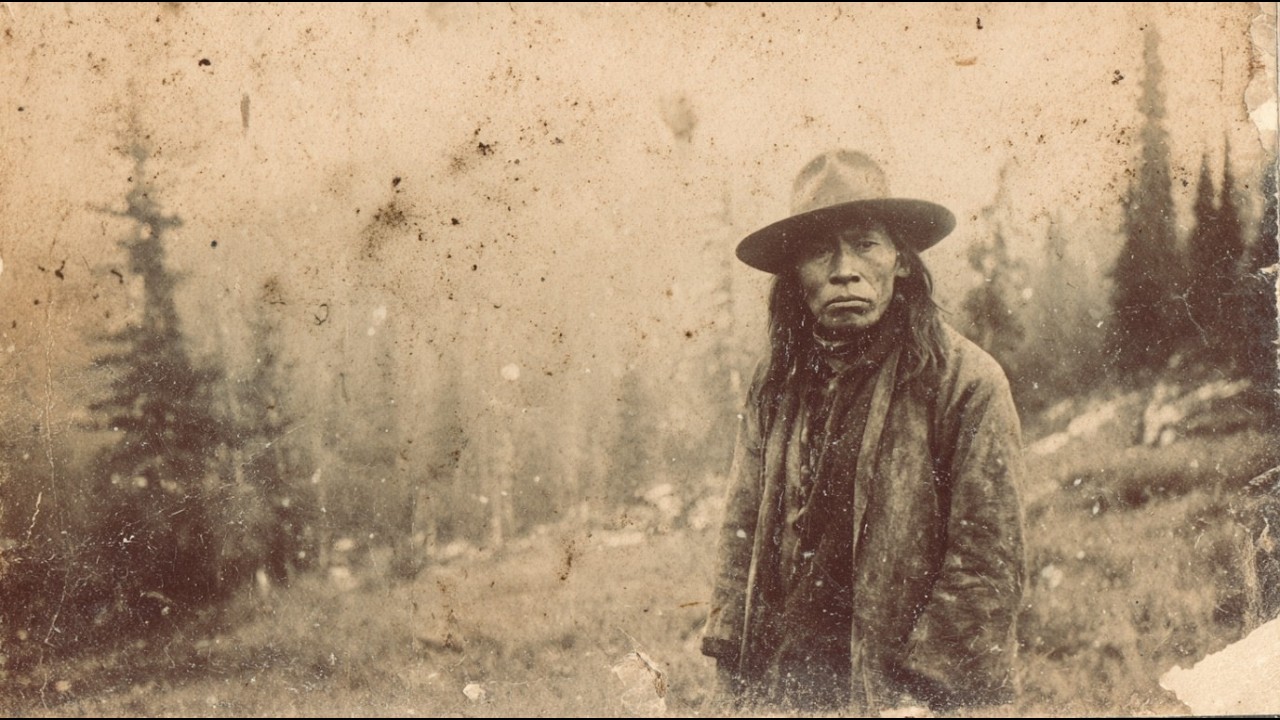
His face was deeply lined, and his eyes were dark and unreadable. He stood completely still, not tense exactly, but alert, aware of everything around him. Quentin saw him first and stopped what he was doing, one hand still on the rope he’d been tying. Mercer turned and followed his gaze.
For a long moment, nobody spoke. The only sound was the creek running over stones and the occasional stamp of a mule’s hoof. Then the man said something in a language Mercer didn’t recognize. Ute, probably, though Mercer wasn’t familiar enough with indigenous languages to be sure.
His tone was neither friendly nor hostile. It was flat, stating something rather than asking. Mercer walked toward him slowly, hands visible and away from his sides. He had enough experience in the territories to know that showing respect was always the right approach.
“We don’t speak your language,” Mercer said, keeping his voice level. “Do you speak English? ”
The man studied him for a moment, his dark eyes moving from Mercer’s face to his hands, to the equipment scattered around the camp, taking inventory. Then he nodded once, a small economical movement.
“You go up there? ” He gestured toward the north, toward the ridge that blocked their view of the valley Mercer had been planning to survey. His English was clear but accented, with pauses in unexpected places. “That’s the plan,” Mercer said.
“We’re making maps for the government. United States Geological Survey. ”
The man’s expression didn’t change, but something shifted in his posture. He looked past Mercer toward the ridge, toward the valley they couldn’t see from where they stood, and when he looked back there was something in his face that Mercer couldn’t quite identify, not fear, not exactly, something older than fear.
“That place is not good,” the man said, and the way he said it, without emphasis, made it sound more serious than if he’d shouted it. “You should not go there. ”
Quentin had walked over to join them, moving quietly, clearly curious. “Why not?
” he asked. The man looked at him, then back at Mercer, as if deciding whether they were worth the effort of explanation. “The old people say that valley is forbidden. Nothing lives there.
The animals do not go there. The water does not taste right. It is a bad place. Has been bad for longer than anyone remembers.
”
Mercer had heard this kind of thing before in Colorado, Wyoming, and Montana: indigenous peoples warning about certain locations, usually with spiritual or traditional reasons that seemed like superstition to white men educated in eastern schools and taught to trust science over folklore. But Mercer had also learned the hard way sometimes that those warnings often had practical reasons underneath the spiritual explanations. Sometimes those places were genuinely dangerous, unstable ground or areas prone to flash floods. Sometimes they were traditional boundaries between tribal territories.
And sometimes, very occasionally, they were places that Mercer couldn’t explain even to himself. “What makes it bad? ” Mercer asked, keeping his tone neutral and respectful. He genuinely wanted to know.
The man was quiet for a moment, as if deciding how much to say, or how to say it in a language that wasn’t his first and might not have the right words anyway. “My grandfather told me stories when I was young. Before the white men came to these mountains, before his grandfather’s time even, our people knew that valley. They did not name it because to name something is to claim it, and no one wanted to claim that place.
They marked it with stone so people would know not to enter. They said things lived there that were not animals, not spirits either. Things that looked wrong when you saw them. Things that moved wrong.
People who went in did not always come out, and those who did come out were not the same afterward. They would not speak of what they saw. Some of them went mad. Some of them died soon after for no reason the medicine men could find.
”
Quentin glanced at Mercer, and Mercer could read the skepticism in his face. But Mercer had learned a long time ago that dismissing local knowledge, even when it sounded like superstition, was a mistake that could get you killed or lost or both. “We appreciate the warning,” Mercer said carefully. “But we have a job to do.
The government sent us here to make maps. We’ll be careful. ”
The man looked at him for a long time, and there was something in his eyes that Mercer would remember later, lying awake in the dark. Not judgment, not anger.
Sadness maybe. The kind of sadness that comes from watching someone walk toward danger and knowing there’s nothing you can do to stop them. “Careful does not matter in that place,” the man said quietly. “Being careful is what white men do when they understand the danger, but you do not understand.
You cannot understand until you see, and once you see, being careful will not help you. You should not go. ”
He turned and walked back down the trail without another word, moving with the easy grace of someone who’d spent his entire life in these mountains, disappearing into the trees below within moments. Mercer and Quentin watched him disappear.
The sound of his footsteps faded quickly, absorbed by the forest. “Well,” Quentin said after a long moment, “that was unsettling. ”
Mercer didn’t answer immediately. He was thinking about the man’s face, that look of sadness, something deeper than personal loss, something that suggested generations of knowledge, warnings passed down through families and tribes for reasons that had been forgotten but were still respected.
“We’re still going,” Mercer said finally, because the job needed to be done, and warnings without specifics weren’t enough to justify abandoning a survey. Quentin nodded. He didn’t look happy about it, but he nodded. “Figured you’d say that.
”
They finished loading the mules, checking the packs twice to make sure nothing would shift during the climb. Mercer’s surveying equipment was packed carefully, wrapped in canvas, and secured with extra rope, because a broken transit or damaged theodolite would end the survey and waste weeks of work. They filled their canteens from the creek, ate a quick breakfast of hardtack and dried meat, and started up the trail toward the ridge. The climb took most of the morning.
The terrain was steep but manageable, a series of long switchbacks cutting through stands of spruce and aspen that thinned as they gained elevation until they were walking through scattered pines clinging to rocky soil. The air grew thinner, and they had to stop periodically to let the mules rest and catch their breath. By noon they’d reached the ridgeline and could see down into the valley for the first time up close. It was smaller than Mercer had estimated from his earlier vantage point, maybe two and a half miles long and perhaps a third of a mile across at its widest.
The floor was relatively flat, covered in what looked like scrubby vegetation, gray-green in the early summer light, nothing like the meadow grass in the valleys below. A stream ran through the center, cutting a dark line through the lighter terrain, and there were patches of darker ground scattered across the valley floor that might have been bogs or just wet soil or something else entirely. The ridges on either side rose steeply, bare rock near the summits with scattered pines clinging to the slopes below, and the whole valley had an enclosed feeling, as if it were cupped between two hands. It looked like a hundred other high mountain valleys Mercer had surveyed over the years, except there was something about the light.
Mercer couldn’t put his finger on it at first, standing there on the ridge with the sun high and the sky clear, but the valley seemed darker than it should have been, as if the shadows were deeper or the colors more muted, as if the light itself was being absorbed by something. He told himself it was probably just the angle of the sun or the composition of the rock, or maybe his imagination influenced by the warning they’d received. Quentin was staring down into the valley with an expression Mercer couldn’t quite read. Not fear exactly, but something close to it.
Unease. “You feel that? ” Quentin asked quietly, not taking his eyes off the valley below. “Feel what?
”
“I don’t know. Something off. Like the air’s different or the temperature’s wrong or something I can’t name. ”
Mercer had felt it too, a subtle wrongness that he couldn’t identify, but he wasn’t going to admit that out loud because admitting it would mean taking it seriously, and taking it seriously would mean questioning whether they should continue.
A vague sense of unease wasn’t a reason to abandon a survey. Mountains played tricks on perception. The indigenous man’s warning had probably primed them psychologically to see or feel things that weren’t actually there. “Let’s get down there,” Mercer said, more firmly than he felt.
The descent was harder than the climb had been. The trail, if it could even be called that, was barely visible, just a faint track through loose scree that might have been made by animals or might have been imagined. The slope was unstable in places, loose rock that shifted underfoot, and they had to lead the mules carefully to keep them from losing their footing and starting a slide that could injure them or destroy equipment. It took them another two hours to reach the valley floor, moving slowly, testing each step.
The moment they stepped off the slope onto level ground, the silence hit them. Complete silence. Not quiet. Silence.
There’s a difference. No birds, no insects, no rustle of wind through grass, even though Mercer could see the grass moving slightly. The stream they’d seen from above was there, running over rocks maybe twenty yards away, but even that seemed muted, quieter than it should have been for the volume of water moving. Mercer stopped and listened, really listened.
Quentin had stopped too, and the mules had their ears back, shifting nervously, pulling slightly against their lead ropes. “This isn’t right,” Quentin said, and there was no skepticism in his voice now, just flat statement of fact. Mercer couldn’t argue. He’d been in plenty of remote places where you might not see another person for weeks, but there was always some kind of ambient noise, even if it was just wind moving through trees or the faint buzz of flies.
Here there was nothing. The air itself felt heavy, thick, like it resisted movement. And when Mercer waved his hand in front of his face, he could swear the motion felt slower than it should. He pulled out his compass to take a bearing.
The needle was spinning, not slowly, not the gradual drift you might see near a large iron deposit. It was rotating in complete circles, fast, like something was pulling it in all directions at once. Mercer tapped the compass casing, thinking it might be stuck or damaged from the descent. The needle kept spinning.
Mercer pulled out his pack, the old brass one his father had given him when he’d first started surveying. Same thing. The needle wouldn’t settle, wouldn’t point north or any other consistent direction, just spun and spun. “Magnetic anomaly,” Mercer said, more to himself than to Quentin, trying to fit this into a framework that made sense.
There must be a significant iron deposit nearby, or volcanic rock with high magnetic content. It happens sometimes in mountain regions. “Or something else,” Quentin muttered. Mercer ignored that because considering other explanations meant acknowledging possibilities he didn’t want to acknowledge.
Magnetic anomalies were rare but not unheard of. They could throw off compass readings for considerable distances. It would make surveying more difficult, but not impossible. He’d have to rely on celestial navigation and triangulation from known peaks.
More time-consuming, but doable. They walked further into the valley, leading the mules, moving slowly because the animals were clearly unhappy and kept trying to turn back toward the slope they’d descended. The ground was firm enough, slightly spongy in places, covered in the strange vegetation Mercer had seen from above. Up close it looked even more wrong.
The plants were low bushes, maybe knee-high, with leaves that seemed too dark, almost black-green, and completely devoid of flowers or seed heads, even though it was June and everything else at this elevation should have been in bloom. The leaves felt wrong when Mercer touched them, too thick, waxy. And when he broke one off to examine it, the smell was unpleasant, chemical, wrong. There were no trees anywhere in the valley, which was unusual for this elevation and latitude.
Scattered pines should have dotted the floor, and there should have been willows along the stream, but there was nothing taller than the low bushes. The whole valley had a barren quality that didn’t match the surrounding terrain, as if something prevented normal growth. After about half an hour of walking, maybe a third of the way into the valley, they found the first cairn. It was a stack of stones about waist-high, deliberately constructed.
The rocks were flat and stacked carefully with the precision that suggested human hands, not natural rockfall. On top was a piece of weathered cloth, so faded by sun and rain and snow that its original color was impossible to determine. Tied to the cloth was a bundle of what looked like dried plants or grasses, bound with what might have been sinew or rawhide, so old it was brittle. Quentin walked around it slowly, not touching it, examining it from different angles.
“This is what he was talking about. The markers. ”
Mercer crouched down to look at how the stones were placed. The cairn was old, probably decades old at minimum, maybe longer.
The cloth was disintegrating at the edges, and the rocks had lichen growing on them in patterns that took years, sometimes decades, to develop at this altitude where growth was slow. “Warning markers,” Mercer said, trying to sound analytical and professional. “Territorial boundaries, probably, or marking a sacred site. ”
“Maybe,” Quentin said.
He didn’t sound convinced, and he kept looking around as if expecting something to appear. They continued deeper into the valley, moving toward where Mercer wanted to set up their first survey station, and they found two more cairns over the next hour. Each one similar to the first, each one placed carefully, forming a rough perimeter across the valley floor, as if marking where people were supposed to stop, beyond which they should not pass. Mercer decided to set up their equipment near the stream, figuring the water would be useful and the ground was flat enough for the transit.
While Quentin tended to the mules and started setting up a basic camp, just enough to get them through a night if they needed to stay over, Mercer assembled his transit and began taking readings, sighting on peaks he could see from the valley floor, recording angles and measurements. The work was methodical and familiar, and it helped push back the unease that had been growing since they’d entered the valley. Numbers and measurements were solid things, real things, and right now he needed that solidity. It was mid-afternoon when he noticed the smell.
Faint at first, easy to dismiss as imagination. Wet earth and decay, but sharper, more chemical. Not quite sulfur, but something in that family, or maybe something that had no comparison, no familiar reference point. It seemed to be coming from further up the valley, from the direction of the darker patches of ground they’d seen from the ridge, areas they hadn’t explored yet.
Quentin noticed it too. He stopped what he was doing, lifting his head like an animal testing the wind. “What is that? ”
“Could be hot springs,” Mercer said.
“Volcanic activity. The Wasatch Range has geothermal features, sulfur springs, things like that. ”
“Smells wrong for sulfur,” Quentin said. “I’ve been near sulfur springs.
This isn’t that. ”
Mercer couldn’t argue. He’d been near hot springs before, in Yellowstone and other places. This wasn’t quite the same.
The smell had a quality that was organic but also chemical, like decay and also like something burning, and underneath it all was something else, something he had no words for. They worked through the rest of the afternoon, Mercer taking measurements while Quentin explored the immediate area, looking for decent grazing for the mules, though there wasn’t much. The animals were still nervous, refusing to move far from where they’d been tied, and they weren’t eating the sparse grass that grew near camp. They stood with their ears back, occasionally making low sounds of distress, and no amount of coaxing would calm them.
As the sun started to drop behind the western ridge, the temperature fell rapidly. Mountain evenings were always cold, the thin air losing heat quickly once the sun disappeared, but this felt more severe than it should have been for mid-June. The light went strange again, the shadows lengthening too quickly, the colors draining from everything until the whole valley looked monochrome, shades of gray and black, with no warmth anywhere. They made camp near the stream, building a small fire with wood they’d brought with them, since there was nothing to burn in the valley itself.
No deadfall, no branches, nothing. They heated coffee in a battered pot and ate cold rations, hardtack and dried beef, neither of them talking much. The silence of the valley had infected them, made conversation feel wrong somehow, or maybe they just didn’t want to voice what they were both thinking. The silence was worse after dark.
Mercer had never experienced silence like this. No coyotes yipping in the distance, no owls calling, no rustle of small animals moving through brush. Nothing. Just the faint sound of the stream, and even that seemed to fade in and out, as if the water itself was uncertain, and the occasional crackle from their fire, which sounded too loud in the stillness, almost obscene.
Mercer tried to sleep but couldn’t. He lay in his bedroll staring up at stars that seemed too bright, too sharp, as if the air were thinner than it should have been at this elevation, or as if he were looking at them through water. The constellations were right, he recognized them, but they felt wrong somehow, arranged correctly but alien. Quentin was awake too.
Mercer could hear him shifting position every few minutes, the sound of his breathing deliberate and controlled, as if he were forcing himself to breathe normally. Around what Mercer estimated was midnight, though without a working compass he couldn’t check his watch’s accuracy, the smell got stronger. Not gradually. All at once, like a door had opened somewhere upwind.
Mercer sat up. Quentin was already sitting up, his face pale in the starlight. “You smell that? ” Quentin whispered.
Mercer did. The same chemical decay odor from earlier, but much more intense now, strong enough to make his eyes water and his throat close, strong enough to make him want to gag. And then they heard the sound. Not a sound, exactly, more like the absence of sound moving toward them.
A zone of deeper silence approaching from further up the valley, from the direction they hadn’t explored. And as it came closer, the smell intensified, became almost unbearable. The mules began making noise. Not braying, exactly, but a low distressed sound Mercer had never heard from them before, something primal and terrified.
“We should go,” Quentin said. His voice was tight, controlled panic. “Right now. We should go right now.
”
Mercer wanted to argue, wanted to say they were being irrational, that there was probably a simple explanation, gas escaping from underground, or wind patterns they didn’t understand. But he couldn’t. Every instinct he had was screaming at him to leave immediately. “Pack up,” he said, his voice coming out rougher than he intended.
They worked quickly and quietly, stuffing gear into packs by the light of their dying fire, not bothering with organization, just getting things secured enough to move. The mules were agitated, pulling at their tethers, making that awful sound. Mercer’s hands were shaking as he tied ropes, and he couldn’t tell if it was from fear or from the cold that seemed to be intensifying, dropping to temperatures that felt more like January than June. As they finished loading, Mercer looked up toward the head of the valley, toward the darker patches of ground they hadn’t explored, toward where the smell seemed to be coming from.
Something was moving up there. Not walking, not quite. The shape was wrong for walking, too long and low to the ground, and its height seemed to change as it moved, sometimes flattened against the earth, sometimes rising up. And it moved in a way that didn’t match anything Mercer had ever seen, flowing rather than stepping, undulating across the barren ground, and where it passed, the ground seemed to darken further, as if the thing itself were absorbing light, creating a wake of deeper shadow that persisted after it moved on.
“Mercer. ” Quentin’s voice was barely audible, tight with fear. “Mercer, we need to go right now. ”
But Mercer couldn’t move.
He stood frozen, watching the shape, trying to understand what he was seeing, trying to fit it into any category his mind could process. It was large, maybe eight or ten feet long, but its dimensions seemed to shift, and there were appendages, maybe legs, maybe something else, too many of them, moving in a pattern that made his stomach turn and his vision blur, geometries that his brain rejected as impossible. And then it stopped moving. It stopped.
And though Mercer couldn’t see eyes or a head or anything that would indicate awareness or direction, he knew with absolute certainty that it was looking at them, that it had become aware of their presence. The smell became overwhelming. Mercer’s eyes streamed, his lungs burned with each breath. Quentin grabbed his arm and pulled him, physically dragged him.
“Move! Now! ”
They ran, not down the valley toward the trail they’d used to descend, because that would take them closer to the thing. They ran laterally toward the western ridge, the slope they hadn’t come down, hoping to find a way up in the dark, hoping there was a way up at all.
The mules followed without needing to be led, their fear overriding their usual stubbornness and careful footing. The sound of hooves on rock was loud in the silence, echoing off the ridges, and Mercer had the horrible certainty that the thing behind them could hear every step, could track them by sound alone in this valley where nothing else made noise. They scrambled up the rocky slope in near total darkness, using moonlight and starlight and desperation. Mercer fell twice, his hands hitting sharp rock, tearing skin, but he didn’t stop, didn’t slow down.
Behind them, maybe a hundred yards back, maybe less, he could hear something moving through the valley, not pursuing exactly, at least not in a straight line, but paralleling them, keeping pace. And there were sounds now, not the absence of sound, but actual sounds: wet sliding noises, and something that might have been breathing if breathing could sound like wind through a tunnel. The climb seemed to take hours, though it was probably only thirty or forty minutes of desperate scrambling over loose rock and around obstacles they could barely see. When they finally reached the ridgeline, gasping for breath in the thin air, Mercer risked a look back.
The valley below was completely dark, darker than it should have been, darker than simple nighttime shadow. No moonlight reached the floor. It was like looking into a hole in the world, into absence itself. But he could see movement down there.
Multiple shapes now, not just one. They moved across the valley floor in patterns that hurt to watch, that made his eyes water and his head ache, geometries that didn’t make sense, things that moved in ways that violated every law of physics and biology he’d ever learned. And the smell reached them even up here, carried on wind that shouldn’t exist. They didn’t stop on the ridge to try to make sense of what they were seeing.
They didn’t take photographs or measurements or any of the things a surveyor is trained to do. They just kept moving, following the ridgeline east in darkness, stumbling over rocks and through scattered pines until they found a way down the far side, back toward terrain they recognized, back toward their original base camp. They walked through the night without speaking, without stopping, except when absolutely necessary. The mules followed, still nervous but calmer once they’d put serious distance between themselves and the valley.
Mercer’s hands were torn up from the falls during their climb, starting to throb and swell, but he barely noticed. His mind was still trying to process what he’d seen, trying to fit it into any framework that made sense, and failing completely. They reached their base camp meadow around dawn, the sun coming up behind the mountains to the east, and the light seemed impossibly bright after the darkness of the valley, almost painful. Everything looked normal here, safe, ordinary.
The meadow grass was green and ordinary. The creek ran clear and sounded right. Birds were singing, normal birds making normal bird sounds. Quentin collapsed onto the ground near the cold fire ring and put his head in his hands.
He was shaking. Mercer stood looking back the way they’d come. His surveying equipment was still down there, his transit and theodolite, expensive government property that he was responsible for, but he couldn’t make himself care about that right now. “What was that?
” Quentin said finally, his voice muffled by his hands. “What the hell was that? ”
Mercer didn’t answer because he didn’t have an answer. Everything in his education, all his years of experience mapping remote territories, all the scientific training he’d received, none of it provided any explanation for what they’d witnessed.
They stayed at the meadow camp for two days, neither of them suggesting they return to the valley. They barely talked at all, just went through the motions of camp life, eating and sleeping and tending to the mules. Mercer’s hands healed slowly, the cuts scabbing over, and he spent hours staring at nothing, replaying what he’d seen, trying to find some rational explanation, and finding none. On the third day, Mercer made a decision that Quentin clearly thought was insane.
“I’m going back,” he said. Quentin stared at him. “You’ve lost your mind. ”
“Maybe,” Mercer admitted, “but I need to document this.
I need photographs, physical evidence, otherwise no one will ever believe what we saw. They’ll think we were hallucinating or lying. ”
“I don’t care if anyone believes us,” Quentin said flatly. “I’m not going back there.
”
Mercer understood. He wouldn’t have forced it, wouldn’t have even suggested Quentin come along, but he couldn’t leave without at least trying to get some kind of proof, something that would validate the experience and convince someone, anyone, that what they’d encountered was real. After a long discussion, Quentin agreed to wait at the base camp while Mercer made a solo trip to the ridgeline above the valley, not down into it, absolutely not descending to the floor, just to a vantage point where he could take photographs and observations during daylight when whatever they’d seen might be less active. Mercer left the next morning early, carrying his camera, a tripod, binoculars, and his field notebook.
He left the mules with Quentin. If something happened, if he didn’t come back, Quentin could get out on his own. The climb to the ridgeline took him most of the day, moving carefully, stopping frequently to rest and to listen, every sense alert for any sign of the wrongness they’d experienced. But the terrain seemed normal.
The silence was ordinary mountain silence, with bird calls and insect noise. By the time he reached the ridge overlooking the valley, it was mid-afternoon with good light for photography. He approached the crest carefully, staying low as he neared the top, moving slowly and quietly, as if whatever was in the valley might somehow see him from below or sense his presence. When he finally looked down into the valley, it appeared completely normal.
Flat terrain covered in the strange dark vegetation, the stream running through the center, the same barren quality they’d noticed on their first approach. But nothing moving. No shapes. No zone of darkness that absorbed light.
No smell. Just an empty valley. Mercer set up his camera on the tripod, hands still somewhat stiff from the healing cuts, and took several photographs, long exposures to capture as much detail as possible in the afternoon light. He used a full plate for each shot, knowing these might be the only evidence he’d ever have.
He sketched the valley’s layout in his notebook, marking the approximate locations where they’d seen the cairns and where they’d made camp. He tried to describe what they’d seen, the shapes and movements, but words failed him. He took compass readings and found that his compass worked fine from the ridge. Whatever caused the magnetic anomaly was localized to the valley floor itself, maybe something in the ground, maybe something else.
He watched through binoculars for three hours, scanning every part of the valley floor he could see, looking for any sign of movement. Nothing. The valley sat under the afternoon sun, quiet and apparently empty. Mercer began to doubt himself.
Had they been hallucinating? Altitude sickness could cause vivid hallucinations, and they’d been at elevation for weeks. The isolation combined with the indigenous man’s warning could have primed them psychologically to see things that weren’t there, suggestion and expectation creating shared delusion. But the smell.
They’d both smelled it, so strong it made them gag. Hallucinations didn’t create shared olfactory experiences. And the mules. The animals had been terrified, making sounds he’d never heard from them.
You couldn’t explain that away with psychology or altitude or suggestion. As the sun started to drop behind the western ridge, throwing long shadows across the valley floor, Mercer packed up his equipment and began the descent back toward base camp. He’d gotten what he came for, photographs and observations, even if they didn’t capture what he’d actually witnessed. He was maybe halfway down, picking his way carefully through loose rock, when he heard the sound.
Faint and distant, coming from the valley, but unmistakable. A kind of low-frequency vibration that he felt more than heard, like the earth itself was humming or groaning, a sound that seemed to resonate in his chest and make his teeth ache. He stopped moving and listened. The sound continued for maybe thirty seconds, rising and falling slightly in pitch, then stopped abruptly.
Mercer looked back toward the valley, but from this angle he couldn’t see the floor anymore, just the ridges surrounding it, silhouetted against the darkening sky. He didn’t linger. He descended as fast as the terrain and fading light allowed, not quite running, but moving with purpose, and he didn’t stop or look back until he was well away from the ridge and the valley it overlooked. He reached the meadow camp after full dark, exhausted and unnerved.
Quentin took one look at his face and didn’t ask what happened, just handed him coffee and let him sit by the fire until he was ready to talk. When Mercer finally did talk, describing the empty valley and the sound he’d heard during his descent, Quentin just nodded. “We’re leaving tomorrow,” Quentin said, “first light, and we’re not coming back. ”
Mercer didn’t argue.
They broke camp at dawn and headed back toward Heber City, following the trails they’d taken to reach this part of the range. The remainder of Mercer’s survey season was spent in different areas, valleys and ridges that didn’t have warnings attached to them, places where compasses worked and the silence was normal, and nothing moved in ways that violated the laws of nature. He completed his assignment, mapped several thousand square miles of mountain terrain, and filed his reports with the USGS, detailed topographical maps and elevation data that would be used for decades. He did not include the unnamed valley in his reports.
His field notes from that trip contained sketches and compass readings and descriptions of terrain for every location they’d surveyed, but when he came to the page for June 19th through June 22nd, the space where he should have recorded data for the valley, he had written only a single sentence in handwriting that was less neat than his usual precise script:
“Unable to complete survey of valley at approximately 46N 111. 3W due to equipment failure and adverse conditions. Recommend avoiding this area for future survey work. ”
The photographs he’d taken from the ridgeline were developed when he returned to the office in Salt Lake City.
They showed the valley clearly, empty and barren under afternoon light. He studied them for hours, looking for any detail he might have missed, any shadow or shape that would explain what they’d experienced. But the photographs showed nothing except an ordinary, if somewhat desolate, mountain valley. He never submitted them to the survey.
He kept them in his personal files, and sometimes late at night in his small apartment, he would take them out and stare at them, trying to reconcile the empty valley in the images with what he knew was there. He found nothing in the photographs, but he noticed something else. In one image, in the far background where the valley extended beyond the visible floor, there was a dark area that might have been shadow, but might have been something else. A zone where the photographic emulsion seemed somehow wrong, the texture different, as if something had affected the chemical process itself.
He had that particular photograph analyzed by a colleague who specialized in photographic chemistry, asking vague questions about exposure problems and chemical anomalies. The colleague couldn’t explain it. The emulsion in that section of the plate had been altered in a way that shouldn’t happen with normal exposure or development, as if something had interfered with the process at a molecular level. Mercer filed that information away and never mentioned it again.
Quentin left packing work after that season and went back to his family’s ranch in the valley below Heber City. He and Mercer stayed in loose contact for a few years, exchanging letters occasionally, carefully avoiding the subject of that valley. In one letter, written in the winter of 1913, Quentin mentioned that he’d been having trouble sleeping. That he’d gone to see a doctor in Salt Lake City because the dreams had gotten so bad he was afraid to go to bed.
Always the same dream, he wrote. Walking in the valley at night, the smell overwhelming, shapes moving at the edge of his vision, and the terrible certainty that if he looked directly at them, if he actually saw them clearly, something fundamental would break in his mind. He would wake up gasping, convinced he could still smell that chemical decay odor. And sometimes it took hours before he could convince himself it wasn’t real, that he was in his bedroom and not in that valley.
The doctor had diagnosed nervous exhaustion, a catch-all term for things doctors didn’t understand, and prescribed rest and a change of scenery. Quentin wrote that he was considering selling his share of the ranch and moving somewhere else, somewhere far from mountains, maybe the coast or the flat plains of Kansas where you could see for miles and there were no hidden valleys. That was the last letter Mercer received from him. He wrote back twice, but never got a reply.
Years later, in 1921, Mercer made some inquiries and learned that Quentin had indeed sold his portion of the family ranch and moved somewhere east. No forwarding address. No word to anyone about where he was going or why. Just gone.
In 1915, Mercer transferred to the Coast and Geodetic Survey and spent the next decade mapping coastlines in California and Oregon, work that kept him near sea level and far from mountain valleys. He married in 1917, a woman named Catherine who taught school in San Francisco, and they had two daughters who grew up hearing their father’s stories about surveying remote territories, but never hearing about a certain valley in Utah. Mercer lived what most people would call a successful and ordinary life. A career that earned him modest recognition in his field, a family that loved him, a comfortable house in Oakland with a view of the bay.
He never went back to Utah, never tried to locate the valley on maps or in survey records, never spoke to anyone except Quentin about what they’d seen. And after Quentin disappeared from contact, Mercer kept it entirely to himself. But sometimes, on summer nights when the air was still and the city was quiet, he would wake up in the dark and lie there next to his sleeping wife, listening to the silence, checking it the way you might check a wound, making sure it was normal silence, the kind with distant sounds of wind and cars and the house settling, the kind of silence that was just absence of noise and not the other thing. Making sure it wasn’t the absolute kind of silence, the kind that pressed against your ears like a physical force, the kind that meant something was coming.
And on those nights, lying there in the dark, Mercer would remember the smell and the shapes that moved wrong, and the terrible certainty he’d felt that they’d seen something that existed outside normal categories of existence. Something that had been in that valley long before humans came to Utah, long before the indigenous peoples who’d marked it with cairns and warnings. Something that would still be there long after humans were gone. In 1943, near the end of his life, Mercer wrote a letter that he sealed and left with his personal papers, with instructions that it not be opened for fifty years.
The letter was discovered in 1993 by a graduate student researching the history of western surveying. The letter described the valley and what they’d seen and included the coordinates he’d recorded, as precise as he could make them without functioning compass bearings. The letter ended with a warning:
“I am an educated man. I was trained in scientific methods and rational analysis.
I do not believe in ghosts or spirits or anything that cannot be measured and observed. But I know what I saw in that valley, and I know that some places on this earth are not meant for human habitation or exploration. Whatever is there, whatever those things were, they should be left alone. Do not seek this place.
Do not try to verify my account. Some doors, once opened, cannot be closed, and some knowledge cannot be unlearned. Let it remain forgotten. ”
The graduate student who found the letter tried to locate the valley using the coordinates Mercer had provided.
Modern topographical maps of the area showed nothing unusual, just wilderness, part of the Uinta-Wasatch-Cache National Forest now. The student organized a hiking trip with several colleagues intending to visit the location and document what, if anything, made it remarkable. They never found it. The coordinates led them to a region of difficult terrain, steep ridges and dense forest, and after three days of searching, they gave up.
In his thesis notes, the graduate student wrote that Mercer’s coordinates were probably approximate and affected by the magnetic anomaly he’d reported, making precise relocation impossible without more detailed information. But one member of that hiking party, a geology student named Sarah Chen, wrote in her private journal that on their second day of searching, they’d climbed a ridge that might have overlooked the valley Mercer described, and from that vantage point, she’d seen an area below that looked wrong somehow. The vegetation was darker, the shadows were deeper, and even from a distance of maybe a mile, she’d felt a strong reluctance to descend toward it, an instinctive revulsion that she couldn’t explain. The group had decided to try a different approach instead, and they’d never gotten close to that area.
But Sarah wrote that she’d been glad for that decision, that there had been something about that distant valley that made her skin crawl, and that she’d had nightmares for weeks afterward about walking through a barren place where nothing made sound and shapes moved in ways that her sleeping mind couldn’t quite visualize, but that left her waking up gasping. The valley is still there, presumably, somewhere in the Wasatch Range at about 10,500 feet elevation, surrounded by ridges that keep it hidden from casual hikers and marked with cairns that are probably weathered beyond recognition now. The indigenous peoples who warned about it are mostly gone, their language is dying, their stories forgotten or dismissed as superstition. But the valley remains, and whatever is in it, whatever Mercer and Quentin saw that night in 1911, is still there too.
Waiting.
