On the 2nd of March 1960, Lucille Ball and Desi Arnaz stood on a sound stage and played a married couple one last time. The cameras rolled. They said their lines. The most watched marriage in America finished its final scene.
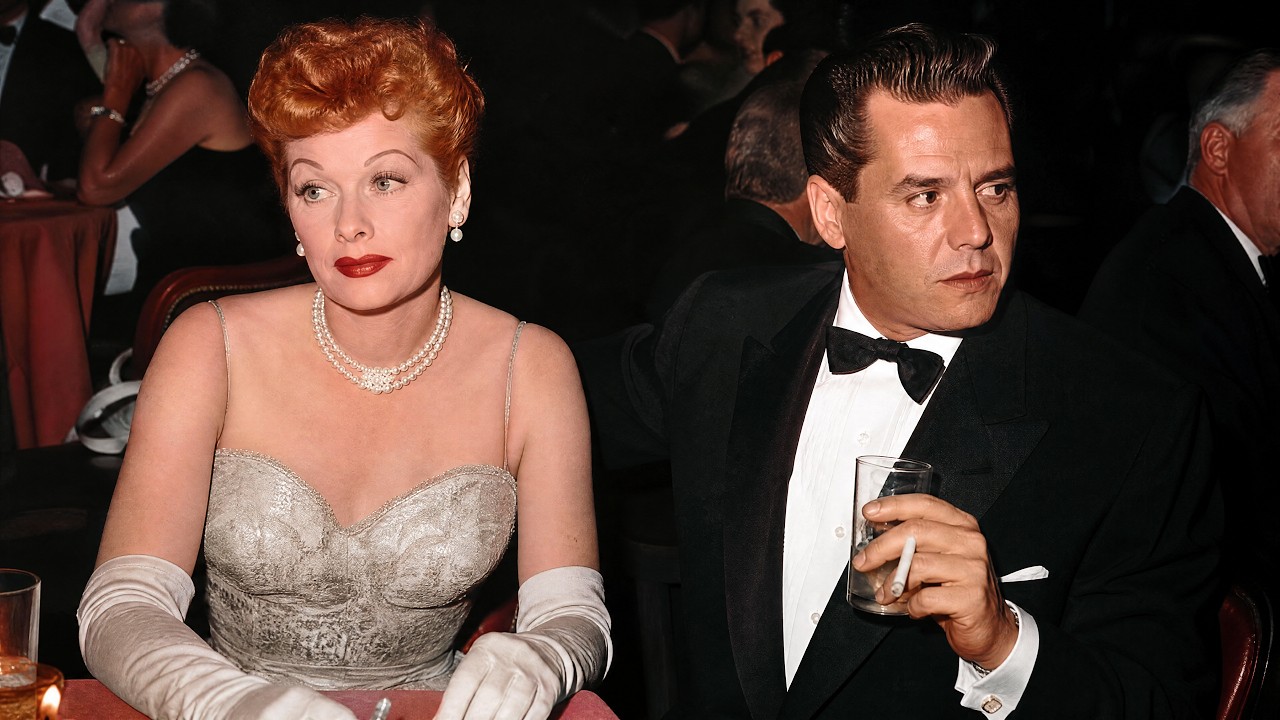
Two days later, on the 4th of March, she drove to a courthouse in Santa Monica and filed for divorce. Two days. That is all that stood between the happy Ricardos and the end of a marriage that had lasted almost twenty years. For nine years, the whole country had watched Lucy and Ricky Ricardo fight and forgive each other week after week and believed every minute of it.
They had no idea they were watching two people perform the one thing they could no longer do off stage. The last time Lucille Ball and Desi Arnaz played husband and wife, they did it for a camera. Forty-eight hours later, she filed to end the marriage. It is one of the cruelest small facts in the history of American entertainment, and almost no one has ever stopped to count the days.
They filmed the final scene of their fictional marriage on a Wednesday. She filed to end the real one on a Friday. Between the two lay a single ordinary weekend, and inside that weekend was the whole distance between the couple the country adored and the couple they actually were. For nine years, America had been let into that marriage every Monday night.
They watched a scheming red-headed housewife and her patient Cuban band leader husband quarrel and scheme and shout, and at the end of every single episode, forgive each other. That was the engine of the whole thing. The trouble built through twenty minutes, and then in the last moments it dissolved into affection. Lucy and Ricky always made up.
The country learned to expect it the way you expect the sun. Whatever went wrong, however loud it got, they would be all right by the closing music. The numbers behind that habit are hard to hold in the mind even now. I Love Lucy finished first in the national ratings for four of its six seasons.
It premiered in October 1951, and within months it was the most watched program in the United States, and it stayed at the top for years. At its height, it reached audiences no program had ever touched. On one January night in 1953, the country watched the fictional wife give birth, and roughly 44 million homes were tuned in—a larger crowd than gathered the next morning to watch a president take the oath of office. For a stretch in the middle of the 1950s, more Americans were watching the Arnaz marriage than were doing almost anything else at the same hour.
And all of it was a performance of a thing that was already failing. The couple who forgave each other on camera every week could not manage the same reconciliation in their own house. The marriage was strained almost from the start by his drinking, by his gambling, by other women, by years spent on separate coasts while he toured with a band and she worked in Hollywood. The show was supposed to be the cure.
For a while, everyone believed it had worked—including, for a while, the two of them. They were not only the most beloved performers in the country. They were two of its shrewdest business people, the owners of a company that would grow into the largest television studio in the world. He invented much of the way the medium still makes money to this day.
She would become the first woman ever to run a major Hollywood studio. They built an empire together, and they did it while pretending on camera to be an ordinary Connecticut couple. The scale of what they achieved is part of what makes the private wreckage so hard to look at. For many of the people watching this now, none of this is history.
It is memory. They were there on those Monday nights—children on the floor in front of the set, mothers in the next room, a whole country keeping the same appointment at the same hour. They grew up with Lucy and Ricky the way you grow up with neighbors. That is the strange power of this marriage.
It did not belong to two people in California. It belonged to everyone who ever laughed at it and everyone who ever believed it, which was very nearly the entire nation. This is a story about the gap between a photograph and a life, about a marriage that the whole country used as a mirror of its own happiness while the two people inside it slowly came apart. And it begins, as these stories so often do, with a borrowed wedding ring and a man nobody thought she should marry.
She was twenty-eight, and the studios called her the queen of the B pictures. Then a twenty-three-year-old Cuban walked onto the set. The year was 1940. The picture was a musical called Too Many Girls, made at RKO, and Desi Arnaz had been brought in to play a version of the thing he already was: a charming Latin band leader.
Lucille Ball had spent a full decade in Hollywood by then, working constantly and rising slowly, pretty and reliable, and never quite allowed to be a star. She had been passed from RKO to Metro-Goldwyn-Mayer and back down again—a contract player the studios used constantly and never quite trusted with the top rank. The title the industry gave her, queen of the B pictures, was meant to sound like a crown. It was really a ceiling.
It meant she worked without stopping and was never given the leading place. Ten years of that teaches a certain hardness. It teaches a woman not to expect the men who run her business to hand her anything. And it is exactly why, when a second chance arrived years later, she would seize control of it with both hands and never once let go.
He was five years younger, new to the country’s film world, loud and quick and magnetic. She was the seasoned professional who had learned to expect very little. The attraction was immediate and mutual, and it moved faster than anyone around them thought wise. Within six months, they had decided to marry.
Desi Arnaz had not come from nothing, though he arrived in America with almost nothing. He was born in Santiago de Cuba in 1917, the only son of a wealthy and powerful political family. When the Cuban Revolution of 1933 swept his family’s world away, they lost the houses, the money, the standing—everything—and landed in Florida to begin again from the bottom. One year the son of a leading family, the next a refugee starting over in a strange country with empty hands.
He built himself back with a smile and a band, playing his way up from nothing to a name. But the memory of everything his family had lost sat underneath all of it, and success, when it came, never quite settled him. A man who has watched one empire vanish does not fully believe in the next one. The courtship was as fast and combustible as everything else about them.
He performed at night. She filmed by day. They chased each other through what little time that left—two people who fought and forgave almost from the first week. The temper was there early on both sides, the shouting and the making up that would one day be sold to the whole country as comedy.
Friends warned them. The studios, protective of their investment in her, were uneasy. None of it slowed them down. They had decided, and when these two decided a thing about each other, no one on earth could talk them out of it—not in 1940, and not for the forty-six years that followed.
They eloped on the 30th of November 1940. They drove up from New York to the Byram River Beagle Club in Greenwich, Connecticut, and were married there. Desi had forgotten to bring a ring. That morning he bought one at a Woolworth counter, a few cents of stamped metal, and slipped it onto the finger of the woman who would one day sell a Hollywood studio for seventeen million dollars.
The whole shape of the story is already in that ring: the poverty at the start, the fortune at the end, and the marriage in between, held together with something cheap and bought in a hurry that neither of them would ever quite be able to let go of. The people around them saw a mismatch, and the era saw it, too. Here was the accented foreigner and the all-American redhead, a pairing the entertainment business would soon insist the public could never accept. The doubt about them started early, and it never fully went away.
It would surface again years later in a network boardroom, and it would shape the whole course of their careers. In 1940, there was only a young couple in love, a cheap ring, a beagle club in Connecticut, and a country that had not yet met them but was about to fall in love with them, too. Through much of the 1940s, Lucille worked in Hollywood while Desi took his orchestra out on the road night after night, city after city, hundreds of miles of American highway between a husband and a wife who had promised to build a life together. The telephone was their marriage for long stretches—a voice on a wire late at night from a hotel in a town neither of them would remember in the morning.
The strain of that distance is where the trouble first found room to grow. A man on the road, young and adored and far from home, drinking after the show, is a man with opportunities his marriage could not survive forever. The absences alone would have tested any couple. For this one, they were the beginning of a pattern that would define the next twenty years: a husband slipping away and a wife holding the marriage together across whatever gap he had opened.
By the end of the 1940s, they both knew that the only way to save the marriage was to stop living apart. And then, at exactly the right moment, television arrived. In 1950, the Columbia Broadcasting System wanted to move Lucille’s popular radio comedy, My Favorite Husband, onto the new medium. The network was enthusiastic about the star.
It was not enthusiastic about her real husband. CBS wanted a conventional American actor to play the part of Lucille’s on-screen spouse. The idea of putting a Cuban band leader with a heavy accent beside a red-haired all-American comedian struck the executives as a risk the audience would reject. It was the same doubt that had followed the couple since 1940, now spoken aloud in a boardroom with a career riding on it.
Lucille refused. She would not do the show unless Desi played her husband on the screen. It was a fight over casting, but for her it was something much larger. It was a way to put her marriage in one place at last, to work beside the man instead of waiting for his telephone calls.
She had spent a decade letting the industry tell her what she was worth. She would not let it tell her who her husband could be. To prove the network wrong, the couple built a live vaudeville act and took it out across the country. The crowds that turned out proved beyond argument that America would happily accept them as a pair.
Rather than simply take a network paycheck and do as they were told, Lucille and Desi formed their own company. They called it Desilu, a joining of both their names, and they built it in 1950. On paper, it was a production company. In truth, it was a marriage repair—a machine designed to keep two people in the same city doing the same work, sleeping under the same roof at last.
After ten years of highways and hotel telephones, they had engineered a way to simply be together. And for a brief and shining stretch, it worked. The marriage the public would soon adore and the marriage they actually lived came very close to being the same thing. They were partners in love and partners in business, building something that was theirs alone, in defiance of a network that had doubted them.
It would never be closer than it was right here, at the peak of the promise, before the whole country arrived to watch. Because the thing they built to save the marriage was about to become the most powerful show in America. And success for this couple would turn out to be far more dangerous than distance ever was. I Love Lucy had premiered on the 15th of October 1951, and within months it had done something no program had done before.
It became the most watched show in the United States, and it stayed there. The country did not simply enjoy it. The country organized its evenings around it—families gathering at the same hour every week to keep the same appointment with the Ricardos. The premise was the marriage.
Lucy Ricardo was a scheming, star-struck housewife, forever trying to force her way into her husband’s nightclub act. Ricky Ricardo was the band leader who loved her through every disaster she caused. The comedy ran on the friction between them, and it always ended in tenderness. And because the two performers really were married, because the affection on the screen came from somewhere real, the country believed it completely.
This was the great innovation hidden inside the laughter. The audience was not watching two actors pretend to be married. They were watching a real husband and a real wife play themselves, or a version of themselves. And the truth in it was what made it irresistible.
The Arnazes’ marriage stopped being a private thing. It became a national possession. Then the illusion pulled off its most astonishing trick. In 1952, Lucille became pregnant in real life, and rather than hide it, the show wrote the pregnancy into the story.
Lucy Ricardo would have a baby, too. The episode in which the fictional wife gave birth was scheduled for a January night in 1953. On that same night, by a planned cesarean, Lucille delivered a son, Desi Arnaz Jr. The country watched a fictional birth on the very evening of the real one.
The line between the show and the marriage did not blur. It vanished entirely. The nation and the family had a baby on the same night, and it felt to millions of people like something that had happened to them personally. The birth episode was seen in an estimated 44 million homes—a larger audience than the one that watched the inauguration of the president of the United States the following morning.
Their daughter Lucie had been born in 1951, the very year the show began. Their son arrived in 1953. A single family, invented and real at the same time, had become the most powerful thing on American television, and it was growing in front of the entire country, child by child, season by season. The public built a whole ideal out of them.
In a country still settling into the calm of the postwar years, hungry for images of the happy home, the Arnazes’ marriage became the picture on the wall. The magazine covers, the fan letters, the sponsors—all of it insisted that here was the perfect American family. Couples measured themselves against the Ricardos. Mothers saw their own kitchens in Lucy’s.
The show sold that home, and the country bought it. What the country could not see, behind the birth and the ratings and the adoration, was that the very success on the screen was already beginning to pull the real marriage apart. The bigger the show became, the more one of them worked and drank and strayed, and the more the other held the whole thing together with her hands. The image was flawless.
The life underneath it had already started to crack. And the man responsible for the flawless image, the man the audience thought of as the patient husband, was doing something in the background that no one watching understood at all. On the screen, he was the lovable band leader who rolled his eyes at his wife’s schemes. Off it, he was rebuilding the entire economics of the medium, and almost no one knew.
The decision that made them rich came at the very start of I Love Lucy, and it was his. The network wanted to broadcast the show live from New York and preserve it only on grainy, low-quality recordings, which was how television was made at the time. Desi refused. He insisted on filming the show in Hollywood on 35 mm film in front of a live studio audience.
This was far more expensive, and CBS would not pay the difference. So Desi and Lucille agreed to take a cut in their own salary to cover the extra cost. In exchange, they asked for one thing: they wanted to own the finished films outright. The network, certain that a comedy episode was worthless once it had aired, agreed.
It was one of the great miscalculations in business history. By owning those films, the couple owned I Love Lucy forever. And when the show could be broadcast again and again to new audiences, the entire modern practice of the rerun was born. Every dollar that has ever been made from replaying a television program, every syndicated rerun, every library of old episodes sold and resold for decades, traces back in part to a young couple who agreed to a pay cut in exchange for keeping the film.
It made them extraordinarily rich. It would later make Lucille rich alone. And the method Desi fought for changed how comedy would be made forever after. Filming in Hollywood before a live audience with several cameras running at once let the performers play a whole scene straight through while the laughter of real people rolled in around them.
It captured the timing, the energy, the feel of a live event, and it kept all of it on film that could be shown again and again. Almost every filmed comedy that followed for the next seventy years worked the way Desi Arnaz insisted this one should. Desilu grew into a giant on the strength of it. In late 1957, the company bought the studio lots of RKO for six million dollars.
RKO was the very studio that had once treated Lucille as a B-picture workhorse, that had underestimated her for a decade and called it a favor. Now she and her husband owned it. The couple who had married with a ring bought at a Woolworth counter now controlled the largest television production operation in the world, on a lot where she had once been just another contract player waiting to be told what she was worth. But inside that triumph was the thing that helped kill the marriage.
Look closely at the arrangement the success had created. Lucille was the star, the name, the beloved face that the whole country knew. Desi was the businessman, the producer, the true engine of the operation—and he was almost invisible to the audience. The most important man in television was known to America mainly as the fellow who put up with Lucy.
Now remember who this man was. He was the son of a family that had once been powerful and had lost it all, a man who had rebuilt himself from nothing and needed more than most to be seen as somebody. And here he was at the height of his genius, cast in the public eye as a supporting player in his wife’s fame. For a man carrying that particular wound, being the unseen half of the most famous marriage in America was its own slow poison.
The more the company grew and the more she became its face, the more he drank and gambled and reached for other women. The machine they had built to save the marriage was quietly making it impossible, because it gave him everything except the one thing he had needed since he was a boy in Cuba: to stand in the light himself. Lucille Ball wrote a memoir called Love, Lucy, and it was published only after her death. In it, she did not decorate the trouble or hide behind the fond public story.
She wrote that the last years were always the same, and she named the enemy plainly: booze and broads. The drinking and the other women. Four blunt words at the heart of a long marriage, and the truest sentence anyone ever wrote about the private life of the happiest couple in America. The drinking grew heavier over the years and harder to control, and it brought the gambling and the women with it.
Picture the shape of that life from inside the house. A woman who adored her husband watching him come apart and unable to stop it. A woman running a marriage, a family, and a company all at once, while the man beside her drank and gambled and strayed. The public saw the smile on the magazine cover, the perfect wife in the perfect kitchen.
She lived with the man in the real house, and the man in the real house was drowning, and she was the one holding everything above the water. The pattern had shown itself early, and it had shown itself hard. In 1944, only four years into the marriage, Lucille had already had enough. She filed for divorce in Los Angeles, citing his drinking and his unfaithfulness, and a court granted her what was called an interlocutory decree—a divorce that would become final only after a waiting period.
Under the law of California at the time, that waiting period required the couple to live apart. They did not live apart. Within a day, they had reconciled and spent the night together, and by doing so, they legally undid their own divorce. The court’s decree simply dissolved.
The marriage went on as though nothing had happened. Four years in, and the first divorce was already tried and already abandoned. They always made up. It was true of Lucy and Ricky at the end of every episode, and it was true of Lucille and Desi in 1944, and it would turn out to be the deepest fact of their whole lives together.
Every collapse ended in a reconciliation. Every time the marriage should have ended, it did not. This was the great strength of the thing, and the great trap, both at once. Because a couple who cannot stay apart and cannot be happy together is a couple bound to a wheel that keeps turning long past the point where anyone is still whole.
She stayed anyway, year after year. She loved him. She had built her life, her family, and her business around him. Leaving would have ended more than one marriage.
It would have broken apart a company, a partnership, a public legend, and a home with two children in it. So she absorbed it. She managed it. She held the smiling version together for the cameras and swallowed the other version at home.
And she did it for the better part of two decades, because the alternative was to detonate everything they had made together. There is a harder and more contested truth that belongs here, because it comes from the person with the most right to tell it. Their daughter, Lucie Arnaz, has spoken about her father’s unfaithfulness at length and in public. She does not deny that he was unfaithful, but she rejects the word affairs.
In her account, her father never had an affair in the true sense of the word—never gave his heart to another woman, did not even know the names of the women he was with, that they were paid company and nothing more. She has said the marriage did not end because of the cheating at all, but because two people who loved each other simply could no longer live together. She has said her parents were happier and calmer after the divorce, that the screaming and the arguing finally stopped. Hold both of these truths at once, because the honest story requires it.
The infidelity is real, recorded in Lucille’s own memoir and in the plain history, and the meaning of it is disputed inside the very family that lived it. The record says he strayed. His daughter says it was never love, only weakness, and that the marriage died of something else entirely: a simple, brutal fact that two people can adore each other and still be unable to share a home. What is certain is that by the end of the 1950s, the wheel had turned one time too many, and the reconciliation that had always come was not going to come again.
But before the marriage reached its quiet end, it would face one more threat. And this one nearly took everything down at once. At the height of the McCarthy years, a 1936 voter card nearly ended the most wholesome marriage on television. The threat did not come from the drinking or the women this time.
It came from politics, from a single decision Lucille had made two decades earlier. The early 1950s were the years of the great fear. Senator Joseph McCarthy and the hunt for communists had turned the entertainment industry into a place of blacklists and ruined careers, where a rumor could end a life’s work overnight. Actors, writers, and directors watched their livelihoods vanish over an old association, a signed petition, a meeting attended years before.
In that climate, the wholesome image was not just an asset. It was a shield. And the Arnaz marriage was the most wholesome image in the country. Then in 1953, it emerged that Lucille Ball had once registered to vote as a communist.
The registration dated to 1936, seventeen years before, and she had done it, by her account, to please her grandfather, an old socialist she loved. It was a small act of family affection from a much younger woman, a granddaughter honoring the beliefs of a man who had raised her. In the climate of 1953, it was a bomb placed directly under the number one show in the country. The sponsors could have fled.
The network could have run for cover. The most beloved marriage on television could have been erased in a week, and with it, the company the couple had spent years building. Everything they had—the show, the studio, the fortune, the future—was suddenly balanced on a single old piece of paper from a decade she could barely remember. It was Desi who saved it.
The unseen businessman, the accented foreigner the network had once been so nervous about, stepped in front of a studio audience and diffused the whole thing with a joke and a plain declaration of love for his wife. He told the crowd that the only thing red about Lucille was her hair, and even that, he said, was not real. The audience laughed, and the laughter broke the fear, and the country decided to believe him. The show survived.
The marriage survived. The immigrant who had been treated as a risk had just protected the most American brand in the nation, using nothing but charm and timing and the audience’s love for them both. But look closely at what that moment actually was, because it shows the whole engine of their public life laid bare. A couple stood in front of the nation and defended their purity, their safety, their all-American wholesomeness, and every piece of it was already a performance.
The wholesome marriage they were fighting to protect was in private coming apart at the seams, the man beside her drinking and straying while he made the crowd laugh. The clean image the scare threatened was itself a manufactured thing, maintained for sponsors and cameras and a trusting country. They saved the image because the image was the asset, the thing that fed them all. And the more skillfully they saved it, the further it drifted from the truth of the two people maintaining it.
The country believed them and went on believing them for years, even as the marriage underneath moved past the point where any joke could reach it. By the end of the 1950s, the marriage was already over, and still they put on the costumes and played the adoring Ricardos. The weekly half hour of I Love Lucy had given way to a run of longer specials, the hour-long Lucy–Desi Comedy Hour, and by the time those were being made, the affection between the two performers had drained almost entirely out of the real marriage. They were acting now in the fullest sense of the word.
Two people who could barely hold a life together in private were putting on the wardrobe of the happiest couple in America and performing forgiveness for the cameras. On the set they were Lucy and Ricky, quarreling and making up, warm and silly and in love. The script still ended as it always had, in reconciliation, the two of them folding back into each other as the music rose. And then the cameras stopped, and the two of them went back to being a husband and wife whose marriage was finished in everything but name.
The performance of the reconciliation had outlived the reconciliation itself. They were selling the country a happiness they no longer had, and doing it beautifully, because they were professionals, and because the whole empire depended on them looking like exactly what they no longer were. Desilu was enormous now, the largest operation of its kind, and the business partnership held even as the marriage emptied out. The thing they had built to keep them together kept them together long past the point where the marriage was gone, because there was simply too much riding on the two of them.
Too much money, too many jobs, too large an institution. A whole studio and everyone in it depended on Lucy and Desi remaining Lucy and Desi. They were bound now by contracts and payrolls, and the sheer size of what they had made, as much as by anything they still felt for each other. And the drinking went on, and the women went on, and the distance between them widened with every special they filmed.
Each performance of the happy Ricardos was a little more hollow than the one before. There is a particular loneliness in performing love for millions of strangers while the love inside your own house has died, and both of them lived inside that loneliness for years, smiling on cue and going home to silence. To the country, the Lucy–Desi Comedy Hour was simply more of the marriage it adored. The Ricardos back again, older and richer, but still in love.
Fans wrote in. Sponsors lined up. And every ounce of that devotion was aimed at a marriage that no longer existed anywhere except on the film itself. Somewhere in those final specials, the decision was made, or simply became undeniable, that this could not go on.
The wheel that had always turned back toward reconciliation had stopped turning. There would be no third rescue, no repeat of the night in 1944 when a divorce dissolved before dawn, no last-minute reconciliation to undo the ending. The marriage had used up all its second chances. The only thing left to decide was when they would stop pretending.
And the answer, when it came, would be measured not in years or months but in days. The final installment of the Lucy–Desi Comedy Hour was taped on the 2nd of March 1960. It featured the guest stars Ernie Kovacs and Edie Adams, and it was the last time Lucille Ball and Desi Arnaz would ever play a married couple. They stood on the set, said the lines, hit the marks, gave the audience the Ricardos one final time, and finished.
The most watched marriage in the history of the medium reached its last scene. The lights came up, and the cameras were switched off for good. Two days later, on the 4th of March 1960, Lucille Ball drove to Santa Monica and filed for divorce, citing mental cruelty. There was no drama left in the timing, only a terrible tidiness.
The performance of the perfect marriage ended on a Wednesday. The real marriage ended on a Friday. The country had spent nine years watching these two forgive each other on schedule. And now, with the cameras finally dark, there was nothing left to forgive their way through and no reason left to try.
She had waited, it seems, until the very last frame of the very last thing they would ever make as a couple. Then she let it go quietly, in a legal filing forty-eight hours after the applause. The divorce was granted that May, ending a marriage that had lasted almost twenty years. Twenty years from the Woolworth ring at the Byram River Beagle Club to a courthouse in Santa Monica.
Twenty years of touring and telephone calls, of a company built to keep them in one city, of the birth watched in 44 million homes, of a studio bought for six million dollars, of drinking and reconciliations and a single joke that beat back the fear of Senator McCarthy. It closed without a headline war, without a public scandal, in the plain language of a court document. A marriage that had been the loudest, most public relationship in America simply stopped in a courthouse with a lawyer and a form. No cameras waited outside.
No crowd gathered. The two people who had spent nine years performing their reconciliation for the country did not perform their divorce for it. They had given the audience everything else. This one moment they kept for themselves.
They did not end it in public rage. There was no bitter battle splashed across the front pages, no war of accusations. They finished the work first. They gave the audience the ending the audience expected—the Ricardos intact and smiling—and only then did they let their own marriage close.
Even at the very end, after everything, they protected the image before they attended to themselves. The performance came first. It always had. The country’s happiness mattered more in that final week than their own, because the country’s happiness was the family business.
The show would live on in reruns, the Ricardos forever making up, forever in love, while the two people who had played them went their separate ways into the rest of their lives. The image survived the marriage. It survives it still, seventy years on. That is the particular cruelty this story exists to name.
And nowhere is it plainer than in these two days in March, when a man and a woman played happiness for a camera and then, forty-eight hours later, admitted to a court that it was gone. What came after the divorce would astonish everyone who thought they knew the story, because the woman the industry had spent a lifetime underestimating was about to become something no woman before her had ever been. In November 1962, Lucille Ball purchased Desi Arnaz’s shares in Desilu. He resigned as president.
She succeeded him, and in doing so, she became the first woman ever to run a major Hollywood studio. The girl the industry had called the queen of the B pictures, the star CBS had not trusted to choose her own on-screen husband, now sat at the head of the largest television production company in the world. And she had gotten there by way of her own divorce, taking sole ownership of the empire in the same act that ended the marriage it was built to save. She did not simply hold the title for show.
She used it. As the head of Desilu, Lucille Ball personally approved the two programs that would become the studio’s greatest legacy. She said yes to Star Trek, and she said yes to Mission: Impossible. Two shows that would outlast almost everything around them and go on to be worth many times more than the entire studio that first made them.
Both of them exist because the woman running Desilu decided they should. The empire her husband had engineered was now hers to steer, and she pointed it at the future. Then in 1967, she sold it. Lucille agreed to sell Desilu to Gulf and Western, the parent company of Paramount, for seventeen million dollars.
The company she and Desi had built from a vaudeville act and a fight with a nervous network was folded into Paramount Television, where its work continues under that name to this day. Follow the arc of the money one last time. A wedding ring bought for a few cents at a Woolworth counter in 1940. A studio sold for seventeen million dollars in 1967.
That is the distance this woman traveled in a single lifetime. Hollywood in 1962 was a business run entirely by men, and had been since it began. Women were the faces on the screen, the stars the studios sold, and almost never the people who owned the studio or signed the checks or decided which shows the country would see. Lucille Ball broke that wall by herself.
She sat at the head of the largest television production company in the world, on the very lots where she had once been a contract player waiting to be told what she was worth, and she answered to no man in the building. Lucille Ball did not fall into ruin. She did not die in poverty or obscurity. She rose.
She married again, to the comedian Gary Morton, in 1961, and that marriage lasted the rest of her life. She ran a studio. She stayed one of the most beloved stars in America for another two decades. By every measure the world holds up and prizes—the money, the power, the fame, the second marriage that held—she won.
And yet the empire was never the thing she had wanted most. She had married for a home and a husband who would stay, and the machine had handed her a studio instead. She got everything except the one thing she had reached for in 1940, when a young band leader slipped a cheap ring onto her finger in Connecticut. The underestimated woman ended up owning it all, and it had cost her the marriage she built the whole empire to protect.
That was her half of the ending, and it looked from the outside like triumph. The other half belonged to Desi, and it looked like nothing of the kind. Desi Arnaz had built the machinery of modern television. He had saved the number one show in the country from ruin.
He had made his wife and himself richer than either of them could have dreamed as young performers on a vaudeville stage. And when it was over, he walked away from nearly all of it. He gave up his share of Desilu, left the company that carried both their names, and retreated to a ranch at Del Mar on the California coast, where the appetites he had carried his whole life finally had him to themselves. The drinking that Lucille had named in her memoir did not stop at the divorce.
It followed him to the coast. On the ranch, by the water, out of the public eye, the man who had been the true engine of an entertainment empire drank heavily and lived quietly, his genius largely uncredited by a public that had only ever known him as the husband who put up with Lucy. He had reinvented an industry, and he was remembered as a supporting character in his own life’s work. He had rebuilt himself from nothing once, as a refugee boy in Florida.
And now, with the fortune made and the marriage gone, there was nothing left to rebuild—only the sea and the bottle, and the long quiet of a man who had done everything and been credited with almost none of it. He married again too, to Edith Mack Hirsch in 1963, and Lucille had married Gary Morton two years before that. Both second marriages lasted, and that is precisely why they matter so little to the deepest truth of this story. Two people can find steady, decent, loving partners and still remain to each other the great unrepeatable relationship of a life.
Neither Lucille nor Desi ever fully let the other go. They had built a family, a fortune, and an empire together, and no later marriage, however kind, ever occupied the same room inside either of them. They had married other people. They had never stopped being each other’s.
The contrast between the two of them in these years is almost unbearable to hold side by side. She was running a studio, choosing the future of television, a star and a boss and a household name for a second full generation. He was on a ranch beside the ocean with a bottle. The architect of it all, watching from a distance as the company that carried half his name went on without him.
He had built the machine. She was driving it. And the marriage that had briefly made them the envy of the whole country had left one of them at the summit of the industry and the other alone at the edge of the sea. There was, near the very end, a mercy.
Roughly a year before his death, after a lifetime spent in its grip, Desi Arnaz finally got sober. His daughter has said she was very proud of him for it. It came too late to give him many years, but it was real, and it meant that the man who reached the end of his life had, at the last, put down the very thing that had done so much of the damage to his marriage and to himself. He died of lung cancer on the 2nd of December 1986, at the age of sixty-nine.
Return for a moment to his daughter’s harder reading of the whole marriage, because this is where it lands with the most weight. Lucie Arnaz has said the divorce was not caused by the cheating, that her father loved her mother and their family, that the true trouble was two people who could not live under one roof no matter how much they loved each other. She has said they were happier apart, that the fighting stopped when the marriage ended. This is a daughter’s account, offered by the one person who watched the whole thing from inside the house.
And it does not erase the record of the drinking and the women. Nor does it try to. It sits alongside that record. The history says he strayed and drank.
His daughter says he never once stopped loving the woman he simply could not live with. In this marriage, both were true at the same time, and neither ever canceled the other. And two days before the end of his life, on a date that meant everything to both of them, that love would find its voice one last time. It was the 30th of November 1986.
Desi Arnaz was dying, weak with the lung cancer that would take him within days. And it was the anniversary of the day in 1940 when he and Lucille had driven up to Connecticut and married with a ring bought that same morning at a Woolworth counter. Their daughter Lucie lifted the receiver so her father could hear his former wife’s voice one last time. Lucille said the same three words over and over, five times: I love you.
And Desi, near the end of everything, answered her: I love you too, honey. Two days later, he was gone. They always made up. It was true at the end of every episode of the show.
And it was true in 1944, when a divorce dissolved in a single night. And it was true here, too, on a telephone, forty-six years to the day after a cheap ring and a beagle club, with one of them dying and the other saying the only thing left to say. The wheel that had turned all through their lives turned one final time. They had never been able to live together, and they had never been able to leave each other.
And in the end, the telephone that had carried their young marriage through all those touring years carried the last of it, too. A voice on a wire, exactly as it had begun. Think of what she was holding in that moment, and what she was not. She had the studio, or the fortune it had become.
She had been the most famous woman on television, the first woman ever to run a major Hollywood studio, the boss who said yes to Star Trek and Mission: Impossible. She had outlasted and outclimbed every man who ever underestimated her, all the way back to the ones who called her the queen of the B pictures. And what she was left holding on their forty-sixth anniversary was a telephone and the fading voice of a dying man she had married for a home she never got to keep. The empire was real.
The love was real. She was never once allowed to have both at the same time. And here is the final cruelty, the one that outlives them both. Because Desi insisted on filming the show and owning it, I Love Lucy has never left the air.
For more than seventy years, the Ricardos have gone on making up week after week in living rooms across the world, forever quarreling and forever forgiving. A marriage preserved at its happiest on the very film that made the couple rich. The whole world still watches a happiness that ended in a courthouse in Santa Monica in 1960. The business decision Desi made to protect his family became the reason the illusion of that family can never die.
The image simply refused to go into the ground with the marriage. There is a photograph the mind keeps returning to, though no camera ever took it. A dying man in a bed by the sea. A daughter leaning over him with a telephone pressed to his ear.
And on the other end of the line, an old woman who owned studios and had made the whole world laugh, saying the same three words again and again to the only man she had ever truly married, because there was nothing else worth saying, and no time left to say anything more. Forty-six years earlier, he had bought her a ring at a Woolworth counter because he had forgotten to bring one. Now he had forgotten nothing, and there was nothing left to give her but those three words. And he gave them.
And then he was gone. We let them into our living rooms every Monday night. We watched them fight and forgive, and we called it the happiest marriage in America. We bought the magazines with their faces on the cover.
We watched a woman perform a home she did not have and a man perform a love he could not live inside. And we never once asked what it cost them to smile on cue. We saw the photograph, and we mistook it for the life. We looked at the bright surface for forty years and called it the truth.
And we changed the channel before the truth could reach us. Lucille Ball wrote that truth herself and sealed it to be read only after she was gone. Four plain words at the heart of a twenty-year marriage: booze and broads. The whole country saw a happy home.
And she lived in the real one. And she kept it secret until she died in 1989, about two and a half years after that last telephone call. So look again at the two days in March—the last taping and the filing—and understand what stood between them. Not a weekend.
A whole hidden life. We had every chance to see it, and we chose the laughter instead.
