There are valleys in the mountains of Kentucky where the road narrows to a single path, then to a gully, then disappears entirely. The ground underfoot begins to feel softer than it should. In 1868, a state surveyor marked one such place on a map with the name Silent Hollow and added a small note beside it: “No records available from this region. ” He also drew a faint pencil circle around it that he never explained.
Forty years later, in 1908, a man named Ellery Van Hoss climbed into that hollow carrying a leather satchel of papers and a folding ruler, on official business for a mining company out of Cincinnati. He was thirty-seven years old, an agent for the company, tall and thin in the way of men from the river cities. His hands were long, stained with ink at the knuckles. He wore a gray coat with a small watch chain his wife had given him in their wedding year.
He kept meticulous ledgers. He wrote his reports in small, patient handwriting. He believed the world was made of things that could be measured, and that the things which could not be measured were simply things he had not measured yet. His temperament matters, because what happened to Ellery Van Hoss in Silent Hollow is not the story of a man who went looking for trouble.
It is the story of a man who did not believe in it, and came home believing in something he never named aloud again. The nearest town to Silent Hollow was called Redwater. In 1908 its population was one hundred and thirty-two, and if you asked any of them where the hollow was, they would point toward the hills without turning their heads. That in itself was significant.
In Redwater, if you asked about a place, people would walk you to the edge of the porch to show you. But about the Hollow, no one rose from his chair. The town had one church, one saloon, one general store, one boarding house, one courthouse, and one post office. Every building faced the road and turned its back to the slope.
That was the second thing Ellery noticed when he stepped down from the wagon. Not that the people were unfriendly or afraid, but that every roofline in town leaned away from the mountain, the way a man turns his shoulder from a sound he does not want to hear in an argument. Ellery carried letters of introduction to two men and one woman in the town. The first was the county clerk, an old man named Ephraim Culpepper, seventy-one years old, thin as a stick, with a white beard he had not trimmed since his wife died.
The second was a timber agent named Verlin Boaz. The third was Permelia Coulter, fifty-four, who ran the only boarding house in Redwater and took Ellery’s dollar and a half for the night with a slight nod and no smile. Permelia was the first person to tell him not to go up there. She did not say it as a warning.
She said it the way a woman tells a guest the well water tastes bad after a storm. She said, “The Hollow keeps to itself, and it doesn’t answer letters. If the company sent you all this way to see a man named Cain, you’ll see him, but you’d best go up in the morning and come back before the light leaves the slope. ” She said this while folding a sheet without looking at him.
When she finished, she said, “And I’d take your supper at the saloon tonight if I were you. My kitchen closes early on days when a stranger comes in off the road. ” That was the first straight thing anyone in Redwater said to him. Ellery had heard the name Cain already, in the offices in Cincinnati.
The mining company held a paper stating the family had owned all of Silent Hollow since 1793, and that the paper was renewed in the courthouse every twenty years in a handwriting that never quite matched the one before it. The company wanted mineral rights. That was all. Ellery would go up, meet the head of the family, make the offer, and come back.
He asked Permelia whether a man named Obadiah Cain still lived in the hollow. She said nothing. She poured his coffee, set a small plate of cornbread beside it, and went out back to feed the chickens. That evening Ellery went to see the postmistress.
Her name was Sophronia Ashmore. She was sixty-eight, small and dark-eyed, with hands that had spent forty years sorting mail into slots she could no longer read without her spectacles. Sophronia was the woman a stranger in Redwater went to when he wanted to know what the townspeople refused to say. She looked at Ellery a long time when he came in, then asked him to close the door behind him and turn the little sign in the window.
She told him this: “My mother came to Redwater in 1851 as a bride, and she was buried in 1899. In all those years she never went up to that hollow, and she never let me go up either. ” She said, “When I was young, the men in town called the Cains ‘the road people’ because of the walking sticks they carried, which were not for leaning on. ” She said, “They cut those sticks from one tree that grows on the sunken ground at the top of the hollow, and they cut them at a particular hour, and they won’t tell you what hour it is.
” She said, “The tree is a black gum. It’s been there longer than anyone can remember. My grandfather told me his grandfather knew that tree, and it looked exactly as it looks now. ” And she said one more thing before she let him go out into the evening light.
She said, “My mother told me, when I was a girl of sixteen and asked her once, that mail comes from Silent Hollow twice a year, in spring and autumn, always on the same two days, always in the same brown envelopes, always in the same handwriting, and always without a specific name. The address on the envelope is just the county name, nothing else. The postmaster before me burned them in the stove behind the office without opening them. ” She said, “I haven’t burned a single one since I took over.
I’ve kept every one of them. ” She opened a drawer beneath her counter and brought out a small stack of brown envelopes tied with jute twine. She set them on the counter and said, “Take these with you when you leave this town, Mr. Van Hoss.
I don’t want them here when I die. ” Ellery, being himself, wrote this down. He also wrote in the margin, “Old woman’s tale. ” Later, he went back and put a small mark beside the marginal note.
That mark has been seen, and no one knows what to make of it. It looks like the beginning of a word he decided not to finish. Ephraim Culpepper met Ellery in the county courthouse the next morning and brought out a ledger bound in green cloth. This ledger was the record of titles for Silent Hollow, dating to 1793.
Ellery expected a chain of ownership, sales, and inheritance, a family passing the land from father to son as families do. Instead, he found a single line written the same way, at twenty-year intervals, in different hands. The line read, “Renewed by Obadiah Cain, his mark. ” Beside it, each time, was a small cross in ink, not a signature at all but a mark drawn like a compass with a north point as sharp as a needle.
Ellery turned the pages back. 1793, Obadiah Cain. 1813, Obadiah Cain. 1833, Obadiah Cain.
1853, 1873, 1893. He looked at Ephraim. Ephraim was watching him with the face of a man who had waited a long time to be the one looking across that ledger at someone else. Ephraim said, “I know what you were about to ask, and I’ll answer it plainly.
It is not a family tradition. I checked the census. In each of those years there is only one adult male in that hollow with the first name Obadiah. And each time the census taker came, he wrote the same age beside the name.
And each time he wrote the same description in the physical characteristics column. Tall, left hand missing its last two fingers, scar above the right eye like a fish hook. ” Ellery, being himself, wrote this down too. Then he asked Ephraim what the census takers made of it.
Ephraim smiled without much humor and said, “Most of them never went up. Those who did went up alone and came back alone and did not sit down for coffee afterward. ” There is a note in the 1880 census written by a man from Frankfort that reads, “Subject uncooperative. Provided no information beyond his given name and his mark.
Refused to allow the enumerator to enter the dwelling. Refused to disclose the ages of the females in the household. Refused refreshment. ” The enumerator wrote in the margin, “This region is closed to further inquiry on my recommendation.
” No government official has been sent there since. Ellery asked about the other records the court kept concerning the hollow. Ephraim said, “We’ll get to those records, but not this morning. This morning you go up there.
Tomorrow, if you come back from there, we’ll look at the rest. ” Ellery noticed that Ephraim had said, “If. ” He wrote it down in his notebook. He left Redwater the next morning at first light.
It is a walk of about four miles uphill to Silent Hollow, on a trail that begins as a wagon road, then becomes a footpath, then a series of blazes cut into the sides of walnut trees. Ellery went alone. He had asked Verlin Boaz to guide him, and Verlin Boaz had looked at him with a kind of pity Ellery did not understand at the time and said, “No one in this county will go up there with you, and the ones who might are the ones you don’t want with you. ” He walked up.
The first mile was ordinary Kentucky woods, walnut and beech, thick underbrush, birdsong, the low sound of a stream running somewhere out of sight. After half a mile he passed an old stone boundary marker, mostly moss-covered. Someone had once scratched a small compass rose onto the face of the stone, with north drawn as a needle-sharp point. Ellery stood a moment and looked at it, then continued.
At the mile-and-a-half mark he crossed a place where the trail bent around a stand of laurel, and he noticed the birds had gone. Not fewer, but gone entirely. He stood and listened. He could still hear the stream.
He could hear his own breathing. He did not hear a single bird. He wrote in his notebook later that the silence was the first sign, and that if he had turned back at that silence, everything might have been different. He did not turn back.
At the two-mile mark he heard the tapping for the first time. It came from somewhere ahead of him, over the hill. It was a slow, regular beat, like a man striking the tip of his stick against a board on a porch. Tap.
Pause. Tap. Pause. Tap.
It continued the whole way up. After a while he noticed his footsteps had begun to fall in time with those taps, so he deliberately broke his stride. For a few steps he walked out of rhythm, then his feet found it again, as if the ground itself were tilted at a slope he could not see. Near the top of the hill, at what he later estimated to be the three-and-a-half-mile point, he reached a place where the road widened into a small clearing.
In the center of it was a low flat stone level with the ground, and on the stone lay a walking stick of pale green wood, unfinished, cut from the gum tree. It was placed there like an offering, or a sign, or like something set down and forgotten. Ellery stepped around the stick. He did not touch it.
He wrote in his notebook, “Passed a stick lying on a stone. Did not pick it up. If that was a decision, it may be the most important decision I make this year. ”
He came out of the woods into Silent Hollow at about ten in the morning.
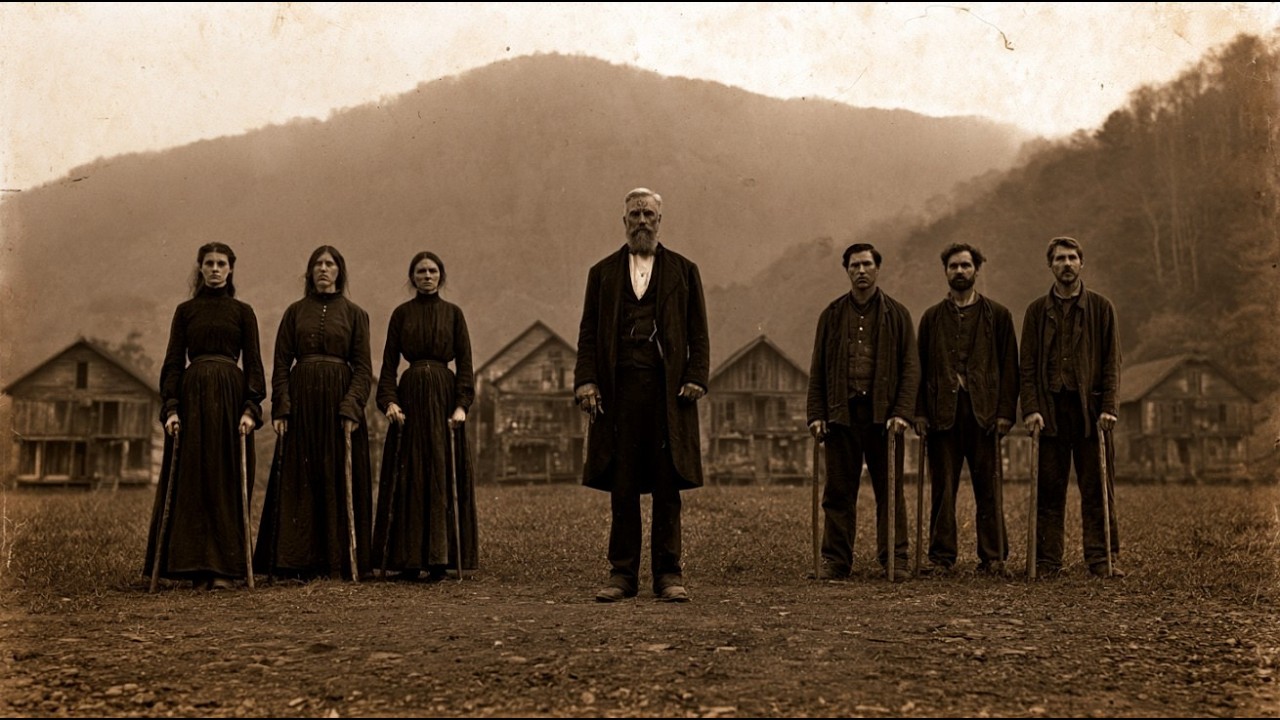
The hollow was a shallow depression of land, about forty acres, ringed by hills on three sides, open on the fourth to a narrow pass leading to the head of a stream. There were seven houses in the hollow, not farmhouses but houses. They stood in an irregular semicircle around a central yard, and each house faced inward toward the center. The yard itself was empty grass.
No well, no fire pit, no garden. Just grass. Ellery noticed the grass was cut short as if grazed, but there were no sheep or goats in the hollow, and no fence to hold them. On the porch of every house sat a person.
Seven porches, seven people. They sat in straight-backed chairs, and each one held a walking stick upright between his knees, resting on the porch floor, and as Ellery walked across the yard every one of them tapped his stick. Tap. Pause.
Tap. Pause. Tap. The rhythms were not identical across the seven porches.
They were different rhythms, but they fit together. Ellery, who could not tell one note from another, understood immediately that they were in harmony. He stopped at the edge of the yard and did not know what to do. He was not a man given to fear.
He was a man given to procedure, and there was no page in the procedure for this. Then one porch fell silent, then another, until all seven were silent. The man on the porch of the largest house, which faced directly where Ellery stood, lifted his stick from the floor and set it beside him, then rose. Obadiah Cain was tall, at least six feet two.
His gray hair was cut short, his beard trimmed close along his jaw. He wore a long black coat and a white shirt buttoned to the collar, no tie. His left hand was missing its last two fingers. There was a scar above his right eye running from the brow bone to the hairline, ending in a small curve like the curve a fish hook makes when it is pulled.
He looked to be in his fifties. He matched, in every detail, the man described in the court record of 1793. Ellery absorbed this. He wrote about that moment later, and among the things he wrote was this: “I realized in that moment that I would have to keep two records of what I saw.
One for the company, and one for myself. ” He crossed the yard and introduced himself. Obadiah Cain shook his hand once, firmly, released it, and said, “Mr. Van Hoss, we have been expecting you.
” Ellery asked how they knew he was coming. Obadiah did not answer. He gestured to a chair on the porch, and Ellery sat, and the six people on the other six porches sat at the same moment without looking at one another. Then, softly, they began to tap again.
They talked for most of an hour, or rather Ellery talked while Obadiah listened. Ellery made the offer. The company would pay a fair price for mineral rights, would not touch the surface, would provide a bond, would respect any existing family use. He read the figures from a sheet.
Obadiah did not interrupt. When Ellery finished, Obadiah said, “We thank the company for its interest, but the mountain has not asked us to sell, and we have no answer to give until it does. ” Ellery, as a land agent, tried three different ways to open that door. Obadiah closed each one politely, and each time he closed a door he tapped his stick once against the porch boards, and each time he tapped, the other six sticks on the other six porches answered with a single tap.
Ellery began to feel that he was not negotiating with a man but with a thing already decided by a committee before he arrived. He said, as diplomatically as he could manage, “Sir, when I speak to you, am I speaking to the family? ” Obadiah looked at him a long time and said, “Mr. Van Hoss, when you speak to me, you are speaking to the hollow.
” It was not said dramatically. It was said the way a bank clerk tells you the interest rate. Ellery stood, and Obadiah said, “You will take supper with us, Mr. Van Hoss, before you go down.
” It was not a question. Ellery said, “All right. ” He wrote later, “I said yes because I wanted to see what was inside the house. I did not say yes because I was hungry.
It was a decision I made as an accountant, not as a man. But by the time I sat down at that table, I was neither. I was a guest. ”
Inside, the house had one long room with a fireplace at the far end, cold, and a table set for nine.
Seven Cains, Ellery, and one empty chair. He noticed the empty chair. He asked politely whether they were expecting another guest. Obadiah said, “The ninth chair is always set.
It has been set since my father’s father sat at this table. ” Ellery, who did not want to know, asked, “For whom? ” Obadiah said, “For whoever signs. ” Then he pulled out the chair, Ellery sat, and supper was served.
The food was ordinary: salt pork, vegetables, cornbread, a pitcher of milk. It was well cooked. Ellery, who had walked four miles uphill in the sun, ate. As he ate, he looked around the table.
There were four men and three women. Two of the men were about Obadiah’s age. One was younger, perhaps thirty. The three women had no discernible age.
That is how Ellery wrote it in his notes. No discernible age. He wrote that he could not have placed any of the three women within a twenty-year range, and that his eye slipped when he tried to focus on them, the way the eye slips on a wet stone. He recorded their names as they were given.
Mahala, Verlin, Zebediah, Hiram, Zaphronia, Sabra, Prudence. He wrote them in the order they sat around the table, clockwise, beginning with Obadiah. Later, going through a bundle of family papers with Ephraim Culpepper, he found the same names in the renewals for 1813, 1833, 1853, and 1873. Always the same seven names.
Always in the same order. During supper, only two people spoke. Obadiah, who spoke to Ellery, and Mahala, who spoke once to Obadiah in a low voice, saying only that the wind had shifted and the ridge would be dry that night. The other five ate in silence and watched Ellery in a way he later described as kind but watchful.
Like the way you watch a bird that has come into the house, waiting to see if it will find the window on its own. At one point Ellery asked how long the family had been in the hollow. Obadiah said, “We have been here since the land agreed to hold us. ” Ellery asked what that meant.
Obadiah said, “My father’s father signed a paper on this land, Mr. Van Hoss. We have been here since. ” Ellery asked what was written on the paper.
Obadiah looked at him across the table and said, “That is a family matter. ” Then, more slowly, he said, “And I want you to hear this clearly. The paper is not for sale. The land under the paper is not for sale.
The rock under the land is not for sale. Please carry that back to Cincinnati. ”
After supper, Obadiah said he would like to show Ellery the head of the hollow before he left. Ellery said yes.
By then he had gotten used to saying yes. They went out the back door of the house, through a small kitchen garden, and up a short trail that climbed the last ridge behind the seven houses. The trail led to a place where the ground opened, not a cave but a gap. It was about six feet across, roughly circular, with soft clay edges that looked as if they had been kneaded by hand.
In the center of the gap was water. The water was black, not dark but black, the black of an ink bottle when you look straight into it in full sun. Obadiah stood at the edge of the gap and did not speak for a moment. Then he said, “This is the Sinking Spring.
It goes down. We do not know how far. My father lowered a rope into it, twelve hundred feet, and never touched bottom. My grandfather did the same.
” Ellery asked, in a voice he later described as quieter than he intended, whether they drank from it. Obadiah said, “No. It drinks from us. ” Then he smiled a very slight smile, the first of the day, and said, “That is only a saying, Mr.
Van Hoss. Not a threat. ” Ellery nodded, wanting very much to believe it. Then Obadiah lifted his stick and tapped the ground three times at the edge of the Sinking Spring, and from somewhere deep in the gap, very far down, came three echoes.
They were not ordinary echoes. Ellery was clear about this in his notes. They were not the same taps repeated against a wall. They were three new taps.
They came late, and they came from below. Ellery stood at the edge of that gap for what he later described as half a minute. He looked at Obadiah. Obadiah looked back without expression.
Ellery, whose profession was measuring things, felt in that moment that he stood at the edge of something no instrument made by the mining company could measure. He took one careful step back from the edge. Obadiah nodded at him as if in approval. There was one more thing Obadiah wanted to show him.
It was a tree, standing about thirty paces from the Sinking Spring on a small rise. A black gum, mature, twisted the way old gum trees twist, dark rough bark. What was strange was not the tree but the ground beneath it. The grass under the tree was flattened in a wide ring, as if many people had stood there many times.
And in the trunk of the tree, at about a man’s chest height, there were cuts. Many cuts. Some old, gray, healed over. Some newer, still pale in the bark.
They were not random wounds. They were straight, precise cuts, the kind a man makes when he begins to shape a piece of wood. Obadiah said, “This is the tree the sticks are cut from. Every man in the hollow, when he comes of age, cuts his stick from this tree.
And when he dies, the stick is returned to the tree. ” He touched a place on the trunk where the bark had grown around a cut and said, “That one belonged to Obadiah’s father’s father. ” Ellery asked whether the tree would ever run out of wood. Obadiah said, “The tree grows.
” Ellery asked how old the tree was. Obadiah said, “We do not count the years. ” Ellery asked why. Obadiah said, “Because the tree does not count us.
” Then Obadiah reached into a leather bag at his waist and brought out a simple, unfinished stick of pale green wood, and held it out to Ellery. He said, “We would like you to carry this down with you, as a gift, so that you remember the hollow. ” Ellery Van Hoss looked at the stick. He looked at Obadiah’s face.
He looked at the tree. He said, and these are his exact words from his notes, “Thank you very much. But I have a good stick already. And my company forbids accepting gifts from a party to a contract under negotiation.
” Obadiah lowered the stick. He did not look offended. He looked, if anything, mildly amused. He said, “Well, then.
We will walk you part of the way down, before what comes later. ”
They did walk him down. All seven of them. Obadiah in front, Ellery behind him, the other six spaced along the trail behind Ellery, walking single file, each tapping his stick.
Not on porch boards now, but on the ground, on roots, on the sides of walnut trunks as they passed. The rhythms of the seven sticks braided into one rhythm that filled the hollow behind them and the woods around them, and Ellery walked the four miles down off that ridge inside that sound. As they passed the low flat stone where the offering stick had lain on the way up, Ellery saw that the stick was no longer there. He did not turn his head to search the underbrush.
He did not ask. He wrote later, “I had a strong feeling the stick was somewhere behind me in the hand of one of the six, and a strong feeling that whoever carried it now carried it because of a decision I had made that morning without knowing I had made it. ” When they reached the last blaze on the last walnut tree before the wagon road, Obadiah stopped. He turned to Ellery, shook his hand once, with the same firmness as before, and said, “Tell the company we thank them for their interest.
” Ellery said he would. Obadiah said, “And what about Mr. Van Hoss? ” Ellery said, “Yes, sir.
” Obadiah said, “If you find you have changed your mind about the stick, it will come back. The tree will know you by then. ” Then the seven turned as one and walked back up the trail toward Silent Hollow. Ellery Van Hoss stood on the wagon road at the head of the stream and watched them go.
He wrote later that when they were out of sight he stood still for what he thought was a minute or two, and when he looked at his watch, forty minutes had passed. He came into Redwater at dusk. He did not stop at Permelia’s boarding house. He went straight to the postmistress.
Sophronia Ashmore looked at him once when he came in and said, “Sit down, Mr. Van Hoss, before you fall down. ” That night Ellery wrote a full report of everything that had happened in the hollow. He wrote it in the parlor of Permelia Coulter’s house, by kerosene lamp, in his narrow patient hand, on twelve pages of ledger paper.
He described Obadiah Cain. He described the Sinking Spring. He described the tree. When he came to the moment when Obadiah had tapped the ground three times and three taps had answered from below, he found he could not write it clearly.
He crossed it out twice. On the third attempt he wrote, “Three sounds came from beneath the surface of the spring, source undetermined. ” He underlined “source undetermined” and went on. He put the pages in his bag.
He blew out the lamp. He lay on top of the covers in his clothes. He did not sleep. He said later he did not sleep because at about eleven o’clock, when the boarding house had gone quiet, he heard a sound from somewhere out in the dark of Redwater.
It was a slow, regular tapping, like a man striking the end of a stick against a porch board. Tap. Pause. Tap.
Pause. Tap. It was not close. It was not near the house.
It was, as far as he could judge, coming from up the ridge, from the direction of Silent Hollow. It continued until dawn. In the morning he went to Ephraim Culpepper and asked to see everything the court kept on Silent Hollow. Ephraim, who had been waiting for that question for forty years, took him to a back room where the old records were kept in wooden boxes.
They opened the boxes. They read old papers. They read the 1793 renewal. Ephraim showed Ellery a marginal note written by the clerk who had recorded it: “Party appeared alone.
Presented signed mark. Refused to state the parish in which he was baptized. Departed without refreshment. ” They found a coroner’s report from 1821.
A state surveyor sent into the hollow to fix a boundary line had returned after two days in what the report described as a general derangement of the mental faculties. He died in Redwater a week later. The coroner wrote, “Cause of death, exhaustion. ” In the margin of the coroner’s report, in a different hand, someone had written, “He never stopped listening.
” Ellery read this, set the paper down, and said nothing for a while. They found another report, from 1849. Two brothers from Perry County had gone into Silent Hollow carrying rifles and a grievance over a claim they said the Cains had taken. They never came back.
Their mother came to Redwater and asked for a search party. No search party was organized. The sheriff of the county at that time, a man named Absalom Prime, wrote in his daybook, “No man in this county will go up to that hollow armed, and no man in this county will go up to that hollow unarmed. This claim is closed by my authority.
” There are headstones for those two brothers in the churchyard at Redwater, but the ground beneath those headstones was never dug. They found a photograph. It was in a cardboard envelope inside a box marked 1868. It had been taken in front of the courthouse on the steps, at the time of a land renewal, and it showed the county clerk of 1868 standing beside a tall gray-haired man in a black coat, his left hand tucked into his waistcoat pocket, a scar above his right eye like a fish hook.
Ellery looked at the photograph for a long time. Then he set it on the desk and said to Ephraim, in a very careful voice, “What year was this? ” Ephraim said, “1868. ” Ellery said, “And yesterday I had supper with this man.
” Ephraim said, “Yes, sir. I know. ”
They found one more thing that morning, and Ephraim brought it out last, setting it on the desk more carefully than he had anything else. It was a small cloth-bound notebook, spine cracked, brown with age.
Ephraim said, “This belonged to my father. He was county clerk before me. He kept this for his own account, and it is not a courthouse record. But he told me, before he died, that if a man from a mining company ever came asking to see the Silent Hollow record, I was to show him this last, and only after everything else.
” Inside the notebook were pages written in a small, precise hand. It was a list of names. Each name had a date beside it. There were forty-one names on the list.
The first was dated 1812. The last was dated 1906, two years before Ellery came to Redwater. Beside each name was a single word. Some names had “walked” beside them.
Some had “listened. ” Some had “signed. ” The names with “signed” beside them had no second date. The names with “walked” and “listened” did.
Ellery read the list. He did not recognize any of the names. He asked Ephraim what the words meant. Ephraim said, “Walked means they went up and came back and did not stay long in Redwater.
Listened means they went up and came back and could not sit in a room without tapping on something. Signed means they went up and never came back, and their people asked after them, and my father made a note. ” Ellery closed the notebook. He asked Ephraim whether his father had ever written down what those people signed.
Ephraim said, “No. Many of them asked over the years, before they went up. None of them said it the same way twice. But there’s one line on the last page my father wrote in his own hand, and I don’t think he was quoting anyone.
” Ephraim opened the notebook to the last page. In a fine, slightly trembling hand at the bottom was written: “Whatever this thing is, it wants a hand to hold it in the dark. If it does not find your hand, it will look for another. ” Ellery Van Hoss read that line three times.
Then he got up from the desk and asked Ephraim for a glass of water. Ellery stayed in Redwater eleven days. Every night from about eleven until dawn he heard the tapping. It came from up the ridge.
It was slow and regular. It was not always in the same place. On the third night he opened his window and listened, and he counted the taps. He counted for a full hour.
He recorded the number in his notebook in groups of four. When he finished, he sat with the figures and found that the number of taps in an hour equaled the number of adults he had seen in Silent Hollow, times four. He did the arithmetic three times. The number was exact.
He wrote at the bottom of the page, “This is impossible, and I have counted wrong. ” He counted again the next night. The number was exact. He wrote at the bottom of the page, “This is impossible, and I have not counted wrong.
” On the fifth night the tapping was closer. Not into town, not yet. But on the fifth night he could hear it from his bed without opening the window, and by the sixth night he heard it clearly enough that he stopped writing at his little desk and sat in the boarding house parlor in the light of a low lamp. Permelia Coulter, who had exchanged only a few words with him since his arrival, came out of her back room in her house dress, sat across from him without a word, and stayed with him there until dawn.
She did not speak. She sat with her hands folded in her lap, watching the door. In the last hour, as the sky went gray, she looked at Ellery and said, “This is not the first time I have done this in this parlor. I have done it four times before in the years I have run this house, for four other guests.
Two of them left the next day. The other two stayed. Do not be one of the ones who stays. ” On the sixth night Ellery wrote a letter to the company in Cincinnati telling them the Cains had refused the offer, that in his opinion no offer would ever be accepted, and that he recommended the company abandon its interest in Silent Hollow entirely.
He did not mail the letter. On the seventh night, Sophronia Ashmore knocked on the door of the boarding house at ten o’clock, and Permelia let her in without a word. Sophronia sat across from Ellery at the parlor table and said, “Mr. Van Hoss, you must leave this town.
My mother told me something when I was a young woman of eighteen, and I have not told another soul in fifty years. I will tell you tonight because I want to sleep before I die. She said that in 1849, my mother’s cousin, a man named Wesley Ashmore, twenty-six years old, went up to Silent Hollow to pursue a legal matter concerning our family. He came back.
He came back looking like himself and talking like himself and eating at my grandmother’s table like himself. He came back carrying a walking stick that had not been with him when he went up. My mother said the stick was pale and greenish and unfinished. She said Wesley put it in the corner behind the kitchen door when he came in, then sat down to supper, ate, and told them the matter was settled and he did not think it would trouble the family anymore.
She said that night at about eleven o’clock, the stick in the corner behind the door tapped once against the floor. She said Wesley heard it. She said Wesley rose from the table, took the stick, and went out the back door without his coat. He walked up the road toward Silent Hollow.
My grandmother stood in the door and called his name three times, but he did not answer. He was never seen in this county again. ” Sophronia looked at Ellery for a long moment and said, “My mother saw that with her own two eyes, and it broke her for the rest of her life. She was thirteen years old the night it happened.
She wore black on the anniversary of that night every year until she died. She never spoke of it aloud again after the day she told me. ” Sophronia looked at Ellery and said, “You went up to that hollow eleven days ago. You did not accept a stick from them.
That is the only reason I am sitting at this table with you tonight. But you went up, and you counted, and you heard. Mr. Van Hoss, whatever you came for, it is finished.
Go home, and do not sit still at night in a quiet room, because the tapping is looking for a place to settle, and if it finds you sitting still with your hand empty, it will put a stick in it. ” She stood. She set on the table the small stack of brown envelopes she had shown him at the post office on the first day, tied with jute twine, and said, “Take these with you. Do not open them.
Do not throw them in the river. Burn them in a stove you tend yourself, in a house that is not this house, in a state that is not this state. ” Then she went out into the dark, and Ellery Van Hoss never saw her again. Ellery packed his bag that night.
He did not sleep. At first light, before Permelia was awake, he left three dollars on the parlor table and left the boarding house with his bag. He walked to the start of the wagon road where the stage passed on Thursdays, and sat on a stone at the roadside to wait. It was not Thursday.
He knew it was not Thursday. But he sat anyway. He said later he did not know what else to do. He sat on the stone for nearly two hours.
As the sun came over the ridge and the light began to fall on the hollow above him, he heard a sound coming down the wagon road from the direction of Silent Hollow. It was not the sound of tapping. It was footsteps, slow and regular. And behind those footsteps, and beneath them, there was a slow and regular tapping.
He did not turn around. He wrote in his notebook later that he did not turn because he was afraid he would see seven men walking down the road toward him, and that if he saw them, he would rise and go to meet them and take the stick from Obadiah Cain’s hand. So he did not turn. He stood.
He walked the other way, across the road, out of Redwater on foot, his bag over his shoulder and his ledger under his arm. He walked six hours before a farmer with a wagon passed and gave him a ride. The farmer looked at him sharply once and said, “You’ve been up there. ” Ellery said, “Sir?
” The farmer said nothing else the whole way and let him off at the edge of Hazard, refusing the coin Ellery offered. Ellery came into Hazard that night. He took a train the next morning. He was home in Cincinnati by the end of the week.
On the train, somewhere between Hazard and the Ohio River, he opened his bag and looked at the small stack of brown envelopes Sophronia had given him. He did not open them. He noticed, however, that the top envelope was addressed in a handwriting he knew. It was his own handwriting.
And he had never written it. He closed the bag and did not look inside it again for the rest of the trip. He did not mail the letter he had written in Redwater. He wrote a new one.
It was three lines. “The Cains will not sell. I recommend the company close the file. I tender my resignation, effective upon receipt.
” He signed it, mailed it, and never worked as a land agent again. That night, in his kitchen, in front of the stove, he burned the brown envelopes one by one. He did not open them. His wife watched him from the doorway and did not ask what he was doing.
She said only that when the last envelope curled and blackened and fell through the grate, there fell over the whole house a quiet so deep it seemed to include the street outside, and that Ellery sat on the kitchen floor with his back to the stove and stayed there until well past midnight. He took a job at a bank in Cincinnati, in the back office, in a windowless room where he counted currency for the rest of his working life. By all accounts he was a good employee. By all accounts he was a quiet man.
By all accounts he was a man who never sat still in a quiet room. His wife wrote, in a letter to his sister in 1914, that Ellery had developed a habit after his trip to Kentucky, a habit of tapping the fingers of one hand on whatever surface he sat near, without seeming to notice he was doing it, and that at first she thought it was a nervousness, then a habit, then neither. She wrote, “It is a rhythm, and I do not know where he learned it, and I will not ask. ”
Ellery Van Hoss died in 1946, at seventy-five, of natural causes, in an ordinary bed in an ordinary house on a quiet street in Cincinnati.
Among his papers were the twelve pages of ledger sheets in his cramped patient hand describing eleven days in Redwater, Kentucky, in 1908. Among his papers also was a small unopened envelope addressed to himself in his own hand, sealed with wax, with a date written on the outside. The date was two years after his death. His widow respected that date.
She did not open it. She kept it in her desk drawer for two years, and on the exact day written on the envelope she took it out, broke the wax, and read what was inside. It was a single sheet. It read, and this is obtained from the widow’s cousin, who saw it before she returned it to the envelope, and at her request it was buried with her, “If I am dead, and if those two years have passed, it is over, and no Cain has come to this house, and no one has knocked at the door in the night.
Burn this paper. Tell no one what you have read. And tell my daughter never to visit Kentucky in her life. ” His widow burned the paper as asked.
She never visited Kentucky. Her daughter never visited Kentucky. There are three other pieces to this account. The first is from 1917.
A hunter from Perry County named Marvin Halleran, forty-four years old, went up into the hills above what had been Silent Hollow, tracking a wounded deer. He came out of the woods on the other side of the ridge two days later, having walked, by his account, in a straight line the whole time. He said the hollow he crossed was empty. He said the houses were still standing.
He said the porches were swept. He said there was no one on any of the porches. And he said, and this is the part that got him ordered to be silent in the saloon that night, that when he stopped at the Sinking Spring to drink, and changed his mind before he cupped the water in his hand, he heard from beneath the surface of the water three taps, spaced like a man’s breathing. When he stepped back from the spring, the taps stopped.
When he stepped forward again, they began. He came out of that hollow the way a boy comes out of a room he was not supposed to be in. He never went back. He never hunted that side of the ridge again.
He lived to be seventy-one and was, by all accounts, a quiet man in his later years. His widow said, when a reporter asked about it in 1960, that her husband had a habit she never understood: every evening after supper he would take a chair out to the porch and sit for a full hour, regardless of weather, and tap two fingers on the armrest the whole time, in a rhythm she came to know so well she could hum its tune, though she declined to hum it for the reporter. She asked him not to put that in his article. The second piece is from 1932.
A folklore researcher named Lucinda Ottway, thirty-nine, from the state university in Lexington, came to Redwater to interview old residents about mountain traditions. She interviewed Ephraim Culpepper, who was by then ninety-five and nearly blind, in the front room of his house. She asked him about the Cains. She wrote in her field notes that Ephraim spoke quietly and clearly for about forty minutes, answering her questions in full with dates.
When she asked whether he had ever gone up to Silent Hollow himself, he said no. When she asked why, he said, “Because when I was a young man, my father asked me the same question, and asked me for a reason, and I have kept my word to him for seventy years, and I will keep it now. ” She wrote, “The subject then politely requested an end to the interview. ” She also wrote that she finally asked whether the Cains were still in the hollow.
Ephraim said, “They are in the hollow. They have always been in the hollow. What you would find if you went up there, that is another matter. ” She left that evening.
Ephraim Culpepper died in his sleep three weeks later. The third piece is from 1955. A state highway crew doing a preliminary survey for what would become a branch of the highway entered Silent Hollow with instruments and papers. They found seven houses.
They found seven porches. They found no people. The houses were in good repair. The porches were clean and swept.
The grass in the central yard was cut precisely. On each porch, in the center, stood a walking stick, upright, unsupported, made of wood that had gone a pale yellow. The highway crew took photographs. Those photographs are in the state archives in Frankfort, filed in an unfinished file in someone’s hand.
They did not take any of the sticks. When they returned the following week with a larger group, the houses were still there. The sticks were not. The road was never built.
The file was closed. There is a small unsigned memo in the file that reads, “Recommendation: no employees of the state highway department shall enter this region for the purpose of survey, construction, or maintenance. This recommendation is permanent. ” That memo has been reviewed and affirmed at every departmental reorganization since 1955.
It remains in effect. In Ellery Van Hoss’s papers there is one additional note, written on a scrap of paper tucked inside the front cover of his ledger, dated a year before his death. It says, in his hand, “It has been thirty-eight years now, and the sound still comes most nights, from somewhere on the other side of the wall. ” It says, “I have learned to sleep inside this sound.
” It says, “I am not sure that means it has stopped. ” That is what he wrote. That is all there is.
That is all anyone has been able to learn about the Cains of Silent Hollow.
