The Pope was honoring a marriage that was, on that day, one of the coldest inside any famous American family. The cameras captured a serene mother whose devotion had ennobled her, but the photograph did not capture the truth. It did not capture that in every one of the thirty-seven years she had been married to Joseph Kennedy, he had been unfaithful. It did not capture the daughter whose brain had been severed by surgeons on her father’s order ten years earlier, while Rose was told nothing until the operation was over.
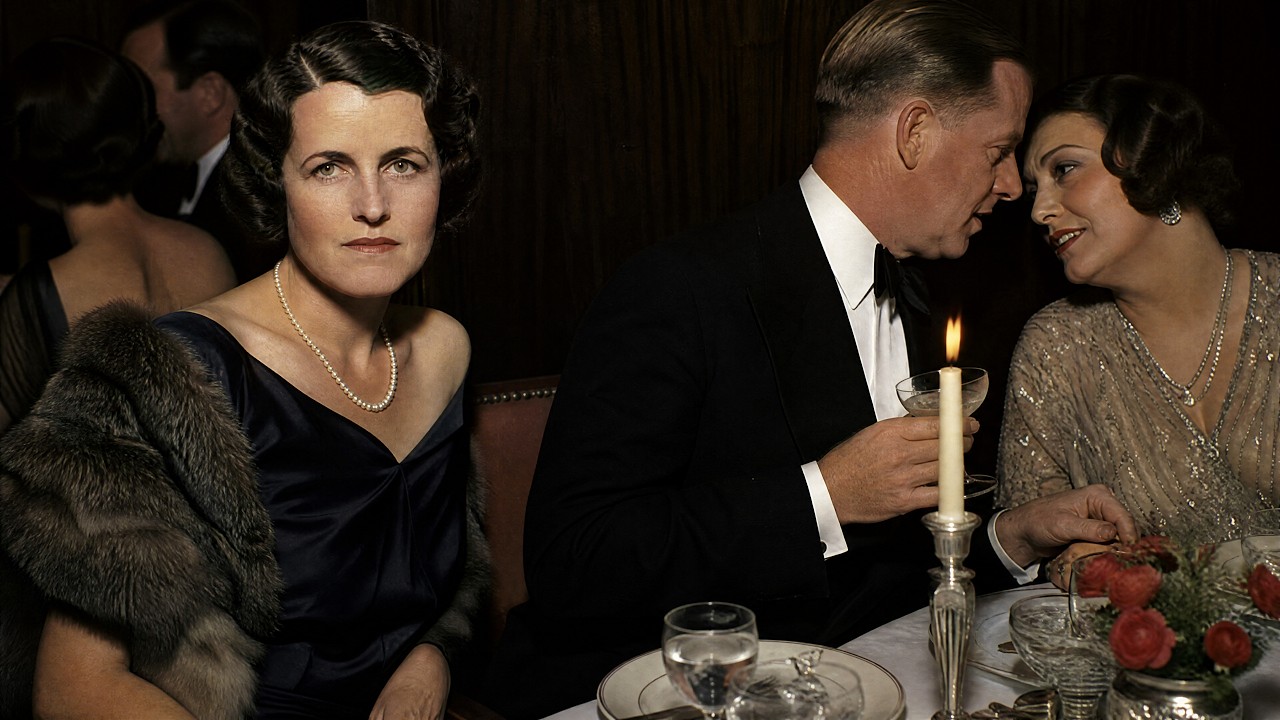
It did not capture the son already lost over Suffolk with no body recovered, or the daughter in the mountains of France. And Rose still had eighteen years of it left. Rose Fitzgerald was born into Boston Irish political royalty on the twenty-second of July 1890, and her father denied her the one thing she asked of him. The house was at Four Garden Court in the North End of Boston, and the North End in 1890 was a corridor of tenements above the Charles Town Bridge where Irish Catholic families raised loud, ambitious children in three-room flats.
Rose was the eldest of six. Her father, John Francis Fitzgerald, was known in every ward of the city as Honey Fitz. He would rise to become a congressman and then twice a popular mayor of Boston, one of the first Irish Catholic men to hold that office in a city that had spent two generations refusing to give it to them. Her mother, Mary Josephine Hannon Fitzgerald, ran the household with the composure that Boston Irish wives were expected to keep and that Rose would later carry to a national stage.
But it was her father who taught Rose what public life demanded. She accompanied him to rallies as a small girl. She learned to smile on command. She sometimes played piano while he sang for the crowd, an early apprenticeship in the work of being a political helpmate.
She learned that a Fitzgerald woman was an ornament to a Fitzgerald man’s career, and that the performance was in itself a kind of labor. She was quick, disciplined, and devout. She wanted, more than anything else in her adolescence, to attend Wellesley College. Wellesley was one of the great American women’s colleges, secular, academically serious, less than fifteen miles from her front door.
She was accepted. She wanted to go. Honey Fitz said no. In the mayor’s calculation, a Fitzgerald daughter did not attend a Protestant secular college.
She attended a convent. So Rose was enrolled instead at the Convent of the Sacred Heart in Boston, and later at the Blumenthal Convent in the Netherlands, and later still at Manhattanville. She was educated by nuns in the discipline of Catholic girlhood: prayer, poise, and the arts. She was educated to marry well.
She called the Wellesley refusal decades later the great regret of her life. She was seventeen when the door closed, and she did not speak against it. The habit of accepting her father’s decisions on the largest questions of her life was already, by that age, second nature. The world she was being trained to enter was smaller than Boston.
It was the drawing rooms of Irish Catholic Boston, where marriage was arranged as much as chosen, where a girl of the right family met a boy of the right family, and the two households consolidated. Rose met Joseph Patrick Kennedy at a Fitzgerald family holiday when she was still a child. Joseph was two years older. His father, Patrick Joseph Kennedy, was a ward boss and saloon keeper in East Boston, and the Kennedys were on the rise.
Honey Fitz did not at first approve. He preferred a different suitor from a more established Irish Catholic family for his beloved eldest daughter. But Rose and Joseph continued to meet. They met at family holidays, at charity dances, at the summer beach at Old Orchard in Maine, where Boston Irish families of the professional class took houses in July.
Rose was, in every account of her adolescence, a young woman of striking self-possession. She was small, she was dark, and she had in the photographs of the period a direct gaze that photographers of the day were not accustomed to seeing on a girl of eighteen. She could speak in company. She could turn a compliment.
She had by then been trained to be exactly the wife of exactly the man she would become the wife of. She was presented in society at a Boston debut when she was eighteen in January of 1911. Four hundred and fifty guests attended the reception at the family home. She wore white satin.
She was photographed on the front steps under the gas lamps of Beacon Hill with her mother behind her, the mayor’s wife, and her father beaming beside her. The Boston papers described her that week as one of the loveliest debutantes of the season. She traveled. She spoke French.
She had in her Blumenthal months in the Netherlands learned German as well. She kept on her body the composure her father had taught her. She learned to say the right thing to the powerful men who came to her mother’s parlor, and to say nothing to the questions that could embarrass her family. She learned, in short, to be useful to the Fitzgerald machine, and she learned to be useful in a way that never called attention to itself as usefulness.
By her early twenties, she had committed to Joseph Kennedy. The engagement was not announced quickly. Joseph was still building the beginning of the fortune he would need, and only then did Honey Fitz withdraw his objections. On the seventh of October 1914, at a small ceremony conducted by Cardinal William O’Connell of Boston in the cardinal’s private chapel, Rose Fitzgerald married Joseph Kennedy.
She was twenty-four. She would be a Kennedy for the rest of her life. The bride wore white satin. She smiled for the photograph.
What she did not know on the seventh of October 1914 was that she had already accepted, without knowing she had accepted it, a marriage in which her husband would keep the freedoms she had been trained to surrender, and in which her role would be, above all else, to hold the pose. The wedding was, by later Kennedy standards, small. Rose was beautiful, standing at the beginning of the fifty-five years the church had described as a sacrament and had promised would end only with death. The bride was twenty-four.
The groom was twenty-six. And by their first anniversary, the pattern of the next fifty-five years had already begun. Joseph Kennedy was a man in a hurry. He had graduated Harvard in 1912.
He had watched his father maneuver ward politics in East Boston, and he had decided that the machine was too small for what he wanted. He wanted money. He wanted, through the money, a place at the table where the sons of the Protestant Brahmins ate, and he was willing to work harder and lie better and marry more prudently than any Kennedy before him. Around 1914, he borrowed forty-five thousand dollars and used the loan to take back control of the Columbia Trust Company in East Boston, the small bank his father had helped found.
He installed himself as its president. He liked to say he was the youngest bank president in America. The claim served, in the first year of his marriage, as an opening line to men who might be useful. It also served as a message to his new wife.
This is the pace of the man you have married. Rose settled into a house at the corner of Beals Street and Abbotsford Road in the suburb of Brookline. The house had white clapboard and a small yard. It was pleasant, respectable, ordinary.
She was pregnant within a year. Their first son, Joseph Jr. , was born on the twenty-fifth of July 1915. Their second son, the future president, was born on the twenty-ninth of May 1917.
Two years later came their first daughter, Rosemary, on the thirteenth of September 1918. Then Kathleen, then Eunice, then Patricia, then Robert, then John, then Edward. Nine children between 1915 and 1932. Rose was, from twenty-five to forty-two, either pregnant or nursing or both.
The men of her circle did not notice the strain, because the men were for the most part not home. Joseph was in New York on business days that turned into weeks. He was in Los Angeles for the film ventures that were already forming in his head. He was in these early years already unfaithful.
The specific women of the early years are less securely documented than those of the later years, but the pattern is not disputed by any serious biographer of the marriage. From the first years, Joseph Kennedy was a man who did not consider his wife’s presence a constraint on his behavior. Rose learned this in stages. She had been trained to look past what her father did in ward politics and what her mother did to keep the household serene.
She applied the same training to her marriage. She organized the children. She kept the accounts of the household. She corresponded with her mother.
And she prayed. The praying was daily and disciplined. She rose early. She attended morning mass at the parish, often with two or three of the older children in tow.
She said her rosary in the afternoons. She kept for herself a set of devotional practices she had brought from the convent, small habits of the interior life that she carried with her into every room of the Brookline house. In the years to come, those habits would become the visible sign of the woman the American press would eventually canonize. They were, in their beginning, the private tools of a young wife making sense of a marriage that was already quietly refusing to give her what she had believed marriage was.
Around 1920, pregnant with her fourth child, Kathleen, she reached the limit. She left the marriage. She took the children and went back to Four Garden Court in the North End. She stayed with her parents for about three weeks.
Her father received her, and then her father spoke to her. Honey Fitz told his beloved eldest daughter that a Catholic woman could not get a divorce. He told her that the church would not permit it, that the family would not permit it, and that he himself would not permit it. He told her she had to go back.
She had married for life, and she had married a wealthy man, and it was not the business of a Fitzgerald to leave a Kennedy. She was to honor her marriage. She was to return. Rose went on a religious retreat first.
She spent the retreat, by later account, in prayer and in silence. She reread the gospel passages on obedience. She reread the passages on the wife. She reached the conclusion the church expected her to reach.
She would return. She would honor the vow she had made at the altar in Cardinal O’Connell’s chapel six years earlier. She would raise her children and continue the family. She would, if necessary, endure.
Then she went back to Brookline. The pattern of the marriage from that day changed shape. It did not become warmer. It became separate.
Rose and Joseph would keep separate bedrooms for the rest of his life. Rose would take separate vacations. She would travel to Europe by herself. She would return to a house full of children whose father was rarely in it.
Joseph would keep his life in New York and Los Angeles and later in London. The marriage would continue in the form the church required, and in no form beyond it. Rose did not tell her children about the three weeks in the North End. She did not tell her friends.
The story surfaced later, from biographers with access to family papers. In the marriage that would produce a president, the wife had already tried to leave and had been sent back at the age of thirty. She had another thirty-nine years of it left with her husband above ground, and another twenty-five years of it left after he was in the ground. The three-week retreat is the most important undocumented moment in the first decade of the marriage.
It is the moment at which Rose Kennedy considered leaving Joseph Kennedy and was told by her own father, the mayor of Boston, that she could not. It is the moment at which the Catholic Church’s ban on divorce, mediated through the person of Honey Fitz, became the private law of Rose’s own house. She would repeat in later decades the reasoning she had been given. She was a Catholic wife.
Catholic wives did not leave. In her 1974 memoir, she would present the marriage as a devout Catholic partnership that had been challenging but loving throughout. The three-week retreat, absent from the memoir, says otherwise. She had considered leaving.
She had done it. She had been sent back. In the 1930s, her name appeared on best-dressed lists that assumed she was the happiest woman in America. She was, by the middle of that decade, in her mid-forties.
Her nine children were most of them in school or nearly there. Her husband was rich beyond what any Boston Irish Catholic family had ever been. He had made a Hollywood fortune, a stock speculation fortune, a liquor importing fortune. Rose Kennedy shopped in Paris.
She shopped at Molyneux and Chanel. She wore couture on transatlantic voyages and in London. Her son’s biographer, Nigel Hamilton, wrote that she spent a fortune on the latest fashions and jewelry. A poll of fashion designers named her the best-dressed woman in public life.
She later appeared on the international best-dressed list. The press photographed her on the arm of her husband or on the arm of one of her sons, and the photographs were beautiful. The mouth was composed. The chin was lifted.
The eyes were kind. The dress was perfectly cut. She looked in these photographs exactly like the woman Boston Irish immigrants had been told for two generations that a Fitzgerald wife could become. The images were not lies.
They were only, in the way of American public images of that decade, incomplete. Behind the couture were the separate bedrooms of Brookline. Behind the smile was the memory of the three-week retreat to the North End that no one had ever named in print. Behind the composed jaw was the daily labor of not asking her husband where he had been.
The couture pictures rested on a scale most readers of the fan magazines could not have imagined. By 1929, Joseph Kennedy’s estimated holdings were around four million dollars. His film ventures had netted more than five million. His Boston bank presidency had been left behind.
The scale of the wealth was not visible to the American reader of a fan magazine, and it was not fully visible to the wife herself, because the accounts were kept always by her husband. She saw the invoices only when she signed them. She saw the bank balances only when Joseph chose to name them. She was the woman on the best-dressed list.
She was not the woman with the checkbook. Then, in 1938, Franklin Roosevelt appointed Joseph Kennedy ambassador to the Court of St. James. The family sailed to London.
They took up residence at 14 Prince’s Gate in Knightsbridge, the ambassadorial house of the United States. Rose was presented at the British court in white with plumes at Buckingham Palace. She dined with the king and queen. She saw her daughters presented as debutantes at the palace in the same ivory gowns and plumes.
In 1939, the family had a private audience with the new pope, Pius XII. Rose knelt before him. Her rosary was blessed. Her daughters kissed his ring.
She was in that room a Catholic woman at the summit of what her people had believed a Catholic woman could reach. For a Boston Irish woman whose people had been excluded from the Protestant clubs of her own city, whose father had been called a bog Irish upstart by the sons of the Puritans, this was the exact height. She had married the man who had bought the way in. She had produced the children who would carry the family forward.
She had held the pose. But the pose was, on the seventeenth day of any of these state occasions, a pose. Joseph was not in London faithful. He was in London adjusting his affairs and his politics to the war he was privately convinced Britain was going to lose.
Rose was in London receiving guests and posing for photographs. She had, at forty-seven, arrived at the top of an image that her marriage was already engineered to require her to hold. There would be no descent from this height that was not at the same time a violence to the family. The church, the dynasty, and the American press all needed her from 1937 forward to keep smiling.
The photograph from the palace steps in 1938 is beautiful. She is forty-seven that summer, turning forty-eight in July. The dress is Molyneux. The smile is her father’s smile.
And behind the smile is a woman who has already been married twenty-four years, has already tried to leave once, has already learned to say nothing about the other women, and has decided definitively that she will hold this pose until the day the man beside her is dead. The ambassadorship was brief. Joseph Kennedy’s political judgment in London deteriorated. He was by 1939 telling anyone who would listen that Britain was going to lose the war and that the United States should keep out of it.
He met privately with figures the White House considered dangerous. He said things to journalists that made headlines against him. By late 1940, he had been recalled. The family sailed home.
Rose sailed home with them. The London years were over, but the image the London years had built for Rose—the papal audience, the palace curtsy, the best-dressed lists—would follow her for the rest of her life. The image did not need Joseph to sustain it. Once made, it sustained itself.
Rose would carry in every American magazine profile for the next fifty years the aura of the woman who had curtsied to the Queen of England and knelt before the Pope. She had seen the exit door of London. She had chosen not to take it. She had held the pose in Buckingham Palace, and she would hold the pose in Bronxville, in Hyannisport, and in the fullness of time at the state funeral of her second son.
On the eleventh of November 1927, Joseph Kennedy met the most famous woman in the world at the Savoy Plaza Hotel and did not go home the same man. The woman was Gloria Swanson. She was thirty. She was at that moment at the height of her Hollywood fame, a leading star of the silent screen for a decade.
She was married to her third husband, the Marquis Henri de la Falaise, a titled French aristocrat who traveled with her and lent her image a further layer of European glamour. She was in the last months of 1927 in a financial position she did not fully understand. Her spending had outpaced her earnings. Her productions had lost her money.
She needed a man to reorganize her. Joseph Kennedy had by that date spent nearly two years in the film business. In 1926, he had bought the Film Booking Offices of America for about one and a half million dollars. He had begun acquiring theater chains.
He was preparing to help form, in 1928, the studio known as RKO. He was staying at the Savoy Plaza. Swanson came to his rooms at his invitation, at a meeting arranged, according to her later memoir, by mutual acquaintances who saw in Kennedy the only kind of financial man Swanson could be persuaded to trust: an Irish Catholic outside the Wall Street establishment who spoke like a man of business but was hungry enough to want her as a client. The meeting was about her finances.
She signed over to him a power of attorney. He restructured her holdings into a new company called Gloria Productions. He agreed to produce her next films. Within weeks, according to Swanson’s own account in her 1980 memoir, Swanson on Swanson, the arrangement had become sexual.
It would remain both a business arrangement and an affair for the next three years, from roughly early 1928 to December 1930. Joseph produced her films. He produced The Trespasser in 1929, her transition to talking pictures, which succeeded. He produced What a Widow in 1930, which lost money.
He produced, most notoriously, Queen Kelly with the director Erich von Stroheim, an enormously expensive project that ran wildly over budget and was in the end shelved unfinished. Swanson at the end of the affair would discover that the lavish gifts Joseph had given her—and there had been many—had been paid for out of her own accounts. She had funded, in effect, the seduction. She had also been left owing large sums on the failed Queen Kelly production.
The specific dollar figures for what Swanson lost vary between accounts, and every serious biographer of Joseph Kennedy flags those numbers as unreliable. What is not in dispute is the pattern the affair produced. Joseph had negotiated the production arrangement. Joseph had approved the escalating budgets.
When the ruin came, the liability sat on Swanson’s ledger. Joseph moved on to other projects. He enriched himself and left the woman whose fame had made the enrichment possible with the bill. Rose in these years was in Brookline and later in Bronxville with the children.
Joseph was on trains, on ships, in Los Angeles for weeks. The absences from home did not need explanation, because Joseph had made himself a Hollywood producer, and Hollywood producers were by definition in Hollywood. The children barely saw him. But Rose knew.
The specific date on which Rose Kennedy came to know that her husband was having an affair with Gloria Swanson is not documented in any surviving primary source. Rose herself never wrote it down. Biographers infer it from her subsequent behavior. What her subsequent behavior showed was that she had chosen, whatever the specific date of the discovery, to give no outward sign that she had made the discovery.
Her granddaughter, Amanda Smith, who later edited her grandfather’s private papers, has recorded in the family’s memory the strategy her grandmother developed for handling disagreement with her husband. Amanda Smith recalled, as a family saying and not as a Rose Kennedy quote, that Rose’s method was to say yes, dear, and then to go to Paris. Say the words that keep the peace, withdraw across the ocean, buy the couture, return with the composure intact. It was in the household a system of survival.
It was also, in the middle years of the marriage, the closest thing Rose had to a form of protest. The trips became more frequent as the Swanson affair extended. Rose sailed for Paris. She sailed again.
She stayed for weeks. She saw the fashion houses of Molyneux and Chanel. She had dresses made. She wrote to the children.
She did not, in what survives, describe Joseph Kennedy’s activities in Hollywood. Paris was in those years the room she went to when she could not stay in the room she was expected to stay in. It was the way, above all else, that she put an ocean between herself and the marriage without leaving it. Joseph, by the end of 1927, had made a decision that would break through even that composure.
He had decided that his relationship with Gloria Swanson would not be conducted secretly in Los Angeles hotels. He had decided that Gloria Swanson would come in her own person into the family orbit. He would produce her films openly. He would appear beside her at premieres.
He would introduce her to his wife. He would insist his wife receive her as a colleague and a friend. He would test the limits of what Rose Kennedy would swallow in silence in public. And Rose, by then thirty-seven years old, would give him no answer at all.
In the autumn of 1929, Joseph Kennedy took both his wife and his mistress on the same ship across the Atlantic to a premiere. The occasion was The Trespasser, Gloria Swanson’s talking picture debut, which had opened successfully in the United States and was headed for a European premiere. The traveling party sailed as two couples: Joseph and Rose Kennedy, Gloria Swanson and her husband, the Marquis Henri de la Falaise. Everyone in the party knew what everyone was doing.
The marquis knew Joseph was sleeping with his wife. Rose knew. Swanson knew. Rose said nothing.
Rose ate the meals. She dressed for dinner. She walked the promenade deck with Joseph on her arm. She was photographed beside Swanson in the ship’s saloon.
Two beautiful women in evening gowns. One of them Joseph Kennedy’s wife, and one of them Joseph Kennedy’s mistress. Both of them smiling. The photographs went home to Boston Irish American newspapers as pictures of the ambassador-in-waiting and his glamorous family.
The photographs went into film magazines as pictures of Swanson and the producer who was, it was said, making her the biggest star in America. Swanson later reflected on Rose’s composure. In her 1980 memoir, more than half a century after the crossing, Swanson wrote of Rose that Rose had never once given any indication that she knew about the affair. Swanson asked herself in print what to make of this.
She wondered whether Rose was a fool, whether she was a saint, or whether she was simply a better actress than Swanson—professionally, an actress of the first rank herself—was. The answer, from the vantage of a hundred years later, is that Rose was in that autumn of 1929 executing the survival strategy she had been trained for. She had been trained in the convent to endure. She had been trained by her father to give the machine what the machine needed.
She had been told by Cardinal O’Connell and by the doctrine of her church that a Catholic wife had no exit. She was in the middle of the Atlantic Ocean, absorbing what her husband had brought aboard. The crossing contained more than a scandal. It contained a whole architecture of silence.
Two adults sleeping with each other outside their marriages. Two spouses who knew and did not speak. One child, Rosemary, aged eleven, in Massachusetts, already showing the intellectual differences her family was working to conceal. Eight other Kennedy children, aged fourteen down to a baby, in the Bronxville house being run by servants and nurses.
A Hollywood production company, Gloria Productions, built on Swanson’s power of attorney to Joseph Kennedy, already losing her money at a rate that would eventually leave her in debt. And a Boston Irish Catholic wife in couture saying yes, dear, and going to Paris. Somebody, and the identity of the person has never been documented, approached Cardinal William O’Connell of Boston that autumn and asked him to meet with Gloria Swanson personally and to end the affair. O’Connell was Rose Kennedy’s own priest.
He had, fifteen years earlier, presided at her wedding. He met Swanson at his residence in Boston. He told her that the relationship with Joseph Kennedy was an occasion for sin. He asked her to end it.
He said he could not tell her who had asked him to intervene, and he never did. Biographers have inferred, but have never proven, that the person who asked the cardinal to intervene was Rose. There is no primary document that says so. There is only the fact that Rose was the person who had the standing to approach the cardinal, who knew the cardinal personally, and who had the motive.
The intervention did not end the affair. The affair ended in December 1930 on its own, when Joseph decided it had run its financial course. Swanson discovered in the accounting that many of the gifts she believed Joseph had bought for her had been paid for with her own money. Queen Kelly had cost her a great deal that she could not recover.
Joseph moved on in his own life without difficulty. Swanson would spend years untangling what he had done to her finances. The ending was cold. Joseph, over the summer and autumn of 1930, simply stopped appearing in Swanson’s schedule.
He returned to Bronxville. He returned to Rose. He returned to the ordinary domestic rituals of the Kennedy household as if the three years of Gloria Productions had been a business venture that had run its course. In her 1980 memoir, Swanson reflected on how completely he had used her, and how the understanding of that use had come to her only years later, when the corporate papers of Gloria Productions were sorted through by other hands.
The coldness Swanson saw at the end was the same coldness Rose had lived with from the beginning. The mistress met it once. The wife met it every morning of the marriage. Rose, in that same December, was in Bronxville with the children.
She had, in the previous three years, absorbed a sustained affair conducted at times inside her own household. She had said nothing about it. She had continued to have his children. Their eighth child had been born in February 1928.
Their ninth and last child, Edward, would be born in February 1932, a little over a year after the affair ended. She was, by the end of 1930, forty years old. She had another thirty-nine years of the marriage left. Everything she had done to survive the Swanson years—the composure, the Paris trips, the refusal to acknowledge—would have to be done again and again and again.
In 1926, at the age of thirty-eight, Joseph Kennedy quietly built the financial architecture that would hold his wife in place for another forty-three years. The architecture was a laddered series of trusts. The first trust was created in 1926, when Joseph was moving out of banking and into film. It provided for his wife and for the children who already existed and for children they had not yet had.
It gave Rose the status of a beneficiary. It did not give her, in her own name, an independent fortune she could withdraw and depart with. The second trust was created in 1936, when Joseph was preparing to take the ambassadorship. It codified the same pattern.
The third trust was created in 1949, when Joseph was ensuring the political futures of his sons. It carried the pattern forward for another generation. The result, by the middle of the century, was that every one of the nine Kennedy children was independently wealthy, guaranteed a lifetime income they did not have to earn, and that Rose, the mother of those nine children and the wife of the man who had made all the money, was still a beneficiary of a trust her husband controlled. Joseph made no secret of what he had built.
He boasted in later years that he had fixed things so that any one of his children could look him in the eye and tell him to go to hell. The point was pride in his children’s autonomy. The unspoken corollary was that no similar arrangement had ever been made for his wife. The fortune had been built in stages.
In 1926, Joseph bought the Film Booking Offices of America for about one and a half million dollars. He acquired chains of movie theaters through the second half of that decade. In 1928, in a series of consolidations, he helped form the studio known as RKO. He netted from the film business more than five million dollars.
He walked out of Hollywood with the affair with Swanson unraveling behind him, richer than he had gone in. He turned to Wall Street. In the 1920s, he made a further fortune in stock speculation using pool tactics that would later be classified as market manipulation and made illegal. By 1929, his estimated holdings were around four million dollars.
Recognizing, as many did not, that the market was overvalued, he sold out before the October 1929 crash. He profited further by selling short as prices fell. He was, on the day of the crash, in a position to become one of the very few Americans who ended 1929 richer than they began it. He turned to liquor.
In September 1933, in the last months before the repeal of Prohibition, he founded Somerset Importers with an initial investment of about one hundred eighteen thousand dollars. He secured exclusive American import rights for major scotch whisky and gin brands. He named the firm deliberately after the Somerset Club, the Protestant Brahmin men’s club of Boston that had excluded Irish Catholics like him. He sold Somerset Importers years later for roughly eight million dollars.
He turned to real estate. In 1945, he bought the Merchandise Mart in Chicago for just under thirteen million dollars. It was at the time one of the largest buildings in the world. The family held it for decades.
It was eventually sold as part of a transaction for about six hundred twenty-five million dollars in 1998, long after his death. The persistent claim that Joseph Kennedy made his money as a Prohibition bootlegger is rejected by his principal biographer, the historian David Nasaw, as false. The rumor circulates because the timing of Somerset Importers is suggestive, and because Joseph later in life did nothing to discourage the story when it suited him. The documented record is that he entered the liquor business legally in the last months before repeal.
The scale of the total fortune was never publicly documented in his lifetime. In 1957, Fortune magazine placed him in the two hundred to four hundred million dollar bracket among the richest Americans. At his death in 1969, the New York Times estimated his estate at about five hundred million dollars. By 1990, Forbes estimated the extended family’s wealth at about eight hundred fifty million dollars.
These are estimates, and every biographer flags them as estimates, but the order of magnitude is not disputed. Set that scale of money against the private life it enabled. Joseph Kennedy could purchase in a single afternoon, and without consultation with his wife, a house on the ocean at Palm Beach. He could move his family into a Bronxville estate on his own decision.
He could hire and fire nannies, chauffeurs, and cooks. He could transfer his mistress’s accounts into a corporation he controlled. He could commission a lobotomy. He could do all of these things because the money was in his name, in trusts he had structured, in accounts his lawyers reported to him and to no one else.
The nine children would inherit their trusts as adults. The wife would inherit her allowance for the rest of the husband’s life. Rose, throughout this fortune’s construction, was not a partner. She was a beneficiary.
She received an allowance she did not set. She traveled on money her husband had earned and her husband had structured. She wore couture bought out of accounts her husband managed. The autonomy her Paris trips gave her was social autonomy, not financial autonomy.
The wealth that made her a fashion icon on the international best-dressed list was the same wealth that made it financially impossible for her to leave. She was, in 1937 and again in 1957 and again in 1969, a woman inside a Catholic marriage to a man whose money was arranged deliberately so that she could go anywhere in the world she wanted, as long as she came back to him. The money was the cage. The couture was the paint on the bars.
In November 1941, Joseph Kennedy delivered his eldest daughter to two doctors and did not tell Rose he had done it. Rosemary Kennedy had been born on the thirteenth of September 1918, the third of the nine children. As a young child, she was warm and eager to please. She was also, from the beginning, developmentally slower than her siblings.
She reached the ordinary milestones later. She struggled with reading. She struggled with instructions. The family, in the twenties and thirties, managed her difference by concealing it.
Rose in particular worked to present Rosemary as a daughter developing typically. Rosemary was included when possible in the family photographs. She was presented at the British court in the London years in the same ivory gown as her sisters on the same afternoon. The photograph of the three Kennedy debutantes at Buckingham Palace is a photograph in which Rosemary looks like her sisters, and in which the family had chosen deliberately to include her.
But she was not like her sisters. In the family papers and in the accounts of the household staff, Rosemary is remembered as a young woman who required patient handling, who could not be trusted alone in unfamiliar situations, and whose intellectual limitations meant that she would never, in adult life, be independent. The family’s public strategy, held through the 1930s, was that Rosemary was gentle, a little slow, and destined for a quiet life. That strategy held through the London ambassadorship.
It began to fail when the family returned to the United States around 1940. Rosemary, in her early twenties, changed. She grew irritable. She grew at times violent.
She began sneaking out at night from the convent school in Washington where the family had placed her. She would go, according to her siblings’ accounts, to bars. The family feared what a young woman with intellectual disability and a public surname could do to the family reputation in the pre-war Catholic America of 1941. They feared she would be seduced.
They feared she would embarrass her father. They feared she would embarrass her brothers, whose futures were already being calculated in political terms. Joseph Kennedy did not consult the psychiatric mainstream. He did not consult his wife.
He consulted Dr. Walter Freeman and Dr. James Watts of George Washington University. Freeman and Watts were promoting, at that moment, an operation they called the prefrontal lobotomy.
The operation severed connections in the frontal lobes of the brain in the belief that it would calm agitated patients. It was, in 1941, briefly celebrated in American medicine. More than fifty thousand American lobotomies would eventually be performed, peaking between 1949 and 1952. The Portuguese physician who had originated the procedure, Egas Moniz, would win the Nobel Prize for medicine in 1949.
Freeman and Watts agreed to operate on Rosemary. Joseph agreed. Joseph did not tell Rose. The operation took place in November 1941 in Washington.
Rosemary was twenty-three years old. She was awake, in accordance with the technique Freeman and Watts used, so that she could speak while they worked. They stopped cutting when her speech deteriorated. When they stopped, the damage they had caused was already catastrophic and permanent.
Rosemary emerged from the operation unable to walk. She was unable to speak intelligibly. She was incontinent. Her functioning had been reduced to that of a very young child.
Over the years that followed, she relearned to walk with a limp. She relearned a few words. She was never again the person she had been the day before the operation. The historical record, as reconstructed by the biographer Kate Clifford Larson in her 2015 book Rosemary, indicates that Joseph did not inform Rose of the decision until after the procedure was completed.
The exact date on which Rose learned the full extent of what had been done to her daughter is characterized in Larson’s biography rather than fixed by primary document, and it should be attributed to Larson when it is repeated. What the record does establish is that Rose was not a party to the decision. Her husband had, in the middle years of the marriage, arranged the surgical destruction of her firstborn daughter without her knowledge, and had told her about it after the fact. Rose did not, in the immediate aftermath, protest publicly.
She could not. The church did not permit her to leave. The dynasty did not permit her to speak. The medical culture of 1941 told her, in the voice of the doctors, that what had been done to Rosemary was a treatment.
She had eight other children still living at home or nearly. The war in Europe was on. Joseph Jr. was already in Navy flight training.
Jack was about to enter it. The younger children were still in school. Rose had in front of her the double task of preparing eight children for the war, for public life, for the Kennedy pattern of achievement, while carrying in the interior the knowledge that her firstborn daughter had been surgically ruined by her own father. She carried both tasks without breaking.
She continued the schedule. She continued the correspondence. She continued the discipline. The children at the dinner table saw nothing.
Rosemary was placed first at a private institution in New York. She was moved in 1949 to St. Coletta of the Sisters of St. Francis of Assisi in Jefferson, Wisconsin.
The family built her a small private cottage on the grounds. She lived at St. Coletta for the rest of her life. Rose reportedly did not visit her daughter for about twenty years.
Joseph never visited her at all. The lobotomy itself remained hidden from the American public for forty-six years. The public was told, in official statements over the decades, that Rosemary had a mental disability and had been placed in a religious institution for her own care. The truth surfaced in 1987, when the historian Doris Kearns Goodwin, working on her book The Fitzgeralds and the Kennedys, uncovered the medical record and published it.
By then, both Joseph and Rose were dead. By November of 1941, Rose Kennedy was fifty-one years old. She had been married twenty-seven years. She had absorbed the affair with Gloria Swanson, at least one other named affair with Clare Boothe Luce, and an unknown number of other women.
She had absorbed the humiliation of the transatlantic crossing. She had absorbed the three-week retreat to the North End and her father’s refusal. And now she absorbed a lobotomized daughter she had not been told about. She had another twenty-eight years of marriage to endure.
She would endure them. The first death arrived in August 1944 over Suffolk, in the air. Joseph Jr. had been born on the twenty-fifth of July 1915.
He was the eldest son, the intended heir, the boy the family had prepared to send into public life. He had grown into a tall, athletic young man with his father’s charm. He had entered Harvard. He had prepared for law school.
He had begun the political career the family had planned for him. Then the war came, and Joseph Jr. became a Navy aviator. He served in the anti-submarine patrols out of England.
By the summer of 1944, he had already completed a full combat tour. He was, by the rules of the service, eligible to go home. He volunteered instead for a mission called Operation Aphrodite. Aphrodite was an early experimental effort to weaponize existing bombers.
The aircraft in the Aphrodite version of the mission were packed with high explosives and flown by a small crew who armed the bomb, bailed out, and left the aircraft to be piloted by radio into the target. The specific target on the twelfth of August 1944 was a suspected German rocket weapons site in occupied France. Joseph Jr. ’s bomber carried roughly twenty-one thousand pounds of high explosive.
It took off from Fersfield in Suffolk, England, in the late afternoon. It flew in formation with its accompanying mother ship over the East Anglian coast. Before Joseph Jr. could arm the payload and bail out, the explosives detonated prematurely.
The aircraft was vaporized. Nothing recoverable remained of the crew. He was twenty-nine. His body was never recovered.
The news reached Hyannis Port. Rose was there. Joseph was there. The younger children were there.
The details of what Rose said that afternoon are not well documented in the historical record. What is documented is that Rose kept the composure the family expected of her. She attended the memorial. She spoke briefly and privately of her son, and she filed him in the family accounting alongside Rosemary.
Then, less than four years later, came Kathleen. Kathleen Kennedy had been born on the twentieth of February 1920. Everyone in the family called her Kick. She had been the second daughter, and the first Kennedy daughter of what she came to seem in the London years to be capable of taking Rosemary’s place as the public face of Kennedy femininity.
She was quick, funny, socially fearless. In London, in the last months before the war, she had fallen in love with William Cavendish, Marquis of Hartington, the heir to the Duke of Devonshire. He was Protestant. His family was one of the oldest in England.
Rose objected to the match with the sharpest language of her life. She threatened to disown Kathleen if the wedding took place. She did not attend it. The wedding took place at a London register office in May 1944.
Four months later, William Cavendish was killed in action in Belgium. Kathleen, twenty-four, was a widow. She stayed in England after the war. She fell in love again, with the Earl Fitzwilliam, an English aristocrat who was married and separated.
Rose threatened again to disown her. Kathleen and Fitzwilliam decided to fly together from Paris toward the French Riviera in May 1948. They chartered a small aircraft on the thirteenth of May 1948 in a storm above the Cévennes mountains. The aircraft flew into a ridge.
Everyone aboard was killed. Kathleen was twenty-eight. Rose did not travel to France for her daughter’s burial. Kathleen was buried at Chatsworth, in the Cavendish family plot in England.
Rose grieved from Hyannis Port. She spoke in the days that followed of her daughter’s soul. Whether she felt, at any level, that her own threats of disownment might have contributed to the trajectory of Kathleen’s decisions in the last years of her life, she never publicly said. By May 1948, Rose Kennedy had lost two children—the eldest son and one of the eldest daughters—at the ages of twenty-nine and twenty-eight.
She had lost, effectively, a third child in Rosemary, then thirty, hidden at St. Coletta and out of the family’s daily view. She had endured, in the same decade, the affair with Gloria Swanson, the ambassadorship, the war, the return of her husband to a life of ordinary infidelity, and the accumulated silences of a marriage that had by then lasted thirty-four years. She had six children left above ground.
Four of them were sons. Three of the four would go into national politics. Two of the three would die by assassination. She held the composure through it.
She sat at Hyannis Port. She said her rosary. She wrote to her surviving children. She met the reporters when the reporters came, with a face that the American public was already, by 1948, comparing to the face of the mother of any Christian saint.
The image machine had by then worked out how to use the losses. The magazines wrote of the brave Kennedy matriarch. The columnists wrote of her devout faith. The photographers found her at Sunday mass and photographed her from the middle pew, small in her hat, back straight, eyes down.
The photographs became part of the currency of Kennedy publicity through the fifties. They said, without a caption saying so, that this family had suffered, that this family had endured, and that this family, by virtue of the mother at its center, was worthy of the political future the sons were about to seek. The dead children had, by the time they became photographs, already begun to become political capital. Rose did not agree to it.
Rose did not refuse it. Rose held the pose. The face was, of course, a face. Behind it was a woman who had understood definitively by that summer that God had not intervened to protect her marriage or her family.
The prayers had not saved Rosemary. The prayers had not saved Joseph Jr. The prayers had not saved Kathleen. The church had told her at every stage that suffering was the currency of a devout life.
She had paid the currency. There would, before the end, be a great deal more of it to pay. The Gloria Swanson affair was only the beginning, and every affair after had to be absorbed the same way. The biographer David Nasaw, whose 2012 book The Patriarch is the standard modern account of Joseph Kennedy, characterizes Joseph as a man who hardly hid his philandering.
Nasaw estimates, in his own voice as a biographer, that Joseph had sex with hundreds of women across the years of the marriage. That is Nasaw’s characterization, not a Kennedy family admission, and it is properly attributed to Nasaw when it is used. The biographer Barbara Perry, in her study Rose Kennedy: The Life and Times of a Political Matriarch, names two of the affairs beyond Swanson. The first is Clare Boothe Luce, the playwright, editor, and later United States congresswoman and ambassador.
The second is a series of casual affairs Joseph pursued in Hollywood, in New York, and in the London years. Perry does not attempt to name every woman. She characterizes the pattern as continuous, and she reads Rose’s response as one of managed denial. Managed denial is a fair term for what Rose did.
She managed, above all, herself. She managed her weight and her waistline with the same discipline that had won her the best-dressed lists. She managed her devotional life with a schedule of prayer that filled entire mornings. She managed the household with the index cards on each child that she had kept since Joseph Jr.
’s birth. On those index cards, she recorded in a small, precise hand the weight of the child, the shoe size, the medical history, the dental history, the illnesses, the vaccinations. She had made of her mothering an administrative practice. It gave her a place to put her attention that was not the man in the next bedroom.
She named the intensity of the household in her own memoir: Kennedy desperation. That was her phrase for the pressure the family applied to its children and to itself at every meal and every game and every conversation. It was the pressure that had swallowed Rosemary into an operating theater. It was the pressure that would send Joseph Jr.
into an aircraft packed with twenty-one thousand pounds of explosive. It was the pressure that would send the surviving sons into the political careers that would kill two of them. Every family meal was a quiz. Joseph interrogated them on the newspaper of the morning, on the history books they were supposed to be reading, on their spelling and their arithmetic.
He announced at every meal the standard of achievement he expected. Rose, at the other end of the table, kept the discipline. She reminded the children of their manners. She corrected their posture.
She made sure the youngest ones ate their vegetables. She reinforced, at her end of the table, the message the father was making at his end. The message was that Kennedys did not, in any room, allow themselves to be second. She survived it, by her own account, on will.
She said, in the sentence that is best remembered from her interviews, that she had made up her mind she would not be vanquished by anything. She said that if she collapsed, it would have a bad effect on the rest of the family, and that she refused to be daunted. She said that willpower and doing what was necessary were what kept her going. The will was, in practice, chemistry as well.
The New England Historical Society summary of Rose’s life records that she relied heavily on prescription medication over the years. The medications it names by name are the tranquilizers Placidyl, Librium, and Dalmane, and various digestive medications. The society characterizes her coping strategy as taking solace in the Roman Catholic Church and in heavy medication. There is no evidence that Rose was addicted in any clinical sense.
There is only the fact that she took, for decades, sedative medications powerful enough that they were, in the middle of the twentieth century, the standard tools of managing a woman’s anxiety in a marriage from which she could not exit. She took what her doctors prescribed. She took what she needed. She kept the composure the family and the church and the electorate required of her.
The refrain of the family surfaced again in these years. Yes, dear. And then she would go to Paris. She went to Paris regularly through the 1950s.
She shopped at the houses she had shopped at in the 1930s. She was fitted for the same kind of clothes. She did not, when she was in Paris, ask her husband where he was. She did not, when she returned, ask him what he had done.
The 1950s campaigns arrived. When her son John Kennedy ran for the United States Senate in 1952, Rose became one of the most effective campaigners the family had. She helped host that year the famous Kennedy Teas. There were about thirty-three such receptions across Massachusetts.
Roughly seventy thousand guests attended, most of them women voters. Rose worked the rooms in her couture, in her jewels, and in her Boston accent. She spoke about being a mother. She spoke about the North End.
She spoke about her father. She did not speak about her husband. She was by then at the height of her second career, which was campaigning. She adapted her pitch to any audience.
She addressed the women of the North End in a headscarf and talked about the price of butter and about the children. She addressed the fashionable audiences of the North Shore in Chanel and talked about the ambassadorial residence in London and about her audience with the Pope. She did not, in any of it, let the interior of her marriage show. By the middle of 1952, Rose Kennedy had been married thirty-eight years.
She had spent, by any reasonable estimate, the majority of those years in the near daily awareness that her husband was having affairs. She had spent eleven years knowing that her firstborn daughter had been surgically destroyed at her husband’s direction. She had spent nearly eight years grieving her eldest son. She had spent nearly four years grieving her second daughter.
She was sixty-two. Her son was on the ballot, and would win. She would go home from the victory party to a house in which her husband kept his own bedroom, and in the last hours of most days, kept his own company. On the twentieth of January 1961, Rose Kennedy watched her son become the first Catholic president of the United States.
She was seventy years old on that January afternoon. She was seated in the reviewing stand in the cold, with her husband beside her. She had, in the ten months preceding, made forty-six campaign appearances across fourteen states. She had been the family’s most consistently effective surrogate—the Kennedy of the older generation who could speak in a Boston Irish grandmother’s cadence and mean it.
She had, in her own account and in her family’s account, campaigned harder for John Kennedy than she had ever campaigned in her life. The morning of the inauguration was clear and freezing. Snow had fallen the night before. The city was scraped clean.
The wind on the Capitol steps was strong enough to lift the papers from the lectern. Rose sat in the reviewing stand and watched Robert Frost read a poem, and Marian Anderson sing the national anthem, and Chief Justice Earl Warren administer the oath. She watched her son remove his coat and top hat and speak, hatless and coatless in the cold, of a new generation of Americans born in this century, tempered by war, disciplined by a hard and bitter peace. She heard him say, ask not what your country can do for you.
She had spent forty-six years preparing him, in one way or another, for the words she was hearing. Behind her, in the reviewing stand, her husband sat silent. Joseph Kennedy did not take a bow. He would not, in the years that followed, seek public credit for what he had built.
He watched. He said nothing to the cameras. Rose attended the inaugural balls. Rose danced.
The photograph of Rose in her white gown, upright and composed on the arm of one of the family’s escorts, ran in every newspaper in America the following morning. She was at that moment at the peak of her image. She was the mother of the first Catholic president of the United States. Every Irish Catholic in Boston understood what that meant.
The generational climb that Honey Fitz had begun in a saloon, that her father had continued in the mayor’s office, that her husband had continued in Hollywood and on Wall Street, had reached the executive mansion. She was, on that day, the ceremonial center of it. For twenty-two months, the peak held. The Kennedys were young.
The White House was young. Rose visited the White House sparingly. She stayed in Hyannis Port. She sent her prayers.
She said her rosary. Joseph, who had suffered his own catastrophe in the meantime, watched from Hyannis in his own way, silent from a wheelchair, unable to speak. Then Dallas, at 12:30 in the afternoon on the twenty-second of November 1963. The president of the United States was shot twice in an open motorcade in downtown Dallas, Texas.
He was pronounced dead less than an hour later at Parkland Memorial Hospital. He was forty-six years old. The telephone rang at Hyannis Port. Rose took the call.
In the account her family later gave, she left the receiver, walked to the private chapel at St. Francis Xavier in Hyannis, said her rosary, and returned. She did not, that afternoon, appear to cry in front of the household. She had made, at some point earlier in her life, the decision to keep the public composure.
She kept it. She did not tell Joseph immediately. Joseph, in his stroke, could no longer speak or comprehend fully. The family debated when to tell him.
When they did, on the following morning, Joseph turned his face to the wall. Rose flew to Washington. She attended the state funeral on the twenty-fifth of November. She was photographed in black, her mouth composed, her chin lifted.
The photographs went around the world. The image was the image the American press had first learned to publish in the 1930s—the image of the perfect Irish Catholic mother in couture at a state occasion. It was the same face. It was now at the funeral of her second son, the face at a funeral of a president.
The eighteen months that followed were, in Rose’s private accounting, a period of tightening. She was seventy-three. Joseph, seventy-five and struck silent, needed daily care. He needed to be lifted.
He needed to be turned. He needed to be fed. Rose stayed at Hyannis Port and gave that care herself, or supervised the nurses who gave it, or both. In the photographs of the last years from Hyannis, Rose sits with Joseph on the porch, he in his wheelchair, she beside him.
The whole rest of the marriage is visible in the frame: the man who had been unfaithful for decades, now silent, cared for by the wife he had wronged. The image does not indict him. The image does not exonerate him. The image just sits, the two of them on the porch in the ordinary hours of a Massachusetts summer.
She had by then buried three of her children. She had one lobotomized in an institution in Wisconsin. She had five living children with careers of their own. She had a husband who could not speak.
She had, by any measure, no marriage in the sense in which the word is normally used. She had, in her own account, a duty. She discharged it. Between 1941 and 1963, Rose Kennedy lost three children: a firstborn daughter to a lobotomy authorized by her husband without her knowledge; an eldest son to a mid-air explosion over Suffolk; a second daughter to a mountain aircraft crash in France; and a second son to an assassin’s rifle in Dallas.
She lost her husband to a stroke that took his speech in December 1961 and left him alive but silent for the last eight years of the marriage. She lost, in the same period, the last of what could be called her personal youth. She had, at seventy-three, been a Kennedy for forty-nine years. She had, at seventy-three, seen the summit and the crater in the same room.
In December 1961, Joseph Kennedy suffered a stroke that took his speech. And for the last eight years of the marriage, Rose cared for a man who could not speak to another woman. The stroke came on the nineteenth of December 1961, in Palm Beach. Joseph had just left his golf game.
He collapsed at his niece’s home. He was rushed to a nearby hospital. The stroke was massive. It paralyzed him on one side.
It destroyed his speech. It left him aware, or partly aware, of his surroundings, but unable to form words that anyone around him could reliably understand. The Kennedy machine, at that moment, was at the height of its national power. His son the president was in the White House.
His son Robert was attorney general. His son Edward would enter the Senate the following year. The man who had built the money that had bought the influence that had built the careers could not, from December 1961 forward, speak to any of them. Rose was seventy-one.
She had by that date spent forty-seven years as his wife. She had absorbed the affairs, the concealments, the lobotomy of Rosemary, the death of Joseph Jr. , the death of Kathleen, the humiliation of the Swanson crossing and of every affair after, the quiet cruelty of a marriage in which her husband did not, in her presence, refer to their daughter Rosemary at all. Now she absorbed a husband in a wheelchair, silent, needing her.
She gave the care. The historical record on the last eight years of the marriage is spare, because the household preserved its privacy. Rose read to him. Rose said the rosary at his bedside.
Rose ate her meals in his room. She attended the family functions that could not be missed. She traveled less than she had in her middle years. She stayed largely at Hyannis Port and at Palm Beach.
She continued to observe publicly the rituals of the devout Catholic wife of a great man. She continued the daily routines she had kept since Brookline. She rose early. She attended morning mass.
She spoke on the telephone with the children. She wrote to the grandchildren. She managed the household. She read her prayer books.
She observed, in her private practice, the same devotional life she had learned in the convent as a girl. The marriage in these years was, on paper, the same marriage it had always been on paper: a Catholic union of a devout wife and a Catholic husband, a public partnership at the head of a great American family. Inside the house, it was something else. It was a duty of nursing.
It was a silence between two people who could no longer speak to each other, for different reasons. It was, in the phrase Rose herself used in the interviews of the period, a burden that God had asked her to carry. She said she had made up her mind that she would not be vanquished by anything. She kept, in the last eight years of Joseph’s life, the vow she had made to herself as a young woman fifty years earlier.
Inside the household, the reversal was complete. The man who had spoken to hundreds of women, who had lied to his wife for fifty years, who had authorized surgery on his daughter without her knowledge, was in his last eight years kept alive by the wife whose life he had ruled. The physical care he needed, she gave or arranged. She did not, in any recorded conversation with any biographer, speak of these years as a burden.
She spoke of them as, again, a duty. She spoke of them as the last chapter of a marriage that God had asked her to complete. The second decade of Joseph’s silence began on the fifth of June 1968. Robert Kennedy, forty-two years old, was campaigning for the Democratic presidential nomination.
He had just won the California primary. He was walking through a kitchen at the Ambassador Hotel in Los Angeles shortly after midnight when he was shot in the head. He died in the early hours of the sixth of June. Rose took the news at Hyannis.
She said her rosary. She helped, over the following days, plan the funeral of her fourth dead child. She was seventy-eight. Robert had, in the years since Dallas, become the family’s political center.
He had left the Justice Department. He had run for and won a Senate seat from New York in 1964. He had, by the spring of 1968, entered the presidential race. He had won primaries.
He was, on the fifth of June, thirty-six hours from the Democratic Convention delegate arithmetic that would have made him the front-runner for the nomination. He had, at the moment of the shooting, just given a victory speech. He had walked off the ballroom stage. He had turned into the kitchen.
He had shaken hands with the busboys. A young man had stepped out and put a revolver against his ear. Rose absorbed the death of her fourth child the way she had absorbed the three before it. She attended the funeral.
She sat through the requiem. She was photographed at the church, upright, composed, in black. The photograph, when it ran in the papers, was almost identical to the photograph of Rose at the state funeral of the president five years earlier. The two photographs, side by side, are the visual record of what an American mother could be asked to do twice in five years.
She had, at seventy-eight, buried her firstborn son, both of the daughters who had been political figures in the family, the son who had been the president of the United States, and now the son who had been the attorney general. She had one child in an institution in Wisconsin from a surgery she had not been consulted on. She had one husband who could not speak. She had four surviving children.
She had, in the sequence of the losses, more graves to visit than most women of any age visit in a lifetime. The last day of the marriage arrived on the eighteenth of November 1969. Joseph Kennedy, eighty-one years old, silent, half paralyzed, kept comfortable in a bed at Hyannis Port, died in the afternoon. Rose was in the room.
His sons and daughters were in the house. He had, on the marriage register, been Rose Kennedy’s husband for fifty-five years, one month, and eleven days. He had, in that time, been unfaithful in ways her biographers would later document and in ways they would not. He had ordered the destruction of their daughter without telling her.
He had made a fortune that had lifted his children into power and had trapped his wife inside a house that was not, in any interior sense, a home. She knelt at the bed. She said the prayers. She and the Catholic Church that had told her fifty-five years earlier that she could not leave released each other.
Rose was seventy-nine. The interior of the marriage was, for the first time in her adult life, only in her own memory. She had another twenty-five years and two months of that memory left. For twenty-five more years after her husband’s death, Rose Kennedy lived with the full record of everything he had done.
She was seventy-nine when he died. She lived to be one hundred four. She spent the twenty-five years between those numbers in Hyannis Port, at Palm Beach, and briefly on trips to Paris until age made the trips impossible. She was the last surviving member of her generation of Kennedys.
She was, in the eyes of the American press, the surviving matriarch of the dynasty her husband had built. She was also, in those twenty-five years, a woman with the freest calendar she had had in her adult life. She did not, in the widowed years, disclose the interior. She did, in 1974, publish a memoir titled Times to Remember.
The book was a bestseller, written in Rose’s own hand with editorial assistance. It presented the marriage as a devout Catholic partnership in which husband and wife had raised remarkable children in the service of the American nation. It described Joseph as a challenging and demanding man who had loved his family. It did not describe Gloria Swanson.
It did not describe the lobotomy of Rosemary. It did not describe the retreat to the North End in 1920. It was, in the phrase her biographers would later use, a book of what a Catholic wife could say. It was, in the phrase her biographers would also use, a book of what a Catholic wife could not.
Times to Remember is not evidence of what happened inside the house. It is evidence of what Rose was still willing, at eighty-four, to allow the public to hear. She was, in the memoir years, an active grandmother. She wrote long letters to her grandchildren.
She corrected their spelling. She sent them clippings. She reminded them of their obligations to the family. She was strict about the discipline the family had made its brand.
She was remembered by grandchildren as loving and demanding in equal measure. She continued to travel while her health allowed. She went to Paris until she could no longer make the flight. She went to the fashion houses whose owners still remembered her from the 1930s.
She sat for photographs when the family asked. She attended the events at Hyannis Port and at Palm Beach and at the family houses in Virginia. She was, in her seventies and early eighties, still the matriarch in the ceremonial sense of the word. She still, at every gathering, said grace.
The interviews of the widowed years are the closest thing to a public record of her interior. She gave them sparingly. She said in these interviews that she had been blessed, that she had lived a full life, that her faith had carried her through every sorrow. She said that Joseph had been a wonderful husband and a devoted father.
She did not name the marriage as anything other than a Catholic marriage of endurance and love. Whether she believed the sentence she was speaking, no one who spoke with her in those years could tell. She was, at that stage of her life, the same disciplined public performer she had been at forty-seven at Buckingham Palace. She had held the pose so long that the pose had become the only expression the world was allowed to see.
In April 1984, she suffered a stroke. She was ninety-three. The stroke left her substantially impaired. She could no longer travel.
She was confined from that day to a wheelchair. She would remain in the wheelchair for the last eleven years of her life. She kept her mind. She still, in the summers, sat by the porch at Hyannis Port.
She still, in the winters, went to Palm Beach. She still, when the family gathered, presided from her chair at the head of the table. She still said her rosary. She still, when reporters asked, spoke of her husband in the phrases the memoir had used.
She had, by ninety-three, made the phrases permanent. The hundredth birthday came on the twenty-second of July 1990. The family gathered at Hyannis Port. Photographs were taken.
The world press covered the milestone. Rose, in her wheelchair in a summer dress, smiled. She was frailer than the photographs of the 1930s, but the composure of the face was, decade after decade, the same composure. She died at Hyannis Port on the twenty-second of January 1995, of complications from pneumonia.
She was one hundred four. Her funeral was held at St. Stephen’s Church in the North End of Boston. St.
Stephen’s was the church in which she had been baptized on the second of August 1890. She had come, in one hundred four years, back to the North End. Her sole surviving son, Edward Kennedy, delivered the eulogy. Edward said that his mother had been the eldest daughter of the mayor of Boston and had grown up to be the mother of a president.
He said that she had faced sorrow beyond ordinary understanding and had faced it in every case with faith. He did not say Rosemary’s name in the eulogy. He did not say Gloria Swanson’s name in the eulogy. He said his mother’s rosary, in one form and another, was the true center of her life.
Rose was buried beside Joseph at Holyhood Cemetery in Brookline, the town where her marriage had begun. She had, above ground, been a Kennedy for eighty years and four months. She would, below ground, be his wife for as long as either of them was remembered. The two graves lie side by side.
There is a shared marker. The dates of the birth and death of each are cut into the stone. There is no inscription that describes the marriage. There does not need to be.
Every visitor to Holyhood who reads the two dates on Rose’s stone—1890 to 1995—and puts them next to the two dates on Joseph’s—1888 to 1969—can do the arithmetic. He was her husband for fifty-five years. She was his widow for twenty-five. She outlived him longer than most marriages last.
The stone does not indict him. The stone does not exonerate her. The stone just holds the arithmetic. The family’s answer to Rosemary was not confession.
It was a movement. In 1946, in the year after the war ended, the family created the Joseph P. Kennedy Jr. Foundation, named for the fallen eldest son.
The foundation was originally conceived as a memorial, a vehicle for charitable donations in the name of a young man who had died in service of his country. Under Rosemary’s sister, Eunice Kennedy Shriver, the foundation slowly turned toward research into the causes and humane treatment of intellectual disability. Eunice had grown up with Rosemary. Eunice, of all the Kennedy children, had been closest to Rosemary in the years before the lobotomy.
Eunice, unlike most of the family, went regularly to St. Coletta to visit her sister in Wisconsin. Eunice, alone among the Kennedys of her generation, made her sister’s condition the animating issue of her adult career. In 1962, Eunice began a day camp for children and young adults with intellectual disabilities at her home in Maryland.
The camp, which was called Camp Shriver, was small at first. It grew. It became, by the end of the decade, an organized program with sponsors and coaches and events. In 1968, Eunice founded the Special Olympics.
She held the first international games that year at Soldier Field in Chicago. About one thousand athletes competed. They came from the United States and from Canada. They ran, they swam, they threw the ball.
The event was covered in the press. The movement grew. By the twenty-first century, the Special Olympics was a global organization with millions of registered athletes across nearly two hundred countries. Every part of that movement traces back directly to the sister who was hidden away.
Eunice never disguised the connection. She said on numerous occasions that she had founded the Special Olympics because of what her family had done and had not done for Rosemary. She said her sister had been the beginning of her work. She was, in her private life and in her public life, the atonement the family had not otherwise made.
Rosemary lived at St. Coletta of the Sisters of St. Francis of Assisi in Jefferson, Wisconsin, from 1949 until her death. The Kennedy family built her a small private cottage on the grounds of the convent.
She was cared for by the sisters. She relearned some words. She relearned to walk with a limp. She never regained the abilities the operation had taken from her.
Rose did not visit her daughter at St. Coletta for about twenty years after Rosemary’s transfer there. That fact is documented in the family record and reported by Larson and others. Rose, in later years, did visit.
She could not, in her own account, bring herself to see her daughter earlier. Joseph never visited Rosemary in Wisconsin at any point in the roughly twenty years of his life that followed her transfer. He had made his decision in a hospital corridor in 1941, and having made it, never revisited the sight of its consequences. The public did not know that Rosemary had been lobotomized.
The family maintained for decades that Rosemary suffered from a mental disability and had been placed in a religious institution for her own care. The word lobotomy did not appear in the official Kennedy narrative. It surfaced in 1987, when the historian Doris Kearns Goodwin published The Fitzgeralds and the Kennedys. Goodwin had been given, in her research, access to family documents that included the medical decisions of 1941.
Goodwin published the truth at a moment when Joseph was long dead and Rose was ninety-six and in impaired health, and could not in either case respond to it. The revelation reached the public in ways the family had never intended. Newspapers picked it up. Talk shows discussed it.
The medical community reviewed, in the light of it, what the Freeman and Watts lobotomy program of the forties and fifties had actually done to its patients. The story of Rosemary Kennedy, from 1987 forward, became one of the founding cases in the American reappraisal of the mid-century treatment of intellectual disability. Rosemary lived on at St. Coletta.
She died on the seventh of January 2005, of natural causes, at the age of eighty-six. Her surviving siblings, most of whom had come to know her as adults through Eunice’s efforts, were at her bedside. The Special Olympics continued. So did the shifting American view of intellectual disability.
The mass institutionalization that had defined the American approach in the middle of the century, and that had swallowed Rosemary into a private cottage in Wisconsin for fifty-six years, was largely dismantled in the second half of the twentieth century. The change was driven by many actors. The Kennedy family, working through Eunice and through the foundation named for the eldest son, was among the most important of them. The atonement was not the same thing as an apology.
Eunice never publicly named her father as the man who had chosen the surgeon. She named her mother, in her own accounts, as a loving parent who had done her best. She did the work anyway. She built the movement anyway.
She made, in the doing, the moral answer the family could no longer make in words. She stood on the field at Soldier Field in 1968 and watched about one thousand young athletes with intellectual disability compete in track events and field events in front of a crowd that had come to see them. She said that day that the games would grow. They grew.
By the last decade of her life, when the movement she had built had athletes on every continent, Eunice would visit her sister at St. Coletta and sit with her, not talking much, just sitting. Rosemary would recognize her. Rosemary would smile.
Rose said in the memoir of 1974 that Rosemary’s condition had been the family’s greatest sorrow. She did not say that the sorrow had been arranged in November 1941 by a surgeon in Washington and by a father who did not tell his wife. Rose lived a further twenty-one years after publishing the memoir, and in those years said nothing more publicly about her eldest daughter. The image of Rose Kennedy that America adored for eighty years was not built by Rose Kennedy.
She provided the face. She provided the composure. She provided the couture and the smile and the rosary and the willingness. But the pedestal itself, the marble platform on which that face was set, was built by every institution that needed her image to be exactly what it was.
The Catholic Church built the pedestal. The church needed a mother whose devotion had survived every affair, every death, every silence. The church needed to say to Catholic wives across America in the middle of the twentieth century that a devout woman could bear a marriage of infidelity, a child of catastrophic disability, four burials, and two assassinations, and still, at the end of it, receive the honor of a papal countess. The church built its pedestal out of a woman it required to keep smiling.
The dynasty built the pedestal. The Kennedy machine required, at every stage, an unassailable Catholic mother at the center of its story. The machine needed her on best-dressed lists in the thirties. It needed her at Buckingham Palace in the thirty-eighth season.
It needed her at the Kennedy Teas in ’52. It needed her at the inauguration in ’61. It needed her at the state funeral in ’63. Every appearance was a use of the pose.
Every use fed the pedestal. The nation built the pedestal. American magazines needed a Catholic mother who could redeem, by her example, the whole century of anti-Catholic prejudice that had shut Irish families out of America’s institutions. American readers wanted an immigrant grandmother who had reached the top by devotion and had held it by grace.
American voters wanted a first family that looked like a family, and they wanted the mother of the first family to look, above all, unshaken. The nation built the pedestal because the nation needed the pedestal. It built the pedestal on the back of a woman who did not, in any interior sense, agree to be built upon. Rose bore it.
She bore the church. She bore the dynasty. She bore the nation. She bore the marriage.
She bore the affairs. She bore the lobotomy. She bore Suffolk and the mountains of France and Dallas and Los Angeles. She bore Palm Beach and Hyannis Port.
She bore the wheelchair years of her husband and the wheelchair years of her own life after her 1984 stroke. She bore, above all, the requirement to say in public that all of it was the will of God and that she had been blessed. She bore it with a discipline the biographer Barbara Perry has described as a kind of ferocious self-control. Perry writes that Rose demanded perfection from herself and tried to perfect everyone and everything around her, and that what she could not perfect, she ignored or masked.
Perry is not, in that passage, being cruel. Perry is naming the strategy that kept Rose alive for one hundred four years. Ignore what you cannot perfect. Mask what you cannot fix.
Smile in the photograph. Say the rosary. Say, in the family conversation, yes, dear. And then go to Paris.
It sounds, at first hearing, like surrender. Say the words that end the argument, then leave the room. In the context of the marriage, inside the church that would not let her divorce, the dynasty that required her performance, and the nation that watched her every appearance, it was not surrender. It was strategy.
It was the closest thing to protest that a Catholic wife in mid-century America was permitted to make. Gloria Swanson, in her 1980 memoir, asked the question that this story has, in one form or another, been asking throughout. Swanson wrote that Rose had never once given any indication that she knew about the affair. Swanson asked whether Rose was a fool or a saint, or simply a better actress than Swanson, professionally an actress of the first rank herself, was.
Swanson wrote the question as a question. She did not answer it. She could not answer it. Only Rose could have answered it.
And Rose chose, across eighty years of public life, not to. So the question falls to us. We watched her on our screens. We bought the magazines with her face.
We read the memoir. We stood in silence for the state funerals. We put her name in the Boston monuments. We told our daughters to be a little more like Rose Kennedy.
We did not, at any point, ask what her interior actually contained. We did not ask whether the church was requiring of her something no woman should be required to give. We did not ask whether the papal countess was a woman who wanted, above all things, to be honored, or a woman who wanted, above all things, to be free. We looked at her and saw a mother, a countess, a matriarch.
For fifty-five years, we did not ask what we were looking at. On the day Rome made Rose Kennedy a papal countess, the sixth American woman ever to receive the rank, the photographers captured a serene mother whose devotion had ennobled her. She was, on that day, one of the coldest women inside any famous American family. She held the pose because the pose was the only thing the world had ever asked her to hold.
She held it, in the end, longer than any of the people who had asked her to hold it. She held it until the twenty-second of January 1995, at the age of one hundred four, in the town of Hyannis Port, in the state of Massachusetts, in the country that had built the pedestal. The question the story leaves is not what Rose Kennedy owed us.
The question the story leaves is what we still owe her.
