
Ottawa’s pivot to Pacific markets represents a fundamental restructuring of North American energy leverage — and Washington is watching from the sidelines.
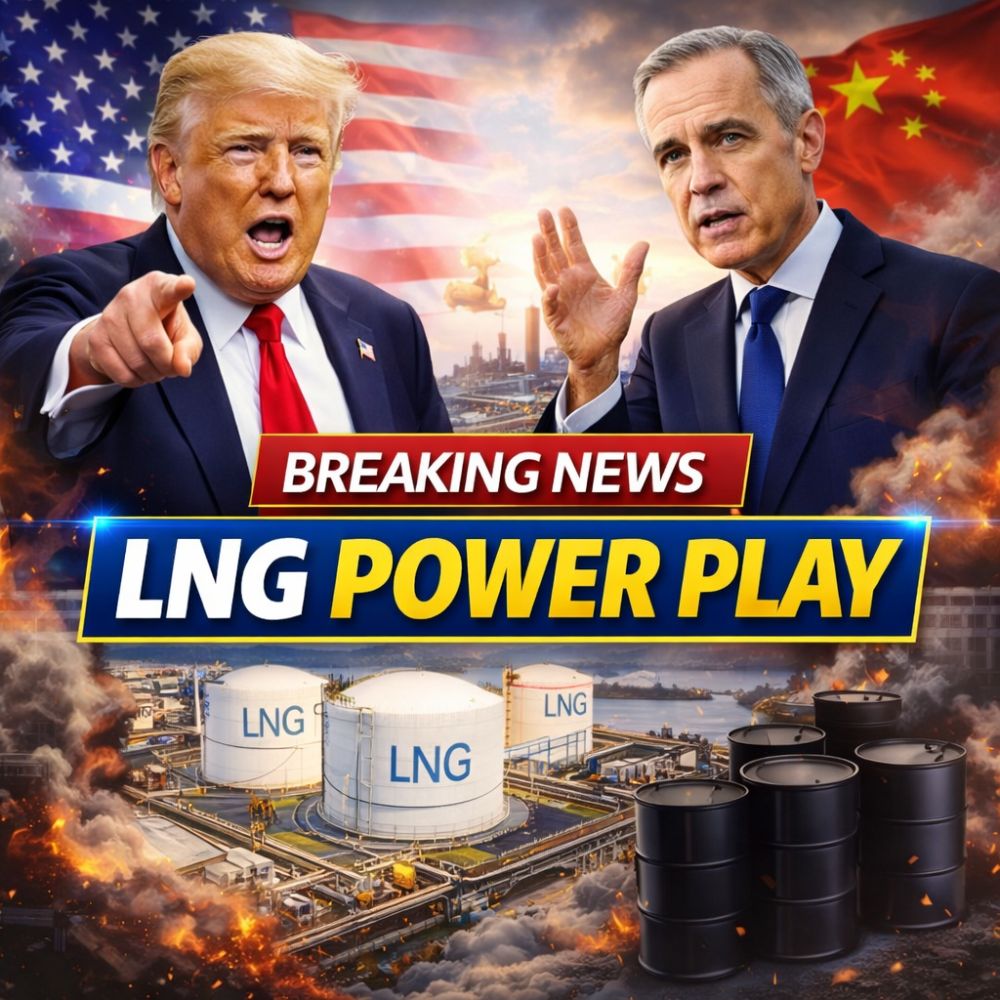
OTTAWA — While Washington remained fixated on tariffs, trade wars, and pressure tactics, Canada quietly made a move that could reshape the energy map of North America for decades.
In a signing ceremony that received little attention in the American press, Canadian officials and Chinese state energy giants finalized a $109 billion liquefied natural gas (LNG) deal — one that deliberately, and permanently, pushes the United States out of Canada’s energy export equation.
The agreement, negotiated over eighteen months and finalized in the early hours of Thursday, commits Canada to supplying China with approximately 15 million tonnes of LNG annually for the next 25 years. The gas will flow from a newly approved export terminal on Canada’s Pacific coast — infrastructure built specifically to bypass American territory entirely.
“This isn’t about one export deal,” said a senior Canadian trade official who spoke on condition of anonymity to discuss the sensitive negotiations. “This is about permanence. Once LNG terminals are built, supply chains are locked in, and investors are committed, leverage doesn’t come back with a phone call. This is structural.”
The Infrastructure That Changes Everything
The centerpiece of the deal is the Cedar LNG project in Kitimat, British Columbia — a floating LNG facility backed by the Haisla Nation and Pembina Pipeline Corporation. With final investment approval secured in June 2024, Cedar LNG is now under construction and on track for commercial operations by late 2028 .
But Cedar is not alone. Across British Columbia, a constellation of LNG terminals is taking shape: the LNG Canada facility, led by Shell, is already nearing completion; Woodfibre LNG is under construction near Squamish; and Ksi Lisims LNG, a partnership between the Nisga’a Nation and Western LNG, is moving through environmental assessment .
Collectively, these projects represent over $80 billion in committed investment — and the capacity to ship more than 40 million tonnes of LNG annually to Asian markets, all without a single pipeline crossing the United States .
For decades, Canadian energy exports have been held hostage by geography. Nearly all of Canada’s oil and natural gas has flowed south — to American refineries, American pipelines, and American markets. That dependence gave Washington enormous leverage. Tariffs, permit delays, or political spats could strangle Canadian energy overnight.
The LNG buildout changes that calculus.
The China Connection
The $109 billion deal with China is the anchor tenant that makes the entire Pacific strategy viable. China, the world’s largest importer of LNG, has been aggressively diversifying its energy suppliers away from Australia, Qatar, and the United States. Canada — with its stable regulatory environment, low-carbon LNG production, and Pacific access — offers Beijing a politically attractive alternative.
“China wants energy security. Canada wants market diversification. That alignment is powerful,” said Dr. Mei Zhang, an energy economist at the University of British Columbia. “The United States has spent years telling Canada it has no other options. Canada just proved otherwise.”
The financial contours are significant. The $109 billion figure represents not just the value of the gas itself, but associated infrastructure, shipping, and long-term service contracts. For British Columbia alone, the LNG buildout is expected to generate $23 billion in government revenue over the next thirty years and support more than 100,000 jobs during construction and operation .
Not Retaliation — Reorientation
Canadian officials have been careful not to frame the deal as retaliation against the United States. Publicly, the message is about economics, not politics: Canada needs new markets, China needs energy, and the Pacific route makes sense for both.
But the timing is impossible to ignore. The deal was finalized just weeks after the Trump administration imposed new tariffs on Canadian goods and threatened to revisit the USMCA trade agreement. And it came months after Washington signaled it would not approve new cross-border pipeline capacity, effectively closing the door on Canadian energy exports heading south.
“This wasn’t retaliation,” said a former Canadian diplomat who worked on energy files. “This was Canada removing a pressure point. The United States has used its position as Canada’s only energy customer to extract concessions for years. Ottawa just built an exit ramp. That changes everything.”
What Washington Lost
The United States has long benefited from its role as the default market for Canadian energy. American refineries in the Midwest and Gulf Coast are optimized for heavy Canadian crude. American natural gas consumers have enjoyed stable supply from their northern neighbor. And American policymakers have wielded energy dependence as a quiet lever of influence.
That lever is now weakening.
Once Canadian LNG flows to China, the infrastructure cannot be easily repurposed. Pipelines, terminals, and shipping contracts are built for specific destinations. The capital that financed them expects returns from Asian markets. Even if a future American administration wanted to reassert dominance over Canadian energy, the physical and financial architecture would no longer support it.
“Leverage doesn’t come back with a phone call,” the Canadian trade official said. “Once you build a terminal facing the Pacific, you don’t un-build it because Washington changes its mind. This is permanent.”
The European and Asian Dimensions
The China deal may be the largest, but it is not the only one. Canada has also been quietly expanding energy ties with Japan, South Korea, and Germany — all of whom see Canadian LNG as a stable, non-Russian, non-American source of supply.
Germany’s Uniper and Canada’s Enbridge have signed preliminary agreements to explore LNG exports to Europe, though those would likely require new infrastructure on Canada’s Atlantic coast . Japan’s JERA, the world’s largest LNG buyer, has taken equity stakes in Canadian projects. South Korea’s KOGAS is in active negotiations for long-term supply contracts.
Taken together, these deals represent a fundamental reorientation of Canadian energy policy: away from continental dependence and toward global diversification.
The Domestic Politics
The deal has not been without controversy in Canada. Environmental groups have criticized LNG exports as incompatible with Canada’s climate commitments. The Pembina Institute, a clean energy think tank, has warned that LNG exports could increase emissions unless paired with aggressive carbon capture and methane reduction measures .
But the economic argument has carried the day. With unemployment rising in resource-dependent provinces and the cost of living squeezing Canadian households, the promise of tens of billions in export revenue and hundreds of thousands of jobs has proven politically irresistible.
Prime Minister Mark Carney’s government has embraced the LNG buildout as a cornerstone of its “Team Canada” economic strategy — one that prioritizes sovereignty, diversification, and long-term infrastructure over short-term political comfort.
What Comes Next
For the United States, the implications are sobering. A Canada that no longer depends on American energy markets is a Canada that can afford to be far less accommodating on trade, defense, and diplomacy. The threat of cutting off energy exports — once unthinkable — is now a live option.
For China, the deal represents a strategic victory: a stable, long-term energy supply from a trusted partner, secured outside the orbit of American influence.
And for Canada, the calculation is simple: after decades of being told it had no choice but to sell to the United States, Ottawa has built another door. Whether Washington chooses to walk through it is now Washington’s problem.
The LNG terminals are rising on Canada’s Pacific coast. The first shipments to China are scheduled for 2029. And the energy equation of North America — once written in Washington — has been quietly, permanently, rewritten in Ottawa.