In October 1649, in the small town of Navalcarnero just outside Madrid, the king of Spain came in secret to see his bride with his own eyes. He was forty-four years old. She was fourteen. She was also his niece, the daughter of his own sister.
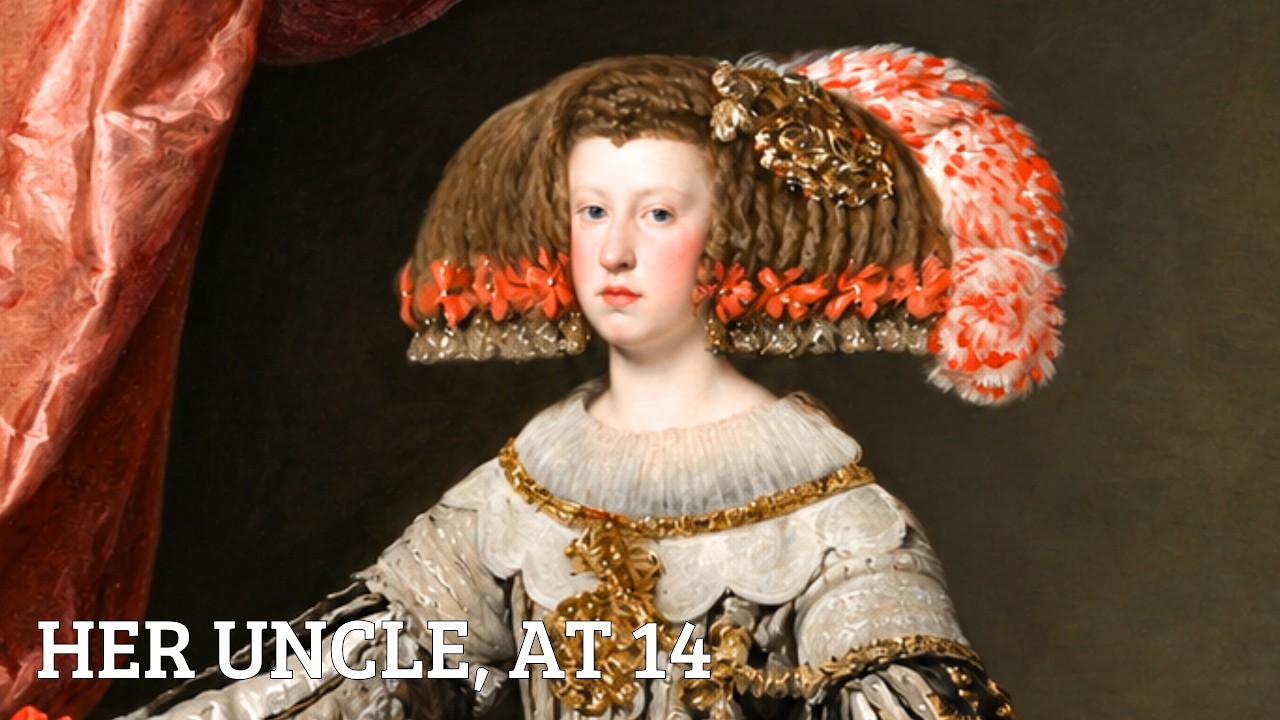
Three years earlier, she had been promised to his son. Then the son died of smallpox at sixteen, and the father took his place. Of the five children she would give him, three died young. The one who survived, Charles, ranks among the most inbred monarchs ever measured.
And one winter night, he would slip out of the palace to escape her. To understand how a fourteen-year-old girl ended up at that altar, you have to start with a family that kept marrying itself. Mariana was born just before Christmas in 1634 in Wiener Neustadt, a palace town south of Vienna. Her father was Ferdinand, soon to become Ferdinand III, Holy Roman Emperor.
Her mother was Maria Anna, a Spanish princess and the younger sister of King Philip IV of Spain. Mariana had an older brother, Ferdinand, and later a little brother named Leopold. Remember Leopold. He will matter more than anyone could have guessed.
The Habsburgs ruled in two branches, one in Vienna, the other in Madrid. For more than a century they had been sending brides back and forth between them. The logic was simple: marry inside the family, and the crowns, the lands, and the alliances stay inside the family too. Cousins married cousins, uncles married nieces.
It was a strategy, and on paper it worked. The cost was written in the bloodline. Modern geneticists have reconstructed the Spanish Habsburg family tree across more than three thousand people and sixteen generations. They calculated an inbreeding coefficient for each royal, an estimate of how much of a person’s genetic inheritance arrives twice from the same ancestors, through both the mother and the father.
The higher the number, the more closed the family circle. When the researchers measured the women who married into the Spanish line, Mariana came out on top. Of all those queens, she was the most inbred, with a score higher even than the average for the Spanish kings themselves. Keep that in mind.
Her son will inherit it, and then some. Her childhood in Vienna was not unhappy, as far as we can tell. She grew up speaking German and would eventually speak and write Castilian and French as well. But in 1646, when she was eleven, her world was rearranged twice in a matter of months.
In May, her mother died at Linz. She was thirty-nine. The woman who connected Mariana to Spain, who was a sister to the Spanish king, was gone. Then, on the eleventh of July, the Spanish and Austrian courts agreed on Mariana’s future.
She would marry her cousin, Balthasar Charles, Prince of Asturias, heir to the Spanish throne. He was sixteen, she was eleven. Both were grandchildren of the same Spanish king, which in this family counted as a recommendation, not a problem. One was destined to be king, the other his queen.
For King Philip, this boy was everything. Philip’s first wife, Elizabeth of France, had died in 1644 after a failed pregnancy. Besides one young daughter, Balthasar Charles was the only legitimate child that marriage had left him. Spain ruled territories across Europe and the Americas, and the entire succession rested on one teenager.
Philip did have other sons, but they were illegitimate and none of them could inherit the crown. One of them, as we will see, would grow up to become Mariana’s most dangerous enemy. About three months after the engagement was agreed, in early October 1646, the heir fell ill in Zaragoza. We know how the court reacted, partly because Philip was writing about it.
For more than two decades, the king kept up a private correspondence with a nun, Sor María de Ágreda, an abbess in the town of Ágreda whom he trusted with his fears, his sins, and his politics. On the seventh of October, he told her the court was hoping this storm would end in smallpox. Smallpox was the hopeful outcome, because at least people survived it. The prince did not.
On the ninth of October 1646, at a quarter to nine at night, Balthasar Charles died in Zaragoza, eight days short of his seventeenth birthday. The cause given was smallpox. Gossip at court also whispered about a venereal disease, and his tutor lost his post over the rumors. But smallpox is what the record states.
Philip wrote to the nun again. He had lost, he said, the only son he had. He meant the only one who counted. Now look at it from Mariana’s side.
Within five months, at eleven years old, she had lost her mother and her future husband. She had been raised to become queen of Spain, and suddenly there was no prince to marry. You might expect the engagement to quietly dissolve. That is not how dynasties worked in the seventeenth century.
Spain still needed an heir. Vienna still wanted a Habsburg queen in Madrid. And Mariana was still the most valuable bride in the family, now available again. The problem was that the only Spanish royal male left to marry her was the king himself.
He was forty-one, almost thirty years older than the girl, a widower, a man who had fathered several children outside marriage, and he was her uncle. Nothing in the surviving record suggests anyone asked the eleven-year-old what she thought. Three days after the prince died, the emperor’s ambassador in Madrid, the Marquis of Grana, put forward a suggestion. It did not come from a grieving father.
It came from Vienna’s man in Madrid, and it came fast. If the son could no longer marry Mariana, why not the father? To see why that suggestion landed so well in Madrid, you need to understand the man receiving it. Philip IV had been king since 1621, when he was just fifteen.
By the autumn of 1646, he had buried his first wife, Elizabeth of France, and now his heir. He had lost the woman who gave him his legitimate children and the son who was supposed to carry everything forward. What he had left was one young daughter and a reputation. The reputation was earned.
Philip was a deeply religious man who wrote anxious letters to a nun about the state of his soul, and he was also a king who fathered a string of children outside marriage. One of them mattered far more than the rest. In April 1629, a famous Madrid actress named María Calderón gave birth to a son. When the baby was baptized, the record named no parents.
It called him a child of the earth, the standard phrase for a foundling of unknown origin. Everyone at court knew exactly whose child he was. In 1642, Philip officially recognized him. The boy was given the name Juan José of Austria, and history usually calls him Don John.
So when Balthasar Charles died, Philip was not technically without sons. He had Don John, seventeen years old, clever, ambitious, and illegitimate. That last word made all the difference. Don John could serve the crown, command its armies, even govern its provinces.
He could never wear it. Spain needed a legitimate heir, and that meant Philip needed a new wife. Vienna had one ready. The ambassador’s idea moved quickly.
On the ninth of January 1647, Philip wrote to his confidant, the nun Sor María, that the emperor was offering him his niece in marriage. Three weeks later, on the thirtieth of January, he wrote again. His new marriage, he said, was now arranged. That is how fast it went.
In October, Mariana had been the fiancée of a teenage prince. By the end of January, she was the intended bride of that prince’s father, her mother’s brother. The formal contract followed in the spring of 1647. Mariana was twelve.
There was no question of an immediate wedding. She was too young, and there was a great deal to prepare. Among other things, she had to become Spanish. She spent two years learning the language of the court she was being sent to rule.
Her future life was being built for her in a country she had never seen, by a man she had never met, who was also family. On the eighth of November 1648, Mariana was married by proxy in Vienna. A proxy wedding meant the vows were made and the marriage became legally binding while the actual groom stayed hundreds of miles away. At the end of December, Philip told his nun simply that his betrothal had been celebrated on the eighth of the previous month.
Mariana was thirteen years old. In the eyes of the law and the church, she was now his wife. Five days later, on the thirteenth of November, she left Vienna. It is tempting to picture a quick carriage ride to Madrid.
It was nothing like that. The journey became one of the great royal processions of the century, and it took the better part of a year. Her household traveled south through the Alps toward Trento in northern Italy, and there the whole enterprise stopped and waited. Spain at that moment was at war with France and facing revolts in Catalonia and Portugal.
Assembling an escort fit for a queen took time and money. Meanwhile, a Spanish delegation had left Madrid in mid-November 1648, sailed from Málaga in January, and worked its way toward the handover point. One passenger on that Spanish voyage is worth noticing. The court painter Diego Velázquez sailed to Italy with the party sent to fetch the new queen.
In a few years, he would paint her more than once. In May 1649, the Spanish and Austrian households finally met at Rovereto, and Mariana passed formally from her father’s world into her husband’s. Her older brother, Ferdinand, traveled with her as far as Milan. That city gave her a grand ceremonial entry in June.
When she moved on, her brother turned back. From Milan she traveled to the coast, reaching the port of Finale in mid-August. On the twenty-fourth of August, the galleys sailed for Spain. One later account says a play was performed on board for her entertainment.
She was fourteen now, going to sea, surrounded by Spanish nobles whose job was to transform an Austrian Archduchess into a Spanish queen before she ever reached Madrid. That transformation produced a famous story, though you should hold it at arm’s length. Decades later, a French writer named Madame d’Aulnoy claimed she had been told that during the journey, townspeople presented the young queen with a gift of silk stockings. Her steward supposedly brushed them aside with the line that the queens of Spain have no legs.
In d’Aulnoy’s version, the girl burst into tears and said she wanted to go back to Vienna. It is a perfect anecdote, and it is also second-hand gossip written down long after the fact by an author whose reliability historians seriously question. What it does capture, true or not, is how the Spanish court looked to outsiders: a world of rigid etiquette where a queen was expected to become something closer to an icon than a girl. On the fourth of September 1649, Mariana landed at Denia on Spain’s eastern coast.
She had left Vienna nearly ten months earlier. She had been a fiancée at eleven, a bride by proxy at thirteen, and now, at fourteen, she was finally standing in the kingdom she had been married to. There was just one thing left. She still had not met her husband.
That changed a month later, a short ride from Madrid. Mariana reached Navalcarnero, a small town southwest of the capital, on the sixth of October 1649. Before any ceremony, Philip came to look at her incognito, unannounced, as a private observer rather than a king. Then he withdrew and spent the night at nearby Brunete.
We do not know what he thought of what he saw, and we have no record of what she knew about it. The next day, Thursday the seventh of October, they were married. The ceremony was performed by Cardinal Moscoso, the Archbishop of Toledo. Philip was forty-four and had been a widower for five years.
Mariana was fourteen, about ten weeks short of her fifteenth birthday. Look at the calendar for a moment. Her first fiancé, Balthasar Charles, had died on the ninth of October 1646. She married his father on the seventh of October 1649, two days short of three years.
And the family arithmetic gets stranger. Philip’s surviving daughter from his first marriage, Maria Teresa, was only about four years younger than her new stepmother. The girl who had been meant to be her sister-in-law was now her stepdaughter. The man who had been meant to be her father-in-law was her husband.
And he had been her uncle the whole time. Madrid, though, was not interested in awkwardness. Madrid wanted a show. On the fifteenth of November 1649, Mariana made her official entry into the capital.
She set out from the Retiro Palace on a white horse that had its own name, El Cisne, the swan. The city had built temporary monuments along the route. There were triumphal arches representing the four continents, and an artificial Mount Parnassus with figures of Apollo and the nine muses alongside nine famous Spanish poets. The message was not subtle.
The whole known world, art and literature included, was welcoming this teenager. Two days later, Philip wrote to his nun about his new wife. Every quality he had discovered so far in her, he said, was great. But notice the word he used.
He did not write my wife or the queen. He wrote that these qualities were in my niece. So what was she actually like? We have a rare contemporary description.
The court chronicler José Pellicer, who saw her, described her as fair-skinned, blonde, cheerful in temperament, and witty. Other accounts agree she loved entertainment, especially the theater. A modern historian of Philip’s reign notes she made her taste for amusement very clear from the start. She was fourteen, after all.
She liked to have fun. The court she had joined was not built for that. The Spanish monarchy ran on an elaborate ceremonial code, and the queen was one of its most visible symbols. Even her clothing had to change.
Historians who have studied her wardrobe describe a radical transformation after she arrived in Madrid. The Austrian Archduchess was dressed in the Spanish fashion, including the guardainfante, a huge rigid farthingale that spread the skirt out wide from the hips. It was spectacular. It was also a kind of armor, turning the girl inside it into a silhouette of royal dignity.
And from the very beginning, there was one expectation that outweighed all the others. Philip had married his niece to get a son. Here, at least at first, things looked hopeful. On the twelfth of July 1651, Mariana gave birth to her first child.
She was sixteen years old. The baby was healthy and survived, but she was a girl. They named her Margarita Teresa. You may know her face.
A few years later, she would stand at the center of the most famous painting in Spain. In Spain, a daughter could inherit under certain circumstances, but no one wanted to rely on that. A princess was a marriage alliance waiting to happen. Philip, now forty-six, needed a male heir, and the pressure fell on the teenage queen whose body was, in dynastic terms, the entire point of the marriage.
Every royal pregnancy was public business, tracked by gossiping newsletter writers and reported to foreign courts. Around this time, the painter who had sailed to Italy with her escort came home and went back to work. Philip had grown impatient waiting for him. In letters to a lady at court, the king complained about what he called Velázquez’s phlegm, his maddening slowness.
Between 1652 and 1653, Velázquez painted Mariana’s official full-length portrait, which now hangs in the Prado in Madrid. She stands in black and red against a scarlet curtain, wearing that enormous farthingale, heavy jewelry, and a large plume in her hair. In one hand she holds a lace handkerchief. The other rests on a chair.
Beside her is a gilded clock. A copy was sent to her father in Vienna in December 1652, and it remains there. But look at her face. The cheerful, witty girl described by Pellicer does not appear in this painting.
Her expression is closed, almost sulky. The art historian Rosemarie Hagen has argued that the change in Mariana reflects life at court itself: repeated pregnancies, boredom, and loneliness. That is an interpretation, not a diary entry. Mariana did not leave us her own description of these years, and a formal portrait was never meant to show a queen smiling.
Still, the contrast is hard to ignore. Within three years of arriving, the girl who loved to laugh had become the figure in black and red, posed with a clock at her side. And the clock was ticking. Spain had a queen, and now a little princess.
What it still did not have was a prince. Over the next decade, Mariana would be pregnant again and again, and the court would watch every single one of those pregnancies. One of the people watching most closely was a man named Jerónimo de Barrionuevo. He wrote regular newsletters from Madrid, a kind of private gossip column sent out to readers who wanted to know what was really happening at court.
He was sharp, nosy, and frequently unkind, which makes him extremely useful. In October 1655, Barrionuevo summed up the king’s situation in one line. When it came to bastards, he wrote, Philip had a very good hand. When it came to legitimate children, his luck was very short.
That was a joke about the king’s past, not proof of any new affair, but it captured the mood. Four years after Margarita’s birth, there was still no prince. Then, on Tuesday the seventh of December 1655, at about eight in the morning, Mariana gave birth again. It was another girl.
She was named María Ambrosia. Barrionuevo’s next reports make painful reading. Eleven days after the birth, he wrote that the baby would not feed. She was, he said, a mere breath.
A few days later, she was dead. She had lived for about two weeks. Her mother was twenty years old. The next year, the gossip turned cruel in a different way.
In the spring of 1656, rumors spread that the queen was pregnant again. Barrionuevo reported them. By the end of August, he was calling it an imagined pregnancy. Picture being a young woman whose body is the subject of weekly speculation across Madrid, and then reading that your pregnancy was apparently a fantasy.
That same year, 1656, Velázquez finished the painting that would make the family immortal. Today we call it Las Meninas. At the center stands little Margarita, about five years old, in a wide pale dress, surrounded by her maids of honor. Velázquez painted himself at a huge canvas on the left.
In the right corner are two court dwarfs, Maribárbola and a small boy named Nicolás Pertusato, who has his foot resting on a large dog. And in a mirror on the back wall, faint but unmistakable, you can see the king and queen, Philip and Mariana. In the Prado’s reading of the scene, they are standing exactly where we stand, watching their daughter while Velázquez paints their portrait. It is an extraordinary image of a royal family, and it is worth noticing who is in it.
The princess is at the center. The parents are reflections. And the boy with his foot on the dog, Nicolás Pertusato, will turn up again in this story, more than twenty years later, in a role nobody looking at this painting could have imagined. Finally, on Wednesday the twenty-eighth of November 1657, at half past eleven in the morning, Mariana gave birth to a son.
Spain had a prince at last. They named him Felipe Próspero, Philip the Prosperous, a name that sounds less like a description than a prayer. The birth nearly cost Mariana her life. Within days, Barrionuevo reported that the queen had been so ill she received the last sacrament, the right given to people expected to die.
She was twenty-two. She survived. The baby prince, for now, survived too. The following year, in December 1658, she gave birth to another son, Fernando Tomás.
For a moment it looked as though the succession had been secured twice over. Then, in October 1659, Fernando Tomás died. He was less than a year old. By the age of twenty-four, Mariana had given birth four times and buried two of those children.
It is tempting to say that every royal family lost babies in the seventeenth century, and that is true. But the modern geneticists who studied the Spanish Habsburgs looked at exactly this question. Of thirty-four children born to the Spanish royal family between 1527 and 1661, nearly thirty percent died before their first birthday, and half died before their tenth. In ordinary Spanish villages of the same era, deaths before the first birthday ran at about twenty percent.
The royal family, with every comfort and every doctor money could buy, was losing children at a strikingly high rate. And the surviving son was not strong. In 1659, Velázquez painted the little prince Felipe Próspero when he was still under two. That portrait was sent as a gift to the court in Vienna and hangs today in the Kunsthistorisches Museum there.
The museum describes the boy as delicate and sickly. Look closely, and you can see what his parents were relying on. Hanging from his clothes are charms. One is a small amulet of black jet in the shape of a closed fist, a traditional protection against the evil eye.
Another is a small gold bell. When the prince’s possessions were inventoried in 1661, the list included a jet charm set with diamonds. Here is the heir to a global empire, and the family is protecting him with a good luck charm. There is one more detail about those portraits going to Vienna.
Felipe Próspero’s was not the only one. Velázquez had also painted Margarita again and again, and those pictures were sent to the Imperial Court too. One shows her in pink in 1654. Another, from 1659, shows her in blue.
The museum notes that a new portrait went to Vienna every two or three years. Partly this was family affection. Partly it was something more practical. A princess was a future marriage, and the Vienna branch of the family was watching her grow up.
Hold on to that thought, because it pays off in an uncomfortable way. For now, though, the court’s attention was fixed on the fragile boy with the charms. Through 1661, Felipe Próspero was sick again and again. He suffered repeated fevers.
A swelling appeared under his ear and had to be lanced. In June of that year, his doctors operated. By the end of that summer, the boy was not yet four and still unwell, and Mariana was pregnant again. In the early hours of the first of November 1661, Felipe Próspero died.
He was three years old, a few weeks short of his fourth birthday. The only living son of the king of Spain was gone, and his mother was nine months pregnant. Months later, Mariana wrote about it in a letter to Vienna, in German. You cannot believe, she said, how much the child suffered.
She blamed his doctors, writing that they had tormented him and sent him to his grave too soon. It is one of the few places where we hear her own voice about her children, and it is not the voice of a cold dynastic machine. It is a mother who watched her son die and was angry about how it happened. Then, five days after that death, on Sunday the sixth of November 1661, she went into labor.
It lasted about an hour. In the early afternoon, she gave birth to a boy. They named him Charles. You can feel the relief and the confusion in Philip’s letters.
Writing to his nun, he said the loss of his son grieved him, but what grieved him even more was the sense that he had angered God. In the same exchange, he called Mariana an angel. And then came a line that sounds almost unbearable today. Our Lord, Philip wrote, had deigned to send him back his son by bringing him another.
One prince died. Five days later, another took his place. From Philip’s perspective, God had given and taken in the same week. Here is where the familiar story starts to wobble.
The popular version says Charles was visibly damaged from the moment he was born and that everyone could see it. But the earliest descriptions do not say that. One account, later quoted by a Spanish historian, described a most beautiful prince, large-headed, black-haired, and rather plump. Mariana’s own letters to Vienna went further.
In German, she called the baby very healthy and strong and the most beautiful child she had ever had. For months afterward, Philip kept writing that the boy was pretty, bright, and healthy. So where does the horror story come from? Largely from the French.
Spain’s great rival was desperate to know whether this heir would survive, because if he did not, French claims to the Spanish throne grew much stronger. And the Spanish court made sure the French could not see him. A French envoy who arrived in late 1661 was not allowed near the baby. It was not until the nineteenth of May 1662, when Charles was about six months old, that two French envoys were finally admitted.
Their dispatch home was brutal. The prince, they reported, seemed very weak, with rashes on both cheeks and his head covered in scabs. Two years later, in 1664, Mariana’s brother Leopold wrote that the French in Vienna were spreading an even stranger rumor: that Spain’s prince was not a boy at all, but a girl. So you have to weigh the sources.
The parents were not neutral, and neither were the French. A hostile diplomat looking for weakness found it. Proud parents looking for health found that instead. What happened over the next few years, though, is harder to argue with.
Charles was breastfed for four years minus twenty days by fourteen different wet nurses. In October 1664, when he was nearly three, a French ambassador reported that the prince still could not stand, to everyone’s astonishment. In January 1665, a letter noted that although he was going on four, he still could not walk on his own feet. By the summer of 1667, court staff recorded that he now walked alone and no longer needed support.
By then, he was almost six. Those are real delays documented in real time. They are also a lot less extreme than the later legend, which claims he could not walk until he was eight or ten. The historian Gabriel Maura, who published many of these letters, dismissed the most extreme version from Madame d’Aulnoy as exactly what it was: a legend.
Which brings us to the science. When the geneticists calculated Charles’s inbreeding coefficient, they got a score of about 0. 25. To put that in perspective, the child of an uncle and a niece would normally be expected to score about half that, around 0.
125. Charles came out at roughly double, because his parents were not just uncle and niece, they were the end point of generations of the same families marrying back into each other. His score is very close to what you would expect for the child of a brother and sister, or of a parent and child. He was the most inbred of all the Spanish Habsburg kings.
Is he the most inbred king in history? That is where honesty matters. According to a 2010 DNA study, Tutankhamun’s parents were full siblings, which would put him at least level, though some scholars dispute that identification. And within Charles’s own family, there is someone who scored even higher.
We will meet her later. So the fair way to say it is this: Charles ranks among the most inbred monarchs ever measured. Another study looked at the famous Habsburg jaw. Ten maxillofacial surgeons examined sixty-six portraits of fifteen members of the dynasty and found a strong link between inbreeding and a protruding lower jaw.
The man with the most pronounced jaw of all, in their assessment, was Philip IV. As for what exactly was wrong with Charles, the researchers proposed two rare inherited conditions, one affecting the pituitary gland and its hormones, the other affecting how the kidneys regulate acid in the body. But they called their own idea highly speculative. It rests on descriptions written centuries ago, not on any medical test.
The honest answer is that we do not know. What we do know is that in September 1665, this fragile little boy was three years old and his father was dying. Philip IV had been ill with fever and bleeding. On the fourteenth of September 1665, he signed his will.
Three days later, just before dawn on Thursday the seventeenth of September, he died. He was sixty years old. A later retelling has him telling his little son that he hoped God would make him happier than he had made his father. It is a moving line, but it comes to us second hand, so treat it as tradition rather than record.
What we can read for ourselves is the will. And the will changed Mariana’s life completely. Clause 21 named her governor of the kingdoms and guardian of the prince until Charles turned fourteen. In practical terms, the teenage bride from Vienna was now the acting ruler of the Spanish monarchy, with territories in Spain, Italy, the Low Countries, the Americas, and the Philippines.
She was thirty years old. Her son was three. Philip did not leave her alone in the job. The will created a governing council called the Junta with six members: the president of the Council of Castile, the vice-chancellor of Aragon, the Archbishop of Toledo, the Inquisitor General, a member of the Council of State, and one grandee.
They were there to advise her. On paper, it was a sensible arrangement. But clause 33 contained a trap. It barred foreigners from serving as ministers or judges.
The rule sounded patriotic. In practice, it meant the queen, who was herself Austrian by birth, could not easily appoint the people she trusted most. Then there was the question of how she would look. After Philip’s death, Mariana cut her hair and put on long, nun-like coifs, the formal widow’s dress of the Spanish court.
Most royal widows wore mourning for a time. Mariana wore it for the rest of her life, about thirty-one years. You can see it in a portrait painted in 1666 by Juan Bautista Martínez del Mazo, Velázquez’s son-in-law, which now hangs in the National Gallery in London. She sits in a black habit with a white wimple framing her face.
In the background you can glimpse the little king, Charles. Compare that to the girl in black and red with the plume and the farthingale. The Mariana of the regency looks less like a queen than an abbess. And within months of taking power, she sent her only surviving daughter away to Vienna.
Remember those portraits of Margarita shipped to Vienna every few years? Here is the uncomfortable payoff. They had been going to the Imperial Court, and the man who ruled that court was now Mariana’s younger brother, Leopold, Holy Roman Emperor since 1658. Margarita was going to marry him.
Leopold was Margarita’s uncle, her mother’s brother, exactly the same relationship Philip had to Mariana. He was looking forward to it. In a private letter from November 1664, he complained impatiently about the delays and wished that his Gretel’s journey would finally happen. Gretel was his pet name for her, roughly Maggie.
At that point, Margarita was thirteen. According to one Austrian biographical dictionary, she in turn called him uncle. On the twenty-fifth of April 1666, Margarita was married to Leopold by proxy in Madrid. She was fourteen.
On the fifth of December, she made her entry into Vienna, and on the twelfth of December, the wedding was celebrated there. She was fifteen. Her new husband was twenty-six. It is hard not to notice the pattern.
Seventeen years earlier, Mariana had made the reverse journey: a girl of thirteen married by proxy, then crossing Europe to marry her mother’s brother at fourteen. Now she was the mother watching her own daughter do it. The surviving sources do not tell us what she said about it. What we know is that she did not stop it, and that the dynasty she served did not see anything to stop.
Meanwhile, Mariana needed help running an empire, and the person she leaned on was a man she had known since childhood. His name was Johann Eberhard Nithard, known in Spain as Juan Everardo Nithard. He was an Austrian Jesuit, born in 1607, and he had been Mariana’s confessor since 1646, the year her mother and her first fiancé died. He had come with her to Spain.
For two decades he had been one of the few constants in her life. Now she brought him into government. In January 1666, he was appointed to the Council of State. But clause 33, the rule against foreigners, stood in the way of anything more.
So Mariana went around it. In August 1666, the cities that voted in the Castilian Parliament were consulted, and on the twentieth of September, Nithard was naturalized as a Spaniard by royal decree. Two days later, on the twenty-second of September, he was named Inquisitor General, head of the Spanish Inquisition. That title mattered, because the Inquisitor General had an automatic seat on the Junta.
On Sunday the fourteenth of November 1666, Nithard took it. Her confessor was now one of the six men governing Spain. Why did she trust him so completely? We have one revealing answer reported from inside her household.
Mariana told one of her ladies that she was rotting from all these affairs of state, and that there was no one she could rely on or trust except her confessor. That is a remarkable thing for a ruler to admit. It also tells you how isolated she was: a foreign-born widow governing for a sickly child, surrounded by Spanish nobles who had their own ambitions, had chosen to place her trust in a foreign priest. To many at court, that looked like an outrage.
And one man in particular decided to do something about it. He was the king’s illegitimate son, the boy once recorded as a child of the earth, now a grown man with years of military command behind him and ambitions of his own. Don John was coming for Nithard. The conflict turned deadly in the summer of 1668.
On the second of June, a man named José Malladas was arrested in Madrid. He was garroted in the palace prison after a trial so fast it barely deserved the name. At the time, it was alleged that Malladas had been involved in a plot hired by Don John to kill Nithard. That was an allegation, and it has never been established.
But the speed of the execution sent a message. The historian Silvia Mitchell, author of the major modern study of Mariana’s government, reads it as a deliberate warning aimed straight at Don John. If it was a warning, he did not take it. That August, Don John was ordered to withdraw to the town of Consuegra and stay there.
In October, an order went out for his arrest. Instead of waiting to be caught, he slipped away and reached Barcelona in November. There he published a manifesto against the Queen’s confessor. Then, on the thirtieth of January 1669, he set out from Barcelona toward Madrid.
He left with an armed escort, and as he traveled, the escort grew until it looked very much like an army. Some historians describe this as the first military pronunciamiento in Spanish history: a military figure marching on the capital to force a political change. One poster that appeared on the streets carried a threat in rhyme. The Queen, it said, could go to the Descalzas, a royal convent, and the King could be given a new guardian, unless the government changed by getting rid of the confessor.
In other words: send the priest away, or we will shut the Queen in a nunnery and take her son. And the campaign against Nithard got personal. In the propaganda war, he was attacked from every angle, and some of his enemies went as far as calling him the queen’s lover. That claim came out of a vicious power struggle, and there is no evidence for it.
But it is worth noticing how quickly a widow’s trust in a confessor was turned into a sexual accusation. Mariana gave way. On the twenty-fifth of February 1669, Nithard was told to go, and he left the court that same afternoon. Some sources put his final departure from Madrid a little later, in March.
One later account says the queen herself, under heavy pressure, asked him to go in tears. He was escorted out by Cardinal Aragón and members of the Inquisition’s council, while Don John’s supporters made sure the departure was loud and public. He reached Rome that May and never came back. He died there in 1681.
Charles, the king in whose name all this was done, was seven years old. Don John had won the first round. But Mariana was still regent, and she found a new man to trust. His name was Fernando de Valenzuela.
He was born in Naples in 1636, into a family of the lower nobility. His father died when he was a child, and he made his way at court as a page in a great noble household. His real advantage was a wife in the queen’s service. In 1661, he married María Ambrosia de Uceda, one of Mariana’s attendants, and that same year he was given a post in the queen’s stables.
Valenzuela became the queen’s eyes and ears. He had free access to her apartments, and he brought her the secrets and gossip of the court. They gave him a nickname that stuck: El Duende de Palacio, the palace goblin. A duende is a mischievous household spirit, the kind that slips through rooms unseen.
His rise after that was steady. In 1671, he was made introducer of ambassadors and a knight of the Order of Santiago. In 1673, he became first equerry. Every single step of it depended entirely on Mariana.
And of course, the gossip followed. Contemporaries said the friendship between the queen and her favorite invited a great deal of malicious comment. Satires mocked him. People whispered that he was her lover.
Once again, there is no documentary evidence of a sexual relationship. Modern historians like Mitchell argue that royal favorites were a normal tool of government across Europe, and that the lover story says more about a world that could not accept a woman holding power than about what actually happened. Her enemies said Mariana was weak, ruled by whatever man stood closest to her. But look at the pattern.
She chose these men. She promoted them. She defended them. A puppet does not usually pick her own strings.
While she fought for power in Madrid, the news from Vienna kept getting worse. Margarita’s marriage to her uncle Leopold had been, by the standards of the time, a loving one. But her body was paying for the dynasty’s demands. Her first son, born in 1667, died a few months later.
A daughter, Maria Antonia, was born in 1669 and survived. A son born in 1670 died the same day. She miscarried in 1671. Another daughter, born in February 1672, lived only two weeks.
In March 1673, heavily pregnant again, Margarita fell ill with a fever. Eight days later, on the twelfth of March, she died. She was twenty-one. Leopold’s own notes record that a dead son was found inside her.
Two days after her death, Leopold wrote that he knew what he had lost and how they had loved each other. He also thought of his sister in Madrid. He asked that the news be broken to Mariana gently, so that she too would not be put in danger. Mariana had now buried four of her five children.
She was thirty-eight. Only Charles remained. Remember the one child of Margarita’s who survived, the little girl Maria Antonia. She will matter later.
And Charles was growing up. In November 1675, he would turn fourteen. Under his father’s will, that was the moment Mariana’s regency was supposed to end. Mariana had no intention of letting it end quietly.
On the first of November 1675, five days before his birthday, Charles told Cardinal Aragón something nobody in his mother’s circle wanted to hear. He intended to rule for himself, and he wanted Don John at his side. His father’s illegitimate son, the man who had driven out his mother’s confessor, was the person the teenage king had chosen. Three days later, on the fourth of November, a decree was placed in front of Charles that would have extended the regency by another two years.
He did not sign it. Instead, he sent a note to Don John. He needed him at his side, he wrote, for the ceremony of taking power and to take his leave of the queen. Read that carefully.
A fourteen-year-old was summoning his mother’s greatest enemy to help him say goodbye to her government. On the sixth of November 1675, Charles’s fourteenth birthday, the day he legally came of age, Don John rode into Madrid and saw the king. Mariana refused to receive him. According to the historian Silvia Mitchell, she sent word that she had a migraine.
Then Charles went in to see his mother. The two of them spent about two hours together. We do not know what was said in that room. What we have is how he looked when he came out.
Witnesses said he showed obvious signs of having cried a great deal. By about six that evening, everything had reversed. The Duke of Medinaceli carried a royal order to Don John, instructing him to leave Madrid and take up a post in Italy. The next day, Don John was gone.
The councils agreed on a compromise. The king would sign decrees, but the governing junta would continue for two more years with the queen presiding. In a single afternoon, after two hours alone with his mother, Charles had reversed himself. For the moment, she had won.
And she promptly made her position more dangerous. Valenzuela, the palace goblin, kept rising. In November 1675, he was made Marquis of Villa Sierra. The following summer, he became master of the horse.
Then came a strange accident. While out hunting, Charles accidentally shot Valenzuela. The favorite survived, and soon afterward he received the highest honor a Spanish noble could hold: he was made a grandee of Spain. By November 1676, he was being described as the king’s first minister, though historians still argue over whether that was a formal title or simply a description of his power.
To the old nobility, this was intolerable. A man from the lower ranks, married to one of the queen’s servants, now outranked families that had served the crown for centuries. On the fifteenth of December 1676, a group of about two dozen grandees signed a manifesto. Its demands included one phrase that tells you exactly who the real target was.
They wanted the queen mother separated from the king completely and forever. Not Valenzuela. Her. The favorite was the excuse.
The mother was the problem. Things moved fast after that. Within days, a council voted for Valenzuela’s arrest, and he fled to the monastery of El Escorial for refuge. On the twenty-seventh of December, Charles wrote secretly to Don John.
In early January, Don John left Zaragoza and headed toward the capital. Then came the night from the beginning of this story. On the fourteenth of January 1677, at about ten at night, the fifteen-year-old king got dressed with the help of the Duke of Medinaceli. His attendants were locked in a room, and Charles slipped out of the Alcázar, the palace where he had lived his whole life with his mother, and was taken across Madrid to the Buen Retiro, the pleasure palace built for his father on the other side of the city.
They arrived after midnight. A contemporary account summed it up in a single phrase. The king, it said, was more obedient to necessity than to his mother. You might wonder whether he actually wanted to go or whether he was carried along by the men around him.
Honestly, the sources do not settle that. He had written to Don John himself. He had also broken down in tears after two hours with his mother a little over a year earlier. Both things can be true of a fifteen-year-old.
What is not in doubt is the result. Later that January, Don John entered Madrid and took control of the government. The palace goblin’s luck ran out next. Troops were sent to El Escorial.
The prior of the monastery tried to protect his guest by demanding a written royal order. The soldiers broke in anyway, arrested Valenzuela, and carried him off to prison in Consuegra. Within days, every grant and title he had received was canceled. The papal nuncio sentenced him to ten years of exile in the Philippines, on the opposite side of the world.
And then it was Mariana’s turn. On the seventeenth of February 1677, a royal order came. The queen mother was to leave Madrid. She was forty-two years old.
She had arrived in the city at fourteen as a bride riding a white horse beneath arches of the four continents. She had buried a husband and three children here and lost a fourth in Vienna. She had ruled an empire here for more than a decade. On the second of March 1677, she left Madrid.
She waited for a time at the Royal Palace of Aranjuez, south of the capital. Then, on the thirty-first of March 1677, she entered Toledo, the old imperial city on its rock above the river Tagus. Historians call it what it was: exile. Her son, the boy she had governed for since he was three years old, had sent her away.
But if Don John and the grandees thought that removing Mariana from Madrid would remove her from power, they were about to discover how wrong they were. From Toledo, Mariana did the one thing her enemies could not stop. She wrote. She wrote to her son constantly, and she signed her letters in a way that is hard to read without a pang: Tu Madre que más te quiere, your mother who loves you most.
Remember, this was the son who had slipped out of her palace at night and then sent her away. She kept writing to him anyway. And she did not just write about feelings. She built a network.
Messengers rode between Toledo and Madrid, sometimes twice in a single day, carrying news, letters, and requests. Among them were the Marquis of Mancera and, remarkably, the Duke of Medinaceli, the same man who had helped Charles get dressed and slip away on that January night. And one of her messengers was a familiar face. Nicolás Pertusato, the small figure in the corner of Las Meninas with his foot on the dog, had been in Mariana’s household since 1650, the year after she arrived in Spain.
In the painting, he looks like a child. But if the traditional identification is right, he was already a young man of about twenty-one when Velázquez painted him, a dwarf from the Duchy of Milan. She later made him a valet of her chamber. Two decades on, he was carrying her messages from exile.
The painting froze a moment of royal family life in 1656. By 1677, the princess at its center was dead, the king in the mirror was dead, and the queen in the mirror was banished to Toledo. And the figure with his foot on the dog was going back and forth, helping her stay in the game. And the game was very real.
About twenty-five letters survive between Mariana and the Imperial Ambassador, Count Harrach, written in just the first months of her exile. She asked for state papers to be sent to her, and Charles sent them. The official story was that she had been removed from government. The paperwork tells a different story.
Don John knew it. He kept a close eye on the young king’s correspondence with his mother, supervising what Charles wrote to her, but he could not cut the connection entirely. One of his major decisions was Charles’s marriage. Don John arranged for the young king to marry a French princess, Marie Louise of Orléans, the niece of Louis XIV.
For Mariana, an Austrian Habsburg to her bones, a French bride was not the obvious choice. And yet, in 1679, when the news had to be broken to her brother, the Emperor Leopold, it was Mariana who smoothed it over with Vienna. On the fourth of May 1679, Charles wrote to thank her. Even in exile, she was still doing the diplomacy.
Then, on the seventeenth of September 1679, Don John died. He was fifty years old. He had held power for less than three years. The man who had marched on Madrid to drive out her confessor and then orchestrated her own removal was gone.
What Charles did next was striking. Just four days later, he went to Toledo to meet his mother. And on the twenty-seventh of September 1679, Mariana returned to Madrid. The official gazette described her reception in gushing terms, saying the whole city welcomed her from their hearts with acclaim and applause beyond any explanation.
Court newspapers always flattered royalty, so treat that with some caution. But a foreign diplomat had no reason to flatter her. The Venetian ambassador wrote that her return was a triumph and a very rare lesson in divine justice. She was forty-four.
She had been gone for two and a half years. That November, she moved into a residence near the Royal Palace, connected to it by a passage, close enough to be consulted, close enough to be there. What about the palace goblin? Valenzuela’s journey was far longer.
He was taken from his prison in April 1678 and shipped to New Spain, where he was held in the fortress of San Juan de Ulúa off the coast at Veracruz. Only in November 1679, about two months after Mariana returned to Madrid, was he finally handed over in the Philippines. He was not brought back. He was freed by royal decree in 1687 and made his way to Mexico City.
There, in January 1692, he died after being kicked by a horse. The man once whispered about as the queen’s lover ended his life on the other side of the world. Back in Madrid, a new queen had arrived. Marie Louise of Orléans married Charles in November 1679.
She was seventeen. Mariana now had to share the court with a French daughter-in-law chosen by her dead enemy. According to Spain’s national biographical dictionary, their relations were cordial at first and then grew rough. French diplomats tried to keep the young queen close to the queen mother, apparently judging that Mariana was the real power worth cultivating.
The deeper problem was the one that had haunted Mariana’s own marriage. Spain needed an heir. Year after year, no child was born. Charles’s first marriage produced no children at all.
Then, in February 1689, Marie Louise fell from her horse while riding in the Retiro. On the twelfth of February, three days later, she died. She was only twenty-six. Rumors of poison spread immediately, especially among the French.
The Spanish court ordered an autopsy partly to silence them. Modern medical historians who have re-examined the descriptions suggest she most likely died of appendicitis leading to a fatal infection. You will sometimes read online that Mariana herself was accused of poisoning her. There is no reliable evidence for that claim, so leave it where it belongs, in the rumor pile.
What the death did mean was urgent. Charles was twenty-seven, childless, and widowed. Spain needed another queen quickly. And the fight over who she would be became the final battle of Mariana’s life.
The choice moved quickly. Within weeks of Marie Louise’s death, Spain’s councils were urging the king to remarry. The bride they settled on was a German princess, Maria Anna of Neuburg. The reasons were blunt.
She came from an enormous family, one of twelve children, which suggested fertility. She had no French blood. And she had the backing of the Emperor Leopold, whose wife was her sister. Historians still disagree about how hard Mariana herself pushed for the match.
The young queen arrived in 1690, and soon the court had two queens and one king. A French agent at court summed up the problem in two words. Both of them, he wrote, wanted to rule. They fought over appointments, and Mariana won some of the biggest.
But the real battle was about the one question hanging over everything. Charles had no children. Who would inherit Spain when he died? The young queen supported her own Austrian relatives.
Mariana chose someone else, and the name she chose closes a circle in this story. Remember Margarita’s one surviving child, the little girl Maria Antonia? She had grown up, married the Elector of Bavaria, and in October 1692 she gave birth to a son, Joseph Ferdinand. That boy was Mariana’s great-grandson, and he was Mariana’s candidate for the throne of Spain.
And the person in Charles’s family who scored even higher on that inbreeding scale? It was Maria Antonia. As the daughter of Margarita and her uncle Leopold, her coefficient was calculated at about 0. 31, higher than Charles, and higher than the child of a brother and sister would normally be expected to score.
The uncle-and-niece pattern had produced another uncle-and-niece marriage, and that marriage had produced someone even more inbred than Charles. Her son was the heir Mariana wanted for Spain. Did Mariana understand what was wrong with her own son? One remark suggests that people around her thought so.
In 1686, a nobleman named Montalto said she deserved praise for her prudence because she knew what she had given birth to. The signs were obvious to outsiders. In the late 1690s, the English ambassador Alexander Stanhope described the king in plain terms. In one letter he wrote that Charles’s lower jaw stood out so far that his two rows of teeth could not meet, so he swallowed his food whole.
In another, he wrote that people near the king could hardly understand his speech. In the spring of 1696, Mariana was seriously ill. She had breast cancer. In one of the more human moments of this whole rivalry, the young queen wrote to her brother asking for doctors to be sent.
But the cancer was already far advanced. Mariana died on the sixteenth of May 1696, in her residence beside the Royal Palace, at a quarter to midnight during an eclipse of the moon. She was sixty-one years old. As she lay dying, Charles promised her that he would make Joseph Ferdinand his heir.
She was buried at El Escorial in the Royal Pantheon, alongside the husband who had been her uncle. Panegyrics were published across the monarchy, and a process was even opened to consider her for beatification. Charles kept his promise. At first, a will naming Joseph Ferdinand was signed that September.
But the king’s health was collapsing, and so was his grip on reality. By 1698, the head of the Inquisition was secretly corresponding with the confessor of a convent in northern Spain where several nuns were believed to be possessed, so that their demons could be questioned about the king. According to the record of those interrogations, the devil claimed Charles had been bewitched with a chocolate drink at the age of fourteen. Stanhope wrote that the king believed devils were very busy tempting him.
Exorcisms of the king followed. Spain’s last Habsburg king became known as Charles the Bewitched. Then, on the sixth of February 1699, Joseph Ferdinand died in Brussels. He was just six years old.
Mariana’s chosen heir was gone. Charles lived less than two more years. In early October 1700, he signed a new will. On the first of November 1700, he died in Madrid.
He was thirty-eight, five days short of his thirty-ninth birthday. The will left the entire Spanish monarchy to a French prince, Philip of Anjou, the grandson of Louis XIV. Europe went to war over it for more than a decade. And here is the final twist.
Philip of Anjou’s grandmother was Maria Teresa, the daughter of Philip IV’s first marriage. That was the stepdaughter who had been only four years younger than Mariana when the fourteen-year-old arrived in Spain. Mariana’s marriage was arranged to keep Spain in the Habsburg family. Every child of that marriage was dead, and the crown passed to the descendants of the French wife who came before her.
So what was Mariana? For centuries, she was remembered as a weak woman, controlled first by her confessor and then by her favorite. Modern historians, above all Silvia Mitchell, have pushed back hard, showing a regent who made her own choices, managed her own diplomacy, and kept governing even from exile. Both images have to sit beside the facts.
A girl married at fourteen to her uncle, who lost four of her five children, who watched her daughter repeat her own marriage, and who spent her last years trying to secure the throne for a child of that same pattern. Her name survives in an unexpected place. In 1668, Jesuit missionaries renamed a chain of Pacific Islands in honor of the regent. We still call them the Mariana Islands.
But the most revealing trace is smaller. In the archive are the letters she sent from Toledo to the son who slipped out of her palace in the middle of the night. She signed them again and again the same way: your mother who loves you most.
