A single jagged black rock stands on a grassy knoll above Connley’s Creek. No name. No date. Just a dark, rough stone set on a green rise, the sort of marker you would walk straight past without ever knowing what lay beneath it.
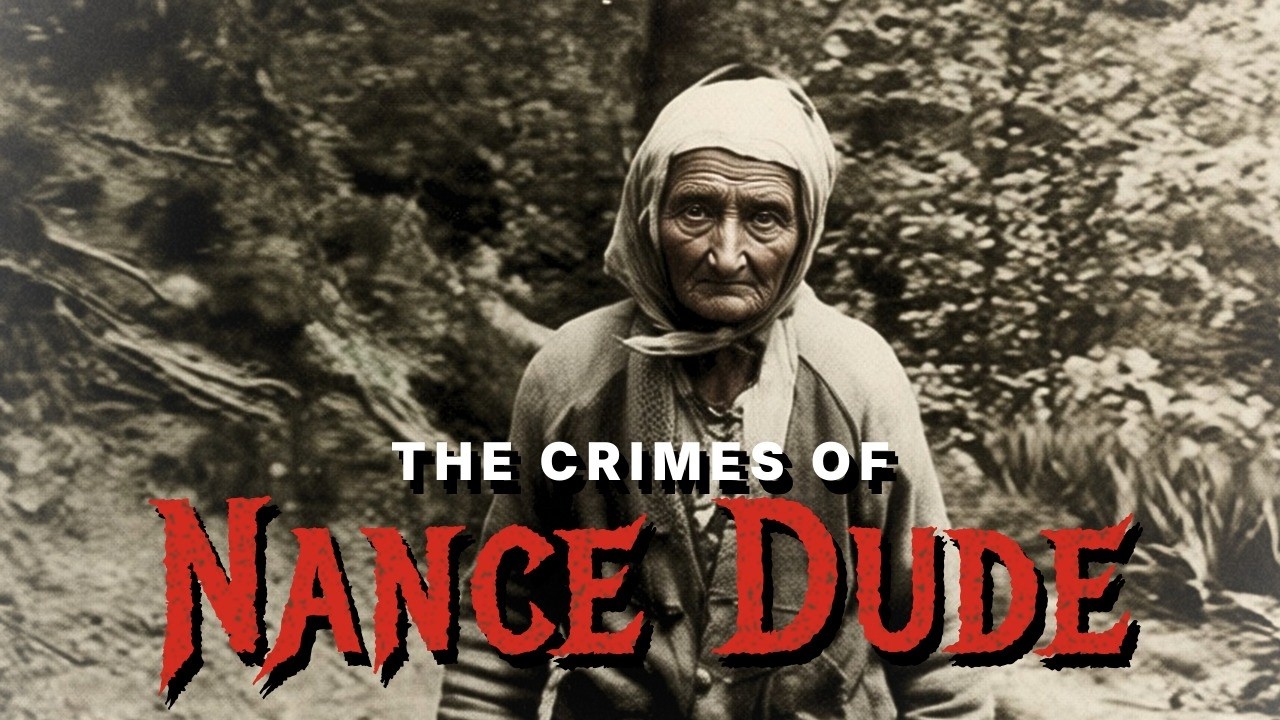
It marks the grave of Nance Dude, if the local tradition is true—and even now, no one can say for certain. She was the woman the mountains feared, a name parents hissed at children along the creeks for decades. But long before she was a bogeyman, she was an old grandmother handed an impossible task, and the child at the center of it all had a name the legend so often forgot to mention: Roberta Anne Putnham. To understand how a name becomes a thing used to frighten children, you have to go back to the mountains of western North Carolina, to a corner of Haywood County where the ridges fold into the Great Smokies and the creeks run cold and fast down toward the valleys.
This was the Cataloochee country—Jonathan Creek, Fie Top, places most of the world had never heard of and never would, until much of this land was folded into the Great Smoky Mountains National Park and the families who farmed it were moved along. In the early years of the twentieth century, this was some of the most remote settled ground in the eastern United States. Cataloochee was one of the largest communities in what would become the park, and yet it was a place of hardscrabble hillside farms, corn planted on slopes so steep a man could stand upright and touch the ground in front of him. Families lived on what they could raise: corn and hogs, timber cut and dragged out by mule.
Cash money was a rare thing, seen a few times a year, and there was never enough of it. That scarcity meant something specific. In Haywood County in 1913, there was no welfare, no county children’s services, no social worker who might come up the holler to check on a family. There was no orphanage close at hand.
If a child had no place, the only formal option anybody could name was the county home—a distant institution most mountain families thought of the way they thought of the poor house, something to be feared, something shameful. So children who had no place were most often absorbed quietly into the households of kin, one more mouth at a table that already did not have enough on it. There was one more pressure, and it mattered here more than anywhere. Most of these families did not own their land.
They worked it as tenants, and the landlord set the terms. A landlord could set a limit on how many souls lived on a tenant farm. Every additional person was a cost, a share of a harvest already too thin to divide. An extra child—especially one the neighbors whispered had been born out of wedlock—was not just a heartache.
It was an economic threat to a family already losing the fight to feed itself. Into this world, on the fifteenth of November, 1910, a little girl named Roberta Anne Putnham was born. Her mother was Sarah Elizabeth Putnham, called Lizzie. Her father, by the record, was Walter Putnham, a man known around the creeks as Will.
Lizzie had married Walter back in 1906. And Lizzie’s mother—Roberta’s grandmother—was a woman then in her sixties who had already lived about as hard a life as those mountains could hand out. Her name was Nancy Anne Connard. The record renders that family name a dozen ways: Connard, Conard, Conrad.
But nobody up those creeks called her by any of them. They called her Nance Dude. The nickname came from an earlier chapter of her life, from a marriage or relationship with a man remembered only as Dude Hannah. By the stories, she had left an earlier husband and a young son for him, and the name Dude stuck to her the rest of her days, longer than any of her marriages lasted.
She married more than once. She was widowed. And by 1913 she was poor, weathered, and largely alone—a mountain grandmother at the ragged edge of a family that was itself at the ragged edge of survival. Her exact age is one of the things the record cannot quite agree on, and it follows her all the way to her grave.
One set of records puts her birth on the thirtieth of July, 1848. Another says 1861—thirteen years apart, and no way now to settle it for certain. That uncertainty becomes part of the legend later. Beneath it all lay a quiet truth.
This was a family with too many people and not enough of anything, living on land they did not own, under rules they did not make, in a county that had built no net of any kind to catch a child who fell through. What happened next did not happen because the mountains were cruel. It happened in part because nobody in a position to help had ever thought to build a place for a child like Roberta to go. In the early days of February 1913, the pressure came to a head.
The family was over the landlord’s headcount. The little girl was, by the whispers, illegitimate, and that made her the one who could be spared. A decision was made that Roberta had to be placed away from the home, and the person given that task was her grandmother. By the account that reached the court, Will Putnham instructed Nance to take the child and give her away—to carry her off and find her a place, whether that meant another family or the state home down in the valley.
So one day that February, Nance Dude took her granddaughter by the hand and walked out of the house on Jonathan Creek. The two of them went up the mountain—up the slope of what the maps call Utah Mountain, a rise also remembered in those parts as Adate Knob. An old woman and a little girl, not yet three years old, climbing away from the last house on the creek. What happened on that mountain is the heart of this case, and the record tells it plainly.
The child was left in a small rock shelter, a shallow cave in the mountainside, and the entrance was closed over with piled stones. Roberta Anne Putnham died there of exposure in the cold of the mountain. The recorded date of her death is the twenty-sixth of February, 1913. She was two and a half years old.
Her final hours are not turned into a story here. But what came after must be told, and so must the accounting of who answered for it, because a child cannot simply vanish, even in a country as empty and roadless as this one. For about two weeks, the little girl was gone. At first, perhaps, the family story held: the child had been given away, she was placed.
But two weeks is a long time, and questions travel fast along a mountain creek, passed hand to hand, house to house, in a society that had no telephones and no newspapers, but never lacked for talk. Somebody began to ask where the Putnham child had truly gone, and the talk did not stop. A search was mounted. On the mountainside, above what is now called Queen’s Farm, in that rock crevice, with its entrance still piled over with stones, they found her.
The discovery answered the question the creeks had been asking, and it opened a far worse one. Now there was a body, and a grave dug out of a cave, and an old woman who had walked up that mountain with a living child and walked back down without her. The old woman was arrested, and the case passed out of the hands of the creeks and into the hands of the county. That meant Waynesville, the Haywood County seat—a courthouse town down in the valley where the sheriff kept his office and the superior court held its terms.
For a woman who had spent her whole life in the high hollows, the journey to Waynesville was a journey into another country, one of paved streets and printed dockets and men in collars who would decide what happened to her. And here the record grows thin in a way that must be stated plainly, because honesty about what is not known is part of telling a true story. The proceedings against Nance Dude took place in Haywood County Superior Court in 1913. But the names of the men who ran that courtroom—the judge who sat the bench, the prosecutor who built the case, the defense counsel who stood beside the old woman—are not preserved in any record open to us today.
They exist somewhere in the county court minutes and in the columns of the Waynesville Mountaineer and the Asheville Citizen from that year, but they have not been brought into the light. This account will not invent them. When the story reaches a wall, it stops at the wall and tells you it is there. What is known is the shape of the case.
Nance was charged with murder. Rather than face a trial for first-degree murder—a charge that in North Carolina in 1913 could carry a sentence of death—she entered a plea. She pleaded guilty to murder in the second degree. Several accounts hold that the guilty plea was precisely a way to step back from the shadow of the gallows, to trade the risk of a capital verdict for the certainty of a prison term.
Whatever calculation lay behind it, the plea settled the legal question. In the eyes of the court, Nance Dude was guilty, and she would go to prison for it. There is a question that hangs over the whole case, and the honest answer is that it has never been resolved. Nance did not walk that child up the mountain on a whim of her own.
She was, by the account that reached the court, carrying out an instruction. The decision to be rid of the child came from within the household—from Roberta’s own parents. The natural question is whether Lizzie Putnham, the child’s mother, or Will Putnham, the child’s father, ever answered for their part. Were they charged, indicted, questioned, and released?
The record we can reach does not say whether the mother or the father faced any charge at all; it is simply not documented in any source open to us. There is a tradition passed down among descendants that Nance took the blame, that she shouldered the whole weight of it to shield the child’s mother—or the mother’s sweetheart—from the law. That tradition tells us responsibility was divided in life, that more than one person had a hand in how Roberta came to be on that mountain. But a family story is not a court verdict.
No charge, no indictment, no trial, and no acquittal for Lizzie Putnham can be found. The participants divided the responsibility among themselves in whatever private accounting families keep, and the court settled the whole of it on one woman. Nance never gave the plain confession people wanted from her. To the end of her days, she told a different story.
In her version, she had not left the child in the cave at all. She had given Roberta to a traveling preacher, handed the living girl over to a stranger passing through, and the child found in the rock shelter was some other child, a dead child, put there in her granddaughter’s place. She held to a version in which she was innocent, and she is said to have held to it until she died. That is her claim, offered here as her claim, not as fact.
The court did not believe it. The record does not support it. But she carried it with her, and a person’s insistence on their own innocence, true or false, is part of who they are. The sentence sent her east, down out of the mountains entirely, to the North Carolina State Prison in Raleigh, to the women’s unit there.
How long she was meant to stay is another of the case’s disputed figures. Some accounts describe the sentence loosely as life. One, from the Smoky Mountain News, sets the nominal term at thirty years. What every account agrees on is the time she actually served.
Nance Dude served about fifteen years at hard labor—fifteen years of a prison work regime endured by a woman already in her sixties when the gate closed behind her. She had gone in around sixty-four or sixty-five years old. When the state of North Carolina paroled her in 1929, she was roughly eighty. She had spent the whole of what most people would call their old age inside prison walls, hundreds of miles from the only country she had ever known.
There was no appeal recorded, no escape, no pardon—just the long grind of the sentence, and then at last parole. An old woman of eighty set free and pointed back toward the mountains. And the mountain she came back to had not forgiven her. This is where the story turns from a court case into something stranger and sadder.
Nance Dude returned west, but not to Jonathan Creek, not to the family that had sent her up that mountain. She settled instead on Connley’s Creek near Bryson City in Jackson County. And she lived there in a poverty so complete it is hard to picture: a shed, a cabin with a dirt floor, no running water, no electricity. An old woman alone in a shack in the hills, rejected by her own kin, shunned by the neighbors who knew exactly who she was and what her name meant.
She survived the way the poorest mountain people had always survived—by her own hands. She cut firewood. And by the time she was cutting it, the world had begun to change around her. The early park was drawing tourists up into the Smokies, travelers with a little cash in their pockets, and an old woman could sell them wood for their fires.
So that is how she passed her last years: splitting kindling and selling it to strangers passing through, a frail figure most of them would never guess had once been the most feared woman in Haywood County. For she was feared. That was the thing that outlived her marriages, outlived the trial, outlived even the memory of the child’s name in most mouths. Along those creeks and ridges for decades, parents warned their children with her: behave, or Nance Dude will get you.
Her name became the county’s bogeyman, a piece of oral tradition passed from one generation to the next, the way the old ballads and the granny-woman cures were passed. Locals said she was something close to a witch. The story goes that mothers would point up toward the ridges and speak her name to bring a wild child to heel. And all the while, the actual living woman behind the fearsome name was sitting alone in a shed on Connley’s Creek with a dirt floor under her feet, chopping wood to trade for pennies, growing older than anyone had a right to expect.
How long she lived is the last of the disputed numbers, and it is the one the legend loved best. By the record, Nance Dude died on the twelfth of September, 1952. For a long time, even that was told wrong, the year sometimes pushed forward by mistake into a later decade. It was 1952, and she is said to have died as she had lived those final years—out at her wood, cutting or hauling the firewood she sold to get by.
An old woman who worked until the day her heart stopped. But how old was she when it stopped? That depends entirely on which birth year you believe. If she was born in 1848, then when she died in 1952, she was 104 years old—and that is the figure the legend seized on and would not let go: the woman who lived past a hundred, the witch of the ridges who simply would not die.
If she was born in 1861, she was closer to ninety-one. Either way, she was very old. The sources say she was reportedly aged well over a hundred, commonly said to have reached 104, though the truth of that number, like so much else about her, cannot be nailed down. What is certain is that she outlived the crime by thirty-nine years.
Thirty-nine years between the February morning on Utah Mountain and the September day her long life finally ended. She served fifteen years and then lived free for more than twenty years after—roughly twenty-three or twenty-four of them out on Connley’s Creek. The child she carried up the mountain had been two and a half. The grandmother lived on for the better part of four more decades.
There is no lesson tucked neatly inside that gap. It is simply one of the strange, uneven facts of the case: the one life ended almost before it began, and the other stretched on and on until it became a marvel and a warning in its own right. And here the story does something most true crimes never do. It refused to stay buried with either of them.
The tale of Nance Dude did not fade when she died in 1952. If anything, it grew. The bogeyman had been a spoken thing, a name hissed at children along the creeks. But in the years after her death, it found its way onto the printed page and onto the stage, and it reached far beyond the ridges of Haywood County.
The man who carried it furthest was a writer named Maurice Stanley. Stanley had a personal thread to the story. His own grandmother, he said, had seen Nance and the little girl walking together shortly before the child’s death—had watched the pair of them pass by in those last February days, not knowing what she was looking at. Stanley heard the story of Nance Dude from that grandmother, and it stayed with him.
Eventually he set out to tell it properly. He went to the court records and the prison records. He read the old newspapers. Out of that research, he wrote a novel called The Legend of Nance Dude, published by Down Home Press, first appearing in 1989 and reprinted in the years after.
It is important to say plainly what that book is. It is a novel. It is fiction, built carefully on the frame of real records, but fiction all the same. The things it imagines—the thoughts it puts in an old woman’s head, the words it puts in her mouth—are the work of a novelist, not the testimony of history.
What the book did, though, was undeniable. It took a name that had lived only in whispers and gave the whole story a shape that people outside the mountains could hold and read. Reviewers took notice, in Publishers Weekly and as far afield as the Baltimore Sun, which ran a review in the spring of 1991. Through Stanley’s pages, the case reached readers who had never heard a creek-side warning in their lives.
From the page, it moved to the stage. A western North Carolina writer and storyteller named Gary Carden took the story and shaped it into a one-woman dramatic monologue simply titled Nance Dude: a single actress alone on a stage, speaking as the old woman, giving voice to the figure the mountains had reduced to a threat. That monologue did not stay in a small regional theater. It was filmed and aired on public television and on the Discovery Channel, carrying the story of a Haywood County grandmother and a child on a cold mountain out to a national audience who had never set foot in Cataloochee.
There was even a song, a ballad called “Poor Child,” written about Roberta and about Nance, joining that long mountain tradition where the hardest true stories get set to melody and sung so the memory of them is carried forward in a way plain speech never quite manages. A murder ballad in the oldest Appalachian sense, for a case that had happened within living memory of the people first singing it. So the woman the mountains feared became something none of her frightened neighbors could have predicted. She became literature.
She became theater. She became a song. The frail figure selling firewood on Connley’s Creek was, in the end, the most enduring character her corner of the mountains ever produced—remembered when the names of the judge and the prosecutor and nearly everyone else in that 1913 courtroom had slipped entirely out of reach. And yet, for all that fame, there is a strange uncertainty about where her body actually lies.
A final unsettled fact to match the unsettled facts of her birth and her age. Two accounts of her grave have come down, and they do not agree. One record, kept at Find a Grave, places her in Bumgarner Cemetery over in Jackson County—a named plot in a named burying ground. The other account is the one local tradition holds, carried in the pages of the Smoky Mountain News, and it is far lonelier.
By that telling, she was laid in the ground on a grassy knoll overlooking Connley’s Creek, the very water she had lived beside in those last poor years, and her grave was marked by nothing but a single jagged black rock. No headstone, no name cut into stone, no dates—just a dark rough stone set on a green rise above the creek. There is something fitting in that uncertainty and something honest in leaving it unresolved. A woman whose birth year cannot be fixed, whose age was argued over, whose very guilt she disputed to her last breath, lies now in one of two places, and even her neighbors could not finally agree which.
The most feared name in the county, and no one can point with certainty to the ground that holds her. The child rests in a plainer, surer place. Roberta Anne Putnham was buried in Delwood Cemetery in Delwood, Haywood County, North Carolina. The record of her resting place, unlike so much else in this case, is steady and unclouded.
She had an older sister, too—a girl named Bertha, born in 1907 to the same parents, Walter and Lizzie Putnham. Bertha lived. She grew up. And that ordinary fact sits quietly alongside the whole tragedy: a reminder that this was a real family with children who survived and went on, not a folk tale invented to frighten the young.
One sister lived a full life. The other lies in Delwood, two and a half years old forever. It is worth sitting for a moment with the sheer distance between the legend and the truth of it, because that distance is the real story here. The legend gave Haywood County a witch, a fiend of the ridges, a name to conjure with.
But strip the legend away, and what you find underneath is not a fiend at all. You find a desperately poor mountain woman, old before her crime and ancient after it, who had lived through more marriages and more hardship than most, who was handed an impossible task by a family that could not feed one more child, in a county that had built no home, no shelter, no institution, and no kindness of any official kind to catch a little girl who had nowhere to go. That is the part the bogeyman story could never hold, because a bogeyman needs to be simple, and Nance Dude was not simple. She was convicted, and convicted she remains.
The court settled the whole weight of it on her shoulders, and she carried that verdict to the grassy knoll above Connley’s Creek. But the record will not let her be only the villain of a children’s warning. It insists quietly on the other facts, too: on the landlord counting heads, on the parents making a decision and then stepping back into the shadows of an unwritten court record, on the absence of any safety net at all in that high, hard country in the winter of 1913. The legend made her larger than life, a witch who lived past a hundred.
The truth made her smaller and sadder than that—a frail old woman splitting kindling for tourists, shunned by everyone who knew her name. Both of those women, the fearsome one and the frail one, are buried now somewhere above that creek. And the child both stories were built around, the one whose name the legend so often forgot to even mention, lies a valley away in Delwood, remembered at last not for how she died but simply for having been here, however briefly. A little girl born in the November cold of 1910, gone by the February cold of 1913, whose short life set in motion a story that outlived every single person who was there to see it.
On a grassy knoll above Connley’s Creek, a single jagged black rock still marks a grave, if the tradition is true. It is a strange, silent stone for a name that once could quiet a room full of children. But the marker that ought to hold our attention is the plainer one in Delwood Cemetery, over the ridge in Haywood County, where Roberta Anne Putnham has rested since the winter of 1913. She was two and a half years old.
She was sent up a mountain because a poor family had run out of room, in a county that had built no place for a child to go. The legend feared the wrong thing. The real sorrow was never a witch on the ridges.
It was a little girl the mountains had nowhere to put, and the long, hard silence that followed her down every creek in Haywood County.
