On a Friday night in 1955, you pull up to the Bijou downtown—or maybe it’s the Strand; every American town had one. The marquee out front, bulbs chasing each other in a loop, a kid in a red uniform tearing tickets by the curb. Tonight’s feature is Rebel Without a Cause, James Dean in a red windbreaker, brand new in theaters. Ticket price: 48 cents.
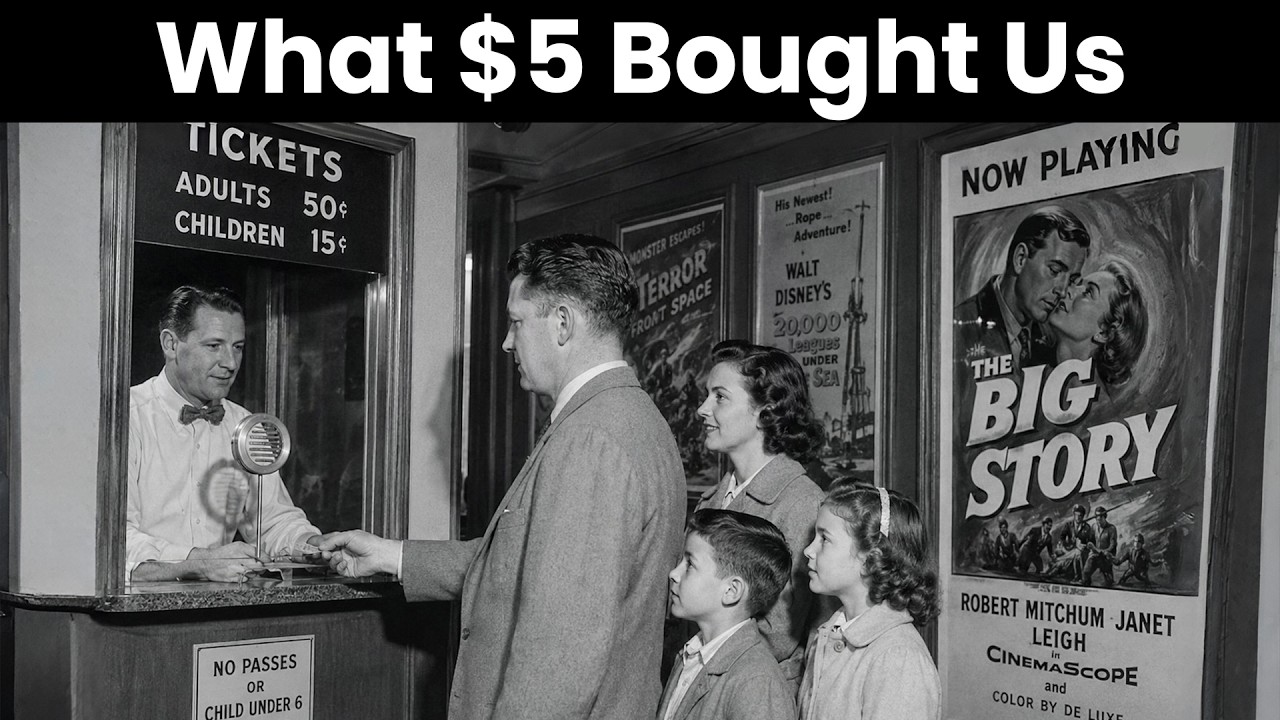
That’s a dollar ninety for you, your wife, and the older kids. The little ones get in free. On the way in, you stop at the concession counter: a box of popcorn runs about 15 cents, a Coca-Cola a dime, a box of Milk Duds another dime. You leave that line with your arms full of food for under a buck.
Then the lights dim, the curtains pull back, and the newsreel rolls—because in 1955, you still got the news at the movies before you got the movie. You’ve spent maybe three dollars total. The whole family is out for the night. Nobody had to cook dinner.
Nobody had to wash the dishes. And you still have two dollars left in your pocket. The trouble is, two dollars today doesn’t get you much further than the corner. But in 1955, it got you the rest of the weekend.
It all started the way any Friday did back then: at the gas station. You pull in, and the bell rings as your front tires roll over the rubber hose. A man in a white shirt and a bow tie comes out of the booth, wearing a cap with a winged star on it. You don’t even have to get out of the car.
“Fill her up. ” That wasn’t customer service; that was just service. He pumps your gas, washes your windshield, checks your oil, and asks about your wife’s mother. You don’t tip him.
It’s his job. The smell of the pump in 1955 wasn’t quite like the smell today—leaded gasoline, sweeter, heavier in the air. If you grew up in it, you can probably still call it up from memory. In 1955, gas runs about 29 cents a gallon, the national average—a few cents less in some states, a couple cents more in others.
Most American family cars hold somewhere around 17 or 18 gallons. A full tank from empty would cost you about five bucks even—your whole five right there. But here’s the thing: nobody ran their tank to empty in 1955. You’d hand him two dollars, and that was a half tank.
Plenty to get through the work week. Plenty to take the family to the lake on Saturday. At the federal minimum wage of 75 cents an hour, that two dollars of gas cost you under three hours of work. Today, two dollars of gas at minimum wage costs you a few minutes—but today, two dollars doesn’t get you much further than the corner.
So you keep three dollars in the wallet. There’s a whole day ahead. Saturday morning comes, and you go to the grocery store. It isn’t a supermarket yet, not the kind you’re picturing.
It’s smaller. The owner knows your name. There’s sawdust on the floor near the meat counter, a bell over the door, and the whole place smells like fresh bread, butcher paper, and the wax on the wooden floor. The butcher leans on the case and asks how thick you want the bacon.
He’ll slice it right there while you wait. You grab the staples: a loaf of fresh bread, 18 cents. A dozen eggs, 60 cents. A pound of bacon, sliced in front of you, 65 cents.
A quart of milk in a glass bottle, around 23 cents. A pound of ground beef, 40 cents. That’s a dollar eighty for the makings of a real Sunday breakfast and a Monday dinner. And you’ve still got change in your hand.
Now, let’s be careful here. There’s a version of this story where the food was better back then—purer, more wholesome. The truth is more complicated. The 1950s had plenty of industrial farming, plenty of pesticides nobody questioned.
Wonder Bread was already an empire, and margarine was selling by the rail car. What was different was simpler than pure food. The bread on your counter in 1955 was, on average, made closer to home. The bacon was sliced in front of you.
The milk came back to the store in glass bottles. And the price tag on all of it—that’s the part that’s hard to argue with. Three dollars of groceries fed a family of four for two or three real meals. Those same five items at today’s average prices run you somewhere around twenty-five dollars.
At federal minimum wage in 1955, that grocery run cost you about four hours of work. At today’s federal minimum wage, that grocery run still costs you about three and a half hours. Almost the same number of hours. So what actually changed?
Not the groceries. Something else. Because the America of 1955 was a one-of-a-kind moment in history. Europe was still rebuilding from the war.
Japan was still rebuilding from the war. American factories had no real foreign competition. American workers, in a lot of industries, were the only game on the planet. That meant wages went up.
Manufacturing jobs paid enough to buy a house, a car, and feed five kids. Union membership was at an all-time high. And the value those workers created with their hours—productivity, in plain English—actually went into worker paychecks. That’s the part that fell apart.
Not the gas pumps, not the diners, not the matinees. The link between what you produced in a day and what you took home in a day. Around 1973, productivity kept climbing. Wages flattened.
They’ve stayed flat, more or less, ever since. That’s not nostalgia. That’s the data. But that’s still a few decades away.
Right now, it’s Saturday, and you’ve still got two bucks in your pocket. Let’s spend the rest. You slide onto a stool at the counter. A waitress named Doris pours you a cup of coffee before you’ve even said hello.
That coffee costs a nickel. The radio behind the counter is on, the cook is whistling through his teeth, and the booth behind you holds two old farmers arguing about the price of corn. This isn’t a special outing. This is just lunch.
The blue plate special today: meatloaf, mashed potatoes, green beans, dinner roll—65 cents. A slice of pie at the end, 20 cents, cherry. With a scoop of vanilla on top, another nickel. Doris brings you the check.
It’s under a dollar. You leave a quarter on the counter, which is a generous tip, and she calls you honey on the way out the door. The whole meal cost about as much as a single candy bar at today’s checkout aisle. You’ve got a dollar and change left.
What does a buck and change do? A haircut at the barber: 50 cents, maybe 75 if you’re getting the works. He’ll trim your sideburns, slap on the witch hazel, and shave the back of your neck with a straight razor warmed in hot water. A pack of cigarettes: 23 cents—not that we recommend that anymore, but in 1955, the doctor in the magazine had probably smoked too.
A daily newspaper: 5 cents, Sunday edition a dime. A Coca-Cola from the chest cooler at the corner store: 5 cents, returnable bottle. A first-class postage stamp: 3 cents. And you drop a dime in the jukebox, and you get three songs—Patti Page, Frank Sinatra, Bill Haley if you’re feeling brave.
That was your day. You started the morning with one five-dollar bill. You filled the tank. You took the family to the pictures.
You bought groceries for the week. You had a hot lunch at the counter. You got a haircut. You read the paper.
You played a song on the jukebox. And you walked home with a few coins jingling in your pocket. In 1955, a five-dollar bill bought you a tank of gas, a night at the movies for the whole family, and a sit-down dinner at the diner, with change left over for a tip. A pack of Lucky Strikes cost 23 cents.
Marilyn Monroe was on every newsstand, and Bill Haley’s “Rock Around the Clock” was getting kids in trouble at sock hops from Tulsa to Toledo. Eisenhower was in the White House, telling Americans the future looked good. He wasn’t wrong—not yet. This isn’t a story about how cheap things used to be.
Cheap is the wrong word. Cheap means flimsy. What 1955 had was different. What 1955 had was a working relationship between a day’s labor and a day’s living.
The kind of relationship where a guy on an honest paycheck could walk into a store, lay a five on the counter, and walk out with something real for his family. Here’s the thing about that 1955 five-dollar bill. It wasn’t magic. Things weren’t perfect.
Half the country still had outdoor plumbing in places. Polio was real. The Civil Rights Movement was just getting underway, and a lot of Americans in 1955 were locked out of this whole story, depending on the color of their skin or the zip code on their mail. So this isn’t a story about a better America.
It’s a story about a different America. A country where a single working man with a high school education could afford a house, a car, three kids, and a vacation to the Jersey Shore—and still have something left over at the end of the year. Your father probably remembered it. Your grandfather built it.
And somewhere along the way, without anybody calling a press conference about it, that country quietly stopped being available to the next guy in line. That country didn’t disappear because Americans got lazy. It didn’t disappear because the dollar got weak. It disappeared because the link between what people made and what people earned slowly came apart—right around the time their kids were starting their first jobs.
And by the time anybody noticed, the gap was too wide to walk back. The five-dollar bill in 1955 wasn’t worth more in some magical way. It was worth more because the wage that earned it was worth more. Same paper, same ink, same Lincoln.
Different country.
