On February 12, 1929, a woman died at dawn in a villa perched on a cliff in Monaco. Her only companions were a paid nurse and two poodles barking in the next room. Her daughter refused to come. Her husband lived in another city.
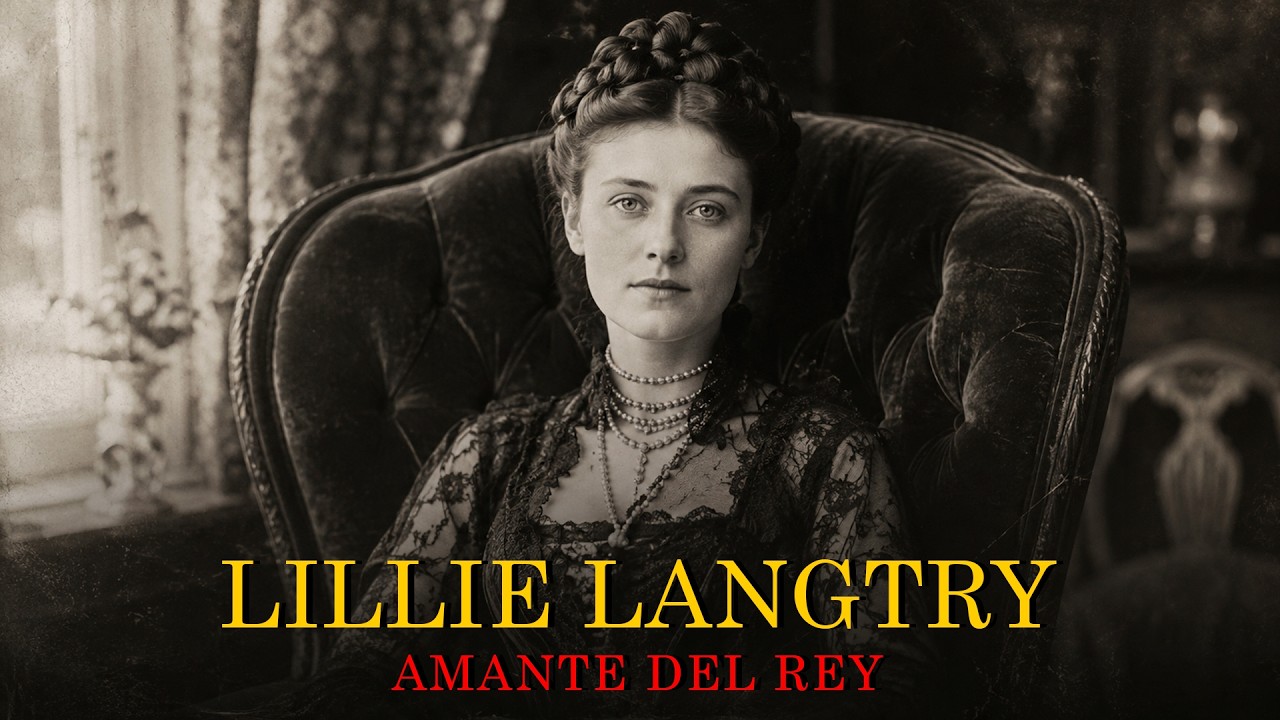
Yet when the news reached London, the newspapers devoted columns to her that were usually reserved for royalty. Because that woman had once stopped traffic in Piccadilly simply by walking down the street. She had been the mistress of the future King of England, the first celebrity to sell a commercial product, and the owner of a fortune equivalent to seventy million dollars today. Her name was Lillie Langtry, and every cent of it she had earned herself.
She was born Emilie Charlotte Le Breton on October 13, 1853, in the rectory of Saint Saviour on the island of Jersey, a small rock in the English Channel more French than English, governed by its own ancient laws. Her father was the dean of Jersey, and Lillie was the only girl among six brothers. She was raised not in the drawing room but in their company, learning Latin, Greek, and mathematics alongside them while climbing trees, jumping fences, and swimming in cold water. She grew tall with pale skin and blue eyes that people would later struggle to describe.
By fourteen, men on the island began to notice her. By sixteen, she had learned something most women of her era were never allowed to discover: the way people looked at her was a form of power. Jersey offered her no outlet. The island’s social calendar revolved around church services, garden parties, and the seasonal arrival of military officers.
Marriage was the only door, and the men who passed through the rectory were too old, too poor, or too boring. She wanted something she could not yet name, but the desire was fierce enough to carry her off the island eventually. All she needed was a way out, and in 1874, a way out sailed into the harbor. Lillie did not fall in love with Edward Langtry.
She fell in love with his twenty-four-meter yacht. Edward was an Irish widower with private income and a fondness for sailing. He was not handsome, not intelligent, not ambitious, but he owned the Red Gauntlet, and the Red Gauntlet could take a woman anywhere. She accepted his proposal with the enthusiasm of a prisoner offered a key.
They married on March 9, 1874, when she was twenty. The first months were everything she had imagined, but Edward had a fatal flaw common among men who inherit money rather than earn it: he confused possession with achievement. He believed that having a beautiful wife was the same as deserving one. He was wrong.
They moved to London in 1876 and were invisible. Their first year passed in rented rooms, attending dinners where no one cared about an unknown couple from Jersey. Then came the evening that changed everything. In the spring of 1877, Lillie attended a reception at Lady Sebright’s house.
Every other woman wore silk, satin, and diamonds. Lillie arrived in a simple black dress, no jewelry, no embroidery. In a room full of decorated women, she was the only one who looked like a painting. The conversation stopped.
Frank Miles, a society artist, crossed the room to ask if he could draw her. Within days, his drawings were reproduced as postcards and sold in every stationery shop in London. John Everett Millais, the most celebrated painter of the age, asked her to pose. His portrait, titled A Jersey Lily, was exhibited at the Royal Academy and drew crowds so dense a policeman had to be stationed beside it.
She had become what Victorians called a professional beauty, a new phenomenon made possible by advances in photographic reproduction and mass printing. Her face appeared on more postcards than any other woman in England. On at least one occasion, traffic in Piccadilly stopped because word had spread that Lillie Langtry was walking down the street. The fame generated by those images was a currency in its own right, and doors that had been closed to Mrs.
Edward Langtry of Eaton Place now opened wide for the Jersey Lily. Edward watched it all with the bewildered passivity of a man who brings home a tiger cub and is surprised when it grows teeth. He began to drink. Lillie barely noticed.
She was too busy becoming the most famous woman in England, and among the many powerful men who now desperately wanted her attention, one stood above all others. He was not the richest or the handsomest, but he was the heir to the throne. When the Prince of Wales wanted Lillie Langtry at his side, he simply moved her husband to the other end of the table. At a dinner on May 24, 1877, the future Edward VII, then forty-five, decided that Lillie would be his next companion.
Within weeks they were inseparable. The mechanics of a royal affair in Victorian England were elaborate. Society had to be informed through gestures rather than announcements, and the prince appeared with Lillie at dinners, theaters, and country house weekends without subtlety. The Princess of Wales, long reconciled to her husband’s infidelities, did more than tolerate Lillie.
She received her, invited her to events, treated her with warmth that signaled to society that Mrs. Langtry was acceptable. In 1878, Lillie was presented at court wearing the prince’s own emblem, three ostrich feathers, in her hair. Queen Victoria received her without comment.
Edward Langtry became a ghost in his own marriage. At dinners he was seated far from his wife, sometimes at a separate table, present enough to maintain the fiction that Lillie was a respectable married woman and absent enough to allow the prince his pleasures. The relationship lasted about three years, and during those years Lillie occupied a position no woman outside the aristocracy had ever held. She was not a wife, not a traditional courtesan, but something new, a woman without high birth or fortune elevated into the inner circle of British power by her beauty alone.
She observed everything, learning how power worked, who controlled the money, who controlled the invitations, who controlled the information. She learned that beauty opens doors but does not keep them open. When the prince withdrew his favor around 1880, the consequences came with the speed of a foreclosure. The gifts stopped, the invitations dried up, and creditors who had extended generous terms to a woman under royal protection suddenly remembered that generosity has limits.
Lillie had been living on credit, her debts considerable. Edward was useless, his inheritance mostly spent, his drinking now a daily necessity. She sold her possessions, the furniture first, then the horses, then the jewelry that was hers to sell. And then, in the middle of the collapse, she discovered she was pregnant.
The father was almost certainly not her husband. The most likely candidate was Arthur Jones, a friend of the prince. A child born to Lillie in London, in full view of a society that had watched her share a bed with the future king, would have been a scandal of unmanageable proportions. She disappeared to Paris, where she gave birth to a daughter on March 8, 1881.
The baby was named Jeanne Marie and within weeks was sent to Lillie’s mother in Jersey, to be raised as the child of Lillie’s brother, who had conveniently died young. Lillie would visit as her aunt. The secret held, the deepest deceit of her life, and unlike her affairs and debts, this one carried a price that would accumulate over the decades. In the spring of 1881, she had a more immediate problem.
She needed money. On December 15, 1881, Lillie Langtry stepped onto the stage of the Haymarket Theatre and spoke her first lines as Kate Hardcastle in She Stoops to Conquer. She was the first woman of society in living memory to become a professional actress. The reaction was volcanic.
Society women did not work. Society women certainly did not display themselves on a public stage for money. The reviews were mixed, her acting competent but not inspired, her stage presence extraordinary. Oscar Wilde, among her earliest admirers, saw what the critics could not: her talent was not acting.
Her talent was being Lillie Langtry in public, and a theater was simply the most efficient place to convert that talent into money. She played a short season in London to full houses, then made a decision that transformed her from a fallen society beauty into one of the richest women of her generation. She booked passage to New York. On her opening night in New York, Lillie Langtry earned one thousand two dollars more than the most famous actress in the world.
She arrived in America in October 1882 aboard the Arizona and discovered the country had been waiting for her. The papers had spent months publishing stories about the Jersey Lily, her beauty, her royal affair, her scandalous fall, her decision to go on stage. At her debut at Wallack’s Theatre on October 30, the house was sold out, the audience including the Vanderbilts and the Astors. The take totaled $6,800.
Sarah Bernhardt, the greatest actress of the century, had earned $5,800 at her own New York debut. Lillie had beaten her by a thousand dollars while acting half as well. The point was never the acting. The point was the spectacle, and Lillie understood something about the American appetite that most European performers never grasped.
Americans did not want perfection. They wanted proximity to fame. She launched her first coast-to-coast tour, playing San Francisco, Chicago, St. Louis, and dozens of smaller cities.
She traveled with a full company, her own staff, and a growing wardrobe. Unlike the men who had kept her, Lillie kept the accounts. She invested heavily in Fifth Avenue real estate during her first visit to America, and in 1882 came the endorsement that changed advertising forever. Thomas J.
Barratt, managing director of Pears’ Soap, approached her with an offer. He wanted her face and name attached to his product. No woman of social position had ever endorsed a commercial product. The practice was considered vulgar.
Lillie said yes. The advertisement appeared, was reproduced millions of times, and became the founding moment of modern celebrity endorsement, the first time a famous face was linked to a consumer product for the explicit purpose of selling more of it. Every perfume ad, every sneaker campaign, every celebrity fragrance line traces its lineage to Lillie Langtry holding a bar of soap. Her financial architecture was methodical.
She earned money through seven distinct sources: touring theatrical performances, London performances, New York real estate investments, endorsement payments, gifts from wealthy admirers, horse racing prizes, and property rental income. By 1898 her personal fortune was approximately two million dollars, equivalent to somewhere between seventy and eighty million today. She commissioned a private Pullman railway car for her American tours, paneled in velvet and decorated with polished brass lilies on every fitting, arriving in each city like a head of state. There was Frederick Gebhard, young, handsome, reckless, heir to a fortune estimated at a hundred million dollars, who fell in love with her and spent money with the determination of a man trying to put out a fire with banknotes.
By the end of the 1880s, Lillie Langtry had done something unprecedented. She had taken beauty, the most fleeting currency a Victorian woman possessed, and converted it into wealth that did not depend on the continued affection of any man. She owned property, investments, and her own theater company. She was, in every meaningful sense, a self-made woman.
But every fortune built on the patronage of men carries a hidden cost. Robert Peel, known as Squire Abington, was possessive, violent, and rich. He beat her in hotel rooms, smashed furniture, threw objects. On at least one occasion he struck her in the face hard enough to leave a black eye, a catastrophe for a woman whose face was literally her fortune.
She spent ten days recovering in hiding, canceling performances, losing income, and yet she kept going back. Her explanation, recorded by contemporaries, remains one of the coldest calculations in Victorian social history. I detest him, she said, but every time he does it, he gives me a check for five thousand pounds. The math was brutal.
Five thousand pounds in the 1880s was roughly six hundred thousand dollars today. A black eye healed in two weeks. The money lasted considerably longer. Gebhard’s devotion also carried its price, emotional dependence.
Their most dramatic rupture came on a summer day in 1888 on a stretch of railway near Shohola, Pennsylvania. Gebhard’s private train, carrying his stable of racehorses, derailed catastrophically. Over a hundred horses died, including Aeolus, his champion runner valued in the tens of thousands. Gebhard emerged physically unharmed but financially and emotionally devastated.
You have already cost me a fortune, he told her, as if the dead horses were somehow her fault. The relationship survived the accident but not the resentment. In a matter of months came the slow separation Lillie had perfected with earlier lovers. At thirty, Lillie was rich, famous, and deeply compromised.
She had built a fortune on foundations of unstable men’s desires. She had created an empire whose maintenance required enduring violence, manipulation, and the constant performance of availability. And buried beneath it all, growing up in Jersey under a false name and a fabricated affiliation, her daughter called her aunt. Jeanne Marie was seven years old.
She had her mother’s eyes. She had no idea who her mother was. Lillie could not acknowledge her daughter without destroying the reputation that generated her income. She could not give up her income without losing the independence that made life bearable.
Something had to change, and in the 1880s she found the one arena where her hunger for competition, her gift for calculation, and her refusal to accept limits combined into something extraordinary. She discovered horse racing. But the Jockey Club had rules, and the most inflexible was that no woman could own a racehorse. So Lillie Langtry became a man named Mr.
Jersey. The alias was transparent. Everyone in racing knew that Mr. Jersey was Lillie Langtry, the Jockey Club, the bookmakers, the crowds at Newmarket and Ascot.
Nobody objected. That was the genius of the stratagem. By adopting a male pseudonym, she had given the Jockey Club what it most needed: plausible deniability. The rules were not technically broken, the fiction was maintained, and Lillie was free to spend her money, train her horses, and collect her winnings.
She bought her first serious racehorse, Dorado, in the early 1890s, but it was Merman who made her fortune on the track. Purchased for sixteen hundred guineas, Merman became one of the most successful long-distance runners in English racing under the turquoise and beige colors. The Cesarewitch of 1897 announced her as a force in the sport. Merman started at odds of 100 to 7, reflecting the bookmakers’ opinion that he had almost no chance.
He won. Lillie had bet heavily. Contemporary accounts place her winnings at approximately 120,000 pounds, over fifteen million dollars today, more than most aristocratic families earned in a decade. She won it in a single afternoon, the rector’s daughter from an island eight miles wide, who was officially not allowed to own the horse that had done it.
She kept winning. The Autumn Handicap, the Goodwood Cup, the Jockey Club Cup, and then in 1900, the prize that crowned her racing career, the Ascot Gold Cup, won by her horse at odds of 20 to 1. She was forty-six, standing in the owners’ enclosure accepting congratulations from the same aristocrats who had dropped her from their guest lists when the prince tired of her. Her personal life produced its most peculiar chapter on July 27, 1899, the same day Merman won the Goodwood Cup.
She married Hugo Gerald de Bathe, a young man of no particular achievement, nineteen years her junior, heir to a baronetcy. The marriage was as transparent a transaction as Mr. Jersey. Hugo gained a famous wife.
Lillie gained a title. Sir Henry de Bathe, Hugo’s father, received news of the marriage with fury, reportedly declaring he wished he could die immediately so his will, which would exclude Hugo from the family fortune, could take effect at once. Sir Henry lived until 1907, giving his son and daughter-in-law eight years of latent resentment before the baronetcy changed hands. Lillie became Lady de Bathe.
They maintained separate residences for most of their marriage. By her standards, it was a perfectly satisfactory relationship. But while Lillie won gold cups and collected titles, a reckoning was approaching that no amount of money could prevent. At a party, Jeanne Marie Langtry discovered that the woman she called aunt was in fact her mother.
The revelation came not in a dramatic confrontation but at a social gathering, when someone who assumed she already knew mentioned the truth everyone else in the room had always known. Jeanne Marie had been raised in Jersey by Lillie’s mother, told her parents were dead, that Lillie was a glamorous relative who visited occasionally, sent money and gifts, but never stayed long. Now a young woman with her mother’s blue eyes, she made no scene. She left the party politely.
Then, in the days and weeks that followed, began the withdrawal that would last for the rest of her mother’s life. There was a confrontation, its details scarce. Jeanne Marie asked questions, and the answers were not enough. No explanation could bridge the distance between the mother who had given her away and the elaborate fiction built to justify the abandonment.
Jeanne Marie married Ian Malcolm, a Scottish politician who later became a member of Parliament. They had four children. The door between mother and daughter did not slam shut. It closed with the soft, irreversible click of a woman who had decided some wounds do not heal.
Lillie never publicly acknowledged her daughter. She never corrected the official story. Whether that was shame, pride, self-protection, or simply habit, she had been acting so long the line between strategy and emotion had dissolved. In the 1890s and early 1900s, her theatrical career reached its artistic peak.
She played Rosalind in As You Like It at the St. James Theatre to sold-out houses for four months. She played Cleopatra to standing ovations. Critics who had dismissed her early work recognized genuine craft.
In 1891 she returned to Jersey to extraordinary reception. The island that had produced her now claimed her. Crowds lined the streets, the governor received her, church bells rang. The rector’s daughter who had fled on a yacht returned as the most famous woman in the British Empire.
The world that had made Lillie Langtry possible was disappearing. Cinema arrived in London in the late 1890s. By 1910, large movie houses were opening across Britain. Radio approached.
The gramophone was already there. A beautiful woman in a theater cost a ticket. A beautiful woman on a screen cost a penny. The economics were ruthless.
In 1913 she made a single film, a short silent picture now largely lost, a gesture toward the future, but the camera did not love her as a live audience did. Meanwhile, the men who had shaped her life reached their ends. Edward Langtry was found demented at a railway station in October 1897, confused, disheveled, unable to explain who he was. He was committed to the county asylum where he died on October 15, 1897, the cause recorded as general paralysis of the insane, almost certainly the final stage of syphilis.
He was fifty-one. The Prince of Wales ascended the throne as King Edward VII in 1901, reigned nine years, and died in 1910. Lillie kept performing, touring America into the 1900s in smaller theaters and shorter seasons, appearing in vaudeville. The venues grew less grand, the audiences shrank, and the reviews began to include the word still, as in she still retains her presence.
The Manchester Guardian published the verdict that captured the shift in one sentence: a world with cinema and radio, the critic wrote, has better things to do than crowd around a beautiful woman. By 1920, at sixty-six, she had retired from the stage. She lived in Monaco, attended the casino, read, and watched the world she had conquered grow smaller in her rearview mirror. The women who succeeded her, the movie stars and radio personalities, did not know her name.
They did not know the entire machinery of modern celebrity, the endorsements, the personal branding, the conversion of fame into fortune, had been invented by the rector’s daughter from Jersey. In her final years, Lillie Langtry dyed her hair, danced with gigolos, and kept a room adjoining her bedroom for her dogs. Villa Lélis stood on the cliffs above Monte Carlo, windows facing the Mediterranean. Hugo de Bathe lived in Nice, a few kilometers away.
They saw each other occasionally. She rose late, read novels and newspapers, walked in the gardens, and in the evenings attended the Casino de Monte Carlo, playing with the careful moderation of a woman who understood odds. She dyed her hair the reddish-brown shade of her youth, a vanity she made no effort to conceal. She danced at social events, sometimes with professional partners.
Her poodles occupied the next room, pampered extravagantly, her most reliable companions in those last years. Somerset Maugham met her in Monaco and left a portrait of a woman who had aged without becoming sentimental, still witty, still sharp, simply reduced to a size she could manage alone. Alfred Lunt, the American actor, met her when she was seventy-eight and later remembered she had the bluest eyes he had ever seen. She looked at you, he recalled, as if deciding whether you were worth the effort.
In 1925 she published her memoirs, The Days I Knew, more remarkable for what they omitted than what they included. She never confirmed the affair with the prince. She never acknowledged her daughter. She never spoke of the men who had beaten her or the money paid in compensation.
She refused, as she had always refused, to give the public the whole truth. They could have the performance. The private self was not for sale. In her will, ten thousand pounds went to Matilda Pitt, her lady in waiting.
Nothing was left to Jeanne Marie. Whether that was punishment, pride, or a final recognition that the relationship was broken beyond repair, Lillie never explained. She never explained anything she did not wish to explain. Illness came in the winter of 1928.
She weakened through January. By February it was clear she was dying. Lillie Langtry died at dawn on February 12, 1929, at seventy-five. The nurse recorded the hour.
The poodles were taken to another room. Hugo de Bathe was notified in Nice. The newspapers were notified in London. She had asked to be buried on Jersey.
February was cruel. Blizzards swept the Channel, the sea violent, the crossing that normally took hours became an odyssey of days. Her coffin was placed aboard the steamer Sambria, which fought the weather to reach the island. The church of Saint Saviour, where her father had preached and where she had been baptized, was prepared for the funeral.
Flowers arrived in quantities that threatened to overflow the small building, from London, Paris, New York, from people who had known her and people who knew only her name. Hugo de Bathe attended, fulfilling his last duty as husband. Jeanne Marie was not there. She had not come.
She would not come. Among the mourners, an old man attracted little attention, but his presence carried a weight only a few people in the church could have understood. He was the former captain of the Red Gauntlet, the yacht that had carried Edward Langtry to Jersey over fifty years earlier, the boat Lillie had married, her first escape. Now he was old, walking slowly, leaning on a cane.
He carried a bouquet of red Jersey lilies, the flower that shared her name, that grew wild on the island she had spent her life leaving and to which she now returned for the last time. He placed the flowers on her grave. He was the only person there who remembered the girl, not the Jersey Lily, not Mrs. Langtry, not Lady de Bathe, but the girl, the rector’s daughter who had climbed trees, jumped fences, and looked at the sea with a hunger no island could satisfy.
She was buried in her parents’ grave in the churchyard of Saint Saviour’s, on the island that measured eight miles by eight. The stone would carry her name. The wind would carry the smell of the sea, and the limits she had spent her life fleeing finally contained her. A contemporary once said it would be hell to be married to her because she was too damned bright.
The remark was meant as a warning. It reads now as a tribute. What survives of Lillie Langtry is scattered across an improbable geography. The grave at Saint Saviour’s attracts visitors who have read her name in history books.
The Jersey Museum preserves photographs, theater posters, the material residue of a career spanning four decades and two continents. In Langtry, Texas, a town named for her by a man she never knew, the saloon of Judge Roy Bean stands as a tourist attraction. Bean, a self-appointed justice of the peace in the Pecos River region, was so infatuated with Lillie that he named his bar Jersey Lily, misspelling the name on the sign. He wrote her letters she never answered.
He named his town for her. He died without ever seeing her in person, though she visited the town shortly after his death. The saloon still draws visitors. In California, a vine Lillie planted in 1888 still grows and produces grapes.
At Goodwood racecourse, the Lillie Langtry Stakes is run every year. She took the most fleeting thing a woman of her era could possess, physical beauty, and turned it into the most durable, money. She took the most dangerous position a woman could occupy, royal mistress, and turned it into the most liberating, independence. She took a system designed to consume women and reversed its current.
She was the one who used. She was the one who discarded. The men who thought they possessed her paid for that belief with everything they had. Edward Langtry died demented in a county asylum.
Frederick Gebhard spent millions and received nothing but heartbreak and dead horses. Squire Abington paid thousands per bruise and received nothing but contempt. Hugo de Bathe survived her and inherited a title accompanied by the memory of a wife who had never needed him. Lillie died titled, comfortable, and alone.
The title came from a husband she did not love. The comfort came from a fortune she had built herself. The solitude came from a lifetime of decisions that prioritized independence over connection, strategy over feeling, survival over love. Her daughter never forgave her.
Her public eventually forgot her. But the architecture she created endures: every celebrity endorsement, every personal brand, every beautiful woman who looks in the mirror and sees not just a face but a business plan. Lillie Langtry was there first. She discovered it in a black dress in a room full of diamonds, in a London that had never seen anything like her.
The system was designed to consume women. She refused to be consumed, and the price of that refusal was a solitude that money could soften but never cure. She paid it every day in the villa on the cliff, with the poodles in the next room and the Mediterranean shining below like a promise finally fulfilled but no longer important. At seventy-five, she had outrun every limit drawn around her.
Every limit, except the last.
