The telephone rang eleven times that morning. No one answered. Fifty-year-old Connie Bennett stood outside her son’s front door, keys in hand, telling herself everything was fine. Maybe they had overslept.
Maybe the receiver had been left off the hook by mistake. Anything, she told herself, anything but the cold stone of dread settling in her chest. She turned the key. The door opened more easily than it should have, as if whoever was inside had already decided this house no longer needed locks.
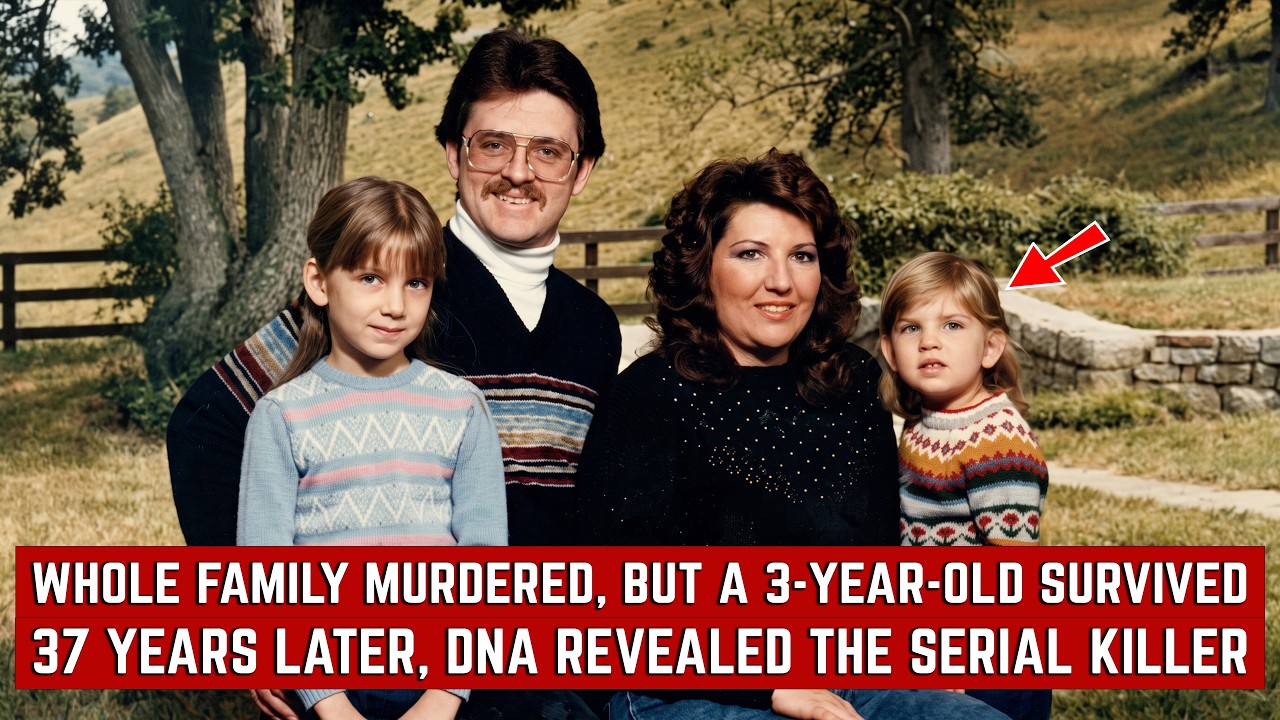
Something was waiting for her across the front hall, and she was perhaps the last person in Aurora who did not yet know what it was. The house belonged to her son, twenty-seven-year-old Bruce Bennett, a former Navy man who carried a quiet discipline that lingered long after the uniform came off. Lately, he spent most of that discipline at the kitchen table after the girls were asleep, studying toward a career as an air traffic controller—a job that depended entirely on rigorous exams, with no room for guesswork. His wife Deborah was twenty-six, vivacious, quick to laugh, the real anchor of the household, managing everything around Bruce’s study routine.
They had been introduced through her brother Larry, as tends to happen in a small town where everyone moves in the same circles. Bruce had two brothers, Richard and Daniel, who lived nearby and would let themselves in through the back door on weekends without calling ahead. There were two daughters. Melissa was seven, two days short of her eighth birthday, and already had firm opinions about the cake, the guest list, and which cousins she was currently not speaking to.
Vanessa was three, still too young to have opinions about much of anything, but she stayed close to wherever her big sister happened to be. Aurora was one of the fastest-growing suburbs east of Denver in the early eighties. Developers threw up new subdivisions nearly as fast as frames could rise, and families moved there for exactly that reason—affordable houses, good schools, the feeling of getting somewhere before the crowds arrived. A year earlier, in 1983, Bruce and Deborah had saved enough for a down payment and bought their first home on East Center Drive in Aurora, Colorado.
It was a corner house on a street of identical driveways, chain-link fences, and basketball hoops bolted above garage doors, where every home held more or less the same kind of family. Someone was paying off a mortgage. Someone was settling a sibling quarrel. Someone was hoping the car would start on a cold morning.
Everyone waved to each other. Nearly no one locked anything. For a young family one year into marriage and a mortgage, the house felt like a success, the place where the rest of life would take shape. Like so many houses on so many quiet streets that winter, they had a habit no one thought twice about.
The garage door was not always closed at night. Sometimes, in the rush of groceries, homework, or bath time, it simply stayed open. It was one more small task that always lost out to something more urgent. Sunday, January 15, 1984, was a completely ordinary evening.
Dinner at the kitchen table. Dishes stacked in the sink. Vanessa’s bath, and Melissa’s failing attempt to stay awake for ten more minutes—the same attempt she made nearly every night and lost nearly every night. Bruce thought about checking the doors before bed, as he always did before sitting down with his study guide.
Deborah sent the girls off to sleep first, humming some vague tune she had heard on the radio. Outside, the temperature was dropping the way Colorado nights do in January. Inside, no one was thinking about the garage door at all. By morning, that single night would become the only thing anyone who knew the family could talk about.
Monday morning, Connie Bennett could not reach her son’s house by phone. She tried once, then again twenty minutes later, then a third time, at an hour when Bruce should have been up for the workday—the sleeping-in excuse no longer held. Something about the silence on the other end unsettled her, though she could not say exactly why. So she drove across the short stretch to East Center Drive, and when no one answered the door, she let herself in with her own key.
The door swung open. The house was silent in a way no ordinary home should be. What she saw at eight that morning made it clear why no one had answered the phone. Bruce lay near the stairs, his head bloodied from the blow of something heavy, his throat cut.
Deborah was found in the bedroom, badly beaten. In the girls’ room, Melissa lay dead, physically violated. This video will not describe more than that. Not because the details end there, but because going deeper into what happened is painful for those who lived through it.
Three-year-old Vanessa had somehow survived. A firefighter found her in the wreckage of that bedroom. She was rushed by ambulance to Denver Children’s Hospital, where doctors told family members plainly that her chances were very slim. Her injuries included a deep wound to the head, brain trauma, and a fractured jaw—wounds so severe that even the trauma team paused before starting to work.
Yet she survived. Emergency surgery, weeks in a coma, and a recovery no one could guarantee—it was a long and agonizing wait. Detective Steven Conner of the Aurora Police Department was among the first officers at the scene, and he did not yet know that this case would consume a large part of the next three decades of his career. His career was still new, and this one case would ultimately define it.
Patrol officers sealed off the entire area. Investigators went through every room and found the garage door open, as it was on so many nights on that street—the one point of entry no one had ever thought to guard, because before that night it had never seemed necessary. There were no signs of forced entry anywhere else in the house. There didn’t need to be.
Forensic specialists spent hours in the home that day collecting evidence and taking photographs, evidence that would grow far more important decades later than anyone could have imagined at the time. The murder weapon was never found at the scene. The pattern of the injuries led investigators to believe it was a hammer, but whoever did it took it with them when they left. The only piece of evidence not deliberately removed was a set of footprints in the fresh snow outside the garage, leading away from the house, fading as quickly as the physical traces.
Neighbors were questioned throughout the area. No one had heard anything. No one had seen a strange car. No one could recall a single detail that seemed important at the time.
That is how nights like these often pass—the absence of anything unusual was the only lead anyone could offer. Word spread quickly through Aurora. A whole family murdered in their own home. The three-year-old was the only survivor, and she was too young and too badly hurt to tell investigators anything useful.
Local news covered the story day after day, cycling through the same few images—the house, the driveway, a school photo of Melissa—because there was nothing else to show yet. A tip line was opened, but every call led nowhere. Strangers pointed fingers at suspicious neighbors, ex-boyfriends, delivery drivers, anyone who even vaguely fit the enormity of the terror. None of it pointed anywhere useful.
Detectives followed every lead anyway, because at this stage ruling something out was progress. The funeral for Bruce, Deborah, and Melissa drew more people than the building could hold. Coworkers from Bruce’s job, neighbors, even people they had only passed in the grocery store came, because an event like this creates a strange sense of obligation in strangers. Week after week, cards and piles of flowers gathered on the porch, left by people who could write nothing more than their grief.
Still, there was no suspect and no apparent motive. Just a box in the evidence room, a new case number in the stack of unsolved files, and a house on East Center Drive that people walked past quietly after dark. Almost no one present in that house that January morning—including the investigators—knew that the exact same kind of attack had already occurred twice in the previous two weeks. It was not even the third.
What investigators eventually pieced together would disturb you more the further back you go. The entire nightmare, from start to finish, happened in just twenty-three days. In any given week of January 1984, news desks across the Denver metro received reports of scattered violent incidents in quiet neighborhoods, but no one had reason to connect them. Eleven days before the Bennett attack, on the night of January 4, a couple named Kim and Jim Henchil died in their Aurora home.
They were both alive, but after that night they were never the same people again. Some wounds healed quickly on paper but took far longer in reality. Outside the house, Kim’s vanity bag lay scattered and disordered. Whatever the motive for this attack was, it was clearly not money.
That same night, across town, a woman named Donna Hom was ambushed as she entered her garage returning from the store. She was brutally beaten and sexually assaulted. Her boyfriend found her in bed with severe head injuries requiring immediate hospitalization. This time, the attacker left the hammer at the scene—physical evidence he no longer felt the need to take with him.
Six days later, on January 10, fifty-year-old interior decorator Patricia Smith, who lived with her daughter and grandchildren in the town of Lakewood, was attacked in broad daylight during a lunch break. She was beaten to death with a hammer and sexually assaulted. As in the previous home, the hammer was left behind. Her daughter found her hours later in the house that had never been a place of fear before that afternoon.
Three generations lived under that roof, including small grandchildren, to whom the family never fully explained what happened. Smith worked as an interior decorator with clients across the Denver metro area. Her job was to enter other people’s homes and earn their trust. It was a cruel irony that no one involved in her case was in any state to appreciate at the time.
Five days after the Bennetts, on January 27, in Kingman, Arizona, hundreds of miles from all of this, a man named Roy Williams was attacked in his sleep with a twenty-five-pound piece of granite. Incredibly, against all odds, he survived. It only came to light when a patrol officer matched footprints found outside his home to the shoes of a stranger living nearby. Four attacks.
Three regions. Twenty-three days. At the center of it all, investigators, with no shared database, slowly began stitching together a preliminary profile. A young man in his twenties, physically capable, accustomed to manual labor, who treated entering through an open garage as second nature.
Robbery was never the primary motive—in nearly every scene, valuable items lay untouched. And the pattern did not stay fixed in one place. Each attack in those twenty-three days was somewhat more violent than the last. A trajectory that led, on January 15, to what was meant to be the culmination of escalating violence.
Hold on to that profile. One day it would be checked against an actual name, and it would be worth remembering how accurate the guess was. By the time Patricia Smith’s body was found, Denver media had begun using a common name for the attacker: the Hammer Attacker, not yet knowing how literal that phrase would become. Suburban residents started rechecking their garage doors, something they had never given much thought to.
That change in behavior faded as quickly as public fear does when the story stops leading the evening news. Here is a fact that should stay with you more than any other. The Aurora Police, the Lakewood Police, and the Arizona authorities were working on fragments of the same case in three separate file systems at that exact moment, with no way to communicate. A detective in Aurora had no way of knowing what a detective in Lakewood was seeing, let alone what the arrest file eight hundred miles away in Arizona contained.
There was no integrated database then—only paper files and phone calls between departments that might never happen, and a fast-moving criminal with prior records in states including Florida and California. Eleven days after the Bennett murders, Arizona police in Kingman arrested someone for the attack on Roy Williams. His name was Alex Christopher Ewing. For at least a moment, there was a chance everything could have ended there.
One patrol officer, one man, arrested less than two weeks after the horror. But it didn’t end. He was a twenty-three-year-old drifter who did construction and odd jobs wherever he went. Records later showed he had obtained a Colorado driver’s license the previous summer.
It was clear he was not just passing through the area—he was living there, working alongside people who had no idea what he did at night. No one in Arizona had any reason to connect him to Colorado. He was just a man charged with assaulting a stranger in a state that had never heard the name Bennett. It took seventeen days to investigate this case.
Documents scattered across three states were organized in a way that did not connect them. If this has kept your attention so far, liking and subscribing to Crime Watch Central encourages more videos like this. Now, back to a jail cell in Kingman, holding a name no one in Colorado had yet thought to ask about. This was the only chance to stop him for the next thirty-four years.
Imprisoned in Kingman on attempted murder and burglary charges, Ewing was held in a jail system so overcrowded he could not be kept there long. He was transferred to a detention center in St. George, Utah, while awaiting trial, and there he told investigators an unverifiable story about coming from Colorado in the cab of a truck. No one had any reason yet to ask him a single question about Aurora, Lakewood, or any family on East Center Drive.
On August 9, 1984, deputies put Ewing in a transport van and drove him from Utah to Arizona for a scheduled court hearing. Somewhere along the route, they stopped in Henderson, Nevada, so the deputies and their prisoners could use the restroom. Ewing escaped. That very night, he broke into a nearby home and savagely beat a couple in their bedroom with an axe handle.
He did not get far. Two days later, park rangers patrolling the area around Lake Mead arrested him, nearly empty-handed, recaptured after forty-eight hours of freedom. A Nevada jury convicted him of escape and the axe attack. The judge sentenced him to 110 years in prison—a sentence so harsh that the Arizona case for the Roy Williams attack was quietly dropped.
Ewing vanished into the Nevada prison system, and for years no one except a few Colorado investigators gave him another thought. His prior arrests in Florida and California, scattered across different states with no central system, meant a man accustomed to violence could easily disappear into someone else’s paperwork. Colorado had preserved his DNA from the three unsolved cases. But it was not yet filed under his name.
While Ewing served that sentence, the Bennett and Smith families lived on without justice. Files sat in Aurora and Lakewood for years, occasionally reviewed, never resolved. In 1984, DNA testing was practically nonexistent as an investigative tool. The technology needed to solve this case was still mostly theoretical, confined to research papers rather than crime labs.
Even by 2002, DNA from two crime scenes could be matched to each other. But there was no system like a fingerprint database against which to compare an unknown DNA profile. There was no way to prove that these two crimes were committed by the same person in a way that would reveal a name. Then, in 2002, forensic analysts at the Colorado Bureau of Investigation achieved a quiet but significant breakthrough.
It was not dramatic—it was the result of extremely patient, methodical laboratory work. The DNA recovered from both crime scenes was confirmed to belong to the same person. The two attacks, six days apart, were finally confirmed as the work of one man. In practical terms, not much changed.
The profile still had no name attached—just a pattern sitting in a database, waiting for a comparison that had not yet happened and would not happen for another sixteen years. A DNA profile without a sample to compare it to is essentially a highly specific description of an unknown person. Eleven more years passed that way. Detective Conner, now older, kept the file open through personal initiative rather than official order—a habit that survived repeated changes in his superiors.
A quiet persistence that never made headlines, but it was the only reason this case could finally be solved decades later. Conner’s persistence still lacked a driving force. In 2013, that chance finally came. The state of Nevada made it mandatory for convicted offenders in their custody to submit DNA samples, part of a national effort to collect DNA in state prisons.
Three years later, in 2016, Nevada’s attorney general applied the rule retroactively to old inmates, allowing people sentenced decades earlier—even for crimes committed long before DNA testing existed—to be tested. It was a bureaucratic, unremarkable policy change that never made the news. And it became the most important development in this thirty-six-year-old case. Ewing’s sample, serving his sentence for the Henderson attack, was taken along with everyone else’s.
It was just one piece of backlogged work, no different from the others at the moment. Within a day of his sample being entered into the national system, it matched the DNA profiles of Bennett and Smith. After thirty-four years of waiting, everything suddenly resolved. Detective Conner received the news in the summer of 2018.
A case that had seen no progress in thirty-four years was answered within twenty-four hours of a routine DNA swab. When Colorado investigators traveled to Nevada to interview Ewing directly and showed him a photograph from the Patricia Smith murder scene, he visibly recoiled. Told that his DNA matched evidence recovered from the scene, he told investigators only this: there must be some mistake. In two separate interviews, he admitted that in 1984 he had lived in the Denver area and worked construction and plumbing jobs around the metro, but he could offer no explanation for how his DNA got to the crime scenes.
For such a massive case, it was a strange and lukewarm moment—a thirty-four-year search ending not with a confession, but with a shrug. Colorado issued an arrest warrant with thirteen separate counts, including six counts of first-degree murder, two for each victim (one for premeditated murder, one for murder committed during another felony), plus attempted murder for the attack on Vanessa, sexual assault charges against both girls, burglary, and enhanced sentencing for violent crime. Ewing, who had spent decades serving a long sentence in Nevada, was told that Arapahoe County wanted him back to face these thirteen counts. A man already serving 110 years for attacking a couple with an axe handle in Nevada.
“Mr. Ewing, the court has received a request for your transfer to the state of Colorado authorities. Are you aware of that? ”
What followed was a series of delays, as Ewing’s lawyer repeatedly filed motions to block his transfer to Colorado.
This went on for over a year. His legal team fought for nearly twenty months, pushing appeals from Nevada courts to the federal level, all the way to the United States Supreme Court, which ultimately declined to intervene and closed the final path. Twenty months of hearings and legal battles for a man who, technically, had been free of any Colorado charges for thirty-six years. In late February 2020, Ewing was flown to Colorado on a government plane, landing at Centennial Airport at midday and taken directly to the Arapahoe County Detention Center, where he was held without bail.
A few days later, at his first court appearance, he stood in a red jail jumpsuit and orange sandals, a chain running from handcuffs to leg shackles that clinked softly with every movement. The hearing lasted about an hour, and he spoke only five times, answering the judge’s routine questions each time in the same calm voice. “Yes, ma’am. ”
Outside the courtroom, the Bennett family learned that after thirty-six years, the case file finally had a face and a name attached—one that had outlasted most of the detectives who had started the case.
For eighty-year-old Connie, it was the first time in decades she could picture the perpetrator as a real person rather than a vague shadow in the snow outside the garage. Thirty-six years after the murders of Patricia Smith and the Bennett family, Alex Ewing was finally going to face a jury for both. DNA had put him in that courtroom. But in the end, this case would not rest on DNA alone.
In the summer of 2021, trial began in Arapahoe County. For the first time in thirty-seven years, a real person sat in the defendant’s chair instead of an empty file. Prosecutors called twenty-five witnesses, including Vanessa, who described what she could of the vague memories of that night from her childhood. But the most important witness was Yvonne “Missy” Woods, a DNA analyst with the Colorado Bureau of Investigation.
She told the jury that genetic material collected from a bedroom quilt in 2001 and 2018 had matched Ewing’s DNA every time. She gave the jury an enormous number to consider: the probability that it belonged to anyone else on Earth was approximately 1 in 3 nonillion—a 3 followed by thirty zeros. It was a number beyond ordinary human comprehension, and Woods spent a considerable part of her testimony explaining what that level of certainty meant. The Patricia Smith murder was also presented within strict legal limits—not as a second charge in this case, but as evidence of intent.
The same hand. The same method. Only six days apart. A week of testimony, countless exhibits, and the burden on the jury of holding thirty-seven years of evidence together in their minds.
When the defense presented its case, the proceeding did not feel like a formality. A fingerprint expert testified that not one of the thirty-one fingerprints found in the Bennett home belonged to Alex Ewing. Defense attorneys further claimed that the original investigators in 1984 had touched critical evidence without gloves. They argued that thirty-six years of storage, transfer, and repeated testing offered ample opportunity for contamination.
At one point during the trial, over how some evidence had been preserved for decades, the defense formally moved to dismiss the case. Throughout much of the trial, a question hung in the room—not drama, but genuine doubt. Could a number like 1 in 3 nonillion outweigh a crime scene that bore no physical trace of the accused? In closing arguments, prosecutors reminded the jury of the calculation.
Three nonillion to one—a number so vast it functioned not as a statistic but as a wall. The defense, in its closing, urged the jury to weigh absence as heavily as presence. Thirty-one fingerprints were found, and none were his. After two days of deliberation, the jury reached their verdict.
The following spring, in a separate trial in Jefferson County for the murder of Patricia Smith, the same core tension arose before a different jury of nine women and three men. The case again turned almost entirely on DNA. Semen was recovered from Smith’s body, the carpet beneath her, and the blanket covering her. The defense again raised doubts about evidence collection methods from an era when DNA testing was not a functional tool in criminal investigation.
During the trial, Ewing directly and of his own accord told the court that the system was conspiring against him. He claimed he had pointed investigators toward other possible suspects, but was dismissed each time. He had maintained the same position since his first interview with Colorado investigators. It was not a confession, nor a firm denial, but a claim that what others were saying was not the whole truth.
Both juries reached the same conclusion. In the end, the thirty-one fingerprints that were not his mattered less to the jury than the DNA. On August 6, 2021, the Arapahoe County jury convicted Ewing on all counts in the Bennett murders. Eleven days later, Judge Darren Vail told him that in his twenty-five years on the bench he had rarely seen crimes so heinous, and sentenced him to three consecutive life terms.
Under the laws of 1984, that was enough to ensure Ewing would die in prison. “The court sentences you to life imprisonment in the correctional facility. ”
The following spring, the second jury in Jefferson County convicted him separately for the murder of Patricia Smith. Her family then released a brief statement: it is difficult to imagine how full their lives might have been had her life not been taken, and it is even harder to think that her death will forever remain a mystery.
Vanessa, the three-year-old survivor of that night, is now a woman in her forties who took a different name after marriage. She still has a metal plate in her forehead, years of physical therapy behind her, and a rage that for a long time had no place to go. Somewhere along the way, she built a real life for herself within all of it. That terrible night in 1984 no longer defines her, though it never fully lets go.
Sitting in that courtroom decades later, facing the man who did this, was a kind of closure she had waited most of her life for. “Hello, Vanessa Bennett. The physical and emotional trauma still lingers. I didn’t just lose my parents and my sister.
I lost my trust in people. I lost my dignity and my pride. I lost the person I was supposed to become. I lost my mental stability.
I want to say this to the court, not to the murderer. Some might compare him to an animal. But I won’t, because I believe every creature on this earth has a purpose. ”
Connie Bennett, who had found her son and his family dead, was in her eighties by the time it all ended.
Outside the courtroom, she told reporters she felt as if a huge weight had been lifted. “This is not closure. We still have to live with it, but we have learned to live with it and accepted that what happened happened, and we’re just doing the best we can. ”
Think one last time about that garage door.
Left open, forgotten, an ordinary sight. In those three weeks of January 1984, it was the only barrier between five ordinary lives and the silent planning of a stranger who was waiting for exactly that kind of neglect. This was not a lesson about garage doors. It was a lesson about the protection we build—and how it is never designed to face someone who waits for the particular night when that protection fails.
The defense argued that none of the fingerprints found in the house belonged to Ewing and that investigators collected critical evidence without gloves. Did that change your certainty, or was the DNA report definitive for you? Patricia Smith’s case had gone unsolved for thirty-eight years. How many more cases like hers might be sitting in some database, waiting for the right sample?
And Vanessa, attacked at three years old, survived, then spent decades quietly building a new life around herself. What do you think it truly takes for that? If it makes you think, that is our purpose.
