The two Gatling guns stood beside the ammunition train, their barrels clean, their mechanisms oiled, each of them capable of pouring out 350 rounds per minute. Fully loaded ammunition crates sat stacked beside them. Only a few guards watched over the weapons. No combatants.
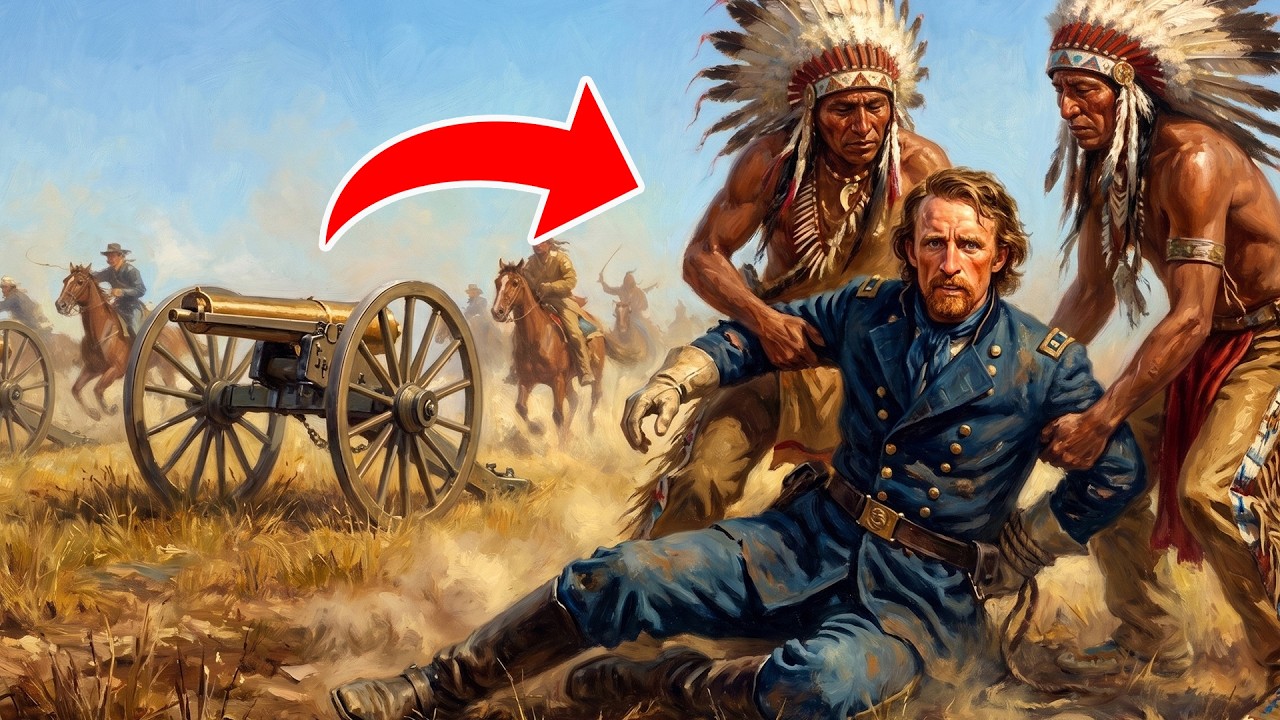
When the relief column reached those guns three days later, they were still standing in the exact same spot, unfired. In the meantime, 210 soldiers had died on the bluffs a few hills away, grappling with single-shot rifles whose empty cartridges had to be pulled out by hand before the next round could be shoved in. A weapon system that could have changed the course of the battle had waited silently, 18 kilometers behind the man who had left it there: General George Armstrong Custer himself. A member of the relief column later wrote a letter describing the moment he approached the guns.
He saw the crews going about their daily routines, cleaning their weapons, feeding the horses, as if nothing had happened. Only hours earlier, the commanders and comrades of those very same men had taken their last breaths within sight of the battery’s position. The contrast seared itself into the men who served those guns. Some later said they carried a strange survivor’s guilt for years, knowing they were alive simply because they had not been allowed to fight.
These were not untested weapons. Invented in 1861 by Richard Gatling, the hand-cranked machine gun had already earned a fearsome reputation on Civil War battlefields. During the Siege of Petersburg, a few Gatling guns alone had halted an infantry assault the size of a regiment. By 1876 the weapon was standard army issue, and the battery allocated to Custer’s campaign held three of them.
Whatever else might be said about the decision, this was not an imaginary what-if. These were proven, ready-to-use weapons placed specifically at Custer’s disposal, and he consciously left them behind. The story of that decision begins five days before the battle, on June 21, 1876, at an encampment at the mouth of Rosebud Creek. There, General Alfred Terry, the commander of the forces arrayed against the Lakota and Cheyenne, convened a final council of war.
Terry had planned to squeeze the tribes with three separate columns converging from different directions: General George Crook from the south, Colonel John Gibbon from the west, and Terry himself along with Custer’s 7th Cavalry from the east. Coordination between these columns was nearly impossible given the communications of the era. Messaging took days by mounted courier, and agreeing on a precise meeting date and point was beyond the reach of practical planning. That uncertainty had shaped the orders Terry gave Custer.
Rather than imposing a strict attack date, Terry granted his subordinate authority to exercise initiative based on field conditions. It was a flexibility that would later become the cornerstone of both the defenses and the criticisms of Custer’s conduct. Terry had two significant additional resources beyond Custer’s 7th Cavalry: four troops of the 2nd Cavalry Regiment under Major James Brisbin, and a Gatling gun battery commanded by Lieutenant William Low. Terry offered both to Custer.
Custer rejected both. The details of that meeting survive in reports and letters written afterward by the men who were present. Terry gathered his officers in a sort of ship’s cabin built on the deck of the steamer Far West, with a map spread across the table as possible routes were discussed. Custer, using the initiative he had been granted, argued that his regiment should move alone, quickly, and independently.
When Brisbin offered his cavalry troops, Custer’s reply was short and final: the 7th Cavalry had the power to fulfill the mission entirely on its own. Some officers present found the answer overly confident, but no one openly challenged it in front of Terry. Custer’s rejection was not an isolated choice. It was the last link in a pattern that ran throughout his career.
At the Washita raid in 1868, he had left heavy artillery support behind to mount a dawn attack using only cavalry. That raid had succeeded, and it reinforced his conviction that speed was everything. During the 1874 Black Hills expedition, he had complained constantly about heavy equipment slowing the pace. Experience had hardened into belief: heavy weapons in a cavalry operation were not an advantage but a constraint.
The village at Washita, however, had been far smaller and far less defended than the one at Little Bighorn. Custer was applying the same prescription to a threat of an entirely different magnitude. Terry had his own reasons for granting Custer such broad latitude. He was essentially an infantry general, not as experienced in cavalry tactics as Custer, and he preferred to leave tactical decisions in the field to the man who knew cavalry best.
It was a common arrangement in the army hierarchy, but it created a critical vulnerability. There was no higher authority practically present on the field to oversee, question, or overturn Custer’s decisions. The Gatling gun itself was revolutionary for its era. A hand crank revolved a bundle of six or ten barrels, firing them in sequence with each turn.
Empty cartridges ejected automatically, fresh rounds loaded automatically, producing a rate of fire between 350 and 400 rounds per minute in trained hands. The army had begun issuing the Model 1866 and Model 1874 versions to infantry and cavalry units. Each gun fired the same . 45-70 caliber round used by the Springfield carbines, a logistical advantage in ammunition standardization.
But the power came at a heavy cost. Each Gatling gun sat on its own wheeled artillery carriage, and the whole assembly, including ammunition, weighed between 180 and 220 kilograms. Pulling it demanded four to six horses or mules. Each gun required its own crew, spare parts, and large quantities of ammunition.
A three-gun battery needed twelve to eighteen draft animals just for its own weight. Adding the standard load of 1,000 to 1,500 rounds per gun, spare barrel sets, repair tools, and crew gear, the convoy needed at least twenty-five to thirty additional animals, each of which required water and pasture in an arid region where grazing was already scarce. Custer’s men had felt the burden firsthand. Throughout the campaign, the wheels of the Gatling carriages had repeatedly stuck in creek beds.
Once a carriage nearly overturned. Several times the tired horses could not pull the load and the column stalled. One of Custer’s officers wrote in his campaign journal that the guns were a constant nuisance, cutting the regiment’s pace of advance by almost half. On one occasion a carriage wheel broke on rocky ground and the whole column waited for hours for repairs.
Another day a carriage bogged down in the mud during a creek crossing; extra horses were rushed in to free it while the crew pushed knee-deep in the sludge. Such setbacks cost time and drained morale. Custer’s plan rested on speed from start to finish. The goal was to surround the village undetected and strike before the warriors could escape.
That meant night marches, rapid maneuvers, and a column traveling as light as possible. The Gatling guns contradicted the equation. They offered firepower but destroyed mobility, and when Custer had to choose between speed and firepower, he chose speed. The rejection of Brisbin’s cavalry carried a different kind of motivation.
Custer wanted the victory to belong to the 7th Cavalry alone. This was part of a calculated effort to salvage his career and rebuild his political standing. If the triumph were shared with another regiment, its personal and political value would shrink. Traces of this ambition appear in Custer’s own letters.
Writing to his wife Elizabeth during the campaign, he described the operation as a potential defining moment of his career and emphasized the importance of a victory over his political enemies in Washington. He reportedly joked to one of his officers that a successful campaign might even carry him toward a future presidential candidacy. Keeping the victory as the exclusive property of the 7th Cavalry was not merely a military preference; it was a direct personal investment. Time pressure compounded the calculation.
1876 was the year of America’s Centennial celebrations, with the great exhibition in Philadelphia set to peak in early July. A victory announced in those same days would be a tremendous public relations opportunity for the army and for Custer. Every day of delay risked missing the symbolic window. A slow column dragging heavy weapons did not fit the timing.
Custer was operating on a media schedule as much as a military one. Lieutenant William Low was furious when he learned of the decision. He saw the exclusion of his battery as both a professional insult and a strategic error. By his account, Custer’s decision was final and not open to debate.
Objections were ignored, and the battery remained with Terry’s main column, moving at the pace of slow-marching infantry. Low’s frustration was not mere pride. After weeks of arduous campaigning, his crew was being kept entirely out of the main engagement. According to some contemporary sources, Low personally appealed to Terry to allow his battery to accompany at least part of Custer’s column.
Terry refused, unwilling to interfere with Custer’s initiative in the field. So on the most critical day of the battle, three Gatling guns and their trained crews waited miles from the fighting, completely useless. On the morning of June 25, Custer’s column approached the Little Bighorn Valley and was halted at Medicine Tail Coulee, one of the two historic river crossings, by Lakota warriors commanded by Gall. It was one of the critical moments that would determine the battle’s fate.
If the crossing could have been held, Custer’s column might have entered the village and carried out the planned raid. The geography made the question concrete. Medicine Tail Coulee was a narrow ravine descending to the river, flanked by high banks on either side. It was exactly the kind of terrain where Gatling guns performed most efficiently: the enemy’s room to maneuver was naturally limited, and the guns could concentrate on a single narrow front.
Had Custer been able to position part of his column behind the pass with the guns deployed, Gall’s attempt to block the crossing would have faced a far higher cost. But for that scenario to happen, Custer had to bring the guns with him and deploy them at the right point at the right time. And that choice had to be made much earlier, at the council on the Rosebud. The answer is not simple.
The guns’ potential impact is hard to dispute. In narrow defiles, they could establish a dense and continuous line of fire that would make advancing warriors pay heavily. In other conflicts of the era, such weapons used defensively in narrow passes provided overwhelming superiority. Yet critics point out that the Little Bighorn terrain was steep, rocky, and demanded rapid maneuver.
Heavy, low-mobility guns could have been isolated, captured, and turned against the army. Every soldier assigned to protect them would have been a soldier pulled from the fighting. In a 210-man column, that could mean a severe loss of manpower. The debate generated a substantial academic literature in the second half of the twentieth century.
Historian Robert Utley, in his biographies of Custer, suggested that the Gatling guns carried the risk of slowing the campaign pace, but that Custer failed to adequately weigh alternative scenarios before accepting that risk. John S. Gray, reconstructing the battle’s hourly chronology, argued that the engagement at Medicine Tail Coulee lasted only minutes, and that even that brief span of concentrated fire could have constituted a critical threshold. Opposing researchers note that Custer’s column was already under attack at multiple points across the broader battlefield, and that guns deployed at a single pass could not have changed the overall flow.
Popular culture’s treatment of the decision shifted over time. Until the mid-twentieth century, Custer’s choice was barely questioned. He was portrayed as a tragic hero, and the idea that his decisions deserved scrutiny was not widespread. Beginning in the 1960s, as American society grew more critical of military leadership in the wake of Vietnam, Custer’s decisions came under fresh examination.
The Gatling gun issue became a symbol of the reassessment. The question was no longer simply why Custer lost, but which of his decisions made the loss inevitable. General Nelson Miles framed the issue in broader terms. He criticized not only the terrain’s suitability for the guns but Custer’s entire style of command, writing in his memoirs that Custer’s confidence in his own abilities sometimes preceded his good judgment.
The Gatling gun decision, in that view, was not an isolated technical preference but a reflection of Custer’s overall character: the same self-assurance, the same devotion to speed, the same belief that his own strength was enough, visible in his rejection of additional cavalry, his dismissal of scouts’ warnings, and finally his decision to divide his column, separating from Reno and Benteen. Yet the opposing view remains strong. Many researchers, including historians and retired artillery officers, emphasize that the battle’s critical moment was not open-terrain maneuver but precisely a narrow-defile defense like Medicine Tail Coulee. In such a scenario, the mobility problem disappears because the guns would already be fixed in position.
A few minutes of concentrated fire could have prevented Gall’s warriors from closing the ford, allowing Custer’s column into the village. Gall’s move, they note, was not a pre-planned defense but a spontaneous reaction born of personal fury and grief over his family’s deaths. If that spontaneous rush had met intense, continuous Gatling fire for even a few minutes, it might have scattered or never formed. Custer’s column could then have entered the village and executed his original tactic of taking women and children hostage, driving the battle toward an entirely different conclusion, perhaps one in his favor.
That scenario is assumption, but it has been tested in military simulations and occupies a real place in the literature. Some researchers extend the question beyond the crossing. If the guns had been deployed on Calhoun Hill or around Custer Hill, the rapid collapse of the defensive line might have been prevented. Cartridge shell patterns show that the Calhoun line held its discipline for the first minutes, then was breached in seconds by Crazy Horse’s mounted maneuver.
Against a flanking movement, a Gatling gun firing continuously over a wide arc could have served as a powerful deterrent. But the gun’s effective range and accuracy against moving, dispersed, fast-mounted warriors were not what they were against a stationary infantry line. The result would not have been guaranteed victory, only a raised probability. Terry’s own column faced the guns’ burden directly.
Moving with Gibbon’s infantry, the column averaged 15 to 20 kilometers a day, far slower than the 40-plus kilometers Custer’s cavalry could make. Had Custer kept the guns, his advance would likely have slowed to a similar pace, potentially delaying his arrival at the village by days. That delay might have let the village detect him and scatter. Or it might have created the coordination needed for a simultaneous attack with Terry and Gibbon.
That was in fact Terry’s original plan: three columns surrounding the village together on June 26, one day after Custer actually attacked. Custer’s premature assault, launched under the false impression that his column had been discovered, broke that coordination. Had he kept the Gatling guns, the slower-moving column would likely have arrived at the same time as the others. Instead of an isolated column of 210 men, the combined force of three columns could have besieged the village simultaneously with vastly greater numbers.
The debate shifts, then, from the battlefield impact of a single weapon to how it might have changed the campaign’s entire timing. Evidence from other conflicts offers a way to test the question. During the Red River War of 1874-1875, army units used Gatling guns in open plains combat with mixed results. Sometimes the guns inflicted heavy casualties; sometimes, due to terrain, they were left behind or deployed late.
At the Battle of Beecher Island in 1879, a smaller conflict, rapid-fire weapons used defensively kept a besieged group alive for days. The pattern suggests the guns’ impact depended heavily on terrain and tactical role: highly effective in stationary defense, a serious burden in mobile offensive operations. Little Bighorn sat between those extremes, which is one reason the debate has never fully settled. After the battle, Terry’s main column arrived at the battlefield on June 27 with the Gatling battery, two days after Custer’s command had been wiped out.
The guns came fully loaded, completely unfired. Their only service that day was as a security measure while the dead were gathered and buried, protecting the burial parties against a possible attack. No shot was fired. The guns that might have saved hundreds of lives two days earlier watched the dead being collected.
One of Terry’s officers noted in his diary that the guns were now a useless, belated force. For Low’s crew, seeing the corpses made plain what their absence had meant. Some soldiers later wrote that the sight left a trauma lasting years, the knowledge that they could have been part of the same battle and simply missed a clash occurring only miles away. Lieutenant Low continued his military career, but it is said he never fully moved past his disappointment.
In later correspondence, he repeatedly asked himself whether he wished he had been there that day, sharing the regiment’s fate. The Gatling guns themselves remained in the army inventory into the late 1880s, gradually retired as the Maxim and Hotchkiss machine guns offered lighter, more reliable designs. Today one of the unused guns from Little Bighorn is exhibited in American military museums, where the informational plaque tells visitors it never fired in the battle because the commander chose to leave it behind. Custer’s decision was a reflection of his military philosophy.
Since the Civil War, speed, audacity, and surprise had been the tools he trusted most, and heavy weapons contradicted them. That approach had won victories before. But the enemy at Little Bighorn was vastly larger, better organized, and better armed than anything in his previous experience. Speed alone was no longer enough, and the firepower he sacrificed was missing exactly when he needed it most.
The tension between speed and firepower recurs throughout military history, from debates over whether armored units should be light and fast or heavy and powerful in the twentieth century to the present. Custer’s mistake was not in experiencing the dilemma. It was making a one-sided decision based on past experience without accurately assessing the enemy’s strength. The formula that worked at Washita failed against an enemy nearly twice the size he estimated, and he could not grasp that difference until he reached the field.
Military historians cite the case as an example of what happens when a commander makes definitive decisions as if he possessed full knowledge while his intelligence is actually incomplete or flawed. The defenders of Custer’s choice point to the intelligence failure as the true cause of the defeat, not the missing guns. Custer estimated he faced 800 to 1,000 warriors; the actual number exceeded 1,800. Had the intelligence been accurate, the existing cavalry might have sufficed, and the guns would not have been needed.
Reducing the disaster to weapons selection, they argue, oversimplifies a far more complex chain of causes. Even with the Gatling guns present, faulty intelligence could have produced a different disaster. What-if questions, they warn, must be used cautiously; isolating a single variable ignores the multi-dimensional reality of warfare. At West Point and other military academies, Little Bighorn is studied in resource allocation and risk assessment classes.
Students learn that rejecting an available resource must depend not only on that resource’s intrinsic value but on the probability of alternative scenarios. Custer’s cost-benefit analysis was internally logical; its fatal flaw was the input. The decision process itself was rational, but built on a false assumption about the enemy’s size. In modern decision theory, that is an input error: the decision logic may be sound, but if the input data is wrong, the output is inevitably flawed.
The lesson reaches beyond military history. Mechanically applying a previously successful strategy to a new and different situation does not guarantee success. If the fundamental parameters are misjudged, especially the true strength of the opponent, the same strategy can turn into disaster. Custer’s speed-is-everything formula, which worked at Washita, became fatal at Little Bighorn because the force facing him was nearly twice his estimate.
He was so certain speed would save him that he left the firepower at his disposal 18 kilometers behind, completely unused. That decision, made before he ever saw the battlefield, had already set the course for the final ninety minutes of 210 men.
