On the morning of November 29th, 1892, Thanksgiving Day, a housemaid at the Hotel del Coronado made her way down the exterior staircase that led from the hotel grounds to the beach. At the bottom, lying on the sand and the steps, she found the body of a young woman. The woman was well-dressed, composed even in death, with a single gunshot wound to the head. Beside her lay a revolver.
The San Diego County coroner was summoned, and his examination produced a determination that was quick and categorical. The wound was self-inflicted. A young woman, clearly in distress, had taken her own life while waiting for a gentleman who had never arrived. The case was closed almost as soon as it was opened.
But at the coroner’s inquest, in the course of the formal proceedings, a detail surfaced that did not fit neatly into that conclusion. It was a passing remark, almost incidental in its delivery, the kind of thing that might easily have been overlooked in a less troubling case. The bullet recovered from the woman’s body did not match the gun found beside her. It was mentioned.
It was recorded. And then the inquest moved on. She had no identification on her person. The police had nothing to work with beyond a physical description, which they telegraphed to agencies across the country.
The newspapers had already begun their accounting of the mystery, and the phrase they settled on was the one that would follow her forever: the beautiful stranger. To understand what happened to that woman, you first have to understand the world that built the place where she died. The 1880s were a decade of almost delirious ambition in America. The Civil War was a generation behind.
Industrialists were accumulating fortunes on a scale the world had rarely seen, and they were spending those fortunes just as spectacularly. This was the Gilded Age, an era of grand hotels and grander gestures, of men who believed that money was not just a measure of success but proof of destiny. If you could dream it and afford it, the logic went, then God himself must have intended it. Nowhere was this fever more acute than in Southern California.
In the mid-1880s, the region was experiencing one of its first great real estate booms, a speculative frenzy driven by the arrival of competing railroad lines that had slashed the cost of passage from the East. Land that had been worthless scrub was suddenly worth a fortune—provided you could convince enough people that it was paradise. Developers learned quickly that the most effective way to sell empty land was to build something magnificent on it first. A grand hotel was not just an amenity.
It was an argument. It said: this place is worth coming to. This place is real. It was into this atmosphere that five investors arrived in November of 1885 and purchased something audacious: Coronado Island and North Island, nearly 4,000 acres of peninsula and coastline just across San Diego Bay, for $110,000.
Among them were two men whose names would define everything that followed. Elisha Babcock was a retired railroad executive from Evansville, Indiana, a visionary who looked at a stretch of windswept peninsula populated by jackrabbits and saw a city. Hampton L. Story was his counterpart and co-conspirator, heir to the Story and Clark Piano Company of Chicago.
Cultured, well-connected, and equally unqualified for what they were about to attempt. Neither man had ever run a hotel or had any particular expertise in construction, hospitality, or resort management. What they had was conviction. Babcock’s vision was almost poetic in its ambition.
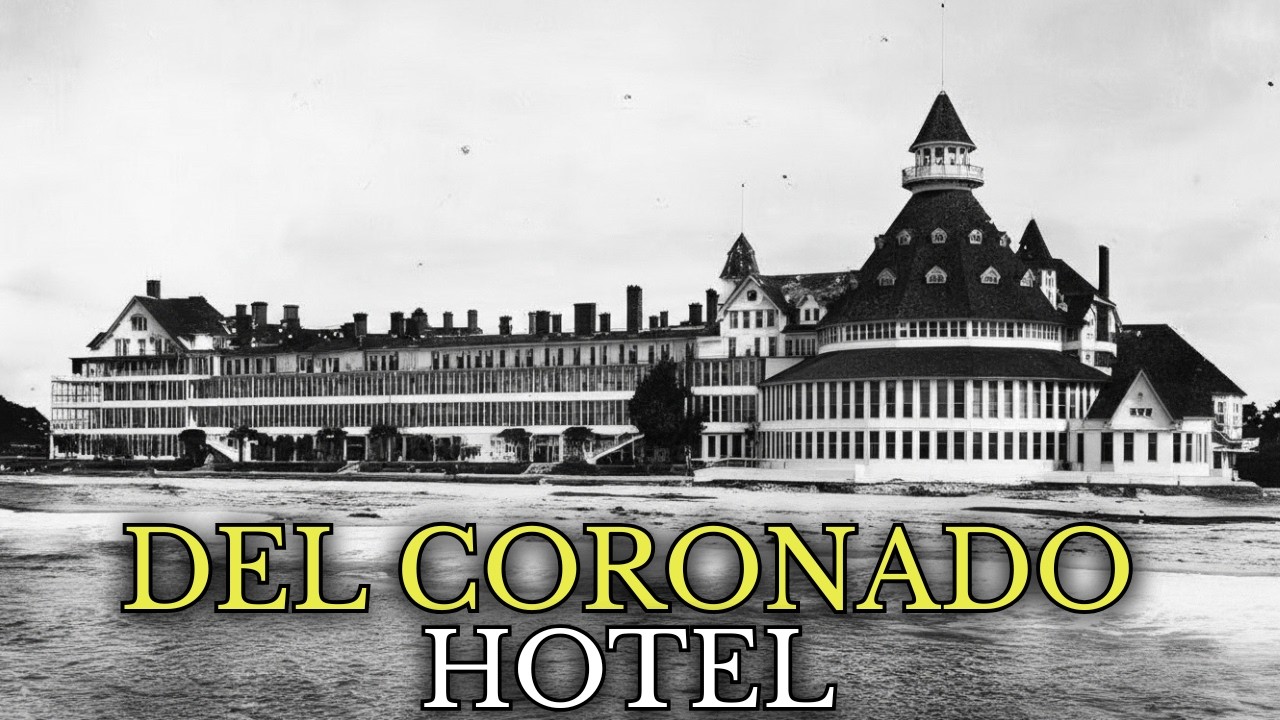
The hotel would be built around a great garden courtyard of tropical trees and flowers. Its dining wing would angle toward the ocean to capture the full view of sea, bay, and city. There would be a pavilion tower on the ocean corner, verandas for rest and promenade. It would be, in his own words, “the talk of the western world,” a place where people would continue to come long after they were gone.
To make any of this possible, they first had to build a world around it. In April of 1886, Babcock and Story created the Coronado Beach Company, then systematically constructed the infrastructure a resort hotel would require. The Coronado Ferry Company built wharves and developed ferryboat service across the bay. The Coronado Water Company piped fresh water under San Diego Bay from the San Diego River.
The Coronado Railroad Company laid rail lines across the peninsula. They built their own electrical power plant and supplied electricity to the entire community of Coronado. Two men without hotel experience were essentially building a small city just so they could build one building inside it. To fund the hotel’s construction, they held a land auction in 1886 that drew a reported 6,000 people to the peninsula.
Three hundred and fifty lots were sold that day, raising approximately $100,000. Lot sales would eventually reach $24 million. The hotel was bankrolled in large part by selling the promise of Coronado to strangers who had never set foot on it. In December of 1886, Babcock summoned a stenographer to the beach on a clear winter afternoon.
With investor Herbert Engel and architect James Reid sitting together in the open air, they sketched the resort’s basic layout on the spot. No formal planning process, no extended deliberation. Just four men on a windswept California peninsula drawing the outlines of something they intended to be the greatest hotel in the world. Reid later recalled that the preliminary sketches were quickly prepared and, for lack of time, remained almost entirely unchanged through construction.
The architects they hired were the Reid brothers of Evansville, Indiana. James Reid was lead designer, with his brother Watson helping to supervise what would become a workforce of nearly 2,000 men. The dream was drawn. The money was raised.
The infrastructure was being assembled piece by piece across a peninsula that had been empty scrub land just months before. Now someone had to actually build the thing. When James Reid surveyed the site at Coronado in early 1887, he confronted a problem that would have stopped a less determined man cold. There was no lumber.
There was no skilled labor. There was no established supply chain of any kind in the San Diego region capable of supporting a construction project of this scale. The nearest serious industrial infrastructure was hundreds of miles away. The site itself was an exposed, windswept peninsula connected to the mainland only by ferry.
Building the largest resort hotel in the world here wasn’t just ambitious. It was, by any reasonable measure, absurd. Reid proceeded anyway. For lumber, he secured exclusive contracts with the Dolbeer and Carson Lumber Company of Eureka, California, one of the largest timber operations on the West Coast.
Raw lumber was shipped directly from their yards on the shores of Humboldt Bay. Because there were no finishing mills nearby capable of processing it, Reid built his own planing mills on site. To obtain brick and concrete, he constructed his own kilns. He built a metal shop and iron works from scratch.
What rose on that Coronado site before the hotel itself was, in effect, a small industrial city assembled entirely for the purpose of assembling one building. The workforce numbered nearly 2,000 men at its peak, drawn largely from Chinese immigrant communities in San Francisco and Oakland. They were the hands that framed every wall, laid every foundation stone, fitted every beam. They worked in the open California sun through the spring and summer of 1887, building something most of them would never be permitted to stay in.
Their names were not recorded in the promotional brochures. Their labor built the palace. History gave them no room in it. Construction began along the hotel’s simpler northern face, a deliberate choice.
The workforce was largely inexperienced with a project of this complexity, and Reid understood that the more intricate southern elevations would demand skill the men hadn’t yet developed. He gave them the simpler sections first. They would learn on the job, and by the time they reached the architectural centerpiece of the entire structure, they would be ready. That centerpiece was the Crown Room.
Nothing else in the building announced its ambitions quite so nakedly. One hundred and sixty feet long, sixty feet wide, with a ceiling that soared thirty-three feet overhead. All of it paneled in Oregon sugar pine, chosen for its absence of knots, its grain as clean and continuous as the surface of still water. The ceiling was installed entirely with pegs and glue.
Not a single nail was used in its construction. It was an engineering statement as much as an aesthetic one. The room still stands as one of the great uninterrupted interior spaces of Victorian American architecture. Fire was the great terror of wooden structures in the 1880s, and Reid addressed it with characteristic thoroughness.
A freshwater pipeline was run under San Diego Bay specifically to supply the hotel’s fire suppression system. Gravity-fed sprinklers were installed throughout. Two enormous cisterns were built in the basement, their concrete walls a full foot thick, designed to store emergency water reserves. They were never used for that purpose.
During Prohibition, decades later, they proved considerably more useful for storing alcohol. The hotel also became home to the world’s first oil furnace, a heating system so novel that a Los Angeles oil company was required to build dedicated tankers just to deliver fuel to Coronado. And when it came to electricity, the Del joined a handful of large American buildings that had been fully wired for electric light. Popular legend credits Thomas Edison with the installation.
The truth is more prosaic: it was the Mather Electric Company of Chicago that installed 2,500 incandescent lamps throughout the building. The electric wires were threaded inside the gas lines as a contingency. If the electricity failed, the gas could still illuminate the rooms. Even the innovation had a backup plan.
Steam-powered hydraulic elevators, among the first in the country, were fitted into the structure. Telephone service was connected. By November of 1887, the exterior was substantially complete. The ballroom tower rose 120 feet above the peninsula, its iconic red roof silhouette visible from miles across the bay.
The interior was still unfinished, but the building’s bones were there—massive, improbable, magnificent. A furniture parade made its way down Orange Avenue from the ferry landing. Freight loads of carved mahogany and brass fittings and velvet upholstery were conveyed in procession toward a building that was still, in places, little more than framed walls and sawdust. When the final accounting was done, the hotel had cost $600,000 to build and $400,000 to furnish.
By December of 1885, while Babcock and Story were still assembling their investment group on the far side of the continent, a young woman named Kate Farmer stood before a minister in Iowa and married a man named Thomas Edwin Morgan. She was 21 years old. Whatever she was hoping this life would bring her, the years ahead offered something different. A child was born on the last day of October 1886.
Two days later, that child was gone. Kate Morgan buried her son and carried on. On February 19th, 1888, the Hotel del Coronado served its first meal in the Crown Room. Fourteen hundred and forty San Diegans crossed the bay that day to witness it.
They came by ferry, dressed in their finest, stepping onto the Coronado Peninsula to see whether the thing that had been promised to them—the thing under construction in plain view across the water for nearly a year—was truly as extraordinary as advertised. It was 399 rooms spread across the building. All of them large, all of them well ventilated, each one catching sunlight at some hour of the day. Hydraulic elevators carried guests between floors.
Two thousand five hundred electric lights burned throughout the structure, a novelty so remarkable that visitors would stop in corridors simply to stand beneath them. An Olympic-sized saltwater pool gleamed on the grounds. A Japanese tea garden offered shade and stillness. Tennis courts, a yacht club, bowling alleys, and deep-sea fishing excursions completed an amenity list that made the hotel feel less like a building and more like its own self-contained world.
Room rates began at $2. 50 per day, and that included three meals. In the years following the opening, the Crown Room acquired the finishing touch that would define it forever. L.
Frank Baum, the author of The Wizard of Oz, became a devoted regular guest from 1904 onward, spending months at a time at the Del, writing at least three books in the Oz series within its walls. Around 1911, he suggested to hotel management that the Crown Room needed something grander overhead and proceeded to design the famous crown-shaped chandeliers that hang there to this day. A man who spent his professional life inventing wonder, adding the final ornament to a room built for exactly that purpose. The hotel’s early years were not without crisis.
Just as construction was nearing completion, the Southern California land boom that had fueled the entire venture collapsed. Babcock and Story found themselves overextended at the worst possible moment. Their rescue came in the form of John D. Spreckels, the sugar magnate known as the Sugar King, who saw in the hotel something worth preserving and provided $100,000 in emergency loans to see it through.
By 1890, Spreckels had purchased the hotel outright. The creation that Babcock had sketched on a beach in December of 1886 now belonged to a man who hadn’t conceived it, hadn’t fought to build it, hadn’t staked his reputation on the idea. The hotel thrived regardless. Meanwhile, the other timeline was running out.
Kate Morgan’s son was buried in the autumn of 1886. Her marriage to Thomas Morgan had collapsed by 1890. She left with another man, a man connected to her husband’s family through the kind of complicated domestic arrangement that the 19th century preferred not to discuss openly. A tangled, compromised choice, the kind made when the respectable options have already failed you.
That relationship did not last either. After that, the record of her life goes almost completely dark. Two years of near silence in the historical record. She was employed at some point as a domestic worker in a wealthy Los Angeles household.
That much is known. But the shape of those two years—what she was thinking and hoping and enduring—that is gone. Lost. As though history itself looked away at the exact moment her life was at its most difficult.
Then, on a gray November afternoon in 1892, a woman walked through the front door of the Hotel del Coronado, approached the desk, and asked for a room. It was November 24th, 1892. Thanksgiving week. The Pacific coast was gray and mild.
The Hotel del Coronado was well into its fifth season. The Crown Room was filling each evening with the comfortable and the wealthy, with the sound of silverware and conversation and the particular laughter of people who have no urgent reason to be anywhere else. Into this world on a Tuesday afternoon walked a young woman, unaccompanied. She was perhaps 28, well-dressed in the manner of someone who understands presentation, who knows what it means to be looked at and has prepared accordingly.
The staff who received her noted these things—the quality of her clothing, the composure of her bearing—and they noted something else as well, something that composure could not entirely conceal. She was pale. Her eyes carried a weight that didn’t belong in a place like this. She looked, one staff member would later recall, like a woman who had been holding herself together through an act of sustained and private will.
She approached the front desk. She signed the register. Mrs. L.
A. Bernard, Detroit. She told the staff she was expecting a gentleman to join her shortly. She was given a room on the third floor.
She went upstairs, and she began to wait. Sometime in the days before November 24th, Kate Morgan had boarded a train heading toward San Diego, and she had not been traveling alone. Fellow passengers later reported that a woman matching Kate’s description had been traveling with a male companion. At some point during the journey, the two argued.
The disagreement, by all accounts, was significant enough to be noticed by strangers in adjacent seats. And before the train reached Coronado, the man was gone. He left her. Whether he stepped off at an earlier stop, whether the parting was final or intended as temporary, no one could say with certainty.
What he left behind was a woman sitting on a train to Coronado, carrying whatever she was carrying, headed toward a hotel where she had apparently arranged to meet him. Who was he? That question was never answered. His name was never recorded.
His connection to Kate was never established beyond the accounts of passengers who saw them together and heard them argue. He is one of the great unnamed figures in the story. A man who stepped out of a train carriage and out of history, leaving a woman to face whatever came next entirely on her own. Her five days at the Hotel del Coronado were observed by staff with a mixture of concern and discretion.
She was always well-dressed when she appeared in public areas. She was polite. She maintained at all times the surface of a respectable woman traveling alone, waiting for her husband to arrive. But beneath that surface, things were visibly wrong.
She barely ate. Staff noted this with quiet concern. Meals were ordered and left largely untouched. She spent time on the veranda watching the entrance.
The gentleman she was expecting had not yet arrived, she explained when asked, but he would be coming soon. Twenty feet from where she sat, the Crown Room hummed with the easy warmth of people who belong there. Dinners unfolded in the amber light beneath Baum’s chandeliers. Conversations carried across tables set with white linen and polished silver.
The world the Hotel del Coronado had been built to provide—beautiful, insulated, ordered—was operating exactly as designed. And somewhere at its edge, on a windswept veranda, a woman was quietly coming apart in a way that no amount of luxury was equipped to address. At some point during her stay, Kate ventured into San Diego. She purchased a handgun.
That purchase is documented. What she intended when she made it belongs to the category of things we will never know for certain. The gentleman never came. In the 1980s, a San Francisco attorney named Alan May revisited the case and raised the possibility, in a book titled The Legend of Kate Morgan, that what happened on those steps was not suicide, but something far more sinister.
His argument rested substantially on that discrepancy: the detail from the inquest that was noted and then set aside. May’s theory was never proven. It was also never definitively disproven. The coroner’s file was closed in 1892.
The official verdict has never been changed. But the questions have never gone away. It took time, but her identity was eventually confirmed. She was Kate Morgan, married and estranged from her husband, last employed as a domestic worker in a wealthy Los Angeles household.
The picture that emerged was of a woman who had spent the last years of her life moving between the margins of other people’s comfort, serving in the homes of the prosperous, ending her days in the most prosperous home of all. She was buried at Mount Hope Cemetery in San Diego, a plain burial for a woman the city had known for five days under a name that wasn’t hers. The instinct of the Hotel del Coronado in the days and weeks following Kate Morgan’s death was the same as every grand resort that has ever found itself inconvenienced by tragedy: to just move on. Gilded Age hotels did not advertise deaths on their staircases.
They did not linger over coroner’s inquests or entertain questions about bullets that didn’t match guns. They changed the subject with fresh flowers and impeccable service, and the implied understanding that unpleasantness was by definition something that happened elsewhere. But the “Beautiful Stranger” story had already traveled far beyond the hotel’s ability to contain it. In the days following her death, accounts of the mysterious young woman—elegant, sorrowful, waiting for a gentleman who never arrived—had circulated across the country.
People read them and felt correctly that something had been left unresolved. The room where Kate stayed, originally designated room 3327, renumbered over the years as the hotel reorganized its corridors, eventually settled into the designation room 502. It began quietly, and then insistently, to attract a different kind of attention. The reports accumulated slowly at first, then with gathering consistency over the decades.
Lights flickering in a room where the wiring had been checked and rechecked. A television switching itself on in the small hours of the morning, tuned to static, with no guest in the room and no explanation for maintenance. Unexplained breezes moving through a space where every window was sealed. Objects—a glass, a book, a personal item left on a nightstand—found in the morning in positions they had not been left in the night before.
Doors opening onto empty hallways. Abrupt drops in temperature with no corresponding change in the building systems. Footsteps in the corridor outside, measured and unhurried, stopping at the door. Voices, sometimes low and indistinct, just below the threshold of comprehension.
The gift shop developed its own reputation. Merchandise was reported flying from shelves with no apparent cause, always landing upright, always unbroken, as though whatever was moving through the building was not interested in destruction, only in being noticed. And along the shoreline and in the hotel’s corridors, guests and staff began to report something else. A figure.
A young woman, well-dressed, with something about her expression that didn’t belong to the present moment. She was seen near the staircase most often. The staircase leading down to the beach. In 1992, exactly 100 years after Kate Morgan checked in under a name that wasn’t hers, the Hotel del Coronado contracted a parapsychologist and anomalist named Christopher Chacon to conduct a formal, confidential assessment of the ongoing phenomena reported throughout the resort.
The investigation ran continuously, 24 hours a day, for 12 months. The hotel did not publicize the investigation while it was underway. The fact that they commissioned it at all says something about the nature and persistence of what was being reported. The hotel’s heritage department eventually published its own official account, Beautiful Stranger: The Ghost of Kate Morgan and the Hotel del Coronado, a carefully researched examination of the 1892 events that leaned toward the coroner’s original verdict of suicide while openly acknowledging the details that verdict had never satisfactorily explained.
It was an honest book. It did not pretend the questions didn’t exist. It simply declined to answer them, because the honest answer was that no one could. Room 502 is now the most requested room in the hotel.
People book it months in advance. Ghost tours called “Haunted Happenings” run on Friday, Saturday, and Sunday evenings, guiding guests through the building’s most storied corners. Consider the particular irony of all this. Kate Morgan arrived at the Hotel del Coronado unrecognized, checked in under a false name, and died unidentified.
A woman so invisible to the world around her that it took a nationwide telegraph inquiry to establish who she was. She came to the most glamorous address on the California coast and was, for the five days of her stay, utterly without companion within it. She is now the most famous guest in the hotel’s 130 years of operation. More celebrated than the presidents, more enduring than the movie stars.
The woman the hotel tried to move past became the story the hotel cannot move past at all. While Kate’s presence was quietly becoming the hotel’s most enduring legacy, the living world outside its walls was sending some of the most powerful figures in American history through its front door. The presidential relationship with the Del began in earnest in 1891, when Benjamin Harrison became the first sitting United States president to visit San Diego. He came for breakfast.
He later told his successor, William Howard Taft—himself a Del visitor—that “one who has ever breathed this atmosphere would want to live here always. ”
Franklin Roosevelt understood the theatrical possibilities even more explicitly when he visited in 1935, returning to a hotel he had first seen in 1914 as assistant secretary of the Navy. He flew the presidential flag from the Del’s iconic turret. For the duration of his stay, the Hotel del Coronado was formally designated the official White House.
The building that had once needed an emergency loan to survive was now, however temporarily, the seat of American executive power. Nixon took the theater further still. On September 3rd, 1970, he hosted the first state dinner ever held outside the White House, in the Crown Room beneath Baum’s chandeliers, for Mexico’s President Gustavo Díaz Ordaz. One thousand guests filled the room that night.
Among them, Lyndon Johnson, Ronald Reagan, Frank Sinatra, and John Wayne. The full roster of mid-century American authority assembled in a Victorian dining room on a California peninsula, conducting the rituals of diplomacy in a building that a young woman from Iowa had once entered without a name and never left. Among the more persistent legends attached to the Del is one that involves a different kind of power—the romantic, catastrophic kind that reshapes the course of nations. On April 7th, 1920, Edward, Prince of Wales, was honored with a grand banquet in the Crown Room.
Edward was young, charming, and not yet the man who would abdicate the British throne for the woman he loved. That woman, Wallis Simpson, was at that precise moment in history a Coronado resident. Her first husband, Earl Winfield Spencer Jr. , was the commanding officer of nearby Naval Air Station San Diego.
She lived, in other words, within a reasonable distance of the hotel where the Prince of Wales was being celebrated that evening. The question has never been definitively settled. Did they meet here first? Both Edward and Wallis wrote in their memoirs that they did not, that their first meeting came years later in different circumstances in a different country.
Most historians accept this account. But the legend persists—perhaps because the Hotel del Coronado has always been the kind of place where the official version of a story and the true version of a story are not always the same thing. Hollywood discovered the Del early and returned often. The hotel appeared in its first film in 1918 and subsequently became one of the most reliably atmospheric locations on the California coast.
The defining Hollywood moment came in 1958, when Billy Wilder brought Marilyn Monroe, Tony Curtis, and Jack Lemmon to Coronado to film Some Like It Hot. The Del stood in for a Florida resort hotel. The American Film Institute would later name it the greatest comedy ever made. Monroe wandered these corridors, laughed on this beach, performed her particular brand of luminous grace in the same building where sixty years earlier a woman had sat on a veranda watching the entrance for a man who never came.
The irony was not acknowledged. Perhaps it didn’t need to be. The gold of this era was real. The glamour was genuine.
The Hotel del Coronado at its peak was everything Babcock had promised on that December beach in 1886: the talk of the western world, a place people came to and never wanted to leave. But no building, however grand, however loved, escapes time. In 1948, the Spreckels family sold the hotel. It was the end of 58 years of single-family stewardship.
The family had not always been attentive owners. There had been years of deferred maintenance, seasons when the grandeur was sustained more by reputation than by investment. But the Spreckels name had provided something harder to quantify than capital: continuity. A sense that the building belonged to someone who understood what it was.
When that ended, the hotel passed to strangers for the first time in its history. The postwar years were not kind to the grand Victorian resort. America in the late 1940s and through the 1950s was remaking itself around new geometries. The interstate highway, the commercial airline, the modern hotel chain offering clean anonymity at reasonable prices.
The traveler of 1955 was not the traveler of 1910. The world that had made the Hotel del Coronado inevitable had quietly made it optional. The building was still striking from the outside. The red roof towers still presided over the peninsula.
The Crown Room still commanded its view. But inside, neglect was beginning to show. In 1960, a local businessman named John Alessio purchased the property and spent $2 million on refurbishment, bringing in Hollywood set designer Al Goodman to oversee the work, restoring the grand ballroom, the Victorian room lounge, and various interior spaces that had deteriorated beyond casual repair. It was a genuine rescue undertaken with genuine care.
The hotel emerged from Alessio’s tenure looking once again like itself. Three years later, it changed hands again. M. Larry Lawrence acquired the Hotel del Coronado in 1963 with a plan that, had it been executed, would have erased everything this story has been building toward.
He intended to demolish the historic Victorian structure and develop the land. The building that Babcock had dreamed, that Reid had engineered, that 2,000 laborers had raised in a single furious year, was going to come down. Lawrence changed his mind. What exactly shifted in his thinking is not entirely clear from the historical record.
What is clear is that the man who arrived intending to demolish the Del became over time one of its most significant benefactors. He invested $150 million during his tenure. He doubled the hotel’s capacity to 700 rooms. He added the Grand Hall Convention Center and two seven-story towers on the southern end of the property.
He did not destroy the dream. He extended it—and in doing so almost certainly saved it from the fate that neglect and changing economics would otherwise have delivered. Lawrence died in 1996. After that, the hotel entered a different kind of existence, one measured less in vision than in transaction.
The ownership history of the Hotel del Coronado in the late 20th and early 21st centuries reads like a document of an era in which historic buildings became financial instruments. The Travelers Group, CNL Hospitality Properties, and KSL Recreation. The Blackstone Group, Strategic Hotels and Resorts. Percentages and valuations and portfolio realignments.
The hotel was a balance-sheet entry passed between institutional hands that understood its worth in dollars considerably more precisely than they understood its worth in everything else. The building endured. It always had. And then, in 2016, came the strangest chapter of all.
Blackstone reached an agreement to sell Strategic Hotels and Resorts, including the Hotel del Coronado, to the Anbang Insurance Group of Beijing, a Chinese company, as part of a $6. 5 billion deal covering 16 luxury American hotel properties. Fifteen of those properties transferred without complication. The Hotel del Coronado did not.
Its sale was specifically blocked by the Committee on Foreign Investment in the United States, a federal interagency body that reviews acquisitions of American assets by foreign entities for potential national security implications. The committee’s concern was straightforward. The hotel sits in close proximity to some of the most significant naval installations on the West Coast. The idea of a foreign company owning the property raised concerns the United States government was not prepared to set aside.
The deal collapsed in October of 2016. The hotel remained in American hands—a building that had survived the collapse of the Gilded Age real estate market, that had outlasted its founders, its rescuers, and its would-be destroyers. In 2017, Hilton Hotels took over management as part of its Curio collection. The name did not change.
The towers did not change. The Crown Room did not change. Through every sale, renovation, near-demolition, and ownership transfer, one thing remained constant: the story embedded in this building since November of 1892. You can replace the carpets, refinish the Crown Room.
You can add towers, convention centers, luxury oceanfront accommodations, and place the whole enterprise under a global hotel management company. You cannot undo what happened on those beach steps. Some things, it turns out, are more permanent than the buildings that contain them. At dusk, when the Pacific light turns gold and low against the California coast, the Hotel del Coronado becomes something difficult to look away from.
The red crown turrets catch the last of the sun. The white Victorian wood holds the warmth of it for a moment longer than everything around it, as though the building is reluctant to let the day go. The ocean beyond it darkens by degrees. The towers are reflected in the wet sand below, where the tide pulls back and leaves the beach momentarily still.
It is, by any measure, one of the most beautiful buildings in America. A monument to what two men with no prior hotel experience and an apparently limitless capacity for audacity managed to will into existence on a California peninsula in the last years of the 19th century. A technological landmark, one of the first large buildings in the country to be fully electrified. A living museum of Victorian engineering assembled by 2,000 workers whose names the history books did not think worth preserving.
A stage on which American power and American glamour conducted themselves for over a century. And underneath all of it—beneath the chandeliers that Baum designed and the flag that Roosevelt flew and every scene that Hollywood ever filmed on this shore—there is a staircase leading down to the beach. At the bottom of that staircase, on a November morning in 1892, a young woman was found with a wound to the head and no name that anyone recognized. Kate Morgan came to the most beautiful hotel in America looking for someone.
She came here looking for a man who had already left her on a train. She waited five days in a room full of other people’s happiness, in a building designed specifically to make the wealthy feel that the world was ordered and beautiful and fundamentally in their favor. She never found him. She never left.
The questions her death raised have never been answered. The bullet that did not match the gun. The man on the train whose name was never recorded. The five days of waiting that we can reconstruct from staff accounts and newspaper descriptions but never fully understand, because the interior of those days—what Kate Morgan was thinking and hoping and grieving in that third-floor room—belongs entirely to her and to the silence she left behind.
That unresolvable mystery is not a footnote to the Hotel del Coronado’s story. It is its soul. The hotel has survived the collapse of the real estate boom that built it. It has survived two world wars, decades of neglect, the death of the Gilded Age world that made it possible, a near-demolition by a developer who changed his mind, and a blocked acquisition by a foreign government.
What it has never been able to do through all of that—through every reinvention and every fresh coat of paint and every new ownership group with new plans for the property—is move on from November of 1892. Some buildings absorb what happens within their walls. Some places are changed in ways that no renovation can reach by the weight of what they have witnessed. The Hotel del Coronado is one of them.
Not because of the flickering lights in room 502. Not because of the ghost tours on Friday evenings. Not because of the items that fall from the gift shop shelves and always land upright. But because a young woman arrived here without a name that was truly hers and waited in the most glamorous building on the California coast for a life that did not come to meet her.
She is still the most requested guest in the house. The hotel remembers her. In the end, that is the only thing here that was never for sale, and the only thing that was never, in 130 years, replaced.
