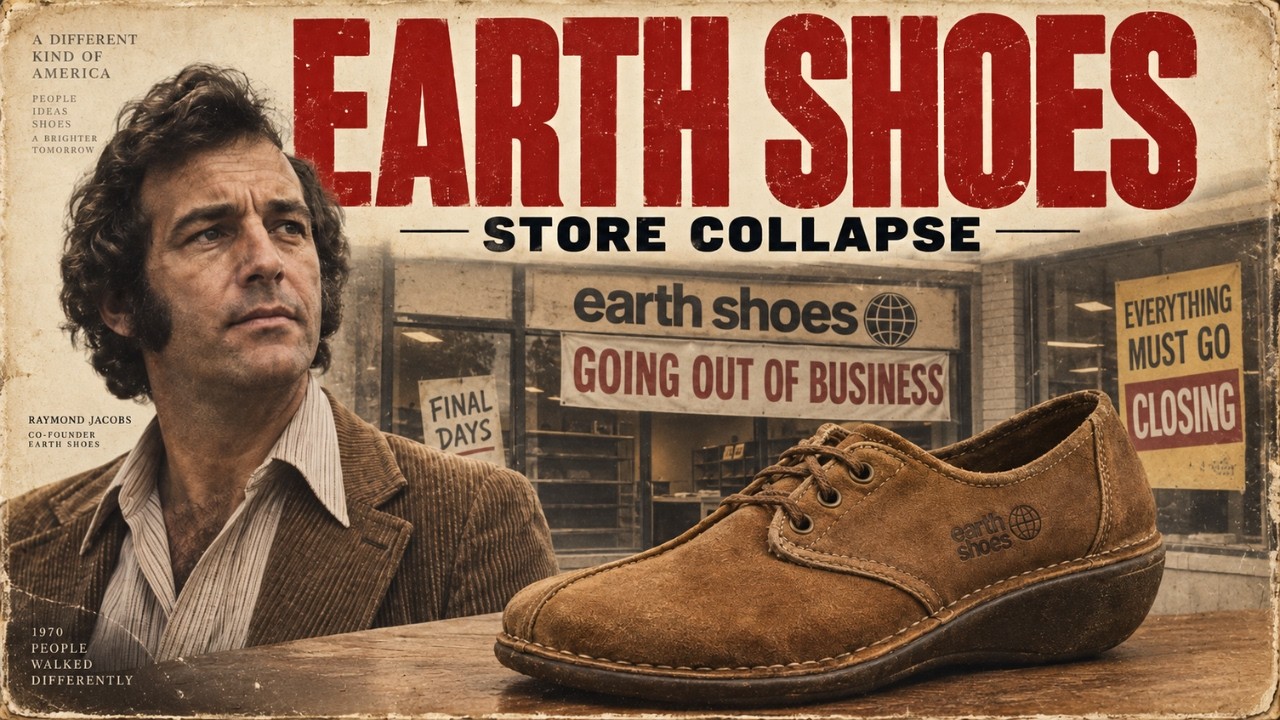
A pair of Earth Origins shoes sits on a shelf at Dillard’s, a name stitched across the box that millions of Americans once recognized. The company that built that name into a nationwide phenomenon has been dead for almost fifty years. In 1970, a young couple named Raymond and Eleanor Jacobs opened a single store in New York City and made a decision in one afternoon that turned into a multi-million dollar business almost overnight. Within a few years, their shoes were on the Tonight Show, in the pages of Time magazine, and on more than one hundred store shelves across three countries.
They had already proven that millions of Americans would change the way they walked for a shoe that promised something better. They had not yet met the bank that would decide their company was not worth saving. The story does not begin on a shelf at Dillard’s. It begins on a beach in Santos, Brazil, in the 1950s.
A Danish yoga instructor named Anna Kalso was traveling through the region when she noticed something in the sand. The indigenous people walking along the shore left footprints that were deeper at the heel than at the toe, a natural pattern formed by walking barefoot on soft ground. Kalso believed that pattern held a clue about how the human body was meant to move and how far modern shoes had drifted from it. She returned to Copenhagen and spent the next decade trying to turn that observation into a shoe.
Working with local shoemakers, she experimented with soles that were thicker at the heel and thinner toward the toe, forcing the foot into the same heel-down angle she had seen on that beach. She called the design negative heel technology. By 1969, Kalso was confident enough in the design to open her first store in Copenhagen, selling the shoes under her own name. The shoes might have stayed a Scandinavian curiosity if not for a young American couple traveling through Denmark.
Raymond and Eleanor Jacobs tried the negative heel design, believed in it immediately, and negotiated the rights to sell it in the United States. In 1970, they opened a single small store in New York City. The store opened on April 1st. Three weeks later, the city was preparing for the first-ever Earth Day, and crowds gathered near the Jacobs’ storefront as part of the celebrations.
Watching the size and energy of that crowd, the couple made a decision on the spot. The shoes had been sold under Kalso’s own name up to that point. That day, the Jacobs changed the sign in their window and renamed the product Earth Shoes. It was a small, almost impulsive act of branding.
Nobody treated it as a defining business decision at the time. The name that would turn the company into a multi-million dollar phenomenon, and the name that would still be sitting on a shelf at Dillard’s more than fifty years later, was chosen in a single afternoon on a whim because of a crowd outside a window. The renamed shoes did not stay a small New York curiosity for long. Word spread first through word of mouth, then through television.
The comedian and actor Orson Bean wore a pair on the Tonight Show starring Johnny Carson, holding his foot up to the camera and explaining the strange design to millions of viewers. For a shoe with no advertising budget, a moment like that on the most watched late-night program in the country was worth more than any campaign the Jacobs could have paid for. In 1974, Time magazine ran a feature on the shoes, describing the design, the philosophy behind it, and the growing line of customers willing to try it. The shoes became a visual shorthand for a certain kind of 1970s identity: health-conscious, skeptical of mainstream fashion, drawn to anything that promised a more natural way of living.
They were recommended in the Whole Earth Catalog, the publication that served as a kind of Bible for the back-to-nature movement of the era. Wearing a pair of Earth shoes was not just a footwear choice. It was a signal about who you were. The business grew to match the culture around it.
What had started as a single storefront expanded into a network of 123 company-owned stores across the United States, Canada, and parts of Europe, selling shoes, boots, and sandals, all built on the same negative heel design. Beyond those company stores, roughly 140 independently owned Earth Shoe franchises opened across the country. By 1976, according to at least one industry estimate, annual sales had climbed to around fourteen million dollars. Even taken cautiously, that figure points to a company operating at a scale that would have seemed unthinkable just six years earlier.
The very success that made Earth Shoes a household name is what invited the forces that would eventually destroy it. A shoe built around a single unconventional idea is by definition an idea that can be copied. Once negative heel shoes proved they could sell in the millions, competitors noticed. Within a few years of the Time magazine feature, more than one hundred imitation products had entered the American market, each claiming some version of the same sloped sole and the same promise of a more natural walk.
Some copied the design closely enough that customers browsing a shoe store shelf could barely tell the difference from the original. To defend its position, the company pushed to expand faster, adding sandals, hiking shoes, fleece-lined boots, and dozens of other variations to the lineup in a short span of time. At some point in this period, Earth Shoe became entangled in litigation with the Penobscot Shoe Company, a Maine-based manufacturer known for its handsewn moccasins, over rights connected to the negative heel design. Lawsuits consumed legal fees, management attention, and time that a rapidly growing company could not easily spare.
Underneath all of this, a quieter problem was taking root. Negative heel shoes were never simple to manufacture. The design demanded a precise slope between heel and toe calibrated to produce the posture effect the entire concept was built around. That level of precision was manageable at the scale of a single Copenhagen workshop or even a handful of American stores.
It became far harder to maintain once production scaled up to meet demand from over one hundred company stores and roughly 140 franchise locations. As manufacturing partners pushed to produce more pairs faster, quality control began to slip. A slope that was slightly off did more than disappoint a buyer. It undermined the entire premise the brand had been selling since its first afternoon in that New York City window.
By the mid-1970s, the quality problems that had started as isolated complaints were becoming something customers noticed as a pattern. A shoe bought from an Earth Shoe store in one city no longer reliably matched the fit and feel of one bought a year earlier. For a product whose entire value proposition rested on a precise, almost clinical design philosophy, inconsistency was a direct contradiction of the promise printed on every piece of marketing the company had ever produced. Behind the storefronts, the company’s finances told an even more precarious story.
The rapid expansion into new product categories, new store locations, and new legal battles had all been financed on the assumption that demand would keep climbing at the same pace it had climbed since 1970. Earth Shoe Corporation was carrying meaningful debt against that assumption. And by the mid-1970s, the assumption itself was starting to look shaky. Chemical Bank, which held a significant line of credit extended to Earth Shoe Corporation, started tightening the terms attached to that credit.
Banks do not make these adjustments randomly. For a lender, a company juggling expanding product lines, ongoing litigation, and softening retail demand at the same time was not a company you extend more patience to. The call, when it came, did not arrive as a negotiation. Chemical Bank called in its loan, demanding immediate repayment of roughly two million dollars the company owed against that line of credit.
This was not a request for a payment plan. It was a demand for the full amount all at once from a company that did not have it. On top of the litigation costs, the expanded product lines, and the softening consumer trust that had already been straining the company’s finances for months, there was no reserve of cash large enough to satisfy a demand of that size on short notice. The only path left was bankruptcy protection.
In 1977, Earth Shoe Corporation filed for Chapter 11. The numbers laid bare in that filing told their own story. The company’s liabilities totaled somewhere around 1. 4 million dollars while its assets were valued at roughly 1.
07 million dollars. The gap between what Earth Shoe Corporation owed and what it actually owned made a straightforward reorganization difficult and a full recovery unlikely. For the Jacobs, this was not just the failure of a business plan. It was the end of something that had started as a spontaneous act of branding on a spring afternoon in 1970, grown faster than almost anyone in the shoe industry thought possible, and was now ending in a courtroom filing seven years later.
For the roughly 140 franchise owners who had built their livelihoods around Earth Shoe storefronts, the news landed with a different kind of shock. Many had no advance warning that the company supplying their inventory was in this much financial trouble. Some had recently placed orders for new stock. Almost none had a contingency plan for what happens when your only supplier disappears overnight.
Away from the franchise storefronts, two brothers were paying closer attention to the bankruptcy proceedings than almost anyone else outside the company. John and Richard Tarnay had run their own Earth Shoe franchise, which meant they understood the product, the manufacturing challenges, and the customer base better than most outside observers. Rather than walking away from a collapsing brand, they saw an opportunity in its wreckage. In 1977, the same year Earth Shoe Corporation filed for bankruptcy, the Tarnays negotiated for and received the exclusive rights to manufacture and distribute the shoes across North America.
They named their new venture Kalso of North America, deliberately reaching back past the Earth Shoes branding to the original name behind the design, Anna Kalso. For roughly three years, between 1977 and 1980, the Tarnays tried to make that rebuild work. They resumed limited manufacturing and worked to reestablish relationships with retailers who had been burned by the previous collapse. That hope ran into the same structural problem that had haunted the shoe from the beginning.
Manufacturing a negative heel design at any real scale was difficult, and doing it consistently was even harder. The Tarnays relied on an East Coast subcontractor to handle production, and over time, that relationship became strained. By around 1980, production stopped. There was no second bankruptcy filing making headlines.
The brand simply went quiet. This was, in every meaningful sense, a second death. For the next two decades, the name Earth Shoe existed only in memory, in closets, and in the occasional secondhand store, with no company behind it, no factory producing it, and no one actively trying to bring it back. A pair of Earth shoes was added to the permanent collection of the Costume Institute at the Metropolitan Museum of Art in New York City.
Earth Shoe was no longer inventory. It was a museum piece. The person who eventually decided the name was worth buying had no connection to the Jacobs, to Anna Kalso, or to the Tarnay brothers. Michel Maynier had immigrated from France to the United States in 1965, initially selling machinery to shoe factories across New England.
Five years later, he launched his own private label footwear manufacturing business, eventually renamed Maynier Designs. In 2001, Maynier purchased the rights to the Earth Shoe name, its negative heel technology, and its associated branded properties. He established a new company, Earth, Inc. , headquartered in Waltham, Massachusetts.
Rather than attempting to recreate the countercultural positioning that had defined the original 1970s brand, the new company built its core business around a different customer entirely. The Earth Origins line, priced for a moderate mainstream shopper, became the company’s primary product, sold largely through QVC alongside a more upscale line still carrying the Earth name. Maynier led the company until his death in 2013, after which his son Philippe Maynier took over as head of what had by then become known as Earth Brands. That family ownership ended in 2021 when the Mayniers sold a majority stake in the company to Windong Global, working in partnership with Hilco.
The deal marked the end of any direct family connection to the brand, replaced by an investment firm whose primary interest was the commercial value of a name that by then had already died and been resurrected once before. The company selling Earth Origins shoes on a shelf at Dillard’s today is not the company Raymond and Eleanor Jacobs built. It never manufactured a single pair under the Jacobs. It never lived through the Chemical Bank phone call, the Chapter 11 filing, or the silence that followed.
What it purchased in 2001 was not a business. It was a name that had already died once, been buried a second time by the Tarnay brothers’ failed revival, and sat quietly in a museum case and a handful of vintage racks for two decades before anyone thought it was worth reviving again. A name is not a company. It is not a factory, a founder, or a set of employees who understood why a product mattered in the first place.
It is a legal asset, separable from everything that originally gave it meaning and available to whoever decides it still carries enough recognition to be worth buying. Earth Shoe Corporation died in 1977. Kalso of North America, the attempt to save it, died again around 1980. Neither death was the end of the name itself.
The company died. The name did not. And as long as a name like that still has commercial value, it will likely never be allowed to stay buried for good.
